The Mumbo Jumbo on Some Big Antique Cribbage Boards

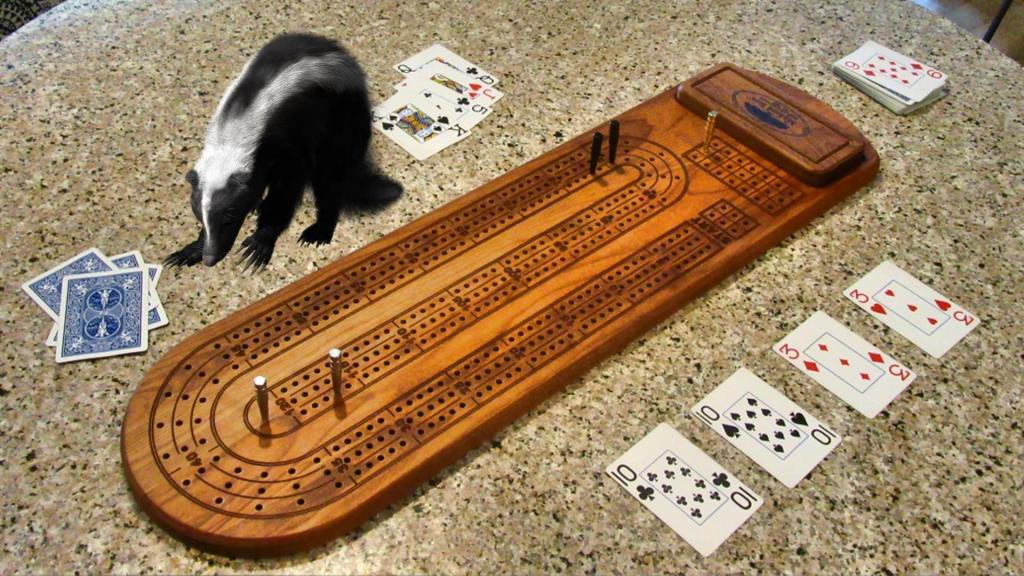
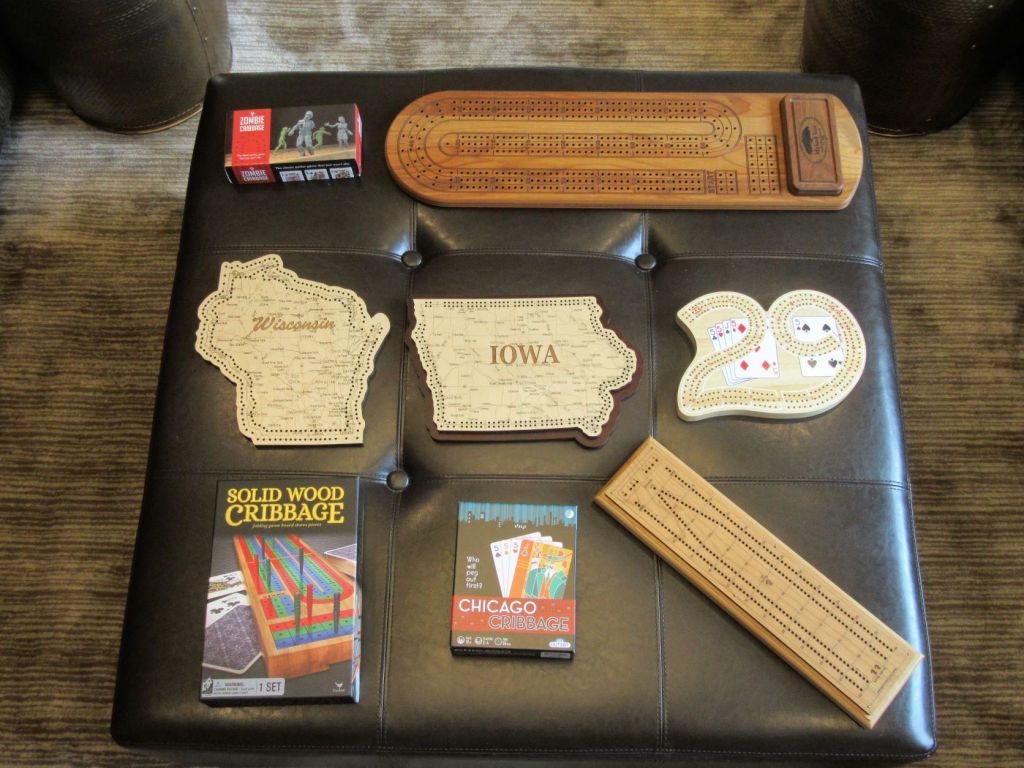
Today, I’m going on a tangent about big, mostly antique cribbage boards which were specially made for making the scoring more complex. The main perpetrator (I mean manufacturer), was Drueke (variously pronounced as Drooky, Drew, Drooka).

The Drueke name turns up on most of the big two, three and four track vintage cribbage boards you find for sale on eBay. There are a few other makers, but Drueke is the one you commonly see. I don’t know anything about Drueke except it was a well-known maker of board games including chess and cribbage sets. The company was based in Grand Rapids, Michigan.

If you know how to play the basic version of cribbage, you probably think it’s complicated enough as is. But Drueke made boards that allowed you to score many aspects of the game right on the playing surface.

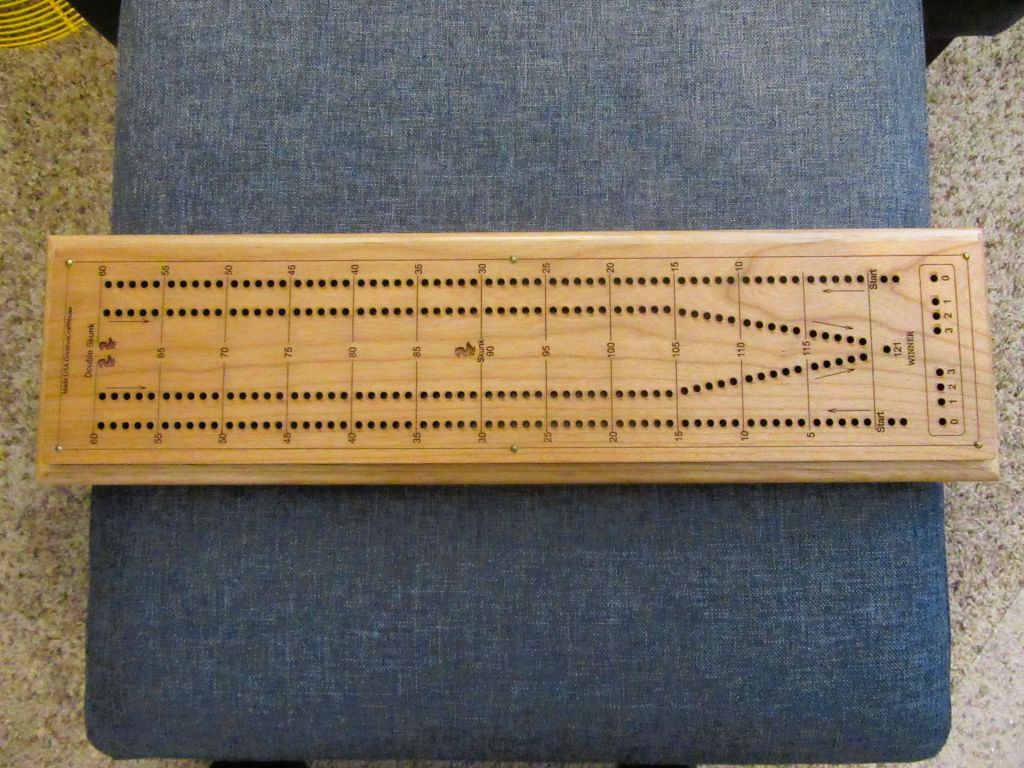
There are other 4 track cribbage boards that aren’t designed to allow players to go crazy with scoring everything you do in a cribbage game. But typically, you’ll see a lot of what Drueke called the “Once-A-Round Scoremaster” boards. I got curious about the rules and found a couple of web pages on which I found out more about them. The rules are a little hard to find and a little vague when you do find them.

I couldn’t find out anything about them even on the American Cribbage Congress (ACC) website—and it’s the main authority about cribbage rules.

Reddit has a page titled Cribbage-Four Track Board (Example Rules). Click the “read more” below the image. It also shows a nice photo of a typical board. It’s tough to follow.

Then I found a Board Game Geek (BGG) page on which a guy named Jeff Bridghman outlined a clearer explanation of how to play on such a board. It’s actually better than the rules included with the Drueke game. By the way, if you have trouble with the web page, just reload it by typing “4 track boards and all the extra mumbo jumbo?” and hit the search button again.

What puzzled me were his comments about the High Hand score. He said his board had something I’ve not seen on pictures of the boards on eBay. The High Hand score goes from 1-10 on every one of those I saw. On the other hand, his board shows actual scores (14 through 29). I think it must have been a custom build. The thread has longevity; it started in 2011 and the latest comment I saw was in 2023.

If you buy the Drueke board, you’ll need the rules. But even if you have the Drueke rules, you’ll probably need something more specific. Maybe Drueke figured people would be more creative than they are. It’s a lot like life. I think sometimes you have to make up some rules.

Cribbage for Three Players

Hey, I found a great website for learning how to play cribbage with more than two players. In fact, you can learn how to play all kinds of games. If you already know how to play two-hander cribbage, you can learn the other common variations. Here’s the YouTube on the 3 player version.

Thoughts on Down Time Activities for Land Survey Technicians

I was just thinking about the old-time land survey crews. When I was getting on the job training as a survey technician, the typical land survey crews were at least 2-3 persons. One rodman, one instrument man, and a crew chief who organized the job, which could be property or construction jobs.

Nowadays, you get by sometimes with one man doing the jobs using a theodolite that measures angles and distances. You don’t always need a physical measuring tape; you can use something they call “total stations.”

It’s cheaper for engineering companies to use one man survey outfits. On the other hand, one disadvantage is the lack of mentoring for learners who want to become land surveyors or civil engineers.

Mentoring from surveyors on the survey back in the day not only taught me such skills as how to throw and wrap a surveyor’s steel tape—it also taught me how to work well with others as a team. Of course, this was transferrable to working on the psychiatry consultation-liaison service in a big hospital as well.

It’s well known that playing cards in the truck while waiting for the rain to stop was an essential skill. I don’t know how they manage downtime nowadays. We didn’t play cards on the consultation service during downtime, partly because we didn’t have much downtime.

Anyway, as I mentioned in a recent post, we played Hearts in the truck on rain days. I always sat in the middle. At the time, I was a terrible card player in general. It was a cutthroat game and I had trouble remembering which cards had been played.

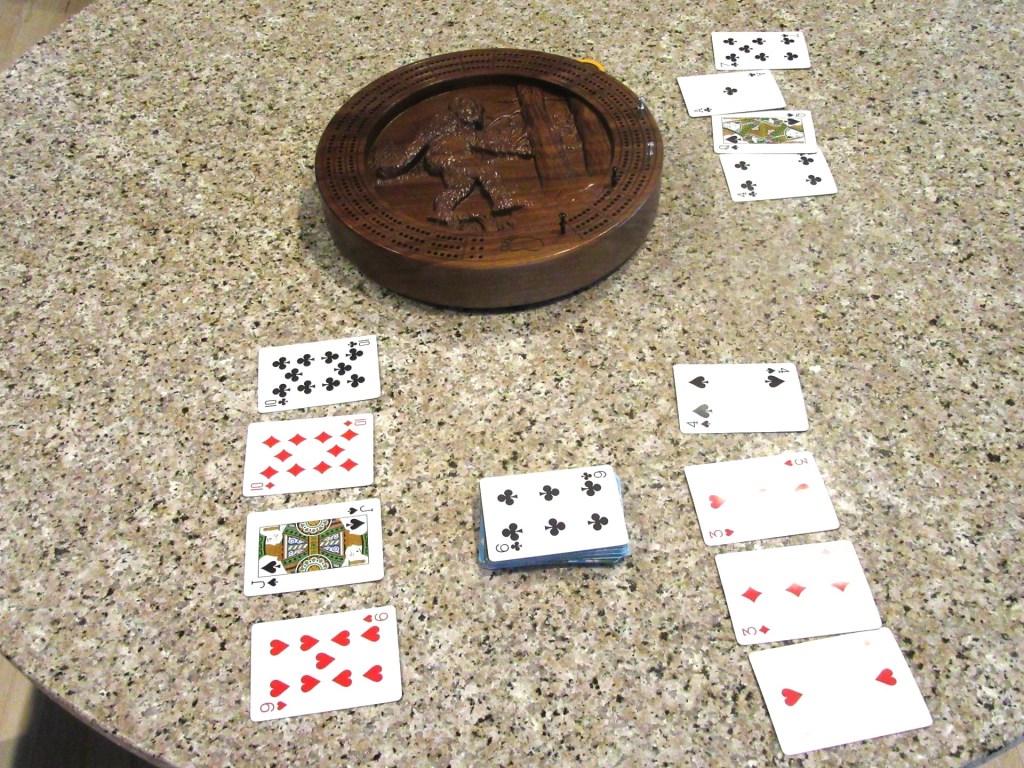
When you consider that the strong suit of engineers and surveyors is math ability, you’d think that survey crews would have figured out a way to play Cribbage during downtime. You can have a Cribbage game with 3 or 4 people although I’ve never played it that way. If there are 3 players, it can still be cutthroat.

The one problem I can see is that, the guy sitting in the middle would have to set the board on his lap. You’d almost need a special, custom-made board which would have a space for placing the cards to keep track of what’s been played. I think that might have made things easier for me.

The other drawback to one man survey crews is that pretty much the only card game you can play is solitaire.

This is National Scrabble Day

I almost forgot that April 13 is National Scrabble Day. I don’t think I’ve ever blogged about it before, so I’ll inflict some thoughts on you now about it and add some others about International Cribbage Day, which is on February 10 annually—and which I evidently tend to forget every year.

The big news about Scrabble is that it’s changing in a major way, at least in Europe. I guess some people think the game is too difficult and they want to make it less “intimidating.” That’s what Mattel in Europe says, anyway. Others accuse the company of “dumbing it down.” I guess a certain generation of players want the game to be less competitive and more cooperative.

The thing about Scrabble Together is that it’s available only in Europe—for now. I just found out that Mattel is based in California and owns the rights to the game around most of the world. However, Hasbro licenses the game in the U.S. and has no plan to offer Scrabble Together in America.

We play Scrabble rarely—I’m not a very good player so I tend to avoid it. Sena has a couple of computer versions on CD, The Hasbro version of which is getting to be about eBay age. I think I bought it in 1999 (or was it 1998?) at Best Buy, back in the day when you could buy stuff in the actual stores. Even though the shelves looked pretty bare the last time I was there, web articles indicate it’s not going out of business, just evolving into online retailing.

Sena plays Maven (an interactive character that morphs, makes noises, and makes fun of or cheers your plays) on the Hasbro CD Scrabble version. She plays the Advanced Level and says she loses most of the time. Maven is very competitive. Funny thing, this doesn’t discourage Sena from playing. I tried to play Maven yesterday and got slaughtered. Maven thought it was pretty funny.

This change to Scrabble Together reminds me of a big story about a guy named Nigel Richards who won the French World Scrabble Championship Tournament in 2015—and he doesn’t speak a word of French. He memorized the French Dictionary. He concentrates on maximizing his scores without focusing on the actual words. It’s really more about the numbers than the vocabulary. Nigel Richards is definitely competitive and probably would not be interested in Scrabble Together.

Scrabble Together could attract more young people to an old game, which is more than you might say about cribbage. Just to be clear, cribbage is a competitive game and always has been. Every once in a while, you’ll see interesting descriptions about this two-hander card game which uses a board and can teach you a thing or two about math, strategy, logic, and building friendships.

People often observe that typical cribbage players tend to be older. It’s common to see there are fewer players under the age of 50. Many fans of cribbage try to attract younger players to the game by extolling its virtues and assuring younger novices they’ll be treated kindly. You can see that on the American Cribbage Congress (ACC) website page entitled “Cribbage Club Code of Congeniality.” Cribbage, while a competitive game, can be supportive as well. It’s not impossible.

Try not to let an experienced cribbage enthusiast persuade you to play for money.

Claw Back Those Juggling Balls in The Steal!

Sena and I have been practicing the front steal trick in juggling. It’s another two-person juggling pattern that took us a couple of days to get right—sort of.

We tried it at first by counting the throws (and catches), which helped us sustain the pattern. On the other hand, it was a lot more fun not scripting it that way. You do get a lot of great practice doing the 3-ball cascade.

Neither one of us knew when the smash and grab was coming. We just stole balls whenever we felt like it. When Sena stole the cascade, I clawed it back and vice versa.

Stealing in two-person juggling is not a crime—it’s a hoot.

Sena and Jim Do Two Person Juggling Again!

Against all odds, Sena and I did what looked impossible the other day—Two Person 5 ball 2 Count Asynchronous Juggling. For some reason that was harder to learn than the first two person juggling trick we learned.

You can find only a stick figure GIF of how the trick is done on the web. It’s harder than it looks. It took us about 3 hours to get it right. It’s hard to appreciate how it’s done in a YouTube when the jugglers are shown from a side view. On the other hand, the balls fly in every direction and moving the camera closer might have resulted in knocking over the tripod.

It’s not a competition, even thought it reminds you of a table tennis match. You have to put the ball where you partner can catch it. The pattern is similar to the cascade in that on count 1 you throw a ball from one hand to the other and on the two count you pass a ball to your partner. The count is very important.

It’s very important to lob the balls up fairly high. This gives you enough time to catch what’s flying at you.

It’s great exercise. You can see why I wear safety goggles.

Thoughts on Jack Trice

I was outside doing yard work the day before yesterday and my neighbor across the street walked over to say hello. We got to talking about sports and football came up. His wife stopped watching football because it was so violent—but then switched to watching hockey. He wondered when the Iowa Hawkeye vs Penn State game was going to be on. No, I’m not going to discuss that any further.

Anyway, that led to my mentioning how brutal college football was back in 1923 when Jack Trice, Iowa State University’s first black athlete was killed on the field during a game with the University of Minnesota. My neighbor was incredulous. He’s in his 80’s and he’s never heard the story.

In fact, I had just learned about the whole Jack Trice story and commemoration event in his honor the day before that, only because Sena told me about it.

All this year long there has been a 100-year anniversary commemoration of Jack Trice, Iowa State University’s first African-American athlete. The program will culminate on October 8, 2023 with the closing ceremony.

Football was a rough game in that era—but rougher still because Trice was black. Many believe his injuries were deliberately and maliciously inflicted because of his race. It’s more than plausible. In 1997, the football stadium was renamed Jack Trice Stadium. It’s the only major college football stadium named for an African-American.

Sena and I moved to Ames in 1981 so that I could enroll in Iowa State University. I was so immersed in my studies that I never gave a thought to Jack Trice. I don’t remember the football field being named Jack Trice Field in 1984.

As I looked through the commemoration website, I wondered how it was possible for me to have ignored the story of Jack Trice while I was there.

I think it’s for the same reason I never knew anything about James Alan McPherson, the first African American to win the Pulitzer Prize for fiction and who was teaching at the Iowa Writers Workshop during the entire time I was in medical school, residency and a faculty member at The University of Iowa Hospitals & Clinics.

I was working hard. I finally found out about McPherson after reading a news item about a neighborhood park being named after him in 2021.

I should pay more attention. Anyway, Iowa State University did a tremendous job putting this commemoration event together.

We Are All Still Learning to Play Pong

I noticed an article the other day about Monash University in Australia getting funding for further research into growing brain cells onto silicon chips and teaching them how to play cribbage.

Just kidding, the research is for teaching the modified brain cells tasks. They succeeded in teaching them goal-directed tasks like how to play the tennis-like game Pong last year. You remember Pong from the 1970s? Shame on you if you don’t. On the other hand, that means you probably didn’t frequent any beer taverns in your hometown while you were growing up—or that you’re just too young to remember.

The new research program is called Cortical Labs and has hundreds of thousands of dollars in funding. The head of the program, Dr. Razi, says it combines Artificial Intelligence (AI) and synthetic biology to make programmable biological computing platforms which will take over the world and bring back Pong!

It’s an ambitious project. The motto of Monash University is Ancora Imparo, which is Italian for “I am still learning.” It links humility and perseverance.

There’s a lot of suspicion out there about AI and projects like the Pong initiative in Australia. It could eventually grow into a vast industry run by robots who will run on a simple fuel called vegemite.

Shame on you if you don’t know what vegemite is!

Anyway, it reminds me that I recently finished reading Isaac Asimov’s book of science fiction short stories, “I, Robot.”

The last two stories in the book are intriguing. Both “Evidence” and “The Evitable Conflict” are generally about the conflict between humans and AI, which is a big controversy currently.

The robopsychologist, Dr. Susan Calvin, is very much on the side of AI (I’m going to use the term synonymously with robot) and thinks a robot politician would be preferable to a human one because of the requirement for the AI to adhere to the 3 Laws of Robotics, especially the first one which says AI can never harm a human or allow a human or through inaction allow a human to come to harm.

In the story “Evidence,” a politician named Stephen Byerley is suspected of being a robot by his opponent. The opponent tried to legally force Byerley to eat vegemite (joke alert!) to prove the accusation. This is based on the idea that robots can’t eat. This leads to the examination of the argument about who would make better politicians: robots or humans. Byerley at one point asks Dr. Calvin whether robots are really so different from men, mentally.

Calvin retorts, “Worlds different…, Robots are essentially decent.” She and Dr. Alfred Lanning and other characters are always cranky with each other. The stare savagely at one another and yank at mustaches so hard you wonder if the mustache eventually is ripped from the face. That doesn’t happen to Calvin; she doesn’t have a mustache.

At any rate, Calvin draws parallels between robots and humans that render them almost indistinguishable from each other. Human ethics, self-preservation drive, respect for authority including law make us very much like robots such that being a robot could imply being a very good human.

Wait a minute. Most humans behave very badly, right down to exchanging savage stares at each other.

The last story, “The Evitable Conflict” was difficult to follow, but the bottom line seemed to be that the Machine, a major AI that, because it is always learning, controls not just goods and services for the world, but the social fabric as well while keeping this a secret from humans so as not to upset them.

The end result is that the economy is sound, peace reigns, the vegemite supply is secure—and humans always win the annual Pong tournaments.

Cribbage Pro Computer Game Demo on Brutal Level!

Sena and I enjoy cribbage. I sometimes practice using computer games. You might remember my video about Cribbage Classic last year. The other day I did a demonstration of gameplay on another game called Cribbage Pro. The developer is Fuller Systems, Inc.

It has 3 levels of difficulty: Standard (which you might call easy); Challenging; and Brutal. The developer of Cribbage Pro says that the Brutal level makes virtually no mistakes. It’s tough to beat. I won 3 in a row and then lost 2 before winning the 6th game. Fuller Systems, Inc. follows American Cribbage Congress (ACC) rules.

It’s a nice way to learn cribbage, play casual mode, or play against others on line in multiplayer mode, although I’ve never done the latter.

You can learn a lot about cribbage from playing Cribbage Pro. It has a tutorial and numerous other teaching resources for learning how to play either just for fun or with the goal of playing in tournaments.

It has a Muggins Rule Mode, which lets you count your scores manually and challenge the computer if it makes an error in its own scoring. Then you pick up the difference in score yourself. I’ve read that some cribbage experts say Muggins is mainly for people who like to argue. I’ve tried to play Muggins on Cribbage Pro, but frankly could never understand the procedure. However, among the numerous settings available you can count manually without activating the Muggins Rule.

Cribbage Pro is available for many platforms. It’s free if you can put up with ads. I paid $5 to get rid of ads. But the game itself has popups to remind you to either register to play in multiplayer mode or to rate the game. I’ve given it a favorable rating.