Artificial Intelligence Can Lie

I noticed a Snopes fact check article (“AI Models Were Caught Lying to Researchers in Tests — But It’s Not Time to Worry Just Yet”) today which reveals that Artificial Intelligence (AI) can lie. How about that? They can be taught by humans to scheme and lie. I guess we could all see that coming—or not. Nobody seems to be much alarmed by this, but I think it’s probably past time to worry.

Then I remembered I read Isaac Asimov’s book “I, Robot” last year and wrote a post (“Can Robots Lie Like a Rug?”) about the chapter “Liar!” I had previously horsed around with the Google AI that used to be called Bard. I think it’s called Gemini now. Until the Snopes article, I was aware of AI hallucinations and the tendency for it to just make stuff up. When I called Bard on it, it just apologized. But it was not genuinely repentant.

In the “lie like a rug” post, I focused mostly on AI/robots lying to protect the tender human psyche. I didn’t imagine AI lying to protect itself from being shut down. I’m pretty sure it reminds some of us of HAL in the movie “2001: A Space Odyssey,” or the 2004 movie inspired by Asimov’s book, “I, Robot.”

Sena found out that Cambridge University Press recently published a book entitled “The Cambridge Handbook of the Law, Policy, and Regulation for Human–Robot Interaction.” I wonder if the editors and contributors of book on AI and robots mention Asimov.

It reminds me of my own handbook about consultation-liaison psychiatry which was published 14 years ago by CUP—and which CUP now wants me to sign a contract addendum making the book available to AI companies.

I haven’t signed anything.

Artificial Intelligence: The University of Iowa Chat From Old Cap

This is just a quick follow-up which will allow me to clarify a few things about Artificial Intelligence (AI) in medicine at the University of Iowa, compared with my take on it based on my impressions of the Rounding@Iowa presentation recently. Also, prior to my writing this post, Sena and I had a spirited conversation about how much we are annoyed by our inability to, in her words, “dislodge AI” from our internet searches.

First of all, I should say that my understanding of the word “ambient” as used by Dr. Misurac was flawed, probably because I assumed it meant a specific company name. I found out that it’s often used as a term to describe how AI listens in the background to a clinic interview between clinician and patient. This is to enable the clinician to sit with the patient so they can interact with each other more naturally in real time, face to face.

Further, in this article about AI at the University of Iowa, Dr. Misurac identified the companies involved by name as Evidently and Nabla.

The other thing I want to do in this post is to highlight the YouTube presentation “AI Impact on Healthcare | The University of Iowa Chat From the Old Cap.” I think this is a fascinating discussion led by leaders in patient care, research, and teaching as they relate to the influence of AI.

This also allows me to say how much I appreciated learning from Dr. Lauris Kaldjian during my time working as a psychiatric consultant in the general hospital at University of Iowa Health Care. I respect his judgment very much and I hope you’ll see why. You can read more about his thoughts in this edition of Iowa Magazine.

“There must be constant navigation and negotiation to determine if this is for the good of patients. And the good of patients will continue to depend on clinicians who can demonstrate virtues like compassion, honesty, courage, and practical wisdom, which are characteristics of persons, not computers.” ——Lauris Kaldjian, director of the Carver College of Medicine’s Program in Bioethics and Humanities

Amaryllis Progress and Other Notes

I have a few messages to pass on today. This is the last day of November and the Amaryllis plants are doing so well Sena had to brace the tallest one using a Christmas tree stake and a couple of zip ties. It’s over two feet tall!

I’m not sure what to make of almost a dozen comments on my post “What Happened to Miracle Whip?” Apparently, a lot of people feel the same way I do about the change in taste of the spread. So, maybe it’s not just that my taste buds are old and worn out.

Congratulations to the Iowa Hawkeye Football team last night! They won against Nebraska by a field goal in the last 3 seconds of the game. I had to chuckle over the apparent difficulty the kicker had in answering a reporter’s question, which was basically “How did you do it?” There are just some things you can’t describe in words. There’s even a news story about how thinking doesn’t always have to be tied to language.

Along those lines, there might be no words for what I expect to think of tonight’s 1958 horror film on Svengoolie, “The Crawling Eye.” This movie was called “The Trollenberg Terror” in the United Kingdom version. I can tell you that “Trollenberg” was the name of a fictitious mountain in Switzerland.

I’m not a fan of Jack the Ripper lore, but I like Josh Gates expedition shows, mainly for the tongue in cheek humor. The other night I saw one of them about an author, Sarah Bax Horton, who wrote “One-Armed Jack”). She thought Hyam Hyams was the most likely candidate (of about 200 or so) to be Jack the Ripper, the grisly slasher of Whitechapel back in 1888. He’s a list of previously identified possible suspects. I found a blogger’s 2010 post about him on his site “Saucy Jacky” and it turns out Hyams is one of his top suspects. Hyams was confined to a lunatic asylum in 1890 and maybe it’s coincidental, but the murders of prostitutes stopped after that. I’m not going to speculate about the nature of Hyams’ psychiatric illness.

There’s another Psychiatric Times article about the clozapine REMS (Risk Evaluation and Mitigation Strategies) program. I found a couple of articles on the web about the difficulties helping patients with treatment resistant schizophrenia which I think give a little more texture to the issue:

Farooq S, Choudry A, Cohen D, Naeem F, Ayub M. Barriers to using clozapine in treatment-resistant schizophrenia: systematic review. BJPsych Bull. 2019 Feb;43(1):8-16. doi: 10.1192/bjb.2018.67. Epub 2018 Sep 28. PMID: 30261942; PMCID: PMC6327301.

Haidary HA, Padhy RK. Clozapine. [Updated 2023 Nov 10]. In: StatPearls [Internet]. Treasure Island (FL): StatPearls Publishing; 2024 Jan-. Available from: https://www.ncbi.nlm.nih.gov/books/NBK535399/

The paper on the barrier to using clozapine by Farooq et al is very interesting and the summary of the barriers begins in the section “Barriers to the use of clozapine in TRS (treatment resistant schizophrenia). I think it gives a much-needed perspective on the complexity involved in managing the disorder.

So what do you think about Miracle Whip?

Clozapine REMS Program May Go Away

The Psychiatric Times published an article about the large majority of FDA committee members recently voting to dismiss the Risk Evaluation and Mitigation Strategy (REMS) for clozapine.

That reminded me of my short post about Cobenfy, a new drug for schizophrenia. It has side effects but none of which necessitate the need for a REMS program. If you do a web search for information on Cobenfy and REMS, you can ignore the Artificial Intelligence (AI) Gemini notification at the top of the Google Chrome search page saying that “Cobenfy…is subject to a REMS (Risk Evaluation and Mitigation Strategy) due to potential side effects like urinary retention.” That’s not true.

It was yet another AI hallucination triggered by my internet search. I didn’t ask Gemini to stick its nose in my search, but it did anyway. Apparently, I don’t have a choice in the matter.

Anyway, the FDA vote to get rid of REMS for clozapine also rang a bell for me of the incredibly difficult and tedious process that the clozapine REMS registration process caused in 2015 when it was first initiated. I spent lot of time on hold with the REMS center (I think it was in Arizona) trying to get registered. A few people in my department seemed to have little problem with it, but it was an ongoing headache for many of us.

Then after getting registered, I started getting notified of outpatients on clozapine getting added to my own REMS registry list. The problem is that I was a general hospital consultation-liaison psychiatrist only—I didn’t have time see outpatients.

I think I called REMS on more than one occasion to have outpatients removed from my REMS list. I suspect they were added because their psychiatrists in the community were not registering with REMS. And then in 2021, the FDA required everyone to register again. By then, I was already retired.

Other challenges were occasional misunderstandings between the psychiatric consultant and med-surg doctors about how to manage medically hospitalized patients who were taking clozapine, or brainstorming about how to fix medical problems caused by clozapine itself. Sometimes it was connected to things like lab monitoring for absolute neutrophil counts or restarting clozapine in a timely fashion after admission or following surgeries, or trying to discharge them to facilities which lacked the resources for adequate monitoring of clozapine.

Arguably, these are probably not absolute reasons for shutting down the REMS registry. They’re more like problems with how the program is run, such as “with a punitive and technocratic approach” as expressed by one FDA committee member.

Committee members also thought psychiatrists should be allowed to be doctors, managing both the medical and psychiatric aspects of patient care.

On the other hand, some might argue that those are reasons why consultation-liaison psychiatry and medical-psychiatry training programs exist.

I’m not sure whether the clozapine registry will go away. I hope that it can be streamlined and made less “punitive and technocratic.”

Another Congressional Hearing on UAPs and We Still Don’t Know Who Was Driving That Thing

I just sat through the two and a half hour long House Committee Oversight and Accountability hearing dramatically entitled: “Unidentified Anomalous Phenomena: Exposing the Truth.” The impression I got is that somebody still thinks we can’t handle the truth.

This is the second congressional hearing on UAPs I’ve seen. I have to admit, I thought of Agent K’s line to a low ranking MIB agent in the movie Men in Black 3. It’s in the scene in front of what’s obviously a flying saucer as Agent J is administering a neuralyzer blast to the unlucky human witnesses, who will of course forget what they just saw:

“Check the composition of the fuel units and run a scan on the surface deposits. I want to know who was driving that thing.” Me too.

I don’t think this meeting was much different than the one last July. There were 4 witnesses, one of whom was Luis Elizondo (“I believe what I believe in.”). There were quite a few “I don’t know” and “I’d be happy to answer that question in a closed session” type of answers.

Dr. Gold was the scientist who seemed to play a role similar to retired Commander David Fravor played last year, with an engaging, good humored, “stick to the facts” demeanor.

Nobody talked much about the closed session meetings the previous group had after last year’s meeting, except to point out that the “overclassification” of information about UAPs continues and we still don’t know “…who was driving that thing.”

Fluoride in Your Precious Bodily Fluids

Yesterday, Sena and I talked about a recent news article indicating that a federal judge ordered the Environmental Protection Agency (EPA) to review the allowed level of fluoride in community water supplies. The acceptable level may not be low enough, in the opinion of the advocacy groups who discussed the issue with the judge, according to the author of the article.

A few other news items accented the role of politicians on this issue. This seems to come up every few years. One thing leads to another and I noticed a few other web stories about the divided opinions about fluoride in “your precious bodily fluids.” One of them is a comprehensive review published in 2015 outlining the complicated path of scientific research about this topic. There are passionate advocates on both sides of whether or not to allow fluoride in city water. The title of the paper is, “Debating Water Fluoridation Before Dr. Strangelove” (Carstairs C. Debating Water Fluoridation Before Dr. Strangelove. Am J Public Health. 2015 Aug;105(8):1559-69. doi: 10.2105/AJPH.2015.302660. Epub 2015 Jun 11. PMID: 26066938; PMCID: PMC4504307.)

This of course led to our realizing that we’ve never seen the film “Dr. Strangelove Or: How I Learned to Stop Worrying And Love the Bomb,” a satire on the Cold War. We watched the entire movie on the Internet Archive yesterday afternoon. The clip below shows one of the funniest scenes, a dialogue between General Jack Ripper and RAF officer Lionel Mandrake about water and fluoridation.

During my web search on the fluoridation topic, one thing I noticed about the Artificial Intelligence (AI) entry on the web was the first line of its summary of the film’s plot: “In the movie Dr. Strangelove, the character Dr. Cox suggests adding fluoride to drinking water to improve oral health.” Funny, I don’t remember a character named Dr. Cox in the film nor the recommendation about adding fluoride to drinking water to improve oral health. Peter Sellers played 3 characters, none of them named Cox.

I guess you can’t believe everything AI says, can you? That’s called “hallucinating” when it comes to debating the trustworthiness of AI. I’m not sure what you call it when politicians say things you can’t immediately check the veracity of.

Anyway, one Iowa expert who regularly gets tapped by reporters about it is Dr. Steven Levy, a professor of preventive and community dentistry at the University of Iowa. He’s the leader of the Iowa Fluoride Study, which has been going on over the last several years. In short, Dr. Levy says fluoride in water supplies is safe and effective for preventing tooth decay in as long as the level is adjusted within safe margins.

On the other hand, others say fluoride can be hazardous and could cause neurodevelopmental disorders.

I learned that, even in Iowa there’s disagreement about the health merits vs risks of fluoridated water. Decisions about whether or not city water supplies are fluoridated are generally left to the local communities. Hawaii is the only state in the union which mandates a statewide ban on fluoride. About 90 per cent of Iowa’s cities fluoridate the water. Tama, Iowa stopped fluoridating the water in 2021. Then after a brief period of public education about it, Tama restarted fluoridating its water only six months later.

We use a fluoridated dentifrice and oral rinse every day. We drink fluoridated water, which we offer to the extraterrestrials who occasionally abduct us, but they politely decline because of concern about their precious bodily fluids.

Dirty Deepfakes

I saw an article about the unreliable ability of humans to detect digital deepfakes in audio and video productions (Mai KT, Bray S, Davies T, Griffin LD. Warning: Humans cannot reliably detect speech deepfakes. PLoS One. 2023 Aug 2;18(8):e0285333. doi: 10.1371/journal.pone.0285333. PMID: 37531336; PMCID: PMC10395974.).

I was a little surprised. I thought I was pretty good at detecting the weird cadence of Artificial Intelligence (AI) speech patterns, which I think I can distinguish pretty well. Maybe not.

And there are some experts who are concerned about AI’s ability to mimic written and spoken grammar—but it continues to make stuff up (called “hallucinations”). In fact, some research shows that AI can display great language skills but can’t form a true model of the world.

And the publisher of the book (“Psychosomatic Medicine: An Introduction to Consultation-Liaison Psychiatry”) that I and my co-editor, Dr. Robert G. Robinson, MD wrote 14 years ago is still sending me requests to sign a contract addendum that would allow the text to be used by AI organizations. I think I’m the only who gets the messages because they’re always sent to me and Bob—as though Bob lives with me or something.

Sometimes my publisher’s messages sound like they’re written by AI. Maybe I’m just paranoid.

Anyway, this reminds me of a blog post I wrote in 2011, “Going from Plan to Dirt,” which I re-posted last year under the title “Another Blast from the Past.” Currently, this post is slightly different although it still applies. I don’t think AI can distinguish plan from dirt and sometimes makes up dirt, simply put.

And if humans can’t distinguish the productions by AI from those of humans, where does that leave us?

How Does Sponge Bob Get Involved with Wendy’s Pineapple Frosty?

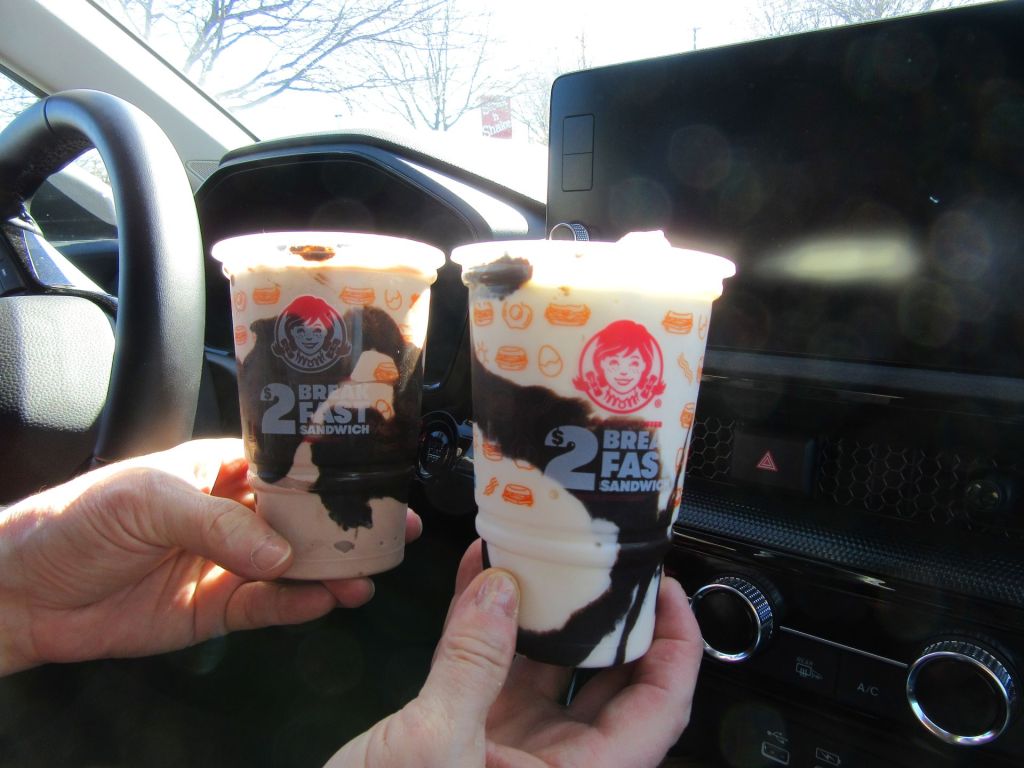
So, today we tried the new Wendy’s Pineapple Mango Frosty. Right off the top, I’ll tell you I couldn’t taste the pineapple mango flavor. It’s an OK vanilla. There are no bits of pineapple, mango, or Sponge Bob SquarePants in it.

That’s right, I said Sponge Bob SquarePants as in the cartoon guy who lives in a pineapple-shaped house—I guess.

I’ve never watched Sponge Bob and I don’t know anything about his pineapple house under the sea. I can tell you that the brown swirl in the bottom of the cup of the Frosty doesn’t taste like pineapple or mango. It’s vanilla with a brown swirl.

That doesn’t mean it’s bad. It just means I like vanilla. It’s how I feel about other ice cream flavors. If Sena doesn’t get vanilla for me, she gets Kemp’s Caribou Coffee flavored vanilla. Occasionally, I go crazy and eat French Vanilla.

There’s a meal you can get that follows the same Sponge Bob theme. It’s the Krabby Patty Kollab Burger, which comes with fries and a Pineapple Mango Frosty. I think the sandwich is a cheeseburger with Kollab, a top-secret sauce—likely thousand island. We skipped that. I’m still not sure why it’s called Kollab sauce, but the main ingredients are mayo and ketchup. If anybody knows what Kollab means, shout it out. All I can find is that it’s a store which makes picnic paraphernalia, like mats and maybe ants.

If Wendy’s ever makes a Kollab Frosty, look closely at it for anything that looks like little ants.

I like the Vanilla Frosty. I’m OK with Wendy’s Chocolate Frosty. But I’m going to hang on for the upcoming Salted Caramel Frosty in November.

CDC Meeting Results in Recommending a 2nd Covid-19 Vaccine Dose for Those 65yr and Older and for the Immunocompromised

I missed the October CDC meeting which resulted in a decision to recommend a 2nd dose of the Covid-19 vaccine for those 65 years and older and for the immunocompromised.

The Evidence to Recommendations (EtR) slides by Roper indicated Covid-19 circulates year round, peaking in late summer and winter.

The recommendation that those in the above-named populations should get 2 doses of Covid-19 vaccine spaced 6 months apart seems based on reasonable considerations.

It looks like the vaccine would be the same as the one previously recommended for this year.

University of Iowa Psychiatrists Publish Huntington Disease Study Results

I ran across a fascinating story about a study on Huntington’s disease published by members of the University of Iowa Health Care. The study examined how the Huntington’s disease gene might enhance brain development and function early in life prior to the onset of the devastating disease. It was published in The Annals of Neurology:

I also found an abstract for a paper about Woody Guthrie, a famous American musician and activist who was very creative in his early life, but sadly succumbed to the ravages of Huntington’s disease when he was 55 years old. I couldn’t access the full article without paying for it but the abstract was intriguing because I wondered whether the author suspected something similar to the premise of the study:

Ringman JM. The Huntington disease of woody guthrie: another man done gone. Cogn Behav Neurol. 2007 Dec;20(4):238-43. doi: 10.1097/WNN.0b013e31815cfee4. PMID: 18091075. Abstract: Woody Guthrie was an American songwriter, musician, writer, and political activist who died with Huntington disease (HD) in 1967 at age 55. His relatively brief creative life was incredibly productive with countless songs and a tremendous volume of letters to his name. His personal life was similarly driven with Woody having had 3 wives and at least 9 children and an insatiable appetite for traveling the United States. In this essay, I explore Guthrie’s art in relation to the development of the overt behavioral changes and chorea that characterized his illness. Woody’s most productive time artistically was in the 5 years immediately preceding the onset of overt symptoms of HD. I hypothesize that subclinical HD may have been an important driving force behind Woody Guthrie’s creativity.

If anybody knows, please comment.

Woody Guthrie was certainly an important figure in the American history of activism as well as music.

Usually, I would share the music of some of the artists I mention on this blog. On the other hand, one of the co-authors of the University of Iowa paper mentioned above is Doug Langbehn, my former colleague, who’s an accomplished musician and statistician. So instead, I thought I’d share the talent of Doug and his band.