There’s a CDC ACIP Meeting scheduled to start at 8:00 AM EST today (caught me off guard). The slides are here.
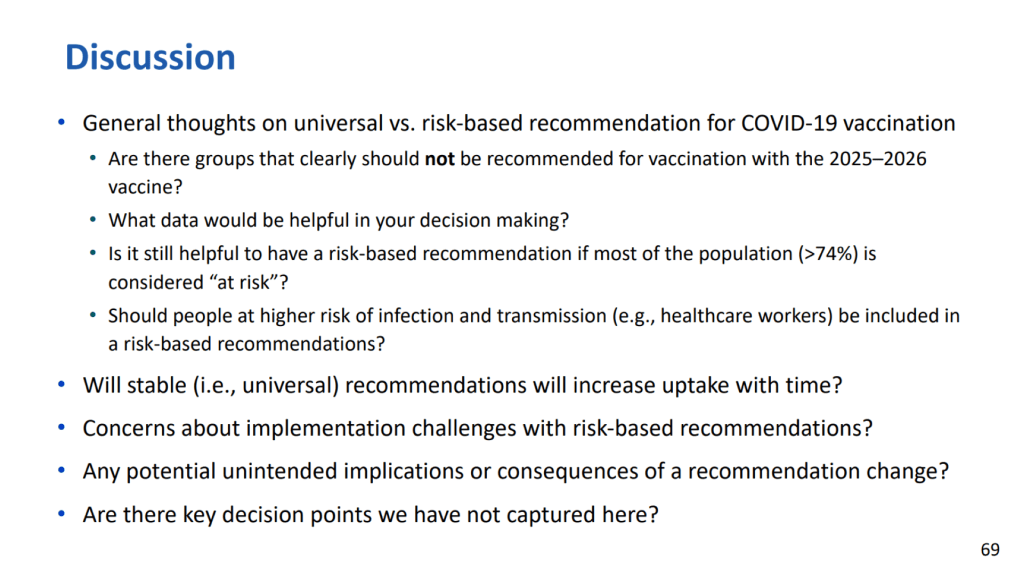
Noteworthy: Dr. Denise Jamieson, MD, MPH is chair of the CMV Working Group. She is Vice President for Medical Affairs and the Tyrone D. Artz Dean, Roy J. and Lucille A. Carver College of Medicine at University of Iowa. In the Q&A session following the Covid-19 vaccine presentation, Dr. Jamieson expressed a preference for a universal recommendation (citing implementation and uptake challenges, which other attendees mentioned as well) for the Covid-19 vaccine as opposed to a risk-based or permissive recommendation. See slide labeled “Discussion” below:
There was no vote scheduled for today’s meeting on the Covid-19 vaccine.
The presentation by Moderna on the new Covid-19 vaccine, mRNA-1283, was helpful. I gather there will be an FDA meeting about it in June.
The title of this post, which is admittedly the lead-in to a lame joke, is inspired partly by the news headlines today and partly by an essay, “Laughter: Better Than a Sharp Stick in Your Eye,” I found on The University of Iowa’s Well-Being at Iowa website. The author, Megan Gogerty, MFA, BA has some pretty sharp opinions about laughter being the best medicine. It’s not always the best.
Anyway, Reuters carried the story “China raises duties on US goods to 125%, calls Trump tariff hikes a ‘joke’,” by Joe Cash and Yukun Zhang, accessed April 11, 2025.
China is pretty upset. So, why did China tell President Trump his tariff strategy is a joke? Because they don’t get it.
Just half-kidding there; actually, I think that might be President Trump’s reply, but I really don’t understand tariffs. That’s probably why I also had trouble with the economist joke below:
Why did the Keynesian psychiatrist get fired? He told his patients to spend their way out of depression.
I found this joke on a YouTube by Jacob Clifford, an economics teacher. I didn’t get the joke, so I repeatedly replayed it because I couldn’t understand the first part. That’s because I didn’t know anything about Keynesian economics. It turns out that it’s based on the belief that proactive actions from the government (like spending) are the only way to control the economy. Get it? Neither do I but it was the only economy joke I could find that included a psychiatrist on a quick internet search.
Here’s twenty economics jokes from Jacob Clifford. They’re pretty lame, but then so is most of the political news.
I’ve been looking over some of the web articles on the Goldwater Rule, which is the APA Ethics Committee guideline enjoining any psychiatrist from making public psychiatric armchair diagnoses of public or political figures without a formal evaluation or permission to conduct one. It was originally made in 1973, years after Fact Magazine in 1964 sent out a questionnaire to psychiatrists asking for their public opinions about the mental stability of then candidate Barry Goldwater who was running for President against Lyndon B. Johnson. Many thought he was psychotic, although there was no evidence for that. Goldwater won a lawsuit against Fact Magazine, which led to the publisher going out of business. It was a big embarrassment for psychiatrists, which contributed to the creation of the Goldwater Rule.
Over the last few years and currently, many psychiatrists question whether the Goldwater Rule should be revised and abolished, making it permissible for psychiatrists who believe they have a duty to warn the public about political leaders they think might be a threat to national security, specifically President Donald Trump.
I’ve found a few articles on the web which helped me think about my own position about this. McLoughlin says the Goldwater Rule should change, but doesn’t tell us how. Glass calls the Goldwater Rule a “gag rule” and tells us why it should change. He resigned from the APA in protest. Ghaemi and others don’t agree on whether the Goldwater Rule should change, and one discussant says the rule only applies if you’re a member of the APA. Blotcky et al tell us how it could change, using sample conversations between reporters and psychiatrists.
I lean toward Blotcky et al. In fact, the final paragraph gives psychiatrists another way to express their opinions to the public. They can give them as private citizens without calling them professional judgments—which is their right.
On the other hand, if you want to know about my psychiatric interview of President Trump, you can see it below.
Mr. President, you have signed an affidavit allowing me to conduct a thorough psychiatric assessment today.
Yes, Dr. Amos, that’s correct.
Can you tell me why an Autopen was used to sign it?
I decline to answer that question on the grounds it may incriminate me.
Have you ever undergone a psychiatric assessment before?
Yes, but I had to fire her when she started asking questions about tariffs.
Very well, then. Can you tell me a little about your childhood?
It was perfect—as long as the other kids paid their tariffs.
Oh. Was there ever a time in your life marked by any problems with having access to the basic necessities of life?
Well, there was one thing. Water pressure was sometimes low, which is why I just wrote an Executive Order ensuring that low water pressure in faucets and showerheads will never again in my lifetime or yours be a problem. Make American Faucets Gush Again (MAFGA).
Thanks, I’m sure. Tell me, how would you typically go about solving an interpersonal conflict between you and others?
Raise tariffs by 300%.
I see. How about talking to people with whom you disagree?
I would say, “You’re fired.”
Would you try anything else first?
I would try tariffs.
Well, I think we’re done here. Thank you for your time, Mr. President.
Of course, this was satire.
References:
McLoughlin A. The Goldwater Rule: a bastion of a bygone era? Hist Psychiatry. 2022 Mar;33(1):87-94. doi: 10.1177/0957154X211062513. Epub 2021 Dec 20. PMID: 34930051; PMCID: PMC8886301.
Nassir Ghaemi, MD MPH.The Goldwater Rule and Presidential Mental Health: Pros and Cons – Medscape – Jun 07, 2017.
Glass, Leonard A. The Goldwater rule is broken. Here’s how to fix it. Stat News. June 28, 2018.
Blotcky, Alan D., PhD; Ronald W. Pies, MD; Moffic, H. Steven, MD. The Goldwater Rule Is Fine, if Refined. Here’s How to Do it. Psychiatric Times. January 6, 2022. Vol. 39, Issue 1
The big news for University of Iowa will be a NASA satellite mission to investigate how solar wind interacts with Earth’s magnetosphere. You can read the whole fascinating story in this issue of Iowa Magazine.
According to the story, “twin spacecraft known as TRACERS—Tandem Reconnection and Cusp Electrodynamics Reconnaissance Satellites—will begin their journey to study Earth’s mysterious magnetic interactions with the sun. The satellites will be packed with scientific instruments along with two small, but meaningful, tokens.”
The two small tokens happen to be purple guitar picks that belonged to University of Iowa physicist, Craig Kletzing, who died from cancer in 2023. Kletzing and colleagues got a $115 million contract from NASA for TRACERS. It’s the largest research award in University of Iowa history.
Kletzing played guitar in a few bands, and one them was named Bipolar—which is the only connection to psychiatry that I could see. He was dedicated to work in basic science, and he was often heard to ask “How can we make this simpler?” referring to chunking big scientific challenges into manageable goals. He was a rare person in that he was both a brilliant scientist and a great teacher. One example of his work ethic was that he skipped a meeting with NASA’s top brass in order to deliver a morning lecture on introductory physics to 275 students.
The members of the UI TRACERS team call the project “Craig’s mission.” I’m pretty sure he would have called it a team effort “… to help scientists better understand the powerful forces harmonizing throughout the universe—something the ancient Greeks described as the music of the spheres.”
And that’s what the purple guitar picks represent.
I just read Dr. Moffic’s column, “Join This Club for Mental Health” in which he described the Clubhouse movement which got started in the 1940s to help those with mental health challenges to cope with their illness and, more importantly, to recover, grow, and achieve success in life.
It made wonder if there are any chapters of the Clubhouse model in Iowa. It turns out there is and it’s Carol House in Davenport, Iowa. It’s connected with the Vera French Mental Health Center. Its namesake is Carol Lujack, who was a member when the center was called “The Frontier Community Outreach Program” in the 1980s in downtown Davenport.
I was looking at the Carol Center website where you can find many interesting features of the people and activities that go on there. The April newsletter is fascinating and funny. You can find out in the April Newsletter about a few of the current members, April holidays (there’s a slew of them), and famous quotes. One of the quotes is familiar and it’s by F. Scott Fitzgerald,
“Vitality shows not only in the ability to persist, but in the ability to start over,” The quote is worded in various ways, but I remember it because I used it as an inspirational quote when The University of Iowa honored me and several of my colleagues with a Feather in Your Cap award back in 2011.
This was shortly after I returned to Iowa after an unsuccessful stab at trying private practice psychiatry in Wisconsin. And it was the second time I did that—the first time was in Illinois.
Did you know that April is National Humor Month? And have you heard the joke “What kind of candy is never on time?” Choco-Late.
One April holiday is not mentioned and that’s Arbor Day, which varies according to what part of the world you’re in as planting times differ. Sena planted a couple of new trees in the back yard.
Starting new chapters of Clubhouse is a little like planting new trees. They need watering.
First of all, if you looked up Saint therapy for depression, you might have accidentally found information on Saint Dymphna, the Catholic patron saint of those living with mental illness.
Actually, SAINT stands for Stanford accelerated intelligent neuromodulation therapy. It’s a personalized protocol for using transcranial magnetic stimulation (TMS) to treat severe depression. The University of Iowa is the first academic center to offer it in the Midwest.
This is a big step forward from the days many years ago when we were starting use right unilateral electrode placement for applying electroconvulsive therapy (ECT) to treat depression because it was thought to lead to fewer cognitive problems post-treatment.
SAINT is a game changer according to Dr. Nicholas Trapp, MD, assistant professor of psychiatry, who describes it as a method to pinpoint the best location in each patient’s brain to target with TMS to treat major depressive disorder. The procedure is quick and recovery from depression can be sustained for months.
Kudos to The University of Iowa. And maybe thanks to Saint Dymphna.
I read Dr. Moffic’s column today about the challenge in finding a rational solution to the objections many psychiatrists have to diagnosing President Donald Trump with a psychiatric disorder, despite the Goldwater Rule against doing that in any public forum.
Dr. Moffic points out that the high emotions aroused on both sides of the political aisle by the president has resulted in proposed legislation by Minnesota republican lawmakers to create a novel psychiatric diagnosis, Trump Derangement Syndrome (TDS), which may justify revising the Goldwater Rule, allowing psychiatrists to go public with diagnoses of President Trump.
I suspect that the TDS law was provoked by the conflict between democrats and republicans about the president. In fact, one of the Minnesota lawmakers has basically admitted that the bill was a prank by calling it “…tongue in cheek…” On the other hand, if this is just frustration between politicians, then I would expect that the whole thing might have been dropped a couple of weeks ago.
Yet, the bill still stands, albeit without any movement forward to committee. One of the authors, Senator Glenn Gruenhagen, has posted a comment on Facebook on March 17, 2025 (the day the bill was introduced), indicating that he knows democrats “…will never allow this bill to pass anyway, so take a breath and calm down.”
Can we do that, please? A good start might be to withdraw the bill.
I also saw a news story posted by The Guardian on March 26, 2025, quoting a New York City Child Psychiatrist, Leon Hoffman, MD, suggesting that the Goldwater Rule is too often broken, and, in response to the TDS gambit, that it might be preferable “…to develop a comparable national rule prohibiting political personnel, both elected and appointed, from creating psychiatric diagnoses as a tool against their political opponents.” Would anyone like to second that emotion?
You can’t just legislate restraint, respect and kindness in public or private discourse. Policies and laws can lay the groundwork for the eventual development of tolerance and maybe even acceptance of others. The Goldwater Rule is too often broken. The Golden Rule is too often broken as well.
Okay, so here’s my pitch on how potential donors can support programs at The University of Iowa. Today the One Day for Iowa fund drive kicks off, and it ends at 11:59 PM today on March 26, 2025.
I got a soft spot in my heart for The University of Iowa College of Medicine and University of Iowa Health Care (UIHC), even though my undergraduate Bachelor’s degree was from Iowa State University.
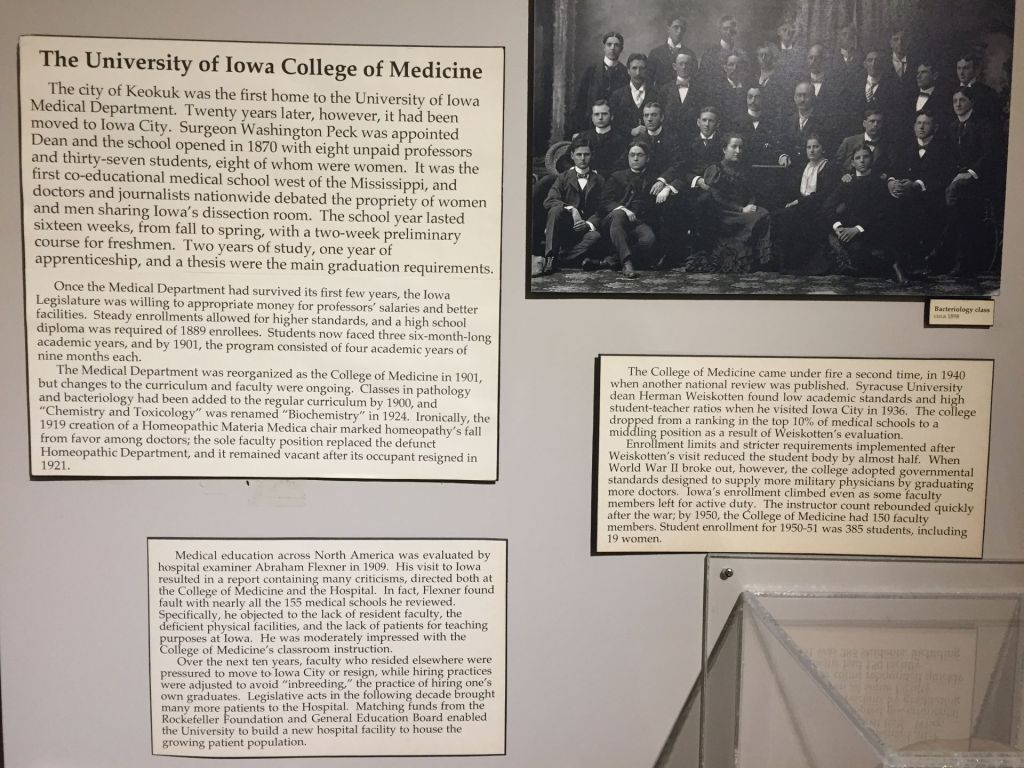
You can find in the UIHC Medical Museum a description of the historical development of the medical school. Following the Flexner Report in 1909 which found fault with all U.S. medical schools including Iowa’s, there was a drive to avoid “inbreeding,” meaning hiring of one’s own graduates. Nowadays, there are legislative efforts to keep as many as we can of Iowa’s best and brightest.
The University of Iowa Stead Family Children’s Hospital Neonatal Intensive Care Unit was recently recognized by the American Academy of Pediatrics (AAP) as one of only two such units in the U.S. having the highest levels of neonatal care.
It reminds me of the Iowa Hawkeye football games where, at the end of the first quarter, all the players and football fans wave from the field to the pediatric patients and their families watching the game from UI Stead Family Children’s Hospital. It’s called the Wave, one of the best traditions in college sports.
Well, the AAP waves to Stead Family Children’s Hospital NICU.
I just read Dr. H. Steven Moffic’s post on Psychiatric Times, “The Space Station as a Model for Intercultural Cooperation.” I also read the blog of another psychiatric I consider a colleague and friend, Dr. George Dawson, MD, and it’s sort of in the oppositive vein, being about the recent snafu of some Republican Minnesota legislators deciding to submit a bill to the legislature mansplaining Trump Derangement Syndrome (TDS) to the Democrats why TDS needs to become a law. It’s going over like a lead space station.
Incidentally, one legislature activity tracking website (Bill Track 50) has an Artificial Intelligence (AI) summary of the bill which says in part, “…the bill appears to be satirical or politically motivated…”
And the Minnesota Senate Minority Leader, Mark T. Johnson, said the bill was “a little bit tongue in cheek,” and possibly unintentionally joked that “Senate Republicans have always supported mental health funding…” while also calling attention to problems that the two political parties have cooperating with each other (story source WCCO News Minnesota, “Minnesota bill to define “Trump derangement syndrome” as mental illness provokes backlash” by Eric Henderson, Caroline Cummings; accessed March 18, 2025). Obviously these two pieces present opposites when it comes to collaboration.
The other issue pertinent to my post today has been the recent tariff and trade war going on between Canada and America, which is all about competition rather than cooperation.
Therefore, I did a web search for any Red Green Show episodes that demonstrated cooperation as a theme. In fact, the usual AI guidance (which I never ask for) pointed out that The Red Green Show didn’t present episodes about cooperation per se, but satirized the topic. For once, I had to agree with AI for the most part.
On the other hand, I did find a Red Green Show episode called “Twinning” that actually seemed to involve collaboration between Canada and Iowa, if you can imagine that nowadays. Back in the year 2000, The Red Green Show sponsored a survey of all 50 states in America, offering an opportunity for persons from an American city to twin with persons from Canada, I think it was Ontario. This meant that Americans would visit Canada and Canadians would visit America. I may not have the exact details right, but the idea of cross-cultural collaboration and getting to know each other was the main idea.
The whole state of Iowa endorsed the twinning offer with The Red Green Show, which of course, represented Canada. At the time, the Iowa Public Broadcasting Service (PBS) network was supporting the Red Green Show.
I never knew about that when it happened in 2000, probably because I was pretty busy working as a consultation-liaison psychiatrist here in Iowa City, Iowa. Anyway, the “Twinning” episode was one of the funniest I’ve seen. You know, identical twins are not exactly identical in every way.













 Go Retire Psychiatrist