I'm a retired consult-liaison psychiatrist. I navigated the path in a phased retirement program through the hospital where I was employed. I was fully retired as of June 30, 2020. This blog chronicles my journey.
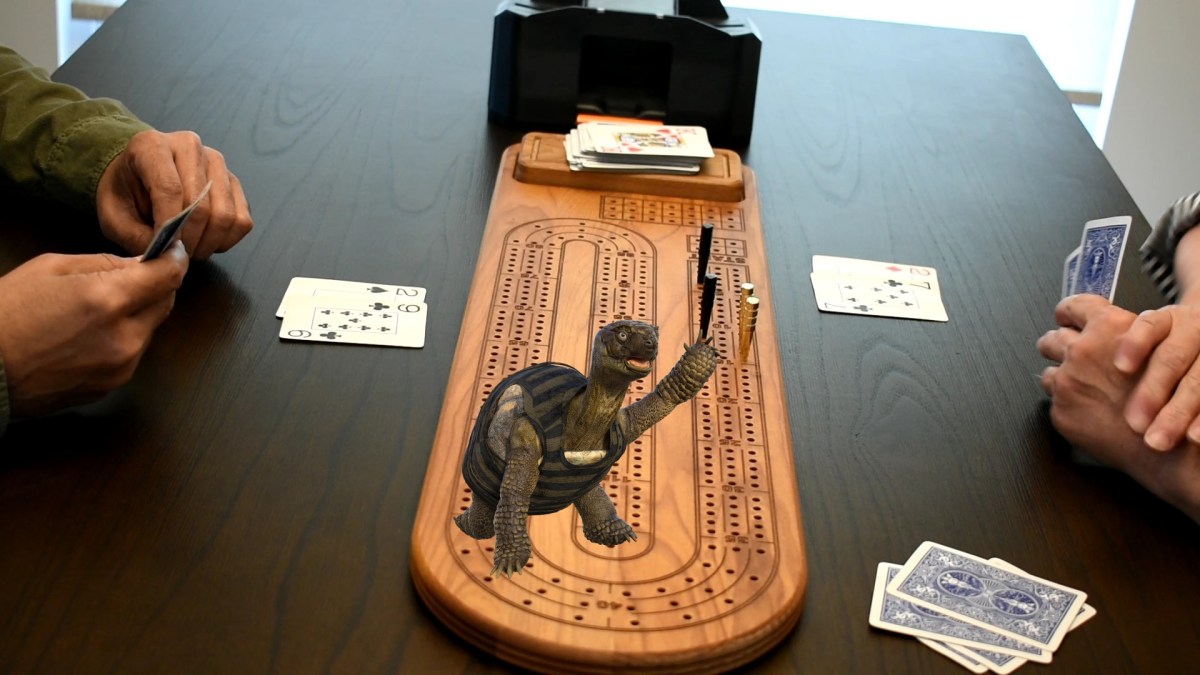
We’re still turtles when it comes to how long we take to play a cribbage game. And, I think I misjudged how randomization works with shuffling cards using a machine. I checked on line and various sources say, in general, whether you’re manually shuffling or using an automatic shuffling machine, adequate randomization of 52 cards would require shuffling seven times.
We experimented a little using a stopwatch. I can shuffle a deck in about 10 seconds using one table shuffle riffle and cuts. Sena probably takes about the same amount of time although she uses a different manual shuffling method (overhand, riffle). Rounding the numbers, shuffling 7 times would take about one minute and over 10 deals (one game), it would use up about 10 minutes or so.
The automatic shuffling machine takes about 5 seconds to shuffle a deck and doing that 7 times would take 35 seconds. Over 10 deals this would take up about 6 minutes. You can see it in action in our YouTube video, “Cribbage Meets Card Shuffler.”
We also ran the 24 face cards through the machine and it didn’t randomize them at all. Adding more cards didn’t improve it that much. It occasionally jams, but overall, it seems to do the job when you’re playing with a full deck—although I’m now skeptical that it does any better at randomizing cards than manual shuffling. And that probably accounts for the recommendation to shuffle seven times—by machine or manual methods.
This imposes an incentive for the tournament cribbage player to cut the time out of certain phases of the game. That’s because of the rule that you need to be able to play a cribbage game in 15 minutes. We wonder if experienced players might skimp on the shuffling phase.
For reference, the American Cribbage Congress (ACC) official rules about proper mixing of the cards (sec. 2.1) says:
2.1. Proper Mixing The pack must be mixed or shuffled at least three times (including mechanical card shufflers) with the cards face down or otherwise hidden from both players. The shuffler is not permitted to look at the bottom card after the last shuffle. If the shuffler should do so, the nonshuffler is to remind the shuffler of the prohibition and score a two-point penalty. The pack shall then be reshuffled by the offender.
What’s interesting about this is that it looks like the ACC allows automatic card shufflers, which made me wonder about whether mufflers are required. Ours makes a real racket. Note that a table riffle would work well to hide the numbers sides of the cards. It’s also clear you have to shuffle at least three times.
We’ve never been to a cribbage tournament so we don’t know how this works in actual practice. Let’s suppose that the strict 15-minute game time limit is the main rule and players shuffle three times. Then using a machine would take up only 3 minutes and manual shuffling would take up 5 minutes—if you’re not that concerned about randomization.
Manual shuffling means a tournament player might have 10 minutes for actual game play, so there could be an incentive to use a machine. On the other hand, experienced cribbage tournament players probably play every phase of the game very fast.
We take about 20 minutes to play a game regardless of whether we shuffle manually or with a machine. That’s how turtles roll.
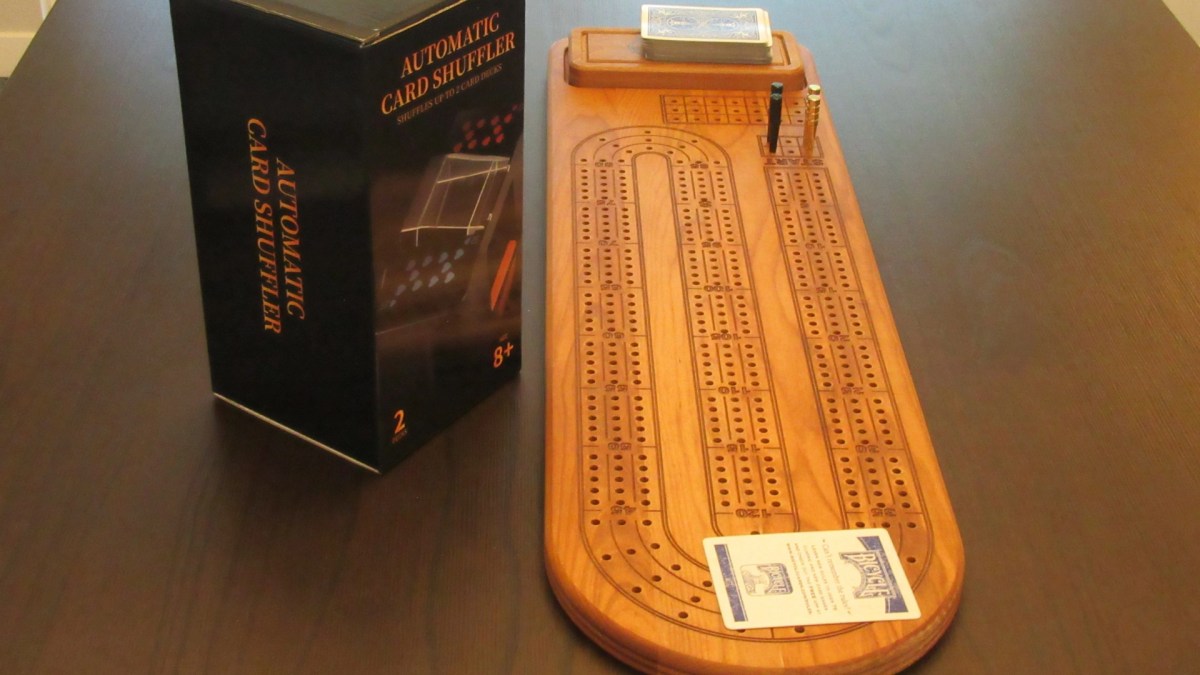
Today we used the automated card shuffler Sena ordered. I couldn’t find a company name or anything else from the box about where it’s made. We know it’s loud, but it does the job.
We’re not sure why it’s so noisy. It sounds like a bunch of pots and pans falling out of the cupboard during a tornado.
It was our first time using it and, while it felt like it was faster, it probably wasn’t according to my stopwatch. It took 22 minutes for us to play a cribbage game and manual shuffling took 25 minutes the other day (Big Time Bigfoot Cribbage Game). On the other hand, I think it randomizes the cards better than we do manually.
We kept starting to shuffle manually just because we’re so accustomed to doing it. It actually isn’t hard to set the cards into the feeder on top of the machine. In fact, you don’t have to be fussy about squaring up the deck before placing it in the shuffler. It’ll also shuffle two decks at once. It came with a charging cord so you don’t need batteries.
I don’t know if the American Cribbage Congress (ACC) allows automatic card shufflers in tournaments. I’ve never entered a tournament, but in photos the players are packed in cheek by jowl. And if you had one as noisy as ours for thousands of players, the din might be loud enough to set off alarms.
I get notices from the Iowa legislators about how great it is that I’m getting to be an old fart. An Iowa senator even reminded me: “Check your driver’s license to see if it’s time to renew!”
That’s one of the few things I’m up to “speed” on—see what I did there?
Other things remind me that I’m getting older. I walk slower. I can make several miles by walking out to the mall, walking up and down inside, and walking back. I made 5 miles yesterday.
Here’s the thing; I don’t powerwalk and, for the first time, I made a couple of stops along the way to rest. I’ve never done that before. Part of the reason is that, early this spring I had a bout of painful shin splints and calf cramps which took me a week to recover from. I wrote a very long blog post about that.
This time, before I set out for home, I was sitting inside and watching people outside. The bench I sat on faces the parking lot and a street runs along just outside of it. There’s a crosswalk visible from my bench.
As I gazed out at the parking lot, I saw one blue SUV with the two doors on the driver’s side wide open, making it impossible for anyone to park in the lane next to it. One elderly gentleman wearing a cap sat shotgun and appeared to be napping. A few minutes later, a woman with an unsteady gait made her way out to the car. She moved slowly and a few times I though she might topple over. She didn’t look very old, and she might have been younger than me, but not by much. She got in the back seat behind the napping man. The two side doors remained open.
A few minutes later, an old man with a wheeled walker came out of the mall and started to cross the street. He would push the walker forward a couple of inches at a time and then sort of drag his legs a couple of steps forward. He pushed the walker forward a couple of inches, and shuffled a couple of steps behind it; that’s the way he went. As I watched him, I wondered if I was going to have to hurry out there to help because I thought he might fall any second.
I actually took my eyes off him for a few minutes and when I looked back, I couldn’t see him in the crosswalk anymore. I figured he made it across, but then I noticed that the SUV was still sitting there and both driver’s side doors were still open. I peered around the crosswalk—and he was still scraping along, inching forward a few inches at a time. Drivers would have to either wait or back up and find another route.
He just kept creeping along. I think it took him all of 15 minutes just to get to the SUV, a distance that could have been measured linearly as not much more than 20 yards or so.
I remember wondering where and who the driver was. There were two seats left and I thought “No way is he the driver!” The driver must have still been in the mall somewhere.
As I sat there, the old man inched over to the SUV and finally made it. I almost could have taken a nap during the whole journey, but I’m not quite that old yet.
Then he opened the driver’s side back side door—and shoved his walker in the back seat! There was now only the driver’s seat open, and still no driver in sight.
And finally—the old guy got in the driver’s seat! He pulled up his trousers, started the SUV, backed carefully out of the parking lane and cruised smoothly out of the parking lot and away to who knows where, maybe a dance hall.
After I recovered from incredulity, I walked back home. I sat down to rest once before trying to across the street where, a month ago I had a sudden attack of calf cramps which nearly stopped me in the middle of the crossing. At that time, I had to hobble over to a bench and massage the cramps before heading the rest of the way home.
This time, as cars waited for me to get across, I could feel the cramps starting again but I slowed down instead of trying to trot across. I thought, “They’ll just have to wait.” No cramps this time.
Maybe that’s one of the reasons the state legislators send out cards and certificates to seniors. We help teach patience to others. You’re welcome.
Today we played cribbage under pressure—time pressure that is. We tried it because we wondered about why, in tournament games, you always hear you should be able to play a game in 15 minutes. The American Cribbage Congress (ACC) has over 200 local grassroots cribbage clubs across North America. If you join one of them, you generally have to learn how to play a cribbage game in 15 minutes.
Most clubs have you play 9 other players during regular meetings, which typically last about two and a half to three hours. I’m sure the practical time range is closer to somewhere between 15-20 minutes, but the driver to keep it shorter is that tournament organizers have to accommodate a large number of entrants. I’m not sure how much you can socialize during meetings. We had to cut the chit chat and focus on the cards.
We’re used to playing at a leisurely pace, chatting and dawdling. Usually, we take about 25 minutes to play a game—sometimes longer. But under time pressure, all phases of the game got more difficult to manage.
We kept getting stuck on certain phases of the game. We probably didn’t throw to the crib as well as we’d like because we felt so pressured to stay under the time limit. I’m sure we made counting and scoring mistakes in both the pegging and scoring phases.
We played 4 games and could play in 15 minutes and 36 seconds in only one of them. It seems like the average for us was somewhere in between 15 and 20 minutes. I used the stopwatch on my cell phone.
Oddly, the second time we tried to play faster led to the fastest time, which was just over 15 minutes as noted above. But each time we played, the longer times got; the first game was around 20 minutes, the next one after that was about 15 minutes; the next was a little over 16 and the next one after that was closer to 17 minutes.
I think fatigue from the pressure got to us. However, I wonder if we just practiced a little more, whether the jitteriness from the sense of pressure would ease because we’d eventually get better at scoring the less common hand and crib scores. Would an expert tell us that? By the way, do you know what the definition of an expert is? A retired drip under pressure.
I gave up on the idea of shuffling 2-3 times each hand and just did it once—which didn’t really seem to improve our times. We’re supposed to get our card shuffling machine tomorrow. I wonder if using that would speed things up or slow us down.
The other point to make is that we usually help each other score and count when we play cribbage. Well, that’s not what tournament players do. You sweat it out and if you make a mistake, your opponent can’t help you. And don’t get me started on the muggins rule. Talk about pressure.
Maybe the answer is to have a fresh deck of cards which don’t stick to each other from the snack foods you eat while playing cribbage just for fun. And don’t talk, joke, laugh, or shuffle too many times, and remember luck is part of the game. Skill can take you just so far. It’s kind of like life. Somebody called cribbage a “finicky game.” OK, so it was Barry Rigal, who’s famous for being a bridge player and edited the book CardGames for Dummies.
So, explain why cribbage players, who I’m guessing are among the most finicky people on the planet, can deal with the pressure of a card game with a lot of finicky rules but manage to play a cribbage game in 15 minutes?
If you’re a cribbage player, we’d love to hear your answers. No pressure.
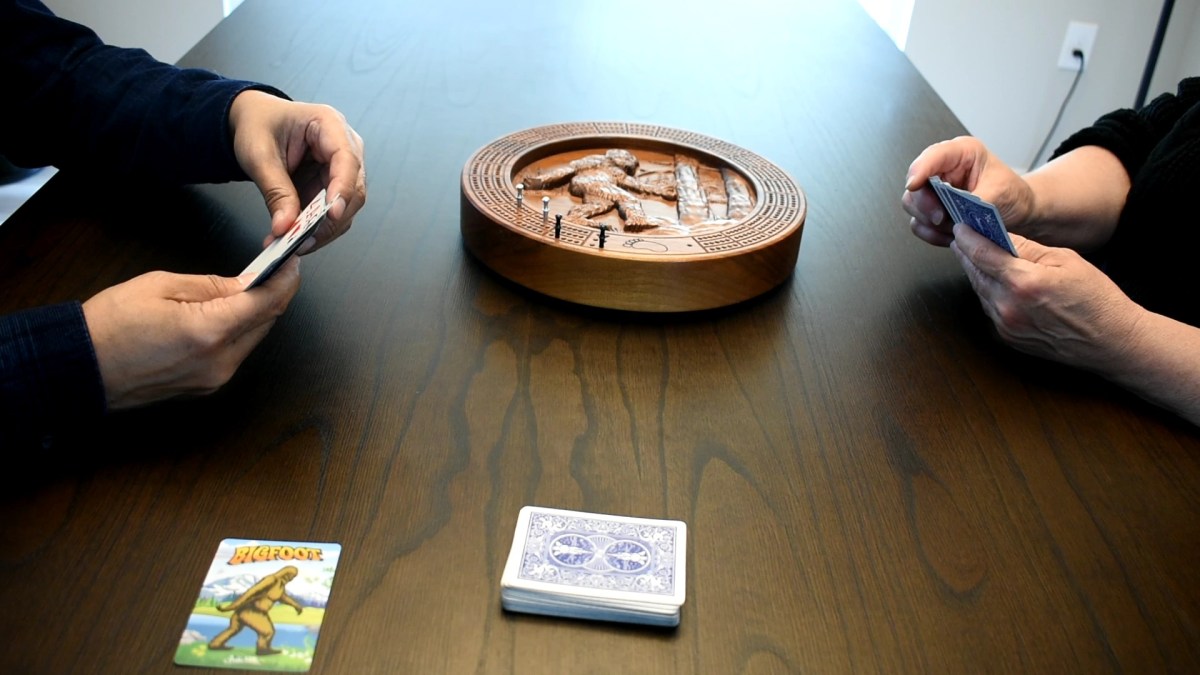
Yesterday, Sena and I had a major cribbage showdown on the Bigfoot cribbage board. It took a little practice to get used to it because we generally use the long board. Aside from the usual hiccups figuring out scores, I did a fair job of keeping up for a while.
However; Sena won. She plays a smart game and I didn’t have the time to crack any Bigfoot jokes during the filming of the full game. We’re not tournament players so we took over 25 minutes to play one game. It was fun, though.
Sena ordered a card shuffler machine, and we’ll see how much time that shaves off playing a game. Probably not much although the maker advertises that it shuffles in less than 2 seconds. I don’t think tournaments allow shuffling machines.
Except for the length of the video, I think what it has going for it is the demo of how the game is played.
And on to the important stuff—a couple of Bigfoot jokes:
Do you know why Bigfoot is so good at hiding? He owes money to Chuck Norris.
Bigfoot claims he saw Chuck Norris once, but nobody believed him.
The reason nobody sees Bigfoot is because Chuck Norris found him first.
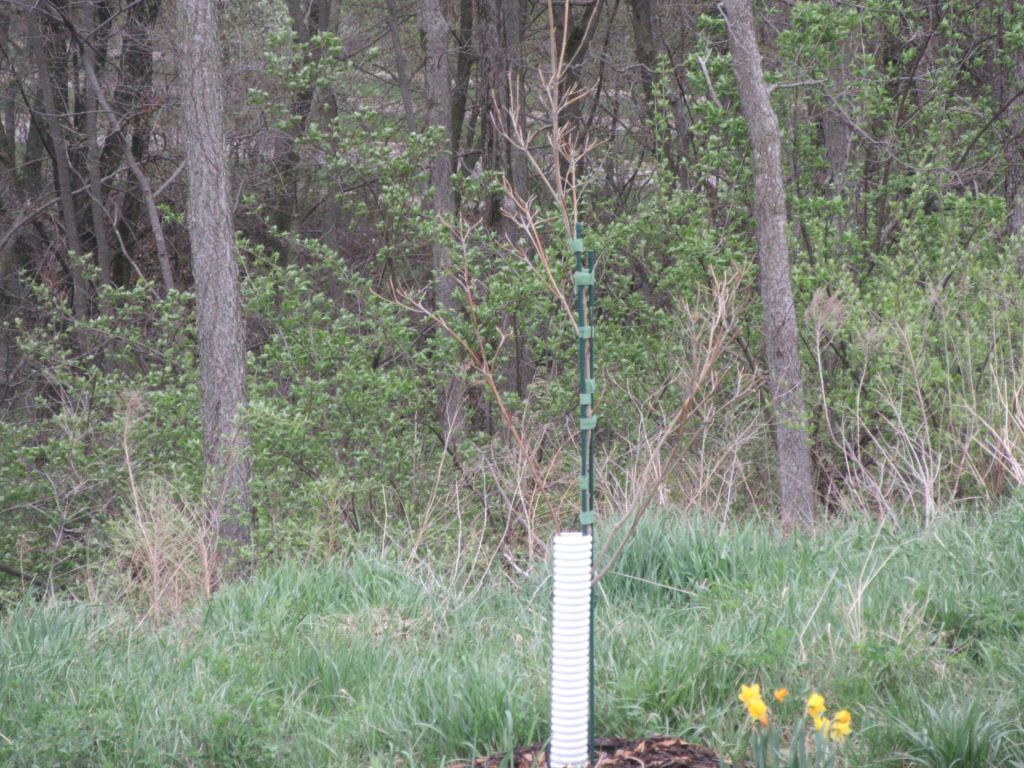
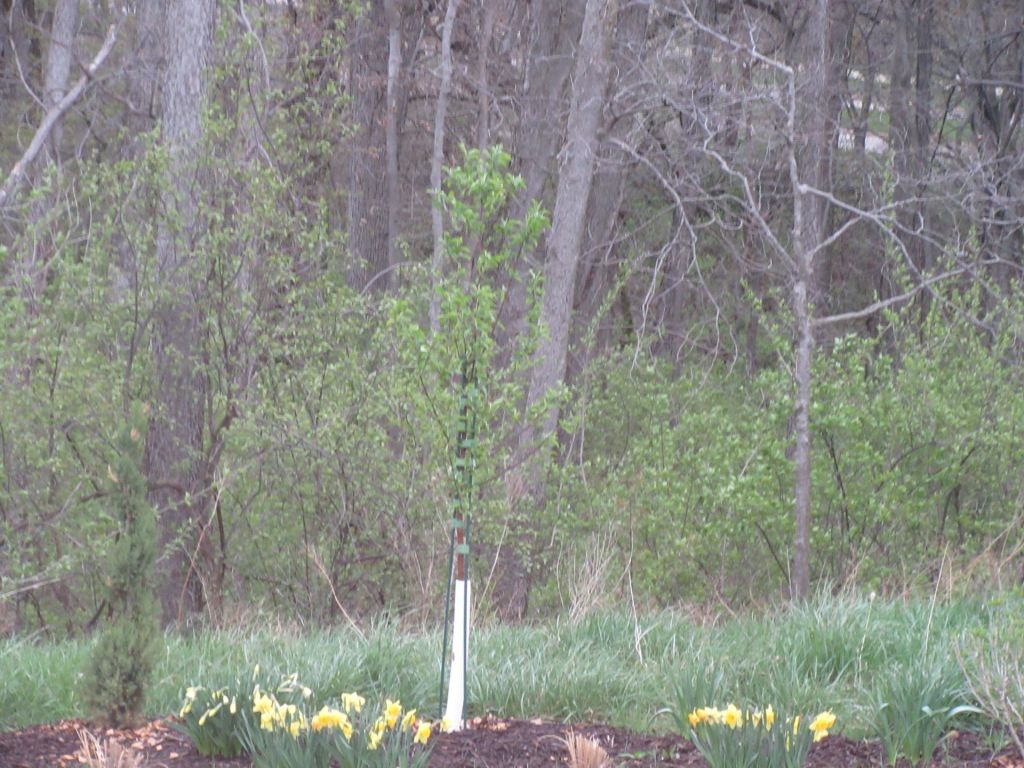
Today is designated Earth Day although there is such a thing as Earth Month. Among the several trees Sena planted in our back yard trees are a few that we hope exemplify the Earth Day theme, which is Our Power, Our Planet.
One of them is a dogwood, which we’re hoping will bloom soon. Dogwoods represent joy and rebirth. There are a couple of crab apple trees, a red jewel and a perfect purple. Crab apple trees represent love and all are very special to Sena and me.
Love, joy, and rebirth. They can all be linked to power, which can be the power of will. The will to respect the planet also implies respecting each other. Practicing humility can be a kind of power.
The power to be still and listen to each other can make us more open to change.
On that note, because I can’t go for long without joking around, I should retell the story about me and the walking dead meditation. About 13 years ago, I had an even more serious case of not listening to others than I do now, if you can believe that. It eventually led to my choosing to take the Mindfulness Based Stress Reduction (MBSR) class ( see this current University of Iowa mindfulness essay). I wrote an essay for the Gold Foundation and it’s still available (I updated the links):
How I left the walking dead for the walking dead meditation (August 13, 2014)
About a year or so later, I bought Jon Kabat-Zinn’s book on Mindfulness-Based Stress Reduction (MBSR), Full Catastrophe Living, because I was dimly aware of the burden of stress weighing on me as a consulting psychiatrist in an academic medical center. I didn’t get much out of Kabat-Zinn’s book on my first read. But then in 2012 I started getting feedback from colleagues and trainees indicating they noticed I was edgy, even angry, and it was time for a change.
Until then, I’d barely noticed the problem. Like most physicians, I had driven on autopilot from medical school onward. I had called myself “passionate” and “direct.” I had argued there were plenty of problems with the “system” that would frustrate any doctor. I had thought to myself that something had to change, but I never thought it was me.
After reflecting on the feedback from my colleagues and students, I enrolled in our university’s 8 week group MBSRprogram. Our teacher debunked myths about mindfulness, one of which is that it involves tuning out stress by relaxing. In reality, mindfulness actually entails tuning in to what hurts as well as what soothes. I was glad to learn that mindfulness is not about passivity.
But I kept thinking of Kabat-Zinn’s book, in which he described a form of meditation called “crazy walking.” It involved class members all walking very quickly, sometimes with their eyes closed, even backwards, and crashing into each other like billiard balls. I hoped our instructor would not make me “crazy walk” because it sounded so—crazy. I dreaded crazy walking so intensely that I considered not attending the 6-hour retreat where it might occur.
We didn’t do crazy walking. Instead, we did what’s called the “walking meditation.” Imagine a very slow and deliberate gait, paying minute attention to each footfall—so much so that we were often off balance, close to crashing into each other like billiard balls.
I prefer to call this exercise the “walking dead meditation” because it bore a strong resemblance to the way zombies move. One member of the class mentioned it when we were finally permitted to speak (except for the last 20 minutes or so, the retreat had to be conducted in utter silence). It turned out we had all noticed the same thing!
Before MBSR, I was like the walking dead. I was on autopilot — going through the motions, resisting inevitable frustrations, avoiding unstoppable feelings, always lost in the story of injustices perpetrated by others and the health care system.
In practicing mindfulness, I began noticing when my brow and my gut were knotted, and why. Just paying attention helped me change from simply reacting to pressures to responding more skillfully, including the systems challenges which contribute to burnout. About halfway through the program, I noticed that the metaphor connecting flexibility in floor yoga to flexibility in solving real life problems worked.
Others noticed the change in me. My professional and personal relationships became less strained. My students learned from my un-mindfulness as well as my mindfulness, a contrast that would not have existed without MBSR.
As my instructor had forewarned, it was easy for me to say I didn’t have time to practice meditation. I had to make the time for it, and I value the practice so much that I’ll keep on making the time. I will probably never again do the walking dead meditation.
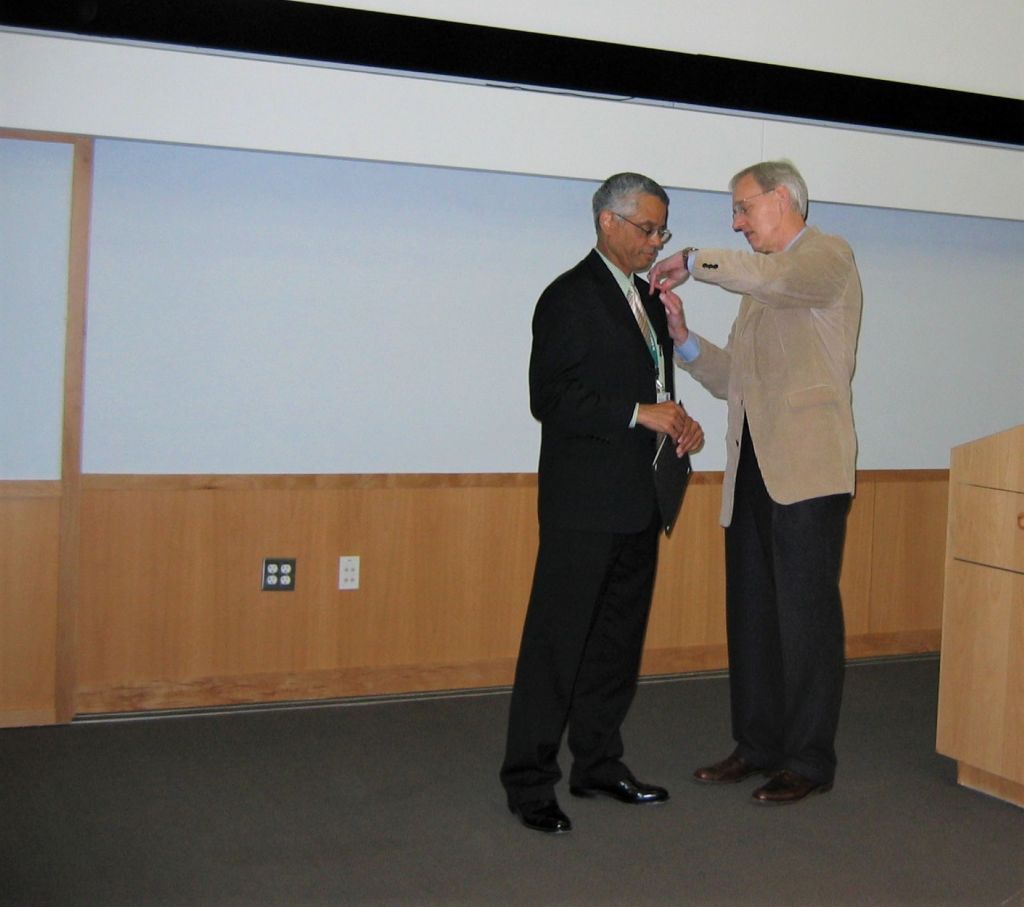
Today we gather to reward a sort of irony. We reward this quality of humanism by giving special recognition to those who might wonder why we make this special effort. Those we honor in this fashion are often abashed and puzzled. They often don’t appear to be making any special effort at being compassionate, respectful, honest, and empathic. And rewards in society are frequently reserved for those who appear to be intensely competitive, even driven.
There is an irony inherent in giving special recognition to those who are not seeking self-aggrandizement. For these, altruism is its own reward. This is often learned only after many years—but our honorees are young. They learned the reward of giving, of service, of sacrifice. The irony is that after one has given up the self in order to give back to others (family, patients, society), after all the ultimate reward—some duty for one to accept thanks in a tangible way remains.
One may ask, why do this? One answer might be that we water what we want to grow. We say to the honorees that we know that what we cherish and respect here today—was not natural for you. You are always giving up something to gain and regain this measure of equanimity, altruism, trust. You mourn the loss privately and no one can deny that to grieve is to suffer.
But what others see is how well you choose.
Leonard Tow awardGetting the pinOn my lapel; in my heart
I’m still practicing mindfulness-more or less. Nobody’s perfect. We hope the dogwood tree blooms soon.
Want a scientific excuse to waste an egg? Sena and I found this experiment that uses vinegar to make a bouncy egg yesterday.
We put a whole raw egg into a bowl full of vinegar and let it sit for 24 hours. Initially, a couple of hours after we put the egg in the bowl of vinegar, Sena noticed pressure building up in the bowl. Even though the lid was on, vinegar was starting to leak out so she set it inside a larger bowl.
I started to worry a little about whether enough pressure would build to blow the lid off in an explosion—but it never happened.
I think a lot of people get this idea around Easter. The main thing that happens is the vinegar (a weak acid) eats away at the egg shell (which is made of calcium carbonate) until the shell dissolves. Carbon dioxide gas bubbles form. It leaves a rubbery membrane behind. The water in the vinegar diffuses across the membrane.
The egg had a lot of bubbles all over it and was visibly larger. The shell had completely dissolved—and it bounced! Sena tried bouncing it from higher and higher levels until the inevitable splat. All that was left was the yolk and the membrane.
It kind of reminds me of the morgue autopsy scene in the 1997 Men in Black movie between the deputy medical examiner Dr. Laurel Weaver and Agent J (everything reminds of Men in Black movies):
Dr. Weaver: Feel that? Where the eggshell should be? Notice anything strange?
Agent J: No, all fine.
Dr. Weaver: Doctor, the whole shell is missing.
Agent J: Well, of course. That’s obviously the first thing I noticed. What I was pointing out is the fact that there are no… pieces…of it left. You know, so the shell is intact; wherever it is whole, somewhere. That we can be sure of.
I watched the Svengoolie movie, “It Came from Outer Space” last night. I’m sure I’ll recover someday. Until then, I’ll have to do my best to write about it. Ray Bradbury actually wrote what’s called the film treatment for the story and Harry Essex wrote the screenplay. I gather there’s a difference between the two, but don’t ask me what it is. So, it’s helpful to know that real movie reviewers also noticed what I noticed, which is that the dialogue has a distinctive literary quality. I’m a Ray Bradbury fan from way back in my youth when they were still using stone tablets to write on. But even I noticed the tone and language were more elevated than what I usually see on the Svengoolie TV show.
Kudos to the movie reviewer who mentioned the literary quality of the dialogue, which in my opinion also are reminiscent of Ray Bradbury:
Interestingly, this blogger’s review says that Bradbury was unhappy with the result of the production.
The other blogger/reviewer had similar remarks, but it was his About post comments which caught my interest, in which his remarks about Svengoolie’s schlocky films on the show are right on target. On the other hand, he likes this movie. He also mentions that Bradbury got fired after getting paid $2,000 for writing the treatment. I’m not clear on why he was fired:
Anyway, I agree with both reviewers that “It Came from Outer Space” is different from most space invaders films in that the extraterrestrials didn’t actually invade Earth. In fact, they had a malfunction in their spacecraft and accidentally crashed here. They were actually headed for somewhere else, possibly Milliways, the restaurant at the end of the universe (“The Hitchhiker’s Guide to the Universe” by Douglas Adams). They took the form of earthlings so they could get around without being noticed.
That doesn’t actually work because, although they looked like us, they talked in a monotone and had blank, unblinking stares. And they crashed here, indicating the same kind of inability to drive that reminded me of the Roswell incident back in 1947 (only a few years before this movie was released) in which a UFO crashed in New Mexico.
The one thing that struck me was that, in the movie, the extraterrestrials not only couldn’t drive their spacecraft, their main goal after crashing was to fix their busted vehicle. Apparently, in their human disguises they had to go to Lowe’s Hardware to buy replacement electrical parts.
So, these extremely advanced creatures who mastered interstellar travel can get electrical parts in a 1950s era hardware store? “Excuse me, can you get me 4,000 gray toggle switches with matching cover plates—and a voltmeter?”
The spaceship carrying the lost creatures looked like a meteor as it crash-landed and again when it took off after it was fixed. Although you can find a Wikpedia article about this movie that, at the very top, links to another which claims that Bradbury published the film treatment as a book, the rest of the article denies that ever happened. I suppose some people are still looking for it, just like those still looking for the Roswell ET bodies.
I noticed the other day that I was having trouble doing the one leg stand. It has been getting harder to sustain it past 10 seconds even. It’s not like I’ve been laying off exercising, including the one leg stand. Hey, I can even do a one leg sit to stand (barely). I posted about the one leg stand, including a video, about 2 years ago.
I found another news item and study about old farts like me and it included a new recommendation about the one leg stand. According to this study, if you can’t do a one leg stand for more than 5 seconds, you’ve got one leg in the grave. If you can do 30 seconds, then you’re all good.
So, I practiced a little more and I even tried the one leg juggling trick, which I also tried two years ago—and clearly faked on a video. Well, one leg clowning is back—and this time it’s for real. I think the Latin quote Ars Longa, Vita Brevis fits for this activity. This one leg stand thing is a skill and you have to work at it, even as you age and your life grows shorter.
I still don’t know if this would be called aging gracefully?
References:
Rezaei A, Bhat SG, Cheng CH, Pignolo RJ, Lu L, Kaufman KR. Age-related changes in gait, balance, and strength parameters: A cross-sectional study. PLoS One. 2024 Oct 23;19(10):e0310764. doi: 10.1371/journal.pone.0310764. PMID: 39441815; PMCID: PMC11498712.
Araujo CG, de Souza E Silva CG, Laukkanen JA, Fiatarone Singh M, Kunutsor SK, Myers J, Franca JF, Castro CL. Successful 10-second one-legged stance performance predicts survival in middle-aged and older individuals. Br J Sports Med. 2022 Sep;56(17):975-980. doi: 10.1136/bjsports-2021-105360. Epub 2022 Jun 21. PMID: 35728834.
I’ve been looking over the web about learning how and where to play cribbage. It’s a card game for two players usually, but there are variations allowing for 3 to 4 players.
First, out of curiosity, I started searching the web on where to play cribbage in Iowa.
There are about 200 local clubs across the U.S. connected with the American Cribbage Congress (ACC). You can find them by looking in the Club Directory on their web site. So where could you play cribbage outside of the ACC with others in Iowa?
It turns out there’s a cribbage club in Des Moines, called Capital City. Like many ACC clubs, members play 9 games vs 9 opponents and they are two player games. They accept people of all ages, although one of the main reasons to join is if your interested in tournament cribbage games. Like the web page says, they have fun, but they also have to learn how to play a game in 15 minutes because that’s the usual speed you’d have to play in tournaments. I would expect the atmosphere to be fun and also competitive.
There’s another sort of cribbage club in Iowa and it’s in Indianola, which is only about 20 miles south of downtown Des Moines. It doesn’t have a specific name and it isn’t connected to the ACC. They play in a conference room an Activity Center. Interestingly, they allow only those over 50 years of age to participate. This probably isn’t going to help ensure that the younger generation learns to play cribbage and keep the game alive.
There is a photo of 4 guys sitting at a table and you can see the cribbage board in a corner of the table. So, there is the opportunity to learn the 4-player variation of cribbage. The web site also has a link to a set of rules about how to play the game. The rules have a puzzling suggestion, which is to lead with your highest card. That seems like asking for trouble because your opponent could drop a 5 card on your ten card and get fifteen for two points right away.
Either way, Sena and I are not about to drive several hours just to play cribbage. We’ve only been playing for a little over 5 years now, but over 20 years ago we tried to learn it. Which brings me to the point of how you learn it from the web.
There are so many YouTube videos and other written tutorials, all with variable quality. Some have too much detail for beginners and some don’t have enough detail to keep you interested. The teachers who allow comments on their videos often get heartwarming stories from those who remember playing cribbage with someone they loved.
I like a couple of videos from Jonathan Pinyan. I just watched the shortest one, which is only about 15 minutes long but teaches you all the basics while he plays a game with a friend.
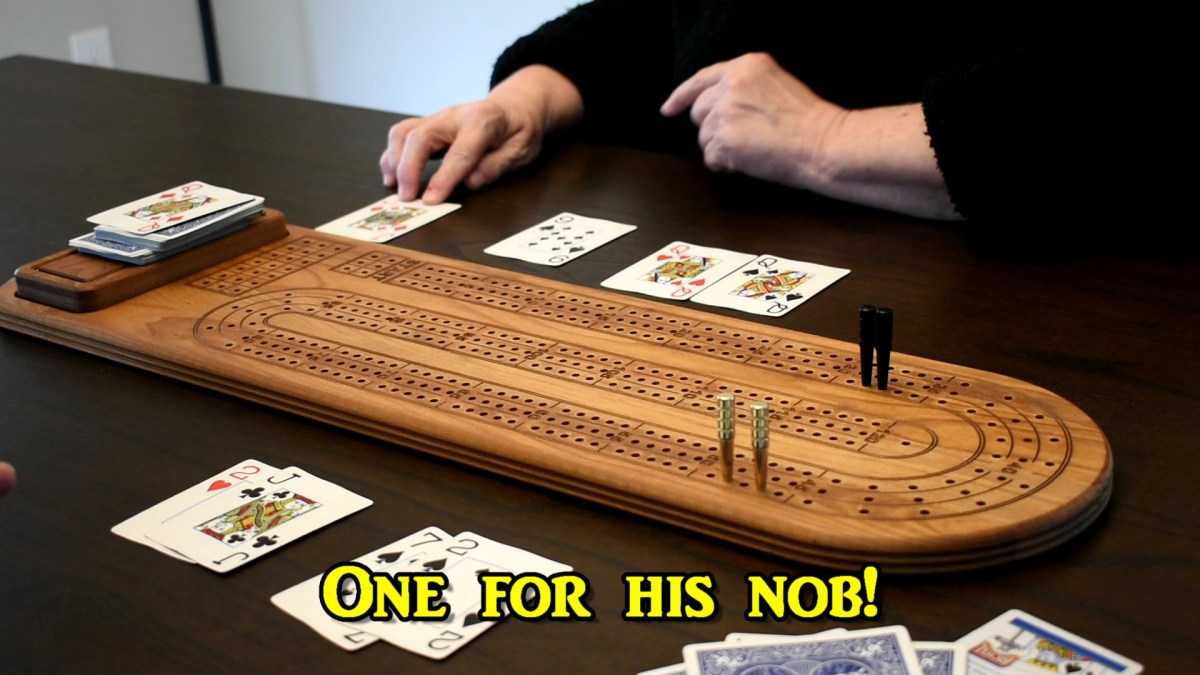
And he made a 20-minute video playing a game with his father. Sena and I watched that one and now she calls the nob jack (one for his nob, the jack of the same suit as the cut card) the right jack because that’s what Jonathan calls it. It’s comical because I always feel like I have to correct her, “It’s the nob jack, not the right jack.”
On the other hand, I just found a web reference which asks about the “his knobs.” You’ll see long, comical discussions on the web about the etymology of terms like that in cribbage, often turning out to be differences between British and American cribbage players’ nomenclature. And the “right jack” is related to the card game Euchre, which is where Jonathan Pinyan got it.








 Go Retire Psychiatrist