I couldn’t think of a less complicated title for this post about the book “James Alan McPherson: On Becoming An American Writer: Essays & Nonfiction.” It’s a collection of James Alan McPherson’s essays, but this humble blog post is not intended to be a review, nothing as grandiose as that. Nobody should think I have any presumption of being a scholar about the author.
I’ve finished reading the essays and I just have a few remarks about the one that resonates with my own experience way back in my younger days in college. It’s the last one in the book: “On Becoming An American Writer.”
I’m only sort of a writer, but I am an American black man. Even as I wrote that sentence, I think of caveats. Right away, I want to point out that I think his main point in this essay is to emphasize that skin color by itself is not the measure of any human being and that becoming an American is a process that should culminate with transcendence of a primarily racial identity. He makes that point clear in many of his essays and his fiction.
What this essay did was trigger memories of my own experience of the path to clarifying my identity. I’m going to inflict some of my biography on you.
McPherson’s story about his college education and description of both his “status” (black man, black American, American, etc.) and his “contract” with various American institutions set off memories of parts of my own life.
As McPherson did, I managed to get out of a limited station in life to one of the Historically Black Colleges and Universities (HBCUs), Huston-Tillotson College (now Huston-Tillotson University) in Austin, Texas. Before that I wrestled with being the offspring of a black father and a white mother. It was tough to explain the word “mulatto” and that often got shortened to “mutt,” or “nigger.”
It was a white woman associated with the church who suggested that the black pastor of H-TC talk to me about going to college there. I’d grown up in white neighborhoods, gone to white schools and a white church, one pastor of which declared that he would not let my “black buccaneer” father set foot in his church. My parents had been separated long before then. But I remember my father telling me that intermarriage was the way to world peace.
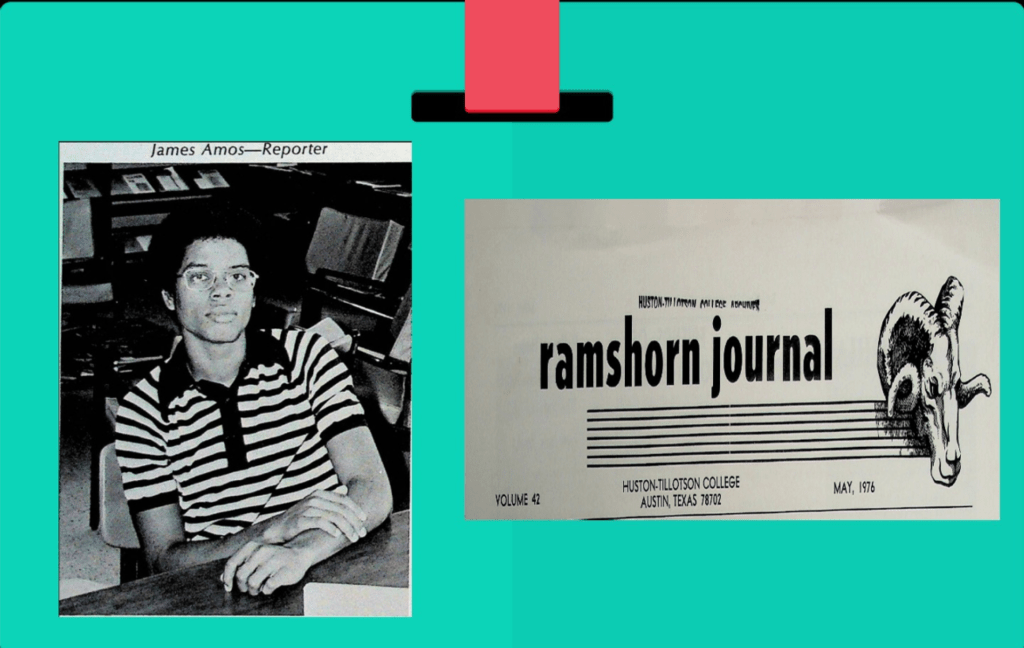
Even as a child I was drawn to writing, which has pretty much always been part of my life. I wrote little stories for my mother. I wrote poetry and few new stories for the student newspaper (The Ramshorn) at H-TC, stayed a few semesters.
Then I transferred to Iowa State University, followed by entering The University of Iowa College of Medicine and eventually co-edited an introductory handbook about consultation-liaison psychiatry after completing medical school and residency in psychiatry at The University of Iowa in Iowa City, Iowa. I entered the 1988 freshman class there after first attending a summer enrichment program intended to give minority students a sort of head start before the regular year academics.
I didn’t do as well as I hoped in the first year of Basic Sciences. In fact, I remember thinking about quitting medical school and either returning to my hometown of Mason City, Iowa and going back to work for a consulting engineers’ firm which gave me my first real job when I was technically too young to hire. I got through it.
I was the only black psychiatrist attending in the Psychiatry Department during my tenure there. Whenever I searched the internet using the term “black psychiatrists in Iowa” the results returned very little except me, one other black psychiatrist in the western part of the state and “Dr. Donald Black”—who is white.
I’ve been retired since 2020. I write this blog, Go Retire Psychiatrist. The title still fits because I’m not sure I’ll ever fully get past the stage of “adjusting” to retirement.
In this essay, McPherson emphasizes his identity as a writer. I confess I had to think hard about his definitions of “status” and “contract” in terms of how he and society perceived them. My understanding of them is less than what I think it should be.
McPherson also says that becoming a simply an American (presumably without reference to skin color) could be achieved “with or without intermarriage.” I’m not sure I believe that despair begets hope, which McPherson describes as coming from Miguel de Unamuno, giving rise to the word “desperado.” Maybe. I believe I have a lot of people to thank for my success, especially my wife, Sena, who kept despair at bay.
Ok, I’m almost done. The last point McPherson makes actually confuses me the most, although I suspect there might be a typo at fault. Paraphrasing some of it, he says if we can resolve all of our contradictions and anxiety about our diversity and learn from that without going crazy, we can “…earn a twountant.”
What does “twountant” mean? It’s not in the dictionary and not on the internet. I think it probably just means that we’ll make progress as decent human beings.






Leave a Reply