
Here’s a reblog post from June 6, 2019. As I reflect on it, I remember with chagrin the time when I tried to fix the challenge of difficult to decipher psychiatry consult questions. What it taught me belatedly is that you just can’t fix everything. I think my frustration was obvious to the trainees and it really didn’t go well. Their hearts weren’t in it, partly because I was on a mission and I think they knew it.
I tracked down this paper I used about the issue and discussed it with the residents. The author wrote it when he was a resident and I was pretty impressed with it. The abstract is worth reading:
Zigun JR. The Psychiatric Consultation Checklist: a structured form to improve the clarity of psychiatric consultation requests. Gen Hosp Psychiatry. 1990 Jan;12(1):36-44. doi: 10.1016/0163-8343(90)90036-c. PMID: 2295434.
Abstract
Medical specialty consultation is requested to obtain expert review of a patient’s condition. The specialist usually receives a case synopsis with pertinent positives and negatives and a specific request for assistance. In contrast, the psychiatrist often gets a statement of diagnostic speculation (e.g., “depressed”) with a request to “please evaluate.” Classically, the psychiatric consultant begins with open-ended empathic questioning in an attempt to redefine the written consultation question. However, given the difficulty consultees have in forming questions, and increasing time limitations, a more structured approach to obtaining data might assist both the consultee (M.D. requesting assistance) and the consultant (psychiatrist). The Psychiatric Consultation Checklist (PCC) was devised to function as a paper “expert” questioning system to provide such assistance. In a pilot study, 10 administrations of the PCC took an average of 3.6 minutes. In comparison to consultations using standard forms, more data were supplied in several categories when the PCC was used, particularly regarding patient stressors, patient behaviors of concern, and consultee speculation on psychiatric diagnostic formulation. The PCC may be used in consultation research, for assessment and education of physicians in training (regarding psychiatric issues in the medical/surgical setting), and for general clinical consultation purposes.
We came up with a checklist:
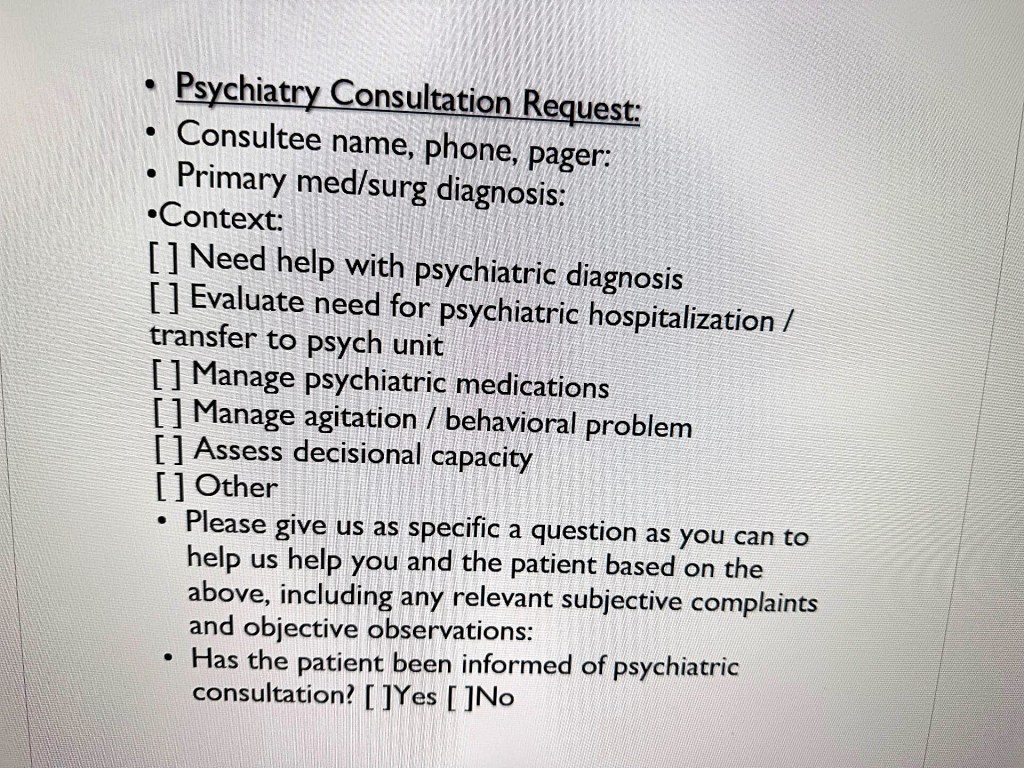
I still think it looks good on paper. I’ll never know if it got into the workflow after I retired in 2020—and I’m OK with that.






Leave a comment