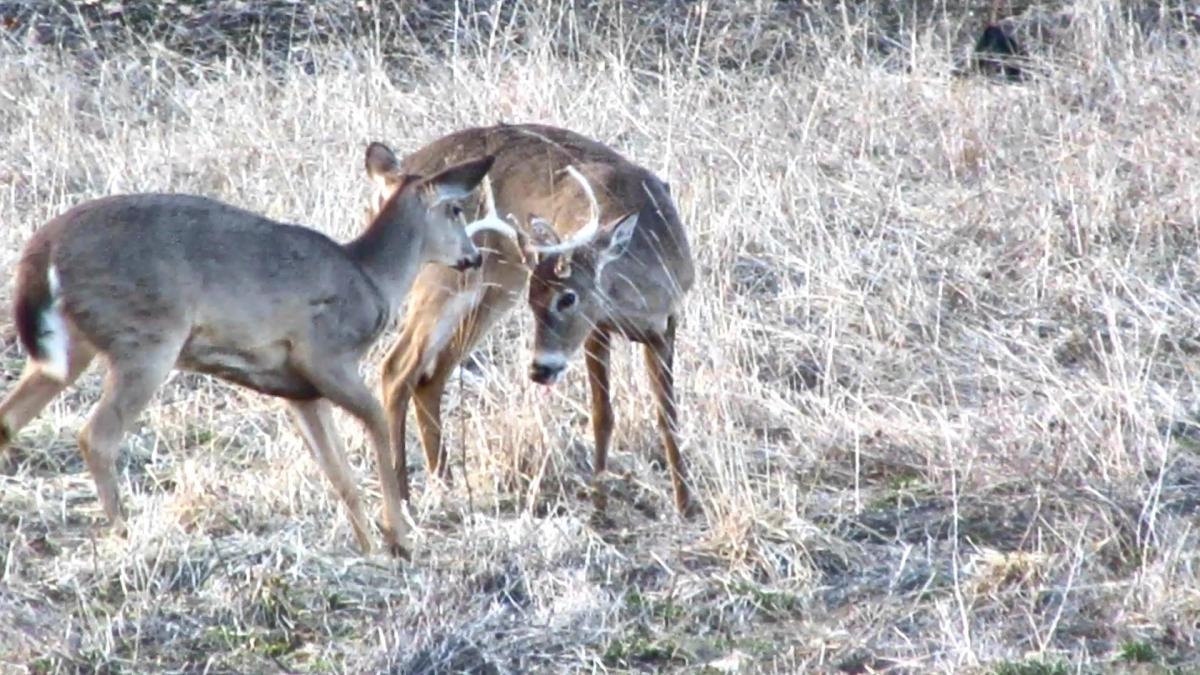
Yesterday, we saw another episode of a whitetail deer hassling the blond and white tabby who was just minding its own business hunting for mice. The deer was definitely not pleased and tried to scare the cat off.
They don’t get along, probably because deer and cats are natural enemies.
You got to hand it to the cat who just kept hunting despite the deer glaring and stomping its feet. Under pressure, the cat caught two mice, right in front of the deer.
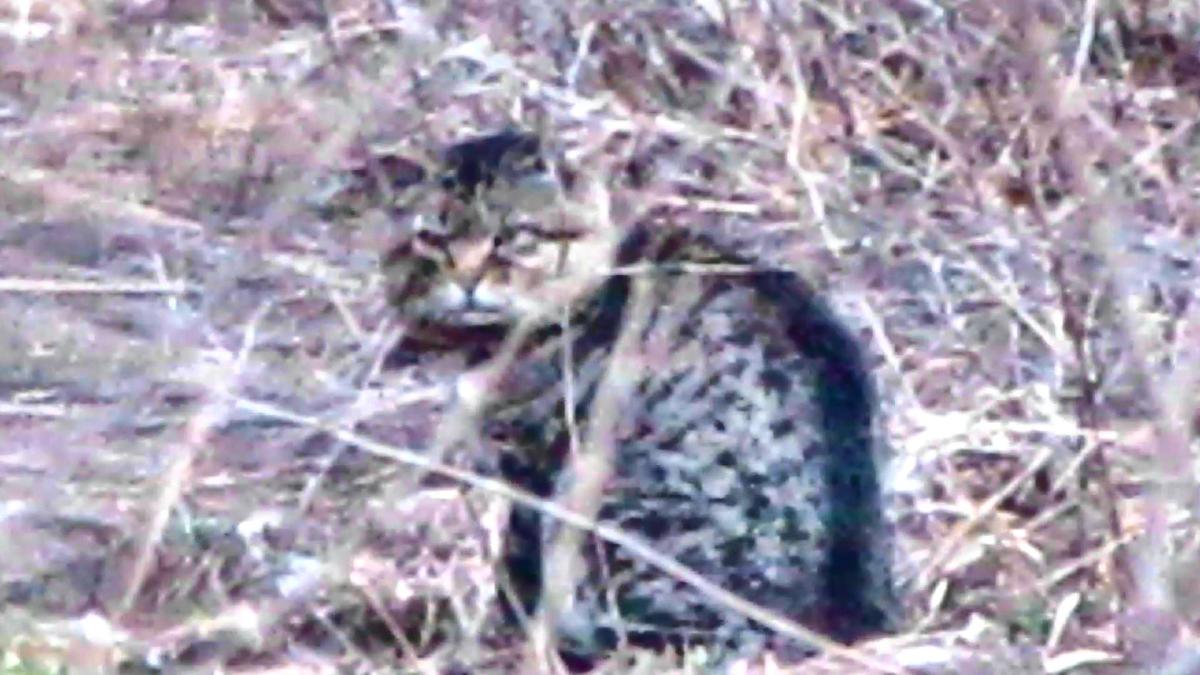
Yesterday, we saw a gray cat with black stripes (one broad black stripe down its back) in the outlet in back of our house. It was about the size of a large housecat. It definitely was not big enough to be one of the large cats which can be seen in Iowa. It wasn’t a lynx, bobcat, or mountain lion. I think it was hunting for rodents.
And today, believe it or not Sena alerted me to another cat in the same location, only it was brown and white. It looked identical otherwise.
I was stumped until I thought of tabby cats. I’m not a cat person so the only way I would know this is because I’ve heard the term before. I found out the tabby cat has a marking on its forehead that looks like the letter “M.” The markings are often striped or swirled. The term “tabby’ doesn’t refer to any particular breed of cat; it just refers to the markings. I think both cats have an “M” marking on their foreheads.
I think Sena saw a cat like this not that far from our back yard last year. It was surrounded by kittens.
I wonder if they’re feral. That led me to the internet. According to one web site, both stray and feral cats are called “community cats.” Strays usually are accustomed to being around humans and can be lost or abandoned. Feral cats are not used to being around humans and live wild.
So, I think these cats are feral tabbies and maybe they’re litter mates. Some say that a large percentage of feral cats are tabbies. I don’t know if they’re male or female—and you can’t pay me enough to check. I gather it’s tough to tell a cat’s gender just by looking at it. Males tend to have wider jowls, and tend to be bigger.
If you think I’m mistaken about what kind of cats these are based on the video, please let me know.
The other interesting thing about the gray feral tabby sighting was how whitetail deer reacted to the cat’s presence. We watched as a deer seemed to approach it warily, staring at it while stamping its hooves. We got the impression that the deer did not want the cat in what looks like its territory, judging from how often deer graze there—which is daily.
I found information on the internet suggesting that deer don’t get along with feral and stray cats. One YouTube video showed deer being aggressive to a stray cat. It makes sense that deer would hate cats. Deer are prey for large cats like mountain lions.
In general, all cats including feral cats can transmit a parasite, Toxoplasma gondii (T. gondii), to both deer and humans. Infection with T. gondii is usually asymptomatic. You get it from eating undercooked meat or contact with cat feces. There are a few studies suggesting that there is a relationship between toxoplasmosis and schizophrenia, although it’s not clear what that connection is yet (Osman E, Mohammad Zahariluddin AS, Sharip S, Md Idris Z, Tan JK. Metabolomic Profiling Reveals Common Metabolic Alterations in Plasma of Patients with Toxoplasma Infection and Schizophrenia. Genes (Basel). 2022 Aug 19;13(8):1482. doi: 10.3390/genes13081482. PMID: 36011393; PMCID: PMC9408728.)
The gray cat left the area, although I’m not sure it was because it felt threatened by the deer or because it just wasn’t having any luck finding food.
Today, the sighting of the brown and white feral tabby was exciting because I caught video of it catching a mouse!
We have a small herd of whitetail deer who regularly visit our lawn because they think it’s a salad bar. They’re all over the neighborhood because the city apparently doesn’t have a consistent deer population management plan. I don’t know anything about the animals, other than what I care to look up on the internet.
We saw several bucks the yesterday. One of them was missing an antler. It might have been lost in a fight with another buck.
As far as we could tell, most of the deer seemed pretty healthy, although I guess you can’t really tell which ones might have chronic wasting disease just by looking at them.
One animal looked like it might have suffered an injury, possibly from a buck. The lesions looked like they might be healing.
I guess this time of year, they would be molting. That probably explains why some of them look scraggly.
Sena taps on the windows and orders them off the property. That doesn’t work. Sometimes they look up at you like they know you’re staring at them—but they usually ignore you and go back to munching on your lawn.
I wonder if I’d feel differently about culling the whitetail deer if I watched hunters actually cull them—or kill them. The word “culling” actually sounds like a nicer version of “killing.” The definition of culling is the reduction in the population of wild animals by “selective slaughtering.”
The origin of the word “cull” is interesting. It comes from the Latin verb colligere, meaning “to gather.” In general, it means to collect a group of animals into separate groups: one to keep and one to kill. Usually, it’s about killing the weak and sick ones.
On the other hand, the origin of the word “kill” seems to be obscure. Of course, it means to strike, hit, put to death. It might derive from an Old English word, “cwellan,” which means to murder, or execute.
Cwellan, cull, kill. I think it’s a coincidence they sound similar. None of them sound like “Bambi.” When me and my brother were little, we had a toy record player that played a simplified version of the Disney classic movie, Bambi. It had either a little storybook that came with it or a little slide show. It got a lot of use. One slide showed a shadowy image of a big stag. Eventually the record got stuck on a place that cried over and over, “Man!”
Maybe that’s why the city doesn’t have a whitetail deer culling plan.



 Go Retire Psychiatrist