Educating Iowa: A University of Exploration (1847-1897) Uncovering Hawkeye History Part 1

I am thrilled to post this episode of the Uncovering Hawkeye History series out of order. It’s because Sena and I missed Part 1 but noticed that the YouTube video recording of it was posted. The volume is pretty soft, so crank it like you mean it. I plan to post something tomorrow about Part 3, The Next Chapter: Blazing New Trails.

The presenters gave stunning presentations and I’m delighted to let them tell their stories in the video below.

Sara Sanders, PhD, Dean of College of Arts and Sciences. She is all about making the most out of combining both the classical and the practical aspects of a college education.

Liz Crooks, Director of the Pentacrest Museum of Natural History. She loves museums, and told a great history about a character at the museum named Rusty the Giant Sloth (no relation to the third presenter, Dr. Rusty Barcelo). Rusty is made of Styrofoam and other materials. He is a giant sloth and the web page gives you a great idea about who he is. Remember, he’s made of artificial materials, so don’t expect too much. According to her LinkedIn profile, she is:

Experienced administrator with a demonstrated history of working in museums and higher education. Skilled in Nonprofit Organizations, Archival Research, Program Evaluation, Museum Education, and Historical Research. Strong professional skills with a Master’s Degree focused in Museum Studies from Western Illinois University.

Dr. Rusty Barceló held various positions at the University of Iowa from 1975 to 1996 including Assistant Provost and Assistant Dean with the Office of the Provost. Rusty has made a ton of other achievements in many other places in the country. Rusty is named for a scholarship to assist disadvantaged students at the University of Minnesota. Rusty was once the only Chicana student at The University of Iowa, and now is one of America’s most highly respected authorities on diversity and equity in higher education.

Next in The Series: The Next Chapter: Blazing New Trails (1998-2047)

The next and final presentation in The University of Iowa Hawkeye History series is entitled The Next Chapter: Blazing New Trails (1998-2047). I believe you can still register here.

It will be a Zoom presentation from 4:30-6:00 PM tomorrow, February 22, 2022. As in the previous presentations, the guide will be university archivist, David McCartney and will feature the following presenters:

Rod Lehnertz (02MBA), senior vice president for finance and operations

Lynette Marshall, UI Center for Advancement president and CEO

Peter Matthes (00BA, 14MBA), senior advisor to the president and vice president for external relations

Interesting highlights can be previewed below:

Milestones in University of Iowa History

Starting Over

Three Leading Professors on the future of The University of Iowa

Hope you can make it!

Update on “Endless Innovation: An R1 Research Institution (1948-1997)”

Last night’s webinar on Uncovering Hawkeye History, “Endless Innovation: An R1 Research Institution (1948-1997) was fascinating for us.

Dr. Bruce Gantz kicked off the first presentation about his work in cochlear implant surgery. Business picked up for him as far as these procedures in the last year and a half partly because of the pandemic. We were stunned to learn that the demand was driven because so many people were wearing masks—which prevented the deaf from lip-reading.

Kevin Washburn was next up and highlighted the great performance of the UI Law school’s stunning list of 4 student-led law review journals. They rank extremely high in the country, up there in the company of Yale and Harvard. I’m off on a tangent here, but Washburn’s status as a citizen of the Chickasaw Nation (which is based in Oklahoma; there are no Chickasaw tribal members in Iowa despite there being a Chickasaw County, by the way) reminded me of a guy who was a year behind my class in medical school. His name is Orrenzo Snyder and he’s a urologist in Oklahoma. Orrenzo and several other fellow students founded the American Indian Student Association (AISA) in 1989, which was later renamed the Native American Student Association (NASA). The University of Iowa Pow Wow was established in 1990. The 26th Annual Pow Wow is scheduled for April 2, 2022. Give it up for Orrenzo!

Anyway, Washburn mentioned one of the many stars in the UI Boyd Law school: Willard (Sandy) Boyd (for whom the college is named) who became one of the youngest University of Iowa presidents to take office and did so during a rowdy time of student unrest—in 1969. He raised a lot of money for the institution and was an advocate of human rights. He was appointed first chair of the University of Iowa’s Human Rights Committee.

You can also discover other facts, such as in 1839 the Iowa Territorial Supreme Court ruled that Ralph, a slave brought into free territory, must be released from slavery, in 1846; Iowa was admitted to the Union as a “Free State;” and in 1868 In Clark v. Board of Directors the Iowa Supreme Court ruled that the Iowa Constitution guarantees the right to public education to all citizens. The plaintiff parent was Alexander Clark, Sr., who later graduated from the Iowa Law School (possibly the first African American to do so at UI). Justice Chester C. Cole wrote the opinion for the case.

University Archivist David McCartney also mentioned 1969 as a noteworthy year because that was the year of the Apollo 11 moon landing. There’s an Iowa connection to the Apollo 11 mission and that is State University of Iowa professor James A. van Allen in the Department of Physics, who warned of the danger to astronauts of the radiation belts encircling the earth (these were later renamed the Van Allen belts).

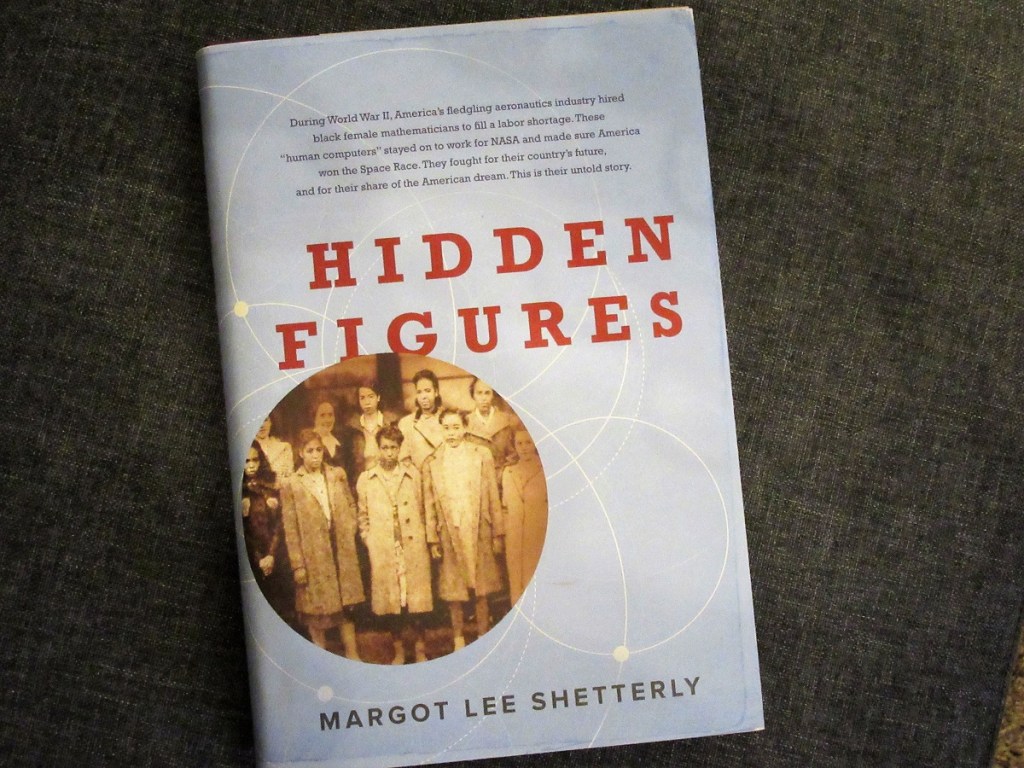
And I would add that African American women helped put astronauts on the moon in 1969.

Ed Wasserman expounded on his scientific work with pigeons and humans, comparing them on how they use their brains to solve problems. Are we better than pigeons? Maybe. Wasserman also gave many examples of how trial and error led to some surprising advances and innovations: the Ponseti method for treating clubfoot, the butterfly stroke in swimming, and Field of Dreams. His point is that the 3 Cs: consequence, context, and coincidence, play the larger role in many great achievements.

In other words, just keep pecking away at it.

Our Impressions of University of Iowa Free Webinar Yesterday: The Stories That Define Us”

We were overall delighted with yesterday’s presentation, University of Iowa Free Webinar: “Breaking Barriers: Arts, Athletics, and Medicine (1898-1947).” It’s one in a series of 4 virtual seminars with two more scheduled this month, which you can register for at this link.

February 15: Endless Innovation: An R1 Research Institution (1948–1997)

February 22: The Next Chapter: Blazing New Trails (1998–2047)

The moderator was university archivist and storyteller, David McCartney.

Presenters include:

Yesterday’s presentation was recorded and will be uploaded to The University of Iowa Center for Advancement YouTube site at a later date.

McCartney did an excellent job as moderator, although got stumped from a question from a viewer about who was the first African American faculty member in the College of Medicine. He’s still working on tracking that down. It wasn’t me. I’m not that old and I am not risen from the dead, as far as I can tell; but to be absolutely clear, you should ask my wife, Sena. I was able to google who was the first African American graduate of the University of Iowa law school: Alexander Clark, Jr. McCartney thinks he might have been the first University of Iowa alumnus, although he couldn’t confirm that.

On the other hand, I could have been the first African American consulting psychiatrist (maybe the only African American psychiatrist ever) in the Department of Psychiatry at UIHC—but I can’t confirm that. Maybe McCartney could work on that, too.

 There are a few words about me in the department’s own history book, “Psychiatry at Iowa: The Shaping of a Discipline: A History of Service, Science, and Education by James Bass: Chapter 5, The New Path of George Winokur, 1971-1990:

“If in Iowa’s Department of Psychiatry there is an essential example of the consultation-liaison psychiatrist, it would be Dr. James Amos. A true in-the-trenches clinician and teacher, Amos’s potential was first spotted by George Winokur and then cultivated by Winokur’s successor, Bob Robinson. Robinson initially sought a research gene in Amos, but, as Amos would be the first to state, clinical work—not research—would be Amos’s true calling. With Russell Noyes, before Noyes’ retirement in 2002, Amos ran the UIHC psychiatry consultation service and then continued on, heroically serving an 811-bed hospital. In 2010 he would edit a book with Robinson entitled Psychosomatic Medicine: An Introduction to Consultation-Liaison Psychiatry.” (Bass, J. (2019). Psychiatry at Iowa: A History of Service, Science, and Education. Iowa City, Iowa, The University of Iowa Department of Psychiatry).”

And in Chapter 6 (Robert G. Robinson and the Widening of Basic Science, 1990-2011), Bass mentions my name in the context of being one of the first clinical track faculty (as distinguished from research track) in the department. In some ways, breaking ground as a clinical track faculty was probably harder than being the only African American faculty member in the department.

I had questions for Lan Samantha Chang and for Dr. Patricia Winokur (who co-staffed the UIHC Medical-Psychiatry Unit with me more years ago than I want to count.

I asked Dr. Chang what role did James Alan McPherson play in the Iowa Writers Workshop. She was finishing her presentation and had not mentioned him, so I thought I’d better bring him up. She had very warm memories of him being her teacher, the first African American to win a Pulitzer Prize for fiction, and a long-time faculty member at the Workshop.

She didn’t mention whether McPherson had ever been a director of the Workshop, though she went through the list of directors from 1897 to when she assumed leadership in 2006. You can read this on the Workshop’s History web page. I have so far read two sources (with Wikipedia repeating the Ploughshares article item) on the web indicating McPherson had been acting director between 2005-2007 after the death of Frank Conroy. One source for this was on Black Past published in 2016 shortly after his death, and the other was a Ploughshares article published in 2008. I sent an email request for clarification to the organizers of the zoom webinar to pass along to Lan Samantha Chang.

I asked Dr. Winokur about George Winokur’s contribution to the science of psychiatric medicine. Dr. George Winokur was her father and he was the Chair of the UIHC Psychiatry Department while I was there. She mentioned his focus on research in schizophrenia and other accomplishments. I’ll quote the last paragraph from Bass’s history on the George Winokur era:

“Winokur, in terms of research, was a prototype of the new empirical psychiatrist. Though his own research was primarily in the clinical realm, he was guided by the new neurobiological paradigm (perhaps in an overbalanced way) that was solidifying psychiatry with comparative quickness. New techniques in imaging and revelations of the possibilities in genetic study and neuropsychopharmacology lay ahead. George Winokur had helped the University of Iowa’s Department of Psychiatry—and American psychiatry as a whole—turn a corner away from subjectivity and irregularity of Freudian-based therapies. And once that corner had been turned there was no going back.”

George Winokur was the department chair at University of Iowa Hospitals and Clinics from 1971 to 1990 and had a unique and memorable style. George also had a rough sense of humor. He had a rolling, gravelly laugh. He had strict guidelines for how residents should behave, only slightly tongue-in-cheek. They were written in the form of 10 commandments. Who knows, maybe there are stone tablets somewhere:

Winokur’s 10 Commandments

  1. Thou shalt not sleep with any UI Psychiatry Hospital patient unless it be thy spouse.
  2. Thou shalt not accept recompense for patient care in this center outside thy salary.
  3. Thou shalt be on time for conferences and meetings.
  4. Thou shalt act toward the staff attending with courtesy.
  5. Thou shalt write progress notes even if no progress has been made.
  6. Thou shalt be prompt and on time with thy letters, admissions and discharge notes.
  7. Thou shalt not moonlight without permission under threat of excommunication.
  8. Data is thy God. No graven images will be accepted in its place.
  9. Thou shalt speak thy mind.
  10. Thou shalt comport thyself with modesty, not omniscience.

Quinn Early has a lot of energy and puts it to good use. His documentary of the sacrifices of African American sports pioneers, including “On the Shoulders of Giants” (Frank Kinney Holbrook) is impressive.

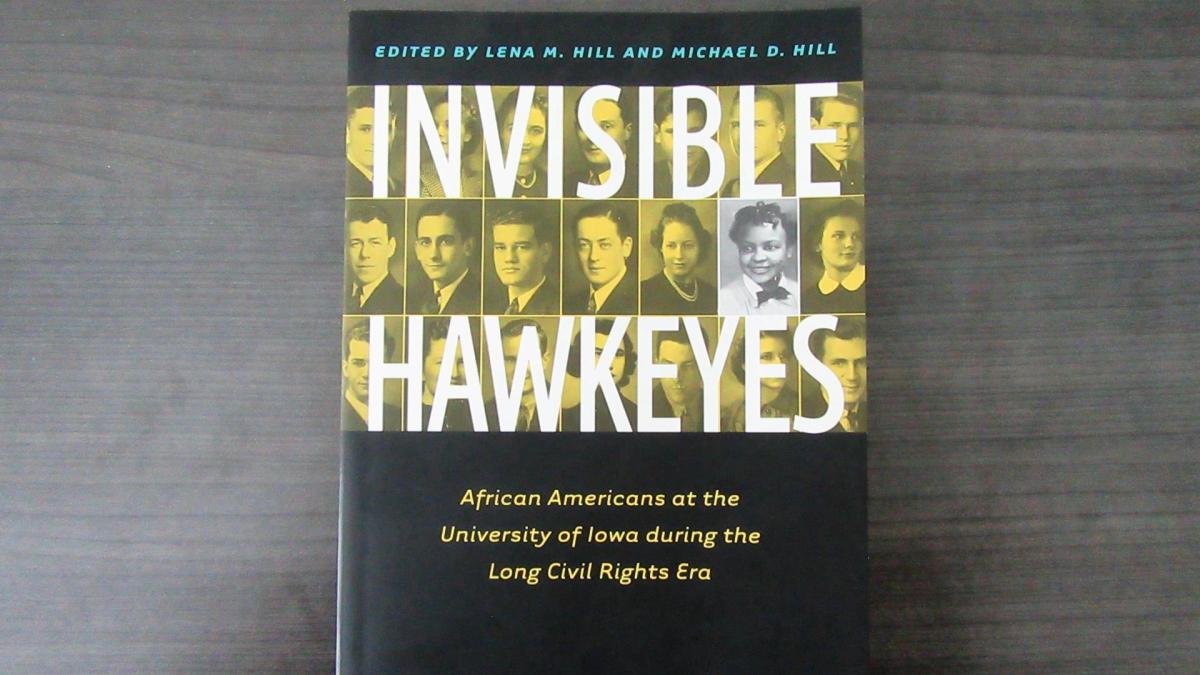
There was a good discussion of the importance of the book “Invisible Hawkeyes: African Americans at the University of Iowa during the Long Civil Rights Era”, edited by former UI faculty, Lena and Michael Hill.

Sena and I thought yesterday’s presentation was excellent. We plan to attend the two upcoming webinars as well. We encourage others to join.

University of Iowa Free Webinar Tonight: The Stories That Define Us”

We just found out that the University of Iowa is presenting a free webinar this evening from 4:30—5:30 PM. It’s a zoom meeting and the title is “Breaking Barriers: Arts, Athletics, and Medicine (1898-1947)”. It’s part of a 4-part series that started February 1, 2022, “Uncovering Hawkeye History: The Stories That Define Us.”

Presenters include:

  • Lan Samantha Chang (93MFA), Iowa Writers’ Workshop director and acclaimed author
  • Quinn Early (87BA), Hawkeye football star and film producer
  • Patricia Winokur (88R, 91F), professor of internal medicine–infectious diseases

We discovered this presentation after a long, spirited conversation about race relations generally this morning over breakfast. Authors mentioned included Ralph Ellison, author of “Invisible Man” and James Alan McPherson, long time faculty and director of the Iowa Writers Workshop, author of first African American to win a Pulitzer Prize winner for fiction with his collection “Elbow Room.”

There were several cross threads in our conversation. One of them was my memory of a visiting professor (whose name, however, I can’t remember) who gave a presentation about being Black in America at Huston-Tillotson College (now Huston-Tillotson University; one of the HBCUs in America) in Austin, Texas. He said something I’ll never forget. I mentioned this in a book review published over 20 years ago in the American Journal of Psychiatry:

A guest lecturer (who, as I recall, had also written a book about being black in America) told us that the white man would never allow a black man to be a man in America. He had only three choices: he could be a clown, an athlete, or a noble savage. These corresponded to the prominent and often stereotyped roles that blacks typically held in entertainment, sports, and black churches. It begged the question of what on earth could we hope to accomplish— JAMES J. AMOS, M.D., Iowa City, Iowa (2000). “Being Black in America Today: A Multiperspective Review of the Problem.” American Journal of Psychiatry 157(5): 845-846.

This is related to another memory, that of the quasi-character Rinehart in Ellison’s “Invisible Man.” The name refers to the multiple perspectives from which a black person (or any person, really) can look himself. You can look at the word itself as compound, containing two words, “rind” and “heart.” Understood as metaphors, you can readily see how it could apply to anyone. We can have a surface personality socially, and we can have an inner core, a heart that is hidden and which can truly define who we are. We’re always changing, inside and out, backwards and forwards.

On the subject of hidden stories, I am also reminded of the book “Invisible Hawkeyes: African Americans at the University of Iowa during the Long Civil Rights Era”, edited by former UI faculty, Lena and Michael Hill. The book describes the mixed reactions of African Americans to the interracial climate in Iowa City and at the University of Iowa during that era. Not all felt welcome, although James Alan McPherson did. Indeed, the Hills often highlight the fluidity of the interactions, which makes me think of Rinehart.

David McCartney, the university archivist, is joining the presentation. He led the drive to rename Johnson County in Iowa for Dr. Lulu Merle Johnson, an accomplished University of Iowa alumna, by putting up an on-line petition which gathered 1,000 signatures. We’re looking forward to this evening’s presentation.

First UIHC COVID-19 Vaccinations!

UIHC Historic Moments

The first supply of the COVID-19 Vaccination vials arrived at the University of Iowa Hospitals and Clinics (UIHC) this week. We couldn’t have wished for a better Christmas gift. As a recent UIHC physician retiree, I know first hand how hard everyone works there. They live the motto: We Stand Together. UIHC is making history—and they’ve been doing that for a long time.

You can find out more about the vaccine at the Iowa Department of Public Health web site.

Way to Go Iowa!

A Giant Chicken

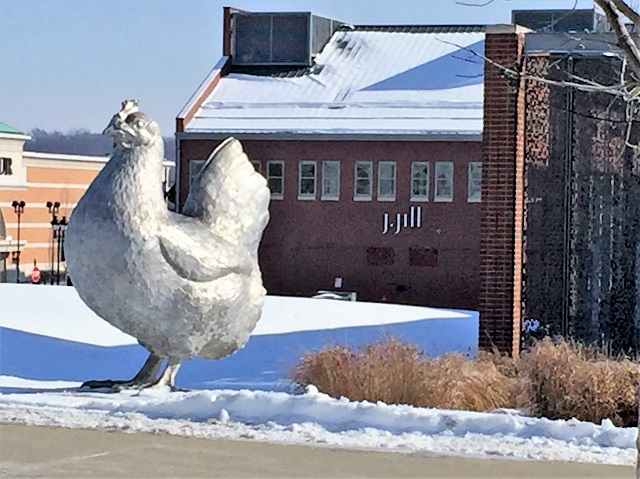
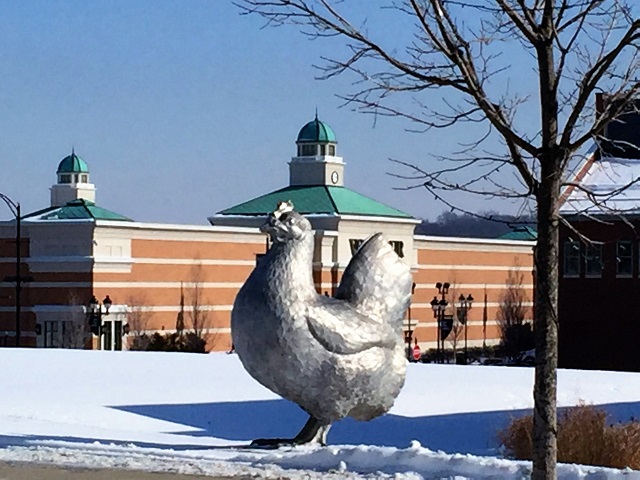
Last week, we were out at the Iowa River Landing (IRL) and saw a giant chicken. It’s actually a metal sculpture entitled Iowa Blue: The Urbane Chicken, 2013, one of 11 such works (all installed in 2013) of art making up the Iowa River Landing Sculpture Walk, located in the Coralville Marriott Hotel and Conference Center.

All of them are linked to literary works by authors associated with the Iowa Writers’ Workshop at the University of Iowa. The artist is Amber O’Harrow’s and her statement about the chicken is:

“I have created a sculpture of the noble chicken, as described in the poem by David B. Axelrod. The Iowa Blue Chicken is the only breed of chicken that was created in the state of Iowa and bred to survive Iowa’s harsh winters and its hot summers.”

The literary reference is to David B. Axelrod’s poem, The Man Who Fell in Love with a Chicken.

The chicken is made from cast aluminum and is taller than I am.

This set me off on an internet journey to find out more about the Iowa Blue chicken breed and Axelrod’s poem. It took a while, because there’s a lot to know.

If you’re a poultry enthusiast and an Iowan, then you know the story about the Iowa Blue Chicken Club (IBCC), not to be confused with the sandwich of the same name which doesn’t yet exist but should. The IBCC is an organization dedicated to making sure that the public at large realizes that the sculpture’s name is Betsy and that there is a big effort to get the breed recognized officially by the American Poultry Association (APA). So far, the APA has deferred, but the IBCC is not giving up.

The story of the origin of the Iowa Blue is somewhat apocryphal in that the breed was said to arise from the union of a White Leghorn (or Red depending on what you’ve been drinking) and a pheasant, which serves to explain the chestnut to striped colors of the feathers and certain behaviors of the chicks, which includes antics like crouching, fast fleeing, and something called “popping” which apparently means a kind of hopping which resembles popcorn popping. I gather this is typical for pheasant chicks.

Iowa Blue roosters will fight hawks, even slapping them with their wings and crowing challenges like “Have some of that!” or “You got something on your face, dude!” They’ll fight just about any critter: opossums, raccoons, snakes, rats, cats, congressmen.

Iowa Blue chickens are bred to thrive in Iowa’s harsh winters and oppressive summers. When the barnyard gets snowed in, they just grab little ergonomic shovels and scoop their way out—they just flip the bird at snow blowers.

Visit the IBCC web site to see photos of these beautiful birds.

Turning to Axelrod’s poem, The Man Who Fell in Love with a Chicken, the web search got a little complicated. For the longest time, I couldn’t find it. All I wanted to do was read it. Heck, you can look up Robert Frost’s The Road Not Taken in half a second at the Poetry Foundation web site.

I finally stumbled on it at a web site (the poetrydoctor) the owner of which I eventually found out was Axelrod himself! I found the chicken poem but the title was The Man Who Fell in Love with His Chicken. Now, I realize that even he says there are typos in the extremely long list of his works which you cannot search by the way, even though the author says there is a search box. The book of his poetry of the same name is 16 pages long and the title is The Man Who Fell in Love with a Chicken, which you can order through Amazon.

Interestingly, one publisher, Cross-Cultural Communications, says the book is “humorous poetry playing on poultry puns.”

This makes me wonder about O’Harrow’s description above including the phrase “…the noble chicken as described in the poem by David B. Axelrod.”

I can’t copy the poem here because that would be copyright violation (despite Axelrod’s making it available on his website—I guess he can do anything he wants with his own work). On the other hand, I think I can say that the poem does, in fact, contain several chicken puns and the man eventually does something to the chicken which is something less than noble and could involve lettuce, tomato, and possibly secret sauce.

The poem is dedicated to someone named Russell Edson, who I learned was called the “grandfather of the prose poem in America.” Edson wrote a few whimsical poems which could have been very much like Axelrod’s poem about the love affair with a chicken. One of them, Let Us Consider, was about a “farmer who makes his straw hat his sweetheart” and “an old woman who makes a floor lamp her son.” See the entry about him at the web site Poetry Foundation—where Axelrod entries can’t be found.

Well, that was my journey through the web about the Iowa Blue chicken sculpture. I’m next to clueless about chickens, unless their roasted, barbecued, fried, or what have you and I’m a terrible poet, as you can see from my video, Pseudobulbar Affect Top Ten—which somehow gets more views than almost anything else on my YouTube Channel.

My own poetry

Long Day; Short Post

OK, it was a long day on the general hospital psychiatry consultation service. This post is going to be short. I put 3.4 miles and 29 floors on my step counter today and I’m feeling every one of them right now. It’s almost 10:30 at night and I’m trying to find a way to end the evening on a high note before I hit the sack .

I found it by listening again to the University of Iowa Shortcoat Podcast (via Radio Public) interview with a former internal medicine resident I had the pleasure of working with, Dr. Keenan Laraway. He’s doing a Nephrology fellowship at the University of Pennsylvania.

The title of the podcast is “Night Float: Finding Mentors, Being a Mentor.” Although I’ve never thought of myself as a mentor, apparently Keenan thought I was one for him.

Dr. Keenan Laraway on mentorship.

Listen to the whole podcast, but just to feed my ego, won’t you please fast forward to about 10 minutes, 50 seconds and hear what Keenan has to say about Dr. Jim Amos?

It made my day. He gave me the highest compliment he can give anybody, which is that I think like an internist. He says that I taught him a whole lot about what it means to be a doctor.

That, more than anything, is going to be the hardest thing to leave when I retire.