Well, early this morning all the drain grates were screwed down tight. We never heard the workers. The rocks we had set on top of them were all piled up neatly on our back yard patio.
Any critter that tries to yank those off will get a hernia. If those grates come off again, we’ll have to call the FBI and report we have an X-File for them.
I’m reposting a piece about a sense of humor and breaking bad news to patients I first wrote for my old blog, The Practical Psychosomaticist about a dozen years ago. I still believe it’s relevant today. The excerpt from Mark Twain is priceless. Because it was published before 1923 (See Mark Twain’s Sketches, published in 1906, on google books) it’s also in the public domain, according to the Mark Twain Project.
Blog: A Sense of Humor is a Wonderful Thing
Most of my colleagues in medicine and psychiatry have a great sense of humor and Psychosomaticists particularly so. I’ll admit I’m biased, but so what? Take issues of breaking bad news, for example. Doctors frequently have to give their patients bad news. Some of do it well and others not so well. As a psychiatric consultant, I’ve occasionally found myself in the awkward position of seeing a cancer patient who has a poor prognosis—and who apparently doesn’t know that because the oncologist has declined to inform her about it. This may come as a shock to some. We’re used to thinking of that sort of paternalism as being a relic of bygone days because we’re so much more enlightened about informed consent, patient centered care, consumer focus with full truth disclosure, the right of patients to know and participate in their care and all that. I can tell you that paternalism is not a relic of bygone days.
Anyway, Mark Twain has a great little story about this called “Breaking It Gently”. A character named Higgins, (much like some doctors I’ve known) is charged with breaking the bad news of old Judge Bagley’s death to his widow. She’s completely unaware that her husband broke his neck and died after falling down the court-house stairs. After the judge’s body is loaded into Higgins’ wagon, Higgins is reminded to give Mrs. Bagley the sad news gently, to be “very guarded and discreet” and to do it “gradually and gently”. What follows is the exchange between Higgins and the now- widowed Mrs. Bagley after he shouts to her from his wagon[1]:
“Does the widder Bagley live here?”
“The widow Bagley? No, Sir!”
“I’ll bet she does. But have it your own way. Well, does Judge Bagley live here?”
“Yes, Judge Bagley lives here”.
“I’ll bet he don’t. But never mind—it ain’t for me to contradict. Is the Judge in?”
“No, not at present.”
“I jest expected as much. Because, you know—take hold o’suthin, mum, for I’m a-going to make a little communication, and I reckon maybe it’ll jar you some. There’s been an accident, mum. I’ve got the old Judge curled up out here in the wagon—and when you see him you’ll acknowledge, yourself, that an inquest is about the only thing that could be a comfort to him!”
That’s an example of the wrong way to break bad news, and something similar or worse still goes on in medicine even today. One of the better models is the SPIKES protocol[2]. Briefly, it goes like this:
Set up the interview, preferably so that both the physician and the patient are seated and allowing for time to connect with each other.
Perception assessment, meaning actively listening for what the patient already knows or thinks she knows.
Invite the patient to request more information about their illness and be ready to sensitively provide it.
Knowledge provided by the doctor in small, manageable chunks, who will avoid cold medical jargon.
Emotions should be acknowledged with empathic responses.
Summarize and set a strategy for future visits with the patient, emphasizing that the doctor will be there for the patient.
Gauging a sense of humor is one element among many of a thorough assessment by any psychiatrist. How does one teach that to interns, residents, and medical students? There’s no simple answer. It helps if there were good role models by a clinician-educator’s own teachers. One of mine was not even a physician. In the early 1970s when I was an undergraduate at Huston Tillotson University (when it was still Huston-Tillotson College), the faculty would occasionally put on an outrageous little talent show for the students in the King Seabrook Chapel. The star, in everyone’s opinion, was Dr. Jenny Lind Porter, who taught English. The normally staid and dignified Dr. Porter did a drop-dead strip tease while reciting classical poetry and some of her own ingenious inventions. Yes, in the chapel. Yes, the niece of author O. Henry; the Poet Laureate of Texas appointed in 1964 by then Texas Governor John Connally; the only woman to receive the Distinguished Diploma of Honor from Pepperdine University in 1979; yes, the Dr. Porter in the Texas Women’s Hall of Fame—almost wearing a very little glittering gold something or other.
It helps to be able to laugh at yourself.
1. Twain, M., et al., Mark Twain’s helpful hints for good living: a handbook for the damned human race. 2004, Berkeley: University of California Press. xiv, 207 p.
2. Baile, W.F., et al., SPIKES-A six-step protocol for delivering bad news: application to the patient with cancer. Oncologist, 2000. 5(4): p. 302-11.
I think a sense of humor is a wonderful thing. I was the
class clown in my youth. I remember my English teacher, Miss Piggott, wrote in
my report card that I was “A little too exuberant.”
Actually, I was a great deal too exuberant. My sense of humor tends to fall into the broad category of what author Dave Barry would call “booger jokes.” By the way, I just finished his latest book, Lessons from Lucy: The Simple Joys of an Old, Happy Dog. I highly recommend it. He mixes a little wisdom in with the booger jokes.
Dave Barry can do more than booger jokes.
As a psychiatrist, I’ve learned to look for a sense of
humor, exuberant or not, in the patients I’ve met. I point it out to them when
I think I detect it. They usually like hearing that. Only a very few are
nonplussed.
One of my teachers was George Winokur, MD, who everyone knows was a giant in psychiatric research. Dr. Winokur was the department chair at University of Iowa Hospitals and Clinics from 1971 to 1990 and had a unique and memorable style. I thought he had a fair amount of exuberance. He had a rolling, sort of gravelly laugh, especially during rounds when he would sometimes make a point of reminding trainees like me that we had a lot to learn, “You all don’t know how to diagnose Somatization Disorder!” I made sure I learned how.
When Winokur was department chair, he created a set of
“commandments” regarding personal behavior and comportment that have stood the
test of time. I don’t know if anyone else has tried to ensure that Winokur’s 10
Commandments be remembered, maybe even cast in a pair of stone tablets. Read
them and follow them.
Winokur’s 10 Commandments
Thou shalt not sleep with any UI Psychiatry
Hospital patient unless it be thy spouse.
Thou shalt not accept recompense for patient
care in this center outside thy salary.
Thou shalt be on time for conferences and
meetings.
Thou shalt act toward the staff attending with
courtesy.
Thou shalt write progress notes even if no
progress has been made.
Thou shalt be prompt and on time with thy
letters, admissions and discharge notes.
Thou shalt not moonlight without permission
under threat of excommunication.
Data is thy God. No graven images will be
accepted in its place.
Thou shalt speak thy mind.
Thou
shalt comport thyself with modesty, not omniscience.
More evidence that a sense of humor is prevalent amongst psychiatrists is the work some residents put into making a video (in two parts) about managing violent patients. I realize that the recent news stories about health care professionals often being the victims of violence from patients might make some think this is nothing to joke about. They were not joking. The video makes a good case for a method to manage the violent patient. It just makes it with an exuberant sense of humor.
Violent behavior by patients in the general hospital is often
caused by delirium. The proxy for delirium in the form of violence could be
what is called the “Code Green” here at our hospital.
The Code Green team at our hospital consists of a group of
people specially trained to use non-violent measures to help patients who are
violent get under control in order to minimize the risk of injury to themselves
and others. These events are often intense encounters in patient’s rooms,
hallways, lobbies, and other places in the hospital where patients who are
confused and out of control can wander. First and foremost, we try to contain
the patient to maintain everyone’s safety, and then ascertain why the patient
is confused and at risk for imminent violence or already perpetrating acts of
violent behavior toward themselves and others. This has to be done quickly so
as to minimize injury.
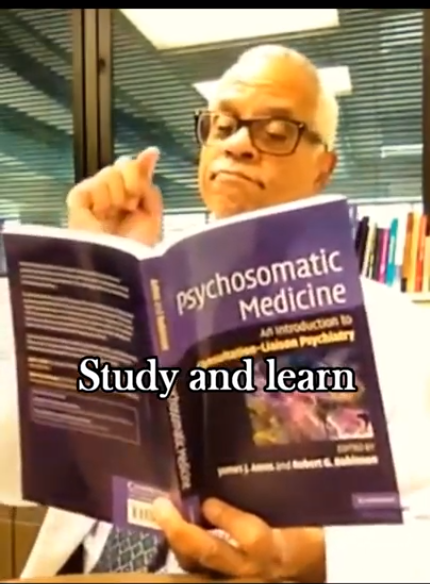
One mnemonic, described in my chapter in our book, Psychosomatic Medicine: An Introduction to Consultation-Liaison Psychiatry is [1]:
1. Amos, J.J., M.D., Assessment and management of the violent patient, in Psychosomatic Medicine: An Introduction to Consultation-Liaison Psychiatry, J.J. Amos, M.D., and R.G. Robinson, M.D., Editors. 2010, Cambridge University Press: New York. p. 58-63.
Containment before
Assessment before
Non-violent
Intervention before
Take down
Shameless plug…
The so-called CAN IT mnemonic is a reference mainly to
containment before all else in order to protect everyone involved in a Code
Green situation. An excerpt from the chapter on the importance of containment
is:
“Containment refers to ensuring that you and the patient both feel relatively safe in the assessment area. Preferably, both of you should have easy access to the door for escape if necessary. At first, it may seem odd to recommend letting the patient escape from the room, but the point is not to force the patient to run over you to get to the door.
Another issue of containment is to ensure that the patient gives up any weapons before you agree to do the evaluation. Sometimes, offering food or drink (not hot enough to injure if hurled in your face) will help set a non-threatening atmosphere. It’s helpful to avoid making intense or prolonged eye contact with the patient, because this may be viewed as threatening.
Always make sure that plenty of other people are available to help you if a take-down situation develops.
Containment under these conditions sometimes is achievable by simply being honest with the patient who is still able to hear you by admitting that he/she is saying or doing things that make you afraid. This may seem counter-intuitive. But, provided it’s delivered calmly as a statement followed by reassurance that you and everyone else involved are committed to maintaining the safety of all persons present (including the patient), this may capitalize on the patient’s own fear of losing control by assuring that you’ll do everything in your power to keep the lid on the situation.”
You can see the exuberant YouTube videos below, illustrating
these principles made by talented trainees in our psychiatry residency program
in 2008.
In 2009, Dr. David Mair, MD was the producer and director of the video. I see he’s now with Innovative Psychological Consultants (IPC) in Maple Grove, MN (they get a lot of snow up there!). Below is his introduction to the videos:
Early in my training, I didn’t quite know how to react with potentially
violent patients. No amount of knowledge
of medicine, physiology, or the DSM provided me the skills to address these
situations. Though we had excellent
training during orientation, I really learned by observing skilled clinicians,
and through my own encounters, both good and bad. This was exemplified during my rotation in
consultation-liaison psychiatry, when working with Dr. Amos, to learn his
logical, step-wise approach, see him in these problematic scenarios, and to
practice what I had learned.
In making this educational video, I wanted to give incoming residents a
quick way to make these observations, and present it to them in a way that was
both useful and entertaining. It helped that I had a cadre of multi-talented
peers and a faculty supervisor who recognized the utility of such a
project. Though managing these patients will
be an eternal source of anxiety for all psychiatrists, my hope is that with
this video, they will feel just a little better prepared. —David Mair, MD.







 Go Retire Psychiatrist