Who Let The Puns Out?

Well, we were out for a walk around Terry Trueblood Trail yesterday and a woman stopped us and excitedly asked, “Do you want to hear a joke about Covid?”

Believe it or not, we didn’t know anybody made jokes about Covid—but we said “Yeah, go ahead.” And then she said it was about dogs, and added that dogs don’t get Covid, as if to reassure us. In fact, it turns out that the CDC says you can’t catch Covid from pets, including dogs. It went like this:

The World Health Organization, or WHO, had feared the dogs could spread Coronavirus and ordered all dogs that were exposed to the virus be held in quarantine. After review, the WHO announced that dogs cannot contract Coronavirus. Dogs previously held in quarantine can now be released.

To be clear: WHO let the dogs out.

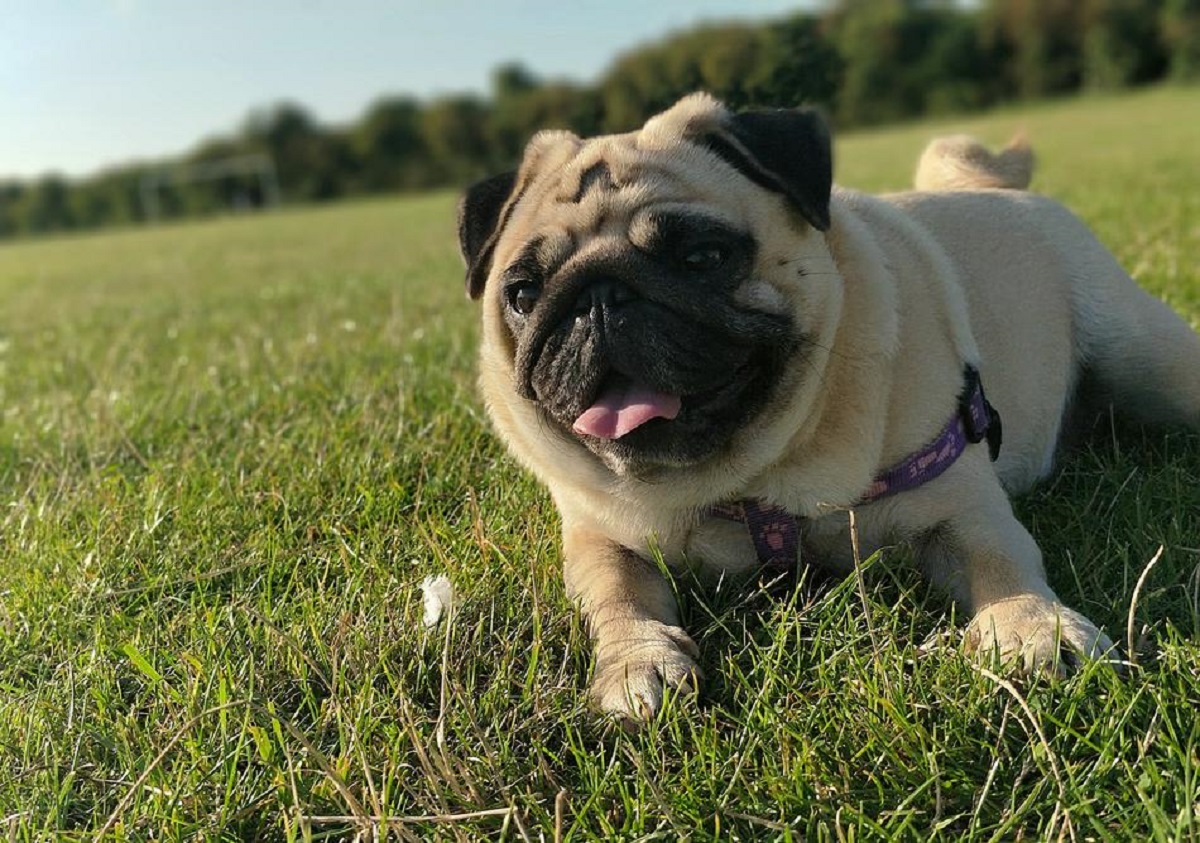
Sena and I immediately thought of the Men in Black II scene with Frank the talking Pug, who is actually an alien—and if you don’t like it you can kiss his furry little butt! I exclaimed, sort of singing (God help everyone within earshot) “Who let the dogs out!” I forgot the barking part, but we all had fun.

Incidentally, my mondegreen for the song “Who Let the Dogs Out” used to be “Who left the dog pound?” For the record, the word “mondegreen” means:  a misunderstood or misinterpreted word or phrase resulting from a mishearing of the lyrics of a song. It often totally changes the meaning of a lyric, resulting in something ludicrously comical.

I think Dave Barry wrote about mondegreens in his book, “Dave Barry’s Book of Bad Songs,” a book I used to own but somehow lost in one of our many moves. I’m hoping he’ll find this blog post somehow and send me a free, autographed copy of the book.

If we’d had our new Polk Signa S2 sound bar when I first heard the line, I could have used the remote control Voice Adjust dialogue level to reproduce clearer, crisper dialogue.

For the record, I’ve never heard the full song “Who Let the Dogs Out,” which was performed by a “Bahamian junkanoo” band formed in 1977 and released in 2000. I had to look up “junkanoo” and it’s a Bahamian cultural celebration, a festival of music, dance, and dog pounds.

There are conflicting opinions about what the song means. Some say that it was about men calling women filthy names and women fighting back by shouting “Who let the dogs out?” On the other hand, I also read that the song won a Grammy.

When we got home, I googled Covid jokes and found a lot of them. One of the better hits was RJ Julia Booksellers, advertising a book entitled Coronavirus Humor. The author was just called “Mad Comedy,” which means several “top comics” contributed. It was published in April 2020 by Indy Pub.

The best part? There was a statement saying “A portion of the proceeds of this book benefit the hard-working ‘essential workers’ who are sacrificing so much to help us all during the 2020 epidemic.”

Who let the wags out?

Featured Image picture credit: pixydotorg
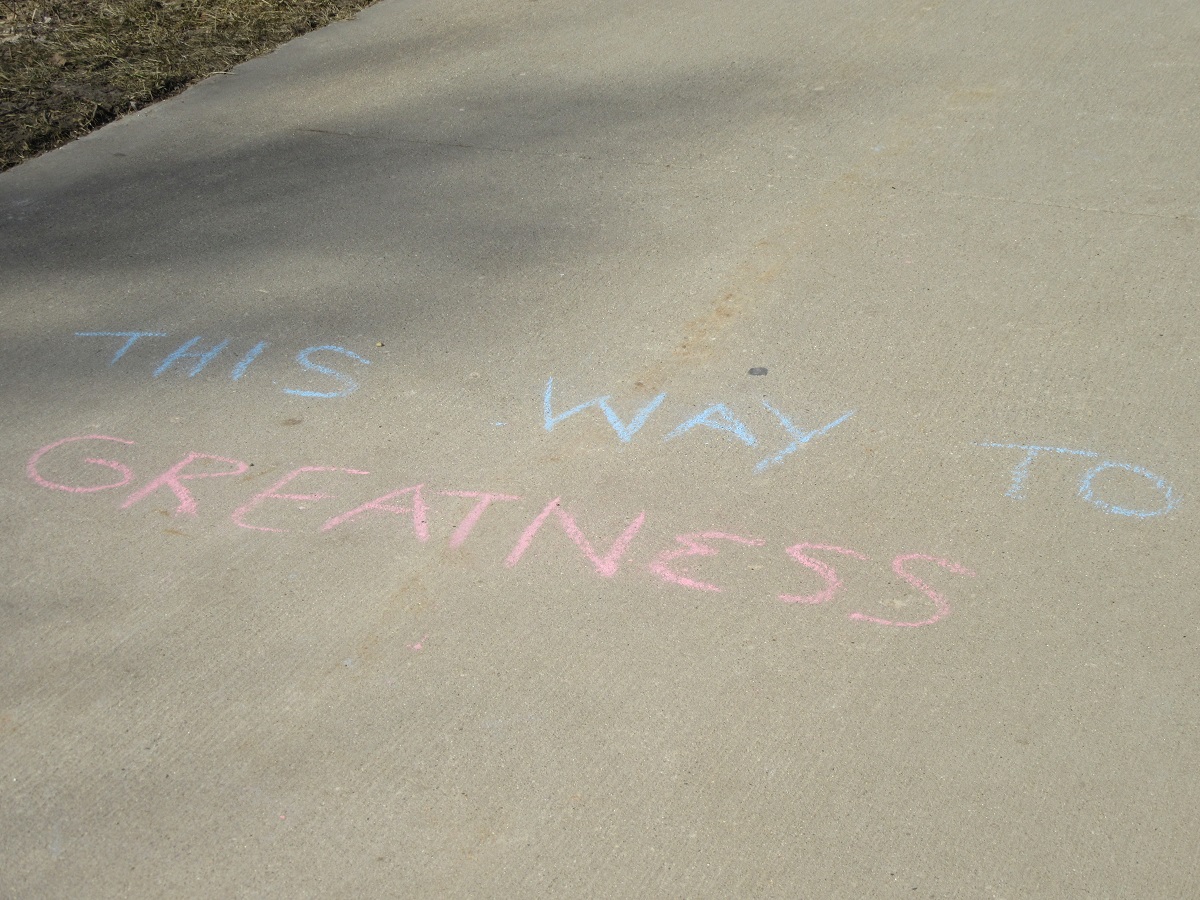
Messages of Hope on the Terry Trueblood Trail

Spring was in the air as we took a turn around the loop of the Terry Trueblood Trail. There was something different about it since we were there in late December. The wind was not as blustery. What leaped out at us were messages of hope written on the sidewalk in brightly colored chalk. The messages said things like “This Way to Greatness,” “Enjoy That View,” “Go Go Go,” and “Stay Strong!”

Along with these written messages were other signs of hope. One of them was a beaver slapping its tail in an unfrozen section of the lake, near its lodge. Snow-white geese and gulls sat further out on the ice, heads tucked in their wings—for now gathering strength before thundering into the sky.

It has been a long year. The pandemic of coronavirus and corrosive social and political upheaval exact a heavy toll on the spirit. It’s hard to see beyond what is callous, pathetic, and catastrophic.

The walks along the Terry Trueblood Trail are often healing, even if only in a small way. It made me wonder who Terry Trueblood was. I found a description of him on the web. Among his many accomplishments, he was Iowa City’s Director of Parks and Recreation. The Iowa Park and Recreation Association unanimously renamed its highest professional award the “Slattery/Trueblood Professional Award.”

Terry Trueblood was a very dedicated professional but more than that, he was devoted to his family. He had a great sense of humor. He was compassionate and generous. He was fair, honest, and was “the definition of integrity.” He “benefited every life he touched.” There are no signs in life pointing the way to greatness. Terry Trueblood found the path anyway.

It’s easy to ignore or deplore the countless common stones we find. We need to see the rare diamonds of hope in the spring.

Stumped

Ever since the derecho last month, we’ve been stumped by stumps—tree stumps. It has been a lesson in the value of persistence. The tree in our front yard got knocked over almost right at ground level. I cut it up with a 20-inch hand saw. But the stump has me stumped so far. You can google “stump removal” and get an idea of what your options are.

One method is to use chemicals, involving drilling holes into the stump, into which the chemical is poured along with water and waiting patiently a few years. One guy’s review of a product revealed what appeared to be a basic misunderstanding of the procedure. It involved mixing the chemical with peanut butter, applying it to the stump which he then set on fire to make a smoke signal which could allow lost hikers to be more easily rescued. And by the way, it also hastened the rotting of a tree. The reviewer even included a photo of the heavily smoking concoction. I suspect the manufacturer published the review mainly for entertainment.

We took a half-hearted stab at chemical rotting. I mainly used a bow saw, believe it or not. That didn’t get the stump low enough below ground level to assure grass would grow above it.

Manual labor methods usually include recommendations for using a chain, a truck with 4-wheel drive, a wrecking bar, shovel, mattock, axe, and a few sticks of dynamite.

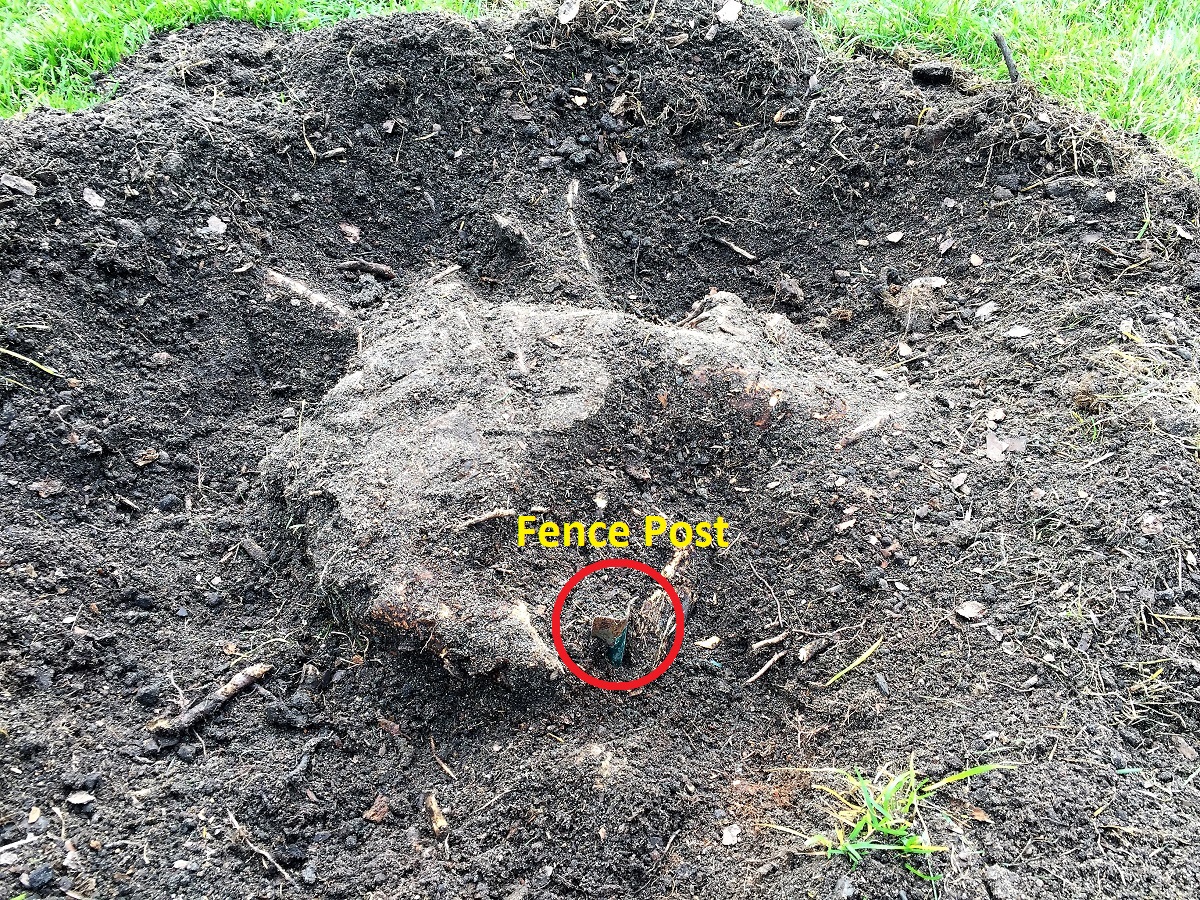
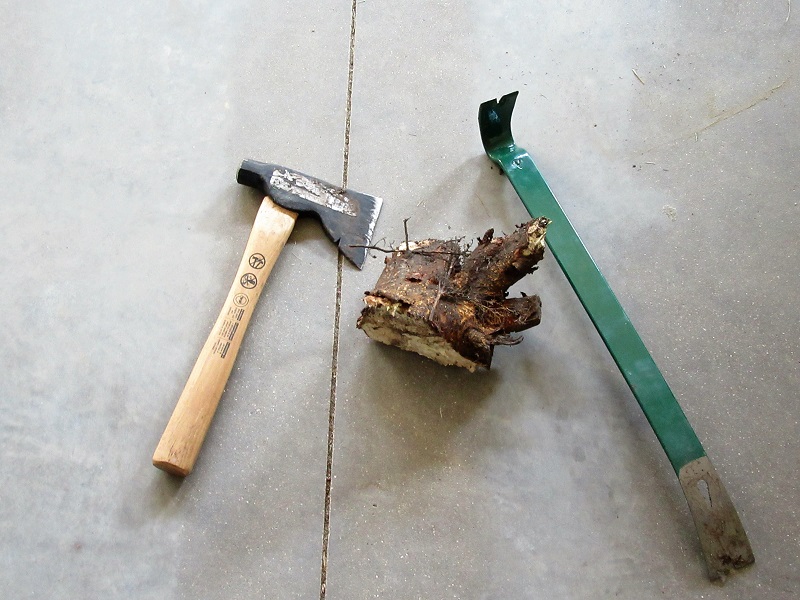
Manual labor has been the main method so far. There was a wire wrapped around the stump and three steel T-bar fence posts, which were probably placed when the tree was first planted several years ago. We got two of the T-bars out but couldn’t get the last one loose (only breaking it in half) until I got a hatchet and a pry bar. Thick roots were wrapped every which way around it and meandered off in all directions. I chopped and pried for hours until I could finally yank it out with vise grips. We hacked a softball-sized chunk of root out of the tangle, and managed to amputate several others away from the main stump. That is why I’m not a big fan of the manual labor method.

And then there’s a guy named Frank, half of a duo owning a stump grinding service. I called him and he came over the following day, shortly after I had removed the T-bar—which probably would not be the best thing for the 21-inch blade on his giant stump remover. He plans to grind it sometime in the next week.

I knew I could rent a stump grinder, but I would never do a thing like that. I’m not the handiest guy in the world, putting it mildly. I’m lucky I didn’t amputate a digit (along with a root) with the hatchet.

We talked with Frank in the front yard as he examined the stump. He said, “Oh, that’s nothing.” He quoted a fair price, which was far less than how much I would have had to pay to rent a stump grinder—and to cover the costs of emergency room charges, damage to the machine, the house and the neighborhood from a runaway grinder.

Frank is pretty busy and we speculated about what the main reasons might be, naturally one being the derecho. Frank thought the coronavirus pandemic might be another one. People sit at home either in self-isolation or quarantine and they have more time to stare at longstanding problems around the house and in the yard.

Having time on your hands can lead to boredom and brooding, which can happen to retirees like me. There are times when I would rather hack at a tree stump than read the daily news. I have to keep focused on where I’m aiming the hatchet or how I’m holding the power pole saw, which occupies me, makes time go by faster, and makes me tired and sore at the end of the day. I feel like I accomplished something. Frank retired several years ago and only later set up the stump grinding business.

We’ll see what happens next week with the stump. Frank’s business card has a picture of his giant machine. He can operate it by remote control. You can see what that looks like in a couple of videos at the website which markets the grinder he uses.

Hanging In There

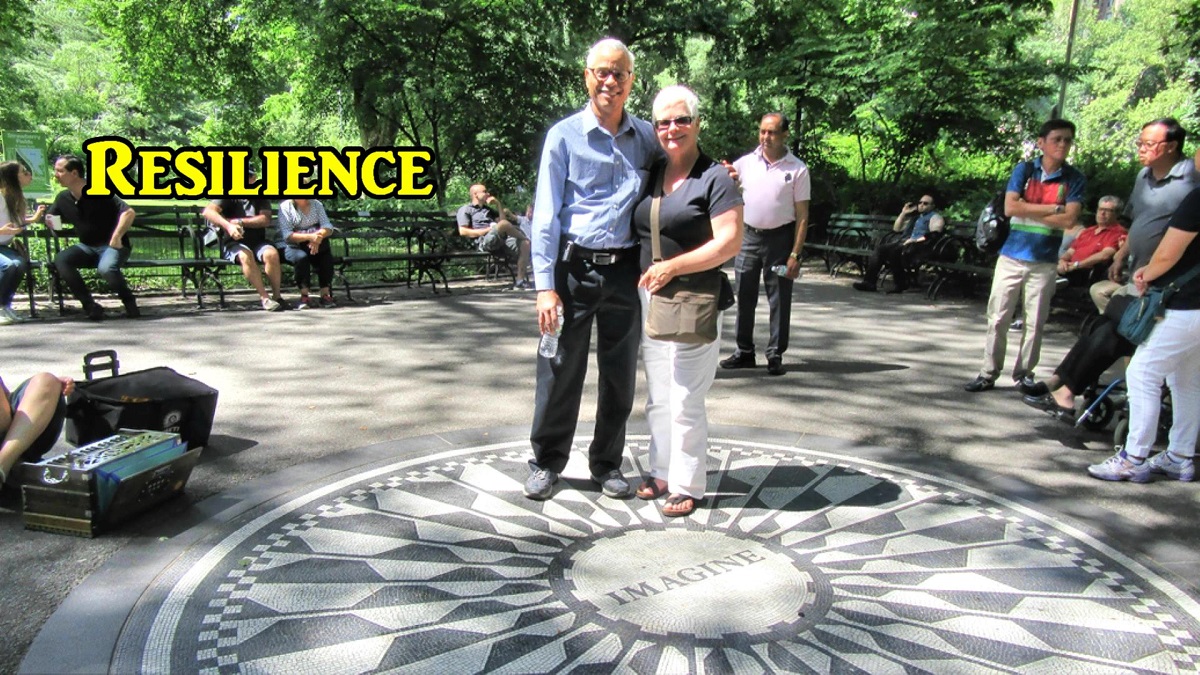
It has been a while since my last post. I’m hanging in there although sometimes it’s difficult to stay optimistic. I’m reminded of the Survivor Tree, the Callery Pear in New York City. You can easily google the story about this tree which somehow survived at Ground Zero after the 9/11 attack on America in 2001. We visited New York in the summer of 2017 and saw the Survivor Tree at the 9/11 Memorial & Museum plaza. It’s hard to believe that was 19 years ago. And now we’re dealing with the Covid-19 pandemic.

I’m still adjusting to my new identity as a retired person. I was reminded of that when I read the recent post “What is your Identity?” on 9/12/2020 by The Good Enough Psychiatrist. She’s resilient and optimistic, traits I admire. I tend to be rigid and pessimistic, especially when I have a lot of time on my hands.

I also need to get out of my head. It’s amazing how easily reminiscence can morph into rumination. Galloping all over the hospital as a psychiatric consultant distracted me from that habit. On the other hand, Sena and I reminisced the other night for quite a while. I was astonished at how much we both recalled about our 42-year long marriage and the adventures and challenges we’ve been through.

Our first house was a challenge. Shortly after we moved in, I had to try to mow the tall grass which had been neglected for a long time. I had to use either a scythe or a weed whacker. I honestly can’t recall exactly what I used but the scythe sounds more impressive, so I suspect it has crept into the story more for dramatic effect. It was a very hot day and my first encounter with my neighbor from across the street was his generous act of lending me his power lawnmower. He was a white man and, back in those days, kindness in that context was uncommon.

The only time I used a power mower other than at that house was when I went to Huston-Tillotson College in Austin, Texas. It’s now called H-T University. It was one of the historically black colleges in the country and I recall feeling a bit awkward there since I had grown up in largely white neighborhoods in the Midwest. Anyway, I helped mow the campus grounds. I guess “helped” might not be the right word, especially if you consider the perspective of the groundskeeper who was in charge of fixing the power lawnmowers I destroyed. I wrecked a few mainly because I kept running over rough, rocky ground. After I dragged the 2nd or 3rd ruined mower back to him, he stared at me and shook with rage. Mercifully, memory fails me at this point.

I’m realizing I could probably go on rambling like this for a good while. I guess that might mean I’m gradually adopting the identity of a garrulous old retired guy. I know that sounds pessimistic.

On a more positive note, Sena and I had a great time in New York City three years ago. We’re glad to have the memories. Sena is optimistic and resilient by nature. She’ll help me imagine brighter times coming in the future.