The other day we had some stormy weather roll across central Iowa, although it was not as bad as the tornado that swept through Greenfield. We hope the best for them. We didn’t actually get a tornado, but I remember wondering why the siren went off about 6:00 a.m. It woke me up and I wondered what was the matter. Turns out it was a tornado warning and we had to sit in the basement for a little while. It was a little scary, but the storm moved east pretty quickly northeast out of our area.
For whatever reason, this eventually led to my reminiscing about my younger days. Maybe it was because of a temporary scare and increased awareness of our mortality.
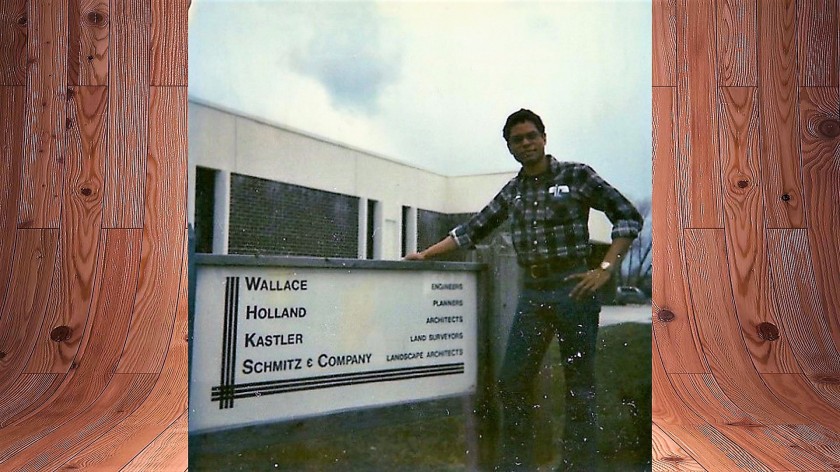
I used to work for a consulting engineers company called WHKS & Co. in Mason City, Iowa. This was back in the days of the dinosaurs when it was challenging to set stakes for rerouting highways around grazing diplodocus herds.
I was young and stupid (compared to being old and stupid now by way of comparison). I lived at the YMCA and took the city bus to the Willowbrook Plaza where the WHKS & Co. office was located on the west side of town.
I usually got there too early and stopped for breakfast at the Country Kitchen. The waitress would make many trips to my table to top off my coffee while I sat there waiting for the office to open. That was fine because I had a strong bladder in those days. I left tips (“Don’t cross the street when the light is red”).
My duties at WHKS & Co. included being rear chain man and rod man, at least when I first started. A “chain” was the word still being used for a steel tape for measuring distances. It was well past the days when land surveyors used actual chains for that purpose. You had to use a plumb bob with the chain to make sure you were straight above the point (usually marked by a nail or an iron property corner pin) you measuring to and from.
You and the lead chain man had to pull hard on each end of the chain to make sure it was straight. It was challenging, especially on hot days when my hands were sweaty and the chain was dirty. Callouses helped.
The rod was for measuring vertical distances and an instrument called a level was used with that. One guy held up the rod which was marked with numbers and the guy using the level read the elevation. Another way to measure both horizontal and vertical angles used a rod and a different instrument that we called a theodolite (older instrument name was “transit”).
We worked in all kinds of weather, although not during thunderstorms. In fact, when it was looking like rain out in the field, a standard joke for us sitting in the truck waiting for rain was to draw a circle on the windshield (imaginary, you just used your finger although if your finger was dirty which it always was, you left a mark) and if a certain number of drops fell in the circle, you could sit in the truck and play cards.
When we played cards, it was always the game Hearts, which I could not play skillfully at all. I always lost. But it kept us out of the rain. If a big thunderstorm blew in, we just headed back home.
This is an update on a couple of Mason City, Iowa YWCA and YMCA renovation posts I wrote in May of 2022 (May 12 and May 25). I’m also going to compare the information about those with recent news about the building which is home to Pagliai’s Pizza.
Recall that the YMCA in Mason City was placed on the National Register of Historic Places in 2002. It was built in 1926. It was also converted into an affordable apartment housing resource. When I was a young man, I used to live in the dormitory. And if you must know, that was in the days of the Pony Express.
And the YWCA in Mason City was built in 1918, well before the YMCA. Yet it is still not on the historic register, which is puzzling. It sat empty for many years before a couple of artists (2 Artists) bought it in 2021. They are trying to renovate the building with some assistance from the city, and their own fund-raising campaign which includes a GoFundMe and other efforts. They plan to use it as a resource for artists, eventually to include studios, apartments, and art shows. The city has received a grant to convert part of the building into apartments.
The State Historical Society of Iowa told me that the YWCA has been deemed eligible twice for nomination (in 1991 and in 2003, which was a year after the YMCA was added to the list). Yet the YWCA has never been nominated. I ended up calling this a mystery in history. It’s true it was neglected for years and renovation is expensive. The nomination process is long and very involved.
A recent, brief local newspaper article indicates that the renovations are still underway, but there is still no mention of trying to get it added to the historic register.
How does that connect to the current news about the building that houses Pagliai’s Pizza? The owner wants to sell the building. However, the building has been there since the 1870s and the Iowa City Historic Preservation Commission has decided along with many others that it belongs on the city’s list of historic landmarks.
The building used to house a dance hall, a grocery store, and a bohemian restaurant. It has been home for Pagliai’s Pizza since 1957. It’s a local favorite; Sena and I have enjoyed pizza there on several occasions.
The owner has misgivings about designating the building a historic landmark as it might hurt its marketability. Nevertheless, the Iowa City Historic Preservation Commission legally decided to recommend it for landmarking. It will be voted on by the Iowa City Planning and Zoning Commission, although it’s not clear exactly when. The owner of the building is not the same person who runs the pizza place—he signed a lease through 2030 and beyond if possible.
My question is if Iowa City can insist on adding a building to the historic register (in a way overriding the owner), why has it never been done for the Mason City YWCA? There is at least as much culturally significant history linked to it as there is with the Iowa City property.
I’m not savvy enough about the intricacies of city planning to figure this one out. So, it remains a mystery in history to me.
Sena and I got to talking about Central Park in Mason City, Iowa. I remember my brother, mother and I taking a walk there occasionally. One time we saw a man who lost his legs and who got around using a small platform on wheels. Later in life, I wondered if he was a disabled war veteran.
That reminded us of the 1884 Memorial Civil War Statue in the center of the park. We looked it up and found it has a complicated history. In the late 1990s it was under repair for about 3 years in Cincinnati, Ohio. When it was finally returned, it was noticed that it had not been repaired correctly. The city decided to keep it anyway, partly because some people, including a Civil War re-enactment supporter, thought the flaws were relatively minor.
Anyway, there are relief busts of famous persons on the statue. We could identify Abraham Lincoln, Ulysses S. Grant, and a Civil War soldier. After a brief web search, we confirmed that the 4th relief bust was that of George Washington.
There are a couple of topics of interest here. One of them is the George Washington relief bust and the other is Civil War re-enactments.
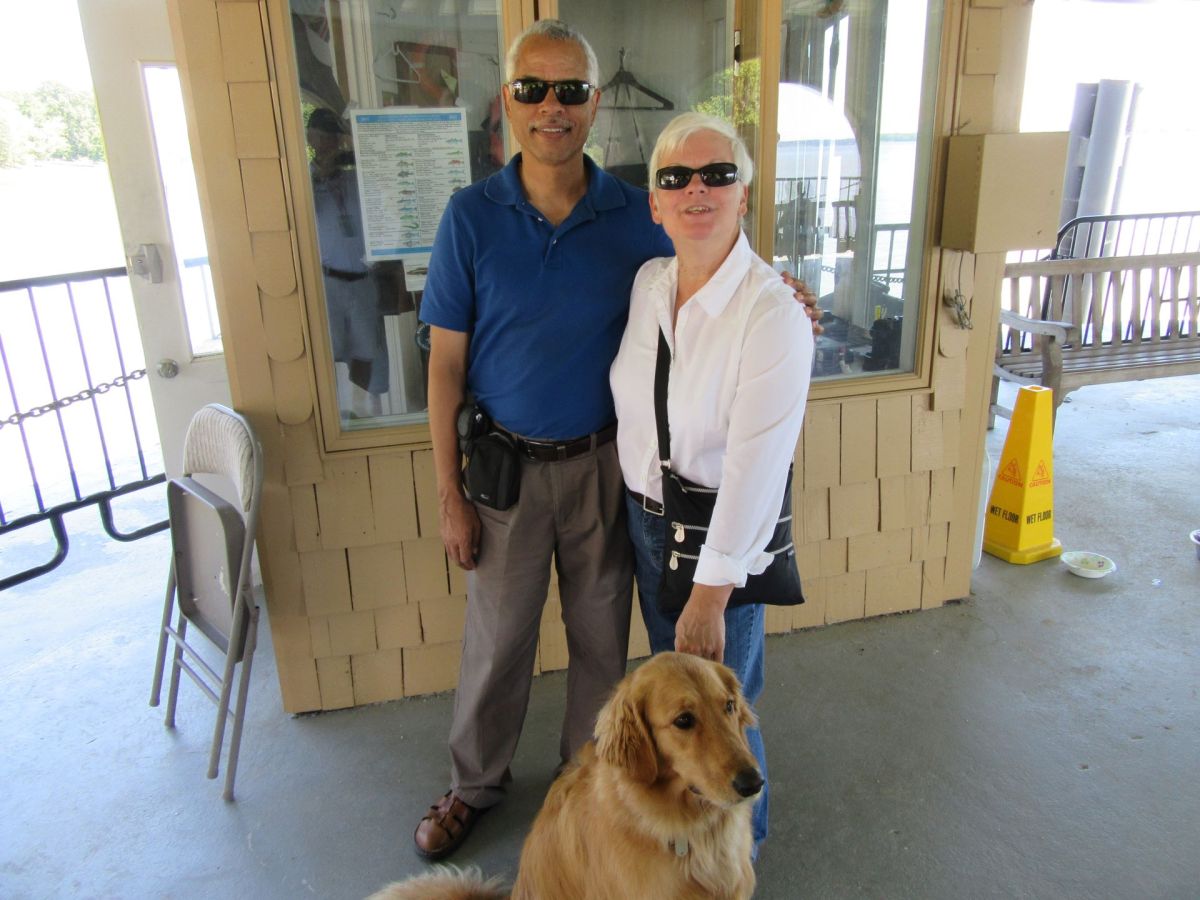
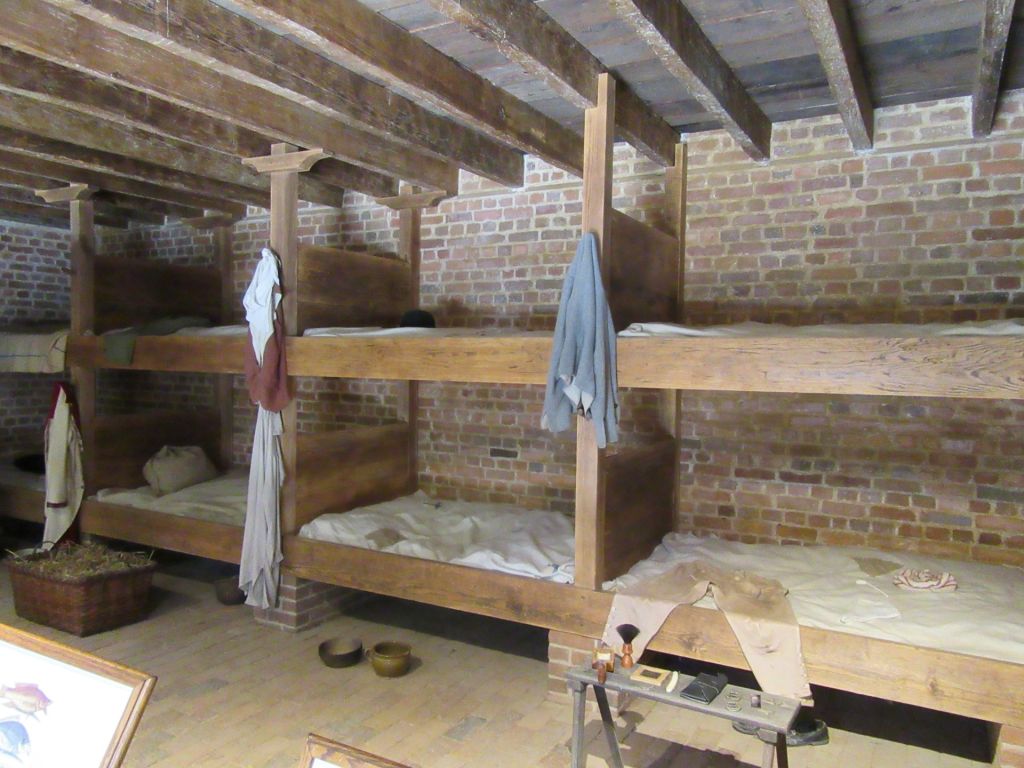
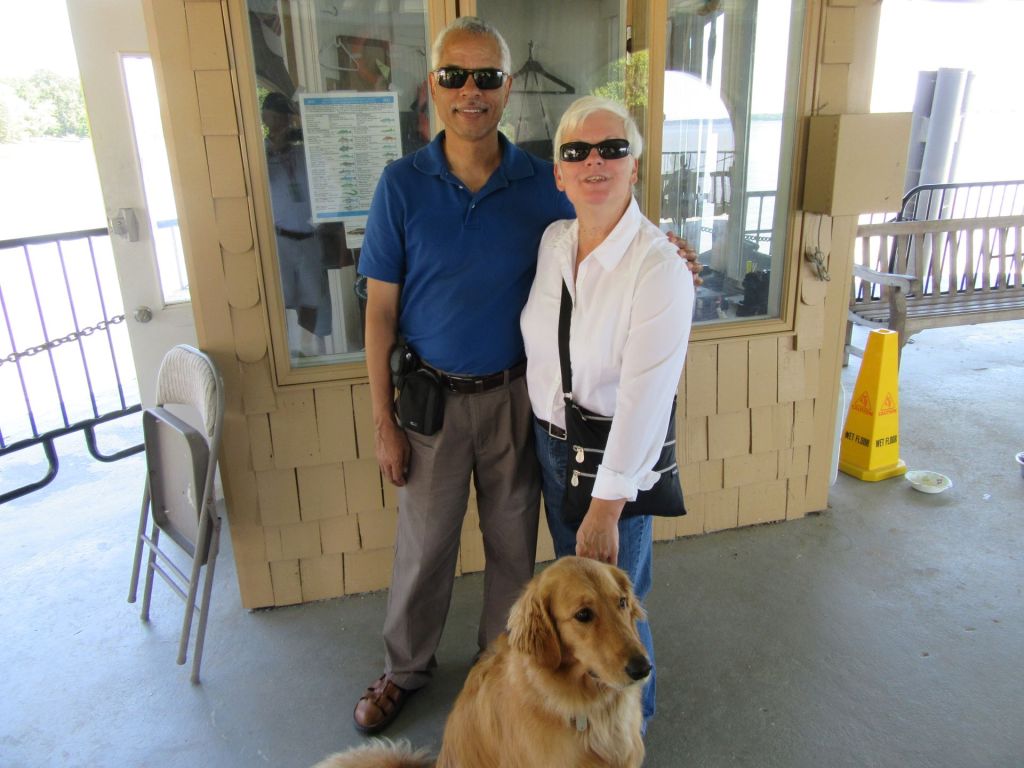
The connection of the Civil War to George Washington is a little puzzling because he owned slaves. We’re aware he freed them upon his death. On the other hand, when we visited Washington D.C. in 2015, we took a tour of Mt. Vernon. It was a scenic boat trip out there. We took a picture at the dock with the dog of the guy who helped people on and off the boat. We also took pictures of the slave quarters. There were no re-enactment persons and we were told we were on our own when viewing those exhibits.
This also reminds me of the news item about a bill recently (on February 9, 2024)) introduced in the West Virginia legislature to remove the statue of former Senator Robert C. Byrd from the West Virginia State Capitol and replace it with 4 other statues: Abraham Lincoln, James Madison, Arthur I. Boreman, and George Washington. Nothing is mentioned in that news story about Senator Robert C. Byrd having been a leader in the Ku Klux Klan in the past, and filibustered against the Civil Rights Act of 1964. This is from a news story posted on the web in 2020 under a link titled “time to remove monuments to senator byrd.”
Again, I struggle a bit with suggesting that a statue of George Washington, a former slave owner, would be an appropriate substitute for that of Senator Byrd. And James Madison, despite saying that slavery was incompatible with Revolutionary principle, owned slaves and made profits on their sale. Arthur I. Boreman is described as not being an abolitionist but a unionist. However, in 1865 he signed a legislative act banning slavery in the state of West Virginia.
Maybe a nice set of abstract sculptures for the corners of the rotunda of the West Virginia State Capitol?
Turning to Civil War re-enactments, I’m ambivalent about them. I remember reading a couple of anecdotes about re-enactments in the book “Our Hidden Conversations” by Michele Norris.
One of them was about black woman re-enactor who played the role of a house slave. This was in Chapter 4, “Coins in the Couch.” The six-word Race Card (p.160) said “Why Do You “Play” A Slave?” Nicole is a slave interpreter. She makes sure that visitors to former plantation sites portray slavery accurately to tourists. She’s a public historian by training who works at the National Center for Civil and Human Rights in Atlanta. She teaches tourists about the reality of chattel slavery, including the sale of relatives to other plantations and the ingenuity of enslaved men in improving farm implements.
The next anecdote about re-enactment in the book is in Chapter 10, “So, You Want to Talk About Lynching?” The six-word Race Card (p. 386) said “Confederate re-enactor chose intimidation as spoils.” A black man and his biracial but white looking friend were at a barbecue in Texas. Two big white guys dressed in Confederate-era uniforms were passing by and one of them placed his rifle on his knee and tried to stare down the black man. The black man stared back and this went on long enough for his friend to get nervous enough to suggest they just leave. Finally, the other re-enactor pulled the sleeve of the intimidator and they were the ones who finally left. Despite this episode, the black guy “…made a choice to accept people as I receive them.”
Apparently, there are regular Civil War re-enactments in Mason City. It looks like the most recent was from Sept 8, 2023-Sept 10, 2023. It was The Battle of Chickamauga, TN. It was held in East Park, where I used to play as a kid. Iowa soldiers in the Civil War fought on the Union side. However, I found out the battle of Chickamauga was won by the Confederates, and it had the second highest number of casualties after the Battle of Gettysburg. There was a battle demonstration and the camps were open all weekend to talk to the re-enactors. And there were food vendors.
There is a newer Mason City Veterans Monument in Central Park. It was built in 2004. It has 12 handsome black granite stones with room for the names of 4,600 veterans. We have seen pictures of it on the web. There are no relief busts.
I came across a couple of items that prompted my renewed gratitude. One of them was an article in Bloomberg on the web, “US Medical Schools Grapple With First Admissions Since End of Affirmative Action” by Richard Abbey, Ilena Peng, and Marie Patino, published on December 14, 2023. It’s about how hard it is for black students to get into and graduate from medical school. Just getting to college is a major hurdle.
The other item is an obituary of one of the most important persons in my life, Pastor Robert Leroy Stone. He authorized scholarships for two years of my undergraduate college education, which were at Huston-Tillotson College (now Huston-Tillotson University, one of the HBCUs) in Austin, Texas. That was back in the 1970s, ancient history now. The issue of Affirmative Action was widely discussed during that time.
As usual, I’m dumbfounded by how often I miss the passing of the critically important people who made my success in life possible. And there is this astonishing connection which followed me even to Iowa City—but of which I was unaware. After he retired, Pastor Stone moved from Mason City to Iowa City in November of 2001. At that time, I had graduated from The University of Iowa College of Medicine, finished my residency in psychiatry in 1996, and was on staff in University of Iowa Dept of Psychiatry. I never knew he was so close. He died in 2002.
Pastor Stone was a Board Member and Chair of the Mason City YMCA, where I lived for a while. He was also a Member of the Board of Chemical Dependency Services of North Iowa as well as the Mental Health Center of North Iowa.
Although I didn’t graduate from Huston-Tillotson College, I was able to transfer credit to Iowa State University. And from there I went to medical school at The University of Iowa.
I’ve read other stories about how hard it is for Black students to get into and finish medical school. My path was indirect and not easy, but Pastor Stone made it possible. And for that, I am grateful.
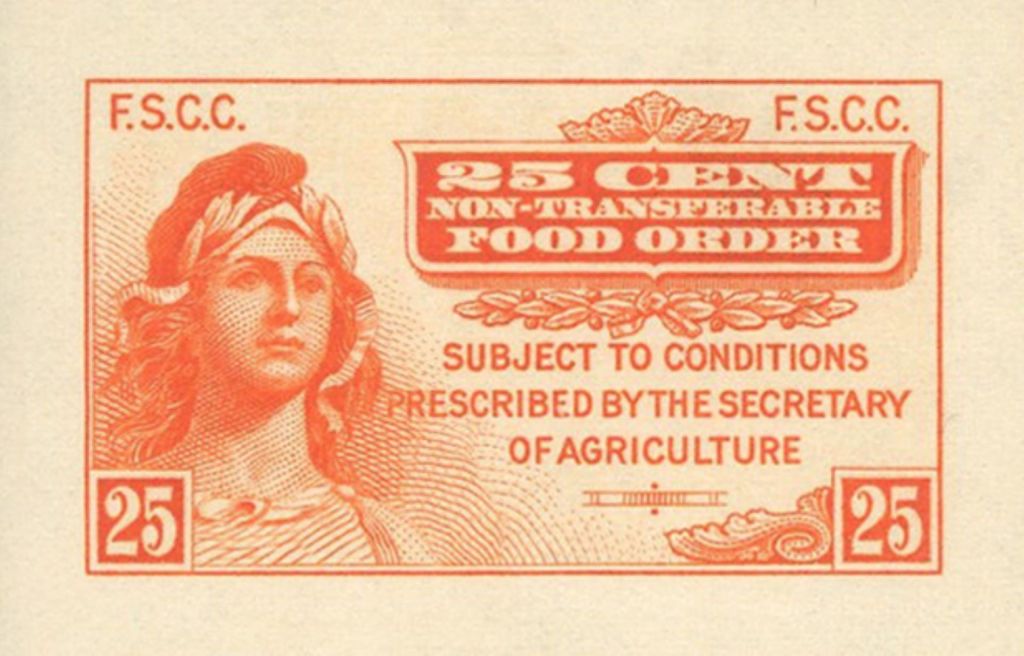
The other day, Sena and I were talking about growing up in Mason City, Iowa. As kids, both of us were the ones who lugged the groceries home. That was back in the days of paper sacks and, for me and her, food stamps. The food stamp program got started during the Great Depression. The goal was to keep people from starving and farmers from going under. In other words, it was kindness.
Food stamps were a sign of hard times and I don’t think that has changed much, except now I think you get a debit card instead of stamps.
I did grocery shopping at Fareway Store, which got its start in Boone, Iowa. Sena did hers at Grupps Food Center.
When it comes to shopping, I followed what my mother put on a list. I got the items and paid with food stamps. I can’t remember ever coming up short. I think I just gave them the cashier the stamps and they took what was needed to cover the price. I walked to Fareway and then I just walked home carrying two or three paper sacks of groceries. It was about a mile trip up and a mile back. My arms were pretty sore when I got home.
On the other hand, Sena came up short on stamps one day. It was embarrassing enough to have to pay using food stamps. But it was awkward as hell when you didn’t have enough to pay. At that time, the cashier was a guy named Bud Grupp. Bud was Carl Grupp’s son. Carl bought the store in the early 1960s.
Bud counted out the stamps and had to tell Sena that there wasn’t enough. She didn’t know what to say. People were lined up behind her and they could probably tell something was wrong. Bud just said “We’ll put you on credit,” and that was that. He sacked all of the groceries like there was nothing out of the ordinary. Sena didn’t know what was done about the balance on credit, whether it was ever settled or it became just a running bill that never got paid off.
Sena also had to walk home carrying bags of groceries. One winter day during a light snowfall, she dropped all of the bags in the snow. They got wet and all torn up. A woman saw it, came out of her house with some bags and helped Sena get the groceries sacked up again. She got home alright.
About a year ago, Sena was in line waiting to check out groceries. An elderly woman was ahead of her and came up short on money to pay for her few items. She fished in her purse and looked embarrassed and pathetic. Sena was thinking about paying for them herself but just before she could, a guy behind her handed the cashier his credit card and told her he would cover it.
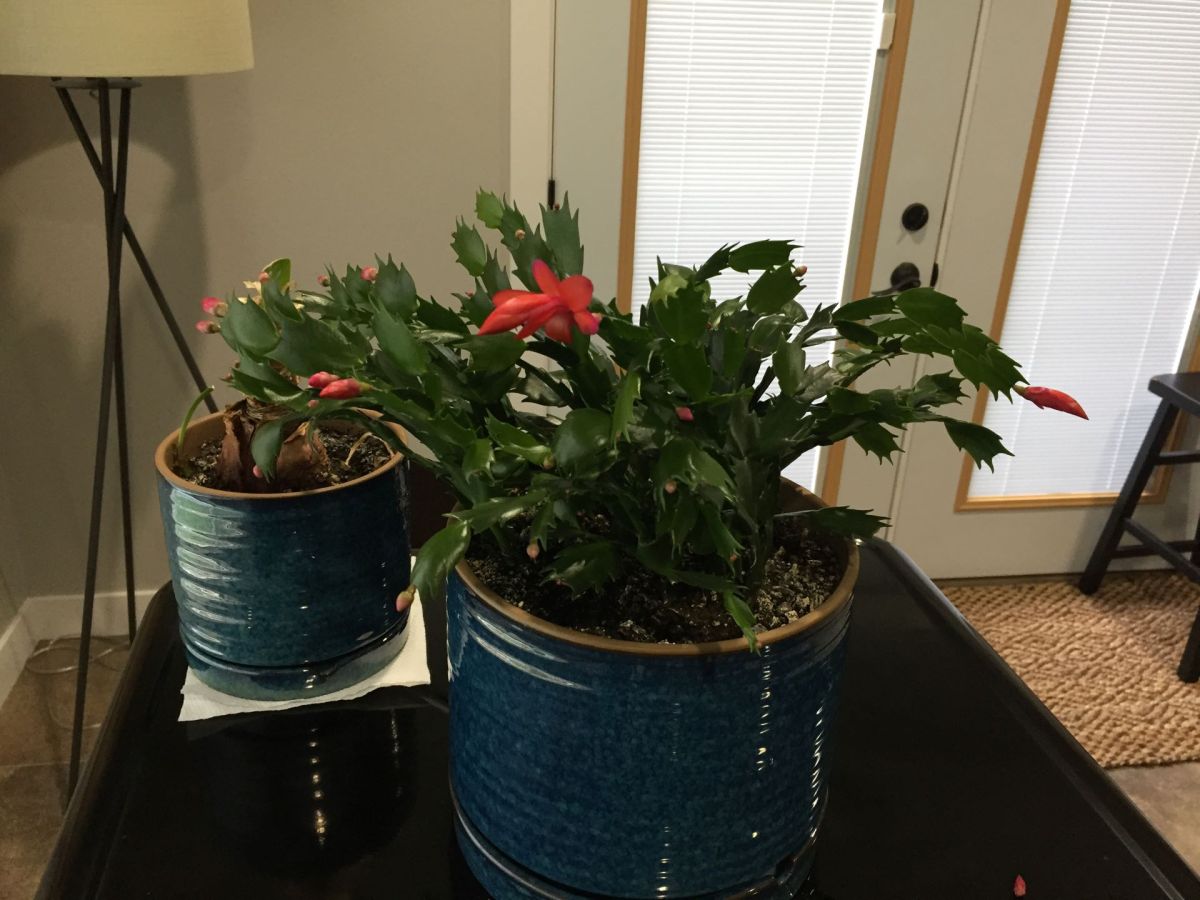
Regardless of what you see in the news, kindness is still out there. Our Christmas cactus is already blooming.
Historically Black Colleges and Universities (HBCU) are in the news lately. It reminds me of the short time I spent at Huston-Tillotson College. It was renamed Huston-Tillotson University (H-TU) in 2005. I was there in the mid-1970s.
A new President and CEO was just named this month, Dr. Melva K. Williams. And H-TU was recently added to the National Register of Historic Places last month. It has been renovated and modernized. Pictures show a well-kept campus pretty much as I remember it over 40 years ago. I didn’t graduate from H-TU, but instead transferred credits to Iowa State University where I graduated in 1985.
My favorite teacher was Dr. Jenny Lind Porter-Scott, who was white, taught English Literature. Another very influential teacher was Reverend Hector Grant who was black. He taught philosophy and religion. He was instrumental in recruiting me to matriculate at H-TU. He helped me to process my loss on the debating team when the question was whether or not the death penalty played any role in the reduction of crime.
My opponent won the debate mainly because he talked so much, I couldn’t get a word in edgewise. I can’t remember which side of the question I argued, but I thought I could have done better if he had just shut up for a few minutes and let me speak. Reverend Grant used the word “bombastic” in describing the approach my opponent used. On the other hand, he also gently pointed out that sometimes this can be how debates are won.
There’s this “On the other hand” tactic in debating and in reflective thought that my debating opponent managed to repeatedly deflect.
I don’t know what ever happened to Reverend Grant. We spoke on the telephone years ago. He sounded much older and a hint of frailty was in his voice.
I could find only a photo on eBay of a man who closely resembles the teacher I knew and the name on the picture is Reverend Hector Grant. The only other artifact is a funeral program for someone I never knew, which lists Reverend Hector Grant as being the pastor and some of the pallbearers were members of one of the Huston-Tillotson College fraternities.
I think it’s unusual for people to disappear like that, especially nowadays when we have the world wide web. Reverend Hector Grant was an important influence for me. He was one of the few black men of professional stature I encountered in my early life.
On the other hand, contrast that with Reverend Glen Bandel, another clergyman who was a white man and another important influence starting in my early childhood. Reverend Bandel persuaded me to be baptized at Christ’s Church in Mason City, Iowa. He radiated mercy, generosity, and kindness. He died in June of this year. I can find out more about him on the web just from his obituary than I can ever find on Reverend Grant, who apparently disappeared from the face of the earth.
Both of these men were leaders for whom skin color didn’t matter when it came to treating others with respect and civility.
My path in life was largely paved by these two clergymen. Reverend Bandel sat up with our family one night when my mother was very sick. His family took me and my little brother into their home when she was in the hospital.
On the other hand, Reverend Grant was instrumental in guiding me to an HBCU where I saw more black people in a couple of years than I ever saw in my entire life. The First Congregational Church in Mason City was instrumental in making that possible because they helped fund the drive to support H-TU (one of six small HBCUs) by the national 17/76 Achievement Fund of the United Church of Christ.
The news is replete with stories, some of them tragic, about how Greek fraternities haze their pledges. On the other hand, H-TU was pretty rough on pledges too. Upper classmen would make the pledges roll down the steep hills around the campus. They looked exhausted, wearing towels around their necks, running in place when they weren’t running somewhere in the Texas heat.
One H-TU professor said that H-TU was “small enough to know you, but big enough to grow you.” Although I can’t remember ever seeing him on campus because he was traveling most of the time, I at least knew the name of the President was John Q. Taylor (1965-1988). On the other hand, when I transferred credit to Iowa State University, I never knew the name of the President of the university.
Habari Gani is Swahili for “What’s the news?” or as it translated in the context I’m about to set, “What’s going on?” Habari Gani was the name for the annually published book of poetry by the H-TU students. Dr. Porter supported the project. I submitted a poem for the 1975 edition, which didn’t make the cut. When I transferred to Iowa State University, I left without getting a copy.
On the other hand, years later, I got a digital copy of that edition. I tracked it down to the H-TU library in 2016. The librarian was gracious.
Habari Gani has always been a reminder of the reason why I went to H-TU in the first place. I grew up in Iowa and was always the only black student in school. I grew up in mostly white neighborhoods.
On the other hand, when I finally got to H-TU, one of the students asked me, “Why do you talk so hard?” That referred to my Northern accent, which was not the only cultural factor that made social life challenging.
Once I tried to play a pickup game of basketball in the gymnasium. I’m the clumsiest person for any sport you’ll ever see. I was terrible. But the other players didn’t give me a bad time about it. They softly encouraged me. This was in stark contrast to the time I played a pickup game with all white men years before in Iowa. When I heard one of them yell, “Don’t worry about the nigger!” I just sat down on the bleachers.
On the other hand, when I was a kid and our family was hit by hardship, Reverend Bandel was the kindest person on earth to us—it didn’t matter that he was white. And my 2nd grade teacher, who was black (the only black teacher I ever had before going to H-TU), slapped me in the face so hard it made my ears ring—because I was rambunctious and accidentally bumped into her. It’s far too easy to polarize people as good or bad based on the color of their skin, especially when you’re young and impressionable.
It takes practice and experience to learn how to say and think, “On the other hand….”
I was thinking of my hometown, Mason City, for some reason today. Then I just happened to think of my childhood pastor, Reverend Glen Bandel. The last time I looked him up on the web was about a year ago and saw a news item dated in 2019. He was celebrating his 90th birthday.
I looked him up today. He died on June 3, 2022.
My deepest condolences to the Bandel family. Reverend Glen Bandel was the definition of the caring family pastor in Mason City. He sat up in the chair with us nearly all night at our house when my mother was sick and my brother and I were little. He had a great sense of humor. The Bandels shared their home with us when times were hard.
They took us with them to visit a family up in Minnesota one winter. I don’t think my mother was with me and my little brother at the time. I think she was in the hospital and the Bandel family took us in.
The family in Minnesota lived and worked on a farm. They didn’t have indoor plumbing. I think Reverend Bandel had a particular reason to visit them. It might have been to try to persuade them to change the way they lived. They had several children.
I had to use the outhouse at night. I was too cold to move my bowels. My family was poor, but not as poor as this one.
I caught the father singing to his little baby daughter. I think the baby’s name was Dolly because he was singing “Hello Dolly” to her. I walked in on them while he was singing the lyric “It’s so nice to have you back where you belong.”
He was having a great time singing to her. But when he looked up and saw me watching him acting like a doting dad, he stopped and looked a little sheepish. I wished he hadn’t seen me.
Reverend Bandel was a hero in the eyes of the many people he served and in my eyes for sure.
I will remember him and the rest of his family for their kindness and generosity as long as I live.
I was thinking yesterday about Ransom’s Cigar Store in Mason City, Iowa. There are actually a couple of reasons why it’s on my mind now.
The first thing about Ransom’s is that it’s an old pool hall on 120 North Federal Avenue. It looks like it has been there for a century. Decades ago, probably in the 1970s, I played a game of eight-ball with Bart Curran. Bart was the host of Bart’s Clubhouse, which I found out has a substantial Facebook following. Bart’s Clubhouse was a popular kids TV show back in my day and it aired on station KGLO (later KIMT) in Mason City.
Anyway, Bart and I played eight-ball (or was it nine-ball?) and drank a short beer. He was shorter than I imagined. He was a real nice guy. I think he asked me what my dad’s name was and when I told him it was John, he looked a little doubtful and said something like “Not the actor John Amos?” I don’t remember who won the pool game. It’s unlikely to have been me.
The second thing is, I searched Ransom’s Cigar Store on the web and found a couple of links to something called Ransom’s Pleazol. I can’t find the word Pleazol in any dictionary, including the Scrabble Dictionary. If anyone knows what that means, please drop a comment.
The title of the post is “Mysteries in History,” and before I chose it, I realized it had a familiar ring to it. It’s from Men in Black II. It’s an imaginary, cheesy, very low budget TV series narrated by Peter Graves in the movie. And it’s actually the perfect title for what my wife and I think about the Mason City, Iowa YWCA not being on the National Register for Historic Places. It’s a mystery in history which is anything but cheesy. I mentioned it in my previous post about the Mason City Ys.
I asked the State Historical Society of Iowa about it. It turns out it has been deemed eligible twice for nomination to the National Register, in 1991 and again in 2003, which was a year after the YMCA was added to the list.
The Mason City YWCA has never been nominated. Why it has never been nominated is the mystery in history.
It’s not a simple matter to get a building on the National Register. The process is outlined on the State Historical Society of Iowa web site. Unless you’re a professional historian, it’s a tough project and can take at least a year to accomplish.
I found a 36-page form on the web which documented the approval of the Mason City YMCA as a historic site fit for the National Register. It’s minutely detailed and I imagine it took a year just to complete the form itself, not to mention all the other hurdles you have to negotiate. The photos bring back memories of when I lived there as a young man. You could actually live in small, single occupancy dormitory rooms. You could do that at the YWCA as well, once upon a time.
There are 2 Artists who bought the YWCA building last year. It’s 100 years old and the place needs a lot of work. There’s a Trulia entry on the web which says it has housed a health spa, an intermediate care facility for people with intellectual and developmental disabilities called One Vision, a Women’s shelter and the list apparently doesn’t stop there.
A couple of articles say that one of the two new owners, Elisha Marin, filmed his music video, “Shining Out,” in an abandoned YWCA. They don’t say which one, but I wonder if it’s the Mason City YWCA. It would fit the long and winding story.
The Mason City Public Library (my favorite place when I was a kid) has a web page with a historical timeline indicating that the YWCA was built in 1918. The YMCA was dedicated in 1927 and placed on the National Register in 2002. I think a lot of the historical documents which helped get the YMCA listed might also prove the YWCA should be listed too.
I found another place called Five College Compass Digital Collections, which also has a ton of documents on microfilm about the Mason City YWCA. It was difficult to navigate and some of the pages were rotated, making them hard to read unless you can bend your head 90 degrees. You can click a button which apparently flips the pages upright, but transforms the text into something that looks like a foreign language.
You can get technical assistance in getting a property listed. The assistant would be available for 24 hours total. You can apply for grants, which can help with some of the expenses. It looks exhausting, though. Hey, I’m the kind of guy who flunked history.
It would sure be nice to solve this mystery in history. Maybe the 2 Artists will consider it. I wish them luck.
This is just a reminiscence. I know the word “wherefores” in the title is old-fashioned, but I’m an old guy and so what? When I was a young guy living in Mason City, Iowa where I grew up, I could not afford to rent an apartment. Shortly after I became an emancipated minor, I was lucky to be able to rent a dormitory room at the YMCA at 15 North Pennsylvania Avenue. The building was placed on the National Register of Historic Places in 2002.
Reference: M, Ben and Clio Admin. “Mason City YMCA (1926-200).” Clio: Your Guide to History. September 30, 2021. Accessed May 10, 2022. https://theclio.com/entry/140366
I guess that makes me sort of historic too. It was built in 1926. I think it rents out apartments now. I recently read a Globe Gazette article about the beginnings of the YWCA on 2 South Adams and it was built in 1918. The current Mason City Family YMCA is located on 1840 S Monroe Avenue.
There is a local legend that bank robber John Dillinger and his gang stayed at the YMCA while planning their robbery of the First National Bank in 1934. Track star Jesse Owens stayed there briefly in 1937, starring for a basketball exhibition.
I recently read a Globe Gazette article on the web about the beginnings of the YWCA on 2 South Adams. As I said, it was built in 1918, but I don’t know when it closed. The YWCA sat empty for years until a couple of artists got a loan from a local realtor. They’re renovating it. (Zachary DuPont. “Old YWCA building takes strides toward renovation,” Globe Gazette on line, 10/29, 2021, updated 1/18/2022).
They plan to build artist studios on the 2nd floor, performance space where a basketball court is presently, a community area and art gallery on the first floor, and make single apartment/dormitory rooms cheaper than regular apartments (maybe similar to what the YMCA had many years ago, up to 12 units on 3rd floor). My wife, Sena, stayed there briefly and that was very helpful.
The YWCA is not on the National Register of Historic Places. It’s not clear why. The artists have raised some money with a GoFundMe campaign toward the renovation project. The website is titled “Save the Historic Mason City YWCA.” So why is it not on the National Register of Historic Places?
Anyway, I moved into a very cramped room at the YMCA on either the 3rd floor in my teens. I was working as a draftsman and surveyor’s assistant for WHKS & Co., a consulting engineering company. It was mainly a place to sleep. Most of the time I was traveling, working on out-of-town jobs such as relocating Highway 13 between Elkader and Strawberry Point (really more like straightening out all the curves in it), land surveys and the like.
Portrait of the legacy blogger as a young man
I also have a distant memory of learning how to swim at the YMCA when I was a kid. I was terrified of even putting my face in the water and used to get fierce headaches just getting into the pool. I’m not sure how I got over it, but I did.
There were a fair number of eccentric characters who lived at the YMCA back in my day. I didn’t consider myself one of them and that’s probably why I didn’t end up staying there for decades. I could have worked in Mason City for the rest of my life, having breakfast at the café in the old Brick and Tile Building on East State Street, and eating all of my other meals in restaurants along Federal Avenue until I was too old to do much more than sit in Central Park.
But I didn’t. I’ll get to that.
There were a number of guys who stayed long term at the YMCA. It was kind of uncomfortable for that. There was only one communal bathroom and shower. There were no kitchens. There was barely enough room for a bed, a kneehole desk and chair, and you had to listen to the cast iron heater radiator clank most of the night. They were just sleeping rooms, but it was a little too loud to sleep sometimes because of the banging noise from the radiators.
I found out one of my neighbors was building a motorcycle in his room. He was very proud of it. It was a large machine and took up a lot of space. He kept it very clean. The Director of the YMCA at the time was John Calhoun and he’d been involved with the YMCA since 1943. He had a reputation for being pretty strict about the rules, which likely included one prohibiting the building of motorcycles in your dormitory room. We kept the motorcycle a secret of course.
There were some guys whose wives kicked them out of the house. They were always going out for coffee. They could drink a lot of coffee, smoke a prodigious number of cigarettes, and talk non-stop about how bad things were in the world in general.
There was an old candy bar vending machine on the floor. I got what must have been an ancient Butterfinger. I bit into it and found what I thought was half a worm wriggling around. Finding a worm was bad enough, but half a worm alarmed me. Where was the other half?
I even telephoned the local hospital emergency room to ask if I were in danger of some kind of poisoning. There was only a pay phone available at the YMCA, even for the guys who lived there. The ER doc couldn’t stop laughing long enough to say more than I’d most likely be just fine. “Fine,” he said. I haven’t eaten a Butterfinger since.
I met one guy who kept saying basically one thing over and over: “So my ancestors came over on the Mayflower. All well and good…” Then he would sort of trail off. His expression didn’t change at all. In fact, he looked flat most of the time. I didn’t know it at the time, but he probably had a chronic, severe mental illness.
I don’t remember who told me that the athletic director was gay. I don’t know if he was or not, and it didn’t matter. He treated everybody with kindness and respect and we treated him likewise. I remember he gave me sound advice about the safest length of time to spend in the steam room after I almost blacked out after sitting in there way too long.
I learned the dollar bill jump trick from an older guy in the weight room. He didn’t call it that, but it was a similar challenge. The idea is to bet you that you can’t bend over or squat, grab just your toes and jump over a broomstick—without letting go of your toes. I think he actually showed it to me and another youngster. We tried over and over. All we did was fall and laugh. It’s a good thing he didn’t make us bet.
There wasn’t much to do around there except play pool. There was this underfed-looking guy who used to play a deadly game of call shot eight ball. He amazed me because he worse eyeglasses that were as thick as pop bottle bottoms. I didn’t understand how he could even see his own hands. He won every game.
I know it sounds a little dull, living at the YMCA. On the other hand, I’d have probably been in a tight spot if the YMCA had not been there when I was young.
I read a Wikipedia article about the song in the late 1970s, “Y.M.C.A.” by the Village People. The author noted that in the early days of the YMCA, the single room occupancy dormitory rooms were for guys who moved to the city from rural areas to find work. Later, YMCA tenants tended to be youth “…facing life issues” or the homeless.
And I met Sena there. She switched jobs from working across the street at a school administration building to work at the YMCA.
I never hung out at the front desk as much as I did after she showed up. I pretended to read the newspaper a lot. She probably wondered why I was always there. We played bumper pool. I don’t remember who won the games, but I had trouble concentrating on my shots.
She does everything. There must be a God because she is God’s gift to me. I guess after all, I did just fine after eating half a worm.








 Go Retire Psychiatrist