Here we go again with the conflict in schedules of the Svengoolie movie, the 1974 Mel Brooks Young Frankenstein this coming Saturday and the Iowa Hawkeye football game. On October 18, 2025, the Iowa Hawkeyes play Penn State starting at 6:00 p.m. Of course, that interferes with the Svengoolie show which starts at 7:00 p.m.
I saw the Svengoolie show movie “Son of Frankenstein” last year and blogged about it. I can’t remember if I’ve ever seen “Young Frankenstein” before, but I think so. It was a long time ago. I’m probably going to watch it on the Internet Archive. Yes, believe it or not, it’s on the Internet Archive!
I think one of the funniest scenes is the dart throwing game between Dr. Frederick Frankenstein (pronounced “Frankensteen”) and Inspector Kemp.
Svengoolie Show Intro: “Calling all stations, clear the air lanes, clear all air lanes for the big broadcast!”
This coming Saturday’s (September 13th) Svengoolie movie will be the 1956 Warner Bros. production of “The Bad Seed,” which is about a little psychopathic girl who dares another kid to knock a stick off her shoulder and when he does, he finds out with a shock it’s not a stick but a venomous snake which bites him on the nose, sending him to the hospital in an ambulance which careens off a bridge into a raging river full of giant piranha which—OK, so that’s not exactly how the movie goes and I’ve never seen it before.
The show is coming on at 6:00 p.m. central time instead of 7:00 p.m., just to let you know.
I saw the 1964 movie “Strait-Jacket” directed by William Castle, starring Joan Crawford for the first time last night on the Svengoolie TV show, and I have to say that it’s one of the better films I’ve seen. Movies that have a psychiatric angle also get my attention because I’m a retired psychiatrist. There won’t be any spoilers.
The quick synopsis is that Lucy Garbin (Joan Crawford) plays a woman who was committed to a psychiatric asylum for 20 years after murdering her husband and his girlfriend with an axe after she found them together in bed. Lucy’s young daughter Carol (Diane Baker), sees the whole grisly thing. Lucy is released from the asylum to the care of her brother Bill and his wife and Carol. Then, the axe murders of several people seem to implicate Lucy might be picking up old habits.
That’s when all the trouble starts, including a lot of references to sharp objects, which is joke fodder for Svengoolie. The film lends itself to that, including a shot of the Columbia film logo with the statue of liberty’s head off and lying at her feet!
Dissociation is an involuntary mental phenomenon that leads to feeling disconnected with one’s environment or one’s self. Time is distorted and flashbacks and hallucinations can occur. This is frequently portrayed by Lucy, even in front of her former psychiatrist, Dr. Anderson, who visits her while on some kind of vacation of all things. During his interview with her, he decides she’s not ready to live in the outside world and must return to the asylum.
This would not have been the procedure for readmitting psychiatric patients even back then, but you have to give Dr. Anderson credit for having a sharp sense of her mental state. He had a well-honed idea of what was happening to her clinically, especially while observing her fiddling with knitting needles.
Images of and references to sharp implements abound throughout the film. You get a sense of being on the razor edge of suspense throughout the film. This is especially evident in the interaction between Lucy and the seemingly dull-witted farmhand, Leo (George Kennedy). He offers her his axe to give her a try at beheading a chicken. You find out later that Leo is smarter than he looks. Carol describes typical work on the farm to Lucy, including name-dropping certain jobs like slaughtering hogs and butchering chickens.
I can mention gaslighting without giving away too much about the film. I never saw the 1944 movie “Gaslight” but the term gaslighting means psychologically manipulating someone into believing she’s insane so as to control her sense of reality. In “Strait-Jacket” the ingenious way this is presented made me think of psychopathy as well as dissociation.
I have to mention one interesting fact about the film which came to me about 3:30 am this morning. I swear this was before I looked it up on the web (see reference below). I noticed that the forty whacks rhyme for Lucy Garbin is taken from the Lizzie Borden rhyme in reference to the axe murders of her parents she was accused of in the 1800s, which is cited on the Encyclopedia Britannica website.
“The children’s rhyme chanted in the movie, “Lucy Harbin took an ax, gave her husband forty whacks. When she saw what she had done, gave his girlfriend forty-one”, is based on the famous rhyme about Lizzie Andrew Borden: “Lizzie Borden took an ax, gave her mother forty whacks. When she saw what she had done, gave her father forty-one.” The Grindhouse Cinema Database (GCDb). Strait Jacket/Fun Facts. Retrieved June 8, 2025, from https://www.grindhousedatabase.com/index.php/Strait_Jacket/Fun_Facts
I found the film entertaining and, although I had a fairly firm idea of who was doing what for which reason, a couple of times I had my doubts. I give the film 4/5 shrilling chickens rating. I had a reservation about the ending. See if you can figure out who has the biggest axe to grind by watching “Strait-Jacket” on the Internet Archive.
I watched the 1957 giant insect movie, “The Deadly Mantis” last night on the Svengoolie TV show, and Sena watched some of it. At times, it was a little hard to tell if this was a romantic comedy or a giant insect horror flick. The reporter Marge Blaine (played by Alix Talton) and Colonel Joe Parkman (played by Craig Stevens) had this fling going on which sometimes took precedence over the huge, deadly papier-mâché praying mantis.
There’s a lot of stock film footage of the military and important military radar dividing lines across the northern hemisphere including the DEW Line (standing for Distant Early Warning Line) which were real. There were a couple of shots of Greenland, which is important to you know which U.S. President—who was probably unaware at the time of the dangerous mantis unthawed from its icebound prison in the North Pole.
If you look carefully in the upper right-hand side of the frame at the 34:48-time mark, in the Internet Archive black and white copy of the film, you’ll see an important goof that Svengoolie pointed out (which I missed at first). It’s the shadow of the large microphone and boom which shows up as Marge and Dr. Nedrick Jackson are leaving the room (Jackson is played by William Hopper, cue Perry Mason music because he played detective Paul Drake on that TV Show). It’s interesting that the Perry Mason show was starting the same year this movie was filmed.
One detail never specified about the monster is its exact species. We can’t tell if it’s the European praying mantis or the invasive Chinese Mantis. That’s not important for the movie, but again, it might be important on the world’s current political stage. Most entomologists advise destroying the eggs of the Chinese Mantis. I don’t know if tariff escalation would work. I think it’s hard to distinguish different mantis species eggs apart and we also don’t know the gender of the giant mantis in the movie.
That’s an important detail, which is only delicately referred to in the film as Dr. Jackson reads aloud from a book about the insect’s mating process, which invariably concludes by the female biting off the head of the male and often eating him (called sexual cannibalism). In the movie, Dr. Jackson reads aloud a gentler description, “The female is larger than the male and invariably destroys her mate when he’s fulfilled his function in life.”
There are interesting parallels to the mantis in the way the male and female lead actors interact with each other in the movie. Colonel Parkman and Dr. Jackson both behave like typical male chauvinists, and Marge never bites their heads off. But the romance doesn’t go that far. Marge dances with the soldiers but there’s no scene with Elvis Presley dancing and singing “Heartbreak Hotel.”
And there’s no time for any of that because the giant mantis is too ravenous after being cooped up for thousands of years in an iceberg. All it wants is breakfast: “Two humans on a raft and wreck’em” or is it “Two humans, dummy side up”? Whatever.
Anyway, the ferocious mantis ends up sort of like the bad-tempered giant cockroach in the 1997 movie “Men in Black.” Agents K and J speed through the New York Brooklyn-Battery Tunnel and have a showdown. The soldiers in The Deadly Mantis have their showdown with the monster in New York also, but it’s in what’s called The Manhattan Tunnel, which I found out doesn’t even exist.
But the parallels don’t stop there. Just before that, the terrifying insect climbs the Washington Monument (to get to the top, of course) and buzzes the White House. During the search for the bad bug, the military brass order that every U.S. citizen in the area report any “Unusual Flying Object,” in other words every UFO.
That means the sequel to both movies would need an extraterrestrial giant, bad-tempered female cockroach and mantis hybrid looking to bite the head off a suitable mate who crash-lands her UFO in the 51st state (formerly Canada) leading to the emergency mobilization of Men in Black who partner with Red Green and the rest of the Possum Lodge members to use duct tape and bug spray to overcome the beast and finally ensure peace by neuralyzing everyone in the world using a souped-up satellite owned by Elon Musk. Svengoolie will tell jokes.
It just goes to show you, we’re humans, but we can change, if we have to…we guess.
Here’s a suitable sort of dad joke Svengoolie style for the 1941 horror movie classic, The Wolf Man:
What do you call a dirty joke about the wolfman given at the strait-laced werewolf convention? A howler.
See what I did there? It puns on the word “howler” defined as an embarrassing mistake that evokes laughter, and also puns on the werewolf’s habit of howling. So, the mistake is the dirty joke being told to a convention audience of strait-laced (strictly moralistic) werewolves. OK, whatever.
I’m not great at telling dad jokes, although I like to hear them. I almost bought a book of dad jokes the other day, but when I read the copyright notice, I decided against it:
The notice of copyright for this book of dad jokes is to inform the purchaser that it is hereby forbidden to share these jokes in written, spoken, whispered, or telepathically delivered form to anyone else. Only the purchaser may whisper the jokes to himself as long as no other person is within earshot although it is preferable to read them silently. If this copyright notice is violated (and we will know because of the cleverly hidden monitoring device inserted in the text on each and every page), the publisher has the right to pursue every legal action necessary to extract money and suitable vengeance on the perpetrator, which means you.
I’ve been to the bookstore which sells several dad joke books and they all have this kind of copyright notice in them, regardless of who writes the books. I end up not buying any of them. Consequently, I never learn how to tell dad jokes. But that probably won’t stop me from trying.
Anyway, we saw The Wolf Man last Saturday and it’s a classic B horror movie. It was our first time seeing it and Lon Chaney, Jr. was a great werewolf. He didn’t like being called junior. We found out his father was a movie star too. I don’t think anybody called him Lon Chaney, Sr.
You can find attempts on the web to attach psychoanalytic interpretations of the Wolf Man, but I don’t buy them. On the other hand, there are some quotes from the film that sound like psychological observations:
Dr. Lloyd, the family physician: “I believe a man lost in the mazes of his own mind may imagine that he’s anything.”
Sir John Talbot (Larry the werewolf’s father): “Larry, to some people, life is very simple. They decide that this is good, that is bad. This is wrong, that’s right. There’s no right in wrong, no good in bad. No shadings and greys, all blacks and whites…Now others of us find that good, bad, right, wrong, are many-sided, complex things. We try to see every side but the more we see, the less sure we are. Now you asked me if I believe a man can become a wolf. If you mean “Can it take on physical traits of an animal?” No, it’s fantastic. However, I do believe that most anything can happen to a man in his own mind.”
You can see The Wolf Man on the internet archive. You can make up your own mind about it.
Both Sena and I stayed up to see the cheesy 1972 horror flick The Gargoyleslast Saturday night. No kidding, Sena stayed up for the whole thing! The show runs from 7-9:30 PM but the actual movie is only a little over an hour long. It’s about a clan of gargoyles that every 500 years hatch from eggs and wage war on humans to take over the planet. They never get the job done, probably because humans have all the guns and all the gargoyles have are claws and flimsy wings which you don’t see used until the very last scene. Like all of the Svengoolie movies, all of the jokes are so bad they’re good.
You can ask a fair question, which would be what else is on in addition to the movie? There’s a lot of commercials, of course, as well as the corny jokes and skits. But the other features last Saturday were excerpts from the Flashback Weekend Chicago Horror Con, in August 2023. I think it’s an annual historical horror convention that takes place in Rosemont, Illinois.
One of the attractions was a panel presentation about the history of the 90th anniversary of the drive-in theater hosted by Svengoolie and Joe Bob Briggs. It was arguably better than the feature flick. I have heard the history elsewhere about how the drive-in theatre began (I think it was on the travel or history channel).
The most interesting part of the history is how the Covid-19 pandemic influenced the recent history of the drive-in theaters. The point was that, when the pandemic hit the country, all indoor theaters closed, leaving the drive-ins the only place to watch movies for several weeks. They did pretty good business.
Moreover, horror movies and drive-ins go together like cheese and crackers (see what I did there, cheese as in cheesy movies?). OK, fine.
Anyway, horror films were mainly linked to low budget projects that big stars and big directors avoided like the plague. Mainly, those movies were played at the drive-ins—which is how they got a tarnished reputation. That led to cherished stories by older people who used to sneak their friends into the drive-ins by stowing them in the trunks of their cars. That probably did happen, even in the old Mason City Drive-In Theater in Iowa where Sena and I grew up. It was demolished in 1997.
As far as The Gargoyle movie goes, the one thing I couldn’t find out was exactly why Bernie Casey, who played the head gargoyle, didn’t voice his own lines. The web references I found just mentioned briefly that it was because his natural speaking voice didn’t fit the character. They were dubbed in by Vic Perrin who did the voice-over for the introduction to The Outer Limits.
Maybe the funniest scene was when the head gargoyle placated and playfully slapped the fanny of the female head breeder gargoyle after she noticed he was flirting with the human woman he kidnapped. The breeder was obviously really jealous. Maybe this means that the battle between gargoyles and humans will always come to a stalemate because we’re too much alike.
Last Saturday on Svengoolie, I watched for the second time the 1963 movie “Comedy of Terrors,” a slapstick horror spinoff of Shakespeare’s farce, “Comedy of Errors”—which I’ve never seen. I didn’t see the whole movie the first time around, and I can’t remember exactly where I saw it. Most likely it was on Svengoolie.
The movie story is not actually based on the Shakespeare comedy itself. Most of the lines by Basil Rathbone (as Mr. Black) sounded vaguely familiar and I think they were from “Macbeth.” Vincent Price (Mr. Trumbull) plays an evil mortician and Peter Lorre (Mr. Gillie) plays his bungling assistant. They bury people in a casket which they use over and over because they dump the corpses in the graves after the mourners leave. Boris Karloff plays Hinchley, the senile father of Trumbull’s wife, Amaryllis who is played by Joyce Jameson.
Basil Rathbone as Mr. Black is the landlord who threatens to evict Trumbull from his house if he doesn’t come up with the rent sooner rather than later. This leads to Trumbull’s plan to kill Mr. Black—who doesn’t stay dead more than a few minutes, repeatedly springing back to life and flawlessly reciting Shakespeare in a thundering voice, before collapsing periodically back into his lifelong affliction with bouts of catalepsy.
Now, you know I’m going to have something to say about catalepsy because I’m a retired consultation-liaison psychiatrist and I’ve seen enough patients with catatonia who display various signs of that neuropsychiatric disorder, including catalepsy. According to the University of Rochester Bush-Francis Catatonia Rating Scale Assessment Resources, catalepsy is defined as “Spontaneous maintenance of posture(s), including mundane (e.g., sitting/standing for long periods without reacting).”
After Mr. Black has an apparent heart attack after being shocked by the sight of Mr. Gillie, who sneaked into his house, the butler calls for the doctor. The butler reminds the doctor that the distinguished gentleman suffers from periodic episodes of “catalepsy.” The doctor insists that Mr. Black is dead after applying a perfunctory examination.
After that Mr. Black abruptly snaps into and out of periods of catalepsy typically reciting Shakespeare perfectly, even after Mr. Trumbull shoots him a few times. Needless to say, catalepsy is only one feature of many. It almost invariably appears in those who have severe neuropsychiatric illness such as schizophrenia or epilepsy and they would rarely be able to speak so eloquently.
What amazed me is that all of the actors remembered and spoke their lines perfectly, despite being lengthy and polysyllabic.
Although the film didn’t do well at the box office, I thought it was pretty funny. You can view it for free at the Internet Archive.
Have you ever wondered if anyone ever made a movie about an attack on planet earth by fried rubber chicken livers? Boy, am I glad I’m not the only one. I suppose I could check the MeTV channel to see if any such film was ever aired by Svengoolie.
I used to watch Svengoolie a long time ago. It’s this guy called Svengoolie, played by Rich Koz, who hosts really awful horror movies. I could watch them for about 10 minutes before I had to switch to something which wouldn’t bore me or make me gag—which I realize often can’t be done nowadays.
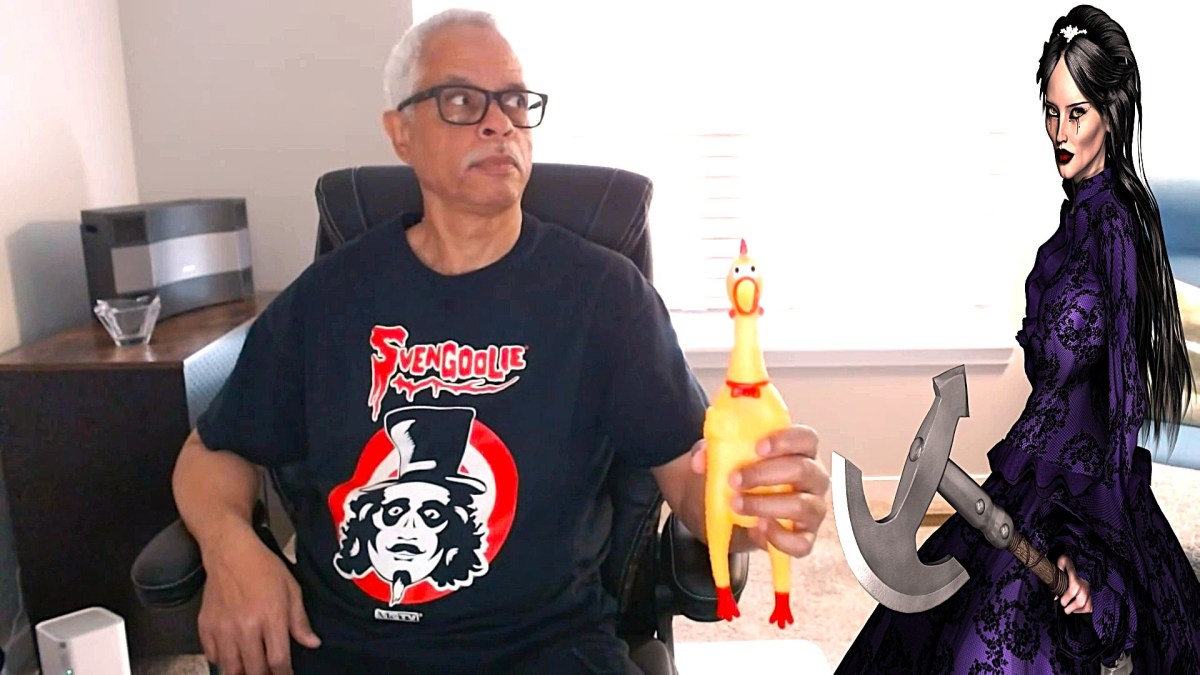
Svengoolie would make corny jokes and get rubber chickens thrown at him. That was actually the best part of the show.
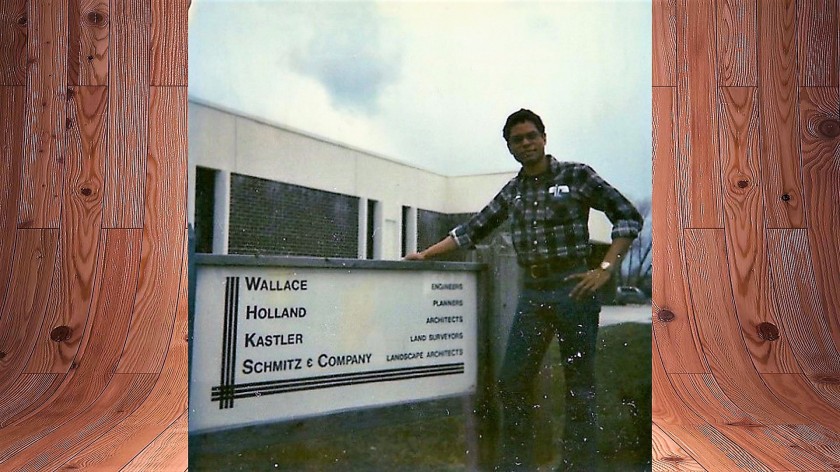
Part of what made me think about this was reminiscing about the early 1970s when I lived at the YMCA and worked for a consulting engineer company called WHKS & Co.
You got a single sleeping room at the YMCA and there was no kitchen. Frankly, it was for old guys who had no place else to go and for young guys trying to find out how to go somewhere else.
I ate in cafes a lot. I also picked up a lot of Kentucky Fried Chicken take out. I realize it’s called KFC nowadays. But back in the 1970s you could openly buy a box of fried chicken livers as a side dish at KFC. I think I began eating them because they’re actually a pretty healthy food item if you prepare them right. You could get a generous serving of them. They were occasionally a little tough to chew—a little on the rubbery side.
You can’t get any franchise owners to admit they sell them now. You’ll see web articles that mention you can still get them at what they call certain “regional” stores. You can also maybe still get KFC chicken gizzards. Neither is on any official menu.
The connection here is fried tough chicken livers and bad old horror movies hosted by Svengoolie who makes corny jokes and dodges rubber chickens. I can easily imagine somebody making a throwback classic B Horror movie called “Attack of the Giant Fried Rubber Chicken Livers.”
Wouldn’t that be great?
Try watching Svengoolie sometime. You might not like the movie, but you’ll get a big kick out of Svengoolie.








 Go Retire Psychiatrist