Taming the Juggling Balls

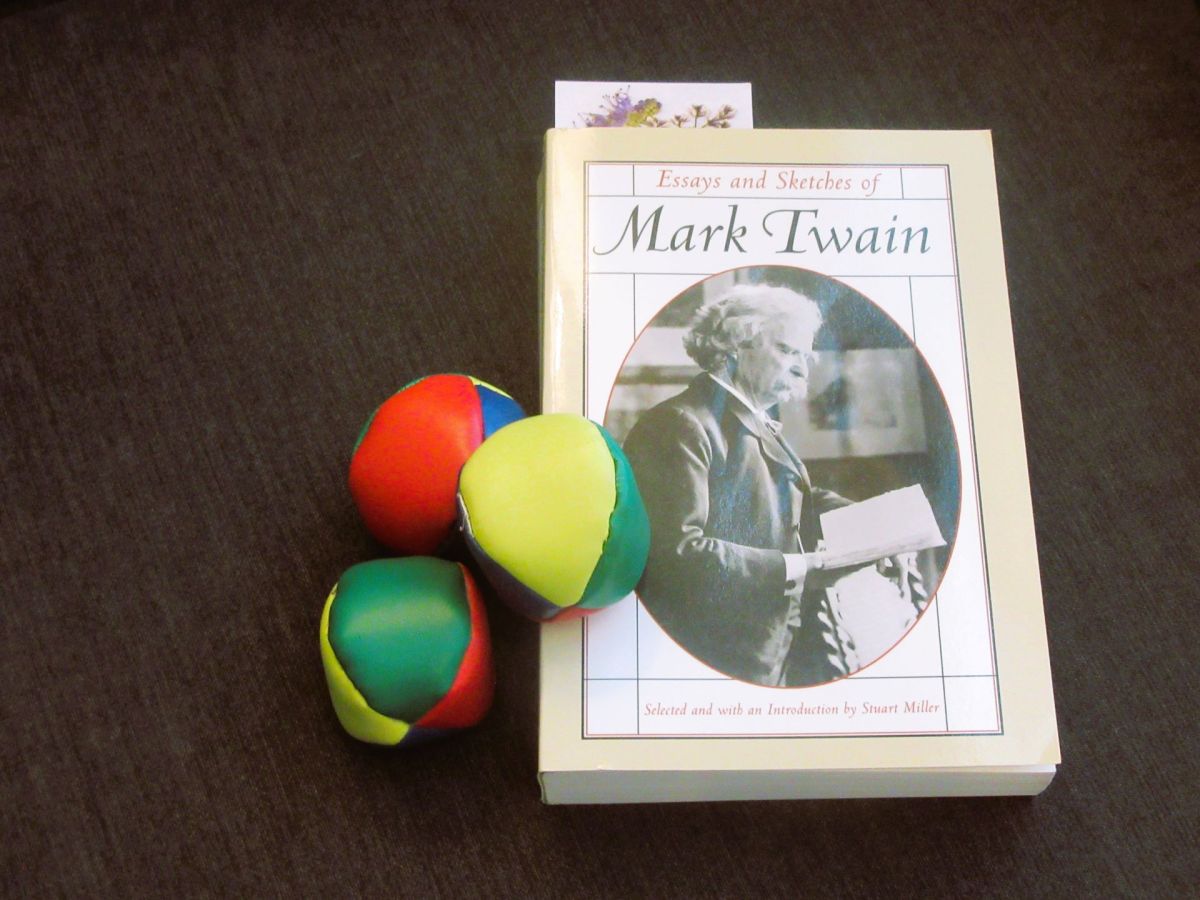
As of November 7, 2022 it has been 22 days since I purchased the Learn to Juggle kit from Barnes and Noble. So far, my learning experience reminds me of a story by Mark Twain, “Taming the Bicycle,” which was published posthumously—obviously after he succumbed from his injuries in the attempt to ride the high-wheeled bicycle in the early 1880s.

Just kidding of course, about his death from the bicycle riding adventure. He did mention using about a barrel of something called Pond’s Extract, which was a liniment for scrapes and other wounds.

Twain was writing about learning something new—a thing all of us are called on to do many times in our lives. He didn’t try to learn to ride the bicycle until he was over 50 years old.

I didn’t try to learn how to juggle until was well past my mid-sixties. How do you account for decisions to embark on new hobbies, adventures, and other nonsense at an age when most people would be content vegetating on the porch or in front of the TV?

I just answered the question, in case you didn’t notice.

Anyway, I am making some progress as juggling, although it’s uneven. It’s hard to believe, but sometimes I think I juggle better as I wander around. I think it might be because there is a natural tendency to throw the balls away from you. That way, I look more adept simply because I’m making a frequently observed beginner’s mistake. But I seem to be steadier even when I walk backward a few paces.

 When I stand firmly in one place and attempt to juggle, I can often barely make it past half a dozen throws. Wandering a little, I have made thirty throws.

But then, randomly, the opposite occurs and the theory fails.

Counting the number of each throw seems to help—occasionally. I also notice that unscheduled, short practice episodes for 10 minutes or less work better than struggling along for a half hour or so at set times.

I don’t dread the practice sessions; in fact, I have a sort of itch to juggle at various times during the day. Sometimes I believe I do it to help me collect my thoughts, to keep my hands occupied, or just to pass the time.

I remember learning to ride the bicycle for the first time when I was a kid. I fell down a lot, just like Twain did—until I got the hang of it. Maybe juggling will turn out to be the same.

But I won’t need Pond’s Extract for juggling mistakes—as long as I don’t try juggling while climbing or descending stairs.
Blob Juggling

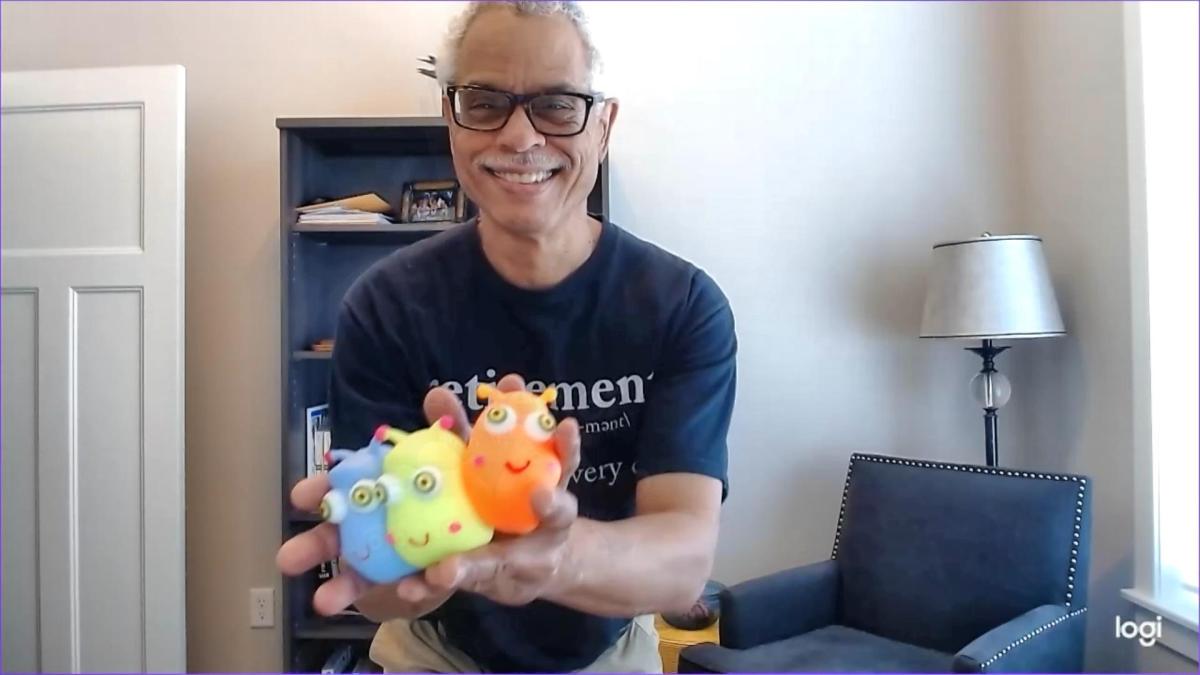
Sena bought me some new juggling items, which include three new balls and 3 Blobs. The Blobs are probably extraterrestrials because they have antennae. They all tend to bounce off my hands, but that’s no excuse for my continuing ugly form, which I swear I’m continuing to work on.

I’m starting to occasionally sneak in an over-the-top throw. I toss it over instead of under the ball. I notice that I hold my left arm above the right one for some reason. It looks weird, but it may be an unconscious way to cheat my way to the silver trophy for 20 throws.

Dryer Ball Juggling Combo!

I’m still making slow but steady progress at juggling. I’m juggling 3 balls although my form and rhythm need a lot of work. I’m still lunging to catch balls I’m tossing too far out in front of me.

But I’m having a great time learning. You’ll notice I sometimes count the throws. I have a long way to go to get to the goal of 30 tosses.

The dryer ball trick includes a couple of dryer balls which I add to the usual 2-inch juggling ball which came with the kit I bought at Barnes and Noble. Or I add the big brown one to the two small regular juggling balls.

The brown dryer ball with a face which looks sort of like a teddy bear is almost 3 inches in diameter and really tough to catch coming down. The knobby blue one is part of a set we’ve had for use in our dryer for a while now.

I can’t tell if the dryer balls work or not in the dryer, but they’re fun to juggle.

Jim and the 3 Ball Flash

Well, just a few days after picking up a kit on how to juggle, complete with 3 juggling balls, I’ve now graduated to the 3 Ball Flash, which I can more or less do consistently—or at least more times than not.

The 3 Ball Flash is to toss and catch 3 balls. You hold two balls in your right hand (or left depending on hand preference) and one ball in your left. You toss one ball in your right hand first over to your left hand. You toss the ball in your left hand over to your right after the first one hits the apex of its arch. Then you toss the second ball in your right hand and catch it in your left so you end up with two balls in your left hand. It’s one, two, three.

If you can do it without dropping balls, the teachers tell you to pat yourself on the back because it’s a big milestone.

You’ll notice in the YouTube video that I make a lot of beginner mistakes. The chief one is that I’m often doing what the author of the juggling manual calls “sprint juggling.” This means that I tend to toss way out in front of me and I end up chasing balls.

There’s this thing called the juggle space in which you’re supposed to toss the balls within a fairly tight space fairly close to your body. The idea is to imagine a sheet of glass in front of you. The bottom two corners are your two hands; the top is in a line just above your head.

When I toss the balls within the frame (which isn’t often!), it’s much easier to toss and catch the balls. What you’ll see me do in the video is the basic 3 Ball Flash, but I sneak in an extra throw or two occasionally—when I feel lucky.

Toeless Mourning Doves

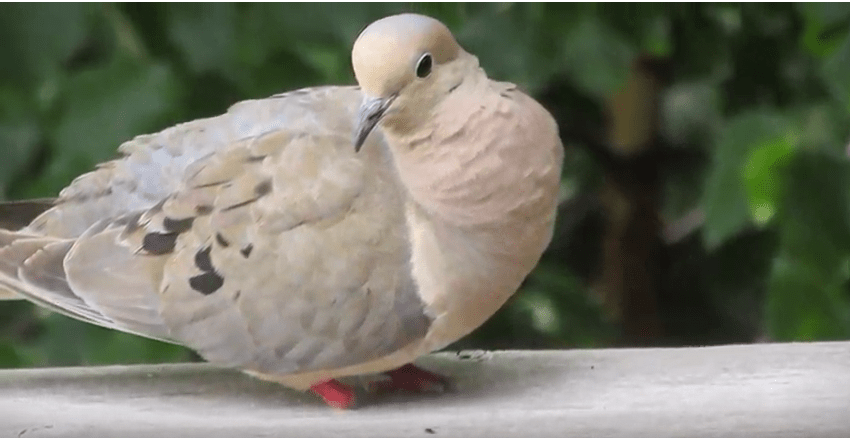
I’m an amateur bird watcher. Last August, I saw a toeless Mourning Dove with what some people would call String Foot, a foot deforming condition that might be caused by a variety of injuries. I had never seen anything like it.

Toeless Mourning Dove

In the slide show you can see a bird seemingly sitting in its own poop, which is said by some to cause the problem—which I suspect is doubtful. The last shot is that of a pair of doves trying to nest in our window box, which was full of sharp, plastic artificial plants. It was painful to watch and I wonder if their hazardous habits could lead to injuring their feet.

Mourning Doves nesting on a speaker

I’ve seen Mourning Doves do strange things, mainly nesting in areas that don’t make much sense. Years ago, we could not dissuade a pair of them from building a home on top of one of the audio speakers mounted outside on our deck. Cranking up the volume didn’t work.

I clicked around the web trying to find out about the problem. Speculation about the causes of these injuries range from something called String Foot (string or human hair used to build nests getting wrapped around toes leading to amputation), sitting in poop leading to infections, and frostbite.

I think frostbite is plausible, and so did a birdwatcher named Nickell, who published an article about it over a half century ago; Nickell, W. P. (1964). “The Effects of Probable Frostbite on the Feet of Mourning Doves Wintering in Southern Michigan.” The Wilson Bulletin 76(1): 94-95, complete with hand-drawn illustrations that look exactly like the one in the slide show.

In the book, Birds of Massachusetts and Other New England States by Edward Howe Forbush, you can read one of the many anecdotes from amateur ornithologists about bird behavior that Forbush collected for his book, which was published circa 1929 (I actually plucked it from one of E.B. White’s essays):

“Mrs. Olive Thorne Miller. Reported case of female tufted titmouse stealing hair from gentleman in Ohio for use in nest building. Bird lit on gentleman’s head, seized a beakful, braced itself, jerked lock out, flew away, came back for more. Gentleman a bird lover, consented to give hair again. No date.”– Forbush, Edward Howe, 1858-1929. Birds of Massachusetts And Other New England States. [Norwood, Mass.: Printed by Berwick and Smith Company], 192529.

I wonder why a bird would risk String Foot by using hair in nests?