Svengoolie Movie: “The Gorgon”

Svengoolie Intro: “Calling all stations! Clear the air lanes! Clear all air lanes for the big broadcast!”

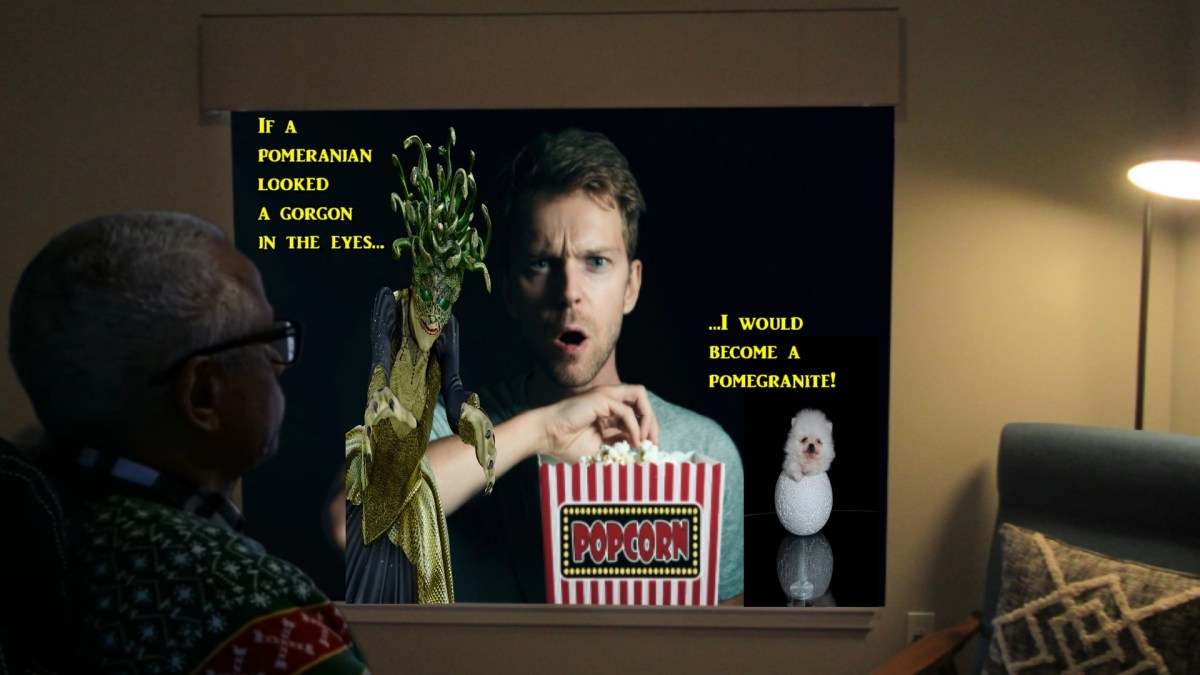
Well, last night I saw the 1964 Hammer Films movie “The Gorgon,” and the first thing to clear up is the name of the gorgon relating to the underlying Greek mythology which, incidentally, the Svengoolie show clearly did early on.

The gorgons were 3 ugly female creatures with snakes in their hair and if you looked at one of them, you’d turn to stone. The most well-known gorgon was Medusa, which Perseus defeated by only looking at her indirectly in a mirror and slicing off her head. Medusa was the only human gorgon and the other two were named Stheno and Euryale.

The problem is the gorgon’s name which is Megaera. Megaera was part of another trio of monsters in Greek mythology called the Erinyes (Furies). They also had snakes in their hair and their names were Megaera, Alecto, and Tisiphone (who is incorrectly identified as a gorgon in the film). They were the goddesses of vengeance who punished men for crimes like murder of relatives and lying. Gazing at them didn’t turn you into stone, but they could drive you crazy, and inflict disease if you didn’t laugh at your father’s Dad Jokes.

Moving right along, the movie begins with a lot of people in early 20th century Europe being turned into stoners who smoke pot by the bongful, leading to Dr. Namaroff (Peter Cushing) noticing that many of them ended up getting institutionalized in the madhouse he runs in Vandorf, a small village in Germany, and where he occasionally removes the brains of some of the inmates and who also has a crush on his assistant, Carla Hoffman (Barbara Shelley).

Actually, the stoners literally turn into stone, presumed by some to be a result of the unbelievable potency of the local pot, but watch out, Prof. Karl Meister (Christopher Lee) has an amazing grasp of Greek mythology although even he can’t separate the Erinyes from the Gorgons.

There’s something weird going on and Meister gets a letter from Professor Jules Hetiz (Michael Goodliffe) who has a close encounter of the craggy kind which leads to Meister sending Paul Heitz (Richard Pasco) to dig into the mystery and also bring back some of that righteous pot.

However, Paul has a pretty bad trip on the stuff and ends up in Dr. Namaroff’s hospital for about a week convalescing. He and Carla really hit it off, which Namaroff gets pretty miffed about because Carla is his girl even if she is a little spooky. The local constabulary (the head of which is Inspector Kanof (Patrick Troughton, who was the second Doctor in Doctor Who in 1966) and is very protective of the secret which is behind all the broken furniture and homemade bongs in the forbidding castle in the neighborhood.

The gorgonizing secret of the whole affair gradually gets revealed in confrontation involving a snake pit in which a cobra bites Chuck Norris and after 7 agonizing days—the cobra dies.

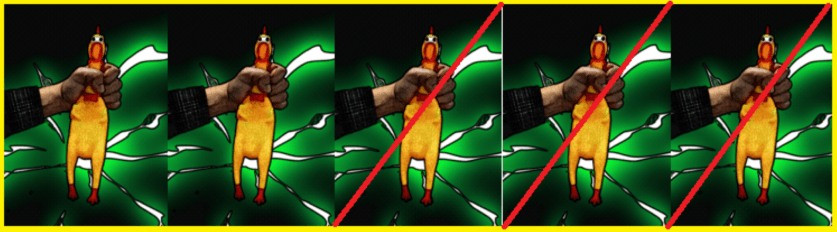
I think the movie is fair but it gets the Greek mythology wrong. I give it a 2/5 Shrilling Chicken Rating. You can see it on the Internet Archive.
Slow Down, Tithonus

What I sometimes don’t like about the X-Files episodes were the esoteric titles. One of them was “Tithonus.” I watched it again last night. It’s about a police photographer named Fellig who claimed to be about 150 years old because he cheated death sometime during the days of Yellow Fever in the U.S. in the 18th through the 20th centuries. He was in a hospital sick from Yellow Fever but didn’t look at Death, which was some kind of entity taking those who were dying from Yellow Fever. Death took his nurse instead because she looked at him.

Ever since then, he’s been trying to catch a glimpse of Death mainly by following people around who he somehow knew were about to die. I think the idea was that if he caught up with Death and stared at it, then he could finally die, because by this time he’s so tired of living that he’s attempted suicide several times. He often acts like he’s in a hurry to catch a glimpse of Death.

The main way Fellig knows who is about to die is because they look black and white instead of in living color. Agent Scully is working with another investigator who believes Fellig is a serial killer. Fellig looks at Scully and she’s monochromatic (black and white) which means she’s about to die. So, he tries to stick close to her so he can get a look at Death. The other investigator shoots Fellig and the bullet also hits Scully. Fellig tells her to close her eyes and he finally gets his chance to look at Death and dies. Scully survives.

So, that preamble leads me to talk about the title “Tithonus” a little. Tithonus in Greek mythology was this rich mortal with whom Eos, the goddess of dawn, fell in love. She made him immortal but forgot to give him eternal youth so he gradually because a shriveled up, demented old fart. This led to some pretty intense arguments between them:

Tithonus: So, here I am, senile because you neglected to give me eternal youth when you gave me immortality. This is just like the time you made me a Braunschweiger sandwich, but instead of using my favorite spread, Miracle Whip, you used mayonnaise!

Eos: How does that even make sense? I try my best! You should use your walker more often; then you wouldn’t trip and fall so much.

Tithonus: Excuses! And you hide my Geritol!

So, Eos turned him into a cricket to interrupt his constant babbling.

Anyway, occasionally I think about my mortality because I’m not getting any younger. I’m more forgetful. I can’t walk as far as I used to. I can still juggle, but I’m beginning to accept the fact that I may never be able to do the shower pattern or the off the head trick. Sena and I still play cribbage, but I’m starting to notice that I make certain mistakes in counting that I didn’t make in the past. I can’t stay up as late as I once did.

On the other hand, I can get along without certain things like TV, mainly because I notice I enjoy reading more. I ignore the news a lot more than I formerly did. I would rather listen to music or watch the birds. I admire Sena’s garden from our back windows, where I can watch the dawn arise.

I’m in no hurry.

Evolutionary Thoughts

By now, you’ve probably read the digital news article describing how we’re all going to evolve into beings who resemble extraterrestrials (ETs) because of our preoccupation with digital technology.

The authors describe us as eventually developing another eyelid that’ll protect us from the blue light emanating from our gadgets. Our hands will become claw-like and permanently flexed because of the way we’re always gripping our smartphones.

You’ll also develop a third hand that protrudes from your butt so you can catch your cell phone as it slips out of the back pocket of your skinny jeans. Come to think of it, that’ll also give rise to a weird new meaning for the term “butt dialing.”

Of course, the article is a criticism of our preoccupation with our gadgets, but it’s still fascinating as speculation about how creatures, including humans, evolve in response to the pressures in our environment.

This kind of thing makes me wonder whatever happened to Neanderthal. The males were huge, especially their arms, which came from frequent arm wrestling with Sasquatch for the last shred of beef jerky. Neanderthal had a very prominent brow which developed to keep snow and pterodactyl droppings out of his eyes.

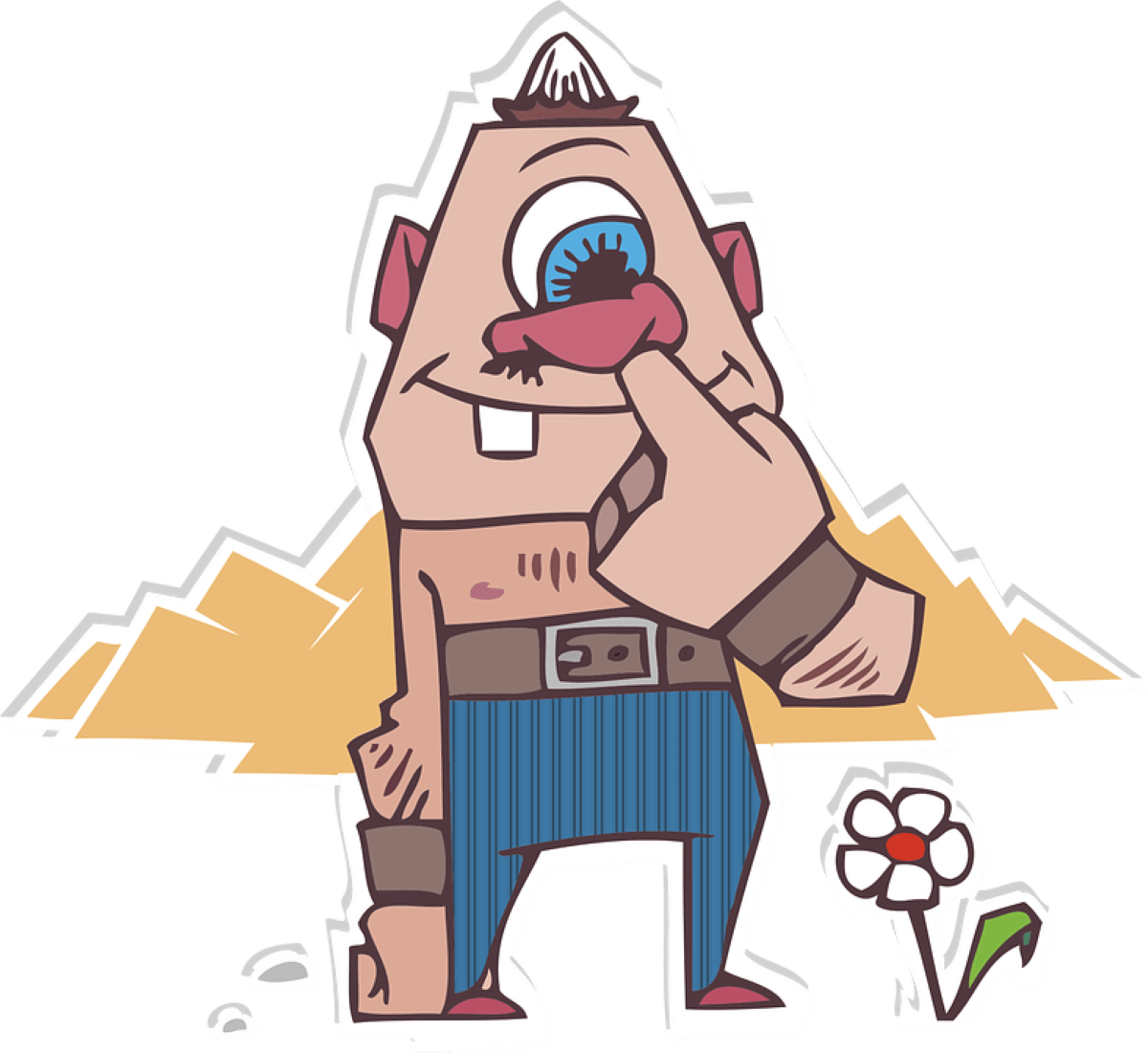
And this reminds me of the discovery of the fossil of a giant creature on the Greek island of Crete in 2003 (I think). The skull had a huge nasal opening in the center of the skull. That was probably for a trunk, as in elephant trunk. But paleontologists thought it might have been the explanation for why ancient Greeks came up with stories about the terrifying one-eyed cyclops.

And what about that carp with a human-like face on the top of its head? I saw that one a week ago on the show The Proof is Out There. I thought sure Michael Primeau, the forensic video analyst on the show, would dryly dismiss it (“This video is clearly faked.”). Instead, the other experts thought it was natural. Tony summarized it as an example of the “plastic” evolution, by which I think he meant phenotypic or evolutionary plasticity. These are changes in a creature’s appearance, morphology, or physiology in response to changes in its environment. Regarding the carp, one expert opined that the face would confuse its main predator, the eel, by confusing it.

I still don’t get that one. How would the carp species even begin the evolutionary process? Does the carp just think, “Huh, I think that eel might get confused if I had a face like a human”? I get it that the changes occur at the genetic level, but how exactly does it get started?

Could you google the answer? I couldn’t find anything specific, like x plus y equals human-like face on a fish that many humans would not care to eat.

And how about writing? I wrote this blog post longhand using pen and paper, something I gave up doing years ago but which I am sort of rediscovering gradually. I had an old typewriter for a while, which gave way to something called a word processor, which was a stand-alone device made writing and editing text, and eventually I got a computer—which really messed things up.

The thing is, I can remember getting something called writer’s cramp. If you remember that, then you probably recall how painful it was. Back then, did anyone ever wonder whether that would lead to the evolution of a claw like hand?

Could evolution have consequences pertinent to people who are always looking up at the sky looking for UFOs? Some of them, for some unexplained reason, never seem to have a smartphone with them. Anyway, could their eyes migrate, carp-like, to the top of their foreheads to counter neck strain? And could this lead to the evolution of a third eye in the center of the forehead? It would prevent falling into manholes. There are other consequences from evolving into a cyclops.

We would be adept at forging thunderbolts. We would be very talented at cultivating vineyards and herding sheep and goats. But our tempers would still be pretty bad, even worse. We would abandon courts of law and ignore justice. We would be violent giants, feasting on the flesh of ordinary humans. All this because we kept searching the sky, hoping to see UFOs and see ETs, which we would eventually resemble anyway because of our preoccupation with our devices.

I have a pretty good supply of pens and paper.

Sena Grows Peonies!

Sena has a peony shrub growing dazzling red blossoms. The red ones are said to symbolize love, respect, and honor. The peony genus classification is Paeonia, which is taken from the Greek word Paean. At least a couple of flower web sites say the origin of the name peony comes from a Greek myth involving a deity called Paean (pronounced “Bud”).

According to the flower web sites version of the myth, Paean was the physician of the gods. He was a student of Aesculapius or Asclepius, whose friends just called him “Bud.”

Paean used a peony root to heal Pluto, which was the Roman name of the deity Hades. I don’t know what was ailing Pluto. Maybe it was the gout. Anyway, Aesculapius got wind of Paean’s treatment, and became really jealous. He tried to kill him, but Zeus wasn’t having any of that baloney, intervened and turned Paean into a peony.

I couldn’t find this version in any scholarly source of Greek mythology. In fact, Edith Hamilton, a Greek scholar who wrote a book entitled simply, Mythology, says Paean was just another name for Apollo or Aesculapius, also known as Asclepius—or “Bud.”

In fact, a paean is a song of thanksgiving or triumph addressed to Apollo.

Hamilton’s version is kind of a soap opera. Greek gods always seemed to be having torrid affairs with humans, often leading to drama involving the transformation of humans into various plants, animals and whatnot—and maybe even destroying them.

This is what happened to a human female named Coronis, who had a fling with Apollo who got her pregnant. She snubbed him for a human guy, which annoyed Apollo so he killed her. However, he saved his baby by tearing Coronis open and plucking him out right out of the womb—really extreme.

Apollo than adopts the kid out to an old fart of a Centaur named Chiron. Apollo ordered Chiron to name the child Aesculapius, or Asclepius, “Bud” for short. He was never named Paean, according to Hamilton.

Chiron was pretty slick with healing arts and taught Bud everything he knew. Then Bud got too big for his britches and brought a guy back from the dead. I can’t recall exactly who got resurrected; it was either Hippolytus or Elvis. Gods got mad about it because making zombies is their business, not Bud’s.

Consequently, Zeus killed Bud by slinging a thunderbolt at him. Contrary to flower shop lore, Zeus never even considered turning him into a peony. In his opinion, you had to teach these pups a lesson.

How do you think Apollo felt about this? How would you feel? What would you do? Apollo got on the phone with his lawyer, and before you could say “peony,” he got a court order authorizing Apollo to kill the Cyclops who were manufacturing all of Zeus’s thunderbolts.

If you think it ended there, you’re wrong. Zeus, not to be outdone, sued Apollo, who lost big time and was sentenced to slavery to King Admetus for one to nine years in solitary confinement.

Bud, on the other hand, even though he was slain, was honored by thousands for hundreds of years. Those who came to his temples were invariably healed of various ailments including but not limited to the gout. Snakes were involved in the treatments, though, and some preferred to live with the gout, so declined to sign the informed consent forms.

Hamilton and other scholars don’t ever mention Bud getting turned into a peony. But Sena’s peonies are still beautiful.

Reference: Edith Hamilton, Mythology, Little, Brown and Company, 1942.