Today, I read Dr. George Dawson’s blog post, “How I ended up in a high-risk pancreatic cancer risk screening clinic.” As usual I was impressed with his erudition, scientific literacy, and rigorous objectivity, even as it pertained to a deadly disease which runs in his family genetic history. I couldn’t help admiring his courage.
And, whether this is a random connection or not, this somehow led to my remembering Dr. George Winokur, a giant in the scientific study (including genetics) of psychiatric diseases, especially mood disorders. He died of pancreatic cancer shortly after he was diagnosed with it in the spring of 1996.
Dr. Winokur was chair of the University of Iowa Department of Psychiatry from 1971 to 1990. He remained on faculty, actively involved in research and teaching up until the day of his death in October of 1996.
I was a resident in psychiatry at University of Iowa from 1992-1996 and I have a clear recollection of meeting with Dr. Winokur in his office during my last year, when I was preparing for job interviews. I knew he had been diagnosed with pancreatic cancer.
He had been actively recruiting me to accept a position in the department and did so even as we spoke briefly. I remember noticing that he gripped an electrical conduit on the wall next to his desk so tightly that I wondered if he were in pain.
He was the main reason I stayed in Iowa. He had a great sense of humor. All of us residents loved him. There was even a list of his “commandments” all new residents received when they began their residencies at Iowa.
Winokur’s 10 Commandments
Thou shalt not sleep with any UI Psychiatry Hospital patient unless it be thy spouse.
Thou shalt not accept recompense for patient care in this center outside thy salary.
Thou shalt be on time for conferences and meetings.
Thou shalt act toward the staff attending with courtesy.
Thou shalt write progress notes even if no progress has been made.
Thou shalt be prompt and on time with thy letters, admissions and discharge notes.
Thou shalt not moonlight without permission under threat of excommunication.
Data is thy God. No graven images will be accepted in its place.
Thou shalt speak thy mind.
Thou shalt comport thyself with modesty, not omniscience.
I never got the impression that George Winokur recruited me because I was black, although it was pretty obvious to me that I would be the first black University of Iowa psychiatry department faculty member. He had too much class to make that an issue.
I’ve known a few classy psychiatrists. Maybe the connection is not so random.
I think a sense of humor is a wonderful thing. I was the
class clown in my youth. I remember my English teacher, Miss Piggott, wrote in
my report card that I was “A little too exuberant.”
Actually, I was a great deal too exuberant. My sense of humor tends to fall into the broad category of what author Dave Barry would call “booger jokes.” By the way, I just finished his latest book, Lessons from Lucy: The Simple Joys of an Old, Happy Dog. I highly recommend it. He mixes a little wisdom in with the booger jokes.
Dave Barry can do more than booger jokes.
As a psychiatrist, I’ve learned to look for a sense of
humor, exuberant or not, in the patients I’ve met. I point it out to them when
I think I detect it. They usually like hearing that. Only a very few are
nonplussed.
One of my teachers was George Winokur, MD, who everyone knows was a giant in psychiatric research. Dr. Winokur was the department chair at University of Iowa Hospitals and Clinics from 1971 to 1990 and had a unique and memorable style. I thought he had a fair amount of exuberance. He had a rolling, sort of gravelly laugh, especially during rounds when he would sometimes make a point of reminding trainees like me that we had a lot to learn, “You all don’t know how to diagnose Somatization Disorder!” I made sure I learned how.
When Winokur was department chair, he created a set of
“commandments” regarding personal behavior and comportment that have stood the
test of time. I don’t know if anyone else has tried to ensure that Winokur’s 10
Commandments be remembered, maybe even cast in a pair of stone tablets. Read
them and follow them.
Winokur’s 10 Commandments
Thou shalt not sleep with any UI Psychiatry
Hospital patient unless it be thy spouse.
Thou shalt not accept recompense for patient
care in this center outside thy salary.
Thou shalt be on time for conferences and
meetings.
Thou shalt act toward the staff attending with
courtesy.
Thou shalt write progress notes even if no
progress has been made.
Thou shalt be prompt and on time with thy
letters, admissions and discharge notes.
Thou shalt not moonlight without permission
under threat of excommunication.
Data is thy God. No graven images will be
accepted in its place.
Thou shalt speak thy mind.
Thou
shalt comport thyself with modesty, not omniscience.
More evidence that a sense of humor is prevalent amongst psychiatrists is the work some residents put into making a video (in two parts) about managing violent patients. I realize that the recent news stories about health care professionals often being the victims of violence from patients might make some think this is nothing to joke about. They were not joking. The video makes a good case for a method to manage the violent patient. It just makes it with an exuberant sense of humor.
Violent behavior by patients in the general hospital is often
caused by delirium. The proxy for delirium in the form of violence could be
what is called the “Code Green” here at our hospital.
The Code Green team at our hospital consists of a group of
people specially trained to use non-violent measures to help patients who are
violent get under control in order to minimize the risk of injury to themselves
and others. These events are often intense encounters in patient’s rooms,
hallways, lobbies, and other places in the hospital where patients who are
confused and out of control can wander. First and foremost, we try to contain
the patient to maintain everyone’s safety, and then ascertain why the patient
is confused and at risk for imminent violence or already perpetrating acts of
violent behavior toward themselves and others. This has to be done quickly so
as to minimize injury.
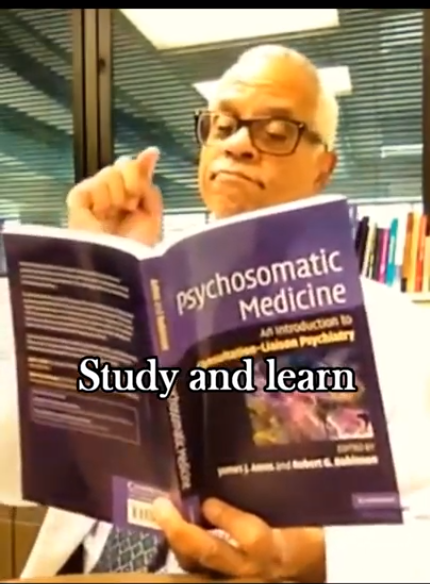
One mnemonic, described in my chapter in our book, Psychosomatic Medicine: An Introduction to Consultation-Liaison Psychiatry is [1]:
1. Amos, J.J., M.D., Assessment and management of the violent patient, in Psychosomatic Medicine: An Introduction to Consultation-Liaison Psychiatry, J.J. Amos, M.D., and R.G. Robinson, M.D., Editors. 2010, Cambridge University Press: New York. p. 58-63.
Containment before
Assessment before
Non-violent
Intervention before
Take down
Shameless plug…
The so-called CAN IT mnemonic is a reference mainly to
containment before all else in order to protect everyone involved in a Code
Green situation. An excerpt from the chapter on the importance of containment
is:
“Containment refers to ensuring that you and the patient both feel relatively safe in the assessment area. Preferably, both of you should have easy access to the door for escape if necessary. At first, it may seem odd to recommend letting the patient escape from the room, but the point is not to force the patient to run over you to get to the door.
Another issue of containment is to ensure that the patient gives up any weapons before you agree to do the evaluation. Sometimes, offering food or drink (not hot enough to injure if hurled in your face) will help set a non-threatening atmosphere. It’s helpful to avoid making intense or prolonged eye contact with the patient, because this may be viewed as threatening.
Always make sure that plenty of other people are available to help you if a take-down situation develops.
Containment under these conditions sometimes is achievable by simply being honest with the patient who is still able to hear you by admitting that he/she is saying or doing things that make you afraid. This may seem counter-intuitive. But, provided it’s delivered calmly as a statement followed by reassurance that you and everyone else involved are committed to maintaining the safety of all persons present (including the patient), this may capitalize on the patient’s own fear of losing control by assuring that you’ll do everything in your power to keep the lid on the situation.”
You can see the exuberant YouTube videos below, illustrating
these principles made by talented trainees in our psychiatry residency program
in 2008.
In 2009, Dr. David Mair, MD was the producer and director of the video. I see he’s now with Innovative Psychological Consultants (IPC) in Maple Grove, MN (they get a lot of snow up there!). Below is his introduction to the videos:
Early in my training, I didn’t quite know how to react with potentially
violent patients. No amount of knowledge
of medicine, physiology, or the DSM provided me the skills to address these
situations. Though we had excellent
training during orientation, I really learned by observing skilled clinicians,
and through my own encounters, both good and bad. This was exemplified during my rotation in
consultation-liaison psychiatry, when working with Dr. Amos, to learn his
logical, step-wise approach, see him in these problematic scenarios, and to
practice what I had learned.
In making this educational video, I wanted to give incoming residents a
quick way to make these observations, and present it to them in a way that was
both useful and entertaining. It helped that I had a cadre of multi-talented
peers and a faculty supervisor who recognized the utility of such a
project. Though managing these patients will
be an eternal source of anxiety for all psychiatrists, my hope is that with
this video, they will feel just a little better prepared. —David Mair, MD.




 Go Retire Psychiatrist