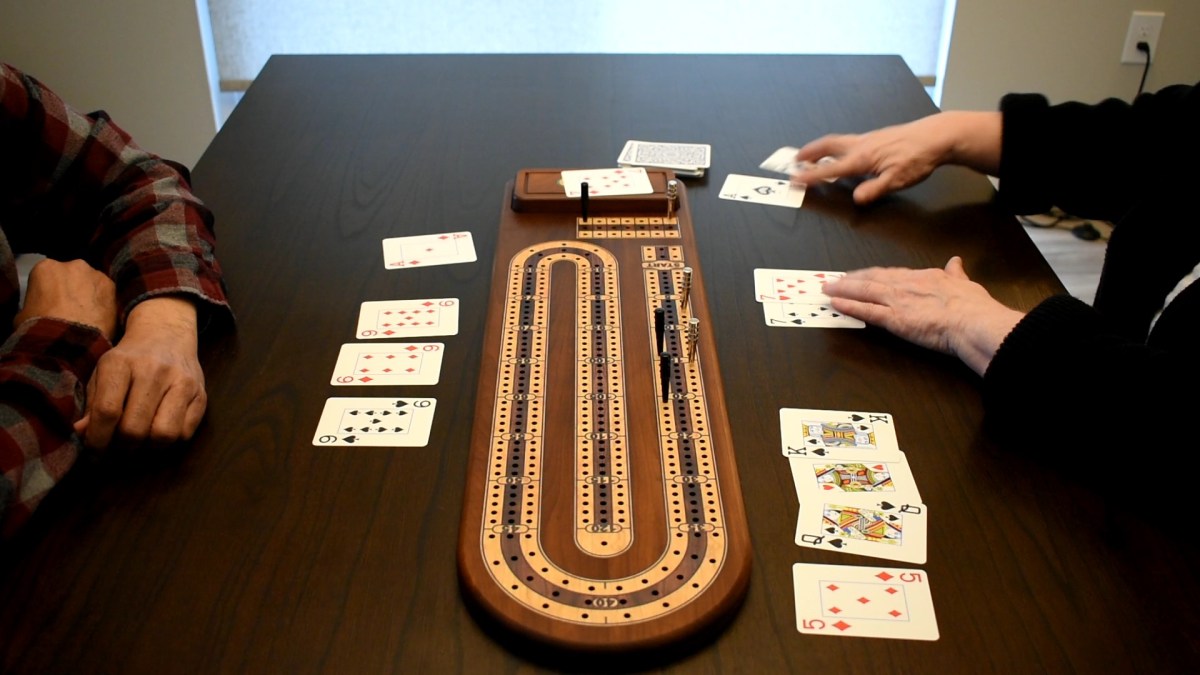
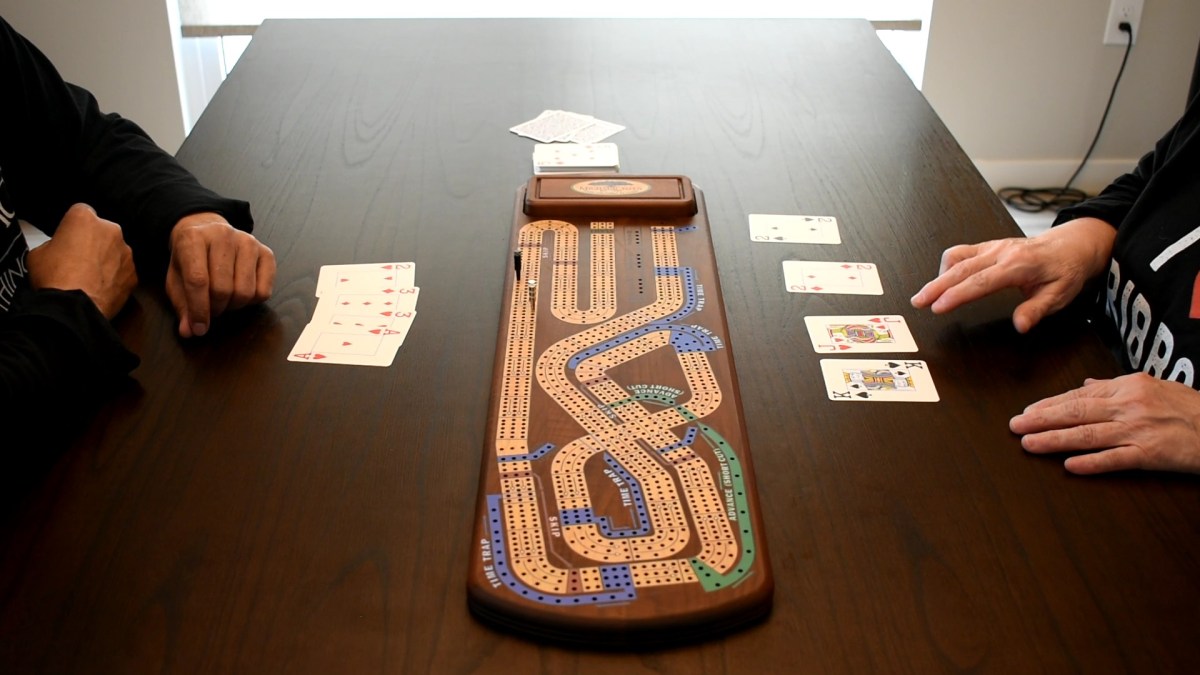
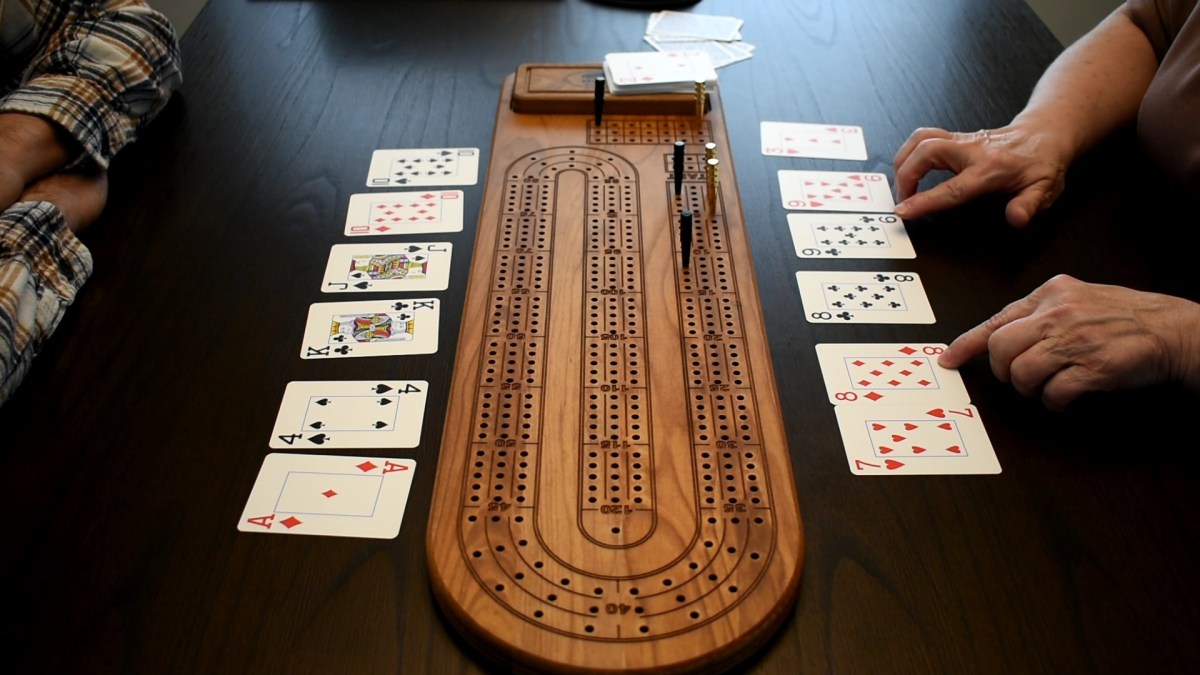
Hey, we played our first game on our brand-new jumbo cribbage board from Michaud Toys in Canada! It looks great! The numbers are easy to see and it seems easier to peg on.
We also got two new batteries for our Nikon camera and it supports recording an entire game which keeps us from fretting over how much time we play while filming.
You might notice we used what we call a “short cut” in counting runs when scoring hands. See this nifty article on how to do that!
Well, by some miracle we got through a Cribbage Rumble game yesterday and we recorded the whole 75-minute event for posterity. We reviewed it several times and it looked pretty good this morning although we were so delirious by the time we finished the marathon, there might be a few bloopers. I also reviewed our house rules and the updated version is below.
This took much longer to play than our first two cribbage wars games we played on the Ebonwood board and which are on my YouTube channel (@JamesAmosMD). We finished those in an hour. This one took 75 minutes.
One question that arose was what does a player in the Blue Time Trap do if his opponent lands in the Blue Penalty Box? I think AI was the only one who explicitly states what happens and it’s below:
According to AI which is the only source for guidance. Although it gives the Crib Wars rules as a reference, I couldn’t find it in the actual pdf source on the web. Anyway, what AI says happens if your opponent lands in the Blue Penalty Box while you’re in the Blue Time Trap:
“Yes, if you are in a blue time trap, you can absolutely use the 20-point forward movement gained from your opponent landing in a blue penalty zone to move forward and potentially exit the trap faster. The rules state that the opponent of the player landing in the penalty box moves 20 holes forward, which takes precedence over your current trapped status.
Key Rules for this Scenario:
Opponent Penalty: In a two-player game, when your opponent lands in a blue penalty box, you, as the opponent, advance 20 holes.
Time Trap Escape: When in a blue time trap, you must follow the blue path. Advancing 20 holes via your opponent’s penalty helps you reach the end of that blue path faster.
Interaction: The forward movement from the penalty is added to your current position, allowing you to move through or past the time trap’s designated path.”
Note: According to Ebonwood rules, an award of 20 points cannot place a player into a new penalty box or time trap; if it would, you skip to the first hole beyond it.
But since neither one of us ever hit the penalty box, that scenario never happened.
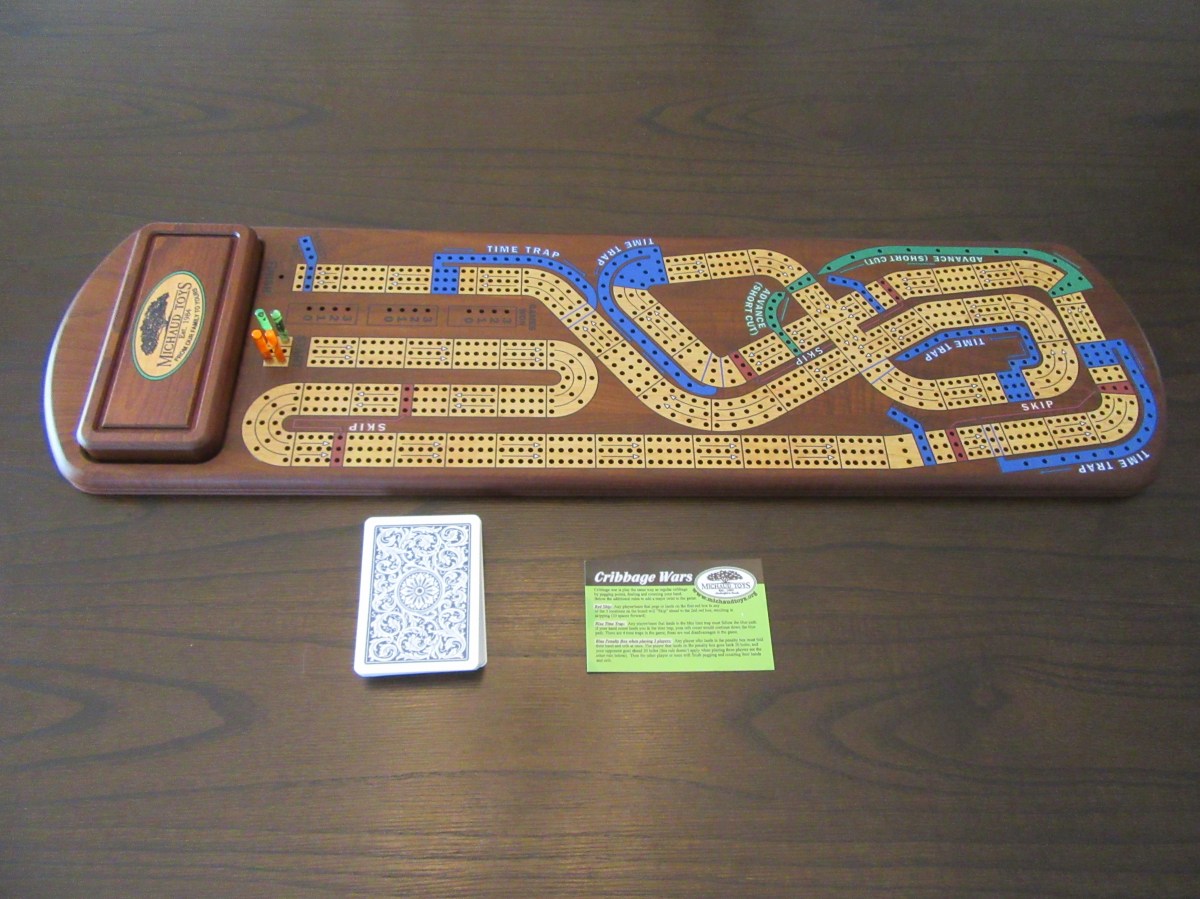
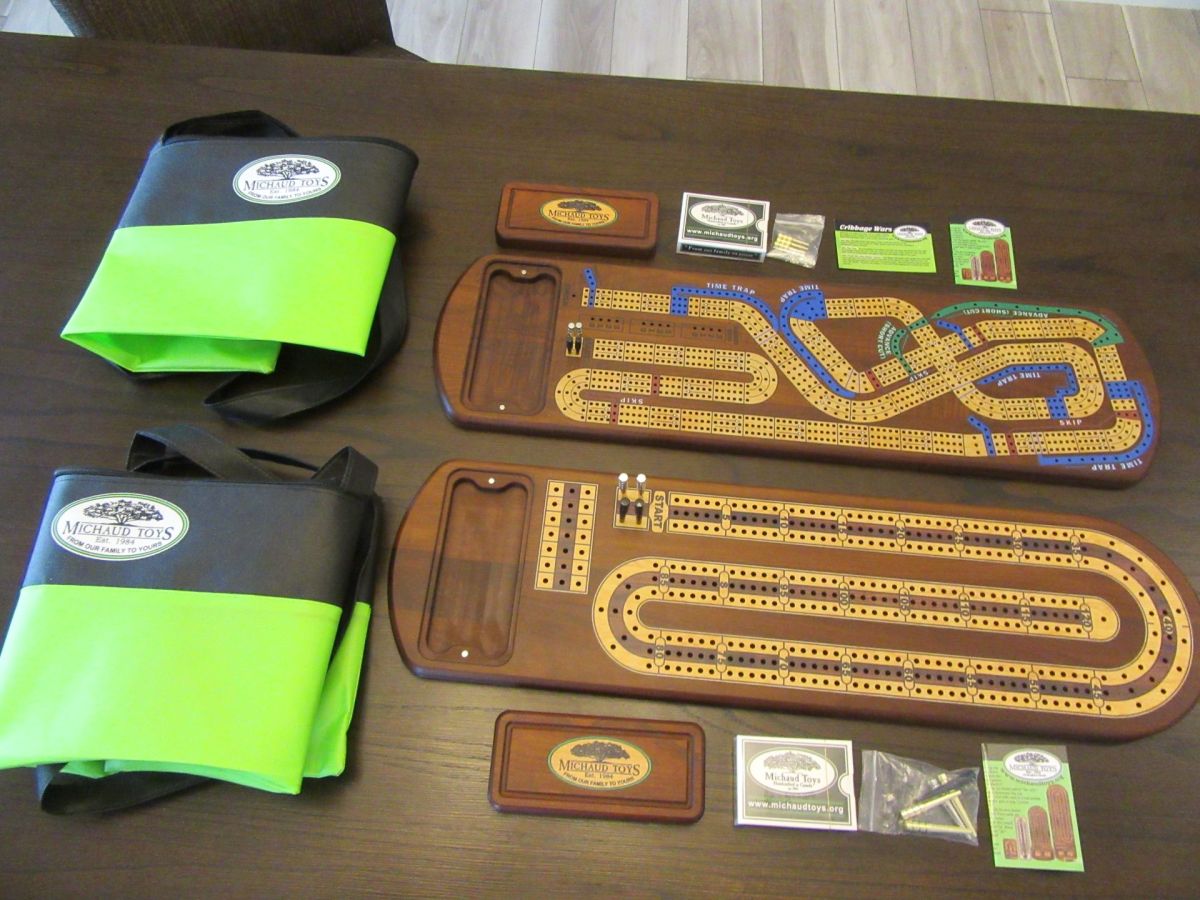
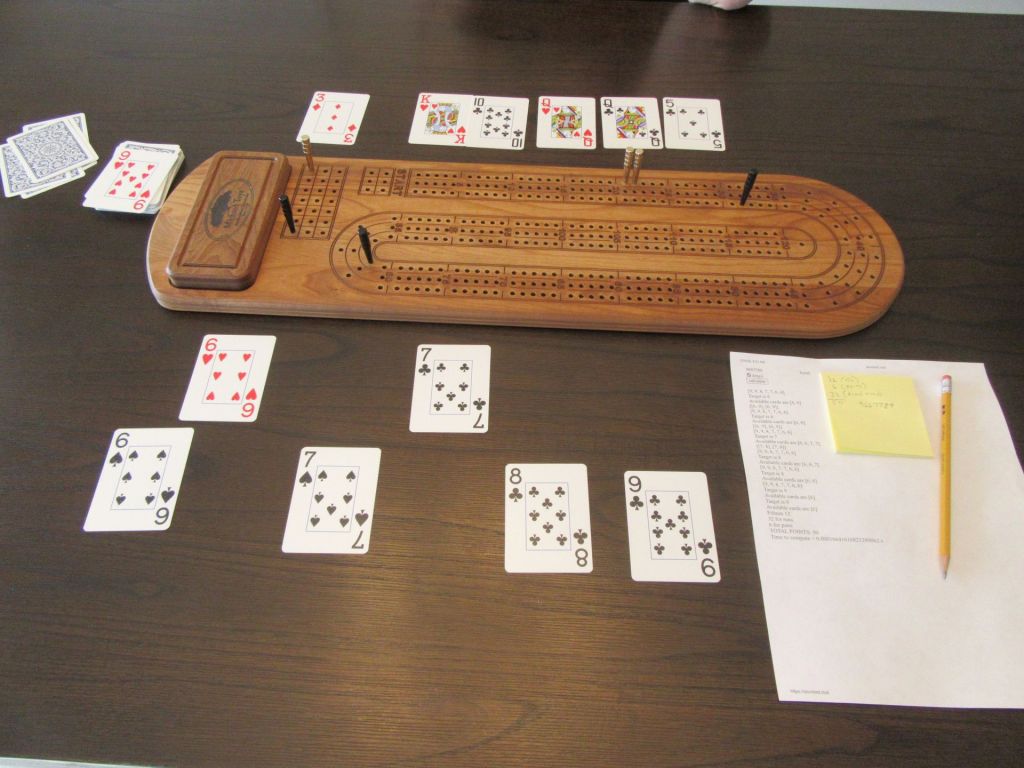
A few words about our new Cribbage Rumble game are in order. First of all, the handsome Cribbage Rumble board is made by Michaud Toys in Ontario, Canada. It’s a slimmer design than our handsome Ebonwood cribbage board, but the basic zones are the same. It’s interesting that Michaud originally called the game Cribbage Wars about a year ago and later changed the name to Cribbage Rumble. On the other hand, when we got the board, it came with a special card with a set of rules for “Cribbage Wars.” The Ebonwood board (made in Wisconsin) cost $210 when we bought it in 2025. The Michaud Toys board cost about $90.
Interesting historical notes: Crib Wars was first invented by a couple of guys from Ontario, Canada. Norm Ackland and Robert J. Prettie patented Crib Wars in 2000. Norm was also an Elvis Tribute Artist (ETA). The terminology for the name of the game is a little confusing. Ackland and Prettie made the first Crib Wars game. There’s also Cribbage Wars, marketed by Ebonwood. They are the same game with the same rules. Cribbage Rumble is also the same game as the first two.
Our updated House Rules for Cribbage Rumble (same as Crib Wars and Cribbage Wars):
There’s no Muggers Alley on either the Ebonwood board or the Michaud Toys board and we never play muggins. Below are my updated descriptions of the colored zones, which we discuss and demonstrate during the video.
Red Skips: There are 3 of these. The rule says if you land on the first red box you should slide to the next red box which gets you 20 holes further along the board. The red box just means the set of 3 holes highlighted with a red color. You get from the first one to the next one by just moving the peg 20 holes. You’ll land in the 2nd set of holes marked in red. This is a boon in the first Red Skip area. However, if you pay attention to the directional arrows in the path guiding you, it looks like they accelerate you toward two of the Blue Time Traps.
Blue Time Traps: There are 4 of these and there will be three blue lines, meaning the blue color covers all three holes and all three peg tracks (3 holes along the track and 3 holes across the track). If you land in a set of three holes highlighted in blue, you end up moving to a blue area of holes that actually set you behind several holes. You have to play your way out of them. Players note that you can end up in repetitious cycling back to the traps largely because of how often you can get one or two points at a time while scoring. In fact, some say that if their opponent gets close to a Blue Time Trap they may purposely lead with a five card (something you would rarely if ever do in a standard cribbage game). That could trap the opponent into playing a ten card or a 5 card, which might risk them moving only a couple of holes right back into the Blue Time Trap. The same thing could happen with falling into the Blue Penalty Boxes. If you land in a Blue Time Trap and your opponent lands in a Blue Penalty Box, you can get out of the trap by moving forward 20 holes, which gets you out of the trap faster.
Blue Penalty Boxes: There are three of them. You fall into one of these by moving your peg into one of the single blue hole lines, meaning one blue track across the three peg tracks. This is a disaster because you immediately have to move back 20 holes and fold your hand and your crib while your opponent moves forward 20 holes, finishes pegging and counts their hand and crib (if they have the crib). Asking AI is the only way I could find out how to learn how to peg moving back and forward 20 holes. The player who lands in the penalty box moves their front peg back 20 holes starting from the penalty box. You don’t move the rear peg. If your front peg lands behind the rear peg, it becomes the new rear peg. The player who doesn’t land in the penalty box moves their front peg forward 20 holes. The player who lands in the penalty box immediately folds their hand and crib.
Green Advances: There are two of them. If you land in a green hole, you take short cut path. The long one saves you from moving toward the Blue Time Trap in the left lower quadrant. You don’t avoid the potential other trap above. If you take the normal track instead you end up moving toward the lower left quadrant Blue Time Trap—but you have a chance at getting into the short Green Advance track before you get there which loops back away from it and you end up going in the direction of the upper Blue Time Trap.
You think you’re in the clear after that? You’re not because there is a sadistically placed Blue Penalty Box in the next to the last hole before the Finish Line!
We’ve been working on the video for our marathon Cribbage Rumble game on our new Cribbage Rumble board. I plan to make the YouTube recording tomorrow! It made our heads spin!
Invisible to us anyway. We’ve been excited about filming our first Cribbage Rumble game and we thought the first video we got on March 25, 2026 was too disorganized and chaotic to accept.
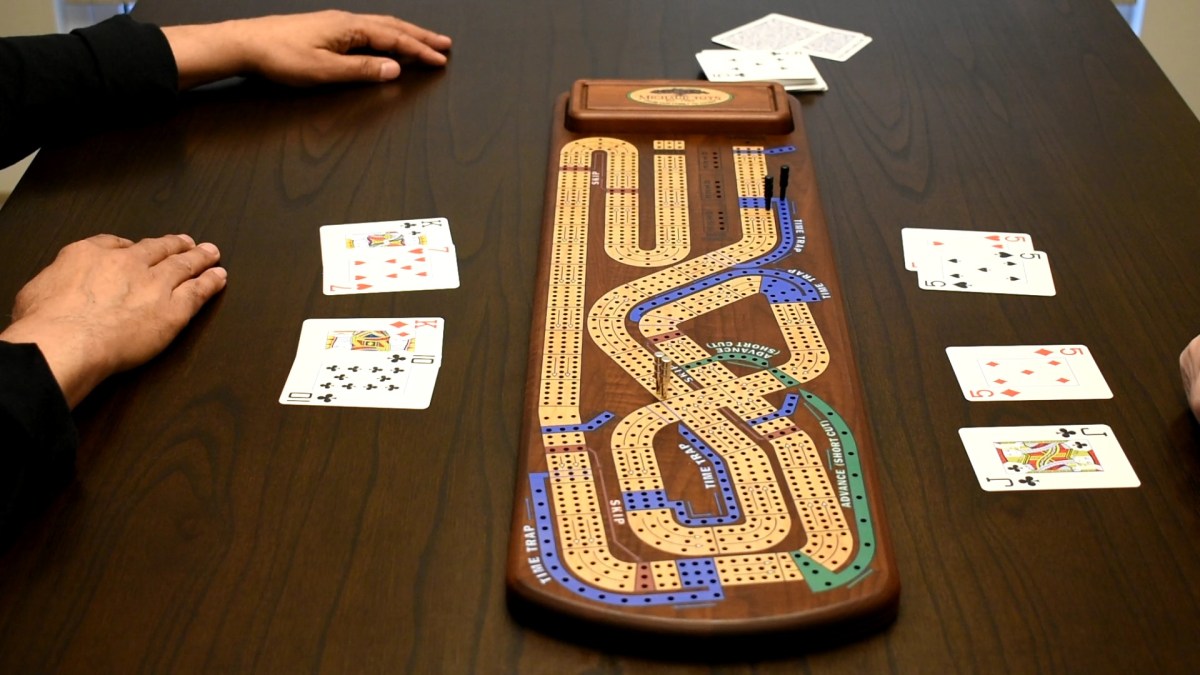
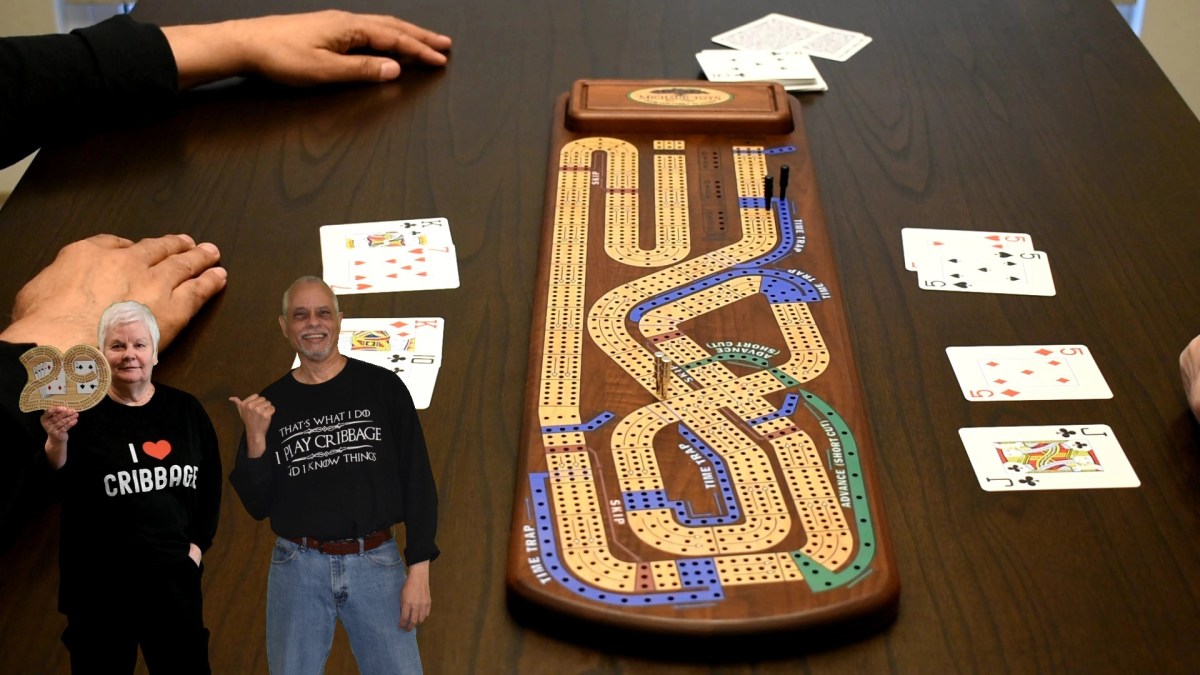
It’s a good thing I didn’t discard the clips—because Sena got a 29 hand. The trouble was we both failed to notice it! We have video evidence of the whole thing. It’s funny and spooky to watch.
OK, it’s time to start making excuses for why we didn’t see the 29 hand. We were playing Cribbage Rumble on our new board from Michaud Toys, so we were focused on the many zones and traps rather than thinking about anything so rare as the 29 hand showing up.
There’s no reason not to expect that a 29 score could happen in a 6-card cribbage game, but our focus was not on that. It was on avoiding things like Blue Time Traps and Blue Penalty Boxes.
Despite our focus on trying to score Sena’s hand, I think we failed to notice the obvious because the context was on Cribbage Rumble, not the rare 29 hand, the odds of which are 1 in 216,580 against getting.
I think that’s why our attention was on the four 5 cards and trying to count the 15s for 2 (which make 8 points) and the other 15s for 2 with the Jack (which is also 8 points). I knew that the four 5s is 4 of a kind which makes 12. In fact, when I said near the end of the video that I remembered seeing something “maybe once before in my life,” all I meant was that I’d seen 4 of a kind. That would have got us to 28 but we didn’t process that. We could see only parts of the elephant.
I think the other reason we didn’t react to it was that we’d played Cribbage Rumble all afternoon and into the early evening. We were tired.
It wasn’t until the next day that I used the skunkeddotclub scorer (just out of curiosity) to see what the total score was. It was 28. Then I added the 1 point because of the nob Jack (same suit as the club 5 card) and came up with 29. The scorer doesn’t deal with suits.
It still didn’t click. I told Sena that her hand’s total score was 29, in a totally offhand way. She didn’t really react to it, either.
Early this morning right after I first woke up, I began to wonder whether the score was an “alternate” way to score the famous and elusive 29 hand in 6 card cribbage. Over a few minutes, it finally dawned on me that thinking of it as “alternate” didn’t make any sense. It just was the 29 hand.
That’s when I got excited and told Sena about it. I said something confusing at the end of the video when I said something about seeing the hand “maybe once before in my life” but all I meant was that I’d seen 4 of a kind (scores 12 points). I still didn’t see that 29 hand at the time.
We finished the first Cribbage Rumble game on our new board today! Remember, yesterday the game was very long and I think the memory card pooped out at a crucial moment. So, today I went out and bought a new memory card with more space on it and we started from scratch making a new video of the game.
It went a lot better although we didn’t get done until late in the day. I’ll make the video tomorrow!
We just finished a train wreck, hilarious, Cribbage Rumble game with our brand new board from Michaud Toys this afternoon (it must have been 3 hrs!). We’ll put something together tomorrow on video if we can manage it!
We’re on schedule to get our new cribbage boards delivered today!
We played 9 card cribbage to 121 today and I got a 50-point hand! We both scored the complex hand, came up with 50 points, checked it with skunkeddotclub and it was correct! We played only 3 hands but the high scores led to a lot of time counting points. That’s why you’ll never see a 9-card cribbage tournament.
On the other hand, this might do something good for elder brain health.
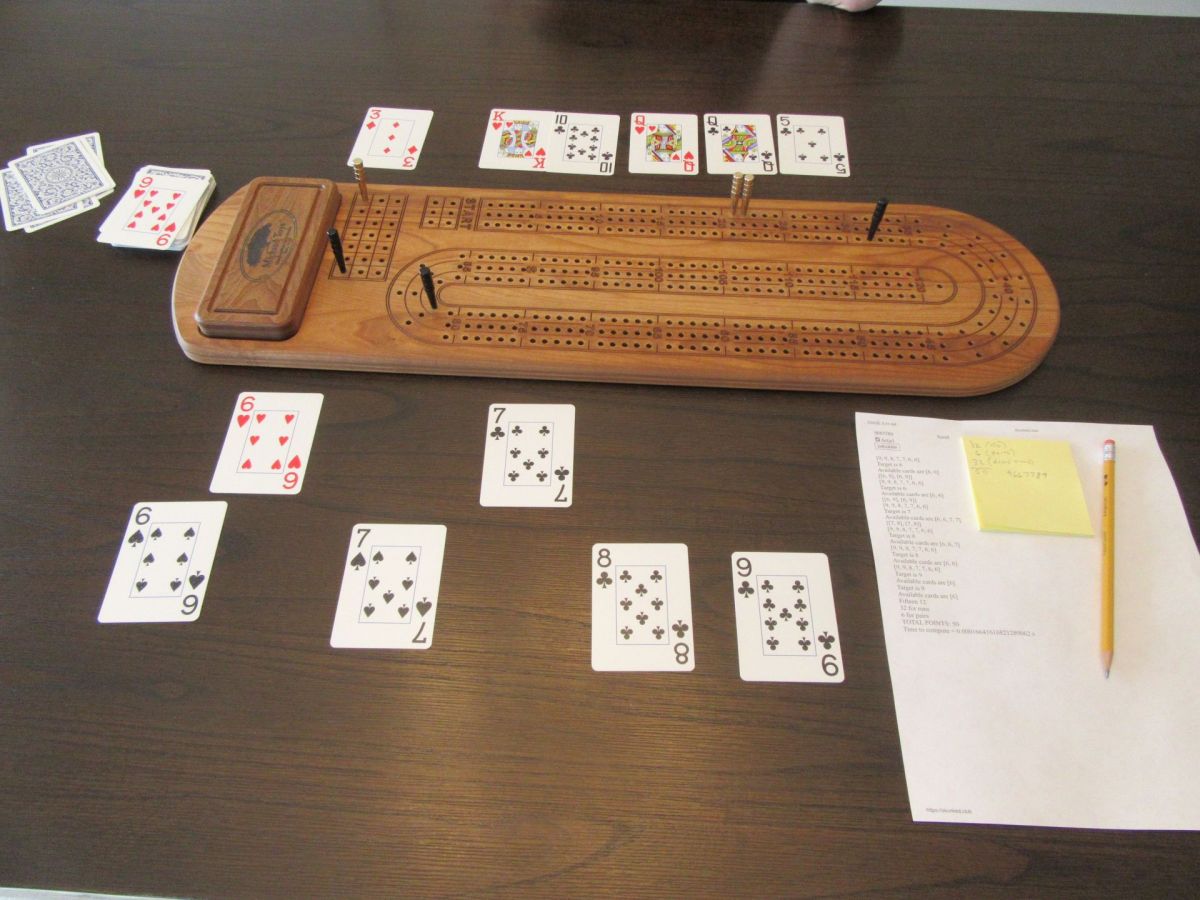
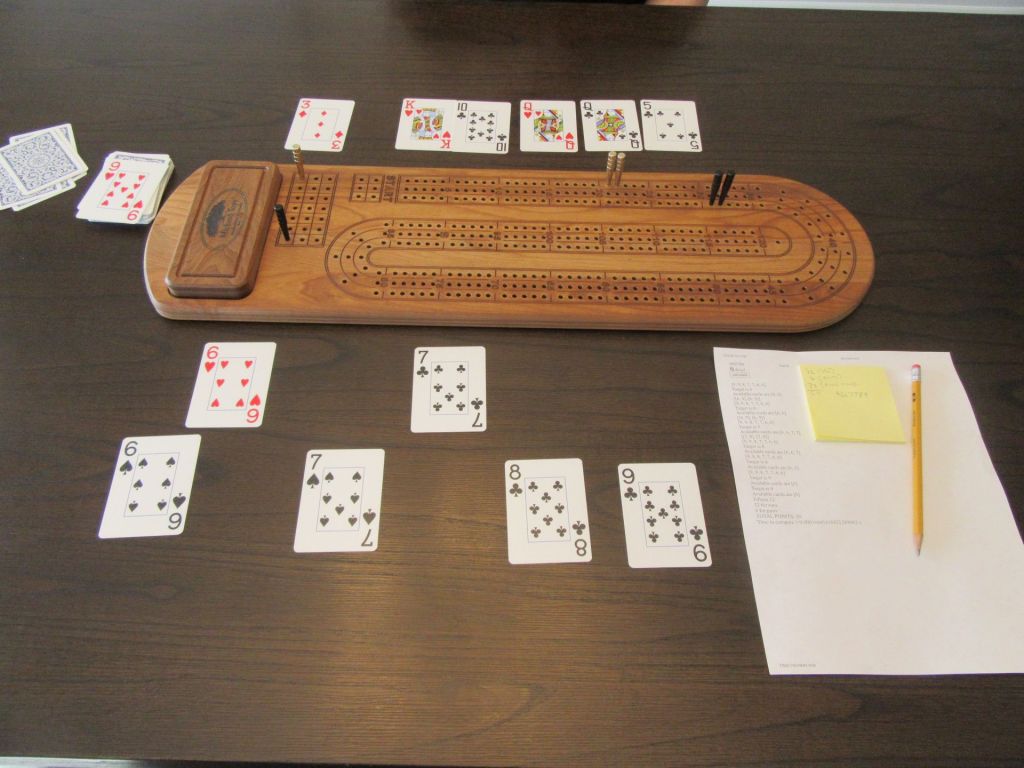
Counting the 50 points for runs was the most difficult part. There were eight different 4 card runs and spreading them out in the offset way shown in the picture made it easier to count them (32 points worth). There was 12 points for 15 for 2s and 6 points for the pairs. Adding the points for the runs, 15s, and pairs made 50. The photos compare the wide 50 point spread between my two black pegs before and after the move.
Before pegging the 50 pointsAfter pegging the 50 points
Today is the day of the answers to the cribbage score quiz last Friday. We were playing 7 card cribbage and got interesting hands to score.
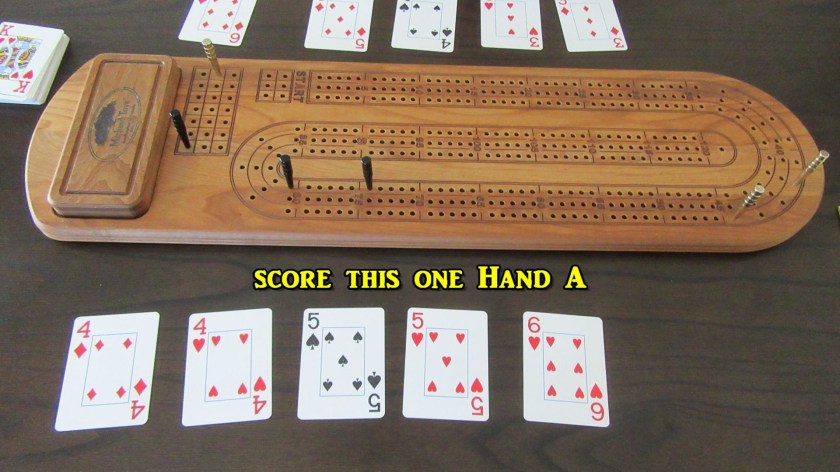
Hand A is 28: There are a dozen points worth of 15s for 2; there are 12 points worth of 3 card runs; and there are 4 points worth of pairs.
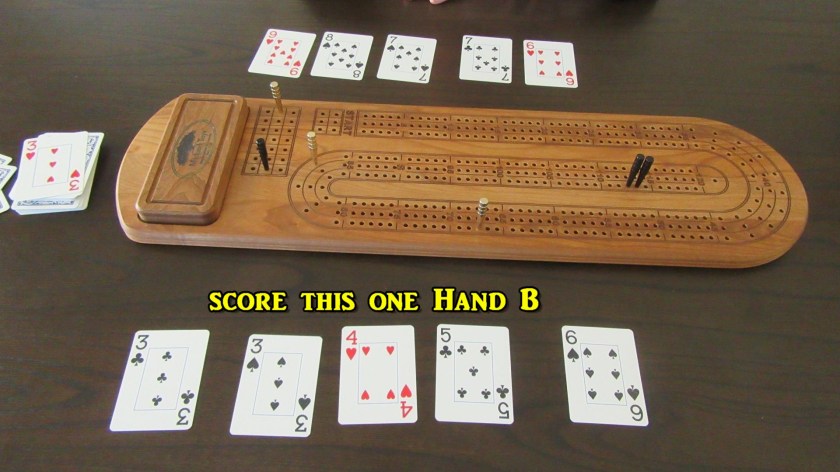
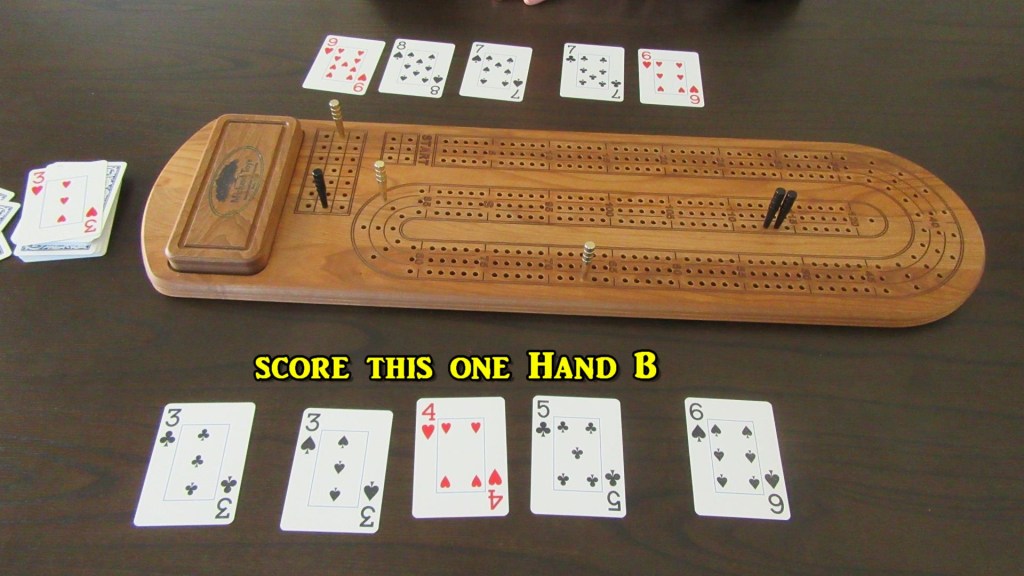
Hand B is also 28: There are ten points worth of 15s for 2; there are 12 points worth of 3 card runs; and there are 6 points worth of pairs.
There are short cuts to counting the runs, although it’s faster to use the short cuts for counting runs, it’s good practice to count the runs and pairs separately.
We’re improving at counting scores in 9 card cribbage. So far we’re only playing to 61 and we often finish a game in only a couple of hands.
We’re scheduled to get our two new cribbage boards from Canada tomorrow. I’ve got my fingers crossed.
Today we played 7 card cribbage and tackled challenging hand scores. It’s quiz time! First, we got to have some rules which are here.
For convenience, the rules are copied below from Masters Traditional Games web site:
“Seven card cribbage
Only experienced players play this game – it can get quite complicated. Play is to 181 points or three times around the board. Deal seven cards to each player and one to the crib. Then each player discards two into the crib so that each hand and the crib all consist of 5 cards.
Play is the same as for standard cribbage except that a flush can consist of 4, 5 or 6 cards for 1 point each card. However, you can only score a 4 or 5 card flush if all the cards in the flush are in the hand.
The highest score under seven card cribbage is 46 which can only be scored when the six cards, including the turned up card, are 6, 6, 5, 5, 4, 4. This is a total of 6 for 3 pairs, 16 for 8 fifteens and 24 for 8 runs.”
We didn’t have flushes. We scored them and did pretty well. I missed one of the fifteens on hand B. We checked our results, so we know the right answers.
Hand A: 44556K
Hand B: 333456
For this to work as a quiz, it’s more fun if you comment. I’ll post the answers this coming Monday.
We’re getting two new cribbage boards. They’re shipping from Michaud Toys in Canada. One of them is a new giant board similar to the one we got in 2020 but fancier. We’re also getting a Cribbage Rumble board which is basically the same as a Cribbage Wars board but shaped more like the narrower giant cribbage board rather than a big square. Otherwise, the hazards and bonus zones are the same but are sort of stretched to fit on the board.
Sena’s been after me for weeks to play 9 card cribbage, so because it’s St. Patrick’s Day, I gave in because we might get lucky and the game might be playable.
We used a computer scorer developed by somebody who posted about 9 card cribbage (and other cribbage variants) and has a link to a program he developed to help with scoring: skunked.club. I found this on a reddit thread.
We got so involved and had so much fun, we lost track of time and couldn’t film the last hand because there wasn’t enough space on the memory card. We used the scorer to check our counts and it was helpful. Sena won!



 Go Retire Psychiatrist