Shine Your Light

It has been a couple of days since my second COVID-19 vaccine shot a couple of days ago. Consistent with what is known about the side effect profile of the second jab, I had one day of the well-described generalized aches and fatigue besides the sore arm, which didn’t limit my activities. It’s working.

I want to thank the University of Iowa Health Care Support Services Building (HSSB) personnel for a kind, well-organized approach to the vaccine administration process for so many people. This was a way for HSSB to shine a light. It was also an opportunity for many to shine their lights—protecting others as well as themselves.
Dr. Patricia Winokur, MD, Executive Dean and Infectious Diseases specialist at the University of Iowa Hospitals and Clinics, deserves special mention for her superb educational video presentations on the COVID-19 vaccines. Now there’s a big light—more like a beacon.

Her father was George Winokur, MD, who was a very influential psychiatrist and a past chairman of the University of Iowa Department of Psychiatry. He had a great sense of humor and was fond of reminding trainees that we had a lot to learn. He came up with a set of 10 commandments for residents:

Winokur’s 10 Commandments

  1. Thou shalt not sleep with any UI Psychiatry Hospital patient unless it be thy spouse.
  2. Thou shalt not accept recompense for patient care in this center outside thy salary.
  3. Thou shalt be on time for conferences and meetings.
  4. Thou shalt act toward the staff attending with courtesy.
  5. Thou shalt write progress notes even if no progress has been made.
  6. Thou shalt be prompt and on time with thy letters, admissions and discharge notes.
  7. Thou shalt not moonlight without permission under threat of excommunication.
  8. Data is thy God. No graven images will be accepted in its place.
  9. Thou shalt speak thy mind.
  10. Thou shalt comport thyself with modesty, not omniscience.

I got a shout-out to the University on Match Day today. A special congratulations to the Psychiatry Department and the new incoming first year residents. I know they’re going to let their lights shine, especially if they commit Winokur’s 10 Commandments to memory.

I’m reminded of Dr. Joan Y. Reede, MD, MPH, MS, MBA, who delivered the Martin Luther King, Jr. Distinguished Lecture in January. Her light glowed. By the way, she delivered the 2018 Harvard Deans Community Service Awards to medical students whose lights shone brightly.  

I also remember my former English Literature professor at Huston-Tillotson College in Austin, Texas ages ago, Dr. Jenny Lind Porter-Scott, who carried her lantern high. I have a copy of one of her books of poetry, The Lantern of Diogenes and Other Poems. The lead poem fits the theme today:

The Lantern of Diogenes

by Jenny Lind Porter

All maturation has a root in quest.

How long thy wick has burned, Diogenes!

I see thy lantern bobbing in unrest

When others sit with babes upon their knees

Unconscious of the twilight or the storm,

Along the streets of Athens, glimmering strange,

Thine eyes upon the one thing keeps thee warm

In all this world of tempest and of change.

Along the pavestones of Florentian town

I see the shadows cower at thy flare,

In Rome and Paris; in an Oxford gown,

Men’s laughter could not shake the anxious care

Which had preserved thy lantern. May it be

That something of thy spirit burns in me!
St. Patrick’s Day Reflections: COVID-19 Vaccine 2nd Jab and More

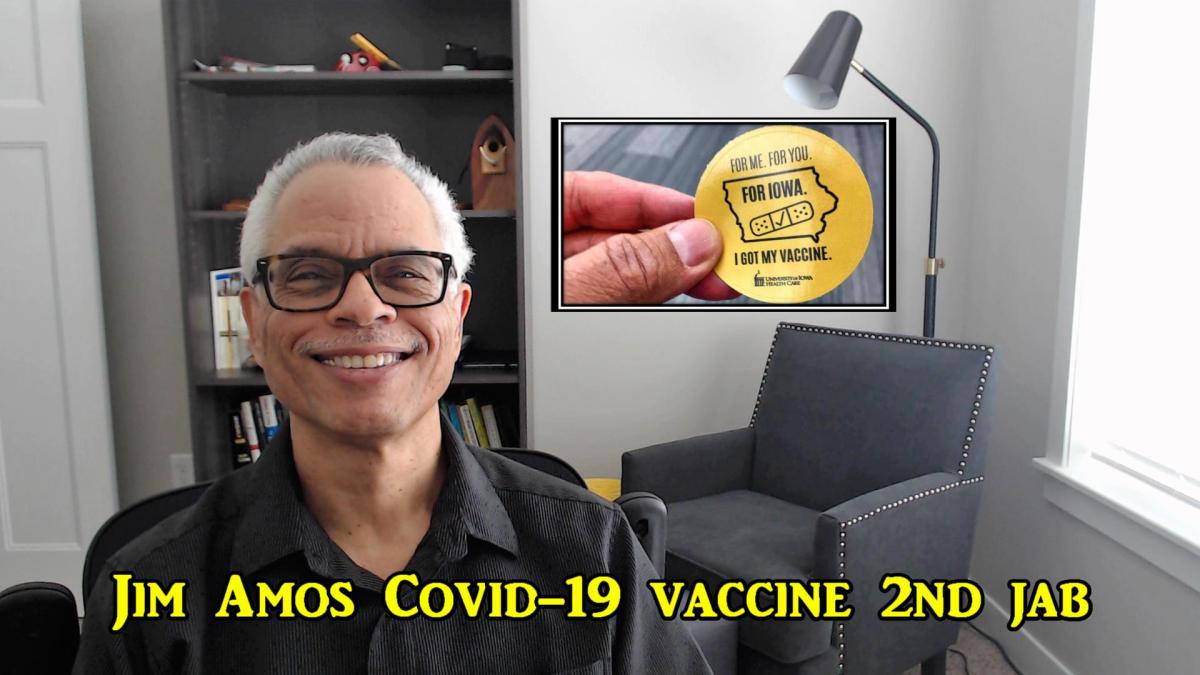
This morning I got my 2nd COVID-19 vaccine shot at the Health Care Support Services Building (HSSB)—just in time for St. Patrick’s Day, as luck would have it. Sena got her first shot yesterday and is scheduled for her second next month. I forgot to wear green, which worried me a little while I was waiting in line when the lady ahead of me poked a lot of fun at a guide for the same sin. He pointed to something bright green on the sole of his shoe, which I didn’t inspect too closely, and which didn’t pass the lady’s inspection.

After my first shot last month, I had some swelling, soreness, redness, and itching in my left arm which didn’t limit my activities. Today, the nurse affirmed that my symptoms after the first shot were not uncommon and that I might have more symptoms after my second shot—or none at all. Like my first experience, the process was very smooth and fast.

I didn’t pay much attention to the type of vaccine I got. I felt lucky to get it. All three, Johnson and Johnson, Moderna, and Pfizer are effective. According to a recent news report, about 88% of Americans who got the first dose of the Pfizer or Moderna vaccine completed the 2-shot series, based on a CDC study of 12 million people.

In other important news, just this past Sunday I spread crab grass preventer and fertilizer on our lawn. On Monday, I shoveled snow from our driveway. Sena assured me that the snow would not hinder the lawn treatment. In fact, things are greening up nicely for St. Patrick’s Day.

The robins have probably been around for about a week. I noticed a robin standing in the street Monday while the snow was coming down. It was mesmerized and seemed to be thinking like me, “Just my luck. Now what?” But the robin didn’t have to shovel a driveway. Luck comes and goes.

I nearly got a 29-hand playing cribbage with Sena last night. She nearly always wins. The odds of getting a 29-hand are 1 in 216,580. In my hand I had the jack of spades and 3 of the four 5 cards. All I needed was a spade 5 cut card, which I did not get. Some players think cribbage is 2/3 luck and 1/3 skill. You need both.

Me and the robin keep looking for the warmer spring sun, and any other good fortune which is coming—and not dependent just on luck.

Messages of Hope on the Terry Trueblood Trail

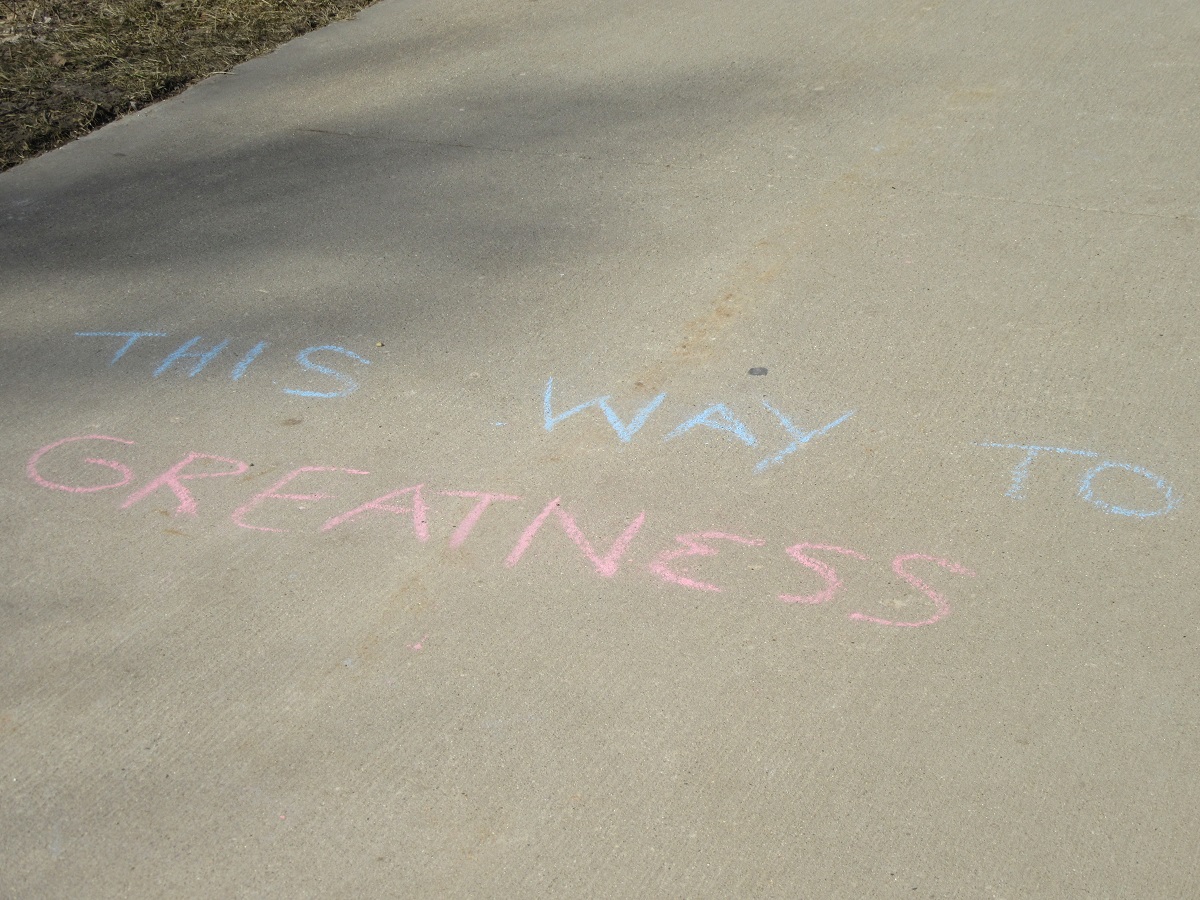
Spring was in the air as we took a turn around the loop of the Terry Trueblood Trail. There was something different about it since we were there in late December. The wind was not as blustery. What leaped out at us were messages of hope written on the sidewalk in brightly colored chalk. The messages said things like “This Way to Greatness,” “Enjoy That View,” “Go Go Go,” and “Stay Strong!”

Along with these written messages were other signs of hope. One of them was a beaver slapping its tail in an unfrozen section of the lake, near its lodge. Snow-white geese and gulls sat further out on the ice, heads tucked in their wings—for now gathering strength before thundering into the sky.

It has been a long year. The pandemic of coronavirus and corrosive social and political upheaval exact a heavy toll on the spirit. It’s hard to see beyond what is callous, pathetic, and catastrophic.

The walks along the Terry Trueblood Trail are often healing, even if only in a small way. It made me wonder who Terry Trueblood was. I found a description of him on the web. Among his many accomplishments, he was Iowa City’s Director of Parks and Recreation. The Iowa Park and Recreation Association unanimously renamed its highest professional award the “Slattery/Trueblood Professional Award.”

Terry Trueblood was a very dedicated professional but more than that, he was devoted to his family. He had a great sense of humor. He was compassionate and generous. He was fair, honest, and was “the definition of integrity.” He “benefited every life he touched.” There are no signs in life pointing the way to greatness. Terry Trueblood found the path anyway.

It’s easy to ignore or deplore the countless common stones we find. We need to see the rare diamonds of hope in the spring.

Music Can Heal

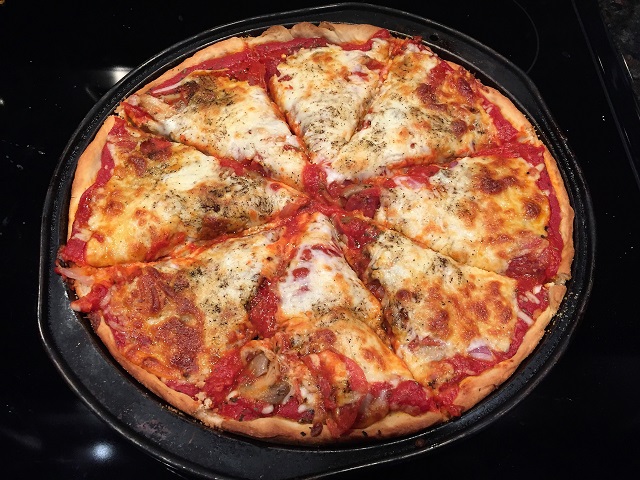
Here’s another post on music. This one got started while watching Eric Clapton Crossroads Guitar Festival 2019 last night on the Iowa Public Broadcasting Service channel. It’s great pizza and beer music. It was the fifth event of its kind since it got started in 2004. Part of the profits go to support the substance abuse treatment center in Antigua, founded by Clapton. Although inpatient treatment programs are currently suspended because of the COVID-19 pandemic, a virtual intensive outpatient treatment program is available.

I don’t mean to belittle Crossroads with the pizza and beer remark. I’m leading up to something and there is nothing wrong with enjoying music of any kind along with pizza and beer. Clapton and Peter Frampton did a superb job doing an old Beatles’ tune, “While My Guitar Gently Weeps.” Clapton did the original guitar solo on that one, which I didn’t know. Sheryl Crow and Bonnie Raitt rocked out Bob Dylan’s “Everything is Broken.” Many of the artists were older than me (I’m no spring chicken although they are definitely not retired). However, a newcomer, Lianne La Havas, delivered an outstanding cover of “I Say a Little Prayer for You,” originally sung by Dionne Warwick, later by Aretha Franklin.

It was great fun listening to these old songs. Most of them, except for “I Say a Little Prayer for You,” did tend to remind me of all the trouble going on in the world now, including the pandemic, political vitriol, and violence. Come to think of it, we could all use a little prayer right now.

I thought about posting the YouTube videos of a few of the Crossroads Festival songs. But I noticed that one of the YouTubers carried a large number of deleted videos, possibly due to copyright infringement issues, and they’re relatively recent. I figured the posted videos might not last long.

This brings me to an old (meaning much older than the 1960s) classical work I heard recently, “Vaughn Williams: Fantasia on a Theme by Thomas Tallis.” I saw it on the Light Classical cable music channel I wrote about a couple of days ago, the one about Samuel Coleridge-Taylor.

This one actually woke me up while I was sleeping on the couch. I frequently fall asleep to most classical music, partly because it helps me relax. However, the Vaughn Williams Fantasia didn’t just calm me—it also energized me. I’ve heard about the quality of music that can do that for people, but I was a bit skeptical. I have since looked for YouTube versions of the work, trying to find the same one I heard on the cable music channel.

I’m pretty sure I found it. It’s the one recorded by the Philharmonia Orchestra (London, UK) just last month, October 2020. I’ve listened to a couple of other highly praised recordings you can hear from a YouTuber called 2ndviolinist. One was by the Boyd Neel String Orchestra conducted by Boyd Neel in 1936. The other was done by the Halle Symphony Orchestra, conducted by Sir John Barbirolli in 1946. Both are widely thought of as masterpieces.

The Philharmonia Orchestra players are all spaced at least 6 feet apart, adhering to the social distancing required to reduce transmission of COVID-19. If I close my eyes (or even if I don’t), this doesn’t make me nervous as I listen to the oceanic sonority of the music itself. Many comments about the recording attest to the beauty of the piece, making it a soothing treasure in our troubled times.

I’m less worried about the possibility of the video ever being deleted. I felt the same way about the one by Samuel Coleridge-Taylor. It isn’t just because they’re old and copyright issues may be less of an issue. It’s more because they’re probably universally viewed as vital for healing our souls. At least I hope so.

Grab a pizza and a beer—and enjoy music that heals.

Stumped

Ever since the derecho last month, we’ve been stumped by stumps—tree stumps. It has been a lesson in the value of persistence. The tree in our front yard got knocked over almost right at ground level. I cut it up with a 20-inch hand saw. But the stump has me stumped so far. You can google “stump removal” and get an idea of what your options are.

One method is to use chemicals, involving drilling holes into the stump, into which the chemical is poured along with water and waiting patiently a few years. One guy’s review of a product revealed what appeared to be a basic misunderstanding of the procedure. It involved mixing the chemical with peanut butter, applying it to the stump which he then set on fire to make a smoke signal which could allow lost hikers to be more easily rescued. And by the way, it also hastened the rotting of a tree. The reviewer even included a photo of the heavily smoking concoction. I suspect the manufacturer published the review mainly for entertainment.

We took a half-hearted stab at chemical rotting. I mainly used a bow saw, believe it or not. That didn’t get the stump low enough below ground level to assure grass would grow above it.

Manual labor methods usually include recommendations for using a chain, a truck with 4-wheel drive, a wrecking bar, shovel, mattock, axe, and a few sticks of dynamite.

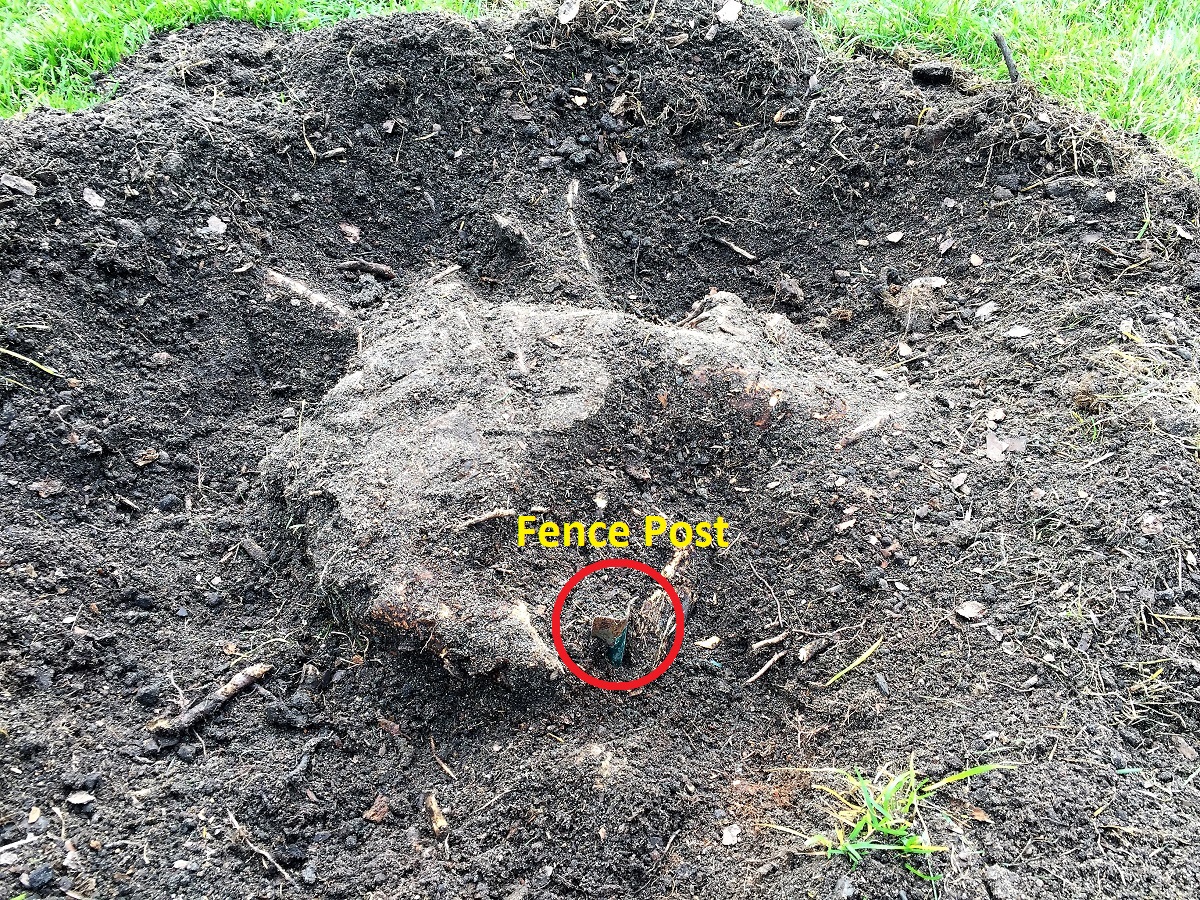
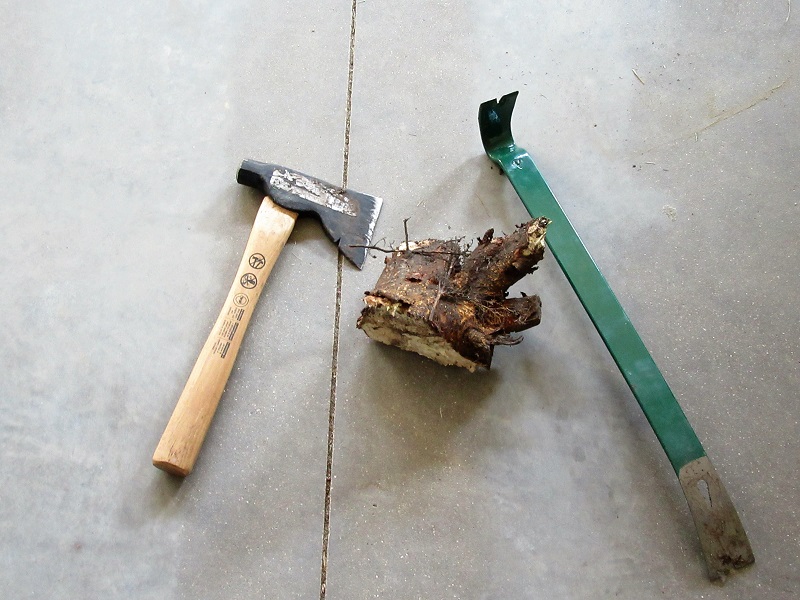
Manual labor has been the main method so far. There was a wire wrapped around the stump and three steel T-bar fence posts, which were probably placed when the tree was first planted several years ago. We got two of the T-bars out but couldn’t get the last one loose (only breaking it in half) until I got a hatchet and a pry bar. Thick roots were wrapped every which way around it and meandered off in all directions. I chopped and pried for hours until I could finally yank it out with vise grips. We hacked a softball-sized chunk of root out of the tangle, and managed to amputate several others away from the main stump. That is why I’m not a big fan of the manual labor method.

And then there’s a guy named Frank, half of a duo owning a stump grinding service. I called him and he came over the following day, shortly after I had removed the T-bar—which probably would not be the best thing for the 21-inch blade on his giant stump remover. He plans to grind it sometime in the next week.

I knew I could rent a stump grinder, but I would never do a thing like that. I’m not the handiest guy in the world, putting it mildly. I’m lucky I didn’t amputate a digit (along with a root) with the hatchet.

We talked with Frank in the front yard as he examined the stump. He said, “Oh, that’s nothing.” He quoted a fair price, which was far less than how much I would have had to pay to rent a stump grinder—and to cover the costs of emergency room charges, damage to the machine, the house and the neighborhood from a runaway grinder.

Frank is pretty busy and we speculated about what the main reasons might be, naturally one being the derecho. Frank thought the coronavirus pandemic might be another one. People sit at home either in self-isolation or quarantine and they have more time to stare at longstanding problems around the house and in the yard.

Having time on your hands can lead to boredom and brooding, which can happen to retirees like me. There are times when I would rather hack at a tree stump than read the daily news. I have to keep focused on where I’m aiming the hatchet or how I’m holding the power pole saw, which occupies me, makes time go by faster, and makes me tired and sore at the end of the day. I feel like I accomplished something. Frank retired several years ago and only later set up the stump grinding business.

We’ll see what happens next week with the stump. Frank’s business card has a picture of his giant machine. He can operate it by remote control. You can see what that looks like in a couple of videos at the website which markets the grinder he uses.

Hanging In There

It has been a while since my last post. I’m hanging in there although sometimes it’s difficult to stay optimistic. I’m reminded of the Survivor Tree, the Callery Pear in New York City. You can easily google the story about this tree which somehow survived at Ground Zero after the 9/11 attack on America in 2001. We visited New York in the summer of 2017 and saw the Survivor Tree at the 9/11 Memorial & Museum plaza. It’s hard to believe that was 19 years ago. And now we’re dealing with the Covid-19 pandemic.

I’m still adjusting to my new identity as a retired person. I was reminded of that when I read the recent post “What is your Identity?” on 9/12/2020 by The Good Enough Psychiatrist. She’s resilient and optimistic, traits I admire. I tend to be rigid and pessimistic, especially when I have a lot of time on my hands.

I also need to get out of my head. It’s amazing how easily reminiscence can morph into rumination. Galloping all over the hospital as a psychiatric consultant distracted me from that habit. On the other hand, Sena and I reminisced the other night for quite a while. I was astonished at how much we both recalled about our 42-year long marriage and the adventures and challenges we’ve been through.

Our first house was a challenge. Shortly after we moved in, I had to try to mow the tall grass which had been neglected for a long time. I had to use either a scythe or a weed whacker. I honestly can’t recall exactly what I used but the scythe sounds more impressive, so I suspect it has crept into the story more for dramatic effect. It was a very hot day and my first encounter with my neighbor from across the street was his generous act of lending me his power lawnmower. He was a white man and, back in those days, kindness in that context was uncommon.

The only time I used a power mower other than at that house was when I went to Huston-Tillotson College in Austin, Texas. It’s now called H-T University. It was one of the historically black colleges in the country and I recall feeling a bit awkward there since I had grown up in largely white neighborhoods in the Midwest. Anyway, I helped mow the campus grounds. I guess “helped” might not be the right word, especially if you consider the perspective of the groundskeeper who was in charge of fixing the power lawnmowers I destroyed. I wrecked a few mainly because I kept running over rough, rocky ground. After I dragged the 2nd or 3rd ruined mower back to him, he stared at me and shook with rage. Mercifully, memory fails me at this point.

I’m realizing I could probably go on rambling like this for a good while. I guess that might mean I’m gradually adopting the identity of a garrulous old retired guy. I know that sounds pessimistic.

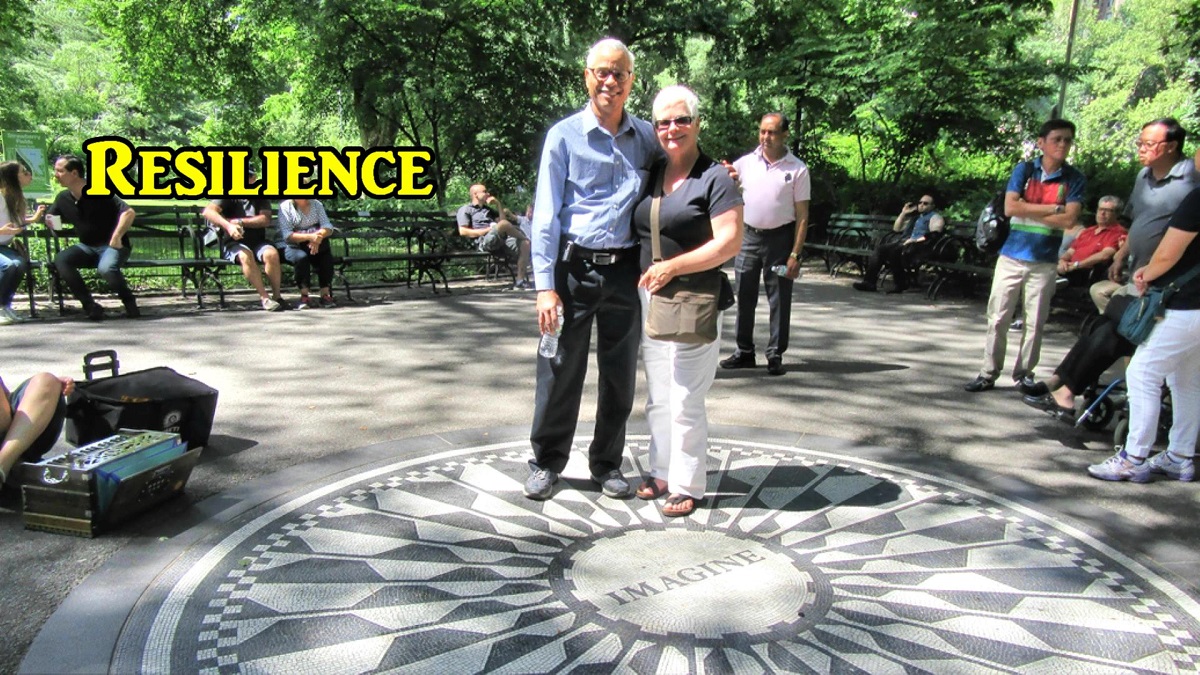
On a more positive note, Sena and I had a great time in New York City three years ago. We’re glad to have the memories. Sena is optimistic and resilient by nature. She’ll help me imagine brighter times coming in the future.

Face Shield Assembly—If You Dare

At the hospital where I work, face shields are preferred over medical grade masks, mainly because they keep you from touching your face. We now wear face masks and shields, according to CDC guidelines.

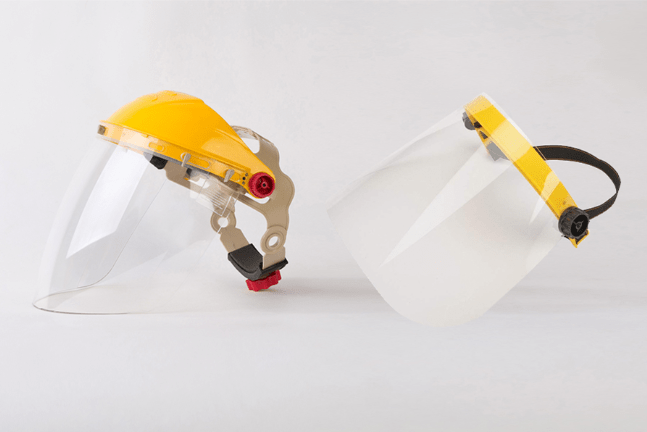
We got a couple of face shields through Amazon. It’s a kit you have to put together. I wish I had known that beforehand. The instructions in the package were not helpful and the picture guides on Amazon were not much better, but they at least got me started.

I put a few scratches in the plastic cover while putting one of the shields together. I did a little better with the second shield. I’m hoping that wearing these out in the community won’t become part of the new normal.

The Robins are Back

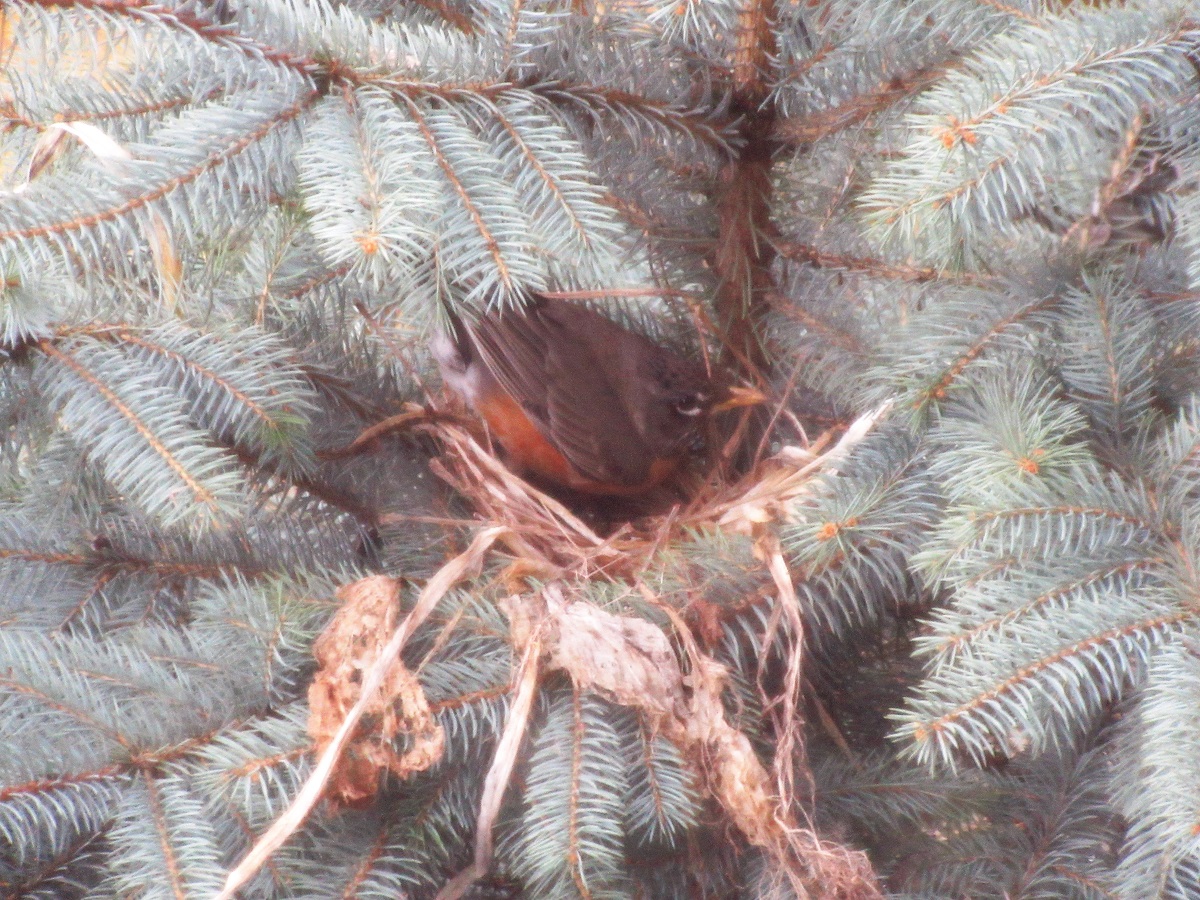
The robins are building their Hurrah’s nests in our back yard again. That’s about the only thing that has not changed. The COVID-19 (C-19) pandemic has changed just about everything else in our lives.

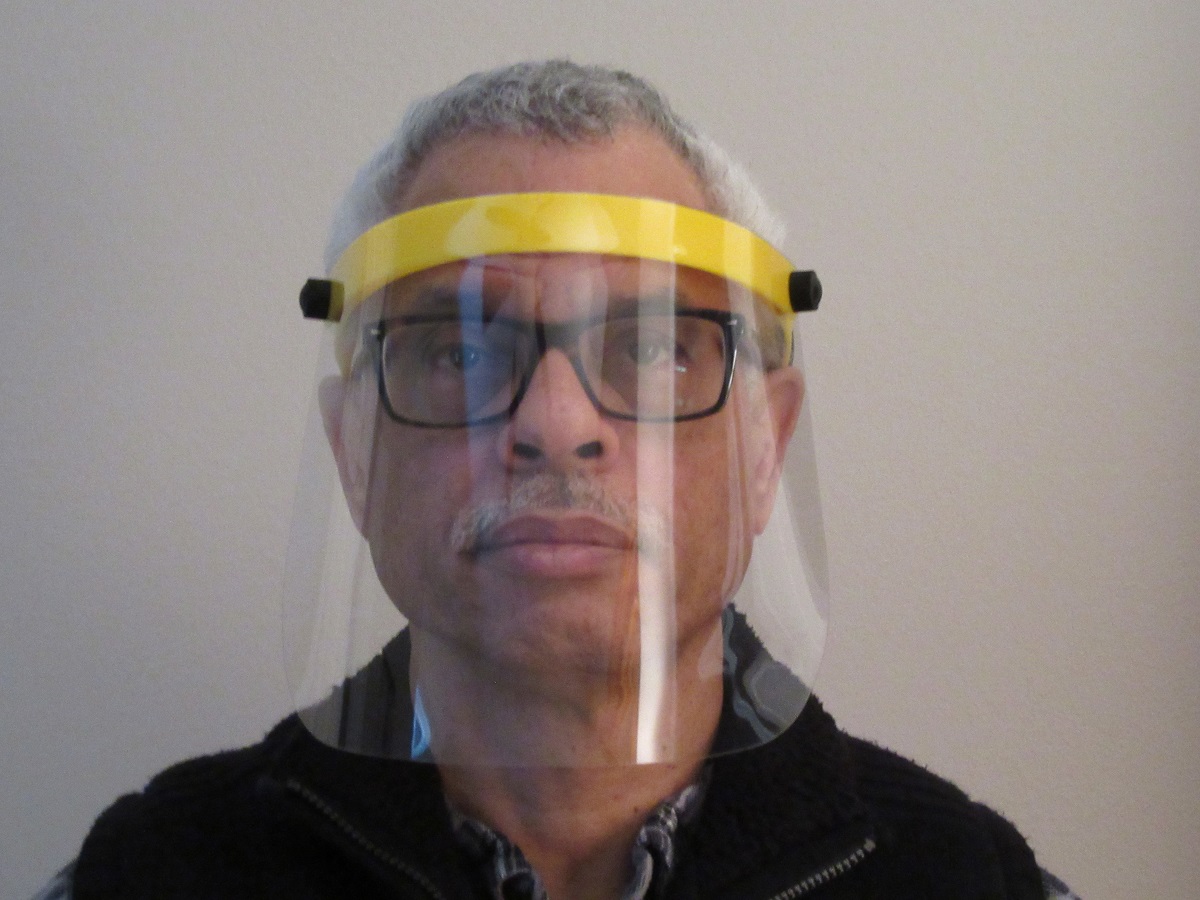
I wear a face shield now at the hospital. We’re told to wear it as much as possible, like putting on our clothes in the morning. Don’t we leave them on all day? The shield keeps you from touching your face, which is why it’s better than a face mask. However, I’ve noticed something about wearing the face shield for much of the day. Before I describe it, let me give you analogy: If you’ve ever worked detasseling corn when you were young a long time ago, you might remember what happened when you closed your eyes at night and tried to go to sleep. I saw corn fields—miles and miles of corn fields. When I opened my eyes, the vision would disappear. But as soon as I closed my eyes again, I saw the vast corn fields.

It’s crazy, but I have a similar sensory after-effect when I doff my face shield–sometimes I still feel the headband. The pressure of it is just the same as if I were still wearing it. I suppose it’s because I cinch it too tightly. But if I don’t, it slips down my brow, pushing my eyeglasses down my nose.

Another change—I’m a Consultation-Liaison (C-L) Psychiatrist, so I’m used to washing my hands in between patients in the hospital. Now, I’ve got something I’ve never had before–alligator hide patterns on the backs of my hands. They’re dry and cracked. I don’t count the number of times I wash my hands, but it’s a lot more frequent than I used to do. It’s not uncommon for health care professionals to wash hands 75-100 times a day in the C-19 era. I have to use hand cream conscientiously—something I almost never did.

I’m less comfortable being closer than several feet away from people. I tend to hug the walls and corners in stairwells, where I now encounter more people than I ever have before. I guess the message everyone hears is “Stand by me—six feet away if you please.”

I don’t shake hands anymore. The lines into the hospital sometimes lead to crowding while we wait to have our temperatures taken and answer the screening questions about whether we’ve had fever, cough, shortness of breath, etc. It’s perfunctory most of the time, because virtually always the answer is “no” and everybody is in a hurry.

I don’t carry my little camp stool with me anymore, which allowed me to sit down with patients and have face to face, eye level interaction. I’m distinctly uncomfortable standing over them because I haven’t done that in years. If there is a chair in the room, I’m hesitant to use it because, like the camp stool, I worry that it might carry C-19 virus on its surface.

I used to evaluate psychiatric patients in our emergency room by simply going there and seeing them face to face, either in their rooms or, when it was really busy (which is most of the time), in the hallways.

I just used a remote telehealth interface platform using an iPad the other day, which allows me to interview patients from my office, in order to avoid the risk of contagion. It was a little slow and awkward, and I was uncomfortable that a health care professional had to be in the emergency room to hold it up for the patient—who was covered in blood. I felt a little guilty.

I used to round with medical students and residents on our patients. We were the movable feast, a sort of MASH (Mobile Army Surgical Hospital) unit, more like Mobile Unifying Shrink Hospital (MUSH). Unifying means unifying medicine and psychiatry. The medical students are not permitted on the wards now, in order to protect them. It’s awkward rounding with only one resident at a time, although another resident can do other things like chart review and telephone relatives for collateral history. I get in the hospital earlier nowadays, and see many non-C-19 patients alone without trainees, preparing for the C-19 surge when I expect we’ll get many more consultation requests to help care for C-19 patients with delirium and depression. It’s a one-man hit-and-run psychiatry consult service and efficiency is mandatory to meet the demand.

I see patients by myself for another reason. Try as we might, C-19 positive patients will slip through the screens. Many are asymptomatic but contagious, and any test will have false negative results. The idea is to expose the least number of health care front line staff members as possible. Faculty capacity is stretched pretty thin, which is pretty much the situation everywhere. I have to choose. I’m older. I’m weeks from retirement. I’m afraid.

But robins don’t have the burden of choice. They obey their instinct every spring, just the same.

Snow Today

It’s snowing today, starting this afternoon. It’s not a blizzard. It comes down slowly and peacefully. Occasionally I see people and their kids and dogs out walking in it, likely grateful for the fresh air. It’s hard to be stuck indoors, self-isolating because of the COVID-19 epidemic. We play cribbage.

Sena tried the grocery pickup thing in order to avoid crowds. She ordered yesterday and picked up this afternoon. For the most part, the shoppers did OK. We noticed that as she was ordering, items would be sold out even before and sometimes after (we found out later) the ordering was done.

But we were able to get toilet paper.

This epidemic changes your life in many ways. I’m in the latter stage of phased retirement and I’ll go back on the consultation-liaison psychiatry service in April. I expect it to be busy, but I’ll likely not do as many face-to-face interviews, depending on the situations in the emergency room and the general hospital.

I probably won’t carry around my camp stool, which I use to sit with patients when I interview them. It’s just another item that the coronavirus can stick to.

We’re told not to wear neckties because they’re germy, but I gave that up a long time ago for banded collar shirts. But now I’ll have to remember to keep my arms bare up to the elbows.

We’re also reminded to avoid elevators so as to maintain social distance (6 feet or 2 meters, roughly). I’ve been taking the stairs for years. Many people avoid the stairs.

I’ve gotten used to handwashing because I’m a hospitalist. I’ll wear masks a lot more frequently as well as don and doff personal protective equipment as needed more often.

I’m older and I worry a little bit about belonging to a higher risk age group for COVID-19 and being exposed more. On the other hand, I’m pretty healthy compared to a lot of patients younger than me.

I’m glad the next generation of doctors will be taking over, though.

I usually never notice how pretty the snow is.

National Neuroscience Curriculum Initiative “Quarantine Curriculum” Starts Tomorrow

I was just notified about the National Neuroscience Curriculum Initiative (NNCI) “Quarantine Curriculum” this afternoon–the program starts tomorrow. It’s a 14-day program. It’s free and all you need to do is register (also free) to log in so they can track usage.

The Zoom web-based conferencing app will be used to facilitate the program. It’s being launched in response to the COVID-19 challenges to providing classroom teaching, one of which is to prevent spread of the virus by cancelling in-person classes. The course description and the Zoom link is here.

The recommendation for social distancing to reduce exposure is leading to school closures (I can hear children playing outside; it’s an all–day recess), and recommendations to find alternative ways to approach the didactic component of medical education. The Quarantine Curriculum is one way.

NNCI is designed by medical educators to meet the need for building a strong neuroscience knowledge base for residents across many disciplines in medicine and psychiatry. I think it’s an excellent platform and one of our faculty members is on the NNCI executive council.

NNCI makes learning neuroscience fun. Check it out!