
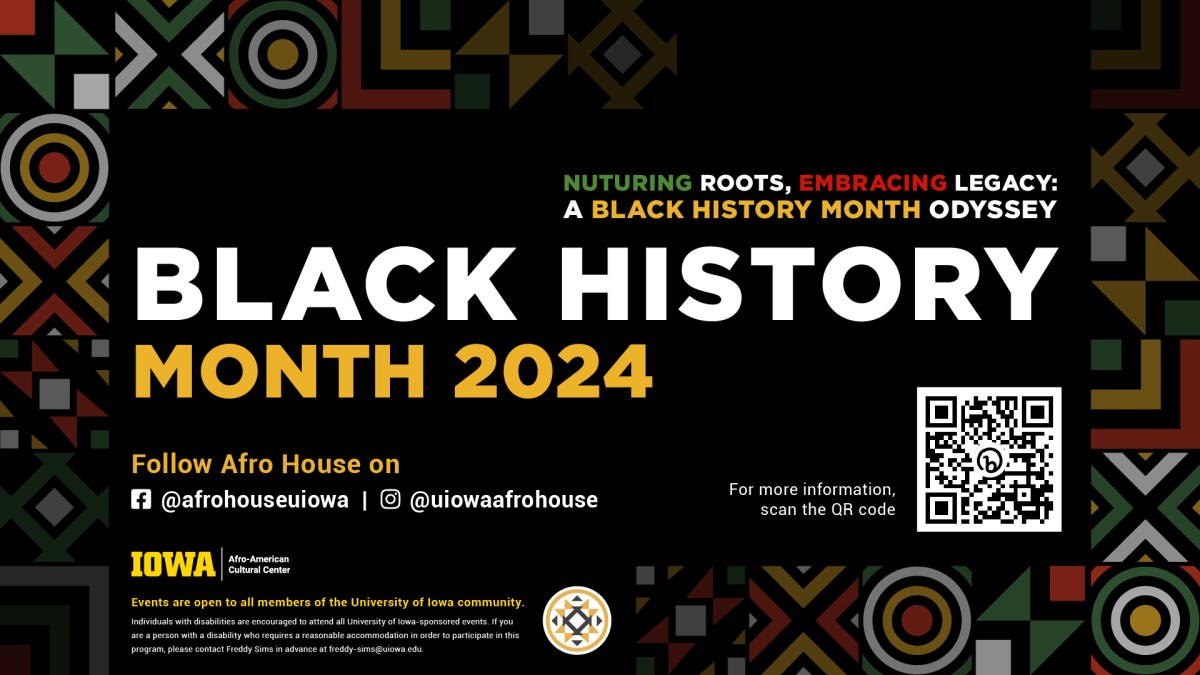
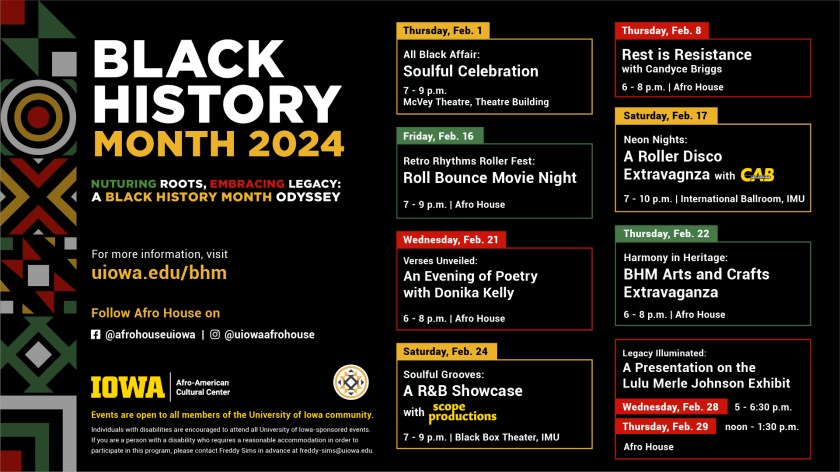
The Afro-American Cultural Center in Iowa City has many activities scheduled for Black History Month 2024. Check it out!

We enjoyed the Dr. Martin Luther King, Jr. Distinguished Education (originally given on January 17, 2023) by Dr. Russell Ledet. He’s definitely a mover and a shaker and this is another recorded presentation that I wish was available for the general public.
His bio is knockdown impressive. And even more interesting to me is that he’s presently in residency toward boarding in adult psychiatry and child psychiatry as well as pediatrics.
That’s right—triple boarding.
His talk was a fascinating oral autobiography from his upbringing in poverty to his military career, to his undergraduate and graduate college career, and his achievement in organizing a very successful nonprofit, The 15 White Coats. This helps get underrepresented minority students into medicine by giving them inspiration and financial support.
His life story by itself is inspiring. It’s also exhausting. The person introducing him wondered aloud if he ever slept!
He began with a well-known quote by Dr. Martin Luther King, Jr:
“It’s all right to tell a man to lift himself by his own bootstraps, but it is a cruel jest to say to a bootless man that he ought to lift himself by his own bootstraps.”
Dr. Ledet’s story of his path from bootlessness to crowning success is compelling. You really have to hear it from him to get a clear idea of how difficult it was. It’s hard to imagine that a star like him once rummaged through dumpsters for food for the family while his mother was on the lookout to make sure he didn’t get caught.
I think a big part of what kept him going was his wife and kids. In fact, his wife, Mallory Alise, insisted that he take the path because of her fear he would die if he continued a dangerous assignment in the military.
A member of the audience who had a career similar to Dr. Ledet asked a question about what more should he do to make sure young people of color would get the kind of opportunities to succeed. Dr. Ledet had a very good answer, but that was not the most interesting part of the interaction. Firstly, the questioner didn’t sound (I know this is going to sound crass) black. He sounded more like someone who had grown up in the Northern United States—like me. But during the course of the conversation, it was clear that he was black. He just didn’t sound like Dr. Ledet. He also mentioned, almost in passing, that some people of color who succeed may develop imposter syndrome.
This sounded strange at first, but I quickly realized that I sometimes had felt like an imposter. This cuts two ways with me. One was the obvious context in which I came out of an impoverished background to finish college and medical school, and had a career as a consultation-liaison psychiatrist at a university medical center where I published and taught for many years. At times I felt like a phony.
The other situation in which imposter syndrome arose was when I went to Huston-Tillotson University (an HBCU formerly called Huston-Tillotson College) in Austin, Texas back in the 1970s. Most of the students were from the region. I had a Northerner’s accent and somebody once remarked on it, asking me “Why do you talk so hard?” I was easily identified simply because of how I spoke. I didn’t always feel comfortable, despite for the first time being not the only black guy in school. Ironically, I didn’t feel like I fit in, even in an HBCU. Even among those who looked like me, I sometimes felt like a phony. But that was not an enduring affliction.
And I think Dr. Ledet has a great deal of confidence and energy. More power to him.
Sena and I viewed a recording of the Dr. Martin Luther King, Jr Distinguished Lecture given by Michele Norris on January 23, 2023. It was not available to the general public, about which I have inquired. It was a very interesting, informative, and entertaining presentation. It was about her 14-year Race Card Project which led to her new book, “Our Hidden Conversations: What Americans Really Think About Race and Identity.”
Michele opened with a little information about Bayard Rustin, which we didn’t know. There’s a film titled “Rustin,” available on Netflix which is about him and Dr. King and their complicated relationship. He was a gay black man, which was difficult for the civil rights movement leaders to accept. He was the key organizer for the 1963 March on Washington for Jobs and Freedom.
In her own words, Ms. Norris created the Race Card Project because she thought no one wanted to talk about race. She found out she was wrong because there was an avalanche of response to her request that people write something about race on a small postcard (6 words) and send it back. Interesting examples:
“Father was racist. I’M NOT. Progress!”
“Did my Southern Grandpa attend lynchings?” (This card came from Iowa.)
“Married a white girl. Now what?” (The girl thought of the guy as an “assimilated” brown man.)
“Alabama. MLK assassinated. Students cheered. Horrified.” (This was in a college classroom.)
“We aren’t all strong, black women.” (Norris’s comment was that it makes black women seem more like a weed and not a flower).
“Two white dads. Three black kids.” (Adorable photo included of gay married men with three adopted black children.)
“Can someone help me find my privilege?” (Photo of a white man included. Ms. Norris said that most of the cards are from white people, which surprised her.)
“My name is Jamaal. I’m white.” (Include a picture of a white guy. This was a story about Iowa. The guy showed up for a job interview, and the receptionist says “I thought you would be taller.”)
“Vote for Obama. Look like me.” (White guy married to white gal; they adopted black girl. I think he meant, in the abstract, that no matter what color you or the candidate are you should vote based on whether the person is qualified for the job. It’s funny that his very young daughter commented on it in a predictably concrete way given her age. She said she lived in Iowa and didn’t see too many people who looked like her. Ms. Norris said this story would be included in the book.)
It’s tough to express complicated ideas in just six words.
Ms. Norris says it’s unlikely that we’re going to agree with each other. She wants to build bridges across the chasm which divides us and she is hopeful about our ability to do that. We ordered her book.
February is Black History Month and in 2024 the theme is African Americans and the Arts.
This reminds me of a blues artist I heard on KCCK on the Big Mo Blues Show last Friday. His name is Toronzo Cannon and his career as a blues guitarist and songwriter is skyrocketing. I heard his song “The Preacher, the Politician, and the Pimp.”
The lyrics reminded me of a character (or maybe more properly a non-character) called Rinehart in Ralph Ellison’s book, Invisible Man. I’m by no means an Ellison scholar but in chapter 23 the main narrator gets mistaken for a black guy named Rinehart who has many faces in the black community. He’s a preacher, a numbers runner, a pimp, and is also related to a political movement in the novel. Rinehart is all of them and none of them, moving between the “rind and heart” of who black people are in America. The implication is that the identity of black people is multifaceted and the similarity of the theme in Toronzo Cannon’s song is striking.
Cannon is also multifaceted. He’s a Blues guitar star and song writer and is also still a bus driver for the Chicago Transit Authority. How does he find time to do all that?
I wonder if Cannon got the idea for the song from Ellison’s novel. I guess I’ll never know.
This reminds me of an encounter I had with a black writer at Huston-Tillotson University (then Huston-Tillotson College, located in Austin, Texas) in the 1970s when I was an undergraduate in college. I’ve described this episode before in another post (“Black Psychiatrists in Iowa” 2019). The excerpt below includes a reference to a book review I wrote that was published in The American Journal of Psychiatry over 20 years ago:
“This reminds me of a book review I wrote for the American Journal of Psychiatry almost 20 years ago (Amos, J. (2000). Being Black in America Today: A multi perspective review of the problem. Am J Psychiatry, 157(5), 845-846.).”
The book was written by Norman Q Brill, M.D. It reminded me of my experience at Huston-Tillotson College (now Huston-Tillotson University, a private school, historically with largely Black enrollment) in Austin, Texas back in the 1970s. I wrote:
“Dr. Brill’s appraisal of many black leaders in chapters such as “Black Leaders in the Black Movement” and “Black Anti-Semitism” may be refreshingly frank in the opinion of some. He tailors his prose so as not to denounce openly those whom many would describe as demagogues. At the same time, it is apparent that his underlying message is that a substantial number of them are not only out of touch with mainstream black America but may even mislead black people into adopting ideological positions that impede rather than foster progress. Dr. Brill’s description of the issue reminded me of my own experience with this phenomenon as a freshman in the mid-1970s at a college of predominantly black enrollment in the southern United States. A guest lecturer (who, as I recall, had also written a book about being black in America) told us that the white man would never allow a black man to be a man in America. He had only three choices: he could be a clown, an athlete, or a noble savage. These corresponded to the prominent and often stereotyped roles that blacks typically held in entertainment, sports, and black churches.”
I was taken aback by the speaker’s judgment and asked him what my choice should then be. He was equally taken aback, I suspect. He advised me to be a clown.
The lyrics of Cannon’s song “The Preacher, The Politician, and the Pimp,” Ellison’s Rinehart, and another writer’s characterization of the roles allowed in American society for black men all resonate together. What drives the similarity of this perception across different artistic platforms?
When I reflect on how I’ve negotiated my life’s path over they years, I guess I would have to admit that I’ve often played the clown. Anyone can see that in the way my sense of humor comes across. Is it the healthiest way to respond to racism in this country? In terms of the psychological defense mechanisms, I think it’s a relatively mature strategy. You could argue with that by asking, “But where’s the maturity in dad jokes?”
Hey, it worked for Dick Gregory:
“I’ve got to go up there as an individual first, a Negro second. I’ve got to be a colored funny man, not a funny colored man”—Dick Gregory.
Dick Gregory
I was thinking about what to write for the first day of Black History Month, which starts today on February 1, 2023.
As usual, I started to reminisce about my time at Iowa State University (ISU) in Ames, Iowa. I usually don’t talk about my undergraduate days. In fact, I had a little trouble finding my diploma. It was in storage in the first place I should have looked. I graduated from ISU in 1985.
The Iowa State Daily ran a story, “Black scientists from Iowa State,” published on February 4, 2021, obviously in honor of Black History Month. Of course, it featured ISU’s most illustrious graduate, George Washington Carver, who earned his graduate degree in 1894. Carver also loved poetry and painting, which I didn’t know.
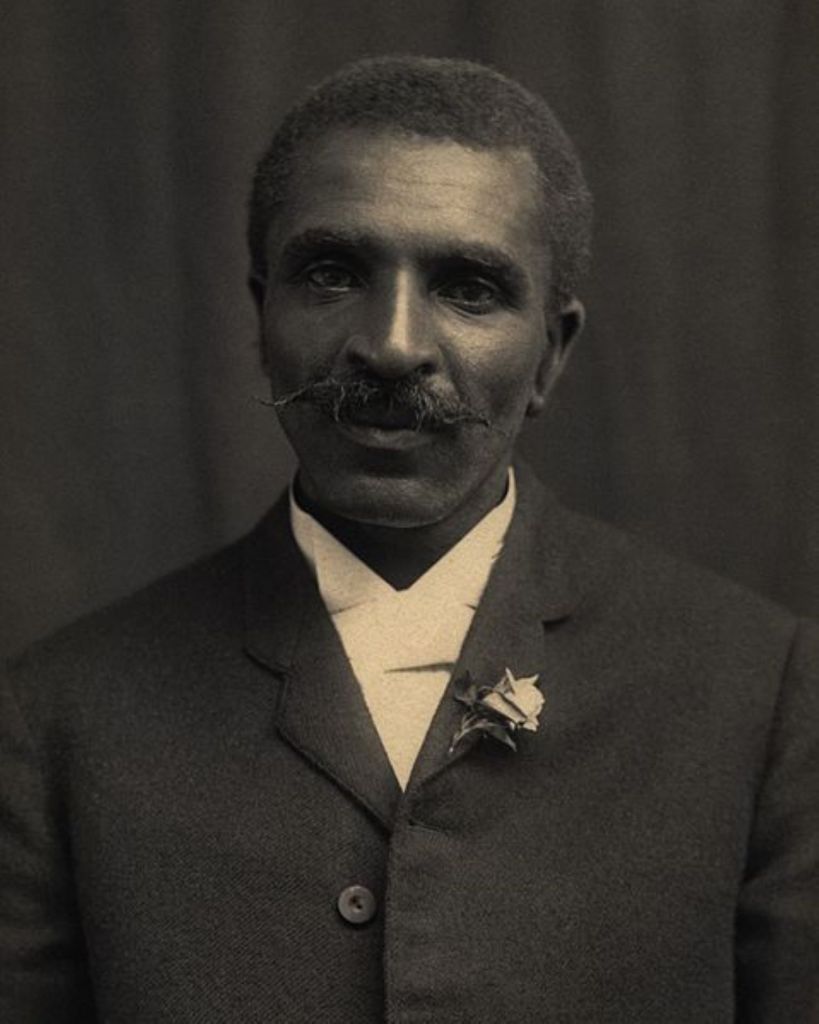
This work is in the public domain in the United States because it was published (or registered with the U.S. Copyright Office) before January 1, 1928
Carver was a scientist and put it to practical use. It fits with the ISU motto, which was short and to the point: “Science with Practice.”
I transferred credit to ISU in the mid-1970s from one of the country’s Historically Black Colleges and Universities (HBCUs), Huston-Tillotson College (now Huston-Tillotson University). I submitted a poem to the college’s annual student poetry contest sponsored by one of the English Professors, Dr. Jenny Lind Porter-Scott. My poem didn’t make the cut, but many students got their work published in the little book, Habari Gani (Swahili for “What’s Going On”), which published the best poems.
Part of the reason I went to ISU was the encouragement I got from my bosses at WHKS &Co, consulting engineers. I was a surveyor’s assistant and drafter. I was the only African-American employee working there.
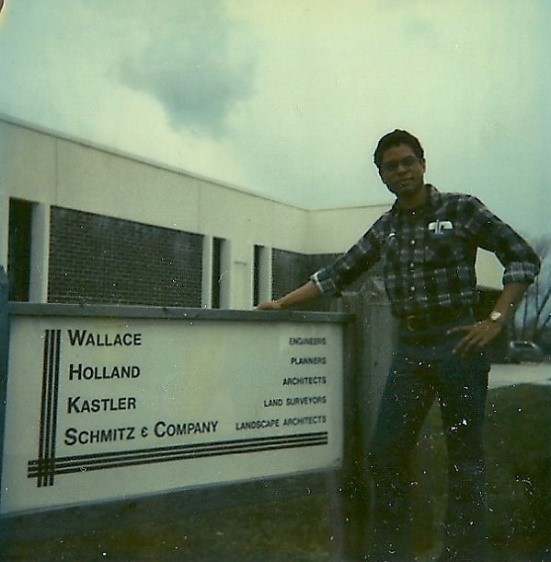
The idea behind going to ISU initially was to pursue a degree in engineering. That didn’t happen because frankly, I didn’t have a head for the mathematics. On the other hand, I got interested in biology, chemistry, and zoology and finally ended up in medical school at The University of Iowa in Iowa City. The rest is history, as they say, which allows the usual cover up of a multitude of sins.
At the time Sena and moved to Ames in the early 1980s, it was a quiet little town, except during VEISHEA, an annual spring celebration on campus. The event got out of hand many times and it was finally banned in 2014.
Back in the days of George Washington Carver, African American students were not allowed to room with other students who did not have black skin on campus. By the time we moved to Ames, the most uncomfortable racial incident I can recall personally was being the butt of a “nigger” joke at a barbershop. I had to find another place to get my hair cut.
I still had a lot of science to digest at ISU after switching my major from engineering to the life sciences. I remember a chemistry professor who looked like the typical hippie who demonstrated how electrons get excited by stacking chairs on top of the counter in front of the chalkboard (which teachers were still using) and climbing to the top and nervously doing a shaky little dance showing what an excited electron he was. I think all of us collectively held our breath, waiting for him to tumble to the floor.
I really had a tough time learning organic chemistry. You had to draw diagrams showing how the molecules and atoms connected after each reaction. I will never forget an Asian Teacher’s Assistant who patiently tutored me, despite my having a very bad cold and a bad attitude to boot.
I graduated and then returned to get more credits to try getting into medical school after finding it very difficult to find employment with my Bachelor of Science degree. It took about 9 months before I finally landed a job in the clinical lab at one of the hospitals in Des Moines. The lab director worked there for a very short time while I was there, and then left to go to medical school.
That was my cue. I think it worked out for the best. By the way, the engraved crystal in the featured image is an appreciation gift from The University of Iowa for my years of service.
And I guess that’s about enough reminiscence for now.
Yesterday Sena and I listened to the Zoom lecture “Pursuing Health Equity—A Call to Action,” delivered by Louis H. Hart, III, MD from noon to 1:00 PM. Dr. Hart is the inaugural Medical Director of Health Equity for Yale New Haven Health System and Assistant Professor of Pediatrics and faculty member in the Yale School of Medicine. The lecture was sponsored by the University of Iowa Office of Diversity, Equity, and Inclusion in the College of Medicine. The introductory remarks about him were that his “leadership work addresses unjust structural and societal barriers that lead to inequitable health outcomes for the patients we serve.” His lecture was intended to “focus on efforts to ingrain an equity lens into clinical operations.”
Sena and I talked a lot about Dr. Hart’s presentation, as usual in a spirited way. We don’t always agree on everything and we’re not shy about saying so to each other. The lecture was recorded. However, since I don’t know when it might be publicly available, I looked on the web, and as luck would have it, I found a YouTube (see below) of a similar lecture he gave on June 22, 2021 in New York. The message was basically the same, and included many of the same slides.
Dr. Hart is very committed and passionate about health equity. Calls to action typically, as you’d expect, are delivered with passion, which sometimes entails emphasizing the “whys” of what must be done over the “hows” regarding implementation of changes to our health care system.
He began by letting the audience know that we’d all probably be a little uncomfortable about some parts of his message. He had a little original one-liner about comfort zones, which I unfortunately can’t recall exactly, but it conveyed a message similar to the one below:
A comfort zone is a beautiful place, but nothing ever grows there.
John Assaraf
In the YouTube video below, Dr. Hart reminds me of myself in my role as a consultation-liaison psychiatrist many years ago, when I was trying to persuade our general hospital medical staff to take delirium much more seriously, stop seeing it as a psychiatric problem, and treat it as a complication of severe medical disease. I got acquainted with a famous critical care doctor, Wes Ely, MD, who recently published a fascinating book, “Every Deep Drawn Breath.” He has worked tirelessly for most of his career to teach his colleagues, nurses, and trainees, especially those in critical care, to get the point he made so succinctly in his research notebook: “Hypothesis: The lung bone is connected to the brain bone.” I wish we could keep it that simple.
I was a crusader at the time. I often took nurses and doctors and medical students out of their comfort zones, driven to ingrain in them the delirium lens that would help save patients from developing dementia and dying from the deadly syndrome of delirium.
My approach sometimes probably didn’t sit too well with my peers and my trainees. My call to action for preventing delirium likely moved a few clinicians—but just as likely alienated others.
I can see how some people might get that feeling from Dr. Hart in the video, although when I compare him with others who beat the drum loudly about structural racism in general and get pretty confrontational, I think he does a pretty fair job of moderating that approach. I get his passion and his urgency, which is for the most part balanced by his impressive ability to articulate all the “whys” about what must be done. I was reasonably confident he could collaborate with all of the people he needs to figure out the “hows.”
Now, to throw you a curve ball, I’m giving you the link to a podcast in which, if I close my eyes, I nearly don’t recognize Dr. Hart as he describes in polished detail the “hows” of his plan to improve health equity. It seemed almost miraculous. He’s just as passionate about his mission, but the crusader gives way to the thorough, confident, caring and even witty administrator presenting his very sophisticated vision of what the health care system of the future might look like. See what you think.
African Americans have made important contributions to classical music, as I pointed out in the post about Samuel Coleridge-Taylor a couple of months ago. I know a little about classical music although I remember the major composers the way many do, by the 4 Bs: Brahms, Bach, Beethoven, and Bigfoot. Bigfoot could really wail, and still does according to some people. Who could forget his iconic and literal smash hit, “Knock 3 times on a Tree Trunk if You Fear Me” (Opus 3, No. 7, adagio on rye in G-Minor)?
Seriously, it turns out that there is an Iowa Connection for an African American musician, Harry T. Burleigh, who influenced Antonin Dvorak’s Symphony No. 9, ‘From the New World.’ I listened to the work for first time in my life as I wrote this post. Burleigh was an accomplished composer, arranger, and baritone vocalist. He sang traditional spirituals, which inspired Dvorak to say “In the negro melodies of America I discover all that is needed for a great and noble school of music.” It is reported by some writers that the Largo of Symphony 9 was influenced by spiritual music. I think even my untrained ear caught that.
Anyway, Dvorak visited Spillville, Iowa back in the summer of 1893. He lived on the second floor of what is now the Dvorak Exhibit and the Bily Clock Museum. A Des Moines Register article published in 2018 mentioned him going for walks along the Turkey River and played the organ for the local church congregation. He carried “his little bucket of beer like everybody did back in the day,” according to a member of a Spillville historical group. David Neely, music director and principal conductor of the Des Moines Metro Opera, said Dvorak “…left a legacy in this country. Not many composers did things like that.” And I would add that Harry T. Burleigh left a legacy in this country as well. Not many people do things like that.
Unfortunately, despite having an impressive funeral after his death in 1949, he was initially buried in an unmarked grave in White Plains, New York. He was later given a proper internment in the Erie Cemetery in Pennsylvania.
There is only one surviving recording of him singing “Go Down Moses.” It’s on YouTube. One of his biographers, Jean E. Snyder, commented that Burleigh himself did not care for the recording. He wrote the definitive arrangement of many Negro Spirituals including “Lift Every Voice and Sing” and “Deep River.”
I just encountered a nugget about the history of Huston-Tillotson University (H-TU), one of the 107 Historically Black Colleges and Universities (HBCU). There is an Iowa connection to the school. In 1877, a farmer named Samuel Huston from either Marengo, Iowa or Honey Creek Township, Iowa (depending on what you read) donated land and money amounting to $10,000 ($9,000 according to other records) to what would become Samuel Huston College in Austin, Texas. In 1952, Samuel Huston College merged with Tillotson College to form Huston-Tillotson College. I was a student there in the mid-1970s.
The Texas State Historical Association (TSHA) says Huston was from Honey Creek Township (there is more than one Honey Creek in Iowa), which is in Iowa County. Just about everyone else says he was from Marengo, which is also in Iowa County.
Baseball legend Jackie Robinson was the basketball coach for one season in the 1940s at Samuel Huston College prior to the merger with Tillotson College. The Rams didn’t fare well, according to the Wikipedia article about H-TU. I recall going to one of the basketball games when I was a student in the 1970s. They didn’t fare well at that game either. At one point, one of the H-TU students in the stands yelled out very loudly “Mets!” This drew laughter even from the fans. He was known for his sense of humor.
The H-TU baseball team played on Downs Field on campus. If I remember the layout correctly, you could cut across Downs Fields to get to Church’s Chicken. It was a short walk. If you press me for details about how I would know that, it might force me to make a few comments about the dining hall food. So, don’t press me. Don’t bother looking for Church’s Chicken in that area on Google maps. It’s long gone.
It wasn’t all about Church’s Chicken. There were outlets for activism at that time. Along with a couple of classmates, I attended a meeting of a few members of the Nation of Islam. We were frisked at the door. Malcolm X had been an influential leader of the Nation of Islam until his assassination in 1965. One speaker at the meeting said a number of times “You might see me anywhere” (Church’s Chicken?). I’m not sure why he said it so many times.
I recall a visiting sociology professor who delivered an electrifying lecture all about how to create change in society by direct action. He assigned me and another student to interview members of the Austin, Texas Police Department about how black people might be targeted for unequal treatment under the law in certain parts of the city. We got stuck in a corner of the department with very large volumes of the uniform crime report. The police were very polite but didn’t say much. I don’t remember how the professor graded us.
One of my favorite teachers at H-TU was Dr. Lamar “Major” Kirven. We called him Major Kirven because he was a military officer as well as a teacher. He taught Black History. He tried to write on the blackboard but nobody could read his handwriting because it was always illegible. It was a running joke with all of his students and he had a great sense of humor about it. One time, I complained about another student in the class who was pretty good at being interruptive. He said, “Brother Amos, patience is a virtue.”
I’ve been trying to learn from Major Kirven ever since.




 Go Retire Psychiatrist