Big Mo Pod Show: “California Bluesin”

Well, I listened to the Big Mod Pod Show today and I have a couple of thoughts. Big Mod mentioned something about some kind of an AI assistant maybe selecting some records on the KCCK Facebook site. He didn’t sound all that pleased with the choices the AI makes, specifically with the John Lee Hooker tune, “Mr. Lucky.”

I may have the wrong understanding about the “AI guy blues buddy” on the Big Mo Facebook page but if it’s the AI guy like CoPilot or Gemini, then it would be great if you could deactivate it somehow. I know I get pretty annoyed with AI when I search the web (not always, but sometimes it’s annoying).

I just happen to have the 1995 CD called “The Very Best of John Lee Hooker.” Far be it from me to be the judge of what’s the best for any blues artist, but I think the CD is pretty good, though I haven’t listened to it in a while. The other thing I have to admit is that I’ve found differences of opinion on is whether “Hobo Blues” is a 12-bar blues type number or not.

If Big Mo says he can’t understand why Hooker would confine himself to a constraining 12-bar blues song, then I’ll have to agree with him.

Then, of course, I ran into something else I don’t know about and that’s something called “trance blues.” Supposedly, John Lee Hooker did trance blues. How I find out about things I don’t know anything about is to peck around the internet and I found this link that defines it as something that has “a strong electronic component.”

I don’t know about “electronic” and I noticed some authors describe trance blues as “repetitive and hypnotic.” Does that mean that 12-bar blues is not trance blues?

So, here’s the thing. I’ve got my own pesky AI assistant Gemini that I never ask for any advice from, but it never misses a chance to make a point about some query I have for the internet—like trance blues.

Gemini says Hooker’s “Boogie Chillen” is an example of trance blues and also mentions that “Hobo Blues” is another example of it.

I don’t know if I can get this straight. Is 12-bar blues an example of a chord progression pattern and is trance blues a genre of blues which has a repetitive, hypnotic rhythm? It’s over my head.


Big Mo Pod Show: “Garage Blues”

I heard the Big Mo Blues Show last night and the Big Mo Pod Show today. I can say that the Garage Show title refers to a get together during the Covid pandemic that Big Mo threw and held in his garage and featured local Blues artists including Bryce Janey, who is number 5 on the list of songs with “Down Home Blues.”

Anyway, the most interesting part of the podcast was the 3rd song, “Coal Black Mare” (misspelled as “Cold Black Mare”) which was produced by Bob Corritore and released as part of historical album released October 17, 2025 entitled “Bob Corritore and Friends—Early Blues Sessions.” It includes songs recorded between 1984 and 2007. Corritore was on harmonica and blues artist Clarence Edwards sang the song (he died in 1993).

I looked up Clarence Edwards on Wikipedia and he was born in Louisiana in 1933 and became more widely known in the 1980s when he performed on a national blues festival circuit. I found a version of Coal Black Mare recorded in 1961 by Edwards.

The song “Coal Black Mare” has a very interesting history all by itself. Most internet articles say Arthur “Big Boy” Crudup, was probably best known for writing the song “That’s All Right” in 1946 which Elvis Presley make famous later. Some say “That’s All Right” was the first rock and roll song. The Blues Hall of Fame says that Crudup was the “The Father of Rock ‘n’ Roll.”

I found references that say Crudup wrote “Coal Black Mare” and released it in 1962 or 1965 (the Fire Sessions) depending on which web site you read. I also found a song entitled “Black Pony Blues” which on most web sites is the same as “Coal Black Mare” and was recorded in 1941 under Crudup’s name. They both sound like the same song.

Opinions differ about the meaning of the song “Coal Black Mare.” While I think most would say that it’s about a black race horse that won a lot of races, I think the “gold earrings” and “gold teeth” lyrics could make some people wonder if this is a metaphor for a woman. I found a web reference hinting at this, speculating that Charley Patton’s 1929 “Pony Blues” might have inspired the song and say that in all versions, including Crudup’s, the black mare stands for “…a black lover.”

I got lost in the internet forest on this one and I’ll be the first to admit I don’t have the first idea of whether or not “Coal Black Mare” was inspired by Charley Patton’s “Pony Blues.” And while I think gold earrings and teeth would look odd on a horse; I also suspect Crudup was probably singing about a race horse.

Your thoughts?

Big Mo Pod Show: “Tribute”

I’m writing about the Big Mo Pod Show from Big Mo’s blues show that was aired on November 7, 2025. I’m a little late, but it doesn’t matter that much because Big Mo will be recorded tonight (Friday, November 14, 2025). He’ll be at the Beaker Street Live show instead.

I think I might have dozed off while listening to his blues show last Friday night because I didn’t remember 3 songs from the list on the pod show:

Luther Dickinson & Datrian Johnson – “Sitting on Top of the World”

John “papa” Gros – “Crazy”

Dr. John – “Food For Thot”

Contributing to my memory loss is this: the 3 songs are not on the list of the songs played that night. So, I can’t say much about the discussion Big Mo and Noah had about the songs, based on what I don’t remember hearing. However, I can take it on faith in Big Mo’s extensive blues knowledge about his idea that the broad spectrum of American music has more blues in it than not.

On the other hand, I can say from reminiscence that I think I first heard Mississippi John Hurt’s song “Make Me a Pallet On Your Floor” many years ago when I first started listening to Friday night blues show. I tried to recall what I was doing in 1966 when Hurt died. I was just a kid.

While I can say I think I wasn’t listening to the blues, I think I can pick out popular songs from 1967 that tend to confirm Big Mo’s statement about most music having threads of the blues: “When a Man Loves a Woman” is just one example I think might fit.

I think I found a Wikipedia article about Mississippi John Hurt that might fit nicely with Big Mo saying he read the story about how Hurt was rediscovered back in the early 1960s. The detail of Avalon being his hometown is mentioned in the section “Rediscovery and death.” Just like Big Mo says, he wasn’t making it up.

Big Mo Pod Show: “Cheers to Kevin”

I’m a little slow getting to the Big Mo Pod Show after his blues show this last Saturday night. I guess that’s just the way things go. The title of the pod show “Cheers to Kevin” is a shout out to somebody important in Big Mo’s life. It turns out Kevin was really supportive of Big Mo when he was just getting started years ago when he was first starting on the KCCK blues show. Kevin has also made many donations to KCCK to support the show. Big Mo calls him his favorite bartender.

That gets me started with the last of the 5 songs Big Mo and Producer Noah talked about, which was Bob Margolin singing the song “Brown Liquor in a Dirty Glass.” I remember speculating in a past blog that the “dirty glass” part might have meant putting olives or olive brine in the drink—but I don’t think so after listening to the song again.

I’m pretty sure it means the singer is feeling so down and dirty himself that he might actually want a dirty glass in the usual sense of the word.

And by the way, Big Mo mentioned “mambo” again. Last week, it was hard to tell what he meant, but this time it sounds like he might be referring to a Latin American dance rhythm influence—maybe. The influence of different rhythms on blues music was a topic in that maybe steered the discussion about one song on the list, and I believe it was “Star” by Gary Clark, Jr., which Big Mo thought had more of a reggae than a blues rhythm to it.

One interesting song was from someone who has been around a long time but I’ve not heard her before, Duffy Bishop. She sang “69 Years Old.” It mentions Viagra, which is in line with the general theme, which is sex and not just for the old. I stumbled on an article in which she’s interviewed about her music. When they start talking about this “69 Years Old song,” Bishop has this funny anecdote. She had just finished singing it at a club in Daytona Beach and some old gentleman walks up to her and says, “Here, I got something for you, pass these on to someone who needs them,” and then hands her some Cialis.

I’m 70 and I’m a little embarrassed about it but I want to pass the tune on to you guys because we just never know.

Big Mo Pod Show: “The Dark Side of Legacy”

This was a fascinating episode of the pod show for more than one reason. The title is interesting if only in the sense that it might a reference to B.B. King—who wasn’t on the playlist either last night or the song selection for today’s podcast. Briefly, what we learned was that B.B. King had a lot of heirs (17 was the number of dependents) to his fortune when he died and that led to conflict over his estate. This came up during the conversation about Mud Morganfield.

One song that I couldn’t find on the Big Mo Blues Show playlist was “Floating Bridge” a 1937 classic by Sleepy John Estes and I couldn’t remember hearing it last night. It’s a deeply personal story of his own near-death experience when he nearly drowned but was saved by a friend. Eric Clapton covered it in 1981.

Another thing we learned about was the double neck guitar, which came up in the conversation about the tune “Blue Guitar” by Earl Hooker. Earl Hooker was famous for playing the double neck guitar, a heavy instrument with two necks, in this case a six string and a 12 string. I found a very long and deep web article about multi-neck guitars and they appeared in the late 17th century.

As Big Mo and Noah pointed out, there were other musicians who played double necks, among them Jimmy Page of Led Zeppelin (“Stairway to Heaven”).

Big Mo mentioned the word “mambo” while talking about Mud Morganfield, who sang “Big Frame Woman.” I had to look up mambo and I think he might have meant a latin dance of Cuba? On the other hand, I found a reference that the word has African origins as well. Maybe some of you have ideas about that?

Big Mo Pod Show: “Across the Blues Universe”

I heard the Big Mo Blues Show last night and the Big Mo Pod Show today. The podcast song selection was part of the Lunch with Chuck portion of the show, which I don’t know a whole lot about. The Lunch with Chuck thing I’ve heard Big Mo talk about and I think it involves a real guy named Chuck who talks music with Big Mo sometimes, although I’ve not heard an actual live Lunch with Chuck program during the blues show. And it might be another Big Mo running joke.

The other thing I want to mention is that I heard Big Mo talk last night just before the Lunch with Chuck thing about something like a “fish psychic”. I think it’s a new comedy bit like MayRee’s Hand-Battered Catfish and Shorty’s Adult Diapers. I can’t remember the whole fish psychic bit, but I’m pretty sure he’ll do it again, maybe even next Friday. I think it’s another faux advertisement, and it might be about some kind of fish psychic who can help you catch lunker bass and the like.

Anyway, I learned something from the pod show today. I’d never heard of something called “race records” which is one term Lightnin Hopkins song “Mojo Hand” led to. Race records were 78-rpm phonograph records marketed to black people back in the days of the victrola, between the years of the 1920s to the 1940s, well before my time.

The other term new to me is the title of Hopkins’ song, “Mojo Hand.” The podcast discussion mentioned that mojo hand referred to African American voodoo charms, one of which happened to be a lucky charm, possibly a dried monkey’s paw. The song is actually about using voodoo to keep a lover from being unfaithful. The song means more now that I know that.

Another thing I learned today was that the song “Feel So Bad” (recorded in 1966) by Little Milton has a lyric in it, “feel like a ball game on a rainy day” that was repeated by boxer Muhammad Ali when he found out he had to wait 6 weeks before the Rumble in the Jungle match in 1974. That was because Foreman had to heal up first because he suffered a laceration above his right eye during a sparring match.

What I also didn’t know was that the Rumble in the Jungle had political overtones. There is an article entitled “Remembering the Rumble in the Jungle” subtitled “The 1974 Rumble in the Jungle was freighted with symbolism regarding American racial politics and the pan-African struggle in the context of the Cold War.”

One more thing I learned from the podcast is related to the song “Wine O’Clock” by Shemekia Copeland. He called this song a women’s support tune and, unlike my disagreement about this issue in last week’s podcast, I tend to agree with this song being about women supporting each other or at least understanding their burdens in a society marked by gender role disparity.

What helped me reach this understanding is an article entitled “What makes up wine o’clock…” published in 2022.

Wright CJC, Miller M, Kuntsche E, Kuntsche S. ‘What makes up wine o’clock? Understanding social practices involved in alcohol use among women aged 40-65 years in Australia. Int J Drug Policy. 2022 Mar;101:103560. doi: 10.1016/j.drugpo.2021.103560. Epub 2021 Dec 29. PMID: 34973490.

The abstract reminds me of the discomfort with the idea of women (or anyone regardless of gender) using alcohol to cope with socially designated roles.

“Think I’ll have another glass; the world can kiss my ass; tick tock, it’s Wine O’Clock.”

I sometimes learn a lot more than I expect from the Big Mo Pod Show.

Big Mo Pod Show: “High Strangeness”

As usual, I listened to the Big Mo Blues Show last night. Today, we listened to the Big Mo Pod Show, and it sure was interesting.

First, I’d like to point out that the title “High Strangeness” doesn’t apply to all of the songs on the podcast. In fact, only the first one, “Neoprene Fedora” would sound a little strange as a blues tune, and then only the first couple of minutes or so of this guitar instrumental. We think it has 3 or 4 segments with only the first one sounding mostly like a surfing tune. Most of it did sound bluesy.

The song “Catfish Blues” by Corey Harris was fascinating mainly because it prompted Big Mo to mention MayRee’s hand-battered catfish. We heard him say that this was about MayRee. We’re not so sure. We couldn’t figure out the connection between MayRee and catfish that you could catch in a river maybe somewhere down south, (possibly Louisiana?) in a very specific place where there used to be a couple of shacks where you could get hand-battered catfish.

He had very specific names for places like “Brownsville” or someplace the name of which reminded me of a French word, “rouleaux” (which I connect with stacks of red blood cells just because I learned this is medical school). But it sounded like it was a place. AI popped right up and said there’s no such place by that name in Louisiana or Texas. Big Mo also mentioned that it was close to a “Missouri river bridge.” I think we heard him right. The Missouri runs along the western boundary of Iowa. There are bridges in that area, but I can’t tell which one is referred to.

I’m thinking this story might just be adding texture to the whole MayRee’s hand-battered catfish yarn.

Another puzzle was somebody Big Mo mentioned called Tail Dragger, to which Corey Harris had a connection. Big Mo didn’t expand on this, but I did manage to find out about somebody named Tail Dragger Jones, who was an American Chicago blues singer. He has an interesting Wikipedia entry on the web. He shot and killed a blues artist known as Boston Blackie and did prison time for it.

And we had the impression that the last song reviewed on the podcast, “Take It Easy” by Ruthie Foster, was a blues song that was readily applicable to anyone having a tough time in life. On the other hand, Big Mo thought it was about women being mistreated by men and how to bear up under this burden.

Conversely, our impression is that most blues songs done by men often have themes that remind you of the chauvinistic attitude men have for women. Just listen to any of the other songs on the podcast list and look up the lyrics (because you can’t always understand them on the recordings).

I especially like songs which have lyrics that I can clearly understand, and “Take It Easy” is one of them.

Big Mo Pod Show: “Passin’ the Torch”

I caught the Big Mo Pod Show last night and listened to the podcast this afternoon. That’s later than I usually do because we were running around today learning how to use our new smartphones. You know, the makers don’t send the phones with even basic instructions. I guess they just expect you to guess right.

It’s like passing the torch (the title of the pod show) with the burning end towards your face. The phones are really slippery because they wash them with triple muddifying brahma bull body wash and add a 3-inch charging cable.

Anyway, I think the passing the torch title really comes from the Morganfield family. One of Muddy Water’s sons named Mud did a number called “She’s Getting her Groove On.” Mckinley is another son of Muddy and he’s also a blues musician.

Big Mo called one of the numbers on the blues show last night a novelty song: “Willie Dixon’s Gone,” by Tom Hambridge. Producer Noah asked him point blank, “What makes a song a novelty song?” to which Big Mo replies, “Ohhh, that is so hard!” He named a few like “Alley Oop.” And in general, his answer was that novelty songs are “overdone” and “over-shticked.” So, the novelty songs are comical.

But for comical, I don’t think you can beat one of my favorite songs that Big Mo played last night but didn’t make today’s list: “Can’t Even Do Wrong Right,” by Elvin Bishop. He grew up on a farm in Iowa. He even did a song titled “Calling All Cows.” I’ll let you look that one up.

Big Mo Pod Show: “Planting Seeds”

The Big Mo Pod Show title is about planting seeds in a metaphorical way. One of the seeds Big Mo sows is his comedy bit on MayRee’s hand-battered catfish. It’s just one of his hilarious faux sponsor routines that he frequently tweaks, and the subtle changes are difficult to catch if you don’t listen to his show every Friday night. It evolves, kind of like a shaggy dog story joke. My lame imitation from my crippled memory is below:

You see, MayRee’s hand-battered catfish is better because it’s battered, cooked to perfection with manic delight, packed with nitrates at her shack which you can find at the corner of Highway 6 and Snowflake Drive, and if you tip her and give her a wink, she’ll set you up with a mason jar of her famous kickin’ mule’ not sure if it’s all the way legal, but it comes in 3 flavors, Classic Clear, Golden Grabass, and just right for the holidays, Pumpkin Spice, that’s Mayree’s hand-battered catfish; it’s better because it’s battered.

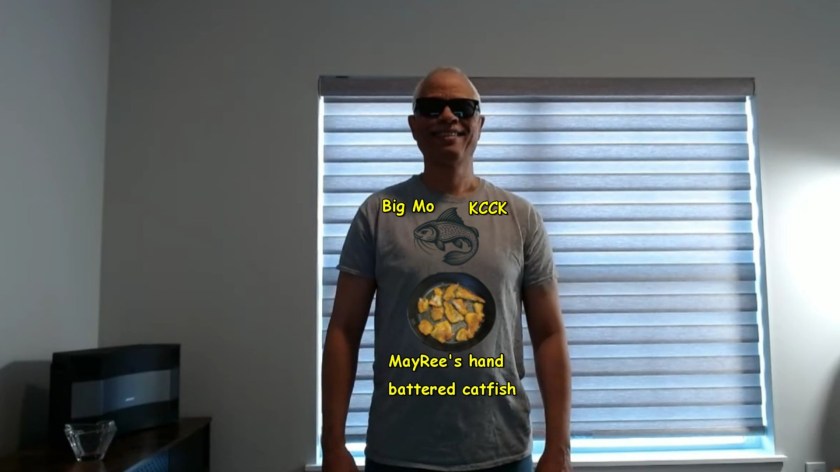
You get the idea. I’m still trying to sell him on my design for a MayRee’s hand-battered catfish tee shirt. Don’t know why he’s not biting that hook. The catfish could be a fire truck red color, just sayin’.

So, the pod show title is “Planting Seeds” and that’s related to the idea of fundamental, historically important basic elements of blues music, specifically in the case of Jessie Mae Hemphill’s song “Jump, Baby, Jump.” Both Big Mo and Producer Noah agree that this example of North Mississippi hill country folk trance or hypnotic griot music (or grio, pronounced Gree-oh; a kind of West African traditional oral folklorist) which serves as the seed or basis for building on other layers (instrumental or otherwise). That’s just what I picked up from the internet.

Big Mo distinguishes this from “production” style music you hear a lot of nowadays on the radio and I get his disparaging tone about it.

Anyway, that’s the rich music history part of the pod show, which you can get by listening to KCCK on your radio dial at 88.3 or click on the Listen Now to hear by internet.

Now, what is also great about the show is Big Mo’s own historical perspective on music. That’s what you get by growing older. And that’s why my favorite song from last night from the Big Mo Blues Show was Curtis Salgado’s “The Longer That I Live.” I can identify with the lyrics.

Big Mo Pod Show: “Hickory Smoked Blues”

Today, the Big Mo Pod Show was about how blues music can you help you “exorcise your demons” as Big Mo himself put it today. Isn’t that what it’s always about? And I can’t explain how that even works.

Big Mo Pod Show 085 – “California Bluesin” KCCK's Big Mo Pod Show

After a short break during the Thanksgiving holiday your hosts are back at it again with another episode! This week features the usual mix of blues eras you’ve come to expect along with a few Californian artists, tune in to see which ones! Songs featured in the episode: Solomon Hicks – “Further On Up The … Continue reading
  1. Big Mo Pod Show 085 – “California Bluesin”
  2. Big Mo Pod Show 084 – “Garage Blues”
  3. Big Mo Pod Show 083 – “Legal Pirate radio”
  4. Big Mo Pod Show 082 – “Tribute”
  5. Big Mo Pod Show 081 – “Cheers To Kevin”

But I don’t always understand how it works. I’m going to admit I’m not sure at all how one song last night by Toranzo Cannon would help anybody, and that’s “I Hate Love.” Of course, it’s contradictory and ironic. I’m not going to pretend I know what blues music is all about and how it can sometimes heal your inner soul pain.

But a lot of people believe that blues can help you get past the pain and it seems that it works paradoxically. I don’t always get it. But I’ve been listening to the Big Mo Blues Show for years.

That reminds me. We had a couple of guys install motorized window shades yesterday and one of them was a blues musician. He plays bass guitar and I gather he plays in local bands. He wore the best hat; it’s a fedora! Sena and I sort of ribbed him about it, but I had a fedora like that once, decades ago. It was gray with a narrow leather band. I don’t have it anymore.

I told him that I wore it while I was interviewing for residency. I wore it to dinner in a hotel in St. Louis, Missouri and a woman passing through the hotel restaurant looked at me and said with a grin, “Wear that hat!”

Sena reacted as if she’d never heard that story before. The fedora guy thought it was funny. Fedora man had that style to him that I think is fairly common in musicians. They look and may act in a way that makes you notice them. I don’t think you can always tell what somebody does just by the way he or she dresses. But when he told us he was a musician who liked the blues, that didn’t surprise us.

What did surprise us was that he didn’t recognize the name of a prominent blues musician in Iowa and a lot of other places—Kevin Burt. But he did have a sense of humor.

I think most blues musicians have a kind of slant sense of humor. It probably comes out in some of the music. I’m more drawn to blues music that makes me chuckle. On the other hand, I liked one song on the blues show last night they didn’t discuss today on the pod show. It’s not funny and I had a hard time finding the lyrics for it. It’s “I’ll Always Remember You” by the Robert Cray Band. I found a couple of sites I think got the lyrics below wrong and didn’t make sense. The way I heard the song the lines went like this:

 “Old clothes and worn-out shoes
Empty bottles and a book that’s way past due.”

The line I keep finding that I think is wrong is the second one, which is often written as “Empty bottles and I put this way past due.”

I think the line “a book that’s way past due” makes more sense because it conveys a sense of regret, waste and loss and promises not kept and opportunities lost and probably a half-dozen other ideas that you probably can’t easily encapsulate. It evokes sorrow that is only partly fixed by the letter’s promise— “I’ll always remember you.”

That may not completely heal you, but it’s a little like something I read about kintsugi. It’s about mending broken pottery with gold in a literal sense. In a metaphorical sense, it’s about repairing what might be broken emotionally broken in us and, despite not being the same as we were before we were broken, we’re somehow still functional and healed though not perfect. A psychiatry resident blogger wrote about that.