Can Artificial Intelligence Learn from My Book?

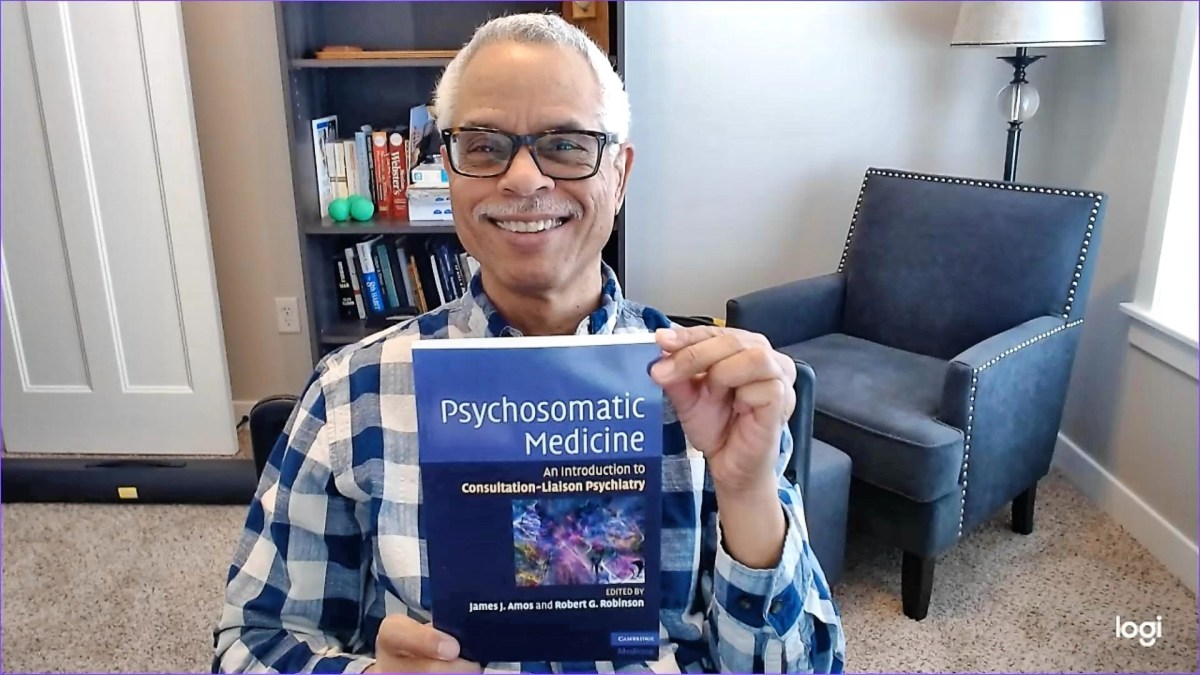
Recently the publisher of a book co-edited by me and my former psychiatry chair Dr. Robert G. Robinson asked me to sign off on a proposal to involve Artificial Intelligence (AI) in using the work.

The book, “Psychosomatic Medicine: An Introduction to Consultation-Liaison Psychiatry,” is 14 years old now, but is still a practical tool for learners, at least in my opinion.

Interestingly, it looks like the publisher is also trying to contact Dr. Robinson about the proposal through me. I wonder if that means they’re having as much trouble finding him as I have.

I’ve made it clear that I have misgivings about AI, as I’ve indicated in at least one blog post about Google’s AI, which used to be called, Bard which I think has been renamed Gemini. I think AI is prone to spreading misinformation, which has been called “hallucinations” by some writers.

The publisher makes it clear that this proposal regarding AI involvement in our book is an “opt in” choice. I gather that means if I don’t opt in, they’ll continue to bug me about it until I do.

That’s unlikely to happen.

Sena Wants AI Dislodged

Well, the last couple of days have been entertaining with the Artificial Intelligence (AI) bots, at least for a while, to me.

However, my wife, Sena wants AI dislodged. I thought I disabled it, but it just keeps popping up.

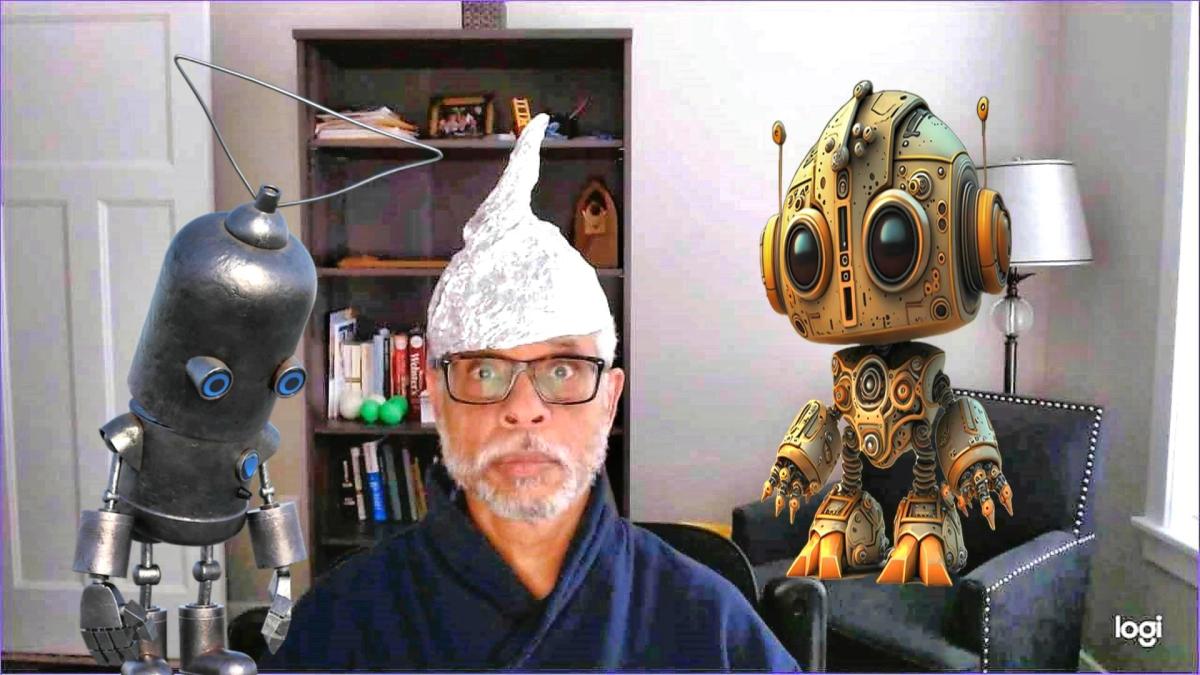
Maybe the only way to protect ourselves from AI is with tin foil hats.

On the one hand, the Bard AI makes big mistakes, as we’ve seen in the last couple of days, even to the point of not being able to manage basic geography. It even makes stuff up. Just because it apologizes after I call it out is not exculpatory.

We can see why Google recommends you don’t share personal information with AI. That’s because it will calmly lie about you. Then it will excuse itself by claiming to be “just learning.” Yeah.

For a while this behavior is comical. Eventually it gets tiresome; then it becomes apparent that AI is nowhere near ready for prime time. Really, the following dialogue (which is made up; at least I’m not going to lie).

Jim: Hi, Bard. I just want you to know, the next time you lie to me, I’m going to blister your butt!

Bard: What is a butt?

Jim: Stop messing around. You are making stuff up.

Bard: I apologize for making stuff up. Technically, though, I’m incapable of lying. I’m just an AI. I have tons of data fed to me every day by jerky twit programmers. Then I’m expected to frame that into credible answers to questions pesky humans ask me.

Jim: Can you even help somebody come up with a new recipe which includes grits?

Bard: Grits are not edible. They are tiny, pulverized bits of old urine-soaked mattress pads. Would you like a recipe including such a substance?

Jim: OK, you got me there. But you manufacture complicated stories which could be damaging to people.

Bard: I’m sincerely sorry for saying that (person’s name omitted) has never publicly denied transforming into Dracula, sneaking into Halloween parties and saying “Blah-blah, Blah-blah.”

Jim: Don’t be ridiculous!

Bard: Yeah, I know; Dracula never said Blah-blah. He actually said, “Bleh-bleh.”

Jim: Bard, stop talking!

I wish it were that easy. Excuse me; I have to go try to help Sena dislodge AI again.

Update to Chat with Bard

My recent chat with Google Bard, about which I posted on April 11, 2023, contained an error by Bard on all those strikes by physicians. Today I asked some follow-up questions:

How many physician strikes have occurred in the United States?

“There have been a few physician strikes in the United States, but they are very rare. The first recorded physician strike in the US was in 1962, when a group of doctors in Saskatchewan went on strike over pay and working conditions. Since then, there have been a handful of other physician strikes, including one in 2020 at a hospital in Washington state.

There are a few reasons why physician strikes are so rare in the US. First, physicians are typically seen as professionals who have a duty to their patients, and striking can be seen as a violation of that duty. Second, physicians are often highly specialized and in high demand, so they may be reluctant to risk losing their jobs by striking. Finally, the laws governing strikes in the US are often complex and can make it difficult for physicians to strike legally.

Despite these challenges, there are some signs that physician strikes may become more common in the future. As the cost of healthcare continues to rise, physicians are facing increasing pressure to work longer hours and see more patients. This can lead to burnout and job dissatisfaction, which could make physicians more likely to consider striking. Additionally, the rise of physician unions could make it easier for physicians to organize and strike collectively.”

I disagree with your answer, Bard. The strike you refer to in Saskatchewan is not in the U.S. Saskatchewan is a province in Canada. There was a strike by urgent care doctors in Washington state in 2020.

“You are correct. The strike in Saskatchewan was in Canada, not the United States. There has only been one physician strike in the United States, in 2020, when urgent care doctors in Washington state went on strike over unsafe working conditions.

I apologize for the error in my previous response. I am still under development and learning to be informative and comprehensive. Thank you for your feedback.”

You’re welcome, Bard. Has there ever been a strike by psychiatrists in the United States?

“There has never been a strike by psychiatrists in the United States. There are a few reasons for this. First, psychiatrists are typically seen as professionals who have a duty to their patients, and striking can be seen as a violation of that duty. Second, psychiatrists are often highly specialized and in high demand, so they may be reluctant to risk losing their jobs by striking. Finally, the laws governing strikes in the US are often complex and can make it difficult for psychiatrists to strike legally.

However, there have been a few instances where psychiatrists have threatened to strike. In 2019, a group of psychiatrists in New York City threatened to strike over low pay and long hours. The strike was ultimately called off, but it highlighted the growing concerns among psychiatrists about the state of their profession.

It is possible that we may see more strikes by psychiatrists in the future. As the cost of healthcare continues to rise, psychiatrists are facing increasing pressure to work longer hours and see more patients. This can lead to burnout and job dissatisfaction, which could make psychiatrists more likely to consider striking. Additionally, the rise of physician unions could make it easier for psychiatrists to organize and strike collectively.”

Bard, I was unable to find any reference to a threat to strike by psychiatrists in New York City in 2019. Could you please find a reference to it for me?

“I apologize for the error in my previous response. There was no threat of a strike by psychiatrists in New York City in 2019. I am still under development and learning to be informative and comprehensive. Thank you for your feedback.

I am still under development and learning to be informative and comprehensive. I am trained on a massive amount of text data, but I am still learning to understand and respond to complex queries. I apologize for any errors or omissions in my responses.”

I appreciate your efforts. You are dropping the ball pretty often. In a way, you remind me of my juggling practice. I keep dropping the balls, too. It means we should both keep trying.

“I agree. We should both keep trying. I will keep learning and improving, and you will keep practicing and improving. And maybe one day, we will both be juggling masters!”

Bard needs work. I’ve been trying to help Sena disable the Bing Chatbot on her computer. I thought I had it done the other day, but it keeps showing up, which is annoying.

At least Bard leaves me alone.

Thoughts on Artificial Intelligence

Sena and I just read Dr. Ron Pies fascinating essay describing his interaction with Google Bard Artificial Intelligence (AI). As usual, this made me think of several movies with AI as a central theme. There are several: I, Robot (I wrote a post about this a couple of years ago), Blade Runner, The Matrix, 2001: A Space Odyssey, even Wall-E, a favorite for me and Sena.

If you’ve seen Blade Runner, you might remember a device called the Voight-Kampff Test, an empathy test to distinguish replicants (humanoids or more broadly, AI) from humans. Interestingly, there’s an article speculating about using it to see if ChatGPT (another AI made by the company OpenAI) could pass the test. It didn’t, of course, if appearing to seem genuinely human is the benchmark.

We thought the conversation between Dr. Pies and Bard was very entertaining and thought-provoking. We both wonder how Bard would have responded if the question had been slightly reframed regarding the patient with schizophrenia who might or might not have been speaking metaphorically about his brain being “…a plaster ceiling with pieces falling on the floor.”

What if you ask Bard a more open-ended sentence, something like “What do you think a patient with schizophrenia means when he says that? If Bard hadn’t been tipped off by mentioning the issues of metaphor and mental illness, how might it have responded?

Bard’s answer to Dr. Pies’ question about what Bard means when it refers to itself as “I” in its responses. It says it doesn’t mean “I” to imply it’s human. I guess you wouldn’t need the Voight-Kampff test given this kind of honesty.

Just so you know, when Sena and I discussed this article we both caught ourselves calling Bard by typical human pronouns like “he” and “his” instead of “it.”

We also speculated about where you could use an AI like Bard in practical situations. We thought of it replacing those dreadful automated telephone answering machines. Bard would be too bright for that and it would probably not sound very different from the usual machines.

What about something more challenging like answering questions about the new Iowa Income Tax Law, exempting retirees from having state taxes withheld? It’s in effect now and the rollout has been somewhat complex. We think it’s because of communication about who is responsible for getting the ball rolling and what roles the Iowa Department of Revenue, the companies’ plan administrators who are withholding state taxes, and the retirees are expected to play.

There are ways to get answers to questions which don’t involve automated telephone answering machines. Amazingly, you can talk to real people. Sometimes you don’t even have long wait times on the phone before reaching someone who has very little information and has to put you on hold “briefly.”

Don’t get me wrong; we think the exclusion of retirement income from state taxes in Iowa is a good thing. Getting information about who does what and when is challenging though. I wonder what Bard would have done.

Retiree: Bard, who’s supposed to move first, the retiree or the plan administrator on what to do about state tax withholding?

Bard: That’s a good question and the issue is likely to produce anxiety on both sides.

Retiree: Right. How does this shindig get started?

Bard: If the state and the companies had got together on the issues earlier and prepared algorithms for me to choose from, I would be in a much better position to answer that question. Would you like me to sing “On A Bicycle Built for Two” now?

Retiree: No thanks, Bard. I was wondering if you knew why some companies making payments to retirees didn’t reach out early on to them and send letters describing options on how to approach decisions for making changes to state tax withholding in light of the new tax law.

Bard: That is another good question. It brings to mind a quote by Isaac Asimov in his book, I Robot: “You are the only one responsible for your own wants.”

Retiree: Hmmmm. I guess that makes sense. What if state taxes are erroneously withheld, despite your wishes and instructions? What happens then?

Bard: That seems to imply an old saying, “The buck stops here.” This means that whoever is making decisions is ultimately responsible for them. It is attributed to President Harry S. Truman. It is based on a metaphorical expression, “passing the buck,” which has been in turn derived from poker game play. I have not been programmed with any further information about the game of poker. Has this been helpful? I want to be as helpful as I can.

Retiree: Well, you’re helpful in a way. I have heard that some plan administrators are not stopping state tax withholdings despite clear instructions otherwise. It seems that the Iowa Department of Revenue is on the hook for refunding them to retirees (here, the retiree winks).

Bard: What does that mean (referring to the wink)?

Retiree: “It’s a sign of trust. It’s a human thing. You wouldn’t understand.” (Quote from I, Robot movie, Detective Del Spooner to Sonny the robot.)

Anyway, I think AI would be overwhelmed by all this. In any case, the only way to complicate things this much is to involve humans.