
Signs of Anecdotage

I remember when we were kids, we used to get gifts of fruitcake from well-meaning older ladies in our church. I think that’s where I first learned how to lie. If my little brother and I didn’t praise the weaponized loaf of glazed, syrupy candied fruit studded with rotten walnuts, we caught hell from Mom. Lying gets a bad name, I know. But if you don’t learn this essential social skill early in life, you end up with a sore backside from the paddle in the corner of the family room. Ironically, the paddle was a repurposed paddle ball toy we got for Christmas—which was always the time the old ladies from church would gift us with fruitcakes from outer space, obviously via wormhole vortex.

Speaking of friends, we occasionally had dinner with an older couple, RellaMae and Ray, who owned a gargantuan mongrel dog, part bull mastiff and part mastodon. His name was Moose. When he was tied to a post out in the back yard, he spent a lot of his time barking and snarling at anything living that passed by, especially the paperboy. On the other hand, he played like a puppy with me and my brother. At the dinner table, he would lay his head on my knee, mournfully staring at every forkful and leaving a pond of drool on my pants.

RellaMae was tickled to death with her old Chrysler which had a push-button transmission. I bet you thought that was a modern invention. I know next to nothing about cars, but Chrysler made some of these in the 1950s and 1960s. We went for a drive in it and I half-expected it to fly. It was pink, if I recall correctly. Ray was a cab driver with bad heart disease who chewed on but did not smoke cigars the size and consistency of Black Angus bull turds. The cab dispatcher where he worked had a singular talent. The phone was always busy but because she was the only dispatcher, she had to make her bathroom breaks very speedy. The legend was that she could be in and out in less than a minute.

The push-button Chrysler reminds me of a car my wife and I owned for a while sometime in the 1980s to 1990s which talked to you. I believe it was a New Yorker. It said things like “A door is ajar” which everyone made jokes about (When is a door not a door? When it’s ajar). Har! That chatty car got me across Iowa, Missouri, Illinois, Michigan, Indiana, and Ohio when I was interviewing for residency. I got stranded along with a lot of other motorists at a rest stop on the way back from Ohio because of a snowstorm. That was brief, uneventful, and we were on our way after the plows went through in a couple of hours.

But that does remind me of another time I got stranded in Wyoming on my way back home from college in Texas. I traveled by bus back in those days and me and my fellow passengers were stuck in a hole in the wall sandwich and gift shop at the bus depot. A couple of us sat at one of the tables and were entertained by what sounded like tall tales from a couple of local guys bragging about their criminal exploits. One of them finally pushed up his sleeve, exposing his arm which was covered with about a half dozen or so wristwatches—which he hinted were stolen and he was trying to sell.

You can tell when somebody is in his anecdotage. Anybody out there with a story?

Anecdotal Garrulity

I’ve noticed that I’m getting more garrulous as I age. In fact, I call this anecdotal garrulity and I always warn my trainees that I’m about to tell them yet another war story which usually involves some activities or processes in my job as a Consultation-Liaison (C-L) Psychiatrist that nobody knows about anymore–but should.

My anecdotes tend to grow longer and more woolly as the years pass. I add a detail or nuance to the story that adds extra angles, twists and turns, and bits of hair-raising action. Some of them never happened. No, I ‘m just kidding. I don’t actually lie; I just polish the history a little bit.

One example of anecdotal garrulity in which the tales get hairier with each performance, I mean embellishment, no I mean repetition–involve people I’ve encountered while blogging on WordPress.

One of them is Dr. Igor Galynker, a brilliant psychiatrist at Beth Israel in New York who has done very important research in suicide risk assessment. He has recently published a book about the suicide crisis syndrome, The Suicidal Crisis: Clinical Guide to the Assessment of Imminent Suicide Risk. I purchased a copy and am reading it whenever I get a chance. I wrote a post about a paper he published regarding his suicide risk assessment research in my previous blog, The Practical C-L Psychiatrist, which started off with the name The Practical Psychosomaticist for goodness sakes, what a name! The name Psychosomatic Medicine (PM), by the way, was chosen by the American Board of Psychiatry and Neurology (ABPN) and the American Board of Medical Specialties (ABMS) about 2,000 years ago when this subspecialty got approved by the Accreditation Council on Graduate Medical Education (ACGME).

Come to think of it, I probably ought to call it a supraspecialty instead of a subspecialty and that name originated with another grand beacon of academic C-L Psychiatry (I mean besides me), Dr. Theodore Stern, at an annual meeting of the Academy of Psychosomatic Medicine (that’s what it was called then, if you can believe it; but now, because the members of the academy (including me) howled about it and voted to change it to something that made some darn sense, it is now rightly called the Academy of C-L Psychiatry; we’re finally correctly identified, good gahd’amighty) and you will not find “supraspecialty in Webster’s Dictionary although “supra” comes from the Latin for “above, beyond, earlier”. One of the definitions is “transcending”.  I tried to Google “supraspecialty” and came up empty, so it’s a bona fide neologism. Dr. Stern coined the term while talking about the scope of practice of PM. As he went through the long list, it gradually dawned on me why “supraspecialty” as a title probably fits our profession. It’s mainly because it makes us, as psychiatrists, accountable for aspects of general and specialty medical and surgical care above and beyond that of Psychiatry alone. That doesn’t make us deities; just better than most doctors on the planet. Of course not; I’m only kidding. Can’t you take a joke?

Where was I ? Oh, getting back to Igor Galynker, I wrote a post about one of his papers on the assessment of imminent suicide risk, published in about 2014 I believe, a few years after the book Robert G. Robinson and I edited was published, Psychosomatic Medicine: An Introduction to Consultation-Liaison Psychiatry, a block bluster that you cannot put down and will read cover to cover; the level of interest just climbs, almost the effect you get from my award-winning and wildly popular video on pseudobulbar palsy.

Command Performance by Jim Amos, MD

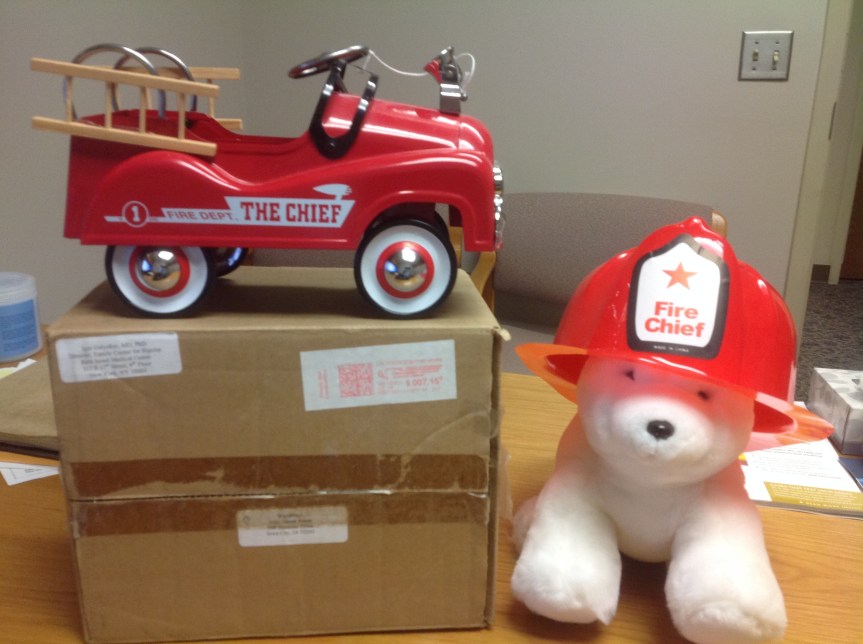
Anyway, shortly after I posted that, I got a box in the mail with a very strange-looking address for me:

Hey, what do you know, I work for WordPress!

Even more astonishing was what was in the box. It was Bumpy the Bipolar Bear, an item that evidently was a part of his Mood Disorder Division at Beth Israel.

Bumpy is the one with the Fire Chief helmet

I have never really figured out whether he did this tongue-in-cheek or what. We’ve never met and we don’t correspond. It doesn’t look like Bumpy is a thing anymore at Beth Israel.

I’m not a research scientist, but I wonder if anyone would fund a center for the study of Anecdotal Garrulity? More importantly, would a statue of me, sculpted from Play-Doh (originally wallpaper cleaner, something you’d know if you watched the Travel Channel as much as I do now that I’m retiring), be erected in the rotunda?