Whatever Happened to the Janus Head Logo for ACLP?

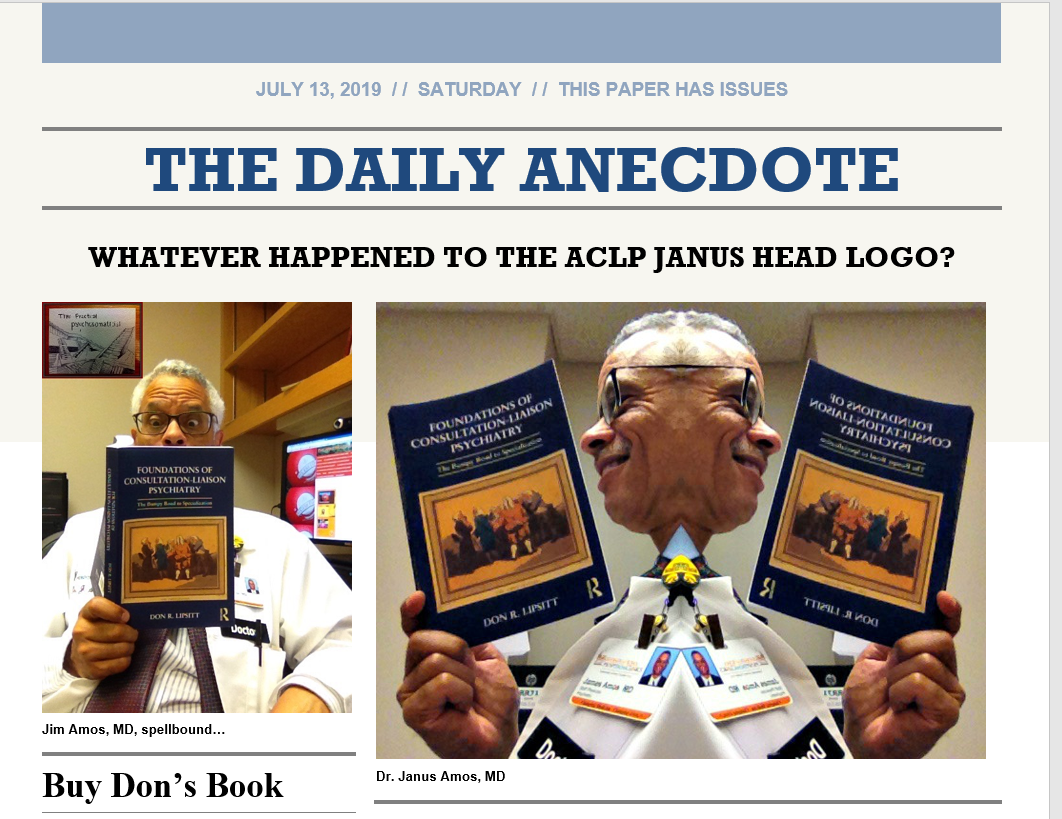
I got an email from Don R. Lipsitt, MD yesterday which reminded me of the Janus Head logo for the Academy of Consultation-Liaison Psychiatry (ACLP). It was changed to another sort of nondescript logo several years ago for reasons I didn’t understand.
Dr. Lipsitt is a luminary in C-L Psychiatry and recently published a definitive history of the field, Foundations of C-L Psychiatry: The Bumpy Road to Specialization (2016).

Go ahead; buy this book!

I posted a blog or two about Don and his book in a previous blog, The Practical C-L Psychiatrist. We’ve never formally met. A few years ago, he noticed that I had written about him and his book. I had sent him an email message about it at around the same time the APM was considering the name change for the organization, telling him that I had plugged his book and asking him what he thought of the name change. Incidentally, he thought both of our books made a great package, so I guess I’m allowed to plug mine, strangely titled Psychosomatic Medicine: An Introduction to C-L Psychiatry, editors James Amos and Robert Robinson (2010).

Go ahead; buy my book, too…

 Don expressed his opinion about the name change:

“I feel I have dealt with that at some length in my book. I still feel C-L is most fitting and that the Board made a big mistake naming it PM. Who were they? Any C-L psychiatrists among them? Any Psychosomaticists? Why are not the “complex medically ill” a special population? And why is APA now offering courses on “integrated” care (which is what C-L psychiatry has always been about? The notion that C-L was not declared a specialty because it was considered a skill of ALL psychiatrists (with minimal training), then how do geriatric or child psychiatry become specialties (that all psychiatrists also have training in)? Don’t get me started.”

He considered his book, in large part, a “polemic” against the name “Psychosomatic Medicine.”

Anyway, the ACLP was formerly the Academy of Psychosomatic Medicine (APM) until a couple of years ago when the organization responded robustly to the membership (of which I was one at the time) to abandon the term “Psychosomatic Medicine” and adopt what rank and file practitioners preferred—Consultation-Liaison Psychiatry.

It was a kind of rebranding and it was not the first time the academy had considered a name change. I and a lot of other C-L Psychiatrists cringed at the term “psychosomatic,” not so much because of the word itself in terms of its true denotation, but because of the unfortunate negative connotations it had acquired.

Another luminary of C-L Psychiatry, Dr. Thomas Hackett, MD, wrote about the term “psychosomatic” in the Massachusetts General Hospital: Handbook of general hospital psychiatry: edited by Hackett and Ned Cassem (1978):

“The term ‘psychosomatic service’ has had a variable history. The term generally leaves a bad taste in the mouths of physicians. It reminds them of the 1930s, 1940s, and 1950s, when various psychosomatic schools espoused doctrines linking specific psychological conflicts or unique personality profiles with diseases designated as psychosomatic. Compounding this misunderstanding has been the term’s abuse by the general public, who regard anything psychosomatic as either imaginary or nervous in origin. As a consequence, most people believe that a psychosomatic disease is not to be taken seriously.”

Well, anyway, because of my anecdotage, I’ve strayed a little from my original story about the Janus head logo.

I already mentioned that the logo was abandoned in favor of something that looks like waves and could lead to seasickness. I inquired about the history of the use of the Janus head logo.

In addition to my curiosity about why the logo was changed, I also wondered why it was chosen in the first place and when. According to Don, it was part of the organization’s journal, Psychosomatics, in the late ‘60s and ‘70s. What was interesting is that it was already in use by the Journal of Geriatric Psychiatry when the Psychosomatics editors started using it. However, a conflicting view was that it was not introduced to the cover until 2010. Hmmmm.

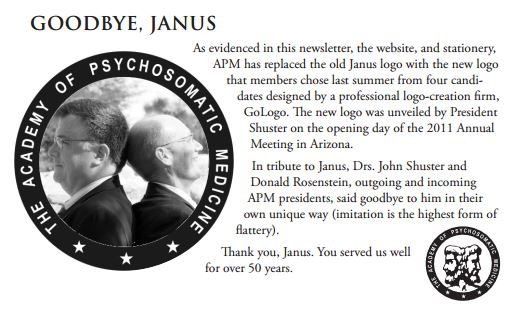
I saw the 2012 issue of the APM Newsletter had a pretty funny picture of Drs. Shuster and Rosenstein posing as Janus and the statement “Thank you, Janus. You served us well for over 50 years.” That might put the origin of the logo, at least, around 1962 although my understanding is that APM was started in 1953 (TN Wise, A Tale of Two Societies, Psychosomatics 1995).
Time to say “Hello, again, Janus?”

 It’s just my opinion, but because Janus is the ancient god of beginnings and transitions, gates, doorways, endings and time, and typically depicted as two-faced because he looks to the future and the past, I think the symbol is a better image for what C-L Psychiatry has been through over the years.

Anyone for re-rebranding and go retro back to the Janus head logo?

Back to the future, Dr. Janus Amos?

Hoofing it Around the Hospital

Again today, I hoofed it around the hospital. I put 43 floors and a little over 4 miles on my step counter.

I don’t like waiting for elevators so I take the stairs. And a Consult-Liaison Psychiatrist is like a fireman, running all over putting out fires.

I did other things today. I gave the usual lecture on delirium and dementia to the medical students. I notice that as I have gotten older, I tend to tell more anecdotes about my experiences managing delirium in patients on the medical side of the hospital.

I’m in my anecdotage, as I told the students today.

I also lamented the decision by the powers that be to copyright the Montreal Cognitive Assessment (MoCA). The medical students will be able to use it for free, but faculty won’t.

I think that’s ageism. I won’t pay so I won’t use the MoCA anymore.

Back in the Saddle

Well, I’m pretty tapped out, so it’ll be a short post today. I’m back in the saddle, running around the hospital on the psychiatry consult service. This is my last year of phased retirement and in 11 months—I’ll be fully retired.

I put 36 floors and 3 miles on the step counter. I’m feeling every one of those. Sena bought me some banded collar shirts and I’m wearing those instead of a shirt with a necktie. I don’t need a tie bar.

And I don’t worry about a delirious, violent patient strangling me with my necktie.

We had a small scare tonight. We were looking at my total compensation statement (the last one) and got the Sharp Elsi Mate EL-505 vintage calculator out to crunch some figures. The calculator went dead.

Still going…

I put some new batteries in it, hopeful. It still didn’t work. We’ve had this calculator for over 30 years and it ran more than a decade on the first set of AA batteries.

I tried another pair of batteries. It worked! The vintage calculator lasted longer than the batteries. It’s nice to know that just because something’s old doesn’t mean it’s useless.

That’s all I got.

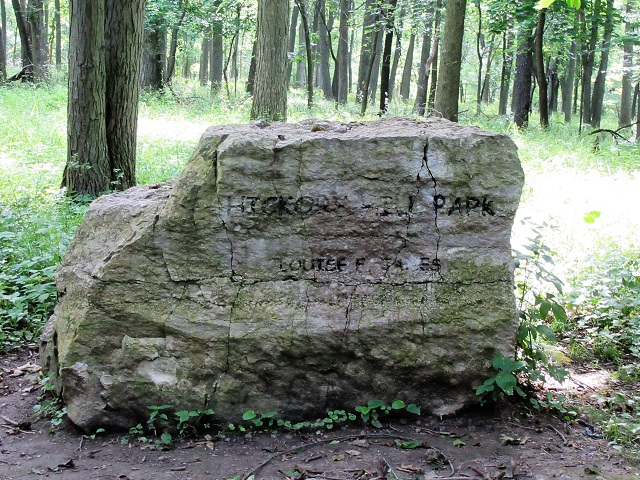
Hickory Hill Park Ramble

We visited Hickory Hill Park today in Iowa City. We’ve lived in this area for 30 years and have been near it but never walked a trail until now. It’s full of trees, birds, and other wildlife, including deer, which seemed to pose for the camera.

Deer posing

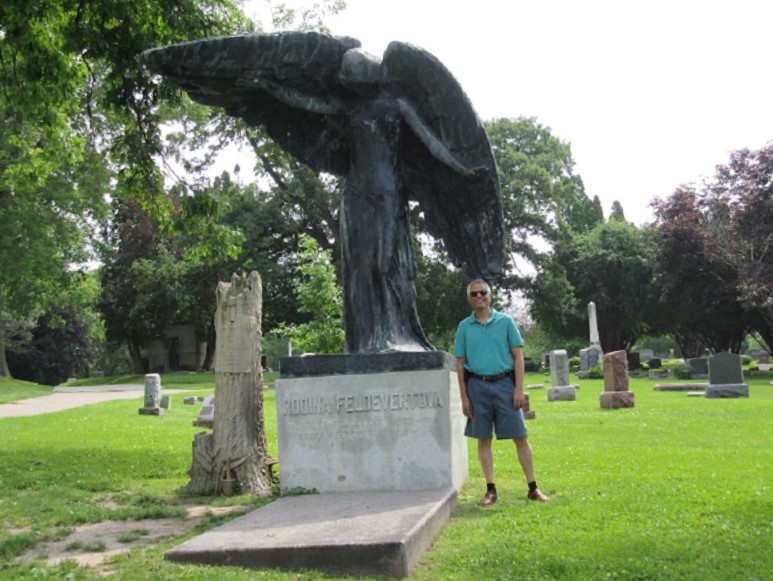
I say we’ve been near it because we have visited Oakland Cemetery, where the famous Black Angel monument is. At least one of the trails leads to one end of the cemetery—which we discovered today.

There are many legends about the Black Angel, most of which are in the vein of various curses and some of which claim that the curses can kill visitors—not true, of course. Many take selfies in front of the Black Angel and toss coins in the base (probably to ward off any curses, just in case).

I was feeling pretty reckless on the day Sena took a snapshot of me in front of the Black Angel. I left a little pocket change. That was a few years ago. The object of the visit was not to visit the Oakland Cemetery but to take part in the picnic and Psychiatry Department Matball Challenge game, Faculty vs Residents at Happy Hollow Park about a block away from the cemetery.

The Black Angel of Oakland Cemetery

Anyway, it was pretty hot today, in excess of 100 degrees with the heat index. We kept the walk short for that reason. It was warm, but the tree canopy kept the heat down a little. There’s something about walking through a thickly wooded area in which most of the sounds you hear are of nature. It tends to make me a little reflective.

Because I’m in my last year of a phased retirement contract and will fully retire next year, I’ve been thinking about transitions, the end of one era of my life and the unknowns about the beginning of another. There are a lot of unknowns. Sometimes I feel a little lost.

Retirement tends to lead me to think about death, which is pretty morbid, I know. I don’t ruminate about it, but walking past some of the park benches, some of which are memorialized to certain persons, got me to wondering about the next bend in the path. On one of them was a small plaque bearing a quote,

“Not all those who wander are lost.”

JRR Tolkien

There was a baseball on the bench.

And not long before we got to that bench, we saw a shoe, apparently lost by someone—who might have been lost. Hickory Hill Park is big. A person could get lost in there.

Lost shoe

We followed a path that others seemed to be taking. It led to the back of Oakland Cemetery where we saw a couple of headstones which puzzled us. The names were very familiar; man and wife, with only the birth years carved in them. But the strange thing was—as far as we knew they were still very much alive! The man had been the closest thing to a mentor that I could remember ever having.

Naturally, later I realized that it was just that they had thought through their own transitions a lot farther than many of us do. They had planned not only for retirement. They had planned for their own deaths. But until I finally got it, I actually searched on the web for obituaries.

Strange, I actually found a pdf file posted that sort of sounded like one—an exquisitely written letter from a relative who described the person we knew in enough detail that it seemed to identify him beyond much doubt. Why would such a beautiful and presumably private remembrance be posted on the web?

Maybe because the relative wanted the world to know how deeply loved this person is—while he is still alive.

Path

Soaring Bird in the Neighborhood

This afternoon after we returned home after lunch out, I got a picture of what could have been the bird that made off with a mouthful of house finch chicks last month.

I don’t know why I didn’t draw up the window blind when I first heard the sound of what reminded me of a bed sheet flapping in a high wind a month ago.

When I finally did crack the blind, I saw the huge, black bird with what seemed like a wingspan as long as my leg beating those wings mightily at the air to stay aloft as it plucked the baby birds from the tree.

It was fast as lightning and the theft was done so quickly, I had no time to be more than a witness.

I vowed not to go pawing into trees anymore looking for bird nests just to get snapshots. I think I gave the big predatory bird, whether crow or turkey vulture or whatever it was a visual cue to where its prey lay helpless.

Informal Bedside Tests for Delirium

Most of this post is an updated redux from years ago about an informal bedside test for delirium called the oral trails test. I learned about it from my senior resident when I was a junior psychiatry resident in training at the VA Medical Center.

There was an elderly patient admitted to the psychiatry unit who was thought to be psychiatrically ill but who actually seemed confused to me and the senior resident. We consulted medicine in order to get him transferred to the general medicine unit but it was tough going. I think the medicine resident disagreed with our clinical impression that he was confused and didn’t think medical transfer was necessary.

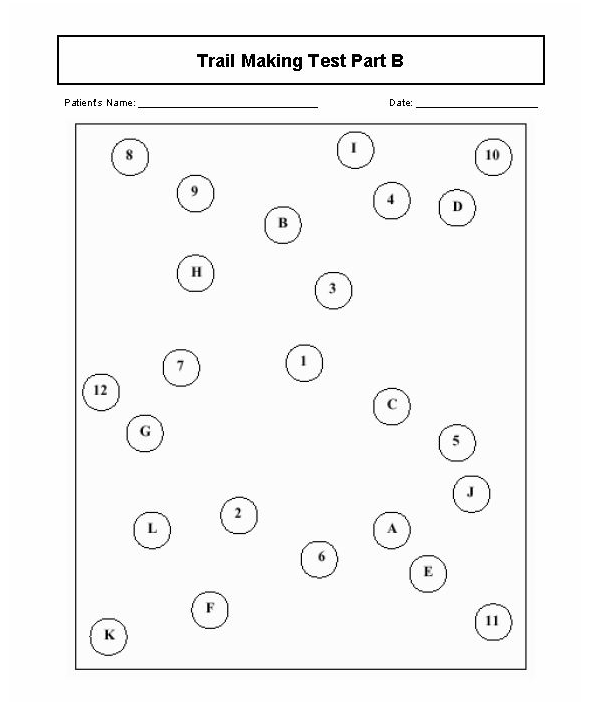
Anyway, my senior resident showed me her version of the oral version of the mixed Trails A and B Test for executive function. There is a written form which is part of the Repeatable Battery for the Assessment of Neuropsychological Status (RBANS). First, she asked him to count from 1 to 7; then she asked him to recite the letters of the alphabet from A to J. She then asked him to try reciting those letters in alternating sequence. Of course, he failed miserably and was eventually transferred to internal medicine. The Trails actually is a paper and pencil test and it looks like a dot to dot game, like the example below:

Trails Test

My senior resident told me she learned the oral Trails test from her senior resident and couldn’t remember anything else about it. I used the test for years but a neuropsychologist criticized the practice, questioning the test’s validity, and rightly so.

Of course, I’d been doing it wrong. You’re supposed to have the patient count to 25, then recite the letters of the alphabet, then recite the numbers and letters in alternating sequence from 1 to 13 and A to M. More than two errors in pairings indicate cognitive impairment.

There are limitations to the verbal Trails and caution is advised in more recent literature, indicating that there are moderate education effects in older patients and that it may be wiser to use both paper and pencil and oral versions together.

Still the search goes on for quick and dirty ways to screen for cognitive impairment in the elderly because this and advanced age are two main risk factors for delirium.

Nowadays, I do the Mini-Cog (shown in the video below) or the Single Question in Delirium (SQiD) test, which just involves asking a family member if the patient seems confused lately.

References:

Mrazik, M., Millis, S., & Drane, D. L. (2010). The oral trail making test: effects of age and concurrent validity. Archives of clinical neuropsychology: the official journal of the National Academy of Neuropsychologists, 25(3), 236–243. doi:10.1093/arclin/acq006

Ricker, J. H., & Axelrod, B. N. (1994). Analysis of an Oral Paradigm for the Trail Making Test. Assessment, 1(1), 47–51. https://doi.org/10.1177/1073191194001001007

Sands, M., Dantoc, B., Hartshorn, A., Ryan, C., & Lujic, S. (2010). Single Question in Delirium (SQiD): testing its efficacy against psychiatrist interview, the Confusion Assessment Method and the Memorial Delirium Assessment Scale. Palliative Medicine, 24(6), 561–565. https://doi.org/10.1177/0269216310371556

My Top Ten YouTube Videos

OK, my top ten YouTube videos are going to get pretty low ratings anyplace else. But where else are you going to see the list but on my blog? In a world where popular videos are viral at a million plus views, I’m way in the back yard.

I wasn’t very picky, of course, because these are the videos I made. I didn’t include any others, especially the ones that were professionally produced. I kept the bar pretty low because I had to. Any video with over 900 views made it to the list, which goes from lowest to highest number of views.

By the way, the only way I could come up with a Top 10 list was to make the bar 900.

10. “Dr. Jim Amos’ Dirty Dozen on Suicide Risk Assessment” published 2012: 940 views

9. “Dr. Jim Amos’ Dirty Dozen on Alcohol Withdrawal Treatment” published 2012: 1,063 views

8. “Dr. Jim Amos’ Dirty Dozen on Catatonia” published 2012: 1,668 views

7. “Mall of America Video” published in 2016: 1,728 views

6. “Dr. Jim Amos’ Dirty Dozen on Interpersonal Psychotherapy” published 2012: 1,840 views

5. “Dr. Jim Amos’ Dirty Dozen on Catatonia, NMS, Serotonin Syndrome” published 2013: 1,960 views

4. “Dirty Dozen on Dr. Allen Frances’ Dozen General Tips on Psychiatric Diagnosis” published 2013: 2,492 views

3. “Pseudobulbar Affect Top Ten” published 2015: 2,613 views

2. “Dr. James Amos’ Dirty Dozen on Somatoform Disorders” published 2012: 8,191 views

1. “Dirty Dozen on Factitious Disorder and Malingering” published 2012: 12,465 views

Now why would a video about abnormal illness behaviors like Factitious Disorder and Malingering be number one?

And why would “Mall of America Video” be my most popular non-work-related video? My wife and I did have a lot of fun there.

I like to think people enjoy “Pseudobulbar Affect Top Ten” because of my superb pseudo-rap acting style—and my hat.

Like my hat?

The Paperboy

I don’t read the news much at all these days. It’s almost always bad, anyway. I was a paperboy in my youth. I delivered the Des Moines Register and Tribune for a year and earned a certificate as Honor Salesman.

My paperboy certificate

Let me tell you a little something about being an Honor Salesman back in those days. First of all, I had to cross some railroad tracks to pick up my papers at the drop up the street from my house. Evidently, tree swallows like to nest around railroad yards sometimes, because they dove at my head like bombers. I had to swing my paper bag at them to fend them off.

And I had to deliver my papers in a little red wagon on Sundays to get the big Sunday edition out. My paper bag wasn’t big enough to carry around my skinny neck with all those supplements, ads, and tons of news.

In the winter, it was twice as bad. If I’d had a sleigh, I could have made like Santa Claus. But I didn’t. All I had was the wagon and dragging it through a foot or more of snow did not put me in a holiday mood.

I learned a little about business. One of the lessons was that you sometimes meet some pretty strange people on a paper route.

I was embarrassed a few times when I had to collect, which was to gather payment from my customers for a paper that one guy said wasn’t worth a shit. In all fairness, he’d been drinking and had fallen on hard times—but he paid me anyway.

Another awkward moment was collecting from a young newlywed couple who always answered the door while wrapped in large bath towels. “Large” is a relative term, especially on the young lady. It left a little to the imagination, but not much.

I folded my papers, which is, of course, a lost art nowadays since everybody gets their news on their electronic devices. I didn’t pitch them on to porches though, because that was frowned on at the time by my boss. We were taught to place it carefully inside the storm door so it wouldn’t get wet or dirty.

Dogs were not as much of a problem as bumblebees, particularly at one house on my route where the guy raised fields of Hollyhocks. They were well over 6 feet tall and they covered his back and front yard, crowding around his front door which I had to open to deliver his paper. The air was always alive with the drone of bees, some of them as big as golf balls (well, it seemed that way). The place scared me to death—but I had to do my job.

I didn’t really develop a head for business but it was good training for life in general.

A Pair of Cufflinks

My wife and I were watching an episode of Antiques Roadshow this evening and saw a spot about a pair of cufflinks that turned out to be worth a lot of money.

That reminded me of the first and only pair of cufflinks I ever owned. Back when I was an undergraduate in the mid-1970s at the private, historically black Huston-Tillotson College (now H-T University), in Austin, Texas, a wealthy, successful white businessman who was fond of my English professor bought me a suit, dress shoes, tie, and cufflinks.

I was ambivalent about the gift as I was being fitted for the suit at the men’s store in downtown Austin.

I wasn’t sure what cufflinks were supposed to do for me. I suppose I shouldn’t judge the guy too harshly. After all, he was just trying to be generous—and probably trying to impress my English professor.

It was the 1970s and it was not a great time for black people in America. There was violent racism of course. There was also a sort of paternalistic generosity which may have emphasized superficial symbols of economic success.

Anyway, after a while the shoes started to squeak. I outgrew the suit. Despite those losses, I became successful through hard work and good luck.

I lost the cufflinks.