The Firefighter Retires

I’m writing this post today because this firefighter retires tomorrow—and I’ll probably be very busy and too weary at the end of my last day on the psychiatry consult service to write. In fact, I’ve been too busy and tired to post for the last several weeks because we’ve been in the process of moving. Does that ever really end?

I can tell that what will really end at around 5:00 PM tomorrow is my career as a general hospital psychiatric consultant. It has been a long time coming. I’ve been on a 3-year phased retirement contract and going back and forth between wishing for it to end sooner and being scared to death as the final day approaches.

There are those last things: handing in the keys, the white coats, the parking hang tag and the like. I’ve cleaned out my office and somebody already wants it. I’m surprised that I’m just the tiniest bit territorial about the place, which is strange. I never spent much time in it because I was always chasing consults around the hospital.

I’ve never retired before. I wonder what the rules are. I still don’t know how to answer everybody’s question: “What are you going to do?”

There is the “new” house. It’s actually an older home, which fits my status as an older person, I guess.

The floors squeak and creak, a lot like my joints. There are little jobs and slightly bigger jobs to do for which I’m painfully aware of the need to develop a whole new skill set—or at least relearn them.

It’s about new noises and new animals. A fox trots across our yard occasionally. I’m used to deer, but we’ve never spotted a fox on our lawn. It has a rusty coat streaked with a lot of gray. It looks old. But it’s a good hunter and more than once we’ve seen it carrying a big mouthful of something that might have put up a pretty good fight.

I’m touched by the well-wishers, and those who say thanks for the memories. Just about every day of the last week, I’ve seen and done something at the hospital which makes me say, “That is what I’ll miss.”

One day to go.

Wind and Wings

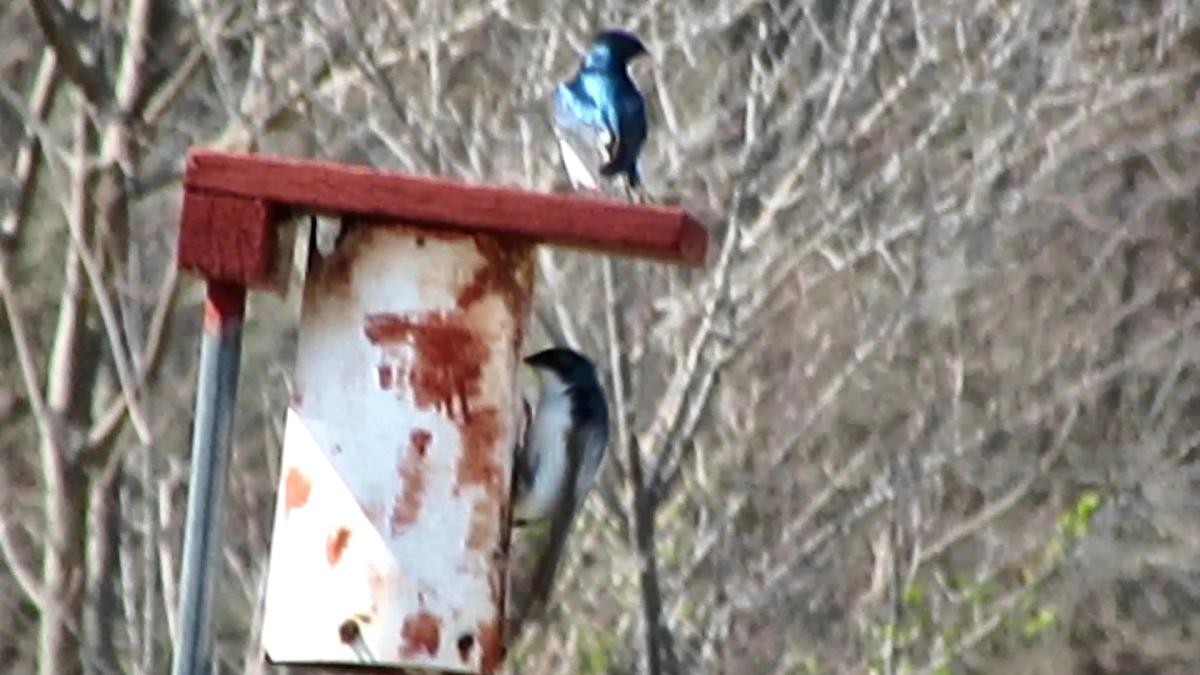
A couple of days ago we were at the Terry Trueblood Recreation Area and it was pretty windy. The birds were challenged just hanging on in the trees. Eastern Kingbirds didn’t hardly ruffle a feather. The Tree Swallows seemed to be pretty good acrobats high up in the trees. The Cowbirds, not so much.

Birds getting their feathers ruffled in the wind!

Kudos to the Goodenough Psychiatrist for Blog Post “The Perfect Balance”

I almost never write more than one post a day, but I’m pretty impressed with the blog post “The Perfect Balance” by The Goodenough Psychiatrist. It was very thought-provoking and the Stuart Ablon Ted Talk on Collaborative Problem Solving was refreshing.

A little over 3 ½ minutes into the video, Ablon says something interesting about conventional wisdom which helps cast doubt on blindly trusting it. When he remarks that conventional wisdom commonly fosters misconceptions including teaching that the earth was flat, it reminded me of a scene from Men in Black (I confess, one of my favorite movies). Agent K says, “A person is smart. People are dumb, panicky dangerous animals and you know it. Fifteen hundred years ago everybody knew the Earth was the center of the universe. Five hundred years ago, everybody knew the Earth was flat, and fifteen minutes ago, you knew that people were alone on this planet. Imagine what you’ll know tomorrow.”

His remarks highlight the challenge to those who break with conventional wisdom, which can sometimes be isolation.

It takes courage.

Please Take Your Seat

I brought my camp stool home from my office at the hospital yesterday. For the past several years and up until the time of the COVID-19 pandemic, I used it while interviewing hospitalized patients as part of my job as a consultation-liaison psychiatrist in the general hospital. I stopped only when I wondered whether carrying around an object which could be contaminated with the virus was a safe thing to do.

A colleague lent me the little chair when he and his colleagues on the Palliative Care Medicine consultation service started using them. I asked him whether he wanted it back and he graciously said I could take it with me now that I’m retiring—and use it as a camp stool (in a way, saying “Please take your seat”). For many years prior to getting the stool, I had been finding a chair or sending my trainees to find one for me. I felt more comfortable sitting eye to eye with patients and I got the impression that my patients appreciated that as well.

I got a lot of positive feedback from patients, family members, and other hospital staff about the little chair. I think it helped break the ice with patients and was a great opener, especially if they felt well enough to express a sense of humor— “Hey, doc; you don’t need nunchucks; I promise I’ll be good!”

There are a few papers in the medical literature supporting the usefulness of sitting with patients. Most authors assert that it helps build rapport and increases the patients’ perception of how interested their physicians or other health care clinicians are in their welfare (see the reference list below).

Once, when my original little chair broke beneath me during an evaluation for catatonia in one patient, the stool abruptly became a novel catatonia assessment tool.

The patient was mute but there was little evidence otherwise for catatonia, one of the chief features of which is the inability to react to any stimulus in the environment. I was seated on the chair explaining in detail the intravenous lorazepam challenge test for catatonia (which often interrupts the episode of muteness and immobility).

I was sitting in front of the patient but facing the family and the consult service trainees while expatiating on the topic. As I was droning on, I heard a sudden pop—and I fell flat on my fundament as the chair collapsed beneath me.

My audience exploded in loud laughter, and pointed at the patient. When I turned to look at him, he was convulsed with silent mirth.

I considered this a negative test for catatonia in this case, though impractical for regular use.

My colleague gave me a replacement camp stool, more securely built. However, he mentioned he might give up using his as a result of my accident which, incidentally, befell (rimshot) another doctor on his team. I’m not sure whether I’ll use the little chair. If I sit on it too long, my legs go numb. I think that’s about 10-15 minutes, about the length of time mentioned in one of the studies below. It didn’t seem to influence the positive perception of the visit—but it did make me walk funny.

I probably spend about the same time with patients now that I don’t use the little chair. But I don’t feel right about it. I’m always reminded of what Hackett said:

“As a matter of courtesy, I sit down when interviewing or visiting patients. Long accustomed to the ritual of making rounds, many physicians remain standing as a matter of course. Standing, physicians remind me of missiles about to be launched, poised to depart. Even if that is not necessarily true, they look the part. Patients sense this and it limits conversation. In addition, when standing, the physician necessarily looks down on the patient. This disparity in height is apt to encourage the attribution of arrogance. Looking down at a patient who is prone emphasizes the dependency of the position. Sitting at the bedside equalizes station. Sitting with a patient need not take longer than standing with him.”—Thomas Hackett, in MGH handbook of general hospital psychiatry, 1978.

References:

Johnson RL, Sadosty AT, Weaver AL, Goyal DG. To sit or not to sit?. Ann Emerg Med. 2008;51(2):188‐193.e1932. doi:10.1016/j.annemergmed.2007.04.024

Swayden KJ, Anderson KK, Connelly LM, Moran JS, McMahon JK, Arnold PM. Effect of sitting vs. standing on perception of provider time at bedside: a pilot study. Patient Educ Couns. 2012;86(2):166‐171. doi:10.1016/j.pec.2011.05.024

Strasser F, Palmer JL, Willey J, et al. Impact of physician sitting versus standing during inpatient oncology consultations: patients’ preference and perception of compassion and duration. A randomized controlled trial. J Pain Symptom Manage. 2005;29(5):489‐497. doi:10.1016/j.jpainsymman.2004.08.011

Orloski CJ, Tabakin ER, Shofer FS, Myers JS, Mills AM. Grab a Seat! Nudging Providers to Sit Improves the Patient Experience in the Emergency Department. J Patient Exp. 2019;6(2):110‐116. doi:10.1177/2374373518778862

Merel SE, McKinney CM, Ufkes P, Kwan AC, White AA. Sitting at patients’ bedsides may improve patients’ perceptions of physician communication skills. J Hosp Med. 2016;11(12):865‐868. doi:10.1002/jhm.2634

Let Nature Speak

While we were out for a walk on the Terry Trueblood Trail today, for a change, my wife gave me the idea that we should just let nature speak. The frogs were in full voice. It was impressive. As we walk, we usually start off by talking a lot. We point out interesting birds and flowers and comment on all we see and hear. The further we go on the trail, the quieter we get. Pretty soon, we don’t talk much at all. We walk at a slower pace. We just listen.

Usually, after we return home, I make a video and try to match it with some kind of music. Nature has its own music, though. Today, we just let that happen.

Mother’s Day for a Robin

Happy Mother’s Day! The blog post for today is a little unusual because it’s about a “mother” robin who built a nest on April 9, 2019 and is still sitting on it as of today. It’s unusual because she’s been sitting on the nest for at least a couple of weeks now even though there have been no eggs in it. We can’t figure why she’s sitting on an empty nest.

Things got started relatively well. In fact, after building the usual sloppy nest, the mother robin laid two eggs in it. That was the largest number of eggs we ever saw. The number went down from two eggs to one to none over a couple of days or so.

“And then there were none.” I never read Agatha Christie’s book by the same name or saw the TV miniseries on which it was based several years ago. On the other hand, death played a role—a natural one—in the case of the very devoted mother robin.

The robins built their nest in an evergreen tree right below one of our windows. What was nice about that was that I never had to creep up on them, see them thunder out of the tree, mess with the branches around the nest, snap photos—and leave a scent trail for large predatory birds.

Now, speaking of predatory birds…I never saw any of them this time. I know last year I heard a heavy flapping noise (like bedsheets on a clothesline) outside of my office window and opened the blinds just in time to see a huge crow or turkey vulture take off from our front yard tree. Its beak was full of house finch nestlings. I swore I would never again engage in monitoring bird nests in that way.

This time there was only circumstantial evidence of nest robbery. My wife saw broken egg shells on the ground under the tree but it’s not clear exactly when she saw that.

But mother robin still sits on the nest. I have not been able to find any information about this behavior in nesting birds.

It’s not that birds never display odd nesting behavior. One of E.B. White’s essays, “Mr. Forbush’s Friends,” published in the Essays of E.B. White (White, E. B. (1977). Essays of E.B. White. New York [etc.: Harper and Row), describes a great number of these peculiar behaviors. One quote: “Had pair of Carolina wrens build nest in basket containing sticks of dynamite. No untoward results.”

I did wonder why our mother robin built a nest so visible from the sky. That was as bad as building a nest in a basket of dynamite. I know we have a tendency to anthropomorphize animal behavior, but I’m having trouble explaining this mother robin’s persistence in sitting on an empty nest. There are no new eggs; yet she acts as if eggs are there. Is she grieving? Is she hallucinating? How long will this go on?

Maybe some of you know what this is all about and I welcome your comments. Until then, it looks like for this robin, Mother’s Day is endless.

Face Shield Assembly—If You Dare

At the hospital where I work, face shields are preferred over medical grade masks, mainly because they keep you from touching your face. We now wear face masks and shields, according to CDC guidelines.

We got a couple of face shields through Amazon. It’s a kit you have to put together. I wish I had known that beforehand. The instructions in the package were not helpful and the picture guides on Amazon were not much better, but they at least got me started.

I put a few scratches in the plastic cover while putting one of the shields together. I did a little better with the second shield. I’m hoping that wearing these out in the community won’t become part of the new normal.

The Masked Walkers on the Terry Trueblood Trail

Today we took another walk on the Terry Trueblood Trail. This time there was a different feel. We wore face masks and there were new signs directing one-way traffic in order to facilitate social distancing. We noticed a few people wearing masks, but not many more than the last time we were out there.

Sena got a kick out of picking up groceries the other day. The guy who brought out the groceries was wearing a face mask—just not covering his face. He knew the guidelines and could recite them, but he had complaints about the mask: “I can’t breathe!”; “It’s hot!”; “It fogs up my glasses!”; “It gets in my way!”

I heard that. But there’s a right way and many wrong ways to wear a face mask.

The Robins are Back

The robins are building their Hurrah’s nests in our back yard again. That’s about the only thing that has not changed. The COVID-19 (C-19) pandemic has changed just about everything else in our lives.

I wear a face shield now at the hospital. We’re told to wear it as much as possible, like putting on our clothes in the morning. Don’t we leave them on all day? The shield keeps you from touching your face, which is why it’s better than a face mask. However, I’ve noticed something about wearing the face shield for much of the day. Before I describe it, let me give you analogy: If you’ve ever worked detasseling corn when you were young a long time ago, you might remember what happened when you closed your eyes at night and tried to go to sleep. I saw corn fields—miles and miles of corn fields. When I opened my eyes, the vision would disappear. But as soon as I closed my eyes again, I saw the vast corn fields.

It’s crazy, but I have a similar sensory after-effect when I doff my face shield–sometimes I still feel the headband. The pressure of it is just the same as if I were still wearing it. I suppose it’s because I cinch it too tightly. But if I don’t, it slips down my brow, pushing my eyeglasses down my nose.

Another change—I’m a Consultation-Liaison (C-L) Psychiatrist, so I’m used to washing my hands in between patients in the hospital. Now, I’ve got something I’ve never had before–alligator hide patterns on the backs of my hands. They’re dry and cracked. I don’t count the number of times I wash my hands, but it’s a lot more frequent than I used to do. It’s not uncommon for health care professionals to wash hands 75-100 times a day in the C-19 era. I have to use hand cream conscientiously—something I almost never did.

I’m less comfortable being closer than several feet away from people. I tend to hug the walls and corners in stairwells, where I now encounter more people than I ever have before. I guess the message everyone hears is “Stand by me—six feet away if you please.”

I don’t shake hands anymore. The lines into the hospital sometimes lead to crowding while we wait to have our temperatures taken and answer the screening questions about whether we’ve had fever, cough, shortness of breath, etc. It’s perfunctory most of the time, because virtually always the answer is “no” and everybody is in a hurry.

I don’t carry my little camp stool with me anymore, which allowed me to sit down with patients and have face to face, eye level interaction. I’m distinctly uncomfortable standing over them because I haven’t done that in years. If there is a chair in the room, I’m hesitant to use it because, like the camp stool, I worry that it might carry C-19 virus on its surface.

I used to evaluate psychiatric patients in our emergency room by simply going there and seeing them face to face, either in their rooms or, when it was really busy (which is most of the time), in the hallways.

I just used a remote telehealth interface platform using an iPad the other day, which allows me to interview patients from my office, in order to avoid the risk of contagion. It was a little slow and awkward, and I was uncomfortable that a health care professional had to be in the emergency room to hold it up for the patient—who was covered in blood. I felt a little guilty.

I used to round with medical students and residents on our patients. We were the movable feast, a sort of MASH (Mobile Army Surgical Hospital) unit, more like Mobile Unifying Shrink Hospital (MUSH). Unifying means unifying medicine and psychiatry. The medical students are not permitted on the wards now, in order to protect them. It’s awkward rounding with only one resident at a time, although another resident can do other things like chart review and telephone relatives for collateral history. I get in the hospital earlier nowadays, and see many non-C-19 patients alone without trainees, preparing for the C-19 surge when I expect we’ll get many more consultation requests to help care for C-19 patients with delirium and depression. It’s a one-man hit-and-run psychiatry consult service and efficiency is mandatory to meet the demand.

I see patients by myself for another reason. Try as we might, C-19 positive patients will slip through the screens. Many are asymptomatic but contagious, and any test will have false negative results. The idea is to expose the least number of health care front line staff members as possible. Faculty capacity is stretched pretty thin, which is pretty much the situation everywhere. I have to choose. I’m older. I’m weeks from retirement. I’m afraid.

But robins don’t have the burden of choice. They obey their instinct every spring, just the same.

Terry Trueblood Trail Break

Today we took a break from the intensity of the pandemic and went out for a walk on the Terry Trueblood Trail. We were a little surprised at the crowd. There were more people there than we’ve ever seen before.

We’re social creatures. After a while, we get a little tired of everything being about coronavirus and making homemade masks out of bandanas and rubber bands. I made one of those—but I didn’t wear it out on the trail. Most people didn’t.

Sena bought me short sleeve shirts so I can be bare below the elbows at the hospital. I’ll think about it tomorrow.

Today we listened to the Eastern Meadowlark’s song and watched Tree Swallows kiss each other on the beak. We saw American Coot up close for the first time.

They were catching bass in the lake. Nobody wants to clean them so they just throw them back. The frogs are cheeping.

We found a little American flag laying on the walkway. We stuck it in the ground and watched it wave. The Tree Swallow nest boxes were stamped “Made in America.”

I wondered how all of these things came together on a sunny afternoon in the spring. I can’t figure it but it sure was nice.