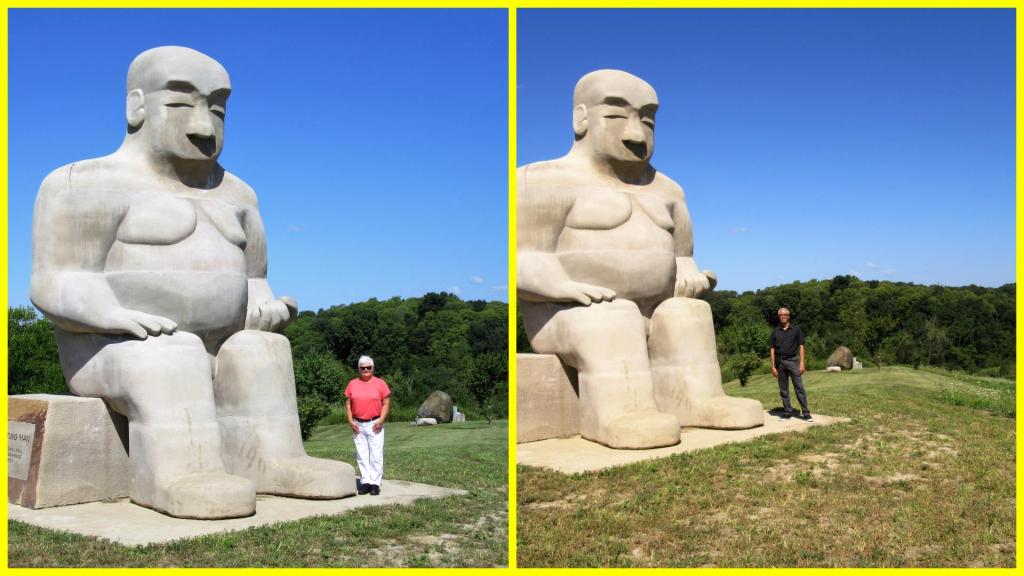
After 33 years living in Iowa City, Iowa, Sena and I finally trekked up Scott Boulevard to see Sitting Man, or Man on a Bench, or the Buddha of Iowa City. Whatever you call him, he’s steady as a rock, which is what he is—110 tons of limestone and 20 feet tall. He was carved by Douglas J. Paul and J.B. Barnhouse and finished in 2013. It was a monumental challenge to move him from the east side of Scott Boulevard to the west side in the summer of 2020 after a change in property ownership. He sits on land owned by Harvest Preserve.
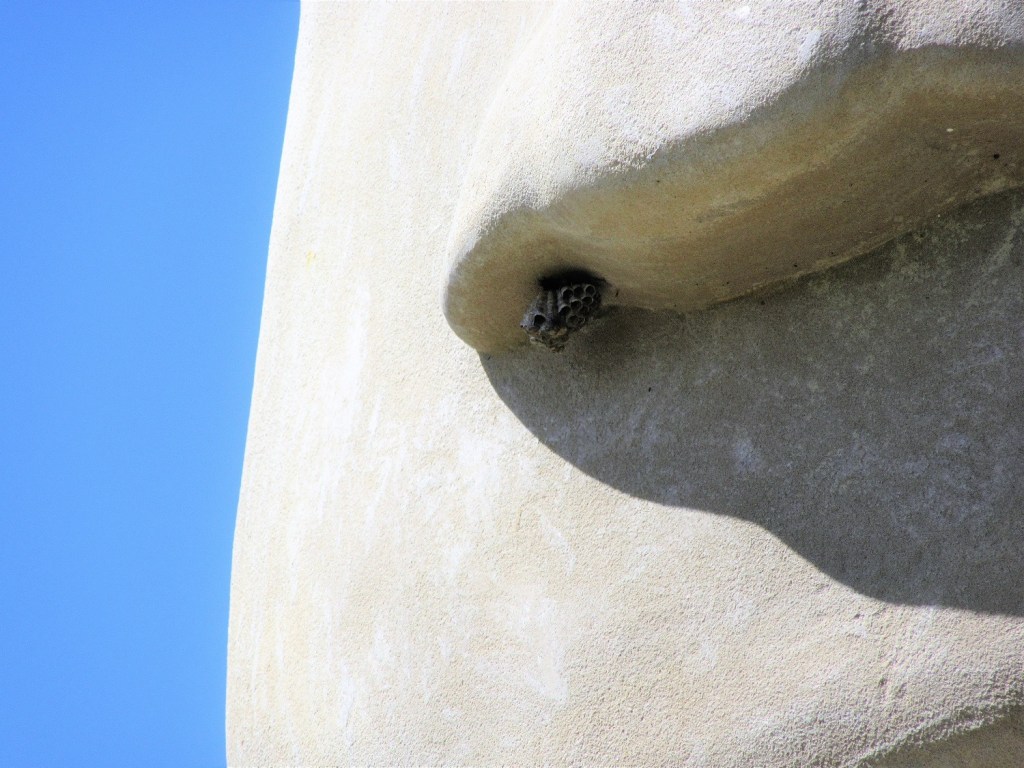
He had an old hornet’s nest booger up his nose, which actually tends to support the idea of him being some kind of Buddha. You have to be pretty serene to put up with that.
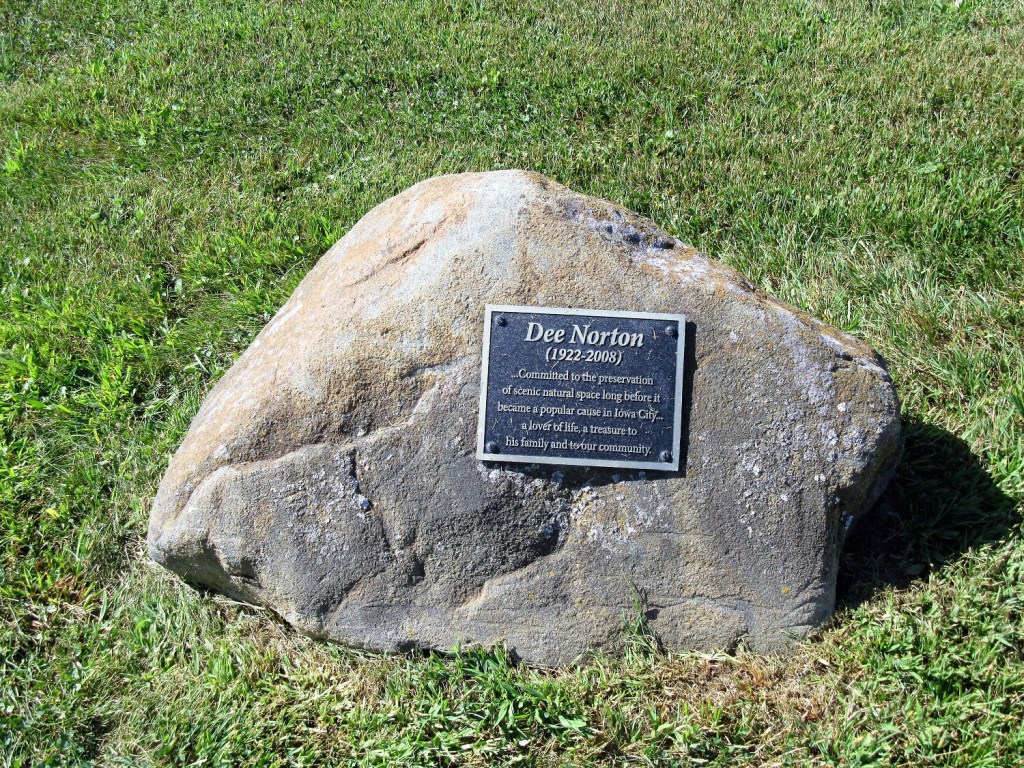
Before you get to the Sitting Man, you reach a contemplative space called the Visionary Stone. The inscription on it is about Dee Norton. According to his obituary on the web, Dee W. Norton was Associate Professor of Psychology and former chair of the Department of Psychology at The University of Iowa. In 1991, he received the Michael J. Brody Award for Faculty Excellence in service to The University of Iowa. He was a longtime member of the Unitarian Universalist Society. He made numerous contributions to education and the community. He had a pretty good sense of humor, too.
I learned more than I thought I would on the journey to the Sitting Man. On the back of the sculpture is an inscription of a prayer, which is dedicated to Paramahansa Yogananda, founder of the Self-Realization Fellowship Church, which I had never heard of or read about when I scanned the web trying to learn more about the Sitting Man. I briefly looked at the website and there seems to be an Iowa City Meditation Circle here, although only an email address is listed (iowacity.srf@gmail.com) and I don’t know what the fellowship is all about in any detail.
There may be more than meets the eye when it comes to a limestone giant with an old hornet’s nest up his nose and a hand open in what is probably a gesture of welcome and acceptance. We could sure use some of this now—minus the hornet’s nest.
Since the weather took a break yesterday from the triple digit temperatures, we took a little getaway to a few of the city parks to see the new public art. This is connected with the Iowa City Public Art Program. Five sculptures were installed about a week ago at Terry Trueblood Recreation Area, Riverfront Crossings Park, and Mercer Park.
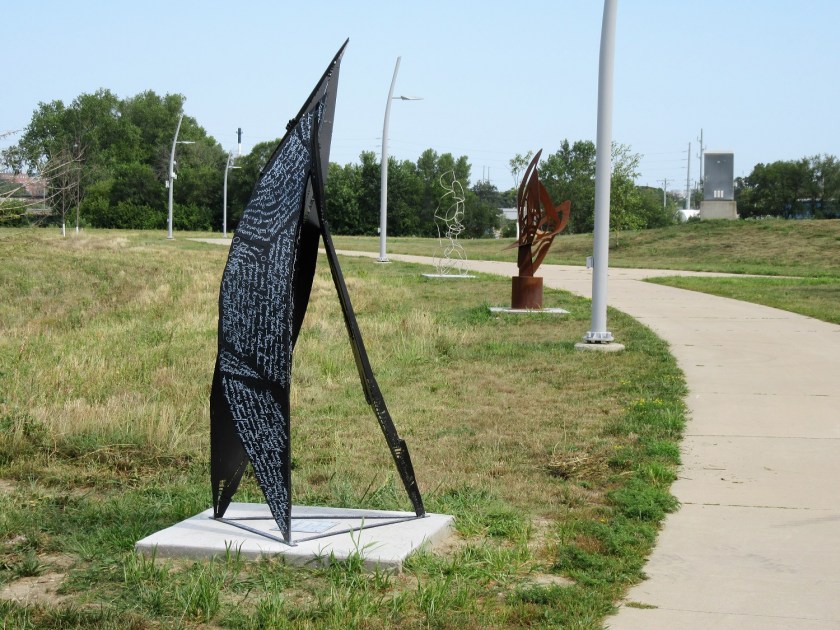
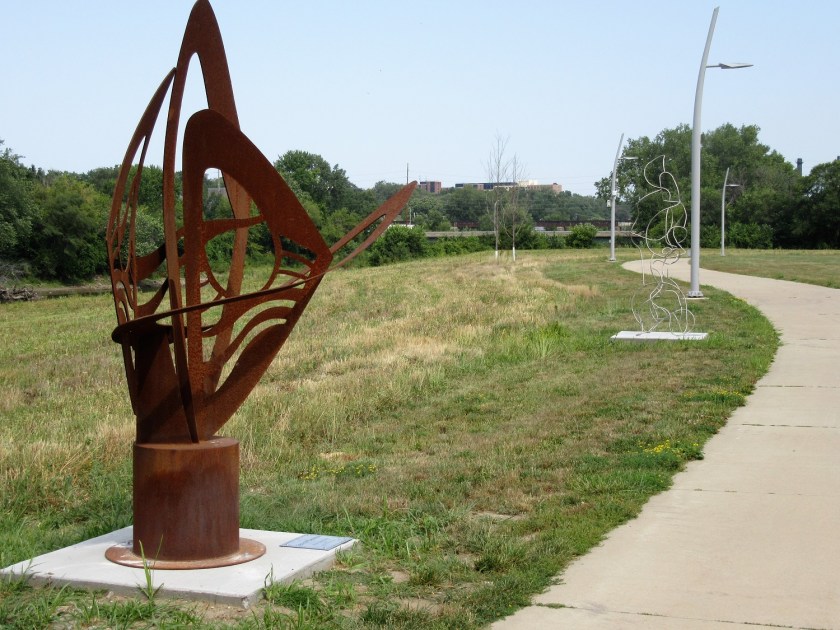
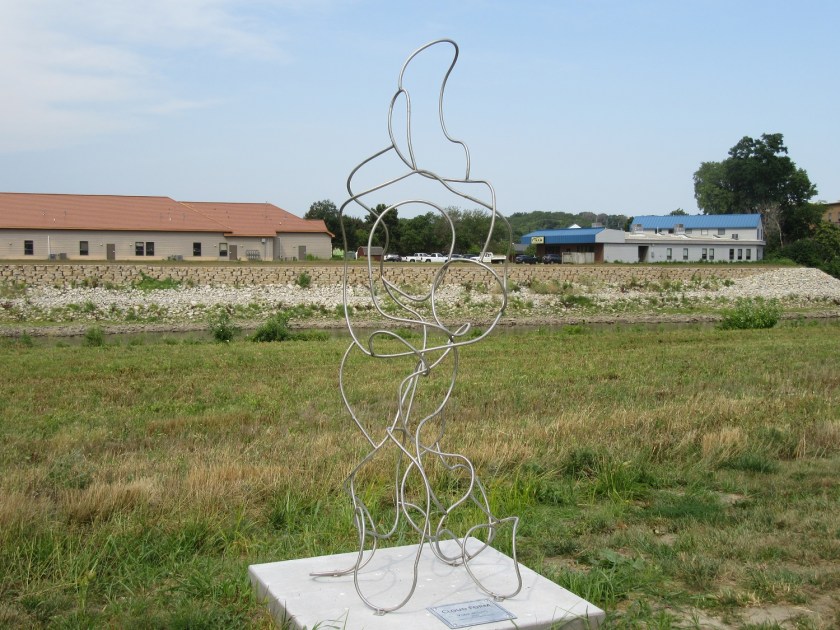
Three sculptures are at Riverfront Crossings. Two are by V. Skip Willits: Palimpsest and Cloud Form. The third is by Hilde DeBruyn: Sea of Change. Sena knows that Sea of Change looks like a sailboat when you look at it from the right angle. We could see clouds through Cloud Form.
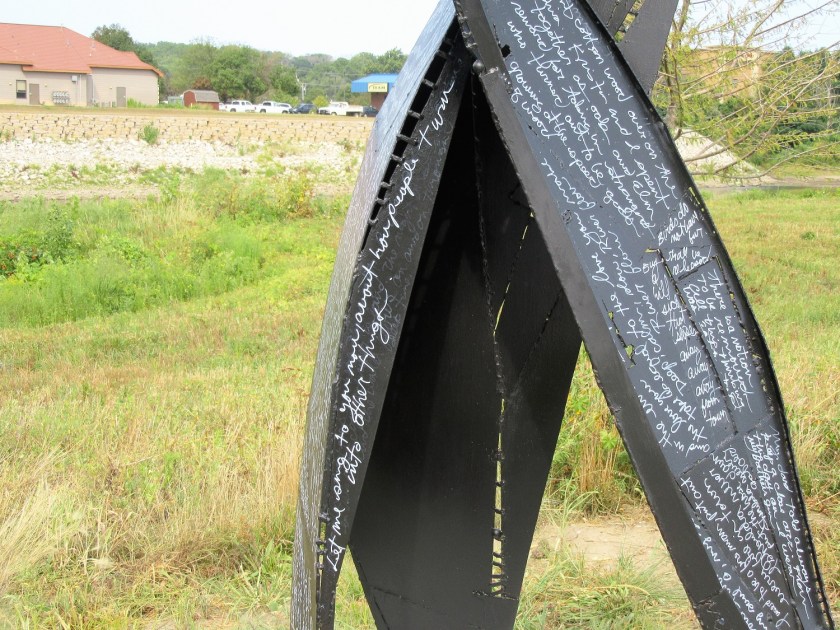
I noticed that V. Skip Willits’s name could be spelled wrong (Willets vs Willits?) on the artist’s nameplate below the sculpture, Palimpsest (also on Cloud Form). I also discovered a 2013 news story of a similar sculpture at the Ames Annual Outdoor Sculpture Exhibition although it was given a different title: Prayer Torso. His sculpture Swans on the Marsh featured in a 2015 image on Sculpture Walk Peoria in Illinois and another fashioned out of corrugated iron in Effingham, Illinois resemble Palimpsest as well. A news story in the March 26, 2021 Effingham Daily News quotes Willits as identifying the sculpture’s title as Cipher. He and probably a few passersby had written on the piece. There are also variant spellings of his name, including V.skip Willits, lower case “s” for “skip.” He’s not the same person as Skip Willits, who is a photographer selling wall art. In any case, Palimpsest is a pretty good example of a palimpsest.
According to the dictionary, a palimpsest is a “piece of writing on which the original writing has been effaced to make room for later writing but of which traces remain.” More generally, it’s something that’s been reused or altered but still has traces of its earlier form. You might want to snap a picture of the sculpture and rotate it in order to see all that’s written there; for example:
“Let me sing to you now, about how people turn into other things.”
I think it could be evocative of what many have noticed and remarked on, only using different words in different languages in different circumstances over millennia. We’re all turning into other things in the turbulent sea of change, sort of like clouds which are the ultimate shape-shifters.
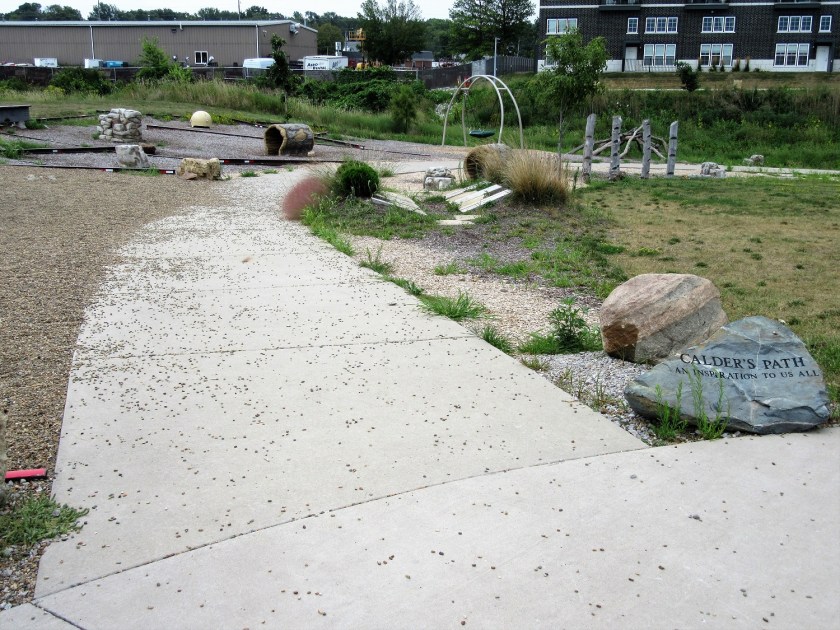
This was the first time we had ever visited Riverfront Crossings Park and we found something familiar there—a stone inscribed with the words Calder’s Path: An Inspiration to Us All. Pebbles were strewn all over the path. After all, no path is without stones. We frequently drive by a small and neatly kept neighborhood park called Calder Park many blocks away. It’s a memorial to a boy named Calder Wills, who passed away of leukemia several years ago. We never knew him or his family. Based on what I’ve gleaned on the web, Calder had big dreams. He was strong. He was a person who turned into a light.
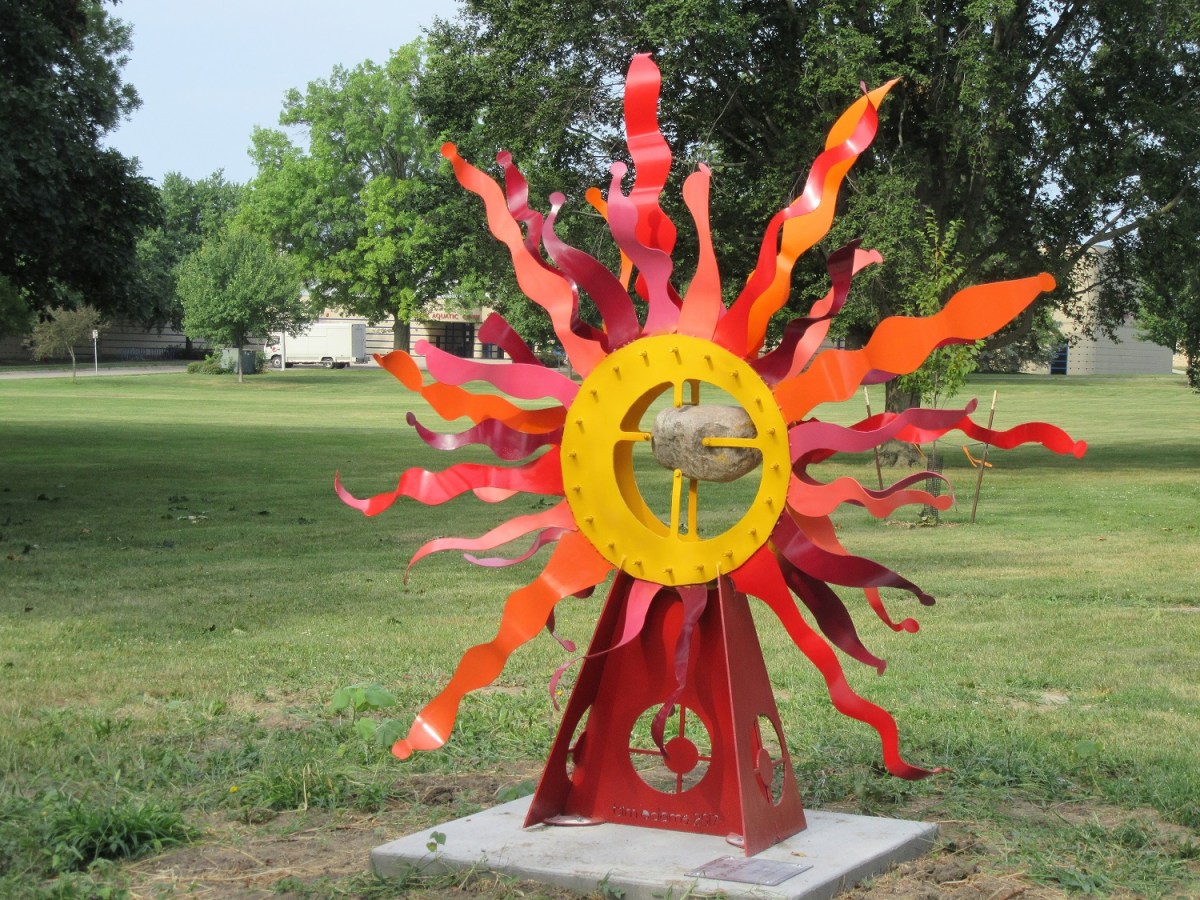
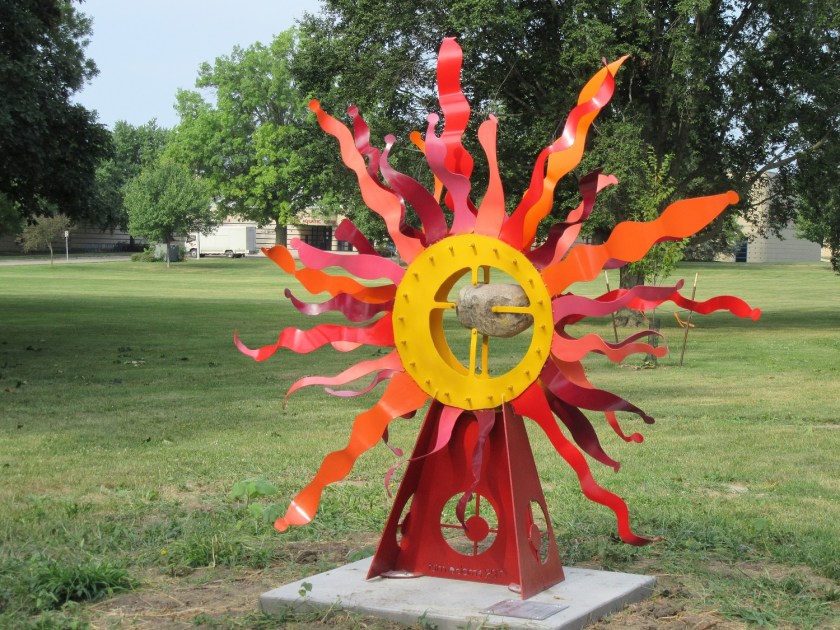
We also enjoyed Mercer Park where we saw the sculpture The Other Extreme, by Tim Adams. Mercer Park and Aquatic Center is named in honor of Leroy S. Mercer who distinguished himself as Iowa City Mayor, state representative and state senator as well as a successful businessman and banker. The sculpture is the sun with a rock at the center. According to Adams, it’s utterly simple; a clear vision of how everything started. There was only the earth and the sun. That was it. And then change took over. Things changing into other things. People turning into other things. Tim Adams art has been influenced by his career as a Registered Landscape Architect. His subjects are influenced by the rugged Iowa weather, which his creations are designed to withstand with little need for maintenance.
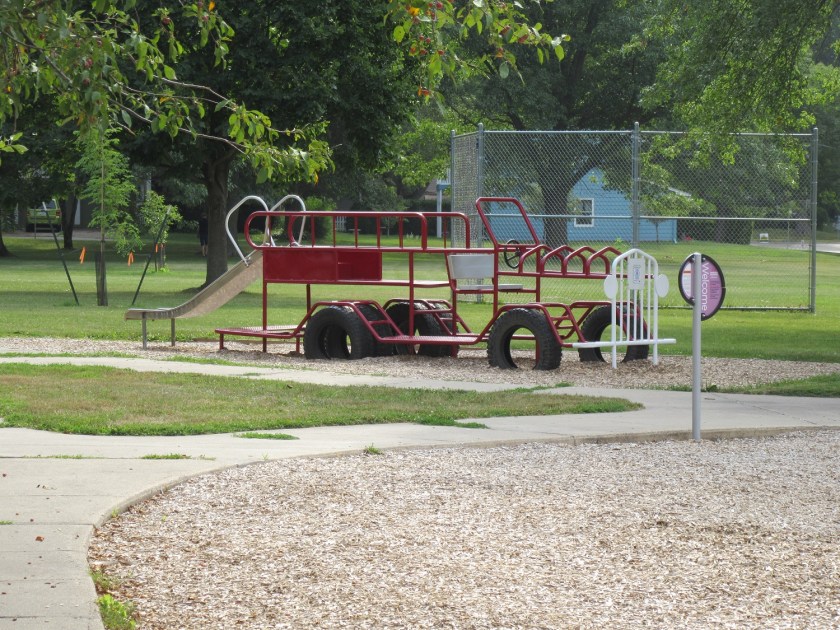
Sena and I both got a kick of the automobile jungle gym.
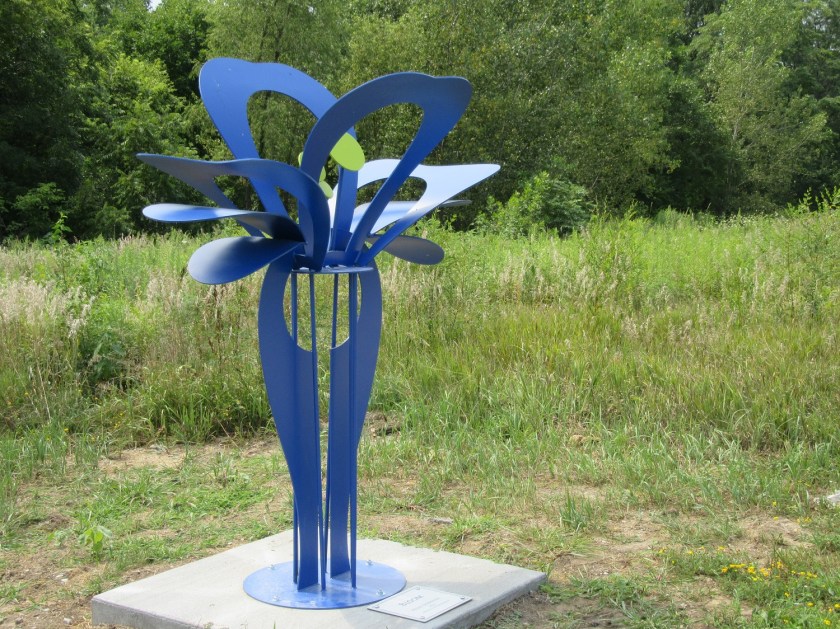
We had already visited the 5th sculpture last week. It is called Bloom by Hilde DeBruyn. Again, the theme of change because it’s a flower and flowers start from seeds in the earth, and burst up to the sun. Because this is where it all begins. DeBruyn is another gifted Iowa artist who has said in an interview with Iowa Artisans Gallery that her work often involves the “natural cycle of growth and decay.”
We begin with one extreme, the raw and wild. Eventually, we reach the other extreme, the ultra-refined and wildly complex. In the middle, we erase and then reconstruct many things from the relics of ancient wisdom or folly, forgetful of bygone grandeur or catastrophe, rarely startled by déjà vu.
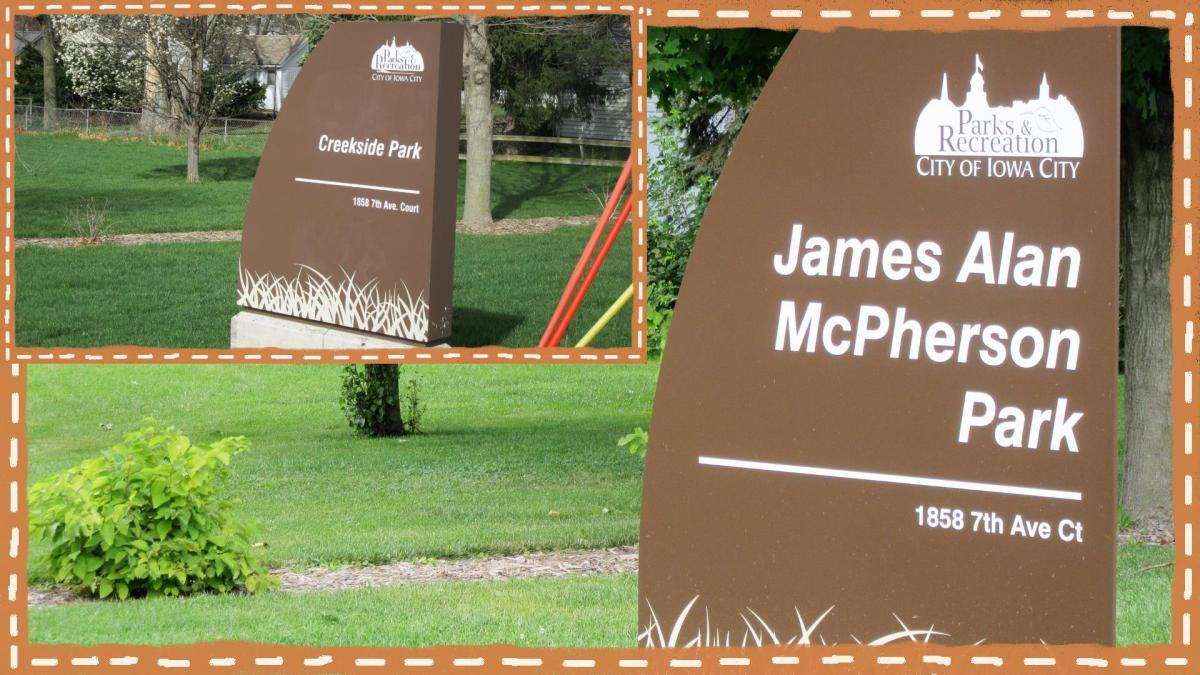
Yesterday evening the new sign reveal of James Alan McPherson Park made the new name of the park official. The weather was balmy and a big crowd showed up for the event, including Iowa City Mayor Bruce Teague. He joined McPherson’s daughter, Rachel McPherson; Director of Parks and Recreation Juli Seydell Johnson, and Iowa City Council member, Pauline Taylor for the ribbon-cutting ceremony.
This was immediately followed by a sing-along of a few bars of “You are My Sunshine,” led by Mayor Teague—who was in fine voice.
And even more music was provided by Cedar County Cobras. They were in a blues mood that evening—very popular with the crowd.
Prior to the ribbon-cutting, there were remarks from Mayor Teague, Rachel McPherson, and Juli Seydell Johnson. They shed personal stories highlighting McPherson’s gifts as a writer, intellectual, and humanist. They seemed to echo poet James Galvin’s perception of McPherson as not just the moral center of the Iowa Writers Workshop, but as the moral center of the universe.
You couldn’t miss the speakers’ impression of McPherson’s sense of humor, which tended to be ironic. Rachel shared an incredible anecdote about his tendency to write to far right-wing organizations (including the KKK) for more information about them, evidently giving them the impression that he was interested in becoming a member—to which they replied with enthusiastic offers to do so! This was not a one-time gag, but a running insider joke for years. Rachel is still getting mail from these groups. She also brought enough memorabilia to fill a table, and it included several “business cards” which deftly deflated the pomposity, posturing, racism, and outright villainy in society. I had to run to the web to get some of the jokes:
Guslar: traditional Bosnian-Croatian-Serbian name for an epic singer who performs long narrative tales (some detailing ancient battles and other historical events) while accompanying himself on a one-or-two stringed instrument called a gusle.
Ebonics: According to the Linguistics Society of America, this means literally “black speech” and refers to English spoken by African-Americans.
Enron was a company which perpetrated one of the largest accounting scandals and bankruptcy in recent history.
We welcomed a member of the Iowa City Police, who set up a table offering many useful free items including a generous helping of good will.
Another part of the presentation was a discussion between consultants and interested community members about future enhancements to the park, which include a plan for a memorial plaque in honor of McPherson.
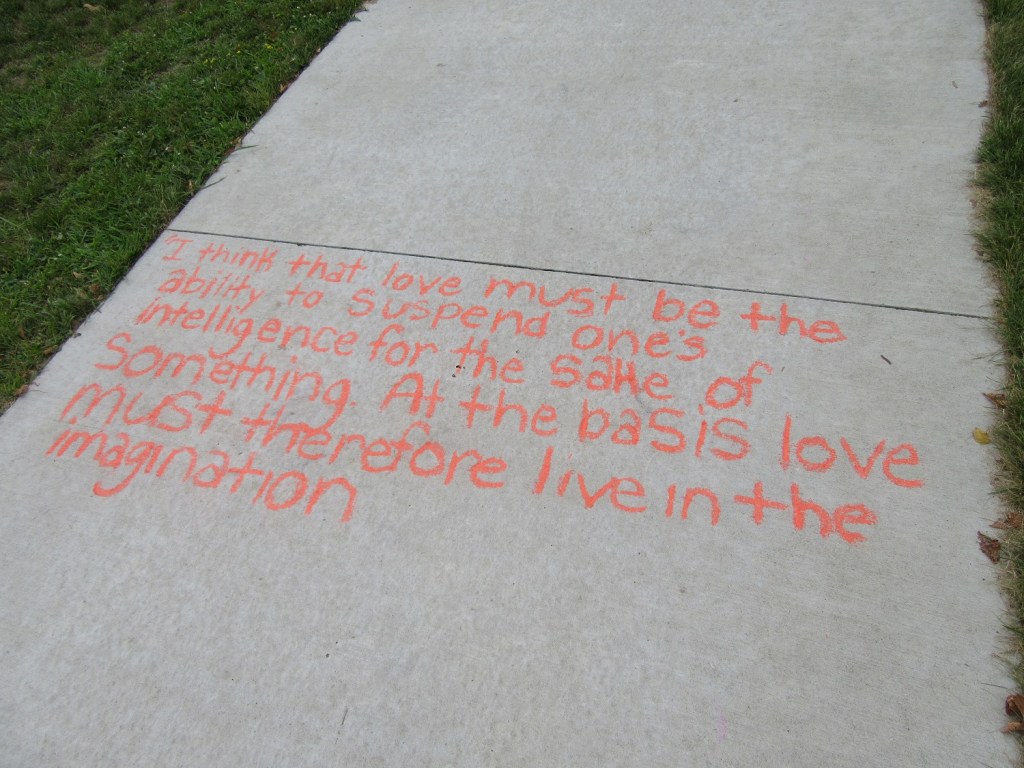
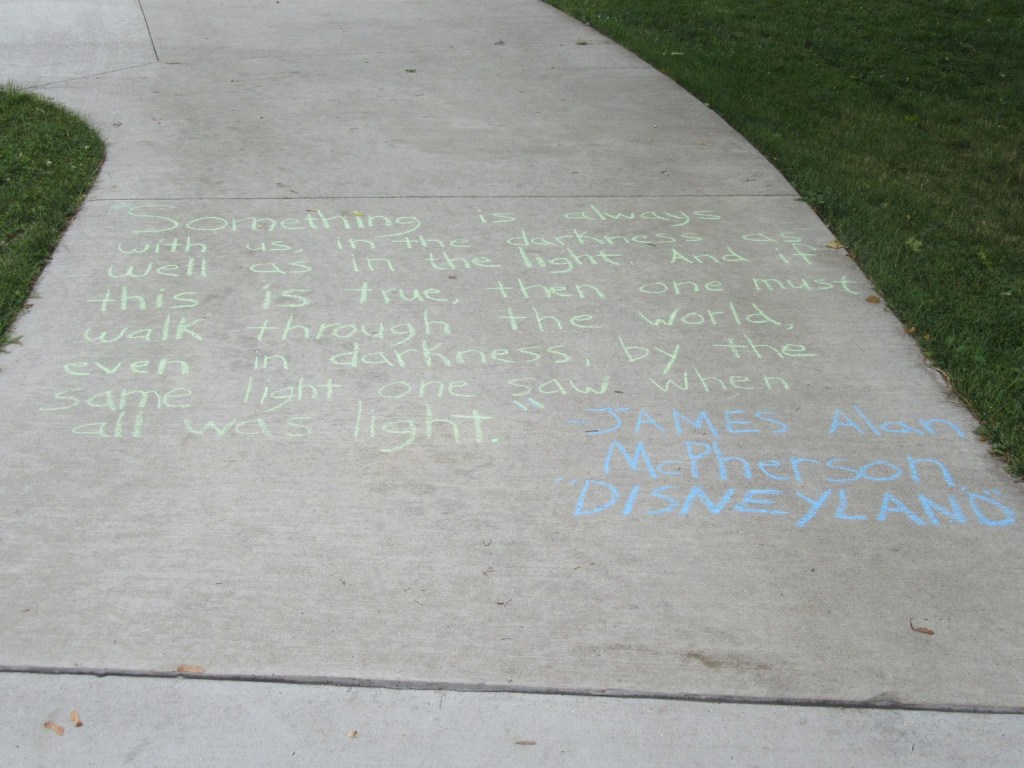
Many quotes from McPherson were written in colorful chalk on the walkways around the park, including one that is also inscribed on his monument in Oakland Cemetery:
“I think that love must be the ability to suspend one’s intelligence for the sake of something. At the basis love must therefore live in the imagination.”
We headed over to James Alan McPherson Park today because we saw a news item about the new sign being up and an upcoming ribbon-cutting ceremony this coming Thursday, August 5, 2021. The party starts at 6:30 PM and goes ‘til 8 PM. There will be live music from the group Cedar County Cobras.
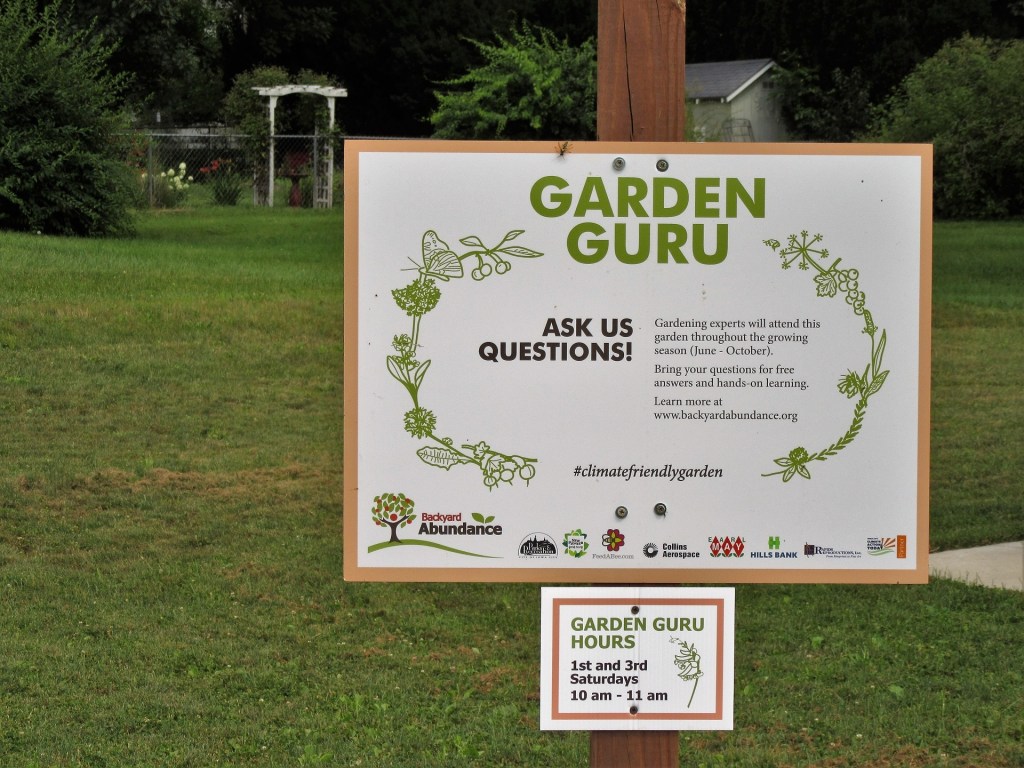
The gardeners have been busy since we first visited in April. White Cloud Catmint, Allium, Black-Eyed Susan, Karl Foerster ornamental grasses and more were thriving. Many of these are reputed to improve your health in various ways. Obviously knowledgeable, those cultivating this communal garden also posted a sign, “Garden Guru” and are eager to teach.
White catmint on the left and allium on the right
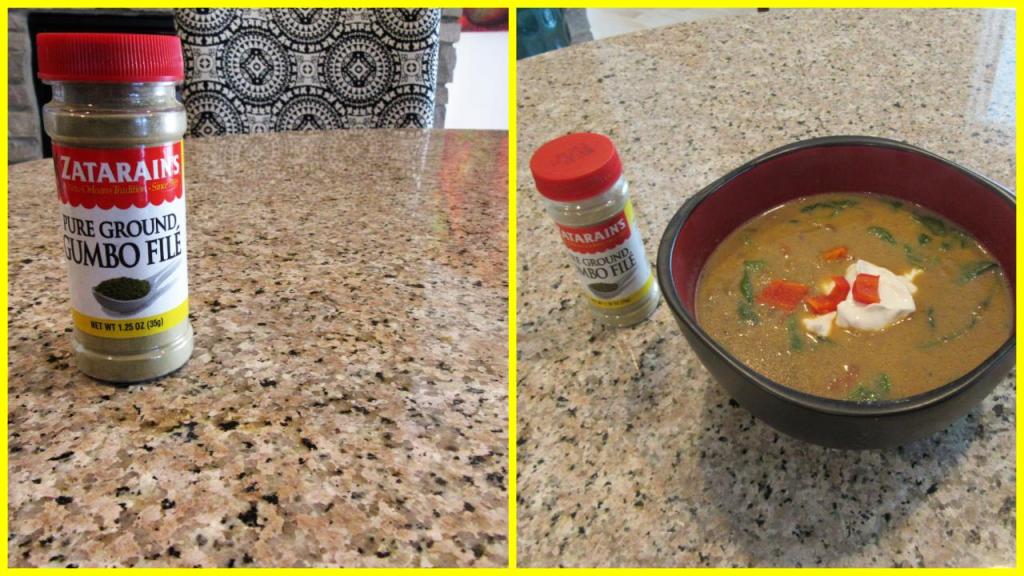
Sena cooked a delicious soup, using Gumbo File, in honor of McPherson. While you couldn’t call it gumbo, it was hearty and file is tasty. By the way, despite what you may read on the web, file is not illegal and does not cause cancer. File is produced from sassafras leaves which don’t contain safrole, a carcinogen banned by the FDA since 1960.
There is a story told by the head of the University of Iowa literature professor Ed Folsom that McPherson, apparently an excellent cook, helped sooth the tension between the Iowa Writers Workshop and the English Department. When it got to an intense pitch, McPherson said softly, “I think we need to have some gumbo.” He invited members from both organizations to his house for gumbo. And he explained how the roux held all of the wide diversity of tastes together. It may have been his metaphor for how a house divided could blend together better and be more harmonious. Ed asked him if that was the case—and McPherson said he was just talking about gumbo. Anyway, things got easier between the two departments.
Folsom summarized what McPherson did, which was to find a way to bind the soul and the body together.
It’s a little like the Men in Black movies in which eating pie (“We need pie”) was a way to solve particularly difficult crimes involving aliens and humans. You did it by doing something completely at odds, apparently, with the usual kind of problem-solving skills and strategies. You did it by introducing a diversity of approaches by a diversity of persons, baking in a sense of humor, and patiently allowing the non-logical eureka moment to evolve.
Maybe we need something like McPherson’s gumbo moment here and now in our planet’s present madness.
Today the CDC posted the data supporting the change in the mask guidelines for the fully vaccinated. It’s in the July 30, 2021 Morbidity and Mortality Weekly Report (MMWR) describing the outbreak of several hundred new cases of the Delta variant COVID-19 infection in Barnstable County, Massachusetts following July 4th events. Those who were fully vaccinated shed virus as much as the unvaccinated.
Organizers of the Iowa State Fair and those planning to attend, take note.
Brown CM, Vostok J, Johnson H, et al. Outbreak of SARS-CoV-2 Infections, Including COVID-19 Vaccine Breakthrough Infections, Associated with Large Public Gatherings — Barnstable County, Massachusetts, July 2021. MMWR Morb Mortal Wkly Rep. ePub: 30 July 2021. DOI: http://dx.doi.org/10.15585/mmwr.mm7031e2external icon.
This is just a post from a retired psychiatrist who barely passed the statistics course in medical school, so take it with a big grain of salt. I found an article written by Rocco J. Perla about something called Shewhart control charts to monitor the course of pandemic fluctuations. I noticed it because of what Perla commented on, which is the tendency of the press to make sensational headlines about every squeak in the turning wheel of COVID-19, including CDC making changes in masking guidelines leading to congressmen calling for investigations of the CDC for making the changes. It makes it look as though we don’t know what we’re doing.
I don’t know if Shewhart charts can help us make better decisions about what to advise us to do at the community level to help monitor and predict outbreaks. But it looks like we need to try something better soon. Because I can’t stand the pop-up ads at the U.S. News & World Report web site and limitations on how many articles I can view for free where I first saw Perla’s story, I looked up his original article published in the Int J Qual Health Care.
This led to my discovering the web site ISQua (International Society for Quality in Health Care). There I found a Shewchart for my state of Iowa, which shows what happened here this month. I don’t know if the Iowa Department of Public Health (IDPH) is already using it and I’m not qualified to tell them what to do. By the way, I think that mindset of “Don’t tell me what to do” crankiness might be an epiphenomenon of the COVID-19 pandemic. Nobody wants to be told to wear masks or to get a vaccine. It just leads to a pandemic of backlashes. I don’t know if Rocco is right about the Shewhart chart method not being in use by public health officials. But I want to go on record as not telling anybody what to do.
The Shewhart charts look labor intensive and maybe that’s why some public health departments don’t use them. They’re understaffed and overworked. Iowa has been scaling back the collection and reporting of COVID-19 data, partly because things appeared to be so rosy early in July. I’m not so sure how rosy they’ll be after the Iowa State Fair in August, which is expected to draw about a million visitors.
But I’m not telling anyone not to go to the state fair and I’m not telling anyone to wear a mask and I’m not telling anyone to get vaccinated. I’m not even telling anyone to pay any attention to Perla’s article on the Shewhart chart. I am telling you that I’m too old and cranky to be getting backlashes about any of this business.
Have fun at the fair.
Perla RJ, Provost SM, Parry GJ, Little K, Provost LP. Understanding variation in reported covid-19 deaths with a novel Shewhart chart application. Int J Qual Health Care. 2021;33(1): mzaa069. doi:10.1093/intqhc/mzaa069
Inkelas M, Blair C, Furukawa D, Manuel VG, Malenfant JH, Martin E, et al. (2021) Using control charts to understand community variation in COVID-19. PLoS ONE 16(4): e0248500. https://doi.org/10.1371/journal.pone.0248500
Like everyone else, I groaned aloud about the revised CDC mask guidelines yesterday. I still trust the CDC guidance, and I’m sure many might disagree with me. I think some headlines overstate the CDC mask change. I don’t believe it’s a “reversal” per se. I think it’s common sense to wear a mask if you’re inside somewhere with a lot of people whose vaccination status you know nothing about.
I think it’s worthwhile to actually read the CDC web site’s mask guidance in the section entitled “When You’ve Been Fully Vaccinated.” What it says is:
“To maximize protection from the Delta variant and prevent possibly spreading it to others, wear a mask indoor in public if you are in an area of substantial transmission.”
It’s a good idea to check your geographical area (COVID-19 Integrated County View) to see what the transmission situation is. It’s moderate where we live in Iowa. That’s enough for me to go back to wearing a mask in tight quarters with people I don’t know.
I was dismayed to read an opinion piece entitled “Stop listening to the CDC,” in which the author said that “the vaccinated are not responsible for the unvaccinated, and vice versa.”
That made me remember my former pastor, Reverend Glen Bandel, who is now in his 90s. When my mother was very sick, he spent a long night sitting up with her. My brother and I were too little to manage the crisis by ourselves. She was unable to keep any food or fluid down and he made many trips from her room to the bathroom, to empty her bucket of vomit in the toilet. You could have made a case for hospitalizing her, but we somehow got by without it.
If we all believed that we are not responsible for each other, we would have been extinct long ago, let alone getting through this pandemic in the last 18 months. Not all of us who got the COVID-19 vaccine did it just for ourselves. I think a great many also did it for those they loved and for whom they felt responsible. This is called altruism and I think humans are still capable of it, despite what you read in the news.
Presentation slides for the ACIP meeting today are available here. Updates to clinical communication indicate that, while patients with a history of Guillain-Barre Syndrome (GBS) are eligible for any of the authorized vaccines, they should discuss with their clinical teams the availability of mRNA vaccines given the association of GBS with the J&J vaccine.
For the summary of the issues regarding giving booster vaccine doses to immunocompromised patients, see data from slide 15 onwards.
This morning I put on my shirt and noticed the pocket flap puckers for the umpteenth time. I also got a reminder about how difficult it is to keep fingernail clippings from zinging all over the bathroom. I did a quick web search and saw that both problems are perennial with no great solutions. There’s an eerie resemblance to the COVID-19 vaccine hesitancy challenges.
One author says the shirt pocket flap pucker problem (say that three times quickly right now!) is caused by shirt manufacturers who fail to hem correctly and by shirt wearers who fail to properly launder them. Various solutions to the nail clipping problem involves innovative modifications to clipper design and other ingenious suggestions you can try yourself, including clipping with your digits inside a sandwich bag to catch the flying parings.
In other words, there are system changes and user changes, which seems to apply to the vaccines as well. For example, there are some researchers investigating the use of intranasal immunization. This has a few advantages, including maybe helping those who are afraid of needles, which is a population probably bigger than we think.
There are systems advantages as well as challenges to the intranasal route. It capitalizes on the IgA immunity cells in the nasal mucosa, which could help prevent travel of the virus to the lungs. The University of Iowa Hospitals & Clinics research team has found that this works in mice. On the other hand, other researchers are abandoning the approach because they haven’t had success in early human trials. And the vaccine injections are highly effective by comparison. Side effects of the intranasal might include more than just wanting to make you sneeze. Although you could cover your nose with a sandwich bag or maybe pinch your nostrils shut with a pair of nail clippers (but what to do with the nostril parings?). Some raise concerns about how close you get to the brain. There was a reported case of Bell’s Palsy after an intranasal influenza vaccination in 2002. Incidentally, the likelihood of getting Bell’s Palsy after the COVID-19 jab is less than getting it from the virus infection itself (MedPage Today report June 2021).
Congress could pass laws preventing shirt manufacturers from making them with pocket flaps in the first place. After all, what pickpocket would be bold enough to try to pick your shirt pocket, assuming you buttoned it? Or the President could write an executive order mandating the owners of shirts with pocket flaps launder them properly, or at least iron them. There could be a door-to-door campaign to distribute innovative nail clippers, or offer free pedicure and manicure services (only after full licensing, of course).
Well, anytime you need my innovative suggestions you can always choose to opt out.
The Advisory Committee on Immunization Practices (ACIP) will meet with the CDC July 22, 2021 to discuss COVID-19 vaccine boosters for immunocompromised individuals and the association of the J&J vaccine with Guillain-Barre Syndrome. See the draft agenda here.















 Go Retire Psychiatrist