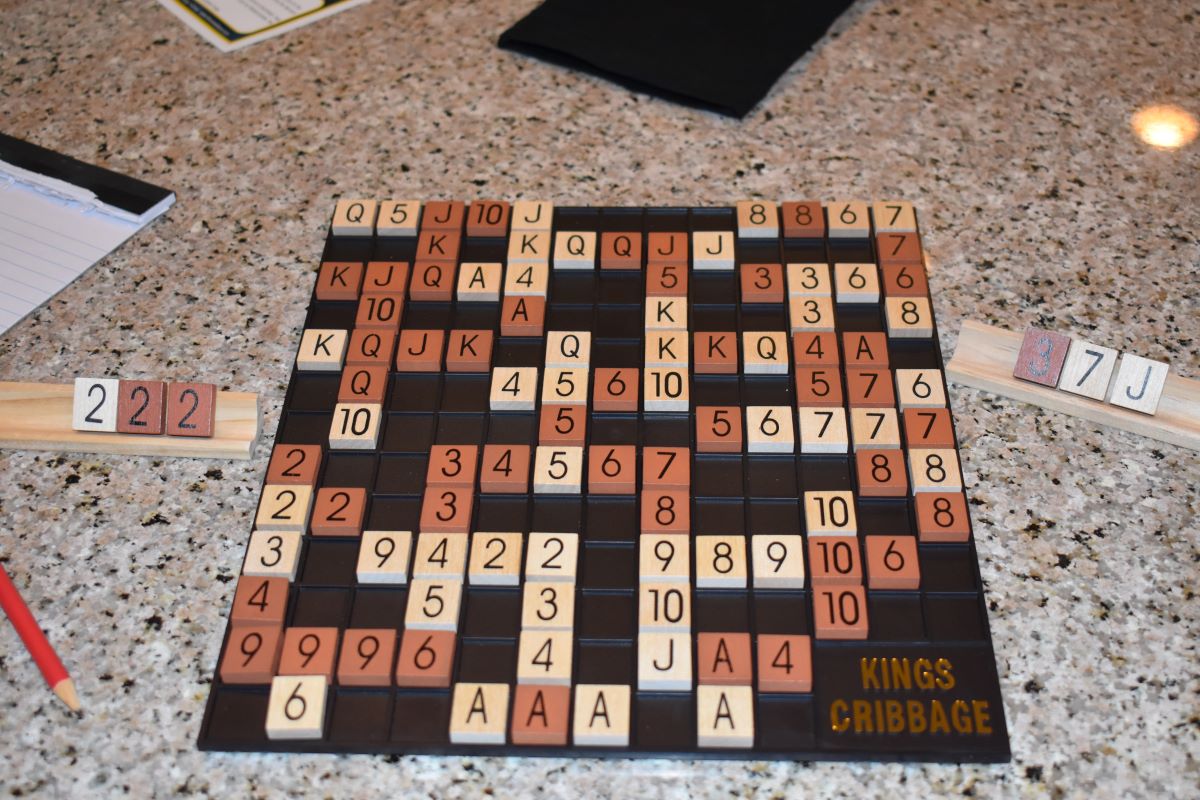
We finally filmed one of our Kings Cribbage games. It’s a hybrid of Scrabble and cribbage. It takes a lot longer to play it than a regular cribbage game, but about as long as a Scrabble game (about 45 minutes to an hour). The rules are included in the YouTube video, but you can also read them on the web.
You score by forming cribbage hands. The 6 can be used as either a 6 or a 9, but once it’s on the board, its value remains the same. Each player gets 5 tiles and no play on the board can be longer than 5 tiles.
You keep score with paper pencil and the player with the higher score at the end of the game wins, after subtracting the face value of any tiles he/she has left.
Yesterday, Sena and I drove out to Oak Hill Cemetery to get some snapshots and video clips of the new Coralville Veterans Memorial. It’s still in progress, with plans for stone medallions from each branch of the military. Even now, it’s beautiful and inspiring.
That includes the inscription on the Tribute Walkway: All Gave Some…Some Gave All…
This quote has been attributed to Korean War veteran Howard William Osterkamp. It’s all over the internet that’s it originated with Sergeant Osterkamp, who was the recipient of the Purple Heart from wounds he suffered while in combat.
Because the words “has been attributed” made me curious (is there doubt?), I looked on the internet, which led to many blind alleys and side streets. Sena and I wanted to find out if the quote originated with Osterkamp, we looked for and found a couple of recordings of interviews with him that took place several years ago.
One of the recordings is in the Library of Congress in a collection called the Veterans History Project. It’s an 88-minute audio from an interview in 2008 and he says a lot about his military history between when he was drafted into the Army in 1951 to when he was discharged in 1953.
Osterkamp says a lot that is arguably more interesting than even the quote often said to originate with him. But nowhere in it does he say “All gave some, some gave all.
The other recording is a YouTube interview posted in 2018. Osterkamp died in 2016 and it’s not clear to me when the interview was conducted. But it’s shorter and less punctuated by the details that made the audio recording so much longer, which was probably because it was to be part of the Veterans History Project.
It is in the YouTube version at around 44 minutes into the interview that Osterkamp says after describing the wounds he suffered, “that’s why they say ‘All gave some, some gave all…that’s a great slogan.”
Saying it that way probably means that the quote didn’t originate with him, although he did, indeed, say it.
I’m going to try to summarize the internet lore around this quote and then circle back to say why I think many people believe it originated with him.
If you just type the quote and hit the search button, you’re likely to get a lot of hits. One was in Special Ops web magazine, the author of which says Osterkamp originally said it. However, below the article is a comment from someone who says it probably was probably around before Osterkamp. He included a link to a May, 1952 newspaper article in about a veterans memorial planned progress for Electra, Texas. The article describes the proposed inscription:
“Dedicated to those who rendered service to their Country…all gave some…some gave all.”
I got to thinking about the ellipsis in that quote as well as the one at the new Coralville memorial. The ellipsis usually indicates something that is left out of a quote or passage in writing.
The bread crumbs were spreading out, leading me to a web site that mentioned a lot of different sources for the quote, none of which included Osterkamp. One of them was a book published in 1882, The Nineteenth Century, “Instructions to My Counsel” pg 988. I found this on the Internet Archive as well. The context appears to involve the history of the Egyptian history:
“The Egyptian people have made heavy sacrifices for the sake of (Pg. 989—ed.) securing to their country liberty, justice, and independence; some gave all they possessed, others the half, but all gave some mite to the National cause, as can be proved by letters and telegrams to the War Minister.” (Bold type mine).
The quote used today is in there, albeit with the two phrases switched. You could place ellipses between them and have the quote used today.
The internet lore doesn’t stop there. There is the song by Billy Ray Cyrus (1992), “Some Gave All” in the album of the same name. Cyrus has told the story about meeting a Vietnam veteran who inspired the song. He’s variously called Sand Cane or Kane, and he reportedly said to Cyrus some version of “After we got back from Vietnam, in rehab camp they told us, “All gave some, but some gave all.” The story changes slightly depending on who’s telling it.
There is even a stranger twist to the Kane story. In the comment section following a review of the best soldier songs, there’s an anecdote from someone who says he met a guy named Sandy Cain, a Vietnam vet who was promoting a song very similar to the one Cyrus wrote with the same title. He recorded it on a small label. The commenter evidently was in a band that recorded it for a radio station in Portsmouth Virginia in 1973 and wonders if it’s the same Sandy Kane (or Sandy Cane, the spelling of the name differs depending on who’s telling the story). It’s puzzling that Cyrus says he couldn’t find the veteran despite contacting state police to help look for him in 3 different states.
Okay, to return to why Sena and I think it probably doesn’t matter whether the quote “All gave some, some gave all” originated with Sergeant Howard William Osterkamp. Although in our opinion, based on our trek through internet lore, he did not create the phrase, it’s fair to say he certainly lived it. The recorded interviews are fascinating and we recommend they be used as the main references for Osterkamp and the Korean War.
The CDC Covid-19 transmission rate has changed to High. Accordingly, the recommendations include wearing a mask indoors in public, being up to date with vaccinations, and any others related to your relative risk for severe illness.
The jumping worm invasion is the big news these days. This is a follow up to the post I wrote on May 19, 2022. I found this article, “Invasive jumping worms now in 34 states—including Iowa.” It was posted by an Indianola, Iowa outdoorsman named Tom Charlton.
The most interesting thing about this article is the jumping worm joke at the end. I’ll have to do this in stages. First, he prefaces this joke with the one about “What’s worse than finding a worm in your apple?” And I can’t help but think he’s got a different version than the one I know. He says “Of course, we all know what’s worse than biting into an apple and finding half a worm.”
I don’t know what would be worse than finding half a worm. In fact, this actually happened to me. I was a young man living at the YMCA in Mason City, Iowa. That was back in the days when you could rent a single occupancy sleeping room there on the cheap. There was an old snack vending machine there and I got a Butterfinger. I bit into it and found—half of some kind of little worm. Spoiler Alert: the worm half was doing something typical for worms. The answer is below.
By the way, that Mason City YMCA was placed on the National Register for Historic Places in 2002 and has been renovated into the River City Apartments, a low-income housing resource. I don’t know if it still has snack vending machines.
I also can’t think of anything worse than finding half a worm. One worm joke site says “Two worms.” Somehow, it doesn’t have the zing of the “half a worm” version.
I thought the joke (which has been found in print since 1911) went more like: “What could be worse than biting into an apple and finding a worm in it?” The punchline is “finding half a worm in it.”
In the next sentence, Mr. Charlton writes: “…but do you know why the young boy thought the jumping worm would taste like chewing gum?”
I really didn’t get this. I googled it and couldn’t find anything about it. Then my wife, Sena, did a web search on Bing and solved the riddle immediately. She gave me a hint which helped: think of a brand of gum.
It’s actually an old worm joke. It’s very similar to Mr. Charlton’s joke, except it leaves out the word “jumping.” Think of a brand of chewing gum and you’ll get it. It’s not Trident.
The punchline is “Because they’re Wrigleys.” I got sidetracked into overthinking it because it was about jumping worms.
That should have made coming up with the punchline easier. Thank you, Mr. Charlton!
There’s this guy who waves at every passing motorist as he walks to and from his job moving boxes around at the Coralville Hy-Vee. He’s been doing it for years and age is beginning to take over the deepening creases in his face. But it doesn’t dim his smile as he waves at every car he can.
He has to cross the street to and from the store parking lot. When the light changes to green he hustles across. His work apron flaps a little. That’s the only time he doesn’t wave. After he’s safely on the other side of the street, he starts waving and smiling.
We figure he walks to and from wherever he lives. We never could figure out where home is for him. It’s hard to see how he ever makes his destination as often as he stops to wave at all of us driving by.
When we lived in the neighborhood and as I was driving to work and driving home, I would wave back—as I kept my eyes fixed on the road ahead of me.
Every once in a while, I’ll google various questions framed around the term “waving man.” I’ll find occasional news items about a waving man in some city. Nobody ever complains about the waving man and most find him to be the bright spot in the day. There’s never an explanation for this behavior, scientific or otherwise. It’s just accepted for what it is—a generous greeting, wishing you well.
When times are good, the waving man is out there. And when times are bad; when the pain and sorrow and loss are overwhelming—the waving man is there.
There’s this quote many people believe was by Muhammad Ali:
“Impossible is just a big word thrown around by small men who find it easier to live in the world they’ve been given than to explore the power they have to change it. Impossible is not a fact. It’s an opinion. Impossible is not a declaration. It’s a dare. Impossible is potential. Impossible is temporary. Impossible is nothing.”
It’s part of a mural in progress on the side of the ICOR Boxing building facing Highway 6 in Iowa City. The Goodwill is on the other side of the highway. The mural is not yet finished. The quote is not complete. The words are black against a yellow background framed by the outline of the state of Iowa. The image of Muhammad Ali is really well done. I wanted to get a picture of it yesterday, but decided to wait until the mural is complete. There are similar images all over the web showing him and this quote together.
Some question whether Ali actually said it. There are some who say that an Adidas advertising copywriter wrote it in 2004. I don’t know who is right and I think it might not matter in the long run. I’m not interested in debating it.
The point of the quote is more important. It’s true the word “impossible” can be misused and distorted. Any historian or scientist can tell you that a great many things which were once thought to be impossible eventually became possible.
There’s this scene in Men in Black in which Agent K is recruiting the soon to be Agent J. He says, “People are dumb, panicky, dangerous animals and you know it. 1500 years ago, everybody knew the Earth was the center of the universe. 500 years ago, everybody knew the earth was flat, and fifteen minutes ago you knew that humans were alone on this planet. Imagine what you’ll know tomorrow.”
It’s just a quote from a movie. But in that quote, there’s just enough of the real-life debate regarding doubt about what divides the possible from the impossible as there is anywhere off the movie set.
That said, there are a few things that are impossible. It’s impossible that:
Sasquatch doesn’t like beef jerky.
Movie stars are not from other galaxies.
Politicians are honest and have our best interests in mind.
Aliens would want anything to do with humans.
I could ever remember the washer and dryer settings from one day to the next.
The title of the post is “Mysteries in History,” and before I chose it, I realized it had a familiar ring to it. It’s from Men in Black II. It’s an imaginary, cheesy, very low budget TV series narrated by Peter Graves in the movie. And it’s actually the perfect title for what my wife and I think about the Mason City, Iowa YWCA not being on the National Register for Historic Places. It’s a mystery in history which is anything but cheesy. I mentioned it in my previous post about the Mason City Ys.
I asked the State Historical Society of Iowa about it. It turns out it has been deemed eligible twice for nomination to the National Register, in 1991 and again in 2003, which was a year after the YMCA was added to the list.
The Mason City YWCA has never been nominated. Why it has never been nominated is the mystery in history.
It’s not a simple matter to get a building on the National Register. The process is outlined on the State Historical Society of Iowa web site. Unless you’re a professional historian, it’s a tough project and can take at least a year to accomplish.
I found a 36-page form on the web which documented the approval of the Mason City YMCA as a historic site fit for the National Register. It’s minutely detailed and I imagine it took a year just to complete the form itself, not to mention all the other hurdles you have to negotiate. The photos bring back memories of when I lived there as a young man. You could actually live in small, single occupancy dormitory rooms. You could do that at the YWCA as well, once upon a time.
There are 2 Artists who bought the YWCA building last year. It’s 100 years old and the place needs a lot of work. There’s a Trulia entry on the web which says it has housed a health spa, an intermediate care facility for people with intellectual and developmental disabilities called One Vision, a Women’s shelter and the list apparently doesn’t stop there.
A couple of articles say that one of the two new owners, Elisha Marin, filmed his music video, “Shining Out,” in an abandoned YWCA. They don’t say which one, but I wonder if it’s the Mason City YWCA. It would fit the long and winding story.
The Mason City Public Library (my favorite place when I was a kid) has a web page with a historical timeline indicating that the YWCA was built in 1918. The YMCA was dedicated in 1927 and placed on the National Register in 2002. I think a lot of the historical documents which helped get the YMCA listed might also prove the YWCA should be listed too.
I found another place called Five College Compass Digital Collections, which also has a ton of documents on microfilm about the Mason City YWCA. It was difficult to navigate and some of the pages were rotated, making them hard to read unless you can bend your head 90 degrees. You can click a button which apparently flips the pages upright, but transforms the text into something that looks like a foreign language.
You can get technical assistance in getting a property listed. The assistant would be available for 24 hours total. You can apply for grants, which can help with some of the expenses. It looks exhausting, though. Hey, I’m the kind of guy who flunked history.
It would sure be nice to solve this mystery in history. Maybe the 2 Artists will consider it. I wish them luck.
The annual Kickball challenge between University of Iowa Department of Psychiatry Residents and Faculty is coming up in June. You know what that means.
Losers suspend the winners’ trophy in Jello. Somebody did that when we played Matball several years ago. If you need a recipe:
Matball was the forerunner of Kickball in the department. I think the Kickball rules are here. Federal law says you have to play in 95-degree heat with insane humidity driving the perceived temperature to slightly above that on the surface of the sun. Other rules:
If the ball melts, faculty wins.
For every point the residents score, faculty automatically score 5.
Faculty may tackle the base runner at any time.
If it rains, faculty win by 10 points.
The thing to do is to recruit Sasquatch for your side, who will always boot the ball into the next county. Bring many replacement balls. Sasquatch will bring the beef jerky.
The games are fun to watch. Residents jumping over faculty; Faculty collapsing from heat stroke.
I never played.
I’m trying to recall whether faculty ever won a game. I don’t think we ever did. I think that’s why the trophy ended up in Jello.
We were out on the Terry Trueblood Trail and saw a lot of different kinds of birds doing the things that birds—and humans do. Looking for mates, mating, nesting, hunting, feeding. We’re a little more romantic about it, at least sometimes.
Often, I wonder. Who are the real bird brains around here?











 Go Retire Psychiatrist