Thoughts About Guns

I think there a lot better places to read about viewpoints on mass shootings than my blog. I recommend you check out Dr. George Dawson’s post “Gun Extremism Not Mental Illness,” posted on May 31, 2022, then read the editorial in Scientific American, “The Science is Clear: Gun Control Saves Lives,” posted on May 26, 2022.

I’m going to chime in mainly to show a few graphics I found which I think send a clear and simple message. Before I get to that, I just want to mention a few anecdotes to show how little hands-on experience I have with guns.

My earliest memory of any contact with firearms is in early childhood. My dad and a friend came home from a hunting trip with some rabbits for dinner for the family, which included my younger brother and my mother. I don’t know who cleaned or cooked them. I’m pretty sure my mom would not have had anything to do with them. I got my first taste and didn’t like it and said so to my dad. He introduced me to the word “gamey.” I didn’t know meat could taste gamey. The other thing I got from that meal was a mouthful of buckshot. I silently vowed I would never eat anything like it again while I lived.

My next encounter with guns was a YMCA program for kids to learn how to shoot. I might have been in my early teens, maybe even younger. We were given BB guns and instructed to do some target shooting. The paper bullseye targets were set up several yards away. I took many shots and collected my target to show the instructor.

I thought I hit it once and pointed to the hole. The instructor looked at it critically for a few seconds and then told me kindly that the hole was where the pin was stuck to fix the target to the wall. I never touched another gun.

Fast forward to when I was a third-year medical student getting through my clinical rotations at the University of Iowa. In 1991, a physics graduate student named Gang Lu shot and killed 6 people on campus including himself, wounded another rendering her paralyzed from the neck down, all apparently because he was not chosen to get an award for his dissertation. I remember feeling shocked when I read about it in the newspaper.

Now let’s move to some graphics I found at a website maintained by The University of Sydney, GunPolicydotorg, International firearm injury prevention and policy https://www.gunpolicy.org/. It makes it easy to put together comparison statistical graphics on things like gun violence. I compared the United States to New Zealand, Australia, and Canada. Click the next few links in order to get the message. In my opinion, I think the last one is a consequence of the first few.

First

Second

Third

Last

I guess now it’s up to Congress. God help us all.

Kickball Challenge in June!

The annual Kickball challenge between University of Iowa Department of Psychiatry Residents and Faculty is coming up in June. You know what that means.

Losers suspend the winners’ trophy in Jello. Somebody did that when we played Matball several years ago. If you need a recipe:

Matball was the forerunner of Kickball in the department. I think the Kickball rules are here. Federal law says you have to play in 95-degree heat with insane humidity driving the perceived temperature to slightly above that on the surface of the sun. Other rules:

If the ball melts, faculty wins.

For every point the residents score, faculty automatically score 5.

Faculty may tackle the base runner at any time.

If it rains, faculty win by 10 points.

The thing to do is to recruit Sasquatch for your side, who will always boot the ball into the next county. Bring many replacement balls. Sasquatch will bring the beef jerky.

The games are fun to watch. Residents jumping over faculty; Faculty collapsing from heat stroke.

I never played.

I’m trying to recall whether faculty ever won a game. I don’t think we ever did. I think that’s why the trophy ended up in Jello.

The Written Word is Blurred

I ran across this quote the other day: littera scripta manet. The English translation is, I think, “the written word endures.”

Not to dwell too much on the prosaic side of the issue which is that, for me, often the word has been blurred because of problems with my vision. I just had retinal detachment surgery a little over a month ago and I’m making a good recovery. But early on I had a lot of trouble with blurry vision, tearing, and light sensitivity.

Just the other night though, I was able to read a section of a book without having as much blurred vision as I did before the surgery when I looked up from the page at something distant. I’ve been wearing progressive lenses for many years and it probably got worse because of the detached retina, which was chronic or maybe acute on chronic.

Now to get beyond trivialities, I saw the quote above in an issue of the University of Iowa publication, Iowa Magazine. It was in the last Old Gold column of University Archivist, David McCartney. He retired in March of this year. The title was “Old Gold: The Enduring Power of the Written Word.”

He notes the Latin expression is on the seal of the U.S. National Archives and Records Administration. McCartney’s point is that technology can undermine as well as strengthen the power of the written word. He identities Horace as the originator of the expression, “the written word endures.”

I went pecking around the internet and found out that a lot of people think an educator named Neil Postman was the originator of this quote. What makes me doubt this is that the original is in Latin, which suggests a much older origin. He was born in 1931 and died in 2003. Interestingly, Postman criticized the effect of technology on thought and culture.

A website that seems dedicated to explaining English translations of Latin indicates that the quote comes from a longer expression: Vox audita perit, littera scripta manet, which translates to “the spoken word perishes, but the written word remains.” One contributor says the originator was Horace. Another insists that “littera” does not mean word at all, although concedes that the proposed translation is correct, nevertheless.

Further, there is a Wikipedia entry which cites the Latin expression differently, “verba volant, scripta manent,” which in English is “spoken words fly away, written words remain.” The author says the proverb originated from a speech of senator Caius Titus to the Roman Senate.

Anyway, McCartney points out that the world is becoming increasingly digitized and that the average website lasts only a little over two and a half years. Some important digital records have been lost, unreadable (blurred?) because of improper management.

My previous blog survived about 7 years but is lost. Maybe that’s not such a bad thing. My current blog is a little over 3 years old. So far, I’m beating the odds as far as typical longevity, but is it worthwhile?

Both written and digital records have strengths and weaknesses in terms of durability. And deciding what to preserve and how is essential to any society. We need good stewards to help us decide.

Good luck in your retirement, David McCartney. I’m sure the University of Iowa treasures your stewardship. Let the written word endure unblurred.

Heads Up from University of Iowa Health Care: Why Vaccinated People Still Catch Covid-19

Some people still get Covid-19 symptoms despite being vaccinated. University of Iowa Health Care infectious disease expert, Dr. Dan Diekema, MD, MS, explains why.

Short History of C-L Psychiatry Fellowship at Iowa

I read a short article, “The case for pursuing a consultation-liaison psychiatry fellowship” by Samuel P. Greenstein, MD in Current Psychiatry (Vol. 1, No. 5, May 2022). After 3 years as an attending, he found his calling as a C-L psychiatrist, especially after getting teaching awards from trainees. But when he applied to academic institutions for position as a C-L academic psychiatrist, people kept advising him to complete a fellowship training program in the subspecialty first. He gave it careful thought and did so, even he called it going “backwards” in his career.

On the other hand, he believes C-L fellowships will help meet the challenges of addressing rising health care costs and improving access to what most people see as the critically important goal of providing access to integrated mental health and medical care.

I’ve been retired from consultation-liaison psychiatry for two years now. I get an enormous sense of achievement on the rare occasions when I hear from former trainees who say things like “For me you were…one of the most outstanding attendings I had at my time at Iowa.” And “I can at least take comfort that University of Iowa is still at the forefront of psychiatry.”

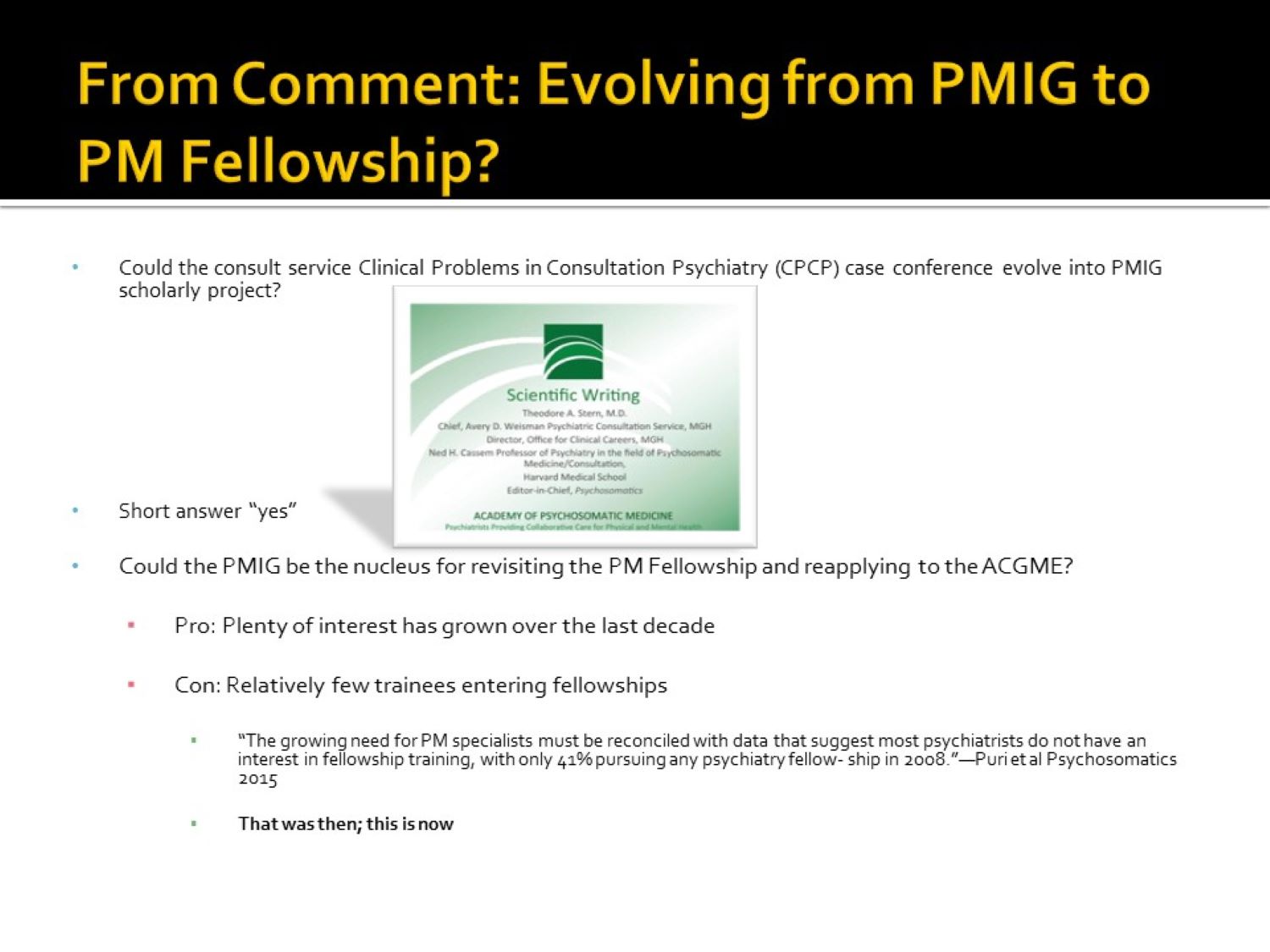
Several years ago, one of the residents suggested starting a Psychosomatic Medicine Interest Group (PMIG). This was before the name of the subspecialty was formally changed to Consultation-Liaison Psychiatry in 2018. I know many of us were very pleased about that.

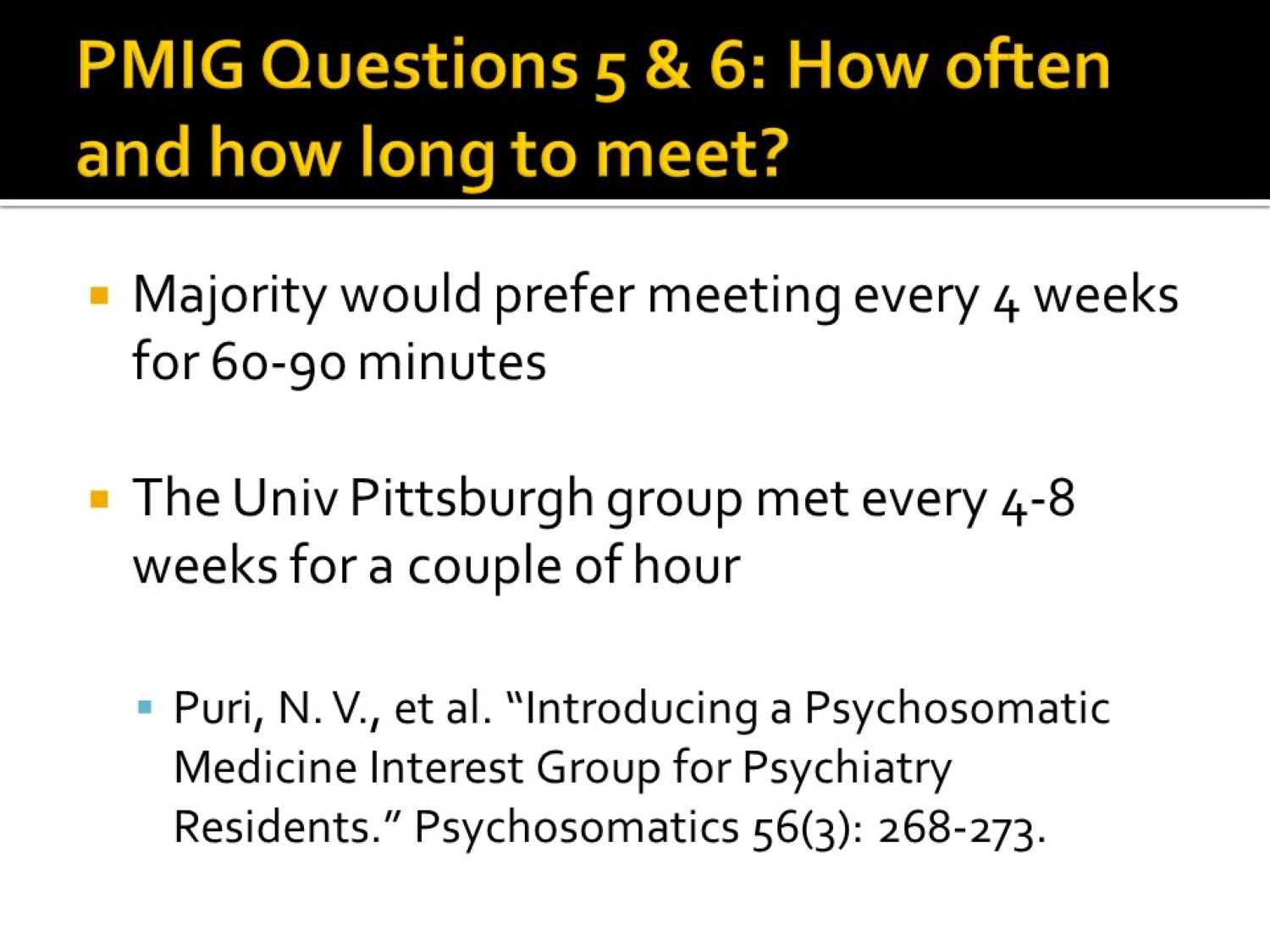
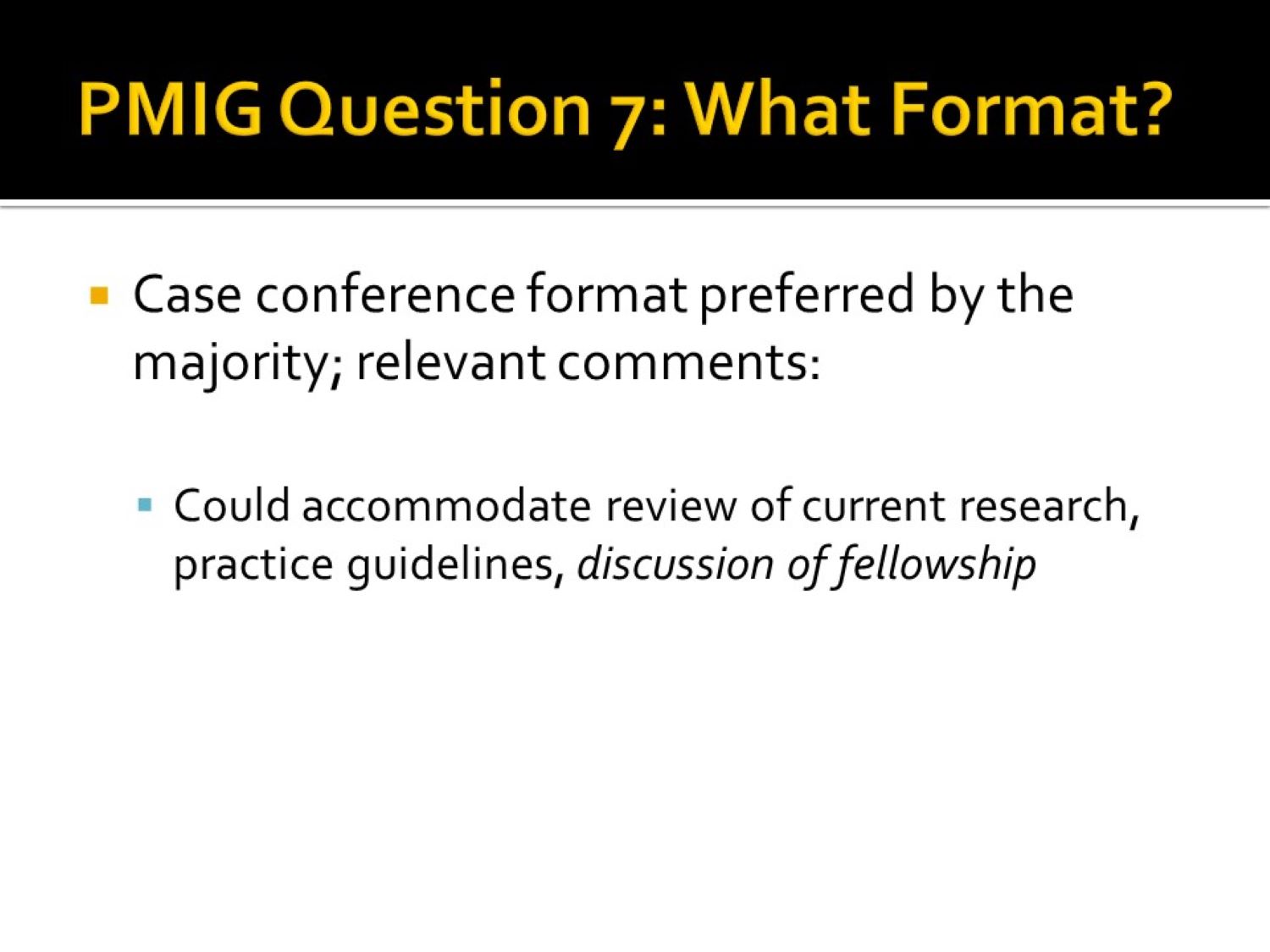
I sent a short survey (see the gallery below the slide show) to the faculty and residents in an effort gauge support for the idea and readiness to participate. I used a paper published at the time to guide the effort, (Puri NV, Azzam P, Gopalan P. Introducing a psychosomatic medicine interest group for psychiatry residents. Psychosomatics. 2015 May-Jun;56(3):268-73. doi: 10.1016/j.psym.2013.08.010. Epub 2013 Dec 18. PMID: 25886971.).

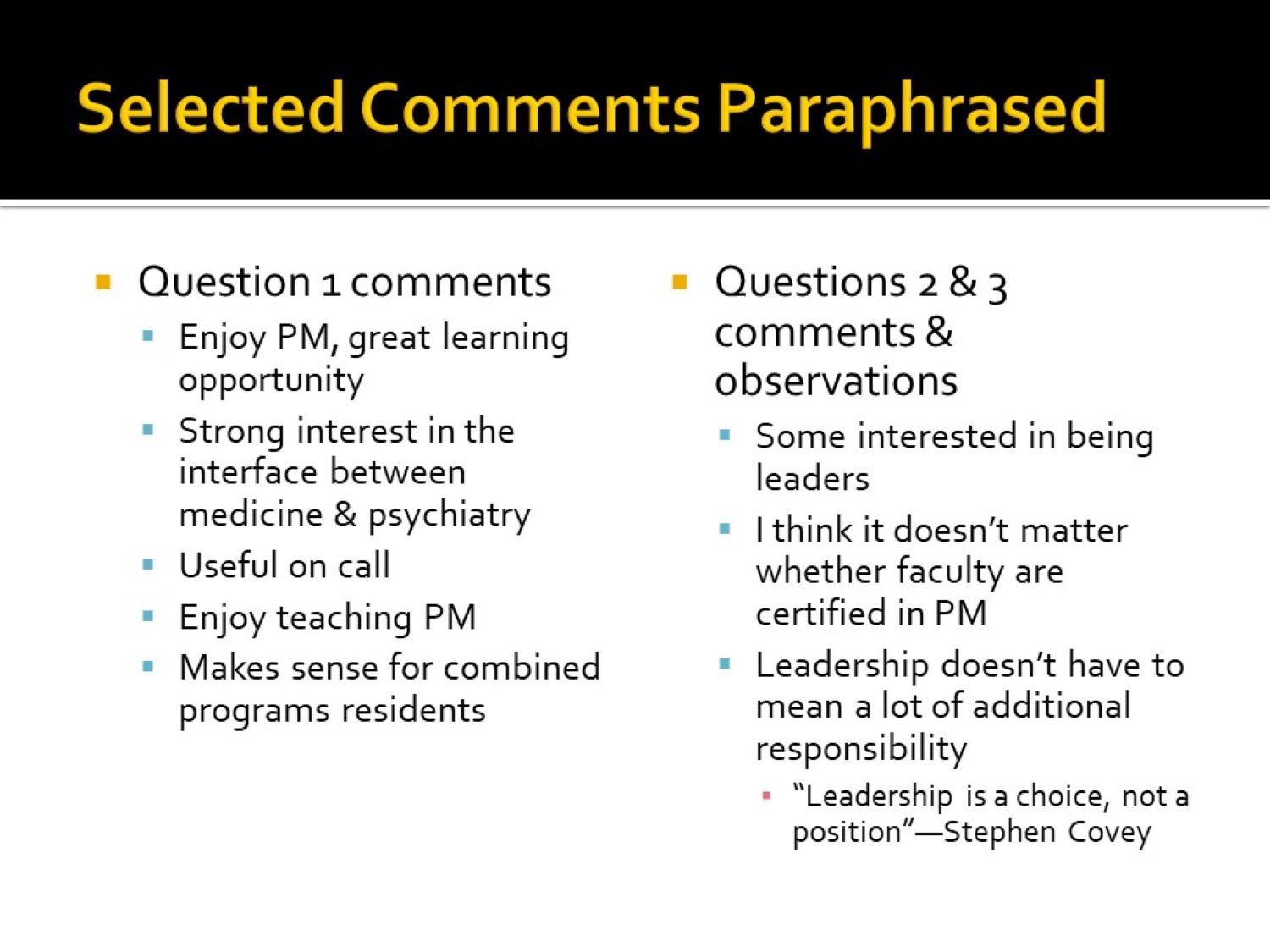
You’ll notice on slide 4 one faculty member’s comment, “I think it doesn’t matter whether faculty are certified in PM.” As Dr. Greenstein discovered, it probably does matter, at least if you want to be board certified.

I was initially certified by the American Board of Psychiatry & Neurology (ABPN), but I objected to the whole Maintenance of Certification (MOC) program, as did many other psychiatrists. I eventually declined to continue participating in the MOC process. However, I notice that the Delirium Clinical Module that I and a resident put together is still accessible on the ABPN website.

Although response numbers were low, there was clearly an interest in starting the interest group. There was also an incentive to reapply to the ACGME for approval of a Psychosomatic Medicine (Consultation-Liaison Psychiatry now) fellowship.

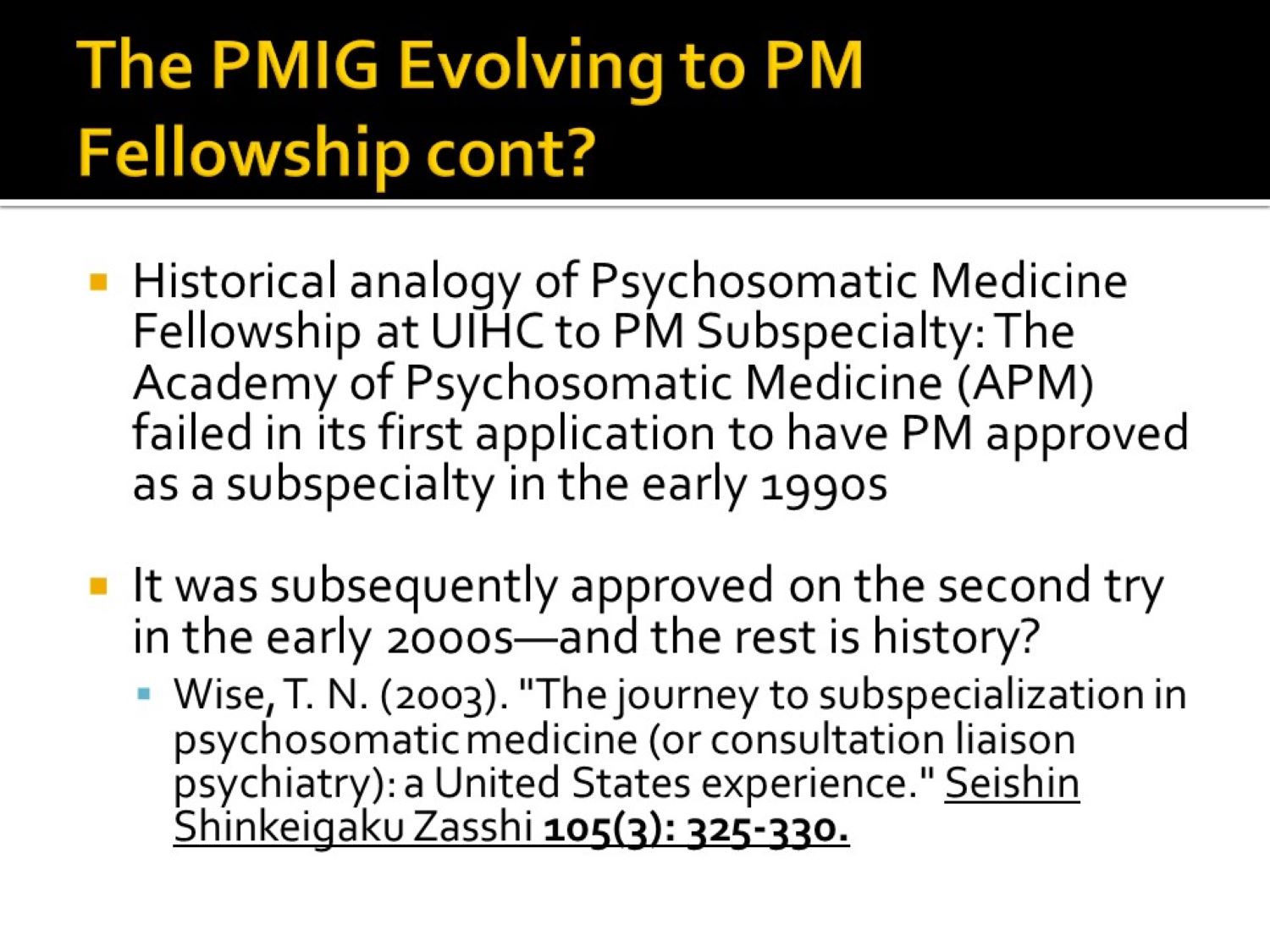
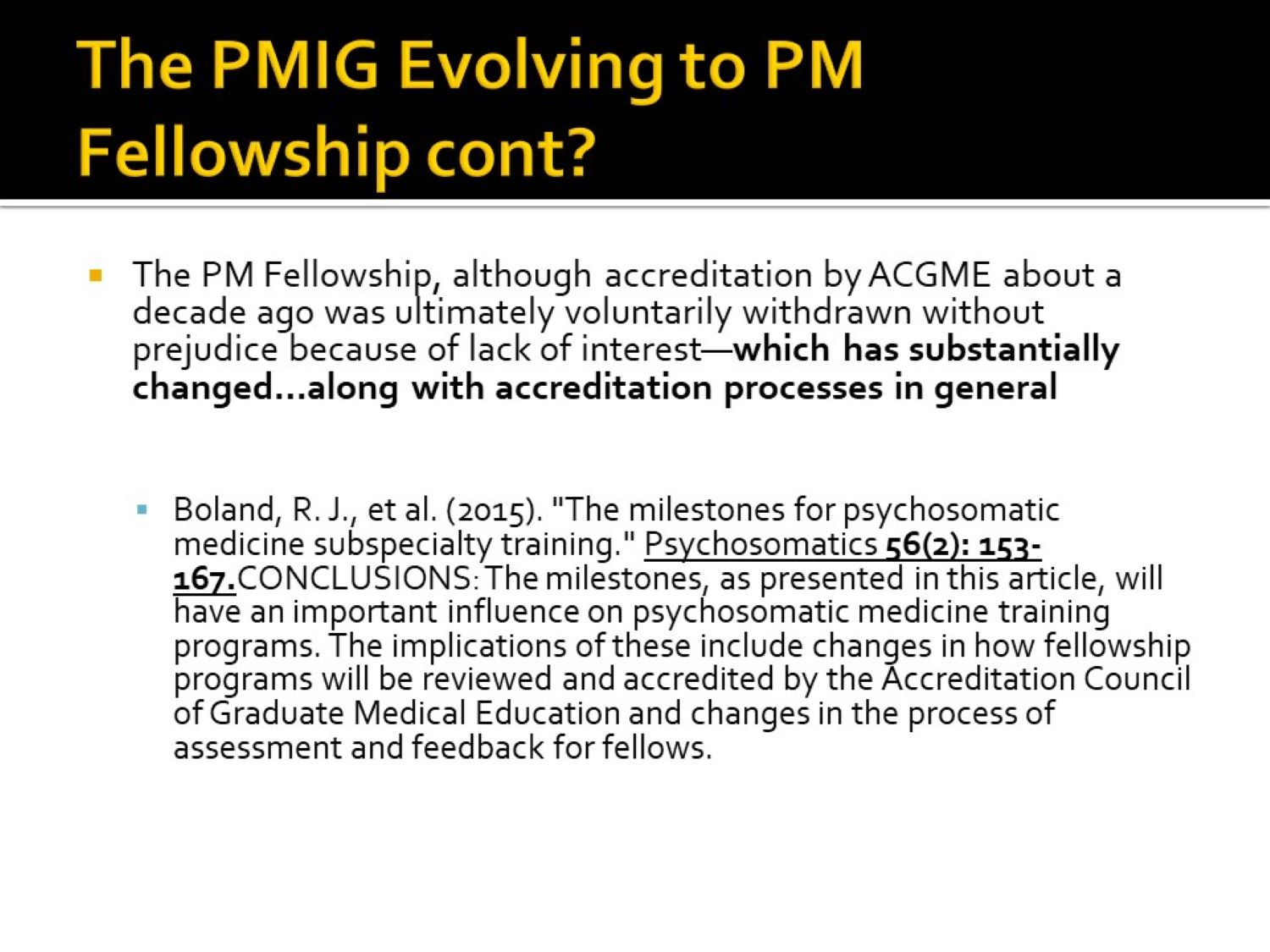
My attempt years earlier had been frustrating. While it was approved, I couldn’t attract any fellows, forcing me to withdraw it without prejudice (meaning another application for approval could be attempted). Fortunately, that situation changed later. The Psychiatry Department at The University of Iowa now has an early career C-L psychiatrist who graduated from the reinstated C-L fellowship.

As the saying goes, “What goes around comes around.” Although the origin of that saying might have originated in the 1970s, at least one person thought his grandmother had her own version in the 1950s: “You get what you give.”

COVID-19 Transmission Level Medium in Johnson County, Iowa

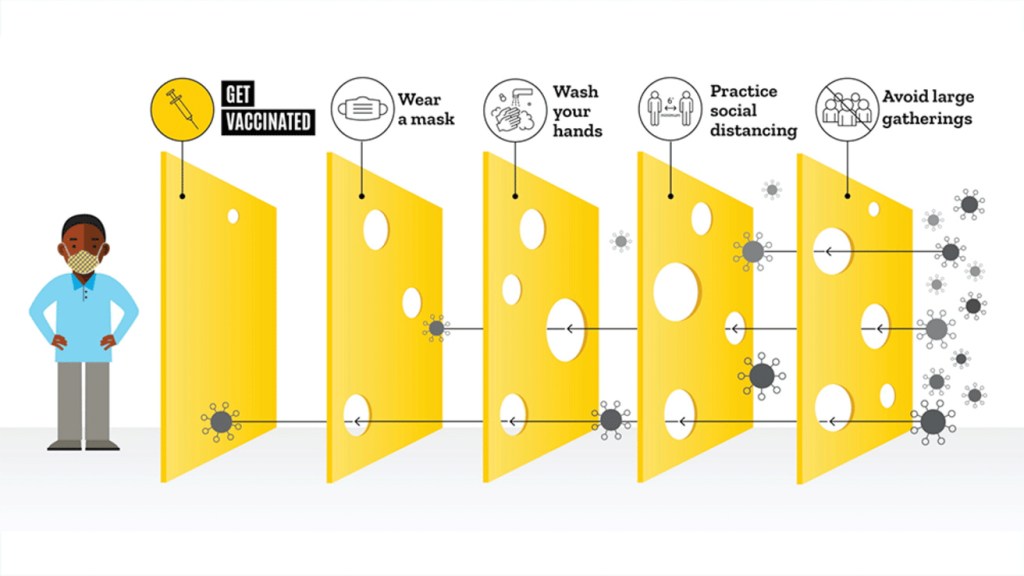
The CDC has reported that the level of COVID-19 transmission in Johnson County, Iowa is Medium. It’s recommended to adopt appropriate safety precautions accordingly. The Swiss Cheese Model is an easy way to remember:

Swiss Cheese Model

Learn more about how to keep yourself and others safe.

University of Iowa Participating in COVAIL Trial on Covid-19 Vaccine Boosters

University of Iowa Health Care is participating in a multi-center Phase 2 clinical trial evaluating various additional COVID-19 vaccine boosters. It’s the COVID-19 Variant Immunologic Landscape (COVAIL) trial, sponsored by the National Institute of Allery and Infectious Disease (NIAID). The trial “will test new and existing booster vaccines in various combinations to see which ones provide immune responses that cover existing and emerging COVID-19 variants.”

Iowa City Nature Challenge Begins!

The Iowa City Nature Challenge began on April 29, 2022. It’s sponsored by the University of Iowa Office of Sustainability and the Environment. According to their web site:

“From April 29th to May 2nd, find and photograph plants and animals in your backyard, in parks, along city streets, on school grounds—anywhere you find nature in Iowa City. Then, simply use the iNaturalist app to upload your photos and add them to the Iowa City project!”

It sounds fun. Read all the instructions carefully. This reminded me of my own amateur naturalist post back in 2019 about a toeless Mourning Dove.

Video Description from my YouTube post:

This is a rather sad little video about a Mourning Dove without toes who visited our back porch in early August 2018. The first slide is of a bird with normal feet, followed by several shots of the bird with abnormal feet.

There’s a slide with a bird seemingly sitting in its own poop, which is said by some to cause the problem–which is doubtful.

The last shot is that of a pair of doves trying to nest in our window box, which was full of sharp, plastic artificial plants, which was painful to watch and I wonder if their hazardous habits could lead to injuring their feet.

Speculation about the causes of these injuries range from something called string foot (string or human hair used to build nests getting wrapped around toes leading to amputation), sitting in poop leading to infections, and frostbite.

I think frostbite is plausible, and so did a birdwatcher named Nickell, who published an article about it over a half century ago; Nickell, W. P. (1964). “The Effects of Probable Frostbite on the Feet of Mourning Doves Wintering in Southern Michigan.” The Wilson Bulletin 76(1): 94-95, complete with hand-drawn illustrations that look exactly like the one in the video.

String foot is also plausible, but I’m reminded of an essay by E.B. White, Mr. Forbush’s Friends, White, E. B. (1966). “Annals of birdwatching: Mr. Forbush’s friends.” New Yorker. 42(1) or in White, E. B. (1999). Essays of E.B. White. New York, Harper Perennial, in which White recounts the book, Birds of Massachusetts and Other New England States by Edward Howe Forbush, in which you can read one of the many anecdotes from amateur ornithologists about bird behavior that Forbush collected for his book, which was published circa 1929:

“Mrs. Olive Thorne Miller. Reported case of female tufted titmouse stealing hair from gentleman in Ohio for use in nest building. Bird lit on gentleman’s head, seized a beakful, braced itself, jerked lock out, flew away, came back for more. Gentleman a bird lover, consented to give hair again. No date.”– Forbush, Edward Howe, 1858-1929. Birds of Massachusetts and Other New England States. [Norwood, Mass.: Printed by Berwick and Smith Company], 192529. I wonder why a bird would risk string foot by using hair in nests?

New Hawkeye Wave Anthem Strong Contender

I formally nominated “I Lived” by OneRepublic to be the new Hawkeye Wave Anthem. On the other hand, I just noticed there is a strong contender for the new Hawkeye Wave song. Dalles Jacobus is a former Hawkeye football player who recently submitted his song, “We Wave.”

He has a lot going for him. He’s a former Iowa football player, He recently graduated from the University of Iowa. He wrote his own song, “We Wave.” He taught himself how to play the guitar by watching YouTube. And there is growing support for the song.

He’s Iowa grown and that’s a real plus for this song. The melody itself feels like a wave. And what Dalles himself says about the song puts the emphasis right where it needs to be, “But, you know, at the end of the day it’s not about the song that’s playing, it’s about the act and the actual wave.”

Featured image picture credit: Pixydotorg.