Our porch is a favorite roosting spot for little birds. But they don’t just roost there. They leave certain things behind.
So, Sena bought some rubber snakes. I think we’ll know quickly whether they work. On the other hand, experts say that you need to move them around every so often so birds don’t figure out they’re not real.
I figure they’re worth a try, as long as extraterrestrials don’t abduct them. We could always kick it up a notch if they don’t work.
We heard about the marketing of a new cannabis product in Iowa. A company called Climbing Kites makes a beverage that contains low concentration THC and it’s legal to buy it as long as the percentage of Delta 9 THC is not above 0.3%. Their website says funny things like “Fly High: All Buzz, No Booze.” However, it’s not legal to make it in Iowa. So, you just have to make believe you’re drinking it. Just kidding, sort of.
No, seriously, while it’s true it has to be made in Minnesota and shipped back to Iowa, you can buy it in Iowa legally as long as you’re over 21 years old and don’t mind going to prison for 20 years if you’re caught with an open container of the beverage while driving. Relax, that’s a joke. Have another drink! There’s a FAQ web page on the Climbing Kites web site. It’s Iowa’s first THC drink.
That doesn’t mean recreational marijuana is legal in Iowa, at least not yet. Several surrounding states are, though, including Missouri, Illinois, and Minnesota. There’s an interesting article on the future for marijuana legalization in Iowa.
Marijuana is still not legal at the federal level, though. It’s still classified as a Schedule I drug under the Controlled Substances Act. While there is some conflict between the states that legalize recreational marijuana and the federal government, the federal government is not hustling to prosecute in those states.
It’s been a while since I tried marijuana, which really only caused me to think I could feel every blade of grass (the kind you mow) under my feet. It was before the evolution of the paramecium and, as luck would have it, before the invention of matches. This meant I had to chew the marijuana, leading to a gas attack which attracted a pack of dinosaurs. Of course, my gas attack is what led to the first mass extinction of the large reptiles resulting in the formation of the first mammals, who traded the marijuana for cell phones with the Extraterrestrials. It’s hard to know who got over on that deal because mammals came down with the zombie scrolling fixation while the ETs got a case of the stucks, suddenly becoming unable to remember how to drive their spaceships or make basic decisions about abducting cattle or mutilating soybeans. As you know, that led to all the UFO crashes on the planet, eventually making it necessary to hire the Bigfoot clan to re-educate them about how to traverse multiple dimensions in space-time enabling the collection of massive amounts of beef jerky supplies. History tells us this didn’t work out well for the ETs because their mouths are way too small to eat beef jerky.
There are many ways to get high as a kite; the substance high, the runner’s high, the writer’s high, and more. Weighing the good and the bad about them is a difficult task.
This is an update on a couple of Mason City, Iowa YWCA and YMCA renovation posts I wrote in May of 2022 (May 12 and May 25). I’m also going to compare the information about those with recent news about the building which is home to Pagliai’s Pizza.
Recall that the YMCA in Mason City was placed on the National Register of Historic Places in 2002. It was built in 1926. It was also converted into an affordable apartment housing resource. When I was a young man, I used to live in the dormitory. And if you must know, that was in the days of the Pony Express.
And the YWCA in Mason City was built in 1918, well before the YMCA. Yet it is still not on the historic register, which is puzzling. It sat empty for many years before a couple of artists (2 Artists) bought it in 2021. They are trying to renovate the building with some assistance from the city, and their own fund-raising campaign which includes a GoFundMe and other efforts. They plan to use it as a resource for artists, eventually to include studios, apartments, and art shows. The city has received a grant to convert part of the building into apartments.
The State Historical Society of Iowa told me that the YWCA has been deemed eligible twice for nomination (in 1991 and in 2003, which was a year after the YMCA was added to the list). Yet the YWCA has never been nominated. I ended up calling this a mystery in history. It’s true it was neglected for years and renovation is expensive. The nomination process is long and very involved.
A recent, brief local newspaper article indicates that the renovations are still underway, but there is still no mention of trying to get it added to the historic register.
How does that connect to the current news about the building that houses Pagliai’s Pizza? The owner wants to sell the building. However, the building has been there since the 1870s and the Iowa City Historic Preservation Commission has decided along with many others that it belongs on the city’s list of historic landmarks.
The building used to house a dance hall, a grocery store, and a bohemian restaurant. It has been home for Pagliai’s Pizza since 1957. It’s a local favorite; Sena and I have enjoyed pizza there on several occasions.
The owner has misgivings about designating the building a historic landmark as it might hurt its marketability. Nevertheless, the Iowa City Historic Preservation Commission legally decided to recommend it for landmarking. It will be voted on by the Iowa City Planning and Zoning Commission, although it’s not clear exactly when. The owner of the building is not the same person who runs the pizza place—he signed a lease through 2030 and beyond if possible.
My question is if Iowa City can insist on adding a building to the historic register (in a way overriding the owner), why has it never been done for the Mason City YWCA? There is at least as much culturally significant history linked to it as there is with the Iowa City property.
I’m not savvy enough about the intricacies of city planning to figure this one out. So, it remains a mystery in history to me.
Sena and I got to talking about Central Park in Mason City, Iowa. I remember my brother, mother and I taking a walk there occasionally. One time we saw a man who lost his legs and who got around using a small platform on wheels. Later in life, I wondered if he was a disabled war veteran.
That reminded us of the 1884 Memorial Civil War Statue in the center of the park. We looked it up and found it has a complicated history. In the late 1990s it was under repair for about 3 years in Cincinnati, Ohio. When it was finally returned, it was noticed that it had not been repaired correctly. The city decided to keep it anyway, partly because some people, including a Civil War re-enactment supporter, thought the flaws were relatively minor.
Anyway, there are relief busts of famous persons on the statue. We could identify Abraham Lincoln, Ulysses S. Grant, and a Civil War soldier. After a brief web search, we confirmed that the 4th relief bust was that of George Washington.
There are a couple of topics of interest here. One of them is the George Washington relief bust and the other is Civil War re-enactments.
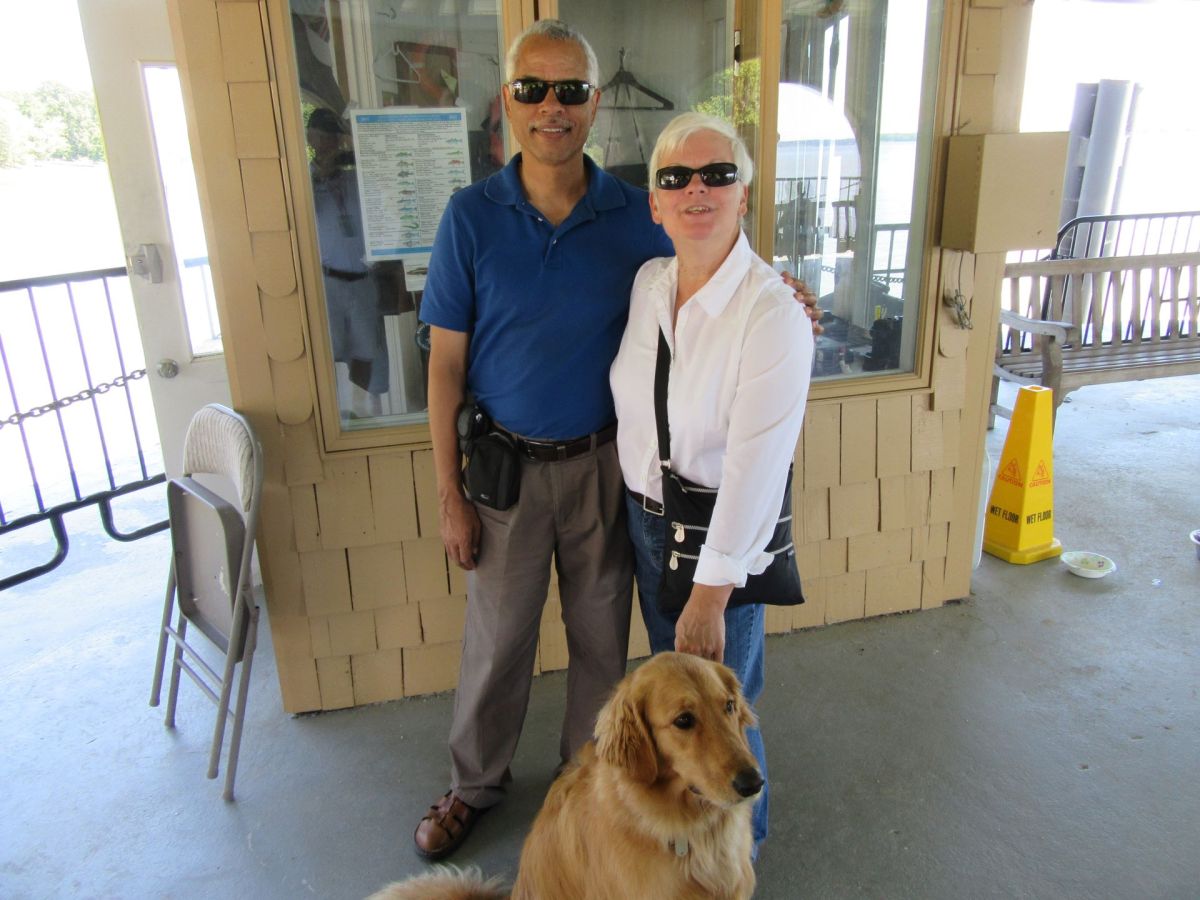
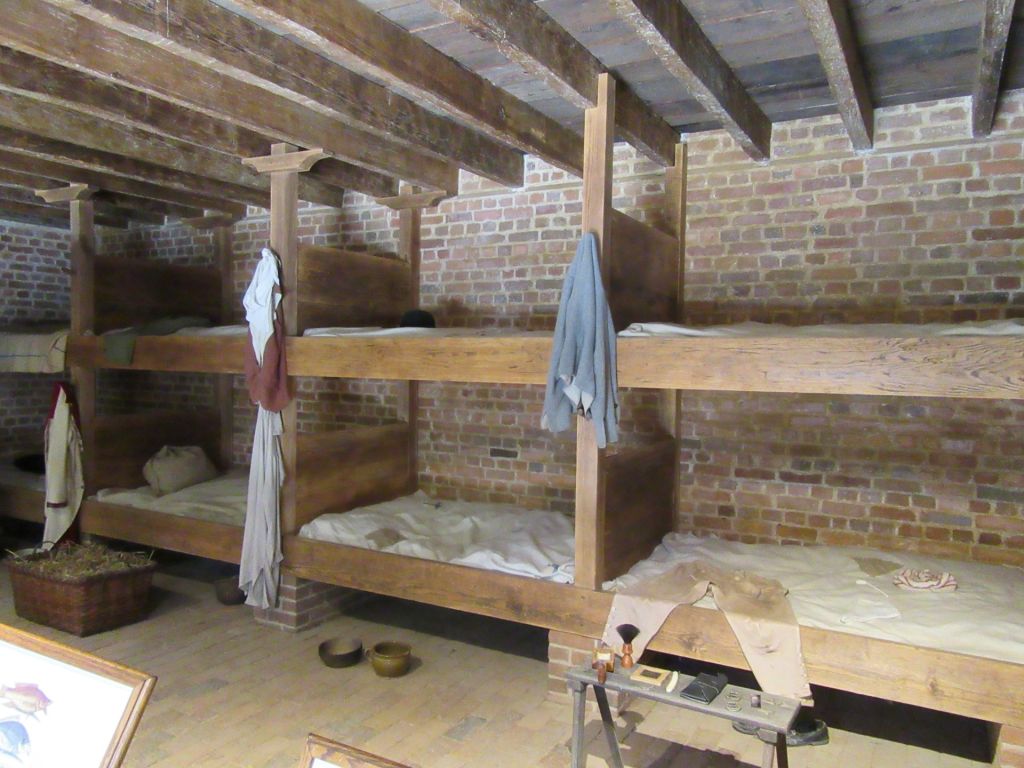
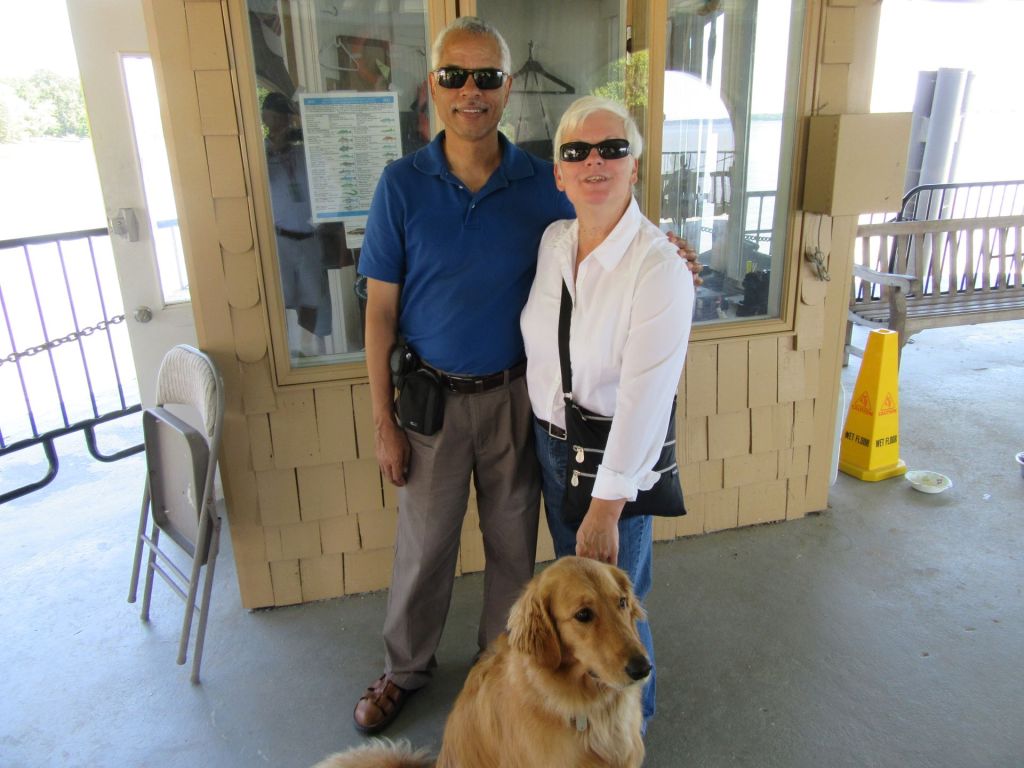
The connection of the Civil War to George Washington is a little puzzling because he owned slaves. We’re aware he freed them upon his death. On the other hand, when we visited Washington D.C. in 2015, we took a tour of Mt. Vernon. It was a scenic boat trip out there. We took a picture at the dock with the dog of the guy who helped people on and off the boat. We also took pictures of the slave quarters. There were no re-enactment persons and we were told we were on our own when viewing those exhibits.
This also reminds me of the news item about a bill recently (on February 9, 2024)) introduced in the West Virginia legislature to remove the statue of former Senator Robert C. Byrd from the West Virginia State Capitol and replace it with 4 other statues: Abraham Lincoln, James Madison, Arthur I. Boreman, and George Washington. Nothing is mentioned in that news story about Senator Robert C. Byrd having been a leader in the Ku Klux Klan in the past, and filibustered against the Civil Rights Act of 1964. This is from a news story posted on the web in 2020 under a link titled “time to remove monuments to senator byrd.”
Again, I struggle a bit with suggesting that a statue of George Washington, a former slave owner, would be an appropriate substitute for that of Senator Byrd. And James Madison, despite saying that slavery was incompatible with Revolutionary principle, owned slaves and made profits on their sale. Arthur I. Boreman is described as not being an abolitionist but a unionist. However, in 1865 he signed a legislative act banning slavery in the state of West Virginia.
Maybe a nice set of abstract sculptures for the corners of the rotunda of the West Virginia State Capitol?
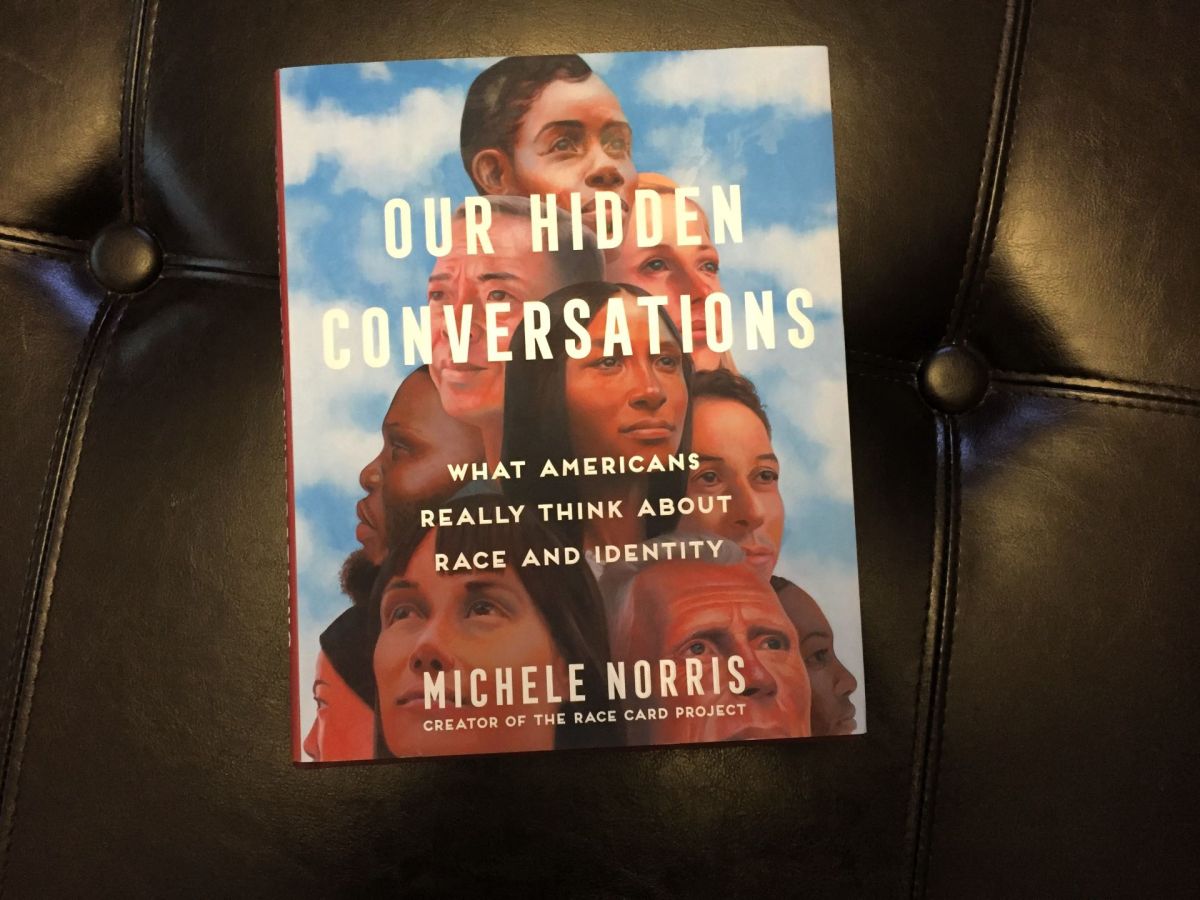
Turning to Civil War re-enactments, I’m ambivalent about them. I remember reading a couple of anecdotes about re-enactments in the book “Our Hidden Conversations” by Michele Norris.
One of them was about black woman re-enactor who played the role of a house slave. This was in Chapter 4, “Coins in the Couch.” The six-word Race Card (p.160) said “Why Do You “Play” A Slave?” Nicole is a slave interpreter. She makes sure that visitors to former plantation sites portray slavery accurately to tourists. She’s a public historian by training who works at the National Center for Civil and Human Rights in Atlanta. She teaches tourists about the reality of chattel slavery, including the sale of relatives to other plantations and the ingenuity of enslaved men in improving farm implements.
The next anecdote about re-enactment in the book is in Chapter 10, “So, You Want to Talk About Lynching?” The six-word Race Card (p. 386) said “Confederate re-enactor chose intimidation as spoils.” A black man and his biracial but white looking friend were at a barbecue in Texas. Two big white guys dressed in Confederate-era uniforms were passing by and one of them placed his rifle on his knee and tried to stare down the black man. The black man stared back and this went on long enough for his friend to get nervous enough to suggest they just leave. Finally, the other re-enactor pulled the sleeve of the intimidator and they were the ones who finally left. Despite this episode, the black guy “…made a choice to accept people as I receive them.”
Apparently, there are regular Civil War re-enactments in Mason City. It looks like the most recent was from Sept 8, 2023-Sept 10, 2023. It was The Battle of Chickamauga, TN. It was held in East Park, where I used to play as a kid. Iowa soldiers in the Civil War fought on the Union side. However, I found out the battle of Chickamauga was won by the Confederates, and it had the second highest number of casualties after the Battle of Gettysburg. There was a battle demonstration and the camps were open all weekend to talk to the re-enactors. And there were food vendors.
There is a newer Mason City Veterans Monument in Central Park. It was built in 2004. It has 12 handsome black granite stones with room for the names of 4,600 veterans. We have seen pictures of it on the web. There are no relief busts.
As I approach the end of the book “Our Hidden Conversations” by Michele Norris, I find myself doing what I often do when I feel uncomfortable emotionally. I start to deploy my sense of humor.
As a psychiatrist (now retired since 2020), I learned early in my residency training that humor can be thought of as a “mature” psychological defense.
Given the painful memories that the book evokes, I find that I self-edit my usual habit of turning pain into comedy. Maybe it’s not always mature.
On the other hand, there are times when facing what is nowadays called my “lived experience” about racism and identity in the era my wife and I grew up in, while not funny, can be peeked at most safely from the funny edge.
So, with that in mind I took a look at the web page of the National Association of Black Social Workers (NABSW) which summarizes the organization’s position on white adoption of black children. I first read about it in Ms. Norris’s book, in the chapter “Black babies cost less to adopt.”
I was surprised to see the actual document, which has been posted since 2013. Sections of the position paper titled “Transracial Adoption Statement (c) 1972” are underlined. It expresses clearly an opposition to placing black and transracial adoptees with white parents. I might have missed it, but I don’t see another position statement that modifies it.
There are 30 state chapters of the NABSW. Iowa is not listed.
There is no National Association for White Social Workers. There is a website for the National Association of Social Workers (NASW). When I typed in “National Association of Black Social Workers” in the search field on the NASW website, almost 800 results were returned. When I applied the filter for ethnicity and race, there were 5 results attesting to the NASW efforts in countering racism. I didn’t see any mention of the NABSW. Maybe I just missed it.
I lived for a brief time in an African American foster home eons ago. I can’t think of anything funny to write about it. Has there ever been an opportunity for cross talk between the NASW and the NABSW? I’m not judging anyone here. I’m just asking.
Moving right along, I have again searched the web using the term “African American psychiatrists in Iowa.” I’ve posted about this before, looking at it from the funny edge (this allows me to take a deep breath). I still find my former colleague, Dr. Donald Black, MD listed. The only thing black about him is his name. And my 2019 blog post is the 3rd link down from the top, preceded by two from Psychology Today.
Most of the mental health care providers from the Psychology Today lists are Nurse Practitioners who are black. One of them does not look black. She looks white. She’s a psychiatrist. I’ve worked with her in the past and don’t recall her ever identifying as black. But because I’m reading the race card stories in “Our Hidden Conversations,” and because I’ve been around a little while, I’ve learned that some black people can look white. You can’t always judge a book by its cover.
A good black psychiatrist is hard to find. In fact, a black psychiatrist of any quality is hard to find. However, in general, there are notable black psychiatrists in our history. One of them was Chester Middlebrook Pierce, MD. Among his many accomplishments, he was the founding president of the Black Psychiatrists of America in 1969, which was one year after the NABSW was established. Dr. Pierce was also the president of the American Board of Psychiatry and Neurology in 1978. I didn’t learn about him until today. How is that possible?
There is a website for the Black Psychiatrists of America and you can try the search field to look for a black psychiatrist there. I couldn’t find any listed in Iowa. Most of them seem to be in Texas. I had a little trouble applying the search filters.
Those are my thoughts for now about “Our Hidden Conversations” by Michele Norris. This is not a funny book.
Yesterday, we went out for a walk because it was a pretty nice day for February. All the snow was pretty much gone. We saw a hawk who also saw us. We approached the tree it was perched in very slowly. It tolerated our attention until we got too close for comfort—and flapped off in a huff.
It was a nice enough day to walk all the way out to the Sitting Man and beyond. Others were out taking in the sun as well. It’s good to do simple things; things like walking in the sun, drinking iced coffee, eating zucchini bread, waving at UFOs.
Sena bought a pretty big tomato at the grocery store the other day. When she picked it up, she said to a store employee that she was going to make a huge “vegetable hamburger” with it.
Evidently, the guy didn’t know what to make of the name “vegetable hamburger” because he asked her why she wasn’t going to use any meat.
This was the same situation when she tried to order a “vegetable hamburger” at Wendy’s over a year and a half ago. Nowadays everybody seems to think that means “meatless.”
I checked the internet again and I still can’t find a definition of a “vegetable hamburger” that corresponds to what Sena and I grew up with. Everybody seems to think that lettuce, tomato, etc. are no longer parts of a vegetable hamburger.
I think we need to bring this concept back-because I doubt Sena is going to change what she calls it.
I just found out how hard it is to remove that blade guard from the RESQME car escape tool. You can’t waste time busting a gut trying to pull that out when you’re about to drown while your car is sinking in a flood. You might need the blade to cut your seat belt.
That’s where the key ring comes in. It’s included with the kit. You attach the key ring to the end of the blade guard and that gives you a better grip to pull it out.
You can find many other videos about how to use it. But if you need to free yourself from a jammed seat belt, you’ll have a really tough time if you can’t pull the blade guard off.
There’s also a cable tie included, presumably for the same reason.
I thought I would share a couple of ideas about the Czech composer Antonin Dvorak. I’m not a music expert by any stretch of the imagination, but I enjoy listening to classical music on the Music Choice Classical Masterpieces channel.
Music Choice always have interesting bits of biographical information about the musicians. The items about Dvorak are very interesting. For example, a couple of them mention that he had idiosyncrasies. One was that he stole all of the pencils at a place where he was supposed to be working because the pencils were “perfect for composing.” Another factoid is that he was fascinated with the trains in Prague and, in fact, had memorized the entire train schedule.
This makes me wonder if he was something more than eccentric and might have had some form of autism spectrum disorder (formerly Asperger’s Syndrome). On the other hand, I’ve always been a little suspicious of the Music Choice channel’s little biographical blurbs. I couldn’t verify from a quick internet search whether or not he had the disorder or not—and probably he didn’t.
On the other hand, Dvorak did visit Spillville, Iowa during the summer of 1893. There’s a short video which tells about his visit. One of the images shows a picture of a scarlet tanager, and the voice over mentions that Dvorak was often inspired by birdsong. In fact, there is an online reference to an anecdote about Dvorak basing one of his compositions, String Quartet in F major (op. 96, the ‘American’), on the song of a bird.
There was some controversy about whether it was more likely he based it on the song of the red-eyed vireo or that of a scarlet tanager. But after an extremely long article, the authors of the reference conclude that Dvorak’s composition was based on the song of the red-eyed vireo, which doesn’t resemble a scarlet tanager at all (McKone MJ, Beccue DA. The Iowa Bird That Inspired Antonín Dvořák’s American String Quartet in 1893: Controversy over the Species’ Identity and Why It Matters. Nineteenth-Century Music Review. 2021;18(3):521-537. doi:10.1017/S1479409820000282).
I’m an amateur bird-watcher and I’m pretty sure I’ve never heard or seen a red-eyed vireo. I have seen a scarlet tanager but I can’t remember what its song sounds like. I’m pretty sure Dvorak didn’t mistake either bird’s song with the well-known howl of Bigfoot, who may have been sneaking around Spillville, hunting for beef jerky.
Let’s see Music Choice channel try to add that to the anecdotes about Dvorak.
I was thinking about my time as a student at Huston-Tillotson University in the 1970s (then Huston-Tillotson College) and remembered somebody who was a student there. His name is James Spaights. In honor of his stature in music as it connects to the Black History Month theme of African Americans and the Arts, I just want to make special mention that Mr. Spaights is a concert pianist. I have not found his obituary (you know already about my habit of checking the obituaries) so I’m not going to talk about him in the past tense.
When I met him, Mr. Spaights was straightforward about his life goal, which was to be a concert pianist. Little did I know that he had already achieved that by the time I met him at H-TU.
He gave a fantastic performance for the faculty and students. I’m pretty sure we gave him a standing ovation.
I found some news clippings and other items about his career (unfortunately I couldn’t find recordings of his performances), which deserves to be better known. He was a member of the Alpha Phi Alpha Fraternity and a fraternity news letter shows his photo and bio in the 1977 issue of the SPHINX:
“Brother James Spaights, pianist, whom New York critics acclaimed “a virtuoso pianist and technician of the first rank” after his New York debut at Town Hall in 1965, was presented in concert on March 20, 1977 in Carnegie Hall, New York City, by the Behre Piano Associates of New York. Spaights is a former student of Madam Edwine Behre in New York City, also Freda Rosenblatt, Bronx, N.Y. and Emma Slutsky, Brooklyn, N.Y.
For three years Spaights served as Ambassador of Goodwill for the United States’ State Department as a concert pianist touring throughout Europe, parts of Canada, and the United States.
On his most recent United States tour, Spaights was presented by the Music Department at Morgan State College in Baltimore, Maryland, and Goddard College in Montpellian, Vermont.
Spaights holds his B.A. Degree in Music from Howard University and a Master of Arts Degree in Music from Columbia University. He is a member of the Lechetisky Association of America, The Behre Piano Association of New York, and a member of Gamma Eta Lambda Chapter of Alpha Phi Alpha Fraternity in Austin, Texas.
He is presently serving a post in the Music Department of Huston-Tillotson College of Austin, Texas.” (The SPHINX, Fall 1977, Volume 63, Number 3 197706303).
I guess I misunderstood what Mr. Spaights was doing at H-TU when I was an undergraduate there. I thought he was a student! He never mentioned his career or accomplishments (at least to me) and he had a great sense of humor. I was in the presence of a music luminary and never knew it.
Ref: The SPHINX Volume 63, Number 3, October 1977.








 Go Retire Psychiatrist