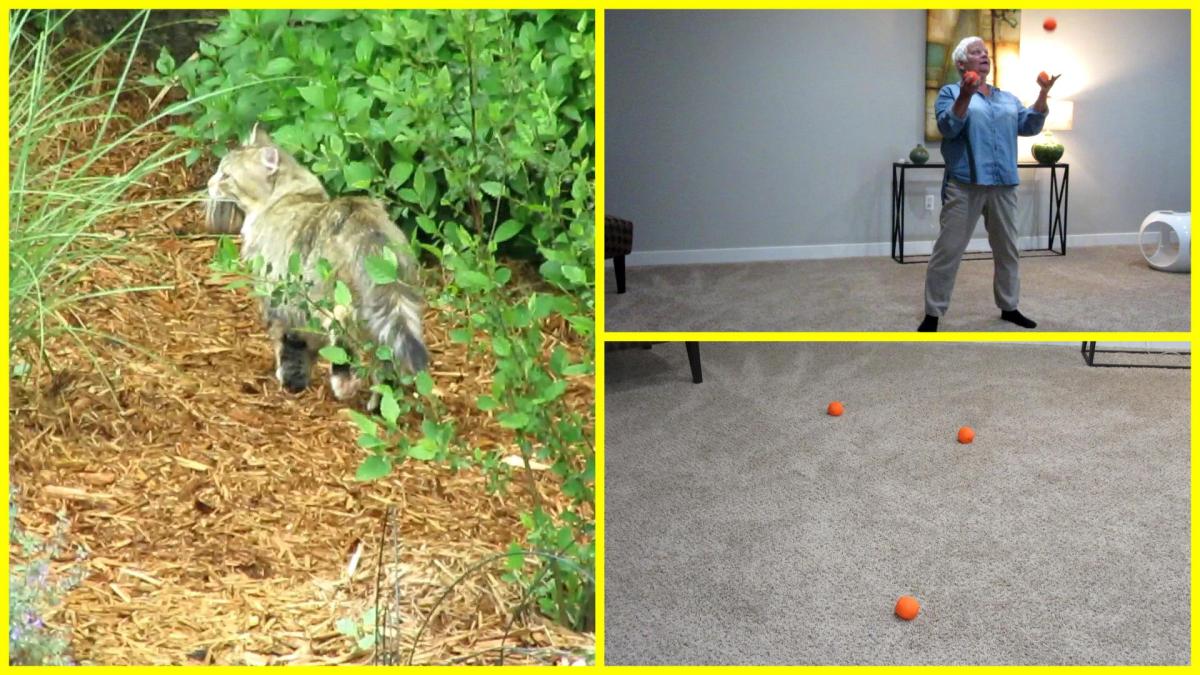
Yesterday Sena practiced her usual 2 or 3 minutes of juggling and then took a break to look out the window. She likes to see how the garden is coming along in the backyard.
In fact, lots of things go on in our backyard garden and beyond. Critters are entertaining. We’ve seen all kinds of birds, deer, turkeys, and even cats catching their dinners.
There are some pretty talented mousers who hunt on the property. Sena got pretty excited when she filmed one catching what she thought was a mouse.
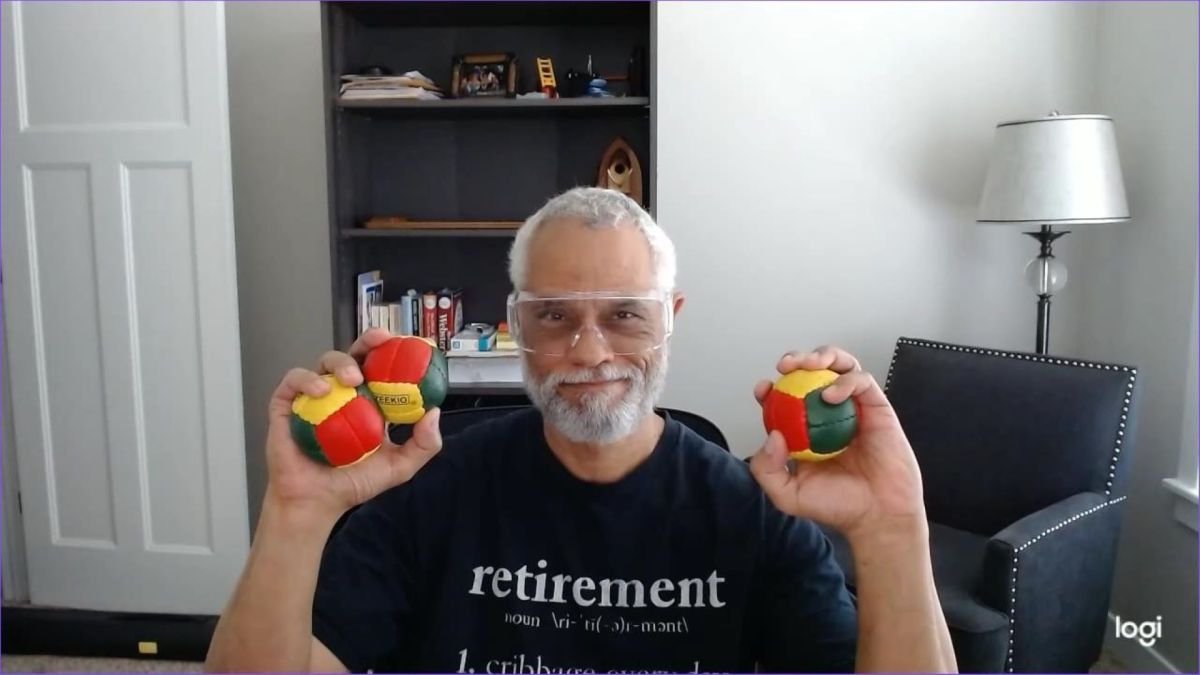
I got new safety goggles the other day. They’re to protect me when I juggle. They’re made by Sattron and Sena got them on Amazon at a good price for 3 pairs. They fit over my eyeglasses. These were my old eyeglasses, which I’ve since replaced with brand new ones. I’m still a little nervous about wearing the goggles over those.
The goggles come with a cleaning cloth and the bows are adjustable. They adjust at the temples up and down through 15 degrees (up, intermediate, and down). It’s hard to move them. You have to really crank them. I don’t think they make that much difference. The length adjustment is a little quirky. You pull them out or push them back in. It’s a ratchet setting adjustment. The soft silicone nose pads will leave smudges on your glasses.
They’re anti-fog, anti-UV, but unfortunately not anti-drop. On the other hand, when a juggling ball drops on my head, I’ll be protected because they’re impact resistant.
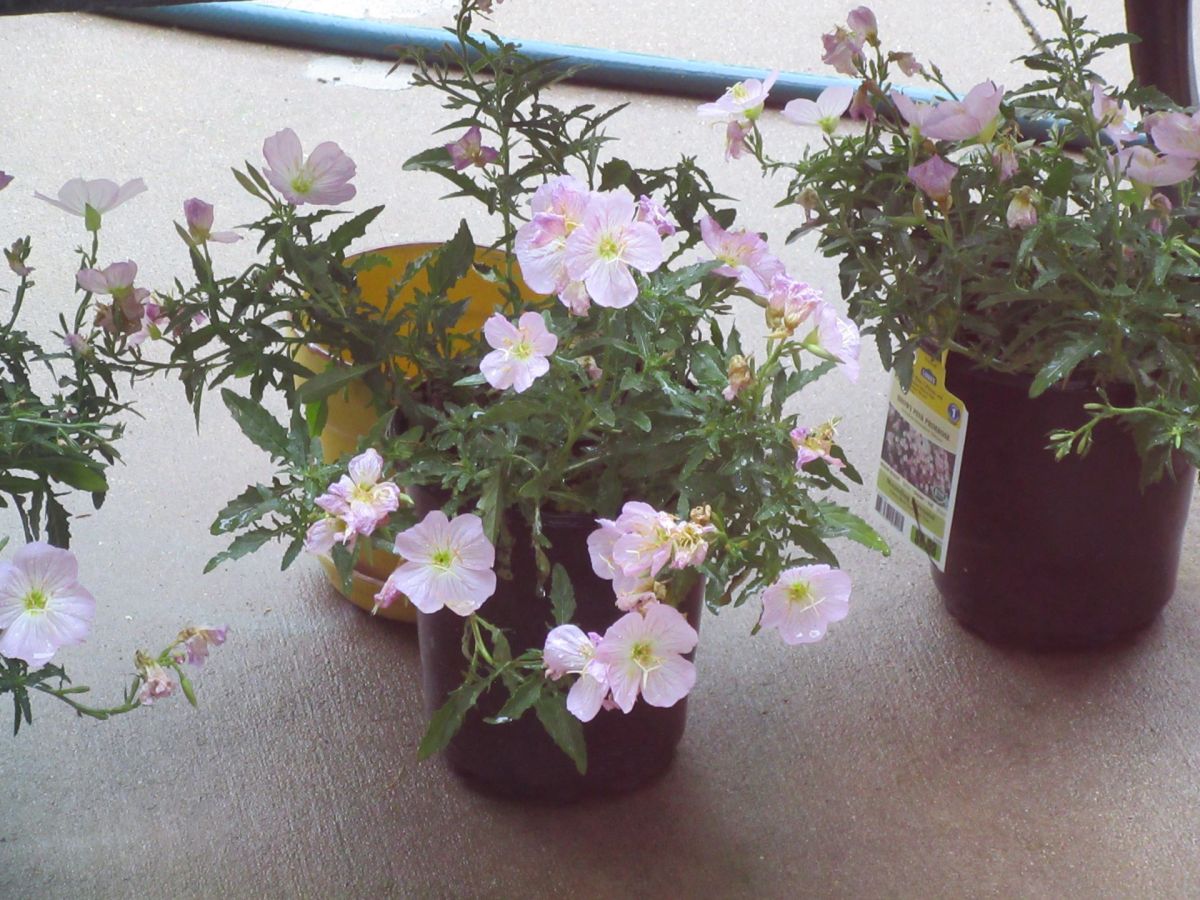
We were very happy when we finally got a little rain the other day. It really brightened up the garden. Sena got some evening primrose. This happens to be one of my favorite flowers. It was one of the many flowers she planted in her big garden at our first house.
The evening primrose I see on the web are mostly the yellow variety. The variety we’ve had is a pale pink color. We were surprised to see that some people warn against planting this in your yard. It’s considered invasive, but we didn’t have any problem with that years ago.
Some say that evening primrose is not intended for human or animal consumption. The Mayo Clinic web page says that, while it’s probably safe to take in pill form in small amounts for a limited period of time, the evidence for its effectiveness for the medical conditions people usually take it for is inconclusive at best. And you shouldn’t use it if you have a bleeding disorder, epilepsy, or schizophrenia.
My very limited web search revealed the rationale for avoiding taking evening primrose if you have schizophrenia was that it might raise the risk for seizures. I saw one Cochrane Database Review from over 20 years ago which said it had no effect on fish oil supplements for schizophrenia. One article from the 1980s suggested that evening primrose oil might increase the risk for seizures in patients with schizophrenia.
The bottom line is you should not ingest it but simply admire its beauty.
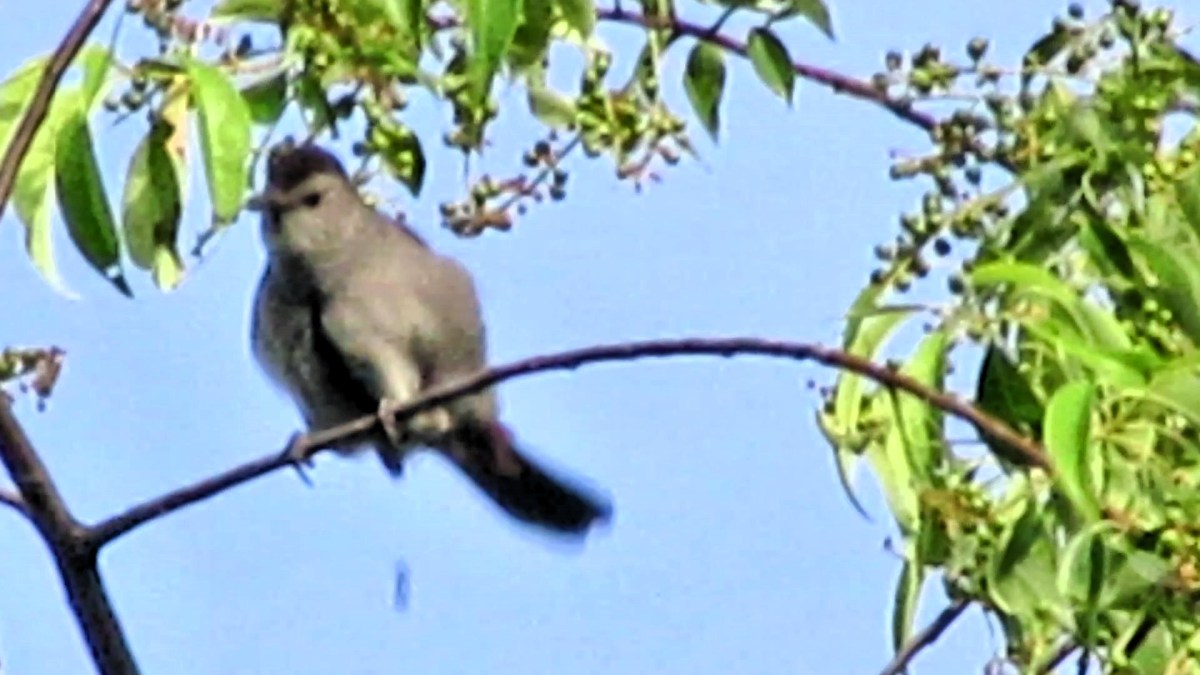
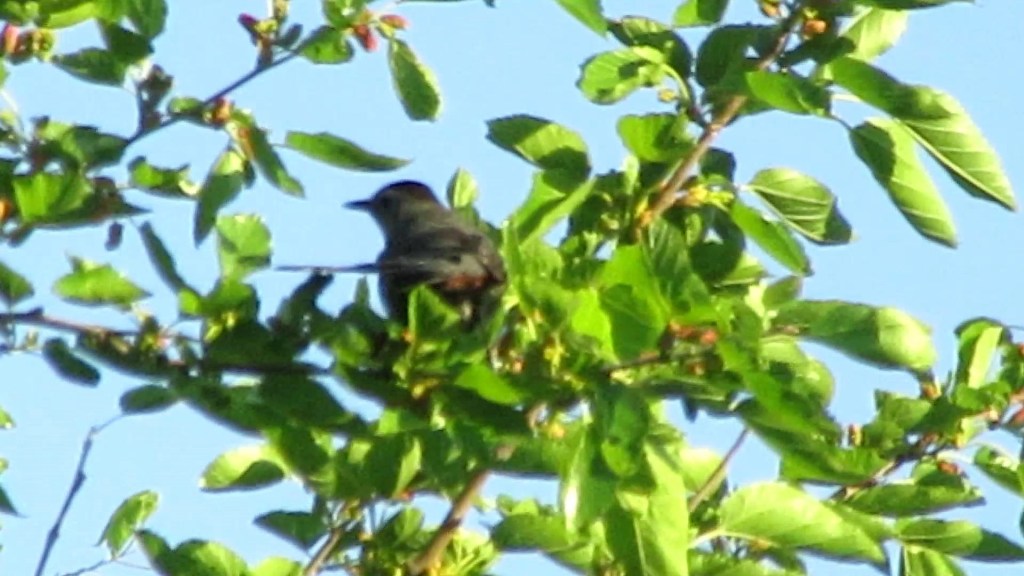
I looked into the mystery of the gray catbird’s rusty rump. I mentioned the rusty colored feathers under its tail feathers in yesterday’s post. For some reason the underside of its tail feathers looks a little messy. I was able to get more video evidence about what might be the cause.
The catbird looks fastidious. That may be misleading. Scientific observation reveals what is really going on.
This is probably also the origin of an old saying. I think it was Plato who said, “Never stand under a bird.”
We hear the gray catbird more often than we see it. When we do see this beautiful gray bird, it’s only a fleeting glimpse. We more often hear it mewing like a cat. It imitates the songs of other birds as well.
I have caught sight of it in our back yard trees. It streaks back and forth from the trees to somewhere else, most likely a nest.
I finally got a short video yesterday morning from which I gleaned a few pictures. It seemed to show off its feathers, even the rust-colored ones you can see only when it lifts its fan-like tail. It has a handsome black cap.
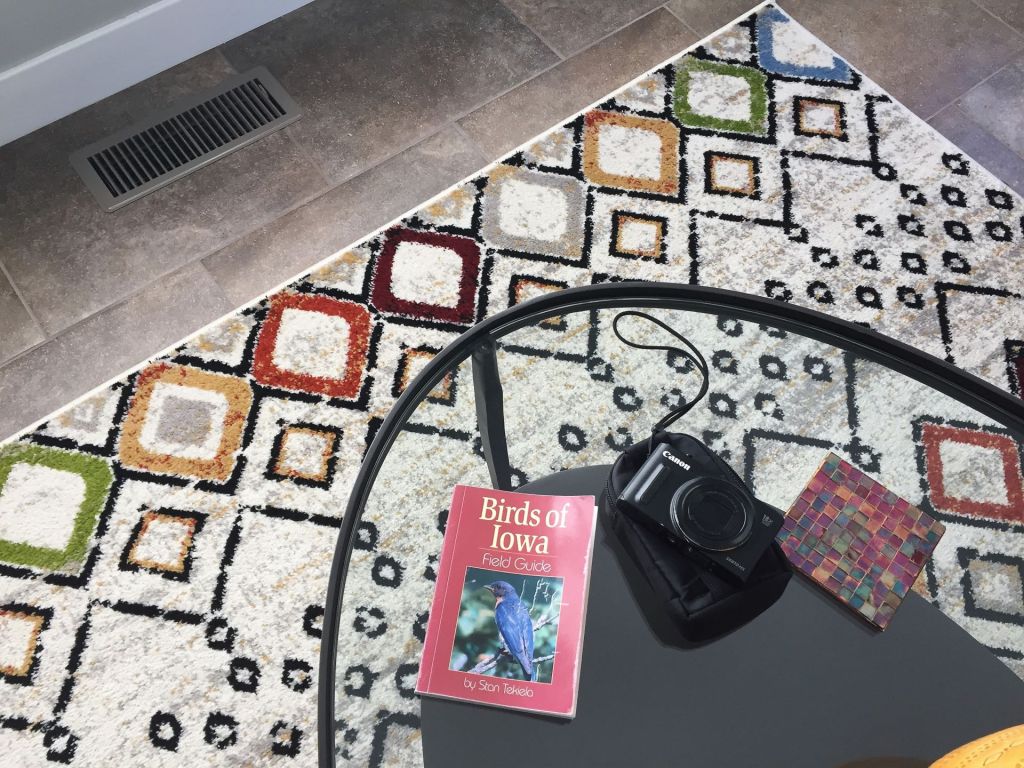
We have a bird book we consult for help identifying birds. The title is Birds of Iowa: Field Guide, written by Stan Tekiela. I first bought the book many years ago. It was published in 2000. I’m pretty sure I bought it at the Iowa Book store on Clinton Street in downtown Iowa City. It was still for sale at the store as recently as last year.
The book makes it easier to identify birds by color. The sections have titles like “Birds that are mostly gray.” Every page has a tab color making it easier to thumb through the book looking for the birds you saw and want to know more about.
The short descriptions are packed with useful descriptions of things like the behavior, migratory patterns, as well as appearance. Tekiela’s description of the gray catbird includes remarks about its color, saying it is “A handsome slate gray bird with black crown…” and “Often seen with tail lifted, exposing chestnut-colored patch under tail.”
Tekiela also would give some pithy and educational stories about birds. According to him, it’s “A secretive bird that the Chippewa Indians named Bird That Cries With Grief due to its raspy call.” Often it mews like a cat, which is how it got its common name.
The other day we were at Terry Trueblood Recreation Area mainly to see how juggling goes outdoors for me. We filmed the event for posterity.
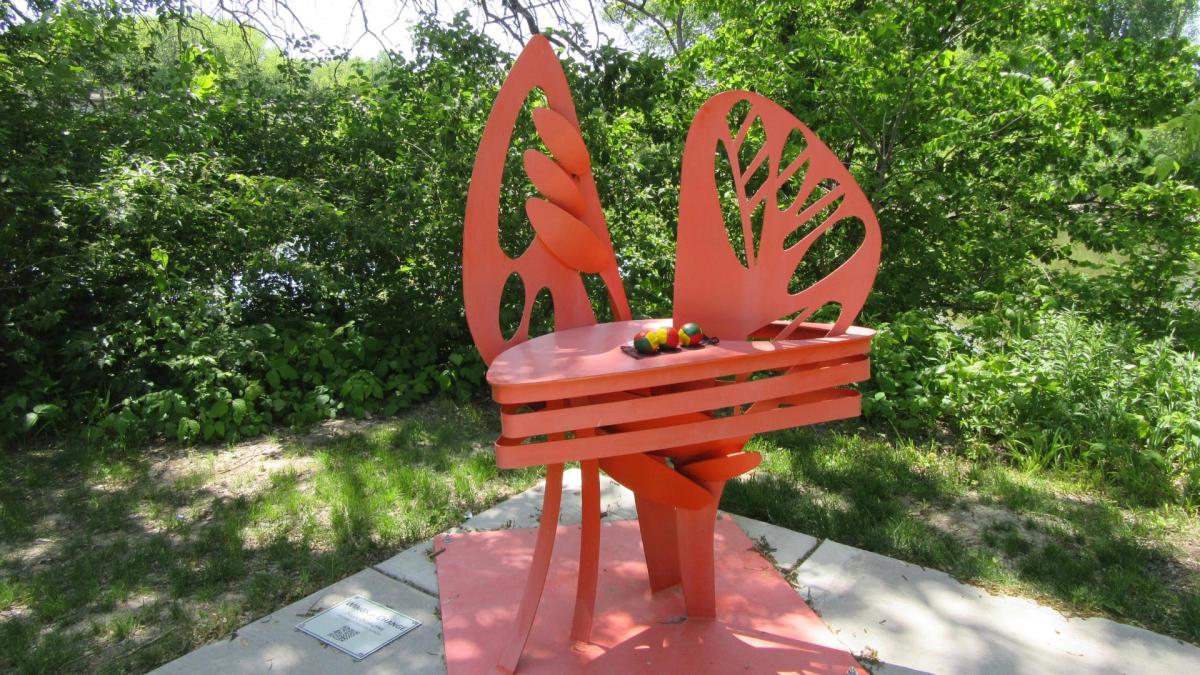
It turns out that “wings” had a lot to do with it. I juggled next to Hilde DeBruyn’s sculpture “Winds of Change.” It’s my favorite sculpture, although the winds of change are dictating that the Iowa City Parks Dept. is again going to accept new sculptures for this year which will replace all of those currently on display.
Wings figured in a different way and you can tell by how I react to the bugs flying around. We picked a nice spring day when all the winged insects were buzzing around in my face.
The level of juggling difficulty goes way up when gnats are zipping up my nose, my ears, my mouth, etc.
I just got a new eyeglass prescription a few days ago. I figured a year was long enough to wait after my surgery for an acute on chronic retinal detachment of my right eye. My vision in that eye has changed quite a bit, but I think new glasses will help a lot.
My old pair of eyeglasses is pretty beat up. Juggling has not helped. I’ve knocked them off my head a couple of times lately. That has not helped the poor fit.
I’m also practicing a new juggling trick called the claw. The throw and catch techniques are very different. You have to claw catch the balls from the top. I end up slamming them on the floor or off my groin. Juggling takes dedication and sacrifice—but there’s a limit.
I think I need safety equipment. I’ll be getting new eyeglasses, but it might be a good idea to get a pair of safety glasses. I just happen to have an old pair of plastic safety glasses from the time Sena bought me a battery-powered pole saw for tree trimming in the back yard a few years ago. Talk about safety. It takes at least as much agility and coordination to dodge a heavy falling tree limb as it does to dodge a juggling ball.
The claw trick puts a vicious spin on the ball and it can fly anywhere at meteoric speed. Controlling the arc and direction to fit the cascade pattern is quite a challenge. Balls frequently ricochet off each other, which is why I don’t drink my coffee during juggling practice. Practicing the claw reminds me that juggling is great exercise. I’m flying all over the place, lunging, leaning, and ducking.
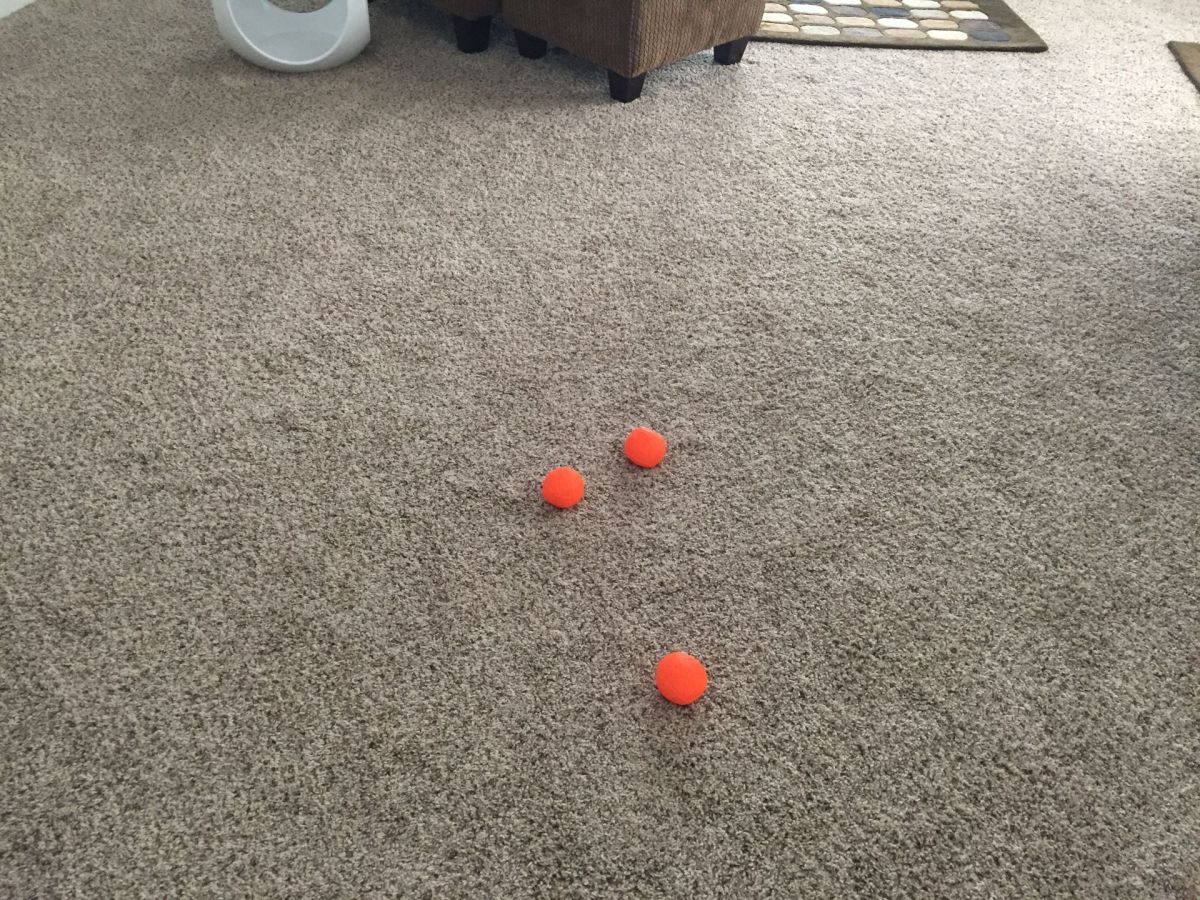
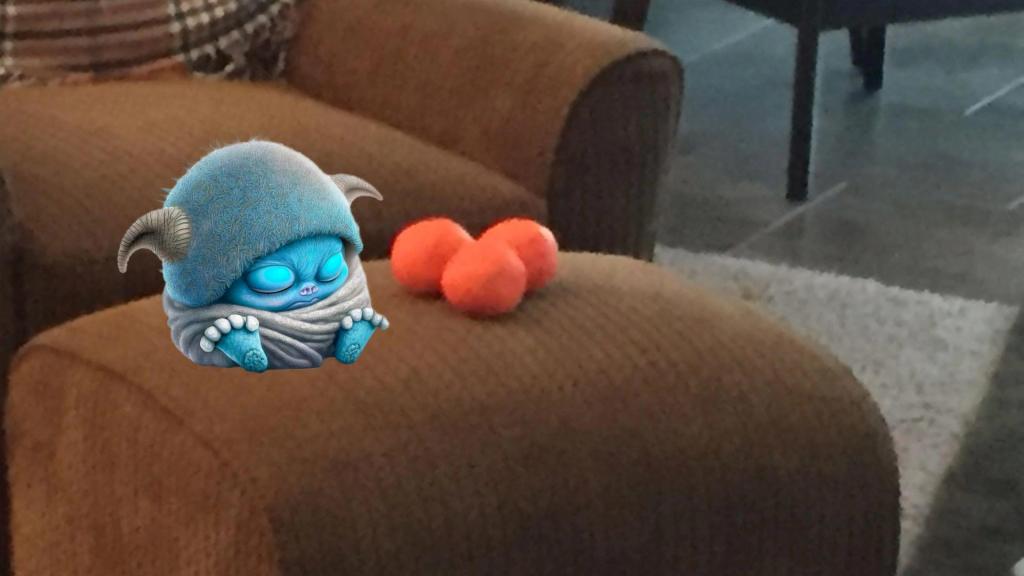
Sena has been letting her juggling balls take a nap lately. The reason is that she has been very busy in her garden. The balls are either on the floor where she drops them—or placed neatly on a footstool.
I left my assistant coach to encourage her to practice. Unfortunately, he’s been sleeping on the job.
However, last night she practiced because I could hear balls dropping!
Just about any time of year is a great opportunity to walk the Terry Trueblood Recreation Area. The birds are busy competing for mates and nesting spaces.
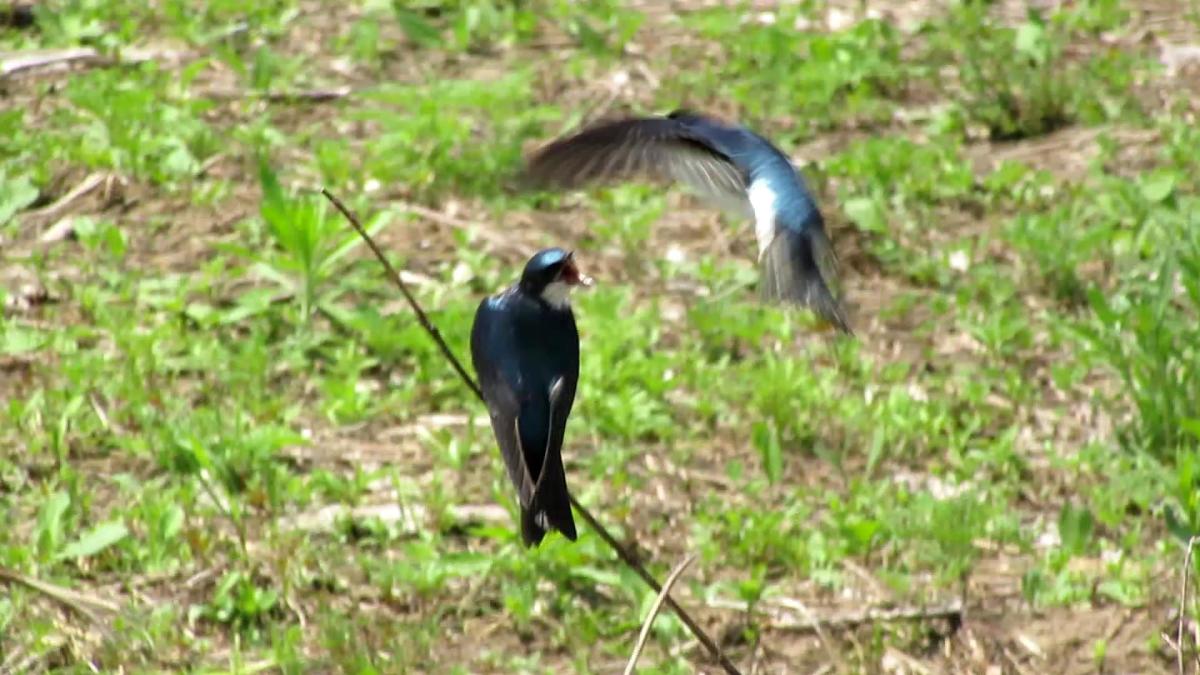
The nest boxes for the tree swallows are up. Already, vacancies are few. Their iridescent feathers are dazzling.
The music in the first part of the video is a piece called “There Are Chirping Birdies In My Soul” by Reed Mathis.
In the second part of the video, we let the birds themselves make the music. The birds don’t just show off; they sound off. All the birds are singing—except for the one killdeer for some reason. I managed to save a few clips of them singing their songs. They are in the last minute or so of the YouTube video. The first is the tree swallow. The next is the red-wing blackbird. Last is the song sparrow.
You’ll need to crank the volume to hear them. The tree swallows have a subtle trilling chirp. The male red-winged blackbirds have a distinctive call that probably sounds very familiar to most of us. We also saw and heard a song sparrow, a first for us.
We were bird watching the other day and saw a few birds we definitely recognized. One of them we puzzled about but finally decided was a sparrow.
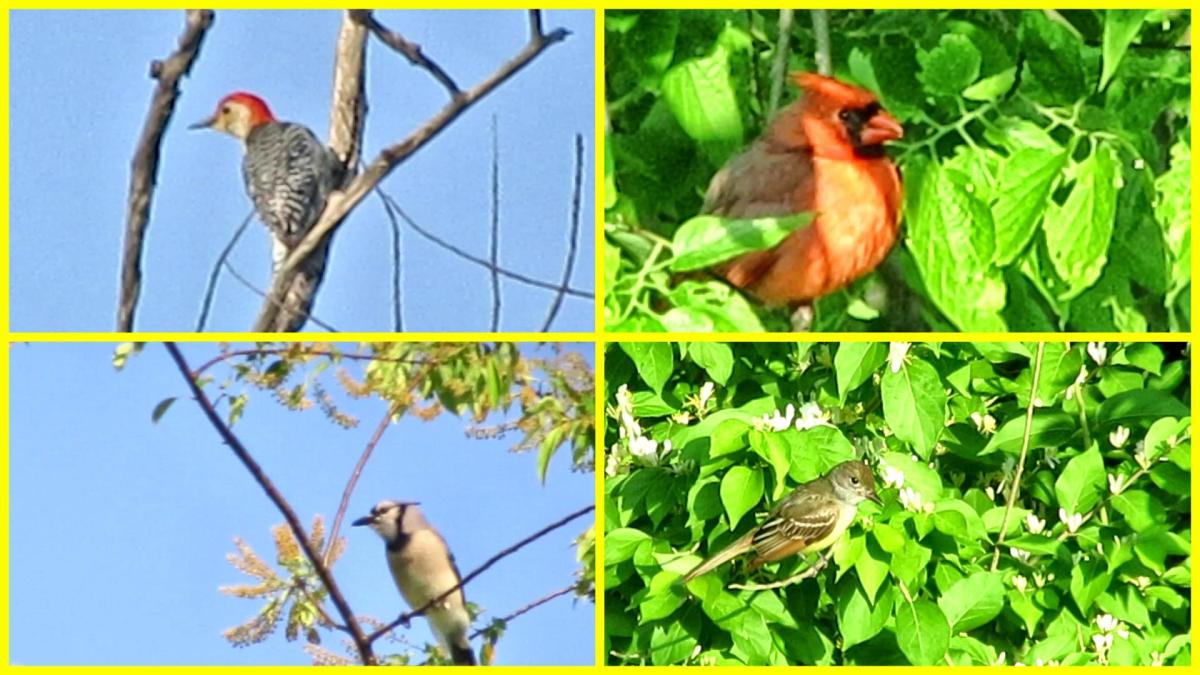
The Red-Bellied Woodpecker is familiar. We think it was a male. The Blue Jay is still interesting because when it’s not in the sunlight it looks like what it really is—a blackbird. When we first saw it, the bird looked sort of grayish black. Finally, it turned just right and its feather bent the light into the familiar blue color. The Northern Cardinal is instantly recognizable, especially the male. They like to sit a long time, which is great for getting pictures.
The last bird looks like a sparrow but the tail seems longer and the bill is narrower. The breast is not streaked. It has head feathers which stick up. It resembles a female house sparrow, but it seems a bit larger than that. We looked around the web to try and identify the sparrow-like bird we saw.
We wonder if it might be a Cassin’s Sparrow. Although it would be out of its range since it’s found mostly in the southwest United States, Cassin’s Sparrow has been known to wander.
On the other hand, it’s not listed on the websites we saw featuring sparrow species seen in Iowa.
I think the reason it had a greenish breast was because it was reflecting the surrounding tree leaves. We’re calling it a Cassin’s Sparrow for now, but if you know better, shout it out.



 Go Retire Psychiatrist