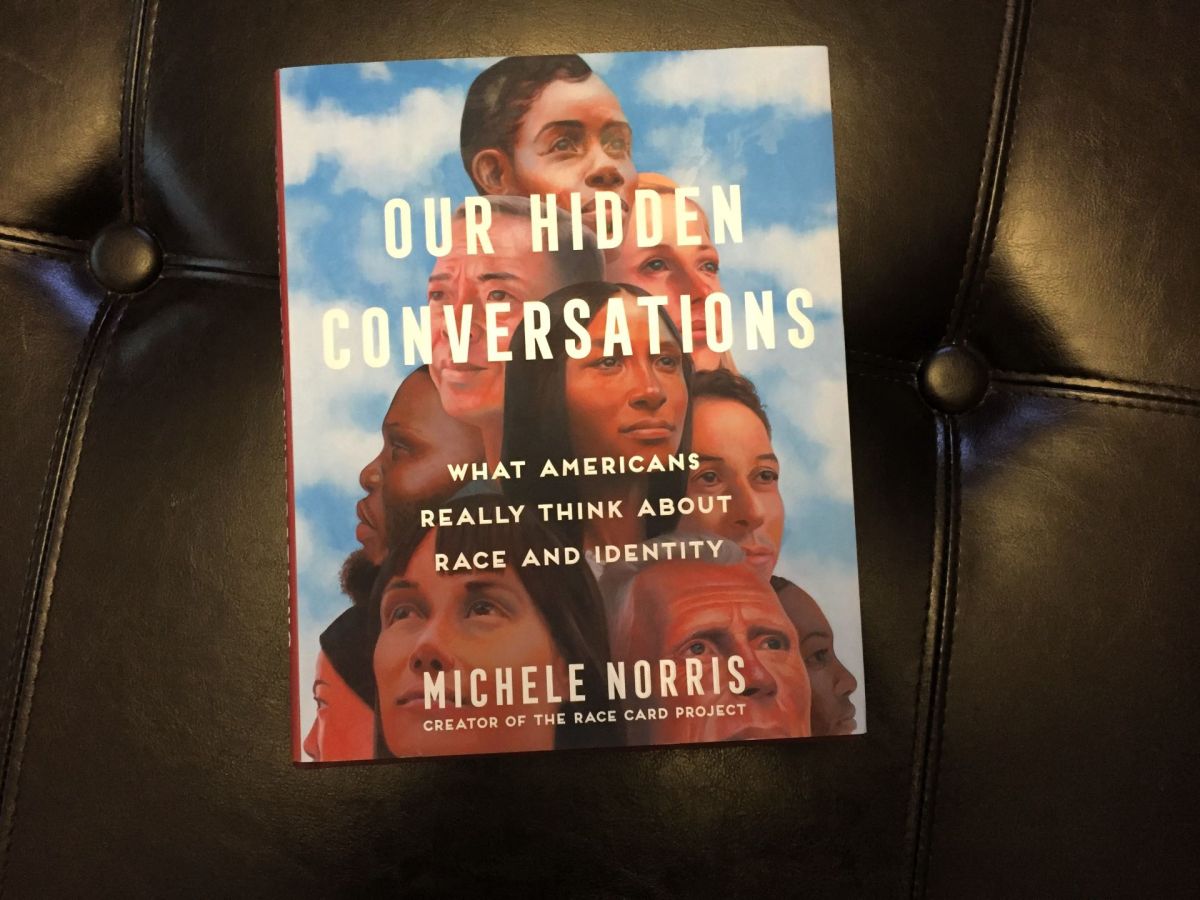
This is a short post about my initial impressions about the book, “Our Hidden Conversation” by Michele Norris.
I’m not finished with the book yet, but I thought I would let you know that the first chapter, “Bread Crumbs” was tough to read. I had to put it down and come back to it a few times because it brought back memories.
The chapter title “Bread Crumbs” means the clues that parents, grandparents, etc. might leave for subsequent generations to find which might shed light on one’s background, explain troubling circumstances, and so on.
I have some bread crumbs left to me by my family. Some are in the form of photos, although there is no family photo of all of us together.
I remember the hair combing routine my mom had with me and my brother every Sunday morning before church when we were kids. Our father was black and my mother was white. Dad was out of the home and we lived with mom. We were the only black kids in the church. In fact, all the members were white.
Mom used a prodigious amount of hair oil while vigorously combing our curly hair back. It took many strokes and the pulling pinched a bit. The ritual took a little while. When I look back on it, I guess the goal was to straighten our hair as much as possible.
Everyone in the church always treated us kindly and I was baptized there.
If you decide to read “Our Hidden Conversations,” give yourself a break whenever you feel like you need it.
I thought I would share a couple of ideas about the Czech composer Antonin Dvorak. I’m not a music expert by any stretch of the imagination, but I enjoy listening to classical music on the Music Choice Classical Masterpieces channel.
Music Choice always have interesting bits of biographical information about the musicians. The items about Dvorak are very interesting. For example, a couple of them mention that he had idiosyncrasies. One was that he stole all of the pencils at a place where he was supposed to be working because the pencils were “perfect for composing.” Another factoid is that he was fascinated with the trains in Prague and, in fact, had memorized the entire train schedule.
This makes me wonder if he was something more than eccentric and might have had some form of autism spectrum disorder (formerly Asperger’s Syndrome). On the other hand, I’ve always been a little suspicious of the Music Choice channel’s little biographical blurbs. I couldn’t verify from a quick internet search whether or not he had the disorder or not—and probably he didn’t.
On the other hand, Dvorak did visit Spillville, Iowa during the summer of 1893. There’s a short video which tells about his visit. One of the images shows a picture of a scarlet tanager, and the voice over mentions that Dvorak was often inspired by birdsong. In fact, there is an online reference to an anecdote about Dvorak basing one of his compositions, String Quartet in F major (op. 96, the ‘American’), on the song of a bird.
There was some controversy about whether it was more likely he based it on the song of the red-eyed vireo or that of a scarlet tanager. But after an extremely long article, the authors of the reference conclude that Dvorak’s composition was based on the song of the red-eyed vireo, which doesn’t resemble a scarlet tanager at all (McKone MJ, Beccue DA. The Iowa Bird That Inspired Antonín Dvořák’s American String Quartet in 1893: Controversy over the Species’ Identity and Why It Matters. Nineteenth-Century Music Review. 2021;18(3):521-537. doi:10.1017/S1479409820000282).
I’m an amateur bird-watcher and I’m pretty sure I’ve never heard or seen a red-eyed vireo. I have seen a scarlet tanager but I can’t remember what its song sounds like. I’m pretty sure Dvorak didn’t mistake either bird’s song with the well-known howl of Bigfoot, who may have been sneaking around Spillville, hunting for beef jerky.
Let’s see Music Choice channel try to add that to the anecdotes about Dvorak.
I was thinking about my time as a student at Huston-Tillotson University in the 1970s (then Huston-Tillotson College) and remembered somebody who was a student there. His name is James Spaights. In honor of his stature in music as it connects to the Black History Month theme of African Americans and the Arts, I just want to make special mention that Mr. Spaights is a concert pianist. I have not found his obituary (you know already about my habit of checking the obituaries) so I’m not going to talk about him in the past tense.
When I met him, Mr. Spaights was straightforward about his life goal, which was to be a concert pianist. Little did I know that he had already achieved that by the time I met him at H-TU.
He gave a fantastic performance for the faculty and students. I’m pretty sure we gave him a standing ovation.
I found some news clippings and other items about his career (unfortunately I couldn’t find recordings of his performances), which deserves to be better known. He was a member of the Alpha Phi Alpha Fraternity and a fraternity news letter shows his photo and bio in the 1977 issue of the SPHINX:
“Brother James Spaights, pianist, whom New York critics acclaimed “a virtuoso pianist and technician of the first rank” after his New York debut at Town Hall in 1965, was presented in concert on March 20, 1977 in Carnegie Hall, New York City, by the Behre Piano Associates of New York. Spaights is a former student of Madam Edwine Behre in New York City, also Freda Rosenblatt, Bronx, N.Y. and Emma Slutsky, Brooklyn, N.Y.
For three years Spaights served as Ambassador of Goodwill for the United States’ State Department as a concert pianist touring throughout Europe, parts of Canada, and the United States.
On his most recent United States tour, Spaights was presented by the Music Department at Morgan State College in Baltimore, Maryland, and Goddard College in Montpellian, Vermont.
Spaights holds his B.A. Degree in Music from Howard University and a Master of Arts Degree in Music from Columbia University. He is a member of the Lechetisky Association of America, The Behre Piano Association of New York, and a member of Gamma Eta Lambda Chapter of Alpha Phi Alpha Fraternity in Austin, Texas.
He is presently serving a post in the Music Department of Huston-Tillotson College of Austin, Texas.” (The SPHINX, Fall 1977, Volume 63, Number 3 197706303).
I guess I misunderstood what Mr. Spaights was doing at H-TU when I was an undergraduate there. I thought he was a student! He never mentioned his career or accomplishments (at least to me) and he had a great sense of humor. I was in the presence of a music luminary and never knew it.
Ref: The SPHINX Volume 63, Number 3, October 1977.
In the spirit Black History Month: African Americans and the Arts, Power and Impact is an exhibit of art work by notable Black artists in Iowa. It’s a partnership of the African American Museum of Iowa and the Cedar Rapids Museum of Art.
The exhibit runs between October 28, 2023 and March 31, 2024.
February is Black History Month and in 2024 the theme is African Americans and the Arts.
This reminds me of a blues artist I heard on KCCK on the Big Mo Blues Show last Friday. His name is Toronzo Cannon and his career as a blues guitarist and songwriter is skyrocketing. I heard his song “The Preacher, the Politician, and the Pimp.”
The lyrics reminded me of a character (or maybe more properly a non-character) called Rinehart in Ralph Ellison’s book, Invisible Man. I’m by no means an Ellison scholar but in chapter 23 the main narrator gets mistaken for a black guy named Rinehart who has many faces in the black community. He’s a preacher, a numbers runner, a pimp, and is also related to a political movement in the novel. Rinehart is all of them and none of them, moving between the “rind and heart” of who black people are in America. The implication is that the identity of black people is multifaceted and the similarity of the theme in Toronzo Cannon’s song is striking.
Cannon is also multifaceted. He’s a Blues guitar star and song writer and is also still a bus driver for the Chicago Transit Authority. How does he find time to do all that?
I wonder if Cannon got the idea for the song from Ellison’s novel. I guess I’ll never know.
This reminds me of an encounter I had with a black writer at Huston-Tillotson University (then Huston-Tillotson College, located in Austin, Texas) in the 1970s when I was an undergraduate in college. I’ve described this episode before in another post (“Black Psychiatrists in Iowa” 2019). The excerpt below includes a reference to a book review I wrote that was published in The American Journal of Psychiatry over 20 years ago:
“This reminds me of a book review I wrote for the American Journal of Psychiatry almost 20 years ago (Amos, J. (2000). Being Black in America Today: A multi perspective review of the problem. Am J Psychiatry, 157(5), 845-846.).”
The book was written by Norman Q Brill, M.D. It reminded me of my experience at Huston-Tillotson College (now Huston-Tillotson University, a private school, historically with largely Black enrollment) in Austin, Texas back in the 1970s. I wrote:
“Dr. Brill’s appraisal of many black leaders in chapters such as “Black Leaders in the Black Movement” and “Black Anti-Semitism” may be refreshingly frank in the opinion of some. He tailors his prose so as not to denounce openly those whom many would describe as demagogues. At the same time, it is apparent that his underlying message is that a substantial number of them are not only out of touch with mainstream black America but may even mislead black people into adopting ideological positions that impede rather than foster progress. Dr. Brill’s description of the issue reminded me of my own experience with this phenomenon as a freshman in the mid-1970s at a college of predominantly black enrollment in the southern United States. A guest lecturer (who, as I recall, had also written a book about being black in America) told us that the white man would never allow a black man to be a man in America. He had only three choices: he could be a clown, an athlete, or a noble savage. These corresponded to the prominent and often stereotyped roles that blacks typically held in entertainment, sports, and black churches.”
I was taken aback by the speaker’s judgment and asked him what my choice should then be. He was equally taken aback, I suspect. He advised me to be a clown.
The lyrics of Cannon’s song “The Preacher, The Politician, and the Pimp,” Ellison’s Rinehart, and another writer’s characterization of the roles allowed in American society for black men all resonate together. What drives the similarity of this perception across different artistic platforms?
When I reflect on how I’ve negotiated my life’s path over they years, I guess I would have to admit that I’ve often played the clown. Anyone can see that in the way my sense of humor comes across. Is it the healthiest way to respond to racism in this country? In terms of the psychological defense mechanisms, I think it’s a relatively mature strategy. You could argue with that by asking, “But where’s the maturity in dad jokes?”
Yesterday, I was thinking about Artie Hicks, one of my old English teachers at Huston-Tillotson University, which was Huston-Tillotson College back in the mid-1970s when I was a student there. I looked him up on the web, just out of curiosity—and found his obituary. That seems to happen a lot lately.
Anyway, he was a gifted teacher and had a great sense of humor. He bought tickets for the whole class to see the movie Harold and Maude, a ground-breaking film in those days. He had a simple and direct approach to talking with students. He always seemed comfortable in a place where white people (including teachers) were the minority—unlike the wider world outside the campus.
He was bald and the students called him Kojak, which was the name of the bald, tough detective star (played by Telly Savalas) of the TV crime drama which aired on CBS from 1973 to 1978.
I think you could have called Artie tough as well; not bad guy tough but honest and direct.
The frigid weather has led to updates in the events for the MLK Celebration. Among them is the postponement of the Unity March and Community-wide Celebration. This is planned for February.
I noticed that Iowa City and Huston-Tillotson University in Austin, Texas have a couple of things in common regarding the celebration of the Martin Luther King holiday this week—one is inclement weather. The other thing is hope for peace and unity.
I was a student at Huston-Tillotson (one of the HBCUs) back in the 1970s. I saw it snow there once. It turns out that one of the MLK events will be postponed to January 27, 2024, and that’s the Austin MLK March. It’ll be too cold, with a chance for freezing rain. The event is billed as the MLK CommUnity March. The MLK Festival and Food Drive has been rescheduled to January 27th as well, and that will be at Huston-Tillotson University. The emphasis is on unity.
In Iowa City, the MLK Peace March on January 15, 2024 will instead be a vehicular parade because of the really cold weather we’ve been having recently. The emphasis is on peace. The parade will start at 9:30 AM.
All of my life I’ve admired Dr. Martin Luther King for his efforts to unite everyone in peace. Despite the world’s current events, I still have hope that the effort will continue.
We all have a lot in common, and it’s not just the weather.