Further Thoughts on Ray Bradbury’s Short Story, “I See You Never”

This is an update to my post from lasts night on Ray Bradbury’s short story, “I See You Never.” My wife, Sena, happened to mention the naturalization process in the U.S. today.

In fact, we both saw the televised naturalization ceremony at the Iowa State Fair of 2024. During that ceremony, 47 children became citizens. In fact, the U.S. Citizenship and Immigration Services has held a celebratory naturalization ceremony at the Iowa State Fair for at least the last ten years.

There was just such a ceremony last month of 69 immigrants at the University of Northern Iowa.

I had a quick peek at the U.S. citizenship and civics test questions and I’m pretty sure I would have a lot of trouble passing it. I’d probably get shipped back to Mars—which Ray Bradbury wrote a lot about.

The naturalization process isn’t easy. Under federal law, you have to live here in the U.S. at least five years as a lawful permanent resident to be eligible for naturalization, three years if you’re the spouse of a U.S. citizen. You have to learn the language. Many other countries have a similar naturalization process.

There’s no exact number of the USCIS naturalization ceremonies per year, but 818,500 took part in 2024.

Many of those who go through the naturalization process think it’s unfair for others to bypass it by getting into the country by other means.

So, I guess that’s the other side of the short story—the one Ray Bradbury probably didn’t write.

May Mental Health Awareness Month Calendar and Checklist (look below this sticky post for other new posts)

Do We See Each Other?

I know that what I’m writing here this evening is going to sound foolishly sentimental and maybe even a little spooky, but I was struck by this weird experience I had tonight. It was just a little odd and too fortuitous. I’m not going to talk at any length about the politics of it, just the strangeness.

We have these two books by Ray Bradbury, and when I was a kid, I loved his science fiction stories. I read many of them, but never like the one I read tonight.

The way this started was I was looking for something to do. I thought about watching old reruns of The Red Green Show on YouTube, which always struck me as funny when I watched them long ago. I still do, but couldn’t get into it tonight.

I turned on the TV and flipped through the channels which, as always, were reruns. I was not even interested in the X-Files reruns and I’m a fan.  And I couldn’t stand the thought of seeing any more in-your-face commercials about total body deodorant.

So, I picked up the hefty paperback of a big collection of a hundred of Ray Bradbury’s short stories, entitled oddly enough, “Bradbury Stories.” I just opened up the book with no particular story in mind and it fell open right to one I’d never read before, “I See you Never.”

It’s all of 3 pages long and it’s about a Mexican immigrant named Mr. Ramirez. He’s been brought by the police to the front door of the rooming house where he’s been living on a temporary visa, which has been revoked. He’s just there to say goodbye to his landlady. He’s being deported and has this sad conversation with her on the doorstep. He just keeps telling her in broken English, “I see you never.” The landlady, Mrs. O’Brian (no accident she has an Irish name, of course) just says repeatedly that he’s been a good tenant and that she’s sorry. Then he leaves with the police. She goes back inside and can’t finish her dinner with her family and realizes she’ll never see Mr. Ramirez again.

There’s a much better summary and analysis than mine written by a professional reviewer. This story was published back in 1947 and is set in the historical context of post WWII America.

I hate politics, and I’m not going to say anything specific about how this little story struck me with its irony given what’s going on this country right now. I was just looking for a little science fiction distraction and instead got irony. I didn’t go looking for this and I’ll be brutally frank—I actively avoid political news and I hate like hell to get reminded of it every day. All I did was open a damn book. I wish I had never seen this story.

I guess maybe that’s what I get for my avoidant approach to certain things. How’s that for a Mental Health Awareness month event?

May is Mental Health Awareness Month!

This is May and it’s Mental Health Awareness Month. I just found out about something exciting and it’s the Iowa Healthiest State Initiative.

See the Calendar of Events and the Checklist.

Procrastinate on Getting the Covid Vaccine?

This post is sort of my thinking out loud about whether or not I should get the Covid vaccine ahead of this summer that was approved last year as being appropriate to get twice a year by the CDC—once in the fall along with the flu shot and once to protect against the Covid summer surge that some experts argue has been happening every summer since the pandemic onset.

The trouble is that the dominant subvariant is no longer the JN.1 or KP.3.11. The currently dominant circulating bug is LP.8.1 according to the CDC Nowcast chart.

And what confuses me is that one expert still recommends getting the September 2023 updated vaccine, but recommends getting the “bivalent booster.”

And a recent article from the University of Minnesota Center for Infectious Disease Research and Policy (CIDRAP) says that a preprint study (not yet peer-reviewed) says the current Covid vaccine was only 53% effective against hospitalization and 39% medically attended Covid-19. Most patients got the vaccine targeting the XBB.1.5 variant. I think that’s related somehow to the KP.2 variant. I have a vague memory of hearing about the XBB.1.5 during the CDC meeting in September 2023.

I’m a retired psychiatrist, not a retired virologist. The information available to the public seems confusing to me and I imagine I’m not the only one so affected.

The CDC is recommending the 2024-2025 Covid-19 vaccines, which target the JN.1 variant, which is now 0% of circulating variants on the list. But I’m not sure whether the current vaccines would be as protective against the different variants now dominant.

The CDC April indicators show downward trends for test positivity, ER visits, hospitalizations, and deaths.

On the other hand, an August 2024 article from Johns Hopkins warns that Covid-19 rates have consistently risen in July-August risen since 2020. The author says that it’s still unclear whether Covid-19 will continue to have dual seasonality. Other factors that affect this in addition to the emergence of more transmissible variants are human behavior, such as staying in air-conditioned spaces more and traveling.

My big question is should an old guy get the 2024-2025 Covid-19 vaccine or just wait and see, especially in light of the difficult political situation with HHS sounding like it might require new, placebo-controlled trials of some vaccines before “tweaking” them to target more current variants—which could take several months.

But it doesn’t look like there’s a plan to tweak the 2024-2025 Covid-19 vaccine in any case. I’m probably worrying too much, but I’m on the fence. I’m already too good at procrastinating.

Fart Around for Your Health!

How many farts can old fart fart if an old fart walks to fart? I’m sure you’ve heard that one by now after a recent news article suggested that farting while going for a walk on the street after dinner (or any meal) could make you healthier.

It’s not like the only reason is that you get rid of gas and increase intestinal motility to prevent constipation. Some medical experts say it can help control blood sugar.

But you have to fart walk within an hour of finishing a meal to control the glucose spike. You could call it the fart walk sweet spot. There are social implications, especially if the fart walk becomes a growing trend.

What the heck should you wear on fart walks? Windbreakers.

For some reason, Artificial Intelligence (AI) has a lot to say about flatulence, but I usually pass gas over it to move on to other websites to find what might be more reliable information than you get from AI.

While farting a couple dozen times a day can be normal, if you can’t leave your house because of your Frequency Of Odoriferous Farting Impulse (FOOFI), you might want get it checked out.

Eating a lot of fiber-rich foods can lead to digestive problems that can lead to excessive flatulence. Have you noticed that when you’re in a crowd, people tend to sprint away from you? When you’re in an elevator, do people push any button to get off, even if it’s in the basement, or even between floors?

By the way, did you hear about the guy who farted on an elevator? It was wrong on so many levels.

The food choice thing can be the downside of what often happens when you follow the advice of health care professionals who tell you to avoid carbs and eat more fruits and vegetable. This can happen to guys who hit middle age and start to get that big belly. I’m not sure that the diet change will help much, especially since new studies show that guys can produce more belly fat cells as they get older.

What do you call a large, hairy cryptid who eats too much beef jerky? Bigfart.

Certain diseases can be linked to farting, like irritable bowel syndrome, celiac disease, bowel obstruction, and constipation. Funny, I thought farting was supposed to prevent constipation.

What do you say to someone who has made a commitment to daily fart walks? Conflatulations!

Earth Day Trees and Other Thoughts

Today is designated Earth Day although there is such a thing as Earth Month. Among the several trees Sena planted in our back yard trees are a few that we hope exemplify the Earth Day theme, which is Our Power, Our Planet.

One of them is a dogwood, which we’re hoping will bloom soon. Dogwoods represent joy and rebirth. There are a couple of crab apple trees, a red jewel and a perfect purple. Crab apple trees represent love and all are very special to Sena and me.

Love, joy, and rebirth. They can all be linked to power, which can be the power of will. The will to respect the planet also implies respecting each other. Practicing humility can be a kind of power.

The power to be still and listen to each other can make us more open to change.

On that note, because I can’t go for long without joking around, I should retell the story about me and the walking dead meditation. About 13 years ago, I had an even more serious case of not listening to others than I do now, if you can believe that. It eventually led to my choosing to take the Mindfulness Based Stress Reduction (MBSR) class ( see this current University of Iowa mindfulness essay). I wrote an essay for the Gold Foundation and it’s still available (I updated the links):

How I left the walking dead for the walking dead meditation (August 13, 2014)

When I was awarded the Leonard Tow Humanism in Medicine Award in 2007, I was the last person I thought would ever suffer from physician burnout. Early in my career I had won several teaching awards and had even edited a 2006 Psychiatric Times Special Report on Stress.

About a year or so later, I bought Jon Kabat-Zinn’s book on Mindfulness-Based Stress Reduction (MBSR), Full Catastrophe Living, because I was dimly aware of the burden of stress weighing on me as a consulting psychiatrist in an academic medical center. I didn’t get much out of Kabat-Zinn’s book on my first read. But then in 2012 I started getting feedback from colleagues and trainees indicating they noticed I was edgy, even angry, and it was time for a change.

Until then, I’d barely noticed the problem. Like most physicians, I had driven on autopilot from medical school onward.  I had called myself “passionate” and “direct.” I had argued there were plenty of problems with the “system” that would frustrate any doctor. I had thought to myself that something had to change, but I never thought it was me.

After reflecting on the feedback from my colleagues and students, I enrolled in our university’s 8 week group MBSR program. Our teacher debunked myths about mindfulness, one of which is that it involves tuning out stress by relaxing. In reality, mindfulness actually entails tuning in to what hurts as well as what soothes. I was glad to learn that mindfulness is not about passivity.

But I kept thinking of Kabat-Zinn’s book, in which he described a form of meditation called “crazy walking.” It involved class members all walking very quickly, sometimes with their eyes closed, even backwards, and crashing into each other like billiard balls.  I hoped our instructor would not make me “crazy walk” because it sounded so—crazy. I dreaded crazy walking so intensely that I considered not attending the 6-hour retreat where it might occur.

We didn’t do crazy walking. Instead, we did what’s called the “walking meditation.” Imagine a very slow and deliberate gait, paying minute attention to each footfall—so much so that we were often off balance, close to crashing into each other like billiard balls.

I prefer to call this exercise the “walking dead meditation” because it bore a strong resemblance to the way zombies move. One member of the class mentioned it when we were finally permitted to speak (except for the last 20 minutes or so, the retreat had to be conducted in utter silence). It turned out we had all noticed the same thing!

Before MBSR, I was like the walking dead.  I was on autopilot — going through the motions, resisting inevitable frustrations, avoiding unstoppable feelings, always lost in the story of injustices perpetrated by others and the health care system.

In practicing mindfulness, I began noticing when my brow and my gut were knotted, and why. Just paying attention helped me change from simply reacting to pressures to responding more skillfully, including the systems challenges which contribute to burnout. About halfway through the program, I noticed that the metaphor connecting flexibility in floor yoga to flexibility in solving real life problems worked.

Others noticed the change in me. My professional and personal relationships became less strained. My students learned from my un-mindfulness as well as my mindfulness, a contrast that would not have existed without MBSR.

As my instructor had forewarned, it was easy for me to say I didn’t have time to practice meditation. I had to make the time for it, and I value the practice so much that I’ll keep on making the time. I will probably never again do the walking dead meditation.

But I’m no longer one of the walking dead.

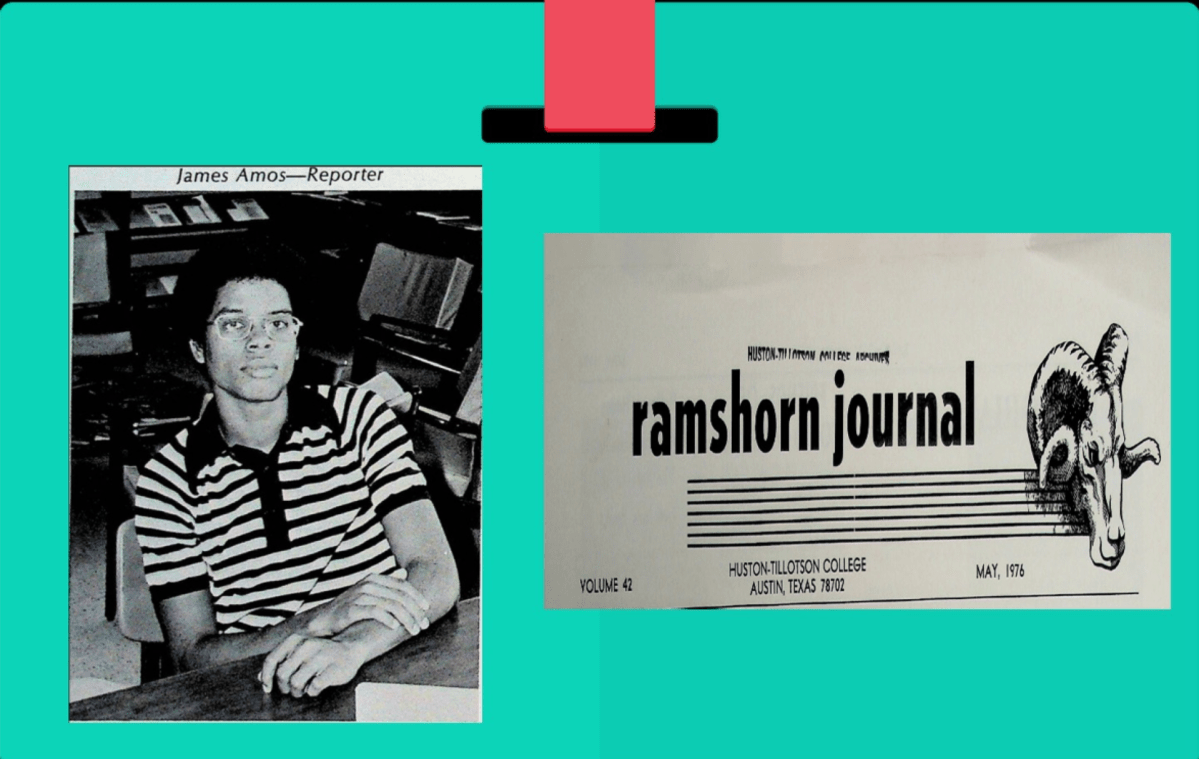
This post was written by Dr. James J. Amos, Clinical Professor of Psychiatry in the UI Carver College of Medicine at The University of Iowa in Iowa City, Iowa. He has co-edited a practical book about consultation psychiatry with Dr. Robert G. Robinson entitled Psychosomatic Medicine: An Introduction to Consultation-Liaison Psychiatry. As a clinician educator, among Dr. Amos’s most treasured achievements is the Leonard Tow Humanism in Medicine Award. He blogs at https://retirepsychiatrist.com/

Below was my acceptance speech for the award:

Today we gather to reward a sort of irony.  We reward this quality of humanism by giving special recognition to those who might wonder why we make this special effort. Those we honor in this fashion are often abashed and puzzled. They often don’t appear to be making any special effort at being compassionate, respectful, honest, and empathic. And rewards in society are frequently reserved for those who appear to be intensely competitive, even driven.

There is an irony inherent in giving special recognition to those who are not seeking self-aggrandizement. For these, altruism is its own reward. This is often learned only after many years—but our honorees are young. They learned the reward of giving, of service, of sacrifice. The irony is that after one has given up the self in order to give back to others (family, patients, society), after all the ultimate reward—some duty for one to accept thanks in a tangible way remains.

One may ask, why do this? One answer might be that we water what we want to grow. We say to the honorees that we know that what we cherish and respect here today—was not natural for you. You are always giving up something to gain and regain this measure of equanimity, altruism, trust. You mourn the loss privately and no one can deny that to grieve is to suffer.

But what others see is how well you choose.

I’m still practicing mindfulness-more or less. Nobody’s perfect. We hope the dogwood tree blooms soon.

One Legged Clowning Again

I noticed the other day that I was having trouble doing the one leg stand. It has been getting harder to sustain it past 10 seconds even. It’s not like I’ve been laying off exercising, including the one leg stand. Hey, I can even do a one leg sit to stand (barely). I posted about the one leg stand, including a video, about 2 years ago.

I found another news item and study about old farts like me and it included a new recommendation about the one leg stand. According to this study, if you can’t do a one leg stand for more than 5 seconds, you’ve got one leg in the grave. If you can do 30 seconds, then you’re all good.

So, I practiced a little more and I even tried the one leg juggling trick, which I also tried two years ago—and clearly faked on a video. Well, one leg clowning is back—and this time it’s for real. I think the Latin quote Ars Longa, Vita Brevis fits for this activity. This one leg stand thing is a skill and you have to work at it, even as you age and your life grows shorter.

I still don’t know if this would be called aging gracefully?

References:

Rezaei A, Bhat SG, Cheng CH, Pignolo RJ, Lu L, Kaufman KR. Age-related changes in gait, balance, and strength parameters: A cross-sectional study. PLoS One. 2024 Oct 23;19(10):e0310764. doi: 10.1371/journal.pone.0310764. PMID: 39441815; PMCID: PMC11498712.

Araujo CG, de Souza E Silva CG, Laukkanen JA, Fiatarone Singh M, Kunutsor SK, Myers J, Franca JF, Castro CL. Successful 10-second one-legged stance performance predicts survival in middle-aged and older individuals. Br J Sports Med. 2022 Sep;56(17):975-980. doi: 10.1136/bjsports-2021-105360. Epub 2022 Jun 21. PMID: 35728834.

CDC ACIP Meeting Today on Vaccines

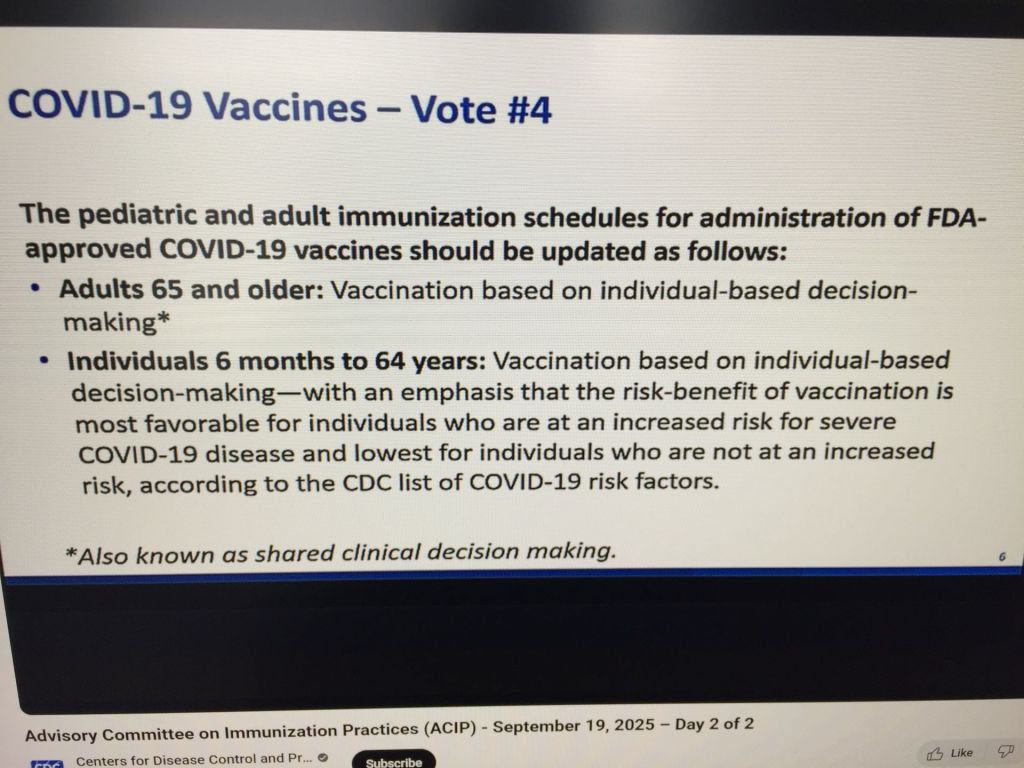
There’s a CDC ACIP Meeting scheduled to start at 8:00 AM EST today (caught me off guard). The slides are here.

Noteworthy: Dr. Denise Jamieson, MD, MPH is chair of the CMV Working Group. She is Vice President for Medical Affairs and the Tyrone D. Artz Dean, Roy J. and Lucille A. Carver College of Medicine at University of Iowa. In the Q&A session following the Covid-19 vaccine presentation, Dr. Jamieson expressed a preference for a universal recommendation (citing implementation and uptake challenges, which other attendees mentioned as well) for the Covid-19 vaccine as opposed to a risk-based or permissive recommendation. See slide labeled “Discussion” below:

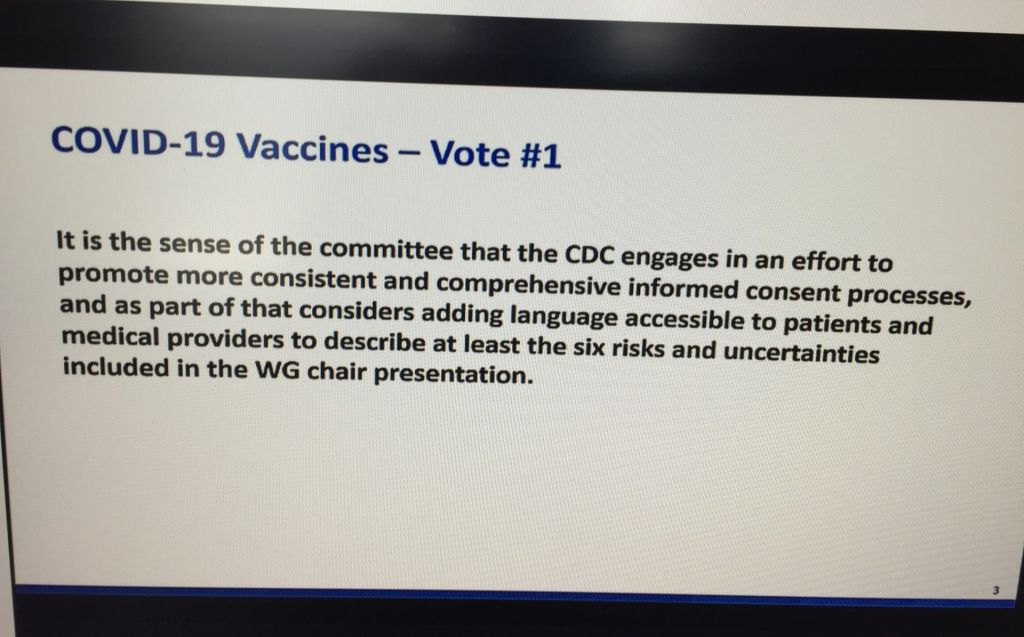
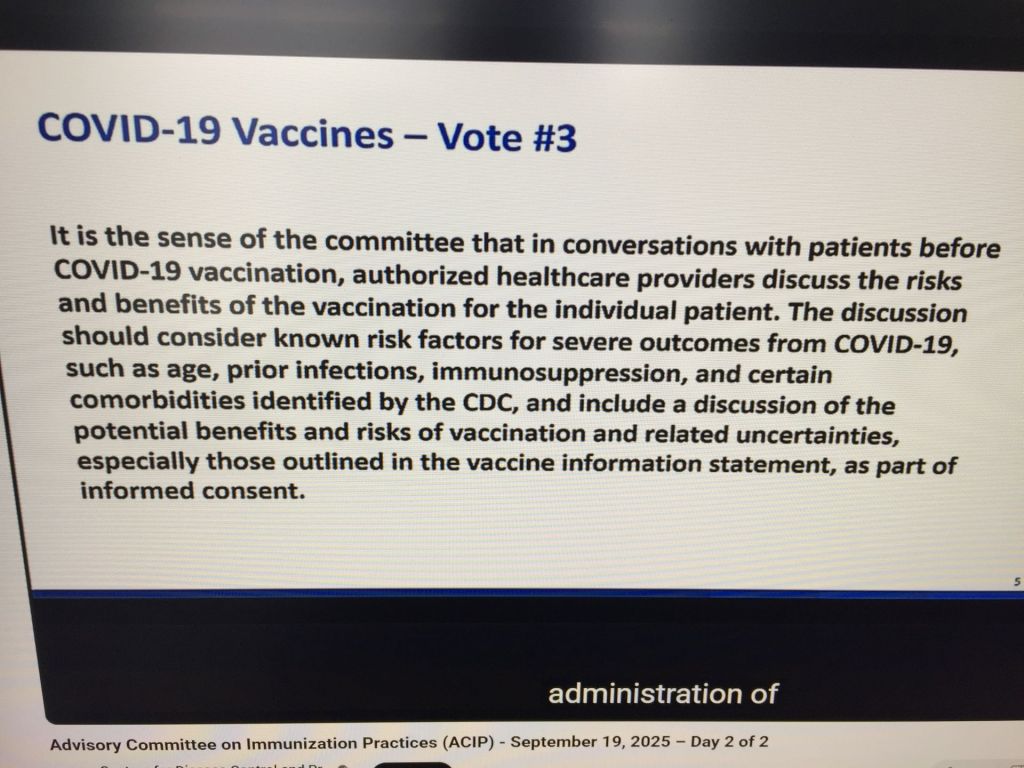
There was no vote scheduled for today’s meeting on the Covid-19 vaccine.

The presentation by Moderna on the new Covid-19 vaccine, mRNA-1283, was helpful. I gather there will be an FDA meeting about it in June.

Why Did China Tell President Trump His Tariff Strategy is a Joke?

The title of this post, which is admittedly the lead-in to a lame joke, is inspired partly by the news headlines today and partly by an essay, “Laughter: Better Than a Sharp Stick in Your Eye,” I found on The University of Iowa’s Well-Being at Iowa website. The author, Megan Gogerty, MFA, BA has some pretty sharp opinions about laughter being the best medicine. It’s not always the best.

Anyway, Reuters carried the story “China raises duties on US goods to 125%, calls Trump tariff hikes a ‘joke’,” by Joe Cash and Yukun Zhang, accessed April 11, 2025.

China is pretty upset. So, why did China tell President Trump his tariff strategy is a joke? Because they don’t get it.

Just half-kidding there; actually, I think that might be President Trump’s reply, but I really don’t understand tariffs. That’s probably why I also had trouble with the economist joke below:

Why did the Keynesian psychiatrist get fired? He told his patients to spend their way out of depression.

I found this joke on a YouTube by Jacob Clifford, an economics teacher. I didn’t get the joke, so I repeatedly replayed it because I couldn’t understand the first part. That’s because I didn’t know anything about Keynesian economics. It turns out that it’s based on the belief that proactive actions from the government (like spending) are the only way to control the economy. Get it? Neither do I but it was the only economy joke I could find that included a psychiatrist on a quick internet search.

Here’s twenty economics jokes from Jacob Clifford. They’re pretty lame, but then so is most of the political news.