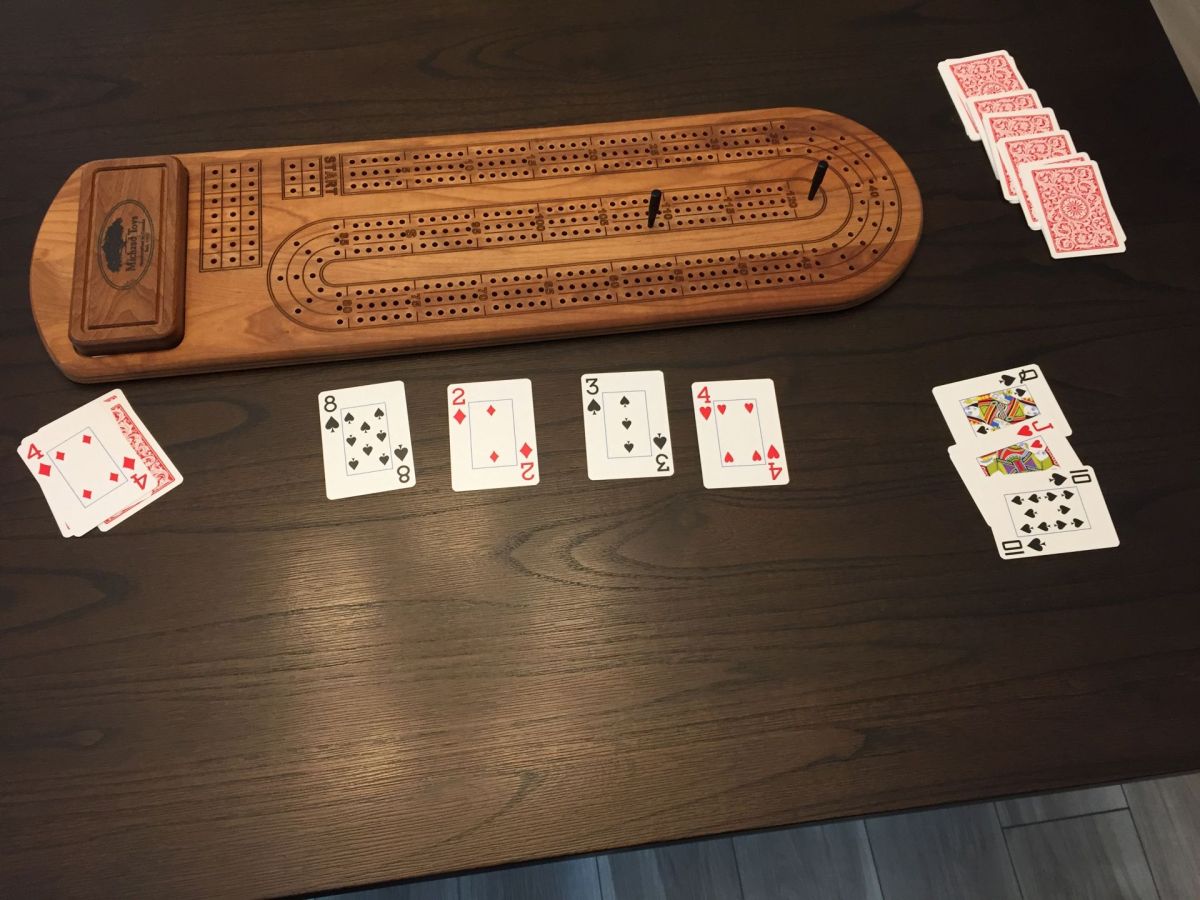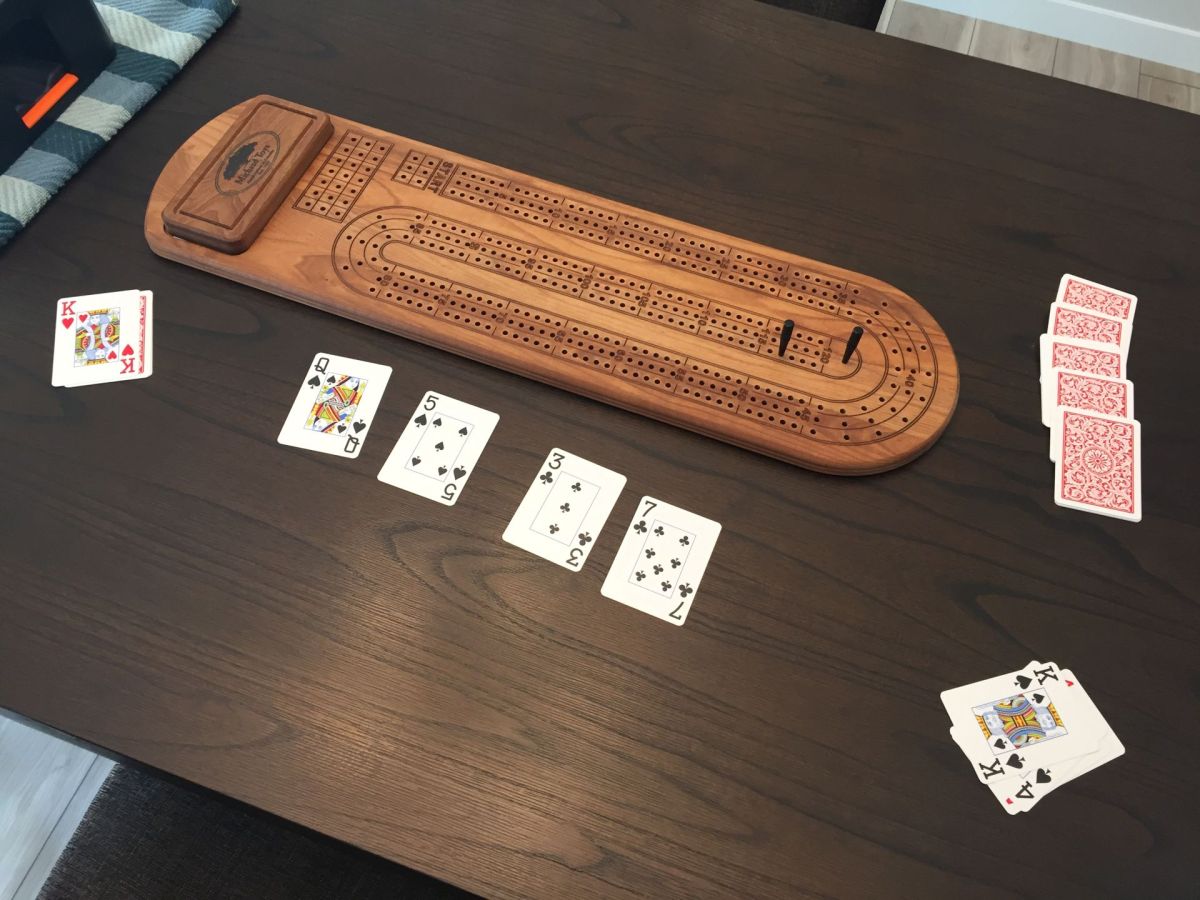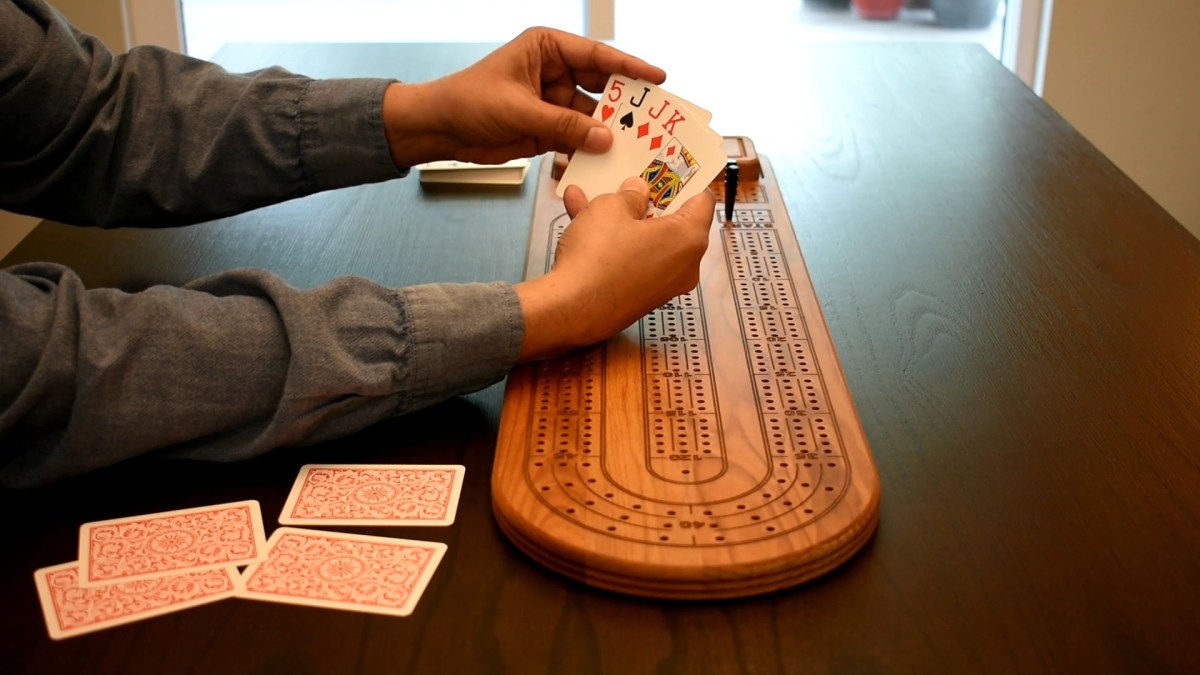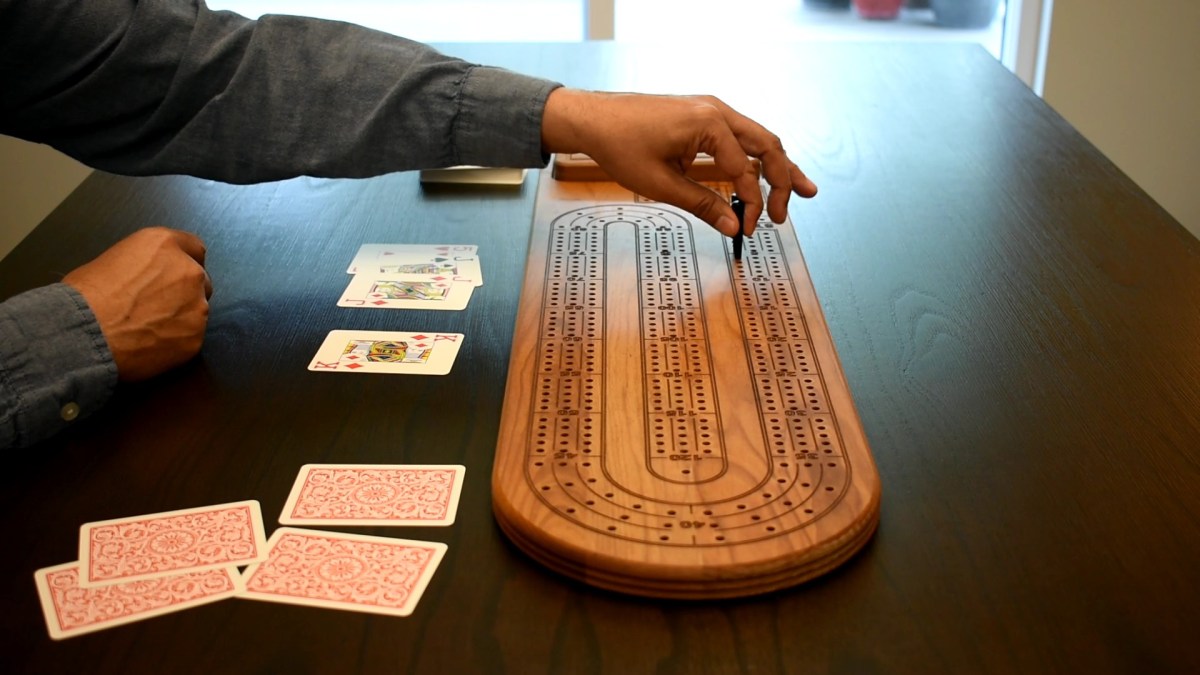
Cribbage for Turtles!

We’re still turtles when it comes to how long we take to play a cribbage game. And, I think I misjudged how randomization works with shuffling cards using a machine. I checked on line and various sources say, in general, whether you’re manually shuffling or using an automatic shuffling machine, adequate randomization of 52 cards would require shuffling seven times.

We experimented a little using a stopwatch. I can shuffle a deck in about 10 seconds using one table shuffle riffle and cuts. Sena probably takes about the same amount of time although she uses a different manual shuffling method (overhand, riffle). Rounding the numbers, shuffling 7 times would take about one minute and over 10 deals (one game), it would use up about 10 minutes or so.

The automatic shuffling machine takes about 5 seconds to shuffle a deck and doing that 7 times would take 35 seconds. Over 10 deals this would take up about 6 minutes. You can see it in action in our YouTube video, “Cribbage Meets Card Shuffler.”

We also ran the 24 face cards through the machine and it didn’t randomize them at all. Adding more cards didn’t improve it that much. It occasionally jams, but overall, it seems to do the job when you’re playing with a full deck—although I’m now skeptical that it does any better at randomizing cards than manual shuffling. And that probably accounts for the recommendation to shuffle seven times—by machine or manual methods.

This imposes an incentive for the tournament cribbage player to cut the time out of certain phases of the game. That’s because of the rule that you need to be able to play a cribbage game in 15 minutes. We wonder if experienced players might skimp on the shuffling phase.

For reference, the American Cribbage Congress (ACC) official rules about proper mixing of the cards (sec. 2.1) says:

2.1. Proper Mixing The pack must be mixed or shuffled at least three times (including mechanical card shufflers) with the cards face down or otherwise hidden from both players. The shuffler is not permitted to look at the bottom card after the last shuffle. If the shuffler should do so, the nonshuffler is to remind the shuffler of the prohibition and score a two-point penalty. The pack shall then be reshuffled by the offender.

What’s interesting about this is that it looks like the ACC allows automatic card shufflers, which made me wonder about whether mufflers are required. Ours makes a real racket. Note that a table riffle would work well to hide the numbers sides of the cards. It’s also clear you have to shuffle at least three times.

We’ve never been to a cribbage tournament so we don’t know how this works in actual practice. Let’s suppose that the strict 15-minute game time limit is the main rule and players shuffle three times. Then using a machine would take up only 3 minutes and manual shuffling would take up 5 minutes—if you’re not that concerned about randomization.  

Manual shuffling means a tournament player might have 10 minutes for actual game play, so there could be an incentive to use a machine. On the other hand, experienced cribbage tournament players probably play every phase of the game very fast.

We take about 20 minutes to play a game regardless of whether we shuffle manually or with a machine. That’s how turtles roll.

The Automatic Card Shuffler for Cribbage!

Today we used the automated card shuffler Sena ordered. I couldn’t find a company name or anything else from the box about where it’s made. We know it’s loud, but it does the job.

We’re not sure why it’s so noisy. It sounds like a bunch of pots and pans falling out of the cupboard during a tornado.

It was our first time using it and, while it felt like it was faster, it probably wasn’t according to my stopwatch. It took 22 minutes for us to play a cribbage game and manual shuffling took 25 minutes the other day (Big Time Bigfoot Cribbage Game). On the other hand, I think it randomizes the cards better than we do manually.

We kept starting to shuffle manually just because we’re so accustomed to doing it. It actually isn’t hard to set the cards into the feeder on top of the machine. In fact, you don’t have to be fussy about squaring up the deck before placing it in the shuffler. It’ll also shuffle two decks at once. It came with a charging cord so you don’t need batteries.

I don’t know if the American Cribbage Congress (ACC) allows automatic card shufflers in tournaments. I’ve never entered a tournament, but in photos the players are packed in cheek by jowl. And if you had one as noisy as ours for thousands of players, the din might be loud enough to set off alarms.

Cribbage Drips Under Pressure

Today we played cribbage under pressure—time pressure that is. We tried it because we wondered about why, in tournament games, you always hear you should be able to play a game in 15 minutes. The American Cribbage Congress (ACC) has over 200 local grassroots cribbage clubs across North America. If you join one of them, you generally have to learn how to play a cribbage game in 15 minutes.

Most clubs have you play 9 other players during regular meetings, which typically last about two and a half to three hours.  I’m sure the practical time range is closer to somewhere between 15-20 minutes, but the driver to keep it shorter is that tournament organizers have to accommodate a large number of entrants. I’m not sure how much you can socialize during meetings. We had to cut the chit chat and focus on the cards.

We’re used to playing at a leisurely pace, chatting and dawdling. Usually, we take about 25 minutes to play a game—sometimes longer. But under time pressure, all phases of the game got more difficult to manage.

We kept getting stuck on certain phases of the game. We probably didn’t throw to the crib as well as we’d like because we felt so pressured to stay under the time limit. I’m sure we made counting and scoring mistakes in both the pegging and scoring phases.

We played 4 games and could play in 15 minutes and 36 seconds in only one of them. It seems like the average for us was somewhere in between 15 and 20 minutes. I used the stopwatch on my cell phone.

Oddly, the second time we tried to play faster led to the fastest time, which was just over 15 minutes as noted above. But each time we played, the longer times got; the first game was around 20 minutes, the next one after that was about 15 minutes; the next was a little over 16 and the next one after that was closer to 17 minutes.

I think fatigue from the pressure got to us. However, I wonder if we just practiced a little more, whether the jitteriness from the sense of pressure would ease because we’d eventually get better at scoring the less common hand and crib scores. Would an expert tell us that? By the way, do you know what the definition of an expert is? A retired drip under pressure.

I gave up on the idea of shuffling 2-3 times each hand and just did it once—which didn’t really seem to improve our times. We’re supposed to get our card shuffling machine tomorrow. I wonder if using that would speed things up or slow us down.

The other point to make is that we usually help each other score and count when we play cribbage. Well, that’s not what tournament players do. You sweat it out and if you make a mistake, your opponent can’t help you. And don’t get me started on the muggins rule. Talk about pressure.

Maybe the answer is to have a fresh deck of cards which don’t stick to each other from the snack foods you eat while playing cribbage just for fun. And don’t talk, joke, laugh, or shuffle too many times, and remember luck is part of the game. Skill can take you just so far. It’s kind of like life. Somebody called cribbage a “finicky game.” OK, so it was Barry Rigal, who’s famous for being a bridge player and edited the book Card Games for Dummies.

So, explain why cribbage players, who I’m guessing are among the most finicky people on the planet, can deal with the pressure of a card game with a lot of finicky rules but manage to play a cribbage game in 15 minutes?

If you’re a cribbage player, we’d love to hear your answers. No pressure.

Big Time Bigfoot Cribbage Game!

Yesterday, Sena and I had a major cribbage showdown on the Bigfoot cribbage board. It took a little practice to get used to it because we generally use the long board. Aside from the usual hiccups figuring out scores, I did a fair job of keeping up for a while.

However; Sena won. She plays a smart game and I didn’t have the time to crack any Bigfoot jokes during the filming of the full game. We’re not tournament players so we took over 25 minutes to play one game. It was fun, though.

Sena ordered a card shuffler machine, and we’ll see how much time that shaves off playing a game. Probably not much although the maker advertises that it shuffles in less than 2 seconds. I don’t think tournaments allow shuffling machines.

Except for the length of the video, I think what it has going for it is the demo of how the game is played.

And on to the important stuff—a couple of Bigfoot jokes:

Do you know why Bigfoot is so good at hiding? He owes money to Chuck Norris.

Bigfoot claims he saw Chuck Norris once, but nobody believed him.

The reason nobody sees Bigfoot is because Chuck Norris found him first.

Bigfoot thinks Chuck Norris is a myth.

Learning to Play Cribbage from the Internet

I’ve been looking over the web about learning how and where to play cribbage. It’s a card game for two players usually, but there are variations allowing for 3 to 4 players.

 First, out of curiosity, I started searching the web on where to play cribbage in Iowa.

There are about 200 local clubs across the U.S. connected with the American Cribbage Congress (ACC). You can find them by looking in the Club Directory on their web site. So where could you play cribbage outside of the ACC with others in Iowa?

It turns out there’s a cribbage club in Des Moines, called Capital City. Like many ACC clubs, members play 9 games vs 9 opponents and they are two player games. They accept people of all ages, although one of the main reasons to join is if your interested in tournament cribbage games. Like the web page says, they have fun, but they also have to learn how to play a game in 15 minutes because that’s the usual speed you’d have to play in tournaments. I would expect the atmosphere to be fun and also competitive.

There’s another sort of cribbage club in Iowa and it’s in Indianola, which is only about 20 miles south of downtown Des Moines. It doesn’t have a specific name and it isn’t connected to the ACC. They play in a conference room an Activity Center. Interestingly, they allow only those over 50 years of age to participate. This probably isn’t going to help ensure that the younger generation learns to play cribbage and keep the game alive.

There is a photo of 4 guys sitting at a table and you can see the cribbage board in a corner of the table. So, there is the opportunity to learn the 4-player variation of cribbage. The web site also has a link to a set of rules about how to play the game. The rules have a puzzling suggestion, which is to lead with your highest card. That seems like asking for trouble because your opponent could drop a 5 card on your ten card and get fifteen for two points right away.

Either way, Sena and I are not about to drive several hours just to play cribbage. We’ve only been playing for a little over 5 years now, but over 20 years ago we tried to learn it. Which brings me to the point of how you learn it from the web.

There are so many YouTube videos and other written tutorials, all with variable quality. Some have too much detail for beginners and some don’t have enough detail to keep you interested. The teachers who allow comments on their videos often get heartwarming stories from those who remember playing cribbage with someone they loved.

I like a couple of videos from Jonathan Pinyan. I just watched the shortest one, which is only about 15 minutes long but teaches you all the basics while he plays a game with a friend.

And he made a 20-minute video playing a game with his father. Sena and I watched that one and now she calls the nob jack (one for his nob, the jack of the same suit as the cut card) the right jack because that’s what Jonathan calls it. It’s comical because I always feel like I have to correct her, “It’s the nob jack, not the right jack.”

On the other hand, I just found a web reference which asks about the “his knobs.” You’ll see long, comical discussions on the web about the etymology of terms like that in cribbage, often turning out to be differences between British and American cribbage players’ nomenclature. And the “right jack” is related to the card game Euchre, which is where Jonathan Pinyan got it.

But let’s not get started on that.

Jim vs Donald Trump on Cribbage Pro

President Donald Trump and I made a deal about his plan to make Canada the 51st state of America. If President Trump wins, he goes ahead and tries it. If I win, he lets it go.

I won.

This is satire! Happy April Fool’s Day!

The Best Cribbage Song You Never Heard Of

I was looking for fun cribbage facts the past few days and while I couldn’t find any good cribbage jokes, I did find an interesting song about cribbage called “One for His Nob (The Cribbage Song.” It was done by a British artist, Richard Thompson. It’s included with another song by him entitled “Meet on the Ledge.” See the credit below and in the YouTube video description.

ADDENDUM 7/16/2025: The video below for the song “One for his nob” has vanished, unfortunately. I found another one called “The Crib Song” by Brett Kessler. You can find out more on my post from 7/16/2025 “Whoops, The One for his nob Cribbage Song Vanished.”

Anyway, the song “One for his Nob” is full of references to cribbage lingo, a lot of which is hard to catch because the tune is so fast. One of the terms is “19 in the box,” which refers to a score of zero in what American cribbage players call the “crib.” A no score in cribbage is often called 19 because that score is impossible. The term “one for his nob” is also standard cribbage lingo for holding the Jack of the same suit as the cut card.

Sena and I thought it would be fun to record a video of us playing cribbage so we could play it back along with Thompson’s song. The thing is I had to speed up the video because it took us a little over 10 minutes to play a cribbage game just to 60 instead of 120. It felt frenetic, but it fits the song a little better because the song is 2 min and 44 seconds long.

If you play the YouTube vide of “One for His Nob” just right and watch our speeded-up video of us playing cribbage, it’s funny. In fact, it just so happened that Sena scored a point twice in the game because she got the nob Jack in two separate hands.

I’ve included the regular speed video of our cribbage game for comparison.

“One for His Nob” is a song about cribbage recorded by British singer-song writer Richard Thompson. It was published by Avon Records and released on July 1, 2015.

Update on the Cribbage Go Rule and More!

I just discovered a little more about the Go Rule in Cribbage. It turns out that it’s easy to over think it. I found a few websites that state it more clearly than what I have recently found and posted about last Friday, January 17th.

Probably the simplest explanation is a pdf document of rules for cribbage available for free.

“A player who cannot play without exceeding 31 does not play a card but says Go, leaving his opponent to continue if possible, pegging for any further combinations made…. Bringing the total to exactly 31 pegs 2, but if the total is 30 or less and neither player can lay a card without going over 31, then the last player to lay a card pegs one for the go or one for last.”

There are a couple of YouTube videos with clear instructions about how to play cribbage. Both are less than 30 minutes long and entertaining. One of them is called “How to Play Cribbage Properly”. The video is well done, in my opinion. The only mistake he made was pointed out by a viewer who noticed he made a minor goof on demonstrating how to peg between two imaginary players “Attenborough” and Bowie.” He just switched the names of the players. It really doesn’t affect the actual demonstration of pegging points.

The other YouTube is also well done and demonstrates the rules of cribbage in a game between a guy and his father, titled “A Game of Cribbage.” Only once is the word “Go” mentioned although they played it according to the rule above.

The Go Rule in Cribbage

Sena and I have been playing cribbage for a number of years but only recently have we begun to question the “Go rule.” I’ve looked on the web for clarification about how to use the Go, and found conflicting guidance. Incidentally, we’ve posted YouTube videos of some of our games, many of them probably showing we had an imperfect understanding of the Go rule. It occurs to me that if I had not turned off the comment section on these YouTube videos, I might have been alerted to what we’d probably been doing wrong over the years. But then I’d have had to deal with many inappropriate comments.

We have gradually realized that our use of the Go has probably been flawed, raising a couple of questions:

Do you score the one point for Go automatically just because your opponent says “Go” when she/he can’t play any cards without going over 31?

What do you do about the double Go sequence when neither of you can play without going over 31?

I looked for answers on the web.

One thing I’ll say is that the automatic pop-up Artificial Intelligence (AI) guidance is wrong. For example, AI says that the player who says “Go” gets the point for Go, which is clearly incorrect.

I also looked this up on the American Cribbage Congress (ACC) website and still couldn’t understand it. Then I found a couple of websites that seemed helpful. It’s notable that both were question/answer threads that went on for years about this one issue with the Go rule. Apparently, a lot of people don’t understand it, so I didn’t feel so bad.

The first site was a Cribbage Corner thread. At the beginning, it gave several helpful examples of the right way to use the Go rule—but then followed years of comments back and forth about it that eventually became difficult to follow. There was a question about the Stink Hole which, suffice it to say, triggered an annoyed reply which advised the questioner to quit using “kitchen table cribbage” rules.

The second one was a Stack Exchange thread. When I looked at it, it started with a question a player had in which he and his friend argued about the Go, and his friend (as it turned out) seemed to be on the right track:

“His rationale, is that when scoring 31, you are getting one point for hitting 31 exactly and 1 bonus point representing your partners’ inability to play an additional card (his “go”). He says “whether a “go” is said or not, the go is implied when you place the last card at the end of the round to make 31….thus giving you two points when you reach 31 even when a “go” is communicated”.”

The thread overall was more helpful and one commenter cited the ACC rule section (to which there’s a link), which clarified the question about reaching 31 which gives the player 2 points. The two points means: one point for the Go and one bonus point for getting the special score of 31.

There was also some clarification about the double Go, which is that if neither player can play a card that won’t take the total count over 31, neither player gets the 1 point for Go.

That has happened to us. I think this is right: If player A is the first to say “Go” and player B also says “Go,” then the count resets to zero and player A leads to the new sequence. If that’s wrong, don’t hesitate to tell me in the comment section—which I assure you will not extend for years going forward.

Update: See my update on this Go issue in the post “Update on the Cribbage Go Rule”, post dated January 23, 2025. Actually, this rule is clarified at this link.

Connection Between Cribbage and Obituaries?

Just for fun today (which is New Year’s Day of 2025) after Sena and I played a few games of cribbage, I searched the internet using the term “cribbage in Iowa.” I found a local newspaper story entitled “There’s No Crying in Cribbage. There’s No Politics Either,” published August 18, 2024 in the digital version of the Cedar Rapids Gazette which, by the way, promised me that I have “unlimited” access to articles.

It was written by Althea Cole and it was longer than I expected it to be. Much of the story was about the longstanding history of annual cribbage tournaments at the Iowa State Fair. She also mentioned that her grandfather had been an avid cribbage player.

But I was also puzzled by the significant number of obituaries that popped up in the web links. I’ve looked up cribbage dozens of times but not with this particular search term. I checked several of the obits and found the majority mentioned that the decedents had been avid cribbage players.

I’m not sure what to make of this. What does it mean that cribbage is associated with obituaries in Iowa? I suppose some would say that it might mean that cribbage is a game mainly played by old people—which is probably true. The American Cribbage Congress (ACC) web site makes it very clear that they encourage young people to play cribbage. Be patient, the site takes a while to load.

That said, whenever I see photos of people of playing cribbage, almost all appear to be over 50 years old.

So, I tried searching the web using the term “cribbage in Wisconsin” and didn’t get any obituaries. I got the same result with “cribbage in Minnesota” and “cribbage in Illinois.” I decided not to run the search for every state in the country, because I think the point is already made. For whatever reason, cribbage in Iowa seems to be associated with obituaries and advanced age.

I imagine some reading this post might point out that the connection with obituaries in Iowa and cribbage could just mean that a lot of Iowans enjoy cribbage. That could be true. However, on the ACC web site, I can find only one city in Iowa that has an ACC Grass Roots Club, and it’s in Des Moines.

There’s a web article entitled “Is cribbage too antiquated to survive this digital world? Players and board collectors sure hope not.” It was written by Rebecca Zandbergen in April 2023 and I reviewed it again today. One thing I can say about cribbage is that it’s probably good exercise for the brain. I can find plenty of article which praise cribbage as a way to keep your brain healthy and engage socially.

I don’t know if there are any scientific studies on the benefits of cribbage for your brain. I had trouble finding them on the web, although I admit I didn’t conduct anything like a thorough search. I did find one study on the association of playing cribbage with social connectedness.

Kitheka, Bernard & Comer, Ronald. (2023). Cribbage culture and social worlds: An analysis of closeness, inclusiveness, and specialization. Journal of Leisure Research. 54. 1-21. 10.1080/00222216.2022.2148145. Accessed January 1, 2025.

“Abstract: Recreation specialization through the lenses of social worlds is a common approach used to describe how people define and are defined by recreation activities. This ethnographic study investigates the social worlds of cribbage players. The study analyzes cultural structures through the lenses of closeness, inclusiveness, and recreation specialization. Using survey questionnaires, informal interviews, and researcher observations, data were collected at cribbage events over a period of 3 years. Findings reveal a distinct cribbage culture characterized by varying levels of commitment, specialization, and degrees of connectedness. The study contributes to the currently limited literature on social worlds and indoor recreation specialization. It provides insight as to how people align at a community level to find meaning via recreational activities. Data also reveals a lack of social diversity in the cribbage community. Findings could be used in leisure programming for diversity and inclusion at community and grassroots levels.”

There was also a paper entitled “Cribbage: An Excellent Exercise in Combinatorial Reasoning:

Markel, William. (2005). Cribbage: An Excellent Exercise in Combinatorial Thinking. The Mathematics Teacher. 98. 519-524. 10.5951/MT.98.8.0519. Accessed January 1, 2025.

Abstract: Card games have long been a rich source of combinatorial exercises. Indeed, determining the probabilities of obtaining various hands in poker, and often in bridge, has been standard fare for elementary texts in both probability and combinatorics. Examples involving the game of cribbage, however, seem rare. This omission is especially surprising when one considers that cribbage hands offer excellent applications of combinatorial reasoning.

It’s a math thing, which is good for brains. Math won’t kill you and neither will cribbage. Happy New Year!