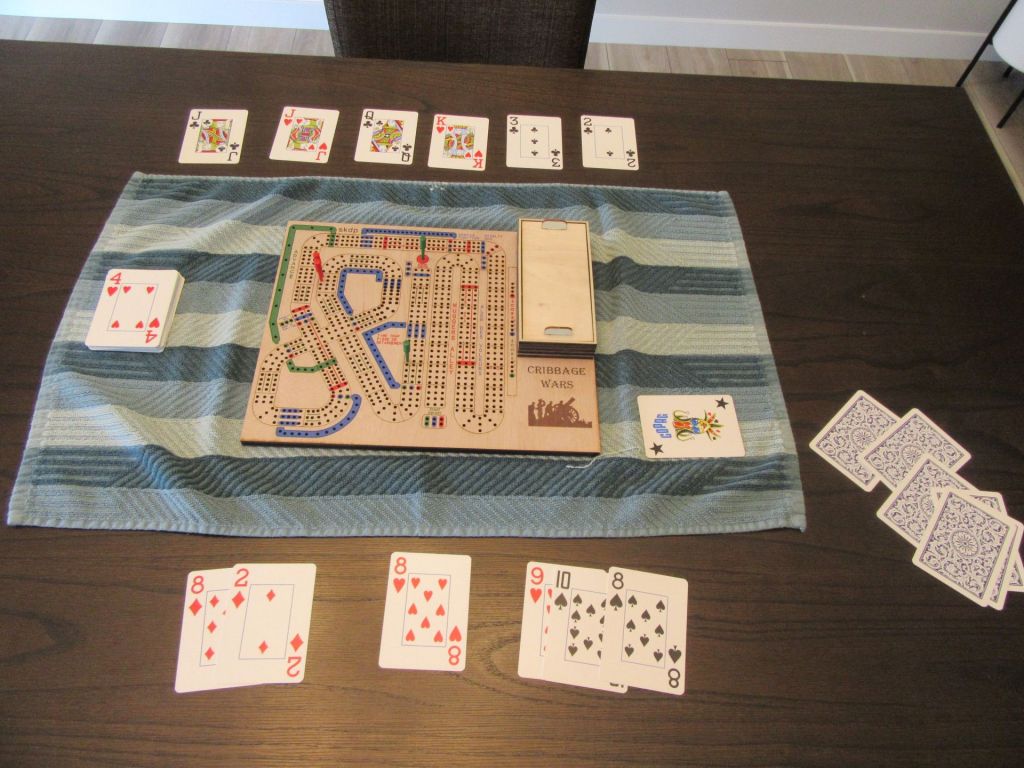
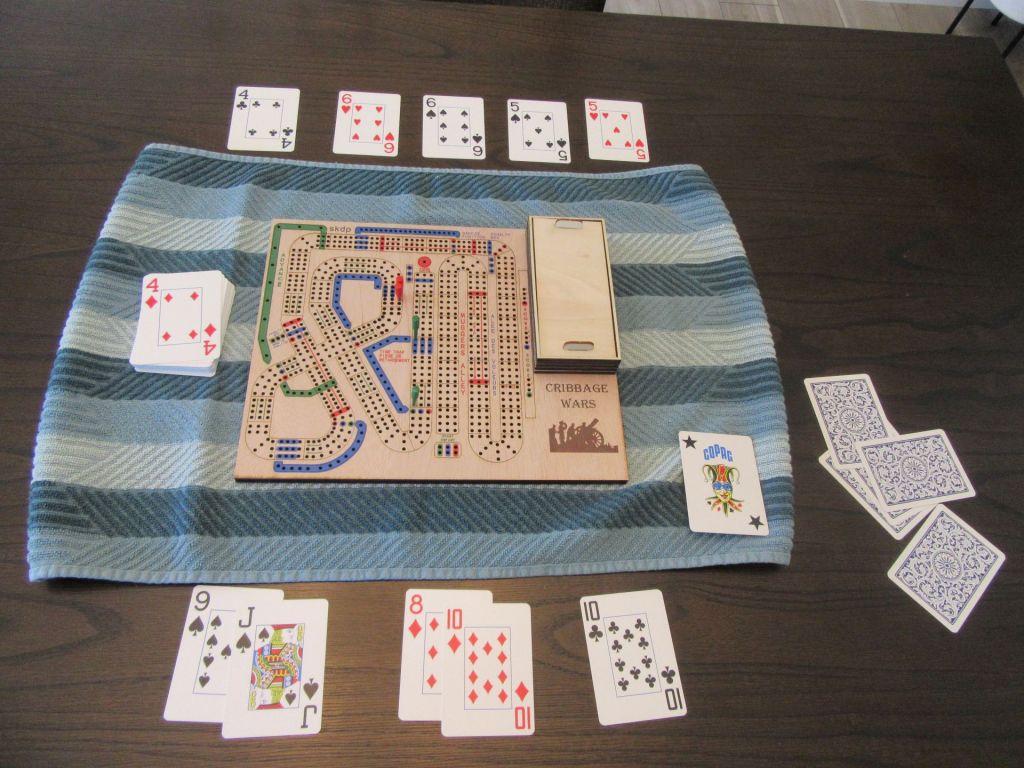
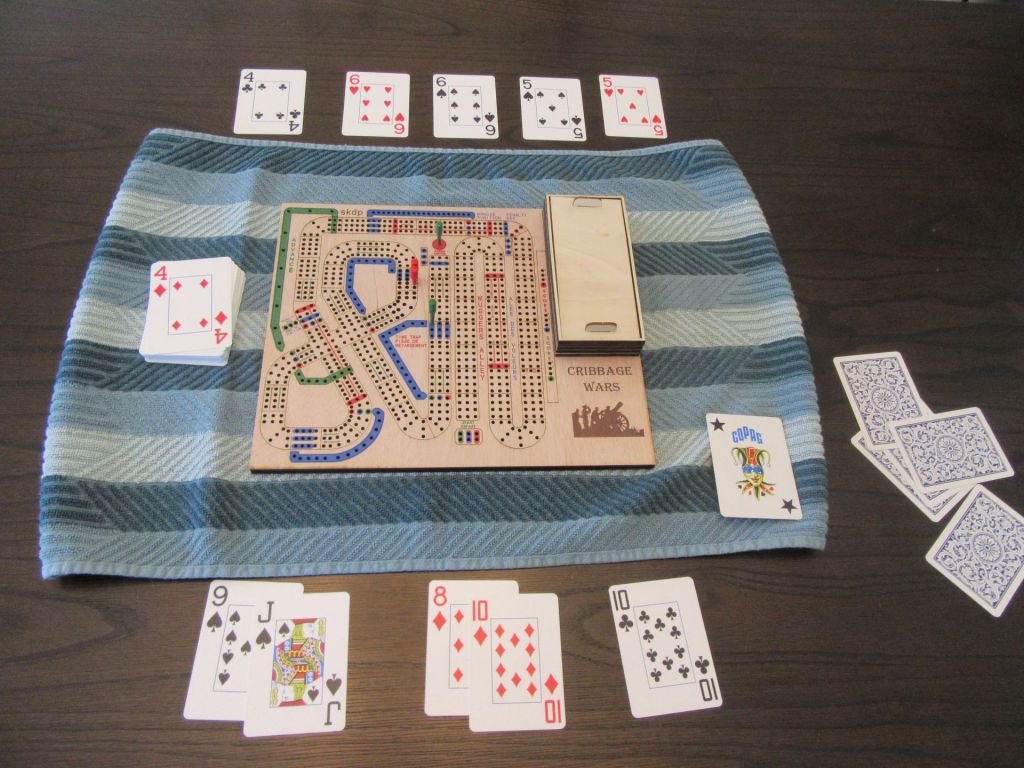
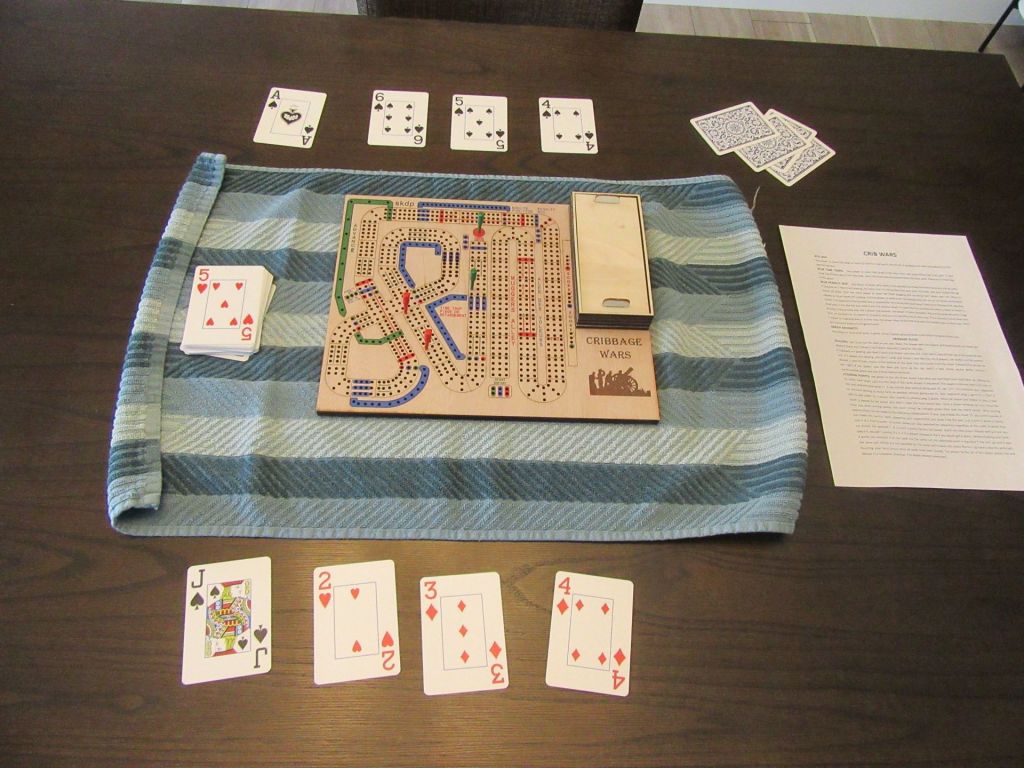
The Wicked Cribbage Lugger card gave us the idea of trying a hybrid game of 10-card cribbage and Crib Wars today. I can’t contain myself; I finally won!
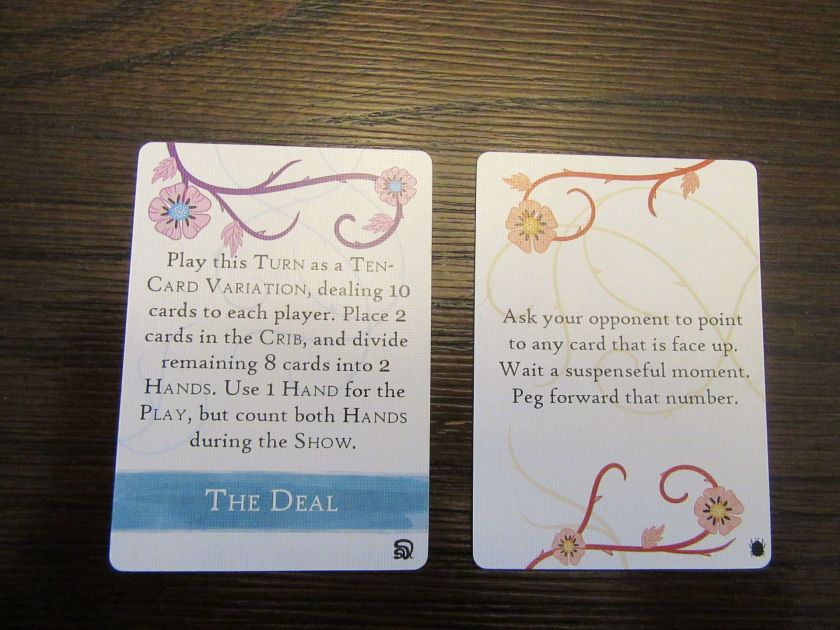
The rules for 10-card cribbage are on the Lugger card from the Wicked Cribbage game although we’ve played it before. We finished the game in 1 hour and 15 minutes. This is despite the confusion from having 3 piles of cards in front of you when you’re the dealer (your regular 4-card hand, the other 4-card hand, and your crib).
It actually plays pretty well, and the scores are easier to count than the 9-card variant because there are only 4 cards to count at a time. I managed to skip all the Red Skip Zones, all the Blue Time Traps, and all the Blue Penalty Zones, but also missed out on the Green Advance Zones. Sena cycled through one of the Blue Time Traps three times.
Sena relies on strategy in card play for Crib Wars and it doesn’t always work. I think luck is the biggest factor, but that doesn’t mean I relax. Sorting through my cards to pick out the best two 4-card hands was tough. We both agree that picking out the two cards to throw to the dealer’s crib was the easy part. Counting holes on the board was a chore because they’re very small. The number of holes in a group can vary a lot. Standard cribbage board holes are always 5 in a group.
I’m still leery of trying to film us playing a game of Crib Wars. The time to play is still way too long for that, mostly because of all the water hazards and sand traps. By the way, why do I not see comparisons of Crib Wars to golf (which I don’t play)?
Some people say that Crib Wars reminds them of Chutes and Ladders. I had to look this up on the web (despite having played this as a kid), but in Chutes and Ladders, chutes slow you down and ladders speed you up. So, it isn’t just the board layout alone of Crib Wars that reminds people of Chutes and Ladders.
Sena and I talked about what cribbage game variant we like best so far as a hybrid with Crib Wars. She kind of likes 9-card but settled on 7-card. I tend to agree with her because, while I think 6-card cribbage might tend to make the game seem too slow after a while, the 7-card might better rather than trying to manage too many cards, even though you can get some pretty high scores in 7-card.
Overall, we both like Crib Wars. It’s fun and absorbing and we’ll probably keep playing. At between $25-30, the price is right.
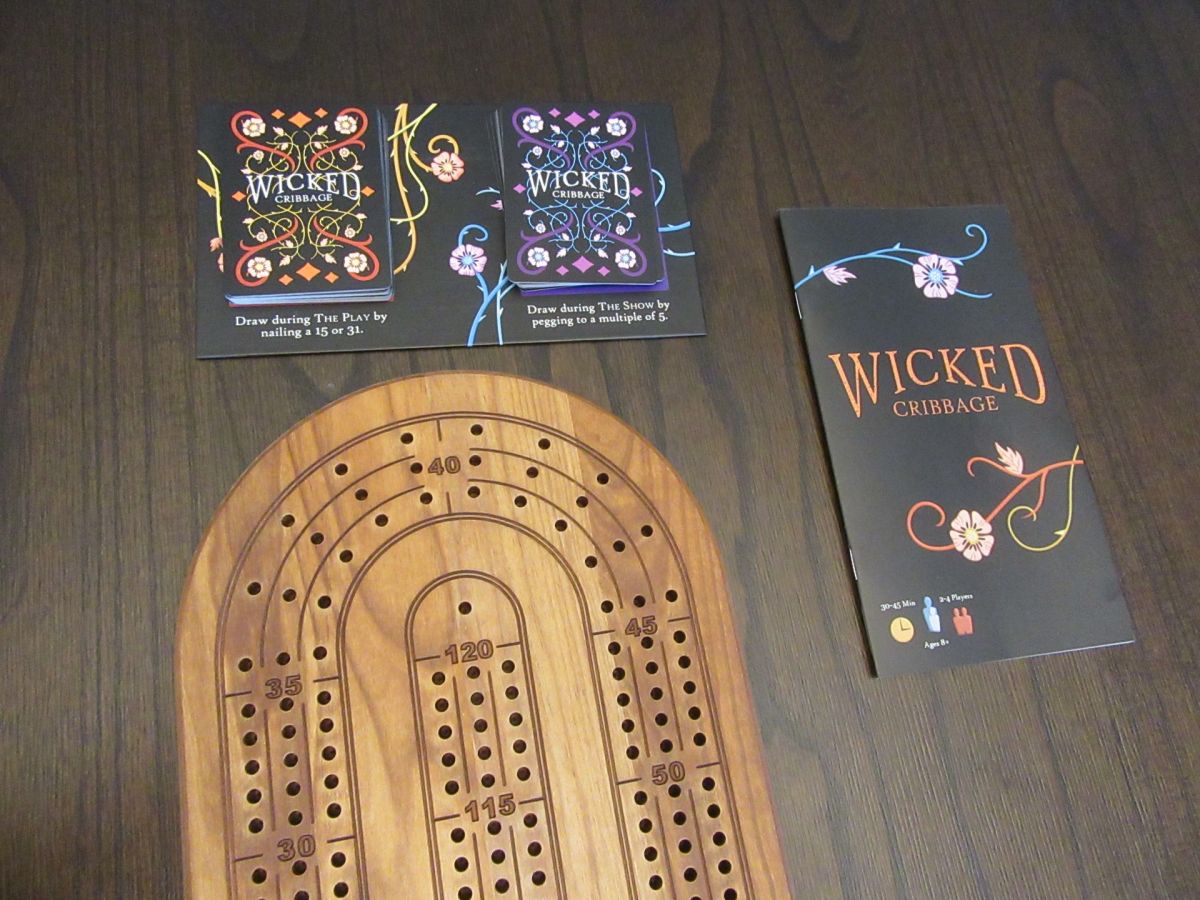
We’ve played Wicked Cribbage twice so far—and yes, Sena won both games, but here’s the thing: it’s fun to play. I think this is called a cribbage overlay in that you need to know how to play standard cribbage and already have the equipment for that.
Then Wicked Cribbage adds special cards with wonky and eyebrow-raising instructions that makes cribbage a weird experience.
There are two decks of cards with special instructions: one called Twinklers and you draw one card immediately each time you peg 15 or 31 and do what it says; another is called Luggers, and you draw one of those and play it later during the show when you land on a hole which is a multiple of 5 (5, 15, 20, 25, etc.).
One of the Lugger cards has you switch to, wait for it—10-card cribbage! We already know how to play that, but if you didn’t the card gives you the rules.
I wonder how 10-card cribbage would work with Crib Wars? Something tells me I don’t want to know.
You want to be careful how much you reveal what’s on any card to your opponent. If you say, “point to any face-up card,” you probably don’t want to say why right away. Sometimes, timing is everything.
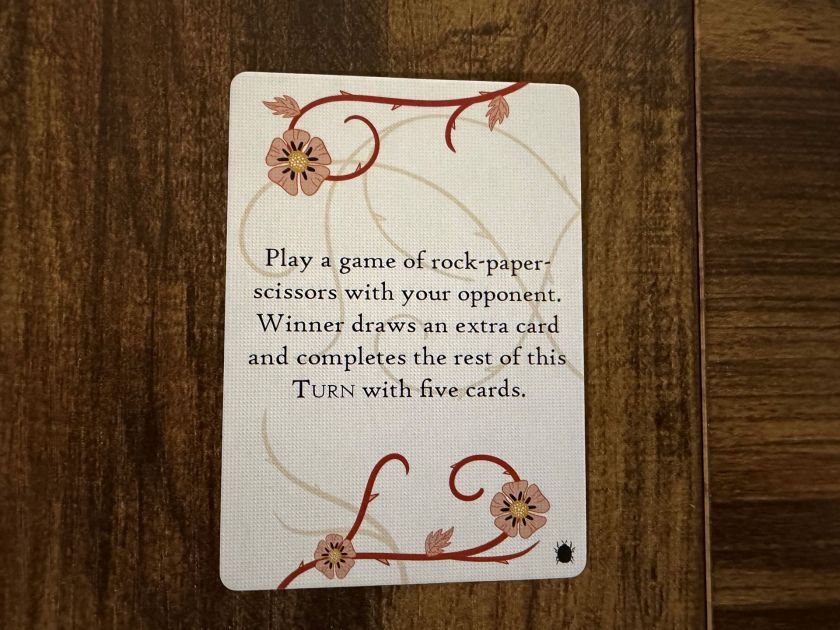
One of the Twinkler cards tells you to play rock, paper, scissors to see which player draws an extra card to add a fifth card to the hand.
That reminds me of a scene from the Svengoolie TV show comedy spots, which are little breaks from the schlocky horror movies—which I often watch. This often features a group of three goofy monsters called the Sven Squad and two of them, Nostalgiaferatoo and Ignatius Malvolio Prankenstein (IMP for short) are playing rock, paper, scissors. The third one, Gwengoolie, happens to catch them on maybe the 30,000th try!
That would make for a wickedly long cribbage game.
Here we go again! Hybrid competitions are the rule around here lately and the news flash today is that Sena won the hybrid 9 card cribbage and crib wars game today, which took an hour and a half to play.
9 card cribbage & Crib Wars and Sena wins again!Sena is modest!
Just as an aside, I used the word “hybrid” because yesterday I just found out about the hybrid Chess Boxing sport in which opponents box for 3 minutes alternating with 3 minutes of blitz chess (fast paced chess game you have to finish in 10 minutes). Figure that one out; I would think that repeated blows to the head would do something not so good for your chess playing skills, but whatever.
So, the assumption here with hybrid 9-card cribbage and crib wars is that the higher than usual cribbage hand and crib scores you get help speed you past the crib wars obstacles like the Blue Time Traps and the Blue Penalty Boxes. However, by the same token you’d probably miss out on the Green Advance zones too—but would that even matter?
Briefly, the rules of 9 card cribbage are that each player is dealt 9 cards, both toss 3 cards to the dealer’s crib, and then you sweat the scoring of both. We tried scoring by hand first, and if we got stuck, we used the scoring program I found on a Reddit thread. We didn’t do too badly and sometimes we didn’t need the scorer. We got scores as high as 38, 28, and 26. If nothing else, the 9-card cribbage variant helps your ability to hand count your scores, something I think computer cribbage apps might not be helpful for.
Anyway, I thought the 9-card game might take even longer than the 3-hour game we had yesterday with the 7-card cribbage and crib wars game. But for some reason it didn’t, even with the running back and forth to run the scoring program. I suspect that’s largely from practice effect although we’ve played crib wars only 3 times (played 6-card, 7-card, and now 9-card variants).
While we did speed past the crib wars board hazards, we also missed the reward zones (Green Advance) as well. It felt more like a long regular cribbage game. And it could turn out the opposite way although you’d probably get out of the hazard zones more quickly. But I think that would tend to make crib wars less fun, because it’s a hybrid game. It’s both a board game and a cribbage game. Some people classify cribbage itself as a board game, but that’s a misnomer because the board is just for keeping score.
You have to use a different strategy in crib wars than you’d use in a straight-up cribbage game. Maybe that’s part of the reason why I’ve lost all 3 crib wars games so far. Nah, Sena is just good.
I just had to get this post out this morning after a 3-hour game of Crib Wars playing 7-card cribbage because Sena won with the highest hand point total of 46! Some say this is analogous to getting a 29 hand in 6-card cribbage. See below for details on the rules, about which opinions differ due to the high point totals players can get.
While the game took 3 hours to finish, it didn’t feel that long because we got pretty absorbed in it.
Recall we just recently learned the 7-card cribbage variant rules and I planned to try it during a Crib Wars game, which we are also just learning. I wondered if it would shorten the game, which it obviously didn’t. We travel farther along the board, but we also take longer to count the often-complicated scores—like 46. There are 8 three-card runs for 24 points; 3 pairs for 6 points; and 8 fifteens for 2 for 16 points.
We didn’t film this game because it took 3 hours to finish. We started at 8:00 a.m. and finished at 11:00 a.m. when Sena got the 46-point hand count. This has been reported to be the highest count in 7-card cribbage according to the web site Masters Traditional Games.
There are other ways to play this game mainly by changing how many cards are dealt to the crib. Some say you should toss 2 cards to the crib as usual, which differs from what Masters Traditional Games says, which is to toss one right after the deal and then 2 more by each player after looking at the hands dealt. This means you get a 5-card crib instead of a 4-card crib. When you end up with a 6-card hand (plus the starter) and a 5-card crib (plus the starter), scoring gets higher and takes longer to count, at least for us.
Now Sena wants to play a mashup of 9-card cribbage and Crib Wars!
Hey, we played our first Crib Wars game today and, wouldn’t you know it, Sena won! We played six card cribbage. We ignored Muggers Alley.
I spent a fair amount of time in two of the Blue Time Traps. She got caught in a couple of cycles around the last Blue Time Trap, but scored big coming out of it. I had red pegs and she had the green. I think we spent about 2 hours playing.
Playing the low cards usually was the big reason why we got caught in the time traps. And despite Sena landing in the Blue Penalty Box at the beginning, she ended up winning! The Red Skip areas helped us both make better progress than we would have otherwise. The Green Advance zone helped Sena. I had to take the main track route and ended up in the Blue Time Trap in the left lower quadrant.
Maybe next time we’ll see if 7-card cribbage makes the game go faster.
We just got two new cribbage games: Crib Wars and Wicked Cribbage. We’ve been looking over the rules for both. We haven’t played either yet. I’ll talk about Crib Wars here.
Crib Wars is the most challenging to tackle, mainly because the rules and the board are open to interpretation.
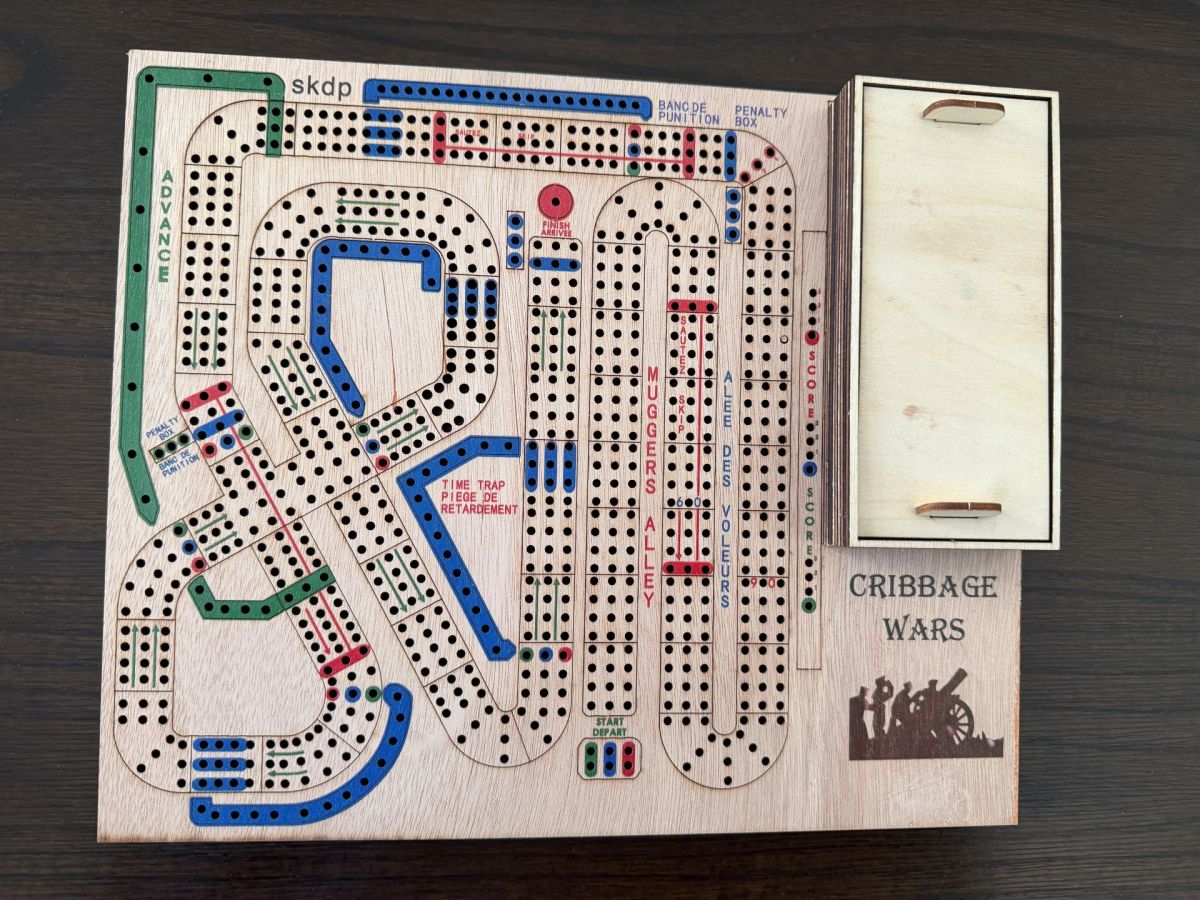
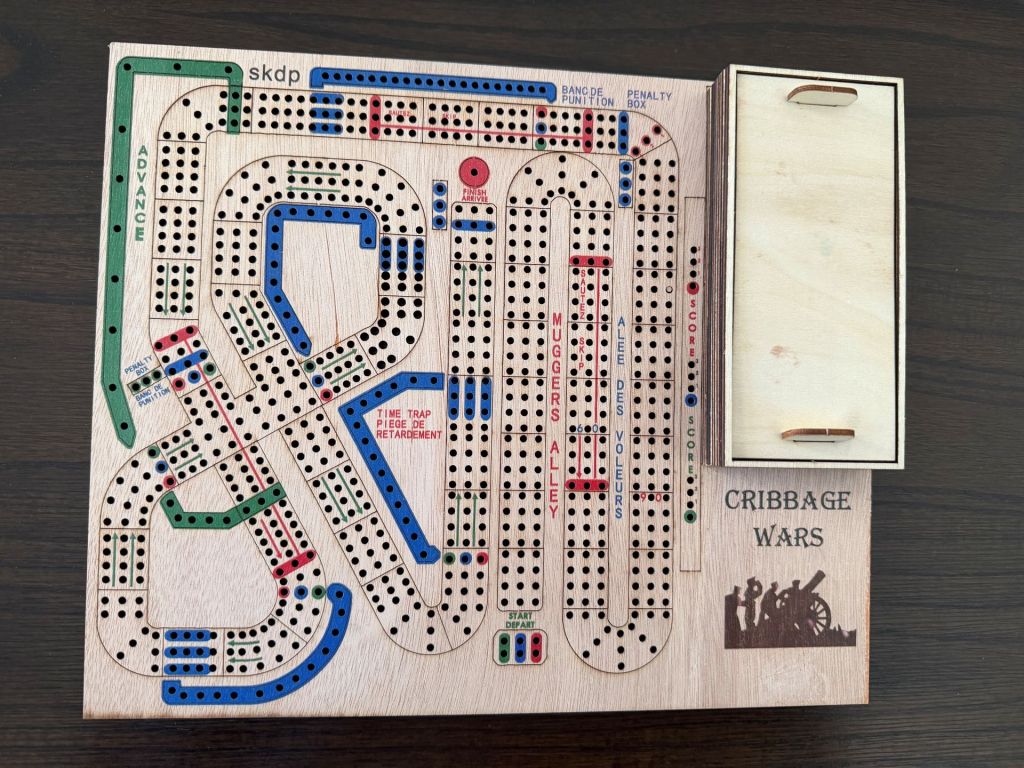
Crib Wars came with a 363-hole board and a set of rules. It was made in China and I have no idea what “skdp” means but it’s stamped on the board at the top. I haven’t seen this on any other similar-looking Crib Wars boards. The first 121 holes is the regular number of holes you’d play in the usual game of cribbage. There is a Muggers Alley in which you can play the Muggins Rule against your opponent. In general, if your opponent miscounts a score, you can call Muggins and take the points they missed. Does that mean we have to play Muggins Rule in that part of the board? I’m not sure how to get around this since you can’t just omit any other part of the game—can you? Judges are not involved. What if you and your opponent don’t agree? Do you play Rock Paper Scissors (you can do that in Wicked Cribbage, by the way, just not for Muggins Rule!). If I can say the quiet part out loud here, Sena and I tried to play Muggins rule once, messed it up and haven’t played since.
The American Cribbage Congress (ACC) rulebook has rules for Muggins Rule:
“Rule 10. Muggins 10.1. When in Effect a. Muggins is the only optional rule (see definition in rule 1.6). b. Officials in charge of tournaments, Grass Roots, or other forms of organized play must announce in their flyers and prior to beginning of play that muggins is in effect. c. When muggins is in effect, pegging out (reaching the game hole) is mandatory. d. When muggins is in effect, it cannot be optional between two players. It is played by all players. 10.2. Situations That Apply Except for the situations listed in rule 10.3, muggins is applied to the underpegging of the full value of any points during the play or scoring of the points in the hand or crib.
10.3. Situations That Do Not Apply a. The omission or underpegging of a penalty. b. The omission or underpegging of a muggins score. c. The dealer’s failure to peg two points for turning a Jack as a starter card. d. Points lost by a player by pegging backward.
10.4. Calling Muggins a. The caller shall state, “Muggins for X points.” During the play of the cards, the score(s) not pegged or underpegged shall be identified. Muggins may not be pegged until both players agree. If the opponent does not agree, judges shall be summoned. If the judges determine that the play was not a muggins, the opponent will be awarded the points taken as a penalty. If the true amount of underpegging is determined to be other than the amount originally claimed, the caller is entitled only to the lesser of the claimed or true amounts. In no case shall the amount of points awarded for muggins exceed the actual number of holes that could have been pegged had the scoring been correctly done. The muggins points shall be scored after the judges render a decision. b. For points missed during the play of the cards, a muggins call must be made: (1) After the player finishes underpegging the score or, if no score is pegged, after the player forfeits the score (see rule 7.2).
(2) Before the scoring player pegs a subsequent score or the pone’s hand is pegged. c. For points missed in a hand or crib: (1) The dealer must call muggins after the pone finishes pegging the score or states there is no score and before the pone’s hand is mixed with other cards or the total count of the dealer’s hand is announced. (2) The pone must call muggins after the dealer completes pegging the hand (or crib) score or states there is no score and before the pone mixes the hand (or crib) with other cards. d. The zero-count hand or crib: once a player claims no count in a hand or crib, muggins may be called immediately. After the player’s opponent says the word “muggins,” the player may not correct his or her count.”—American Cribbage Congress Cribbage Tournament Rules 2025 edition, Rule 10 Muggins Sec 10.1-10.4, pp 44-46 https://www.cribbage.org/NewSite/rules/rulebook_2025.pdf
There are other versions of the boards:
Michaud Toys makes a game called Cribbage Rumble. They called it Cribbage Wars about 7 months ago in a Facebook post. It looks different mainly because the design of the track and other markings are on an elongated board typical for most cribbage boards. That’s to make it easier for two players to see because they usually sit opposite each other with the board in between them. Despite the distortion, the design is very similar to the Crib Wars board that typically is made on a rectangular board. There is no Muggers Alley. The Crib Wars game we got was shipped with a one-page sheet with description and rules. I don’t know if Michaud Toys includes the rules. For U.S. customers, it costs $89.95 plus a 35% tariff and an extra $25 UPS brokerage fee paid before delivery.
Ebonwood is a company located in Appleton Wisconsin and they make a variety of wood objects including cribbage boards including a Cribbage Wars game. It’s rectangular and similar to what we got. However, it lacks directional arrows on the track in the lower left quadrant. There is no Muggers Alley. The rules for Cribbage Wars are on the Ebonwood web site. I don’t know if the board ships with rules. Ebonwood charges $210 for it.
If you already know how to play basic cribbage, you can ignore most of what’s on the rules sheet because there’s only a short section for the Crib Wars rules. It describes the colored areas and what the players are supposed to do with them. There are only a couple of YouTube videos demonstrating how to play the game and I’ve not been able to sit through them because they’re both over an hour and half long. There’s a shorter separate video of an explanation of just the rules as they pertain to the colored areas. It’s mostly helpful, although I think there’s room for interpretation.
I have just a few comments and questions so far about our Crib Wars board:
Red Skips: There are 3 of these. The rule says if you land on the first red box you should “slide” to the next red box which gets you 20 holes further along the board. The red box just means the set of 3 holes highlighted with a red color. You get from the first one to the next one by just moving it 20 holes. You’ll land in the 2nd set of holes marked in red. This is a boon in the first Red Skip area. However, if you pay attention to the directional arrows (two skinny green arrows in the middle of the track) guiding you, it looks like they accelerate you toward two of the Blue Time Traps.
Blue Time Traps: There are 4 of these and there will be three blue lines, meaning the blue color covers all three holes and all three peg tracks (3 holes along the track and 3 holes across the track). If you land in a set of three holes highlighted in blue, you end up moving to a blue area of holes that actually set you behind several holes. You have to play your way out of them. Players note that you can end up in repetitious cycling back to the traps largely because of how often you can get one or two points at a time while scoring. In fact, some say that if their opponent gets close to a Blue Time Trap they may purposely lead with a five card (something you would rarely if ever do in a standard cribbage game). That could trap the opponent into playing a ten card or a 5 card, which might risk them moving only a couple of holes right back into the Blue Time Trap. The same thing could happen with falling into the Blue Penalty Boxes.
Blue Penalty Boxes: There are three of them. This one is also open to interpretation. You fall into one of these by moving your peg into one of the single blue hole lines, meaning one blue track across the three peg tracks. This is a disaster because you immediately have to fold your hand and your crib while your opponent plays through, so to speak. And the one who pegs into the Blue Penalty Box has to move back 20 holes while the opponent pegs forward by 20 holes. But the other thing is that the person who incurs the penalty also has to “sit in the box.” There are 3 holes next to the track and this is where you put your peg. At first, I didn’t understand the need for a box to sit in if you’re also supposed to move backwards 20 holes. After I thought about it, it made sense that while you’re sitting out the hand, you have to wait for your opponent to play their hand and crib first and move forward. After that is done is when the respective 20-point loss and gain are taken. Anyway, that’s why you sit in the box.
Green Advances: There are two of them. I think they’re tricky. If you land in a green hole, you take a short cut path. The long one ends in what looks to me like an arrow pointing at the hole you should go to next on the main track. That puts you on the track which allows you to avoid the lower left quadrant Blue Time Trap. You don’t avoid the potential other trap above. If you take the normal track instead you end up moving toward the lower left quadrant Blue Time Trap—but you have a chance at getting into the short Green Advance track before you get there which loops back away from it and you end up going in the direction of the upper Blue Time Trap. Fun, huh?
You think you’re in the clear after that? You’re not because there is a sadistically placed Blue Penalty Box in the next to the last hole before the Finish Line!
Now I see why there are so few YouTube videos. Incidentally, Crib Wars came with a small yellow packet with Chinese lettering on it and the name Osmanthus printed on it. I found out that Osmanthus is a flower and it can have a variety of meanings including love, prosperity, optimism, luck, or good fortune. Sena cut the packet open because she thought it might contain flower seeds (she’s a gardener) but it just contained a square piece of white felt.
I wonder about trying to play a mashup of 7-card cribbage on the Crib Wars board. That might be the ultimate Calvinball cribbage game.
I just discovered that I owe a big thanks to a guy called EndersGame who has posted both our YouTube videos about Chicago Cribbage on BoardGameGeek. Moreover, AI gives a direct link to my blog about Chicago Zombie Cribbage—which was not a demo about it but a joke about combining Chicago Cribbage and Zombie Cribbage 4 years ago, but hey, whatever.
And EndersGame has posted both our demos to BoardGameGeek both of our demos of Chicago Cribbage, the first one in 2021 and the rematch in 2022. EndersGame also posted the link to my blog post about the rematch.
I think our Chicago Cribbage YouTube videos are the only instructional videos for the game. The rules are on the web.
We’ve also played CrossCribb and King’s Cribbage. We no longer have any of these games. But we’re about to get something called Wicked Cribbage and Crib Wars. Stay Tuned!
Sena asked me the other day if I had checked back on the price of a fancy Canadian cribbage board, Cribbage Rumble. I had not, so of course since that was my assignment, I looked on the Michaud Toys website and found that the high tariff price had disappeared, apparently. There were no alarming notes in red type with multiple exclamation points. And the price was $89.95.
However, as I noted yesterday, they replaced the message that U.S. orders are subject to a 35% tariff and a 25% UPS brokerage fee paid before delivery!
That is too high.
This led to a search for more information about Cribbage Rumble, which sounds a lot like Crib Wars (or Cribbage Wars, if you prefer since I think these games are all the same animal). In fact, it didn’t surprise me very much to find a Facebook post from Michaud Toys enthusiastically advertising “Cribbage Wars” 7 months ago for the low, low price of $89.95.
That’s right; they called it Cribbage Wars just 7 months ago although they call it Cribbage Rumble nowadays. Why is that? I’m glad you asked.
I began to wonder just what exactly is Crib Wars, is that different from Cribbage Wars, and why in blazes does the sight of the game board always prompt people to exclaim that it reminds them of Snakes and Ladders or Chutes and Ladders?
There’s this convoluted and confusing story about Chutes and Ladders and Snakes and Ladders. I think it’s partly because the Crib Wars board layout sort of reminds people in my age group of the layout of Chutes and Ladders. There’s this convoluted and sometimes contradictory history of the name of Snakes and Ladders being changed to Chutes and Ladders (some writers reverse them) to make it less scary for kids.
I think the story of the origin of the game has something to do with teaching morals to children in India. Some web articles say the original game from India was called Snakes and Ladders. Some people make things even worse by calling the game “Shoots and Ladders.” In modern times, the way you played the Chutes and Ladders was to spin a dial and move up a ladder or down a chute and you were supposed to try to be the first to reach the final goal. The morality theme was abandoned and—you know where that left all of us.
Milton-Bradley changed the name from Snakes and Ladders to Chutes and Ladders in 1943 because they thought snakes scared kids.
Where was I? Oh, the Crib Wars and Cribbage Wars game are probably the same, as I said earlier. When I try to search the term http://www.cribwars.com (a suggested search term), I just get an error message. When I search for “cribbage wars” I end up at a game supply store called Ebonwood and they’re located in Appleton, Wisconsin—which is a very nice place. I interviewed for a position in a private practice psychiatry clinic there years ago.
Ebonwood sells the Crib Wars game for $210. You can find the rules on their web site. The board they sell doesn’t put much in the way of markings on it, not even numbers. A reviewer on BoardGameGeek site reviews it and shows a very nice photo of the board. All of them look pretty much like that.
I think the origin of Crib Wars is fascinating. Recall that Michaud Toys in Ontario, Canada has produced and is marketing a Cribbage Rumble board (which is really just another Crib Wars board). It turns out that the two inventors of Crib Wars are from Ontario, Canada as well. One of them is Norm Ackland, an Elvis Tribute Artist, and Robert J. Prettie. They patented the game in the late 1990s.
On the other hand, you can buy a copy of the game for about $30 at Amazon or Walmart and be cursing your luck for hours over a game which many people play only once or twice. It can take hours to play.
That pretty much makes it just another Calvinball crib game, thanks to the Calvinball Cribbage Crowd (CCC). I’m on to their tricks—and they know it.
This just in; we found a Crib Wars game on Amazon for only $20! I’ll have a lot more to say about Crib Wars/Cribbage Wars tomorrow.
We’ve been thinking about taking this game out for a spin for a while.
Sena also ordered something called Wicked Cribbage. I don’t know anything about it except it’s a deck of special cards which gives you a chance to cheat during a regular cribbage game. It’s yet another Calvinball cribbage item similar in nature to games like Crib Wars.
This reminds me of another variant we used to have: Chicago Cribbage. We don’t have it anymore, but it’s pretty complicated and the rules are on the web. In fact, I just found out that our demonstration of it is posted on BoardGameGeek. It also comes with a special card deck which has cards that allow you to essentially penalize your opponent.
Another Calvinball crib variant we messed around with was Zombie Cribbage about 3 years ago. It comes with a rickety 61-hole folding plastic board that often got stuck closed and the pegs were plastic zombie figurines!
One of the Zombie Cribbage variants involved using jokers although the rules for using them was tough to figure out. There were two female and two male zombies. One of the guys had a big hole in his chest and was missing an arm, which is actually normal for zombies. The cards are decorated with zombies.
We also considered trying to invent a mashup of Zombie and Chicago cribbage that we could call Chicago Zombie Cribbage. If you played your reverse counting card, you could tell your opponent, “Walk like a zombie, only backwards!” That never got off the ground, or should I say out of the grave?
Our zombie cribbage game YouTube video is at the top of a google search, but only because there are no similar videos made, apparently! There are plenty of mistakes in it, but it didn’t really matter. It got over 300 views. We don’t have the game anymore.
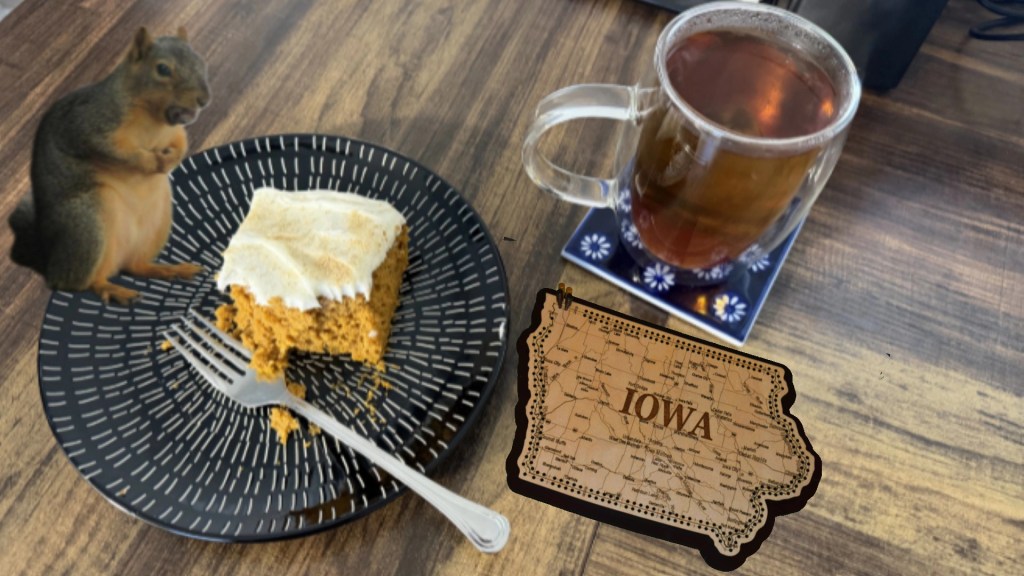
And the other news is even more absorbing. I’m not sure how it happened, but a squirrel got in the house and took a few bites from my pumpkin spice cake. And it brought a cribbage board, but forgot a deck of cards!
And another thing! We just found out that the Michaud Toys company has again today replaced the message (missing in the last couple of days) that U.S. orders are subject to a 35% tariff and a 25% UPS brokerage fee paid before delivery!
Today we went back to playing standard 6-card cribbage and it was a relief! After all of the Calvinball cribbage variations we’ve been muddling through, getting back to a standard game felt great.
I thought of a name for an imaginary group that comes up with all of the cribbage variations (whether they exist or not): the Calvinball Cribbage Crowd (CCC). The name “Calvinball crib” came from a Reddit thread contributor who replied to someone who posted an inquiry if anyone had ever played 10 card cribbage. The answer was “Yes, there have been many many posts of Calvinball crib.”
Actually, there’s another instance of the Calvinball name applied to cribbage on Reddit. It occurred on a different topic with a lot of comments about how to teach cribbage to someone else: “Cribbage is basically Calvinball.”
If you just google the term “Calvinball cribbage” you’ll find my blog posts using it in the titles in the last week.
As a reminder, the word “Calvinball” comes from the Calvin and Hobbes comic strip series which ran in the papers between 1985-1995. It’s even defined in the Oxford English Dictionary. The word is used mainly in North America. The definition as it relates to cribbage is that it refers to the creation of a so many different rules made by different cribbage players that it ultimately leads to a sense of chaos in that there seems to be no consistent set of rules at all.
Anyway, as we played some of the cribbage variations that include increasing numbers of playing cards, I began to wonder why there isn’t a 12-card cribbage ever listed. That’s because the so-called 11 and 13 card variants are listed on the American Cribbage Congress (ACC) website, yet there’s no mention of a 12-card variant.
What gives? Is this a ploy to confuse the public about cribbage? Is the CCC a secret splinter group of the ACC? And is the CCC attempting to subvert the effort to maintain the supremacy of the classic standard 6-card game?
Let’s hope so (I’m only kidding). But this line of thought probably led to Sena asking if the United Kingdom has a national cribbage organization like the ACC in North America. I googled it for the first time today. In 2017, the United Kingdom Cribbage Association (UKCA) was formed to address the declining popularity of cribbage in the country, which actually got started there by Sir John Suckling in the 17th century. Recall the ACC got started in 1980.
Naturally, that prompts the question of how common is Calvinball cribbage in the UKCA? You knew I was going to say that and don’t try to deny it. It’s difficult to answer. It looks like they prefer the 6-card game to 121 also although, admittedly, I didn’t investigate it thoroughly. They seem to be more conservative. So far, I don’t see any evidence (yet) for a UK chapter of the CCC. Of course this leads to the conspiracy theory (why not?) of the UK colluding with the Canadians to create the secret CCC in an effort to undermine the popularity of standard cribbage in northwestern and northeastern U.S. (where cribbage is very popular) and instead promote a collection of Calvinball crib variations to preoccupy Americans with counting endless complicated scoring combinations that prevent the completion of any games which typically last several hours and lead to starvation, exhaustion, confusion (did you say there are 40 fifteens for two or 142?), hemorrhoids from sitting too long, and the dreaded cankles.
In case you think I’m exaggerating, try to answer this question: Why is there no information whatsoever on 12-card cribbage? Don’t include AI instructions because they are confabulated.









 Go Retire Psychiatrist