Exercise for Brain Health

University of Iowa research shows that exercise could help for protecting us against Alzheimer’s disease. After age 65, our risk for this category of dementia doubles every 5 years.

Even if scientists develop effective and safe senolytic compounds that could allow us to live to be 200 years old, that won’t be happening in the near future. There’s another way to help prevent Alzheimer’s disease.

Exercise can lower the risk for Alzheimer’s disease, especially some form of aerobic exercise.

When it comes to exercise, any exercise is better than none.

Update on James Alan McPherson Park Memorial Plaque

Sena suggested we send a message to Iowa City Mayor Bruce Teague inquiring about the proposed memorial plaque to James Alan McPherson, Pulitzer Prize winning author and longtime Iowa Writers’ Workshop faculty member.

I can remember only one other time in my life that I wrote a letter to an elected official. I wrote President Barack Obama in 2013, basically complaining about the Maintenance of Certification (MOC) program for physicians. I’m not sure what I expected him to do about it. Like many doctors, I was frustrated about the regulatory requirements from certification boards. I thought they were unnecessary and burdensome.

I received a reply which was completely off topic and probably not written by the President. The letter from “President Obama” didn’t answer or even come close to addressing the concerns about what I thought was regulatory harassment. In fact, I never kept the reply and forgot about it.

But the email to Mayor Bruce Teague was different. We just asked about the timeline on the memorial plaque for the James Alan McPherson Park, which was renamed last year. The celebration and ribbon cutting reveal of the new sign was in early August 2021. The memorial plaque was still in the planning stage. We’ve driven by the park several times in the last year looking for it.

Mayor Teague’s reply came the day after we sent our message. It was definitely pertinent and to the point. McPherson’s daughter Rachel is still looking over the wording on the mock-up of the plaque, considering what to include. After her approval, it would take about 10-12 weeks to complete.

Now that’s a quick and specific answer from a political leader. Mayor Teague also sings.

The Kids to Decide on the Next Hawkeye Wave Song!

The new Hawkeye Wave song will be decided by the kids, and it won’t be just a single song. According to a story in Iowa Now:

For every home game the Iowa football team plays inside Kinnick Stadium, the UI Department of Athletics, in coordination with the UI Stead Family Children’s Hospital Kid Captain program, will ask that week’s Kid Captain to help select a new song to accompany the Hawkeye Wave.

It’s a great idea! Back in April, fans were asked to nominate a song to be played between the first and second quarters of the Iowa Hawkeye football games while the team members and fans wave to the kids watching from UI Stead Family Children’s Hospital.

It’s up to the Kid Captains!

Learning About Monkeypox

The University of Iowa podcast Rounding@Iowa, hosted by Dr. Gerard Clancy, MD talked with Infectious Diseases specialist Dr. Jeffery Meier, MD about the essential facts about Monkeypox for health care professionals, recorded on June 2, 2022.

This podcast would also be interesting to anyone interested in learning more about Monkeypox.

Short History of C-L Psychiatry Fellowship at Iowa

I read a short article, “The case for pursuing a consultation-liaison psychiatry fellowship” by Samuel P. Greenstein, MD in Current Psychiatry (Vol. 1, No. 5, May 2022). After 3 years as an attending, he found his calling as a C-L psychiatrist, especially after getting teaching awards from trainees. But when he applied to academic institutions for position as a C-L academic psychiatrist, people kept advising him to complete a fellowship training program in the subspecialty first. He gave it careful thought and did so, even he called it going “backwards” in his career.

On the other hand, he believes C-L fellowships will help meet the challenges of addressing rising health care costs and improving access to what most people see as the critically important goal of providing access to integrated mental health and medical care.

I’ve been retired from consultation-liaison psychiatry for two years now. I get an enormous sense of achievement on the rare occasions when I hear from former trainees who say things like “For me you were…one of the most outstanding attendings I had at my time at Iowa.” And “I can at least take comfort that University of Iowa is still at the forefront of psychiatry.”

Several years ago, one of the residents suggested starting a Psychosomatic Medicine Interest Group (PMIG). This was before the name of the subspecialty was formally changed to Consultation-Liaison Psychiatry in 2018. I know many of us were very pleased about that.

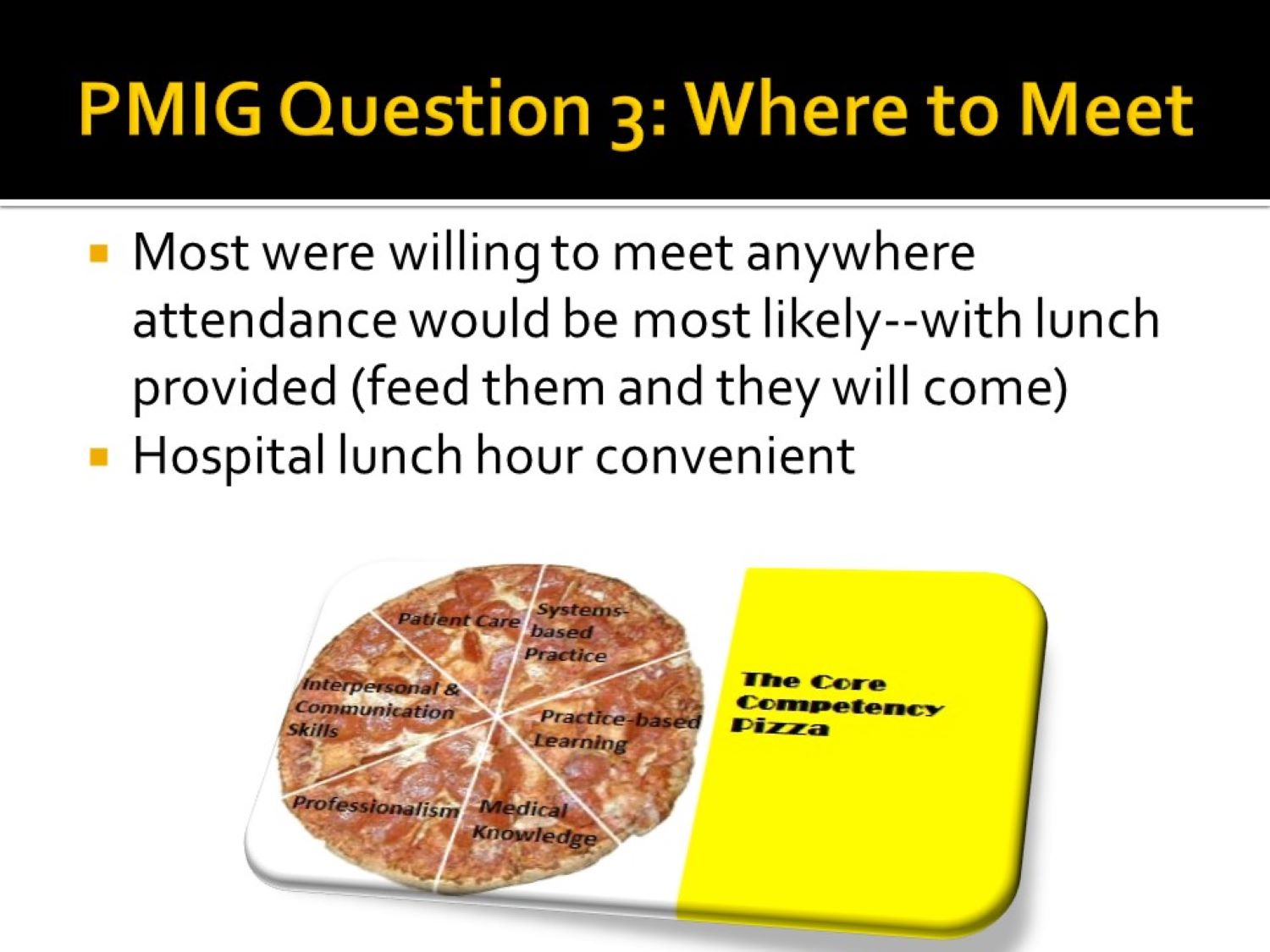
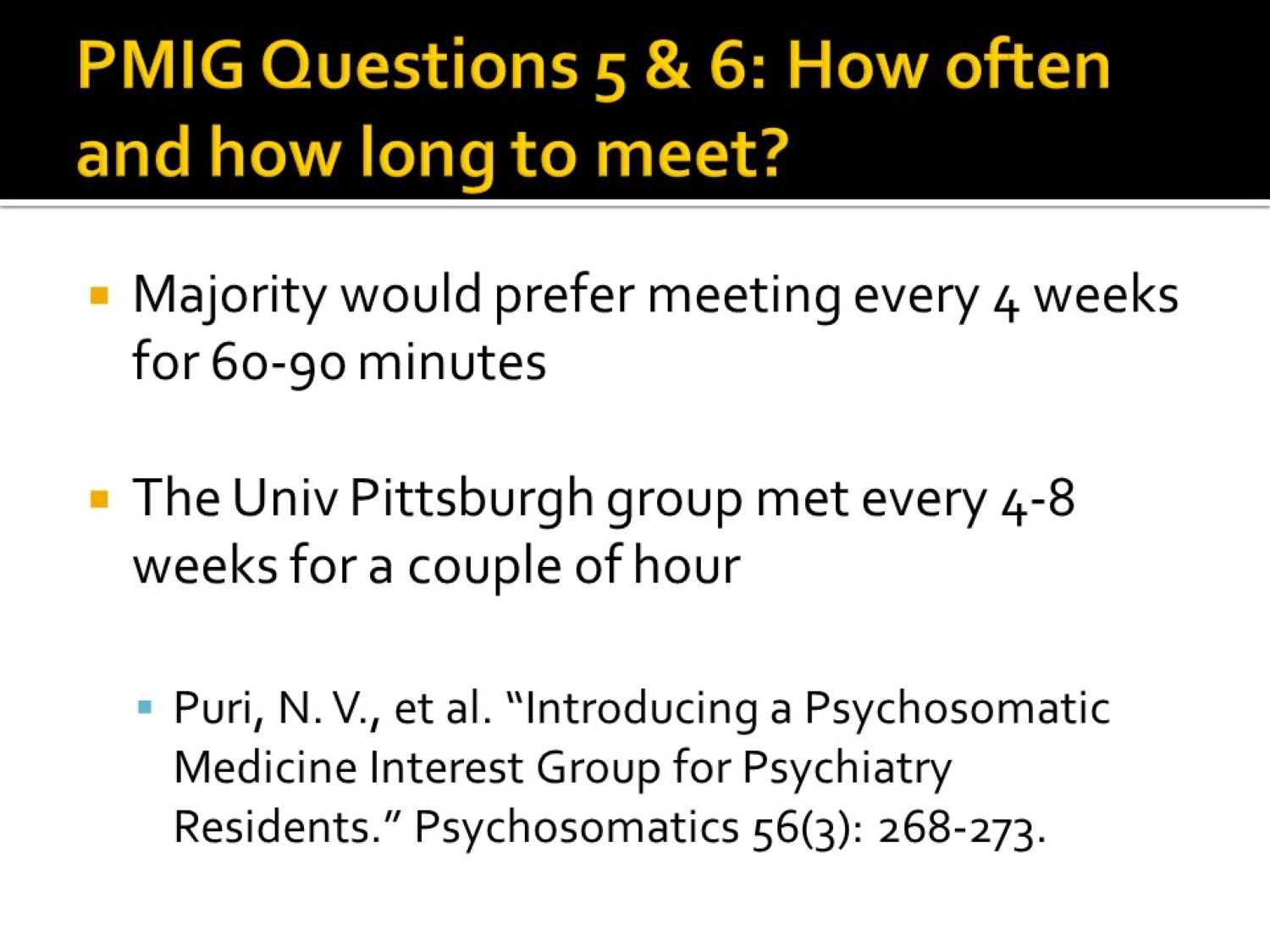
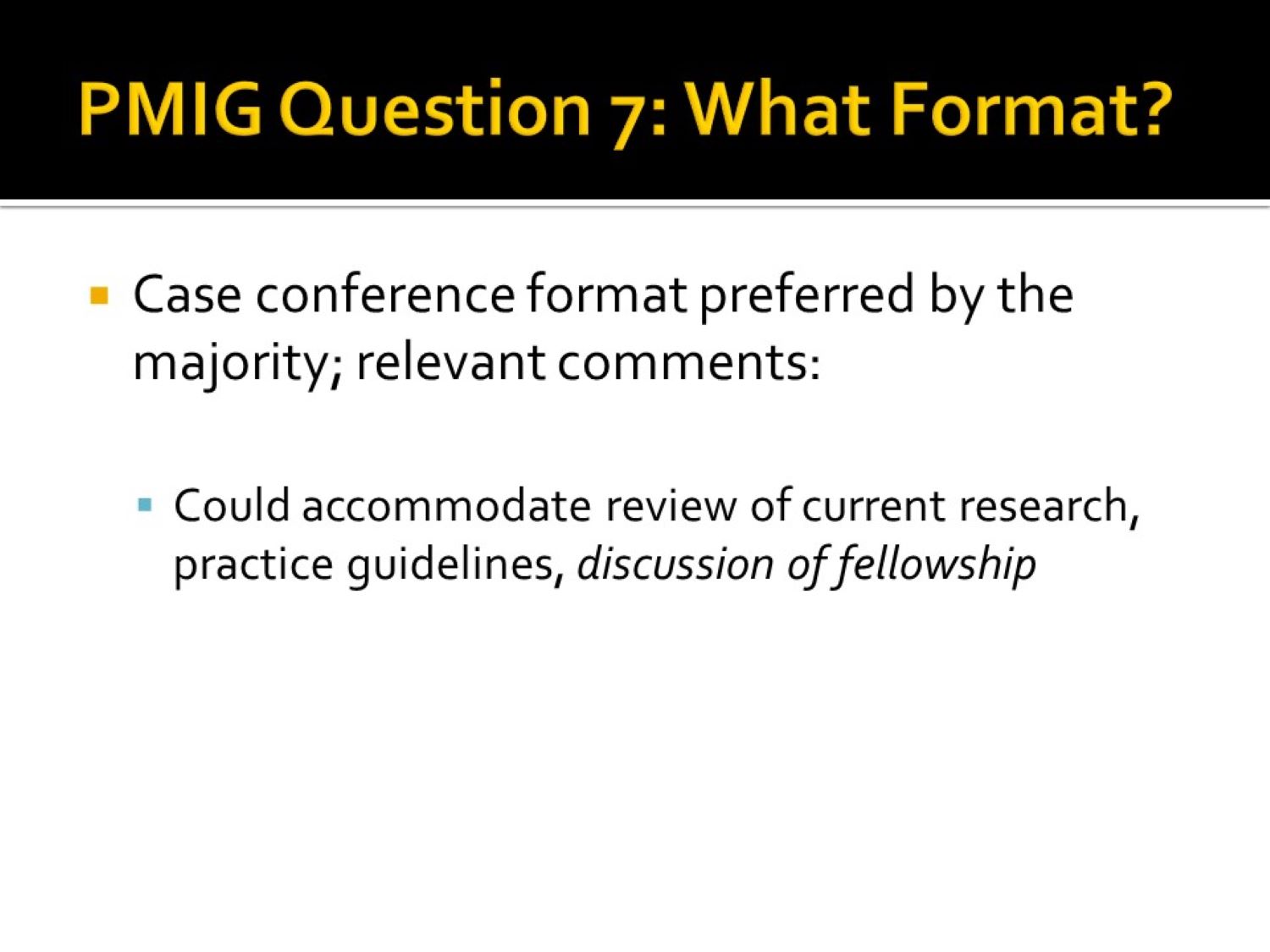
I sent a short survey (see the gallery below the slide show) to the faculty and residents in an effort gauge support for the idea and readiness to participate. I used a paper published at the time to guide the effort, (Puri NV, Azzam P, Gopalan P. Introducing a psychosomatic medicine interest group for psychiatry residents. Psychosomatics. 2015 May-Jun;56(3):268-73. doi: 10.1016/j.psym.2013.08.010. Epub 2013 Dec 18. PMID: 25886971.).

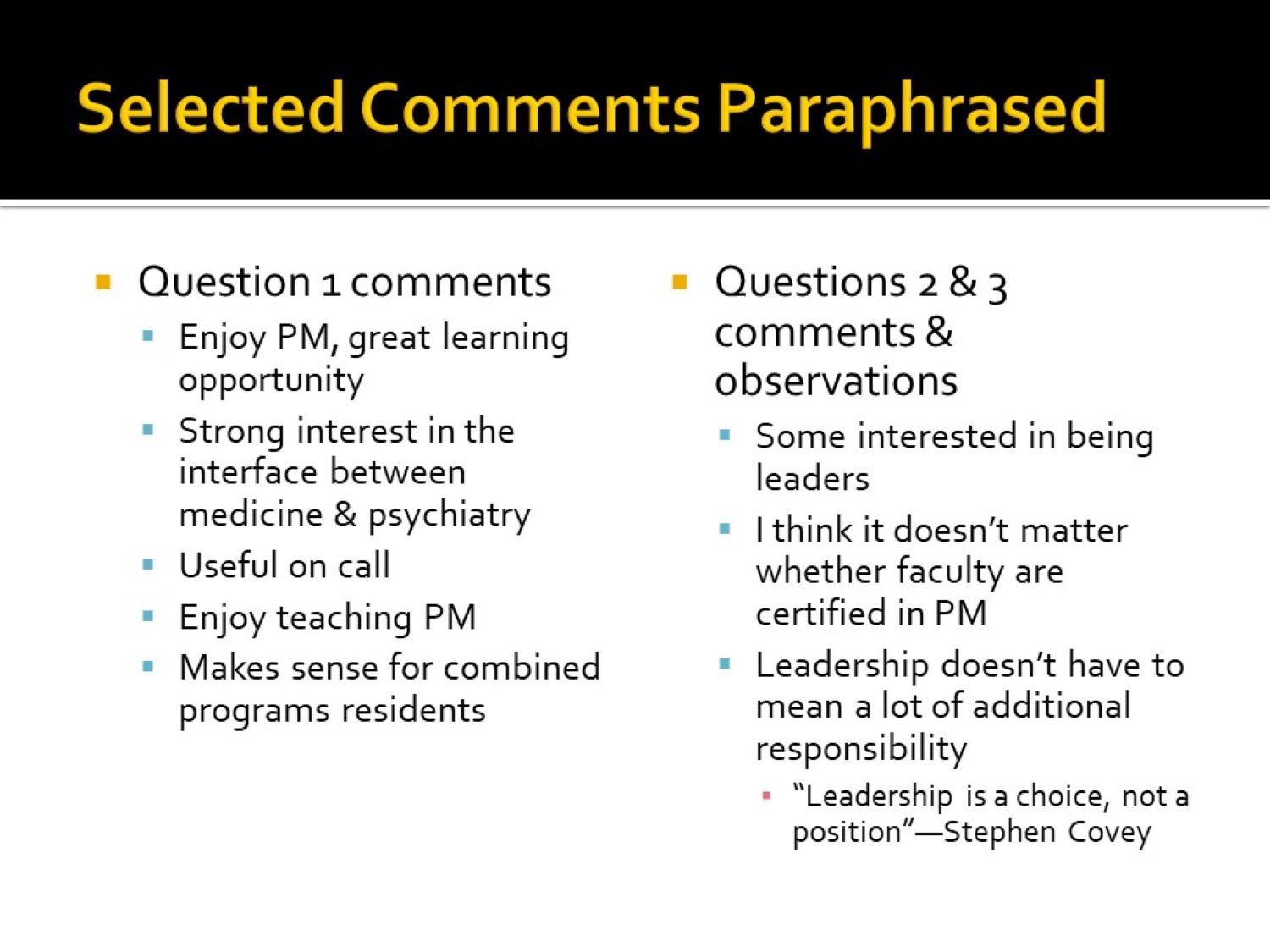
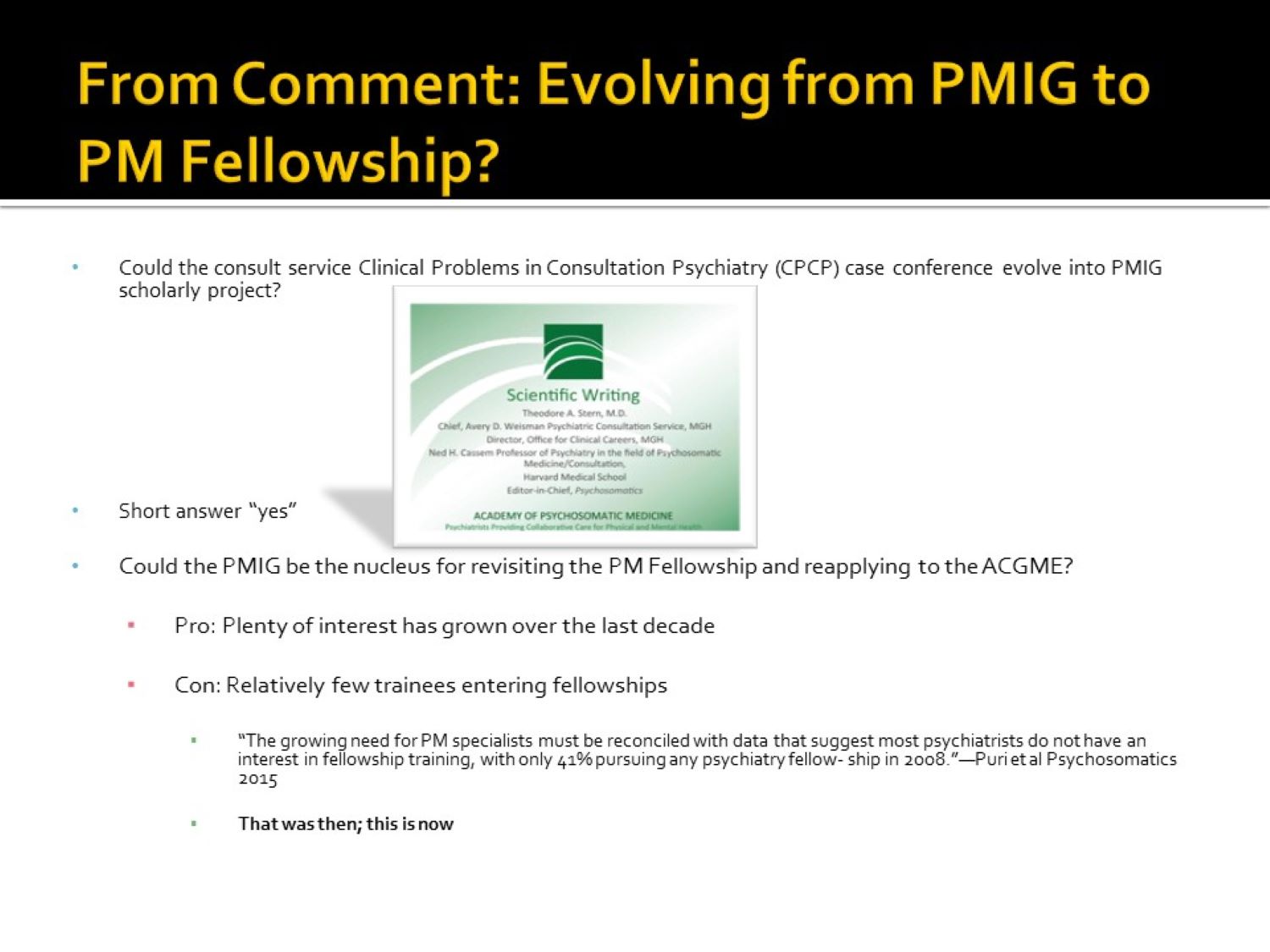
You’ll notice on slide 4 one faculty member’s comment, “I think it doesn’t matter whether faculty are certified in PM.” As Dr. Greenstein discovered, it probably does matter, at least if you want to be board certified.

I was initially certified by the American Board of Psychiatry & Neurology (ABPN), but I objected to the whole Maintenance of Certification (MOC) program, as did many other psychiatrists. I eventually declined to continue participating in the MOC process. However, I notice that the Delirium Clinical Module that I and a resident put together is still accessible on the ABPN website.

Although response numbers were low, there was clearly an interest in starting the interest group. There was also an incentive to reapply to the ACGME for approval of a Psychosomatic Medicine (Consultation-Liaison Psychiatry now) fellowship.

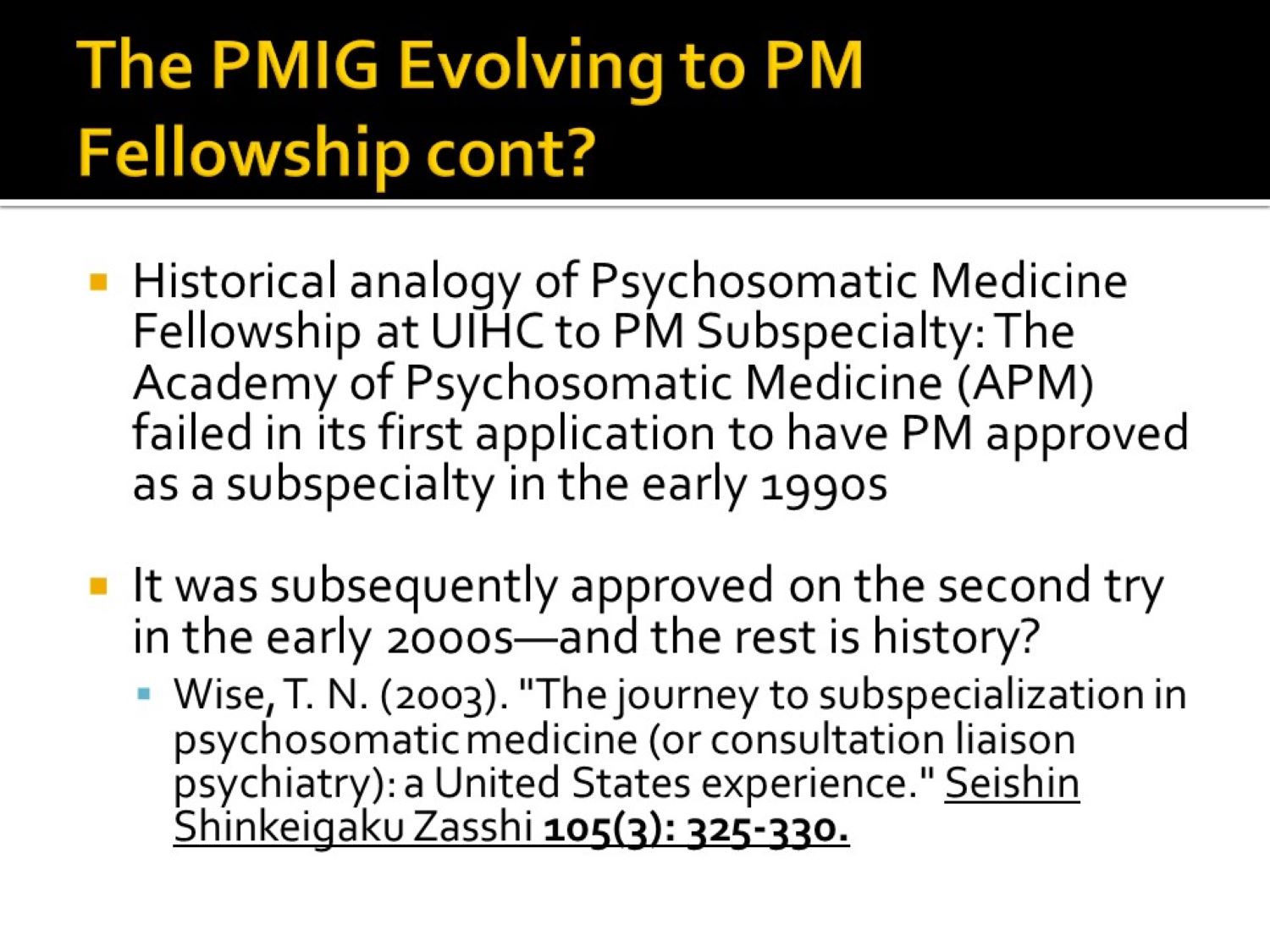
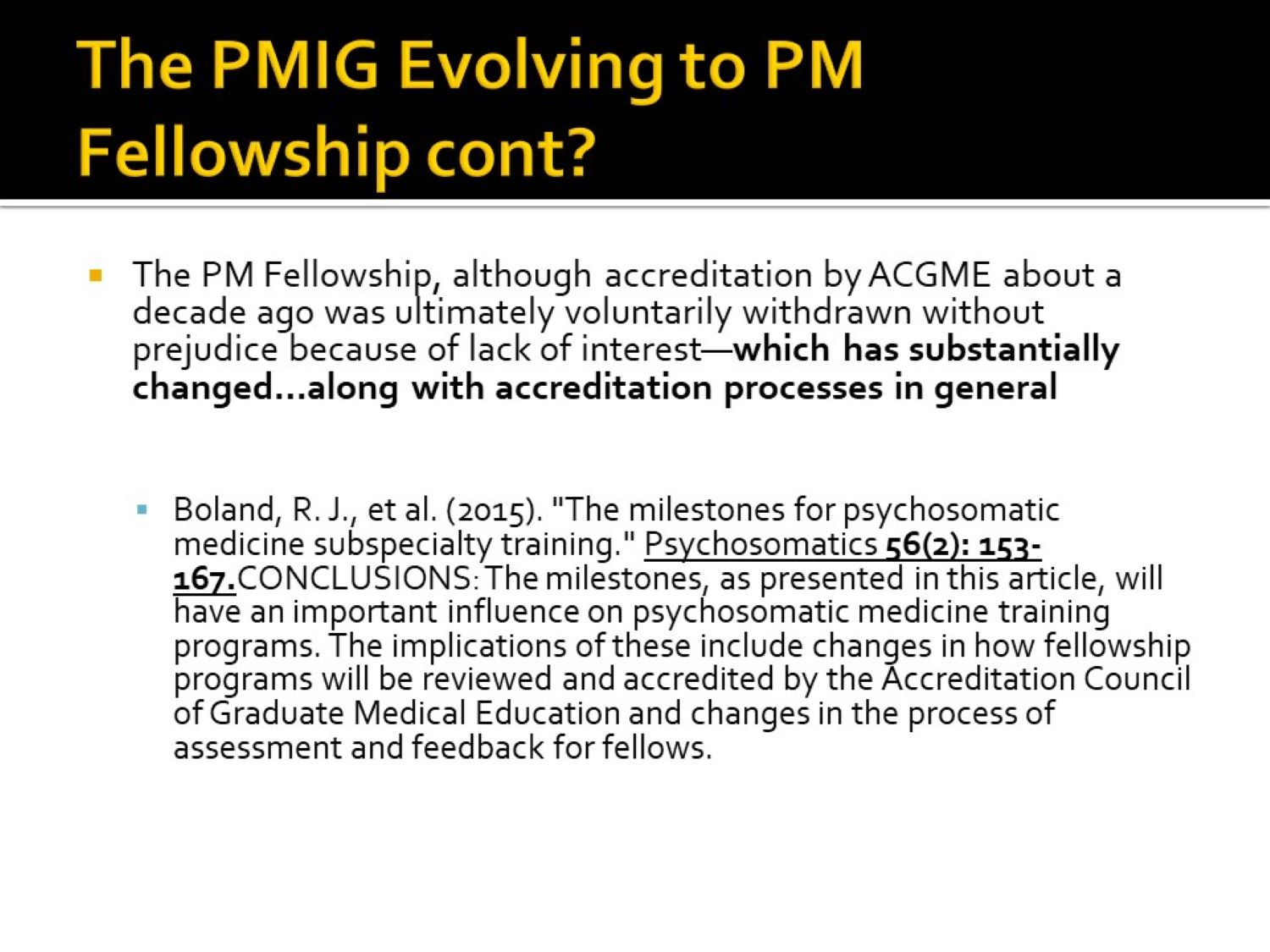
My attempt years earlier had been frustrating. While it was approved, I couldn’t attract any fellows, forcing me to withdraw it without prejudice (meaning another application for approval could be attempted). Fortunately, that situation changed later. The Psychiatry Department at The University of Iowa now has an early career C-L psychiatrist who graduated from the reinstated C-L fellowship.

As the saying goes, “What goes around comes around.” Although the origin of that saying might have originated in the 1970s, at least one person thought his grandmother had her own version in the 1950s: “You get what you give.”

COVID-19 Transmission Level Medium in Johnson County, Iowa

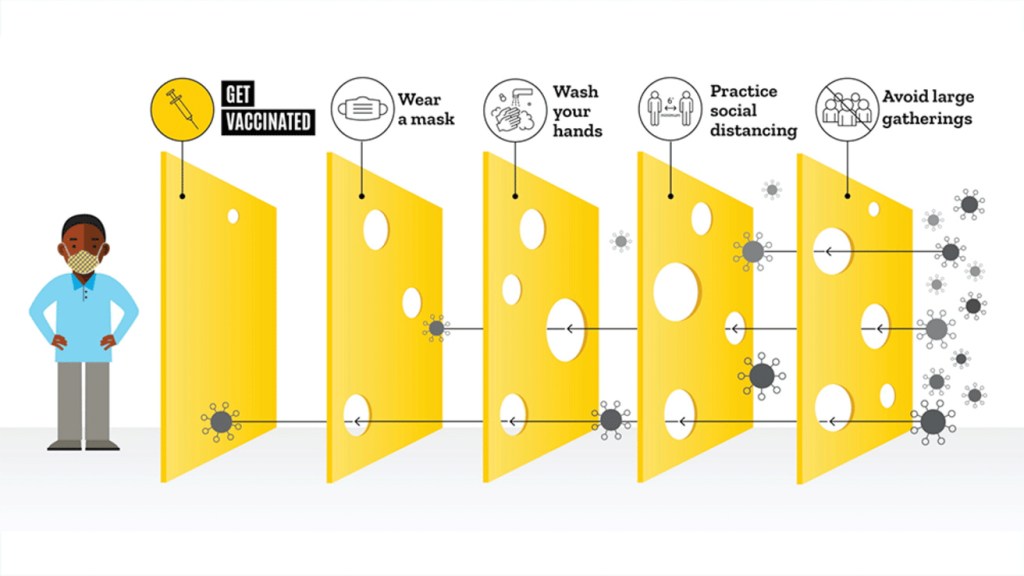
The CDC has reported that the level of COVID-19 transmission in Johnson County, Iowa is Medium. It’s recommended to adopt appropriate safety precautions accordingly. The Swiss Cheese Model is an easy way to remember:

Swiss Cheese Model

Learn more about how to keep yourself and others safe.

Not Ambivalent I’m A Hawkeye

I searched the web for a picture of ambivalence and had a tough time finding one. The featured image comes close. The reason I’m ambivalent is because of a conflict I have about the Iowa Hawkeye football program, which is currently the subject of a lawsuit by former African American players compared to the University of Iowa asking fans to find a new song to accompany the traditional Hawkeye Wave, in which players and fans wave at the kids watching the game from the UI Stead Family Children’s Hospital.

I think it’s a moving gesture. I’d like to formally nominate a new song. But I’m not sure I could call myself a fan, given the conflict between two principles: honoring the families with sick children, and also wanting a just outcome for the former football players suing the Hawkeye football program, alleging that it created a hostile environment.

I dislike bringing this up, mainly because I want to be fair to both sides. On the one hand, the former Hawkeye players and the Hawkeye football program somehow need to find justice. On the other, I really believe families love the Hawkeye Wave, and so do I. I’m very ambivalent.

I even have a song I’d like to formally vote for. It’s “I Lived” by OneRepublic. It was originally dedicated to children with cystic fibrosis and, when the music video was released in 2014, it featured Bryan Warnecke, a 15-year-old showing how he not only lived with, but triumphed over the disease.

I want the best for both sides of this conflict between ideals. I don’t know if I can count myself as a fan of the Hawkeye football program right now.

But speaking as a retired University of Iowa general hospital psychiatric consultant who once served as a colleague to the pulmonology specialists who called me to help care for the emotional and physical health of their patients with cystic fibrosis, a few of whom were living into young adulthood—they are Hawkeyes and so am I.

So, I’m voting informally for “I Lived” because I think it captures the spirit of what the Hawkeye Wave is really all about—kindness, generosity, and hope.

Featured image picture credit Pixabaydotcom.

Update April 24, 2022: I voted formally today for “I Lived” by OneRepublic. You can submit yours here.

The Connection Between The University of Iowa and Factitious Disorder

I found another old blog post, Thoughts on Munchausen’s Syndrome, which reminded me of a psychiatric disorder I saw probably more frequently than most psychiatrists unless they are consultation-liaison specialists. I wrote it in June of 2011. I still don’t understand the disorder and I doubt anyone else does either. The interesting connection to Iowa is that a patient with Factitious Disorder was admitted to the University of Iowa Hospital in the 1950s. The treating doctor published a paper about him in the Journal of the American Medical Association.:

“I ran across an old poem written by William Bennett Bean, M.D., who was a physician in the Department of Medicine at the University of Iowa. It’s called “The Munchausen Syndrome” and it was published in 1959 [1]. Dr. Bean was Professor and Chairman of the Department of Medicine at the University of Iowa in 1948. Of course, he did more than write interesting poetry. He specialized in nutrition. He was named the Sir William Osler Professor of Medicine at Iowa in 1970.  He was well-known as a clinician and teacher. He was also called a “masterful teller of tales”, which may explain in part why he wrote “The Munchausen Syndrome.”  One quotation is “The one mark of maturity, especially in a physician, and perhaps it is even rarer in a scientist, is the capacity to deal with uncertainty.”

The poem is about a psychiatric disorder about which there is a great deal of uncertainty, formerly called Munchausen’s Syndrome, now known as Factitious Disorder. It’s based on an actual case of the disorder, an account of which was published in the medical literature [3]. An excerpt from the beginning of the work follows:

THE MUNCHAUSEN SYNDROME

By WILLIAM B. BEAN, M.D.

IOWA CITY, IOWA

The patient who shops around from doctor to doctor, the dowager alert for some new handsome young physician to hear her flatulent and oleagi­nous outpourings, the bewildered neurotic who has had a dozen operations for a thousand misunderstood complaints—these we recognize as interest­ing patients or as nuisances we have to deal with as charitably as we may. They occupy the lower end of the spectrum of humanity with all its in­finitely various people. Nearby reside the malingerer and the deadbeat, a shoplifter of medical aid who escapes just ahead of the policeman. At the frayed end of this spectrum we find a fascinating derelict, human flotsam detached from his moorings, the peripatetic medical vagrant, the itiner­ant fabricator of a nearly perfect facsimile of serious illness—the victim of Munchausen’s syndrome. This is the tale of such a patient. He had our medical department in an uproar off and on for forty days and forty nights. His Odyssey I outline here in verse. I find to my anguish that much of the verse does not scan, some does not rhyme, and all is obscure. I proceed.

THE MUNCHAUSEN SAGA

In the summer of Nineteen and Fifty-four At Iowa City, our hospital door,—

Mecca for hundreds every day—

A merchant seaman came our way—A part time wrestler, in denim jacket

Crashed through the door with a horrible racket,

Two hundred sixty pounds at least,

He was covered with blood like a wounded beast.

Try to excuse the tone of the piece; it was written in another era when a more intolerant attitude toward illness mimicry was viewed as malicious undermining of the physician-patient relationship. In fact, it’s virtually impossible to distinguish Factitious Disorder from Malingering. We think of the former as belonging in the category of mental illness and the latter as, well, not an illness at all, but lying in order to get something or to get out of something. Factitious Disorder is marked by lying as well and some try to make the case that the lying which patients with Factitious Disorder engage in, sometimes called “pseudologia fantastica” or pathologic lying, is somehow different from ordinary lying. According to Bean, it’s like this:

He gave us a history, in elegant diction, Which later we found was all out fiction. Carpenter, wrestler and bosun’s mate And stevedore. He could exaggerate! His body was covered with many a scar He said from surgeons near and far

His appendix went in County Cork A navel hernia in New York.

Once, he declared, in Portland, Maine,

A surgeon stripped out his saphenous vein. Surgical scars above one kidney

Came from an ectomy done in Sidney. Scarred, he was, on his abdomen

From a wreck, he said, when with women roamin.’ Another injury he wouldn’t reveal us

Messed up his left internal malleolus. From time to time, as he wove this story

He boasted of prowess and wealth and glory. By courage he ruled his fellow sailors

But he didn’t say much of his many jailors.

In fact, we understand very little about so-called pathologic lying, though the telling of tales is engaged in not just by psychiatric patients. One of the most fascinating consequences of the frustration physicians feel about Factitious  Disorder was the fraudulent case report about Factitious Munchausen’s Syndrome. The paper was published by a couple of resident physicians in the New England Journal of Medicine and was a spurious account of an emergency room patient named Norman U. Senchbau, who claimed to actually have Munchausen’s Syndrome and who demanded admission to hospital for treatment [2].  He supposedly confessed to having undergone many surgeries and to prove it, displayed many scars on his abdomen…which washed off with soap and water. Of course, the name of the patient is just an anagram of Baron Munchausen.

I occasionally get calls from internists and surgeons about patients whom they suspect of manufacturing illness for the sake of taking the role of patient (part of the definition of the disorder in the Diagnostic and Statistical Manual of Mental Disorders). As often as not, I have no clear idea of how to proceed with interviewing someone who probably does deliberately produce illness, other than to do my best to listen for understanding, to avoid confronting them, and to seek some way to interrupt their self-destructive behavior. In the end I don’t believe we now know much more than Bean did:

What do we know of the pathogenesis

Of hospital vagrants and doctors menaces? Maybe the person acts unenlightened

From a real disease which has him frightened. Does part of the reason he may vex you all Lurk in dark leanings homosexual?

What is the cause, and what are the reasons He wandered pitifully through the seasons? Lonely pilgrim out of orbit

Peace and quiet lost in forfeit.

Hospital haunters, doctor deceivers

Their acting confounds even nonbelievers. Derelicts lost in a cold society

Wanderlusting, without satiety.

Social pariah or medical freak

Whence does he come and what does he seek?

I cannot relieve my brain’s congestion By unveiling an answer to this question In the age of sputniks, the fall of parity We all should try to think with clarity.

L’Envoi

Princes and wise men of many conditions

Beautiful ladies and honored physicians

I’m sorry I cannot fasten my claws in

What causes the Syndrome named Munchausen, This off again, on again, gone again Finnegan

Comes in, than goes out and at length comes in again. Munchausen’s victims must be expected

To plague our lives unless detected.

Those we identify when we sight ’em

Should be restricted ad infinitum

So be alert for this great nonesuchman Munchausen syndrome’s flying Dutchman.

1.    Bean, W.B., The Munchausen syndrome. Perspectives in biology and medicine, 1959. 2(3): p. 347-53.

2.   Gurwith, M. and C. Langston, Factitious Munchausen’s syndrome. The New England journal of medicine, 1980. 302(26): p. 1483-4.

3.   Chapman, J.S., Peregrinating problem patients; Munchausen’s syndrome. Journal of the American Medical Association, 1957. 165(8): p. 927-33.”

Video of UI Breaking Barriers: Arts, Athletics, and Medicine (1898-1947)

Here is The University of Iowa video of the presentations from the February 8, 2022 Uncovering Hawkeye History series (2nd in the series), celebrating the 175th anniversary of the University of Iowa beginnings in 1847. The audio is fine on this one.

Thoughts on “The Next Chapter: Blazing New Trails (1998-2047)

The final presentation of the series night before last, Uncovering Hawkeye History in honor of the 175th anniversary of the University of Iowa was a fascinating review of the changes in architecture of the campus, how local and national politics influenced the university and vice versa, as well as the expansion of the role of philanthropy to support its mission over the years. A YouTube video of the recorded presentation will be posted here at a later date.

There was not enough time to do much more than briefly mention the new trails being blazed by three leading programs. However, you can read more about them in Iowa Magazine.

Craig Kletzing is the principal investigator for NASA’s TRACERS mission. He’s a UI physics and astronomy professor who secured the largest research grant in the history of The University of Iowa in 2019 to study the interactions of the magnetic fields of the sun and the Earth.

Christopher Merrill is the director of the International Writing Program and professor of English. Merrill has made cultural diplomacy mission to over 50 countries. He once served on the U.S. National Commission for UNESCO and the National Council on the Humanities.

Dr. Patricia Winokur, the executive dean of the Roy J. and Lucille A. Carver College of Medicine, physician and professor of internal medicine—infectious diseases, and leader of Iowa’s Covid-19 vaccine clinical trials. Dr. Winokur is a nationally recognized leader in the field of infectious diseases. She created the UI Vaccine and Treatment Evaluation Unit, one of the top vaccine research programs in the country and one of only nine nationwide funded by the National Institute of Allergy and Infectious Diseases.

At the end of the presentations, university archivist David McCartney announced that he will be retiring as soon as next week. He wished everyone well and the presenters I’m sure all wish him well.

He has held the archivist position since 2001. He has led a very interesting and varied life. A story posted in The Academic Archivist on November 12, 2020 by Katie Nash, MLIS, CA reveals he got his undergraduate degree in journalism from the University of Wisconsin-Madison. He received his MA in history and MLS (master’s degree in library and information studies) in 1998, both from the University of Maryland at College Park.

He also was a reporter for radio stations in Alaska and the Midwest. I’ll bet that was interesting. He was between warehouse jobs in the summer of 1992 when he drove around the Midwest, researching Carrie Chapman Catt, the woman suffrage leader and founder of the League of Women Voters. It turns out Catt grew up near David’s hometown. That work led to publishing a collection of Catt’s papers in a catalog.

David has done a great many things. He believes that his profession’s worth and legitimacy are being challenged, and that the value of the work he and others do is often unrecognized. He firmly believes that institutions and corporations have to understand their responsibility to maintain a strong archives and records management program. He’s very motivated to advocate for his profession.

I probably would not have looked for any further information about David McCartney had he not announced his retirement at the close of the final presentation of this series. He made his point simply and humbly, saying the challenges of keeping up with the technology demands of his job were part of the reason for his retirement.

He even said he hoped he would see the presenters in the Ped Mall (officially named City Plaza), a pedestrian mall in downtown Iowa City near the UI campus, built in 1979 as the centerpiece of the city’s urban renewal project. It’s a popular gathering place for students and locals. There are concerts, jazz festivals, and art shows.

As a relatively recent retiree myself in June 2020 (19 months or 86 weeks or 606 days ago but who’s counting?), I can relate to David on this issue. Many of those I worked with were sad to see me go. I think many will be sad to see David go.