Yesterday, I was thinking about Artie Hicks, one of my old English teachers at Huston-Tillotson University, which was Huston-Tillotson College back in the mid-1970s when I was a student there. I looked him up on the web, just out of curiosity—and found his obituary. That seems to happen a lot lately.
Anyway, he was a gifted teacher and had a great sense of humor. He bought tickets for the whole class to see the movie Harold and Maude, a ground-breaking film in those days. He had a simple and direct approach to talking with students. He always seemed comfortable in a place where white people (including teachers) were the minority—unlike the wider world outside the campus.
He was bald and the students called him Kojak, which was the name of the bald, tough detective star (played by Telly Savalas) of the TV crime drama which aired on CBS from 1973 to 1978.
I think you could have called Artie tough as well; not bad guy tough but honest and direct.
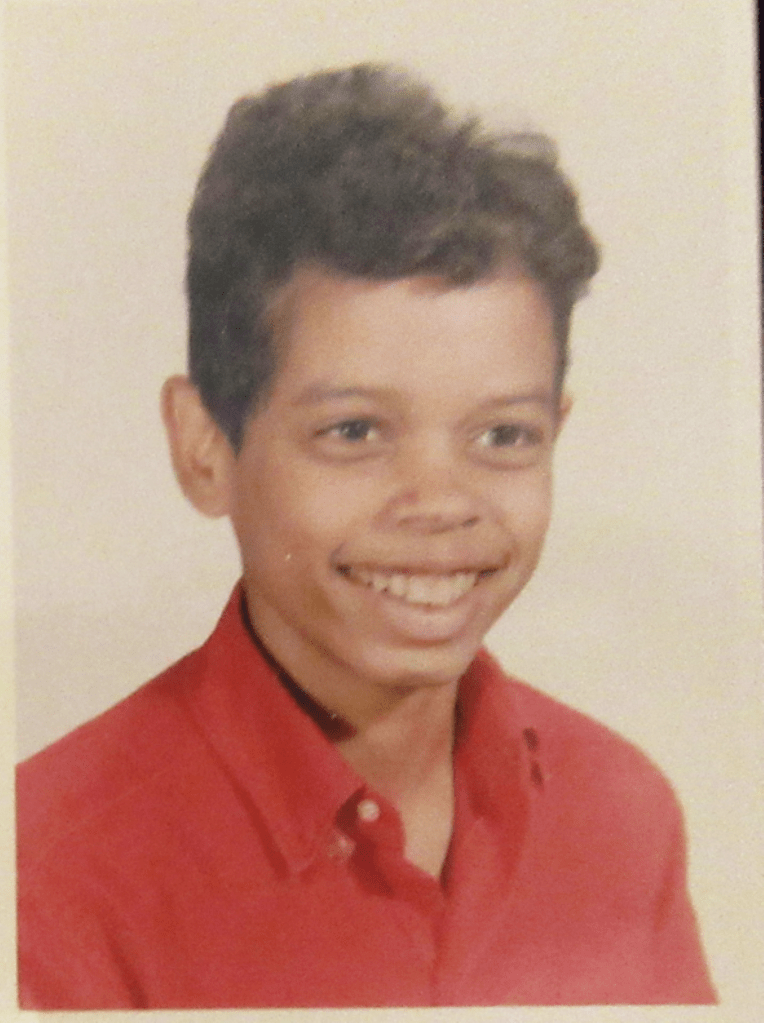
Teacher Appreciation Week this year started on May 8, 2023. I found my old report cards from Lincoln Elementary School in Mason City, Iowa. Lincoln was torn down many years ago to make room for expanding the Post Office. But I have my memories. I rediscovered reasons to celebrate the dedication of teachers. I don’t know how many people keep their grade school report cards. My mother kept mine along with old elementary school photos, including class pictures.
Jimmy!
Brief remarks on my grade cards remind me how supportive my teachers were—and how they expected me to buckle down. I was kind of a handful and there are indications that I had difficulty focusing my attention. My fifth-grade teacher, Mrs. Cole, was instrumental in identifying my near sightedness, which helped me to get my first pair of eyeglasses.
It wasn’t a bed of roses. My third-grade teacher, Mrs. Myrton (who always smelled like cigarettes), once slapped me so hard it made my nose bleed because I bumped into her when I was running around the classroom. I don’t remember why I was doing that. She was really sorry for slapping me.
And there was the time me and another kid got caught throwing snowballs on the playground (I can’t remember what grade I was in), which led to the usual penalty levied by the school Principal, Esther Ahrens. We each had to draw really small circles (signifying snowballs) to fill a sheet of paper.
We (meaning the kids) thought Ms. Ahrens was a witch. On the other hand, on a really hot day shortly before summer break, my 4th grade teacher, Ms. Hrubes, started acting really strange and was sort of wobbling at the open window in the classroom. There was no air conditioning in the school. Ms. Ahrens happened to be walking by the room and rushed into the room just in time to catch Ms. Hrubes as she was falling backward in a dead faint from heat exhaustion.
But other than that, along with the usual physical and psychological cuts and scrapes of elementary school, I remember those years as instrumental in turning me and other kids into smarter, nicer people and better citizens. We also learned how to make really tasty homemade ice cream the old-fashioned way, using nested containers, the larger of which had a mixture of salt an ice and a hand crank.
The notes and letters with my report cards often had illuminating comments:
“Jimmy has done well in Physical Education class. He has excellent aim and can hit a moving car’s windshield with a rock (yelling ‘bombs away’) with fair accuracy.”
“During this quarter, I was able to dissuade Jimmy from trying to fly like superman from the second-floor window of the classroom.”
“Jimmy reads well. He could apply himself more carefully in science. We were finally able to remove all the exploded paint from the gymnasium. It took only a few weeks this quarter.”
“Jimmy’s command of spatial relationships has improved a great deal! He can figure out how to fill his emptied milk carton with spinach in seconds, often without attracting the attention of the lunchroom monitors.”
I’m giving a great big thank you to all the teachers! You deserve it!
I remember Dr. Mady Gray. I met her wen I was a student at the HBCU, Huston-Tillotson College (now Huston-Tillotson University) in Austin, Texas. This was way back in the mid-1970s. She died in 2014 and a legacy entry is all I can find about her on the web.
She was one of the kindest persons I ever met. She taught the Intensive English course to the international students. It was a tough job. Many came from politically complicated areas of the world, including Iran. I remember hearing many heated diatribes against the Shah. Mady took it in stride.
I don’t remember calling her Dr. Gray. Dr. Jenny Lind Porter called her by her first name, Mady. I think that’s what I called her.
She invited me to her home to meet her family. Her husband cultivated a hydroponic tomato garden in the house. He was very devoted to it.
Mady was very patient with the international students. They loved her. All of us did.
Mady performed music in the annual faculty talent show, held in the Agard-Lovinggood Chapel (now Agard-Lovinggood Auditorium). I can’t remember much about it. She sang a song and accompanied herself on the guitar. The song had something to do with how many flags she has been under, which included Texas, the United States of America, Indonesia, and there must have been several others because her introduction to the song made a reference to Six Flags Over Texas, but she had even more “Flags over me.” She was funny and endearing during the performance.
I think Mady Gray deserves special mention for Women’s History Month.
I met Dr. Jenny Lind Porter Scott, one of my favorite teachers, in the mid-1970s during my first two years of college at what was then called Huston-Tillotson College (now Huston-Tillotson University or HTU). It’s one of America’s historically black colleges. I didn’t graduate from there, instead transferring credit to Iowa State University and taking a degree from there which eventually led to my graduating from the University of Iowa College of Medicine.
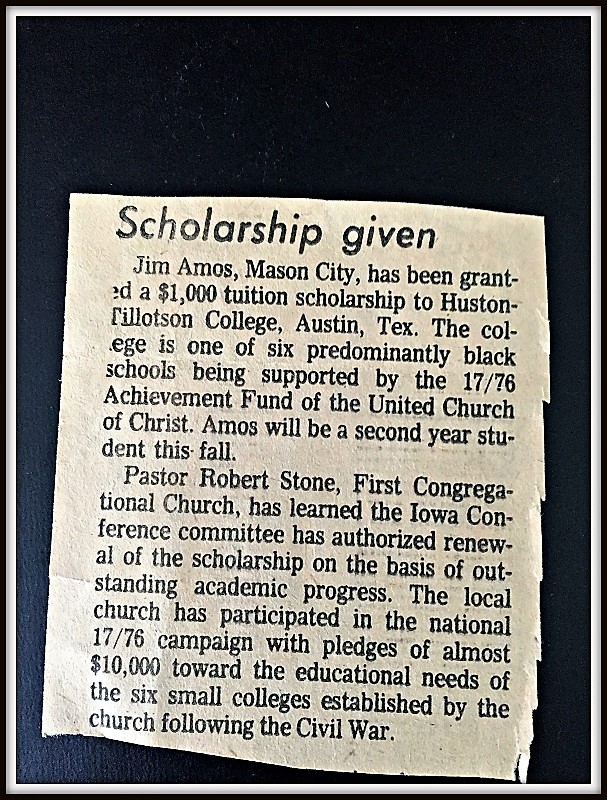
I’m sure there are no records of my attendance at HTU. I was recruited by Dr. Hector Grant, a professor of religious studies and philosophy who was traveling around the country and giving presentations to various church organizations to garner financial support for the college. I was awarded a $1,000 tuition grant under the auspices of the 17/76 Achievement Fund of the United Church of Christ.
I have neither degree nor transcripts from HTU. But I have my memories, and one of the most special memories is of Dr. Porter. One of the main reasons for today’s post is my finding her obituary on the web this morning. She died at the age of 93 in July of this year. I saw two obituaries, one apparently written by the funeral home on the Texas State Cemetery web site and the other appears in the Austin American Statesman.
Both list her many achievements as an educator, a leader among women, and a gifted writer. They also cite what might seem to be a minor detail to anyone but me and other students who knew her in the 1970s, which is that she “…established a Creative Writing program at Huston-Tillotson University…”
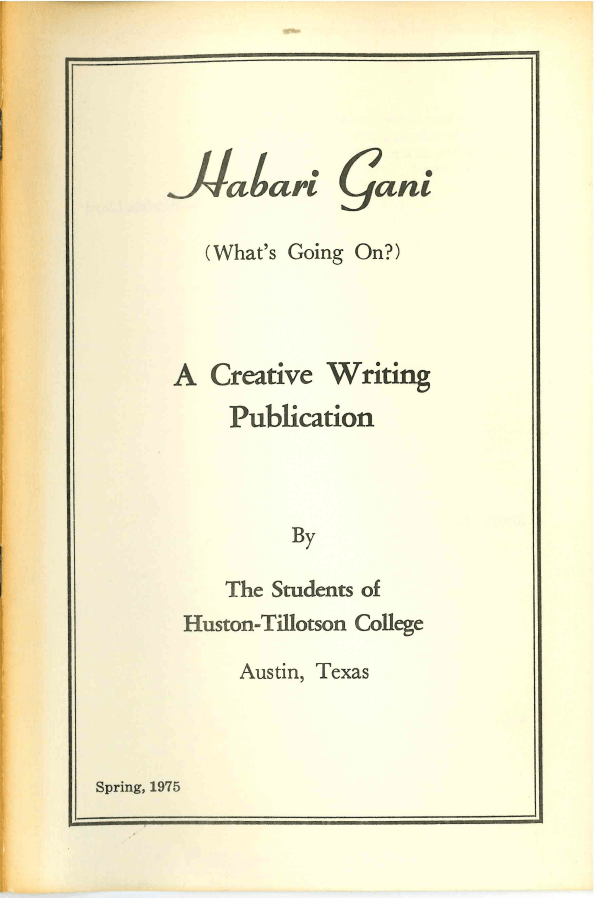
One of the products of that program was Habari Gani, a poetry anthology created and supported by the HTU student government and sponsored by Dr. Porter. “Habari Gani” is Swahili, which means “What’s going on?”
There was a poetry contest which preceded the publishing of Habari Gani. Mine didn’t make the cut and I left the school before I could get a copy of the anthology. Luckily, after a short web search, I was able to connect with the HTU librarian, who was kind enough to send me a digital copy in 2016. I like the introductory poem:
“Let your hum be the dream
Of an understanding universe…
Let your hum be a perfect
Utopia of love”
–Patricia Lloyd
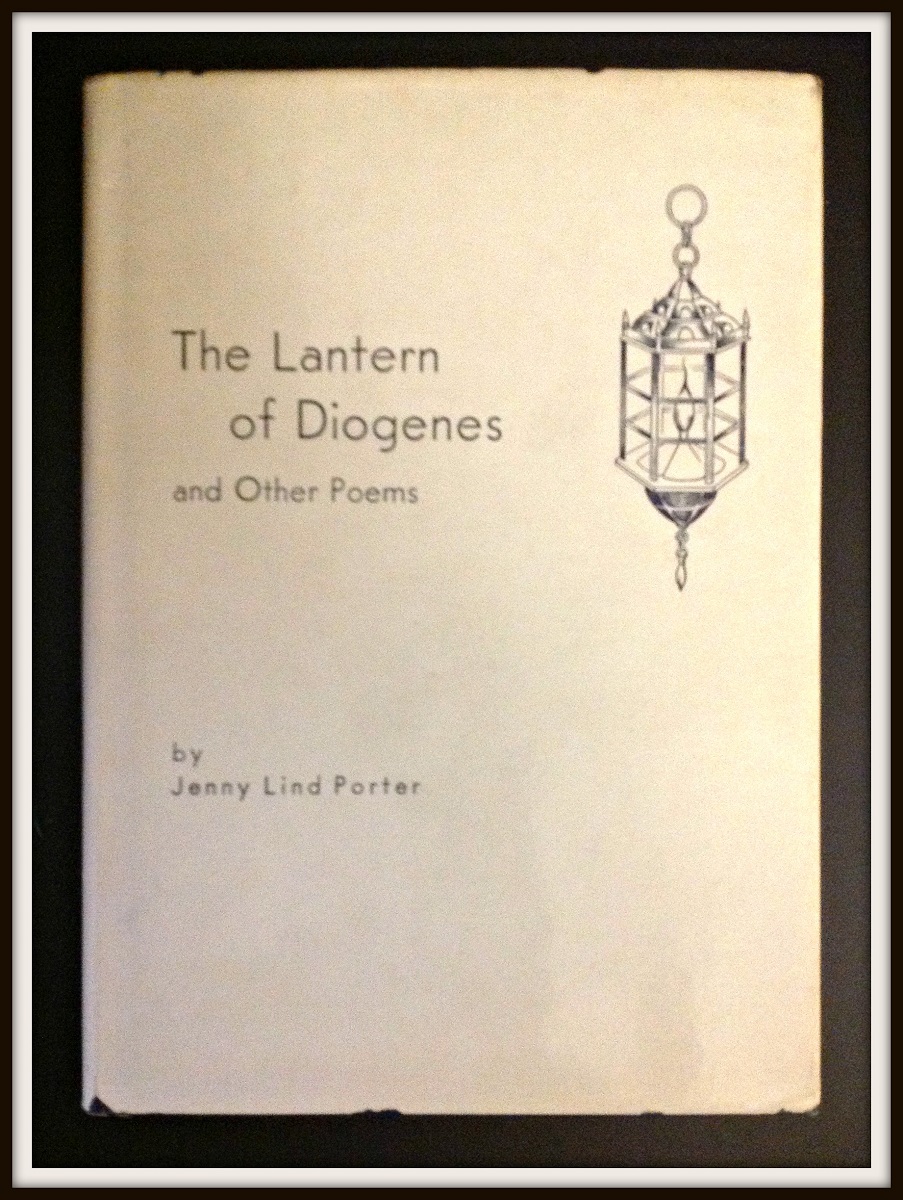
Around that same time and in previous years, I would sometimes hear about Dr. Porter. Just when I had forgotten her, it would seem like somebody would send me a message about her. That began around 2011 when I left the one and only review on Amazon about one of her books of poetry, The Lantern of Diogenes and Other Poems, first published in 1954. It’s the only one I have. I was never able to connect with her after I left HTU.
Sadly, in 2016, I found out that the City of Austin, Texas was proposing to demolish her house. I watched the video-recorded public proceedings of the city council meetings involving the Austin Historic Landmark Commission. Those who knew Dr. Porter wanted to preserve the house as an example of the work done by a famous local architect (which they believed they could verify) and to honor her stature in literature and education. The meetings were painful to watch. I gathered that Dr. Porter’s house had fallen into disrepair and little could be done to preserve it. She had also developed a dementing illness which impaired her ability to manage her own affairs. Her husband had died several years earlier and it sounded like a decision-maker had been appointed to help her.
I had email messages from the Historic Preservation Officer and the local architect who planned to build a house with similar architectural style for a client. The plan included a micro free library, a small replica of the original house at the corner of the lot, and other items. The project was to begin about 8 months after demolition and I’ve not heard anything since. A Google Map search dated March 2019 shows a weed-covered empty lot at 1715 Summit View Place. There are hard facts of life I would rather forget sometimes. But I keep a few memories.
What I remember most vividly is her live poetry reading performance at the annual Faculty Talent Show on campus. It was held in the Agard-Lovinggood Auditorium (now a campus administration building).
Her act brought down the house because it was a strip tease. Don’t get me wrong, there was nothing salacious about it. It was absolutely typical for her legendary sense of humor and style. Of course, it was the ‘70s. Too bad I didn’t have a camera.
Dr. Porter loved her students. We believed in her courage, kindness, and strict attention to the sense and structure of English literature and language. My poem didn’t make it into Habari Gani for any other reason other than it was bad poetry. The important thing was—our lives mattered a great deal to her. She tried to teach me about Rosicrucianism, but it was over my head. The lead poem from her book is pretty down to earth.
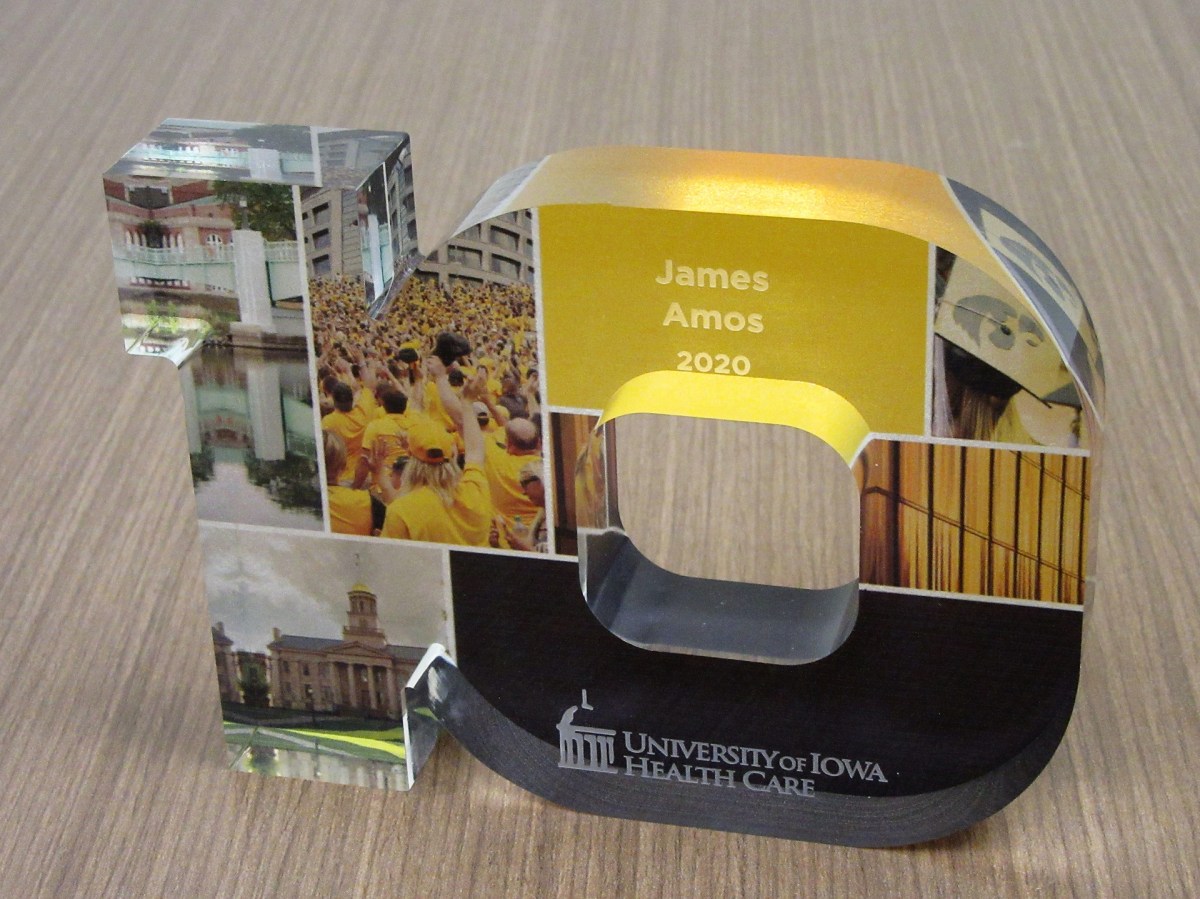
I got a nice, if puzzling surprise today. At a faculty meeting I was recognized for my 10-year anniversary of service at our hospital. It’s an important milestone, even if it is wrong. They scheduled this small event a couple of months ago, but I was too busy on the psychiatry consult service to break away. I also usually carry the pager for the trainees during the noon hour when the faculty meetings are held.
The 10-year anniversary recognition was very kind—except that I’ve been here for twenty odd years, not counting residency and medical school.
In all fairness, my department knows that and we shared a few jokes about it. I guess I should clarify that I have left the university for private practice a couple of times, which interrupts the years of service recognition timelines.
I was gone both times for a total of less than 12 months—just sayin’. I returned for a few reasons, although mainly because I missed teaching.
Anyway, I showed up at the faculty meeting, albeit a little guilty looking because I’m usually too busy to attend. My department chair arrived and said that she had to run back to get my “statue.”
That jarred me. Several years ago, when I had my first blog, The Practical Consultation-Liaison (C-L) Psychiatrist, I used to kid my readers that someday a statue of me would be erected in the university Quad. It would be made of Play-Doh.
And that’s why I asked her as she turned to leave, “Is it made of Play-Doh?” She looked puzzled and I didn’t really think I could explain in a way that wouldn’t make me look like I’d been smoking something illegal.
The “statue” is a handsome little sculpture of the number 10, standing for 10 years of service. It has color photos embedded in it of various aspects of academic life at the University of Iowa, many of which I’ve had the privilege of enjoying in the 30 odd years my wife, Sena, and I have been in Iowa City.
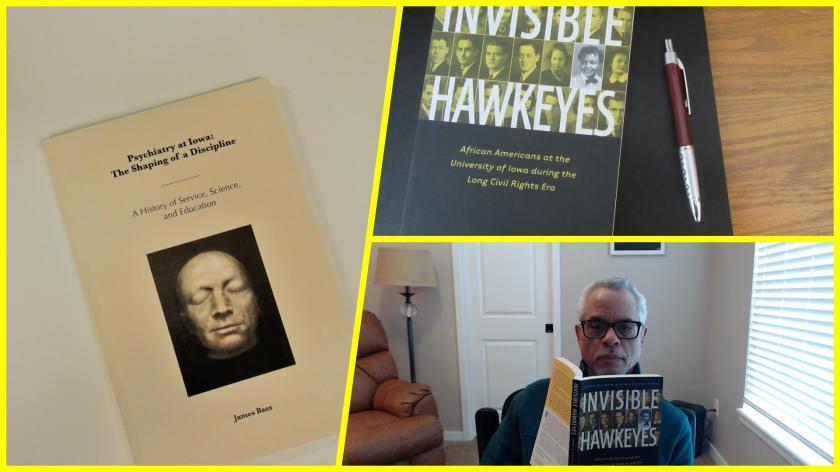
Just before the meeting, I had walked up to the 8th floor (I always take the stairs) to the psychiatry department offices to see if I could get a copy of the recently published history of the department, Psychiatry at Iowa: The Shaping of a Discipline: A History of Service, Science, and Education, written by James Bass.
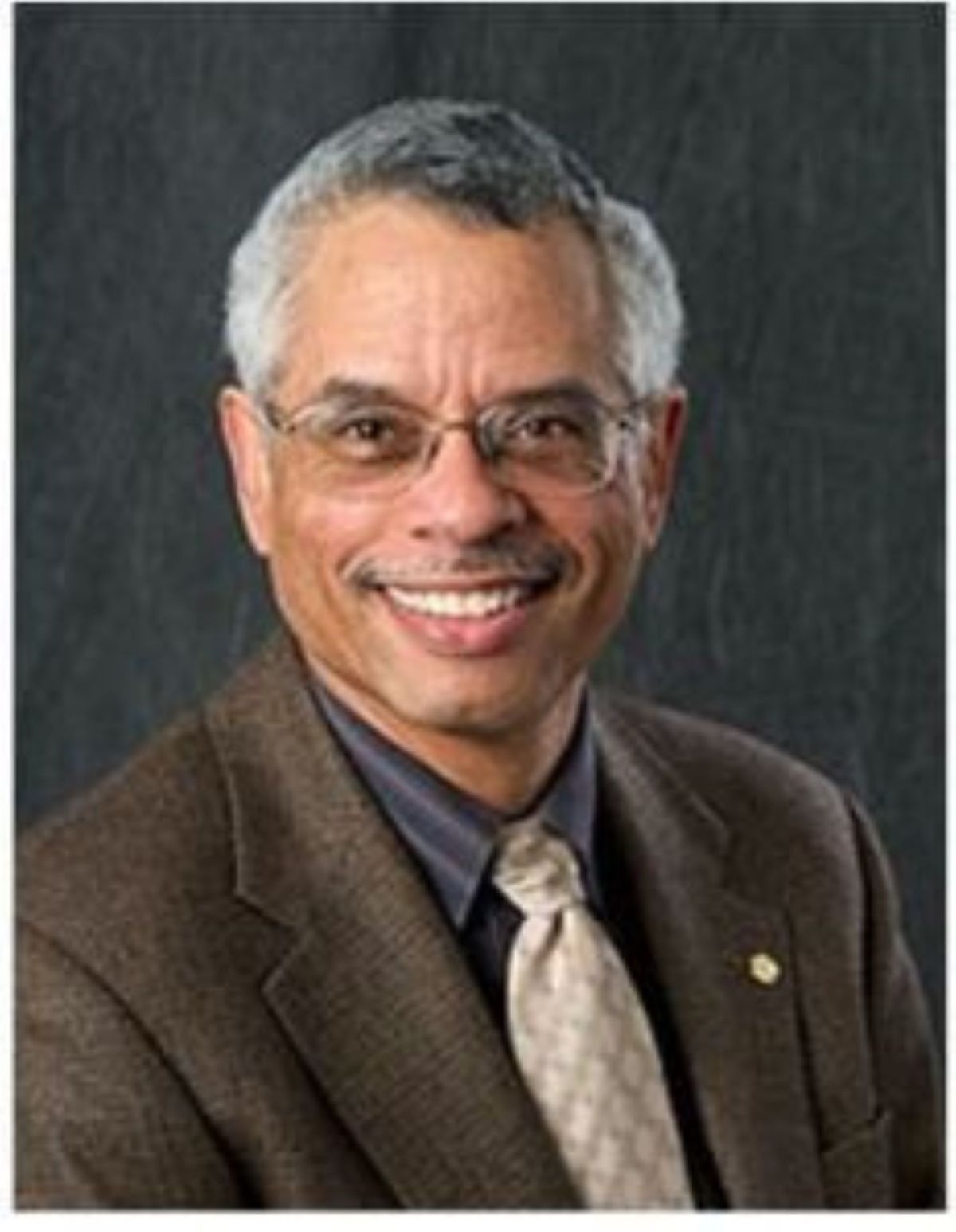
Mr. Bass interviewed many people in the department, including me. I didn’t expect that my perspective on the consultation service, the clinical track, or my race would even get mentioned. However, 2 out of 3 made it into print.
It didn’t really surprise me that my being African American was not mentioned. I think I’m probably the only African American faculty member of the department in its 100-year history, at least until very recently.
It reminded me of another book that I just acquired, Invisible Hawkeyes: African Americans at the University of Iowa during the Long Civil Rights Era, edited by Lena M. Hill and Michael D. Hill.
In a small way, I’m making the invisible visible.
Making the invisible visible
And also, because it’s great for my ego, I’m going to quote what Bass wrote about me in Chapter 5, The New Path of George Winokur, 1971-1990:
“If in Iowa’s Department of Psychiatry there is an essential example of the consultation-liaison psychiatrist, it would be Dr. James Amos. A true in-the-trenches clinician and teacher, Amos’s potential was first spotted by George Winokur and then cultivated by Winokur’s successor, Bob Robinson. Robinson initially sought a research gene in Amos, but, as Amos would be the first to state, clinical work—not research—would be Amos’s true calling. With Russell Noyes, before Noyes’ retirement in 2002, Amos ran the UIHC psychiatry consultation service and then continued on, heroically serving an 811-bed hospital. In 2010 he would edit a book with Robinson entitled Psychosomatic Medicine: An Introduction to Consultation-Liaison Psychiatry.” (Bass, J. (2019). Psychiatry at Iowa: A History of Service, Science, and Education. Iowa City, Iowa, The University of Iowa Department of Psychiatry).
In chapter 6 (Robert G. Robinson and the Widening of Basic Science, 1990-2011), he mentions my name in the context of being one of the first clinical track faculty in the department. In some ways, breaking ground as a clinical track faculty was probably harder than being the only African American faculty member in the department.
As retirement approaches this coming June, I look back at what others and I worked together to accomplish within consultation-liaison psychiatry. The challenges were best described by a former President of the Academy of Consultation-Liaison Psychiatry, Thomas Hackett (this quote I helped find for James Bass and anyone can view it on the Internet Archive):
“A distinction must be made between a consultation service and a consultation liaison service. A consultation service is a rescue squad. It responds to requests from other services for help with the diagnosis, treatment, or disposition of perplexing patients. At worst, consultation work is nothing more than a brief foray into the territory of another service, usually ending with a note written in the chart outlining a plan of action. The actual intervention is left to the consultee. Like a volunteer firefighter, a consultant puts out the blaze and then returns home. Like a volunteer fire brigade, a consultation service seldom has the time or manpower to set up fire prevention programs or to educate the citizenry about fireproofing. A consultation service is the most common type of psychiatric-medical interface found in departments of psychiatry around the United States today.
A liaison service requires manpower, money, and motivation. Sufficient personnel are necessary to allow the psychiatric consultant time to perform services other than simply interviewing troublesome patients in the area assigned. He must be able to attend rounds, discuss patients individually with house officers, and hold teaching sessions for nurses. Liaison work is further distinguished from consultation activity in that patients are seen at the discretion of the psychiatric consultant as well as the referring physician. Because the consultant attends social service rounds with the house officers, he is able to spot potential psychiatric problems.”— Hackett, T. P., MD (1978). Beginnings: liaison psychiatry in a general hospital. Massachusetts General Hospital: Handbook of general hospital psychiatry. T. P. Hackett, MD and N. H. Cassem, MD. St. Louis, Missouri, The C.V. Mosby Company: 1-14.
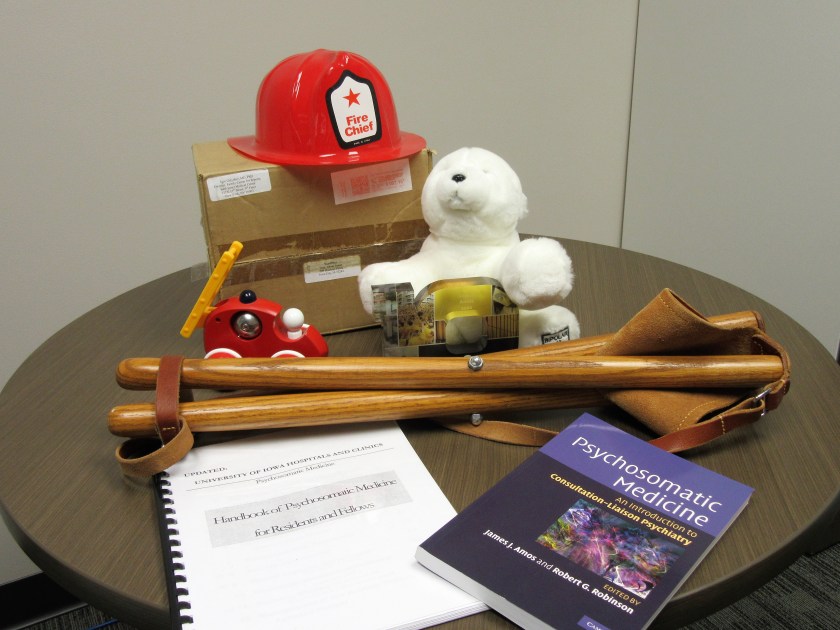
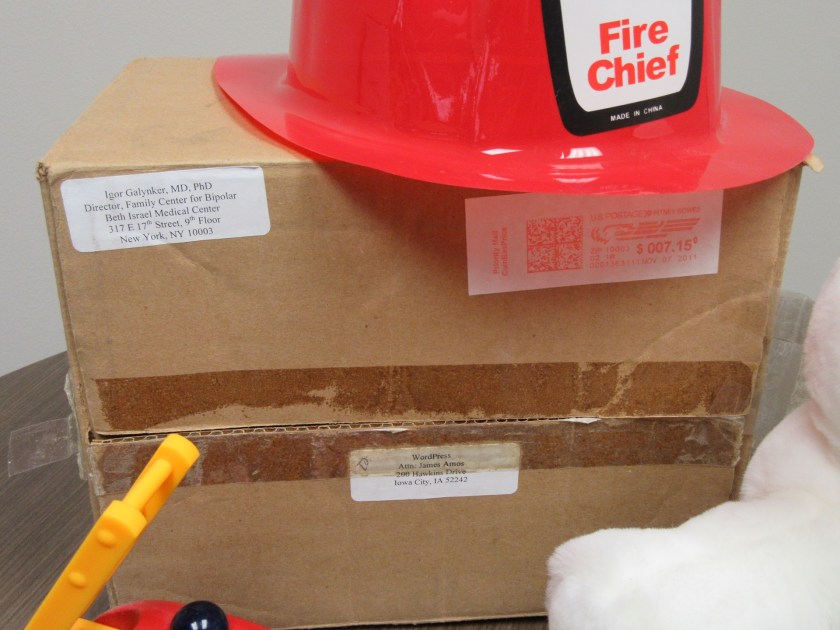
I have what seems like precious few mementos of my sojourn here in the department and, indeed, on this earth. I have a toy fireman’s helmet I found hanging in a plastic sack on my office doorknob one day. It was a gift from a Family Medicine resident who rotated on the consult service and who learned why I called it a fire brigade.
For the same reason, I have a toy fire truck, sent to me by a New York psychoanalyst who was also a blogger.
I have Bumpy the Bipolar Bear, believe or not, sent to me by psychiatrist, Dr. Igor Galynker, about whose emergency room suicide risk assessment method I had blogged about several years ago. C-L psychiatrists do a lot of suicide risk assessments in the hospital and the clinics. I still have the box with the address to me:
WordPress
Attn: James Amos
200 Hawkins Drive
Iowa City, IA 52242
I have my first homemade handbook for C-L Psychiatry and the published handbook that eventually replaced it. Thank goodness the leaders of the Academy of Consultation-Liaison Psychiatry listened to the membership and changed the name from Psychosomatic Medicine to C-L Psychiatry.
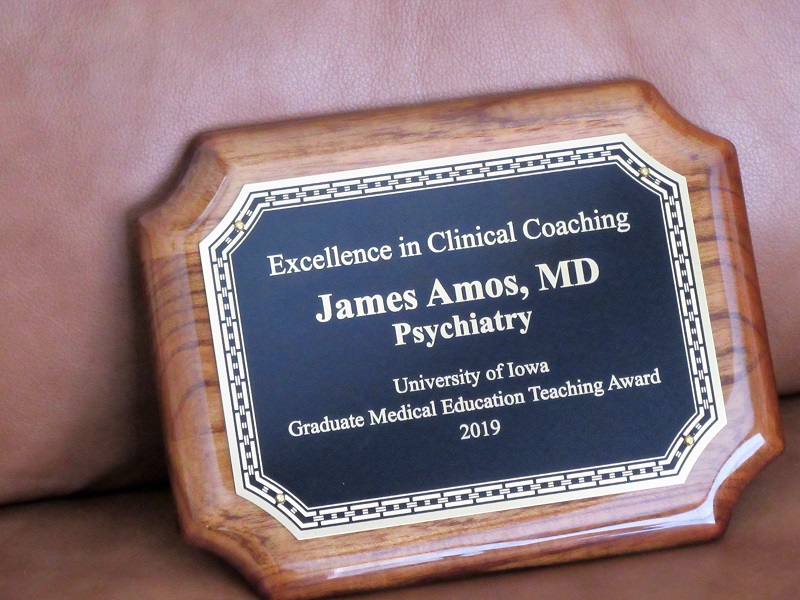
I have an award for being an excellent clinical coach.
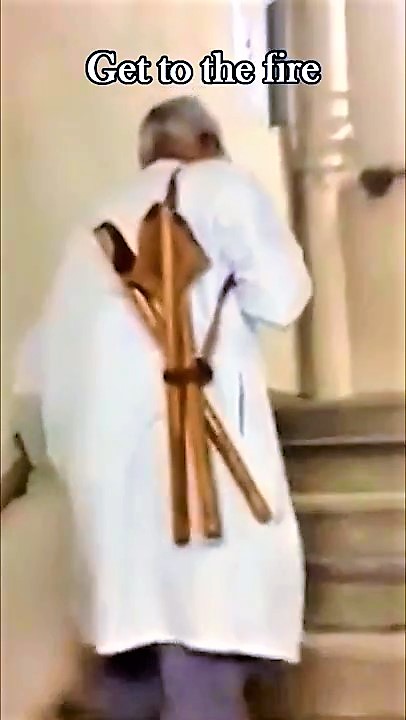
And I have my little camp stool, which a colleague who is a surgeon and emergency medicine physician gave me and which allows me to sit with my patients anywhere in the hospital, so that I don’t have to stand over them.
It will all fit in a cardboard box on my last day—the next milestone.
I took the picture of the little chair one of the residents brought to the psychiatry consult office yesterday. I got a big charge out of it, especially because I’ve been using a version made of wood and leather for a few years now. I think it’s possible that it could be an auspicious chair.
The resident actually used his, too. It was a busy day; I put in about 4 miles and 40 floors on my step counter—which meant the residents did too. The chair is obviously useful to rest our feet, but I think Thomas P. Hackett summed up the best ever rationale for sitting with patients:
“As a matter of courtesy, I sit down when interviewing or visiting patients. Long accustomed to the ritual of making rounds, many physicians remain standing as a matter of course. Standing, physicians remind me of missiles about to be launched, poised to depart. Even if that is not necessarily true, they look the part. Patients sense this and it limits conversation. In addition, when standing, the physician necessarily looks down on the patient. This disparity in height is apt to encourage the attribution of arrogance. Looking down at a patient who is prone emphasizes the dependency of the position. Sitting at the bedside equalizes station. Sitting with a patient need not take longer than standing with him.”— Hackett, T. P., MD (1978). Beginnings: liaison psychiatry in a general hospital. Massachusetts General Hospital: Handbook of general hospital psychiatry. T. P. Hackett, MD and N. H. Cassem, MD. St. Louis, Missouri, The C.V. Mosby Company: 1-14.
I had a little fun with the chair in a YouTube video as well.
The chair I use now is a replacement for the first one I got as a sort of loaner from a colleague in Palliative Care Medicine. That one broke during a consultation visit with a patient and his family (circumstances disguised to protect confidentiality) in the emergency room in which we were asked to evaluate for catatonia. The patient was mute but there was little evidence otherwise for catatonia, one of the chief features of which is the inability to react to any stimulus in the environment. I was sitting on the chair explaining in detail the intravenous lorazepam challenge test for catatonia (which often interrupts the episode of muteness and immobility).
I was sitting in front of the patient but facing the family and the consult service trainees while expatiating on the topic. As I was droning on, I heard a sudden pop—and I fell unceremoniously on my rear end as the chair collapsed beneath me.
My audience exploded in loud laughter, of course, as you’d expect when a pompous ass falls on his ass. But they also pointed to the patient. When I turned to look at him, he was convulsed with apparent mirth although still unable to make a sound.
I considered this a novel test for catatonia, negative in this case. Of course, it would be impractical for regular use.
Where was I? Oh, the little chair the resident brought for consult rounds. I was honored by it. It seemed to show that I was leaving a legacy as I head for retirement in June.
Another sign of leaving a legacy was a New Year’s email message I got from a former resident, Dr. Paul Thisayakorn, MD, who has been making an auspicious beginning in the field of consultation-liaison psychiatry in Thailand. He’s working very hard and is an outstanding clinician, researcher, and teacher. He has a lovely family. He and I respect each other a great deal.
Speaking of auspicious, when Paul graduated from our psychiatry residency and before leaving for his Consultation-Liaison fellowship program, he gave me a necktie with white elephants printed on it. I still have it. I may not have the symbolic meaning of the white elephant exactly right, but I think the white elephant in Thai culture is called “chang samkhan,” or maybe “chang phueak” which means “auspicious elephant.” In general, I think the idea is they symbolize success or at least the promise of success. Paul’s gift showed his gratitude and respect for me because I was one of his teachers. I am still honored to have been a part of his education and his life. I will always treasure his gift of gratitude.
An auspicious tie
Paul is very hard-working and very successful. And if the residents now start to use the little camp stools to sit with their patients, I would treasure that legacy as well.








 Go Retire Psychiatrist