Could Artificial Intelligence Help Clinicians Conduct Suicide Risk Assessments?

I found an article in JAMA Network (Medical News & Perspectives) the other day which discussed a recent study on the use of Artificial Intelligence (AI) in suicide risk assessment (Hswen Y, Abbasi J. How AI Could Help Clinicians Identify American Indian Patients at Risk for Suicide. JAMA. Published online January 10, 2025. doi:10.1001/jama.2024.24063).

I’ve published several posts expressing my objections to AI in medicine. On the other hand, I did a lot of suicide risk assessments during my career as a psychiatric consultant in the general hospital. I appreciated the comments made by one of the co-authors, Emily E. Haroz, PhD (see link above).

Dr. Haroz preferred the term “risk assessment” rather than “prediction” referring to the study (Haroz EE, Rebman P, Goklish N, et al. Performance of Machine Learning Suicide Risk Models in an American Indian Population. JAMA Netw Open. 2024;7(10):e2439269. doi:10.1001/jamanetworkopen.2024.39269).

The model used for the AI input used data available to clinicians in patient charts. The charts can be very large and it makes sense to apply computers to search them for the variables that can be linked to suicide risk. What impressed me most was the admission that AI alone can’t solve the problem of suicide risk assessment. Clinicians, administrators, and community case managers all have to be involved.

The answer to the question “How do you know when someone’s at high risk?” was that the patient was crying. Dr. Haroz points out that AI probably can’t detect that.

That reminded me of Dr. Igor Galynker, who has published a lot about how to assess for high risk of suicide. His work on the suicide crisis syndrome is well known and you can check out his website at the Icahn School of Medicine at Mount Sinai. I still remember my first “encounter” with him, which you can read about here.

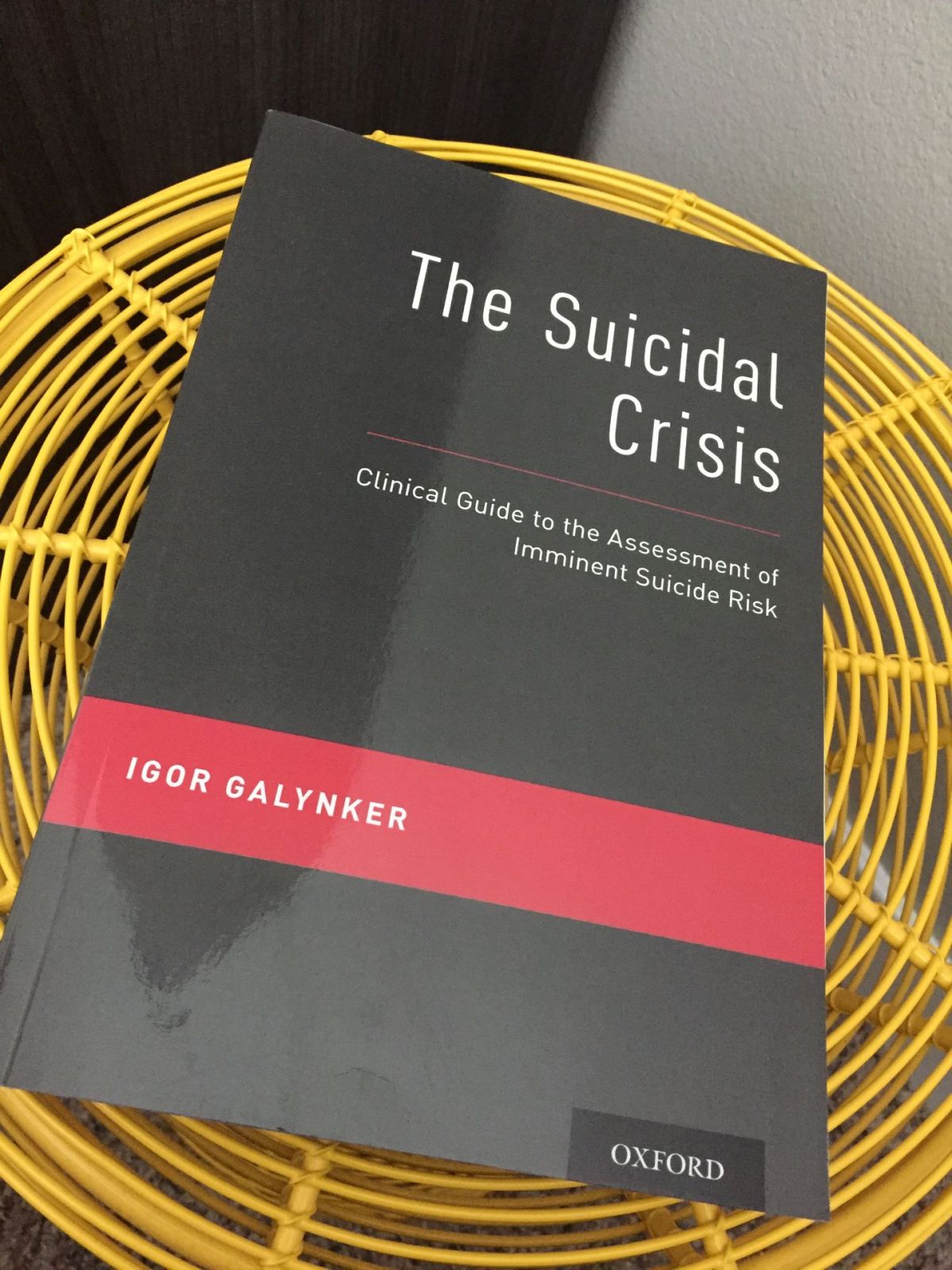
His checklist for the suicide crisis syndrome is available on his website and he’s published a book about as well, “The Suicidal Crisis: Clinical Guide to the Assessment of Imminent Suicide Risk 2nd Edition”. There is also a free access article about it on the World Psychiatry journal website.

Although I have reservations about the involvement of AI in medicine, I have to admit that computers can do some things better than humans. There may be a role for AI in suicide risk assessment, and I wonder if Dr. Galynker’s work could be part of the process used to teach AI about it.
Dr. Igor Galynker and The Suicidal Crisis Syndrome

I was looking at my bookshelves and found the copy of the book, “The Suicidal Crisis: Clinical Guide to the Assessment of Imminent Suicide Risk.” It was written by Dr. Igor Galynker. It’s a fit topic for this month because September is National Suicide Prevention Month.

This brings back memories. I still have a gift from Dr. Galynker. It’s a stuffed animal called Bumpy the Bipolar Bear.

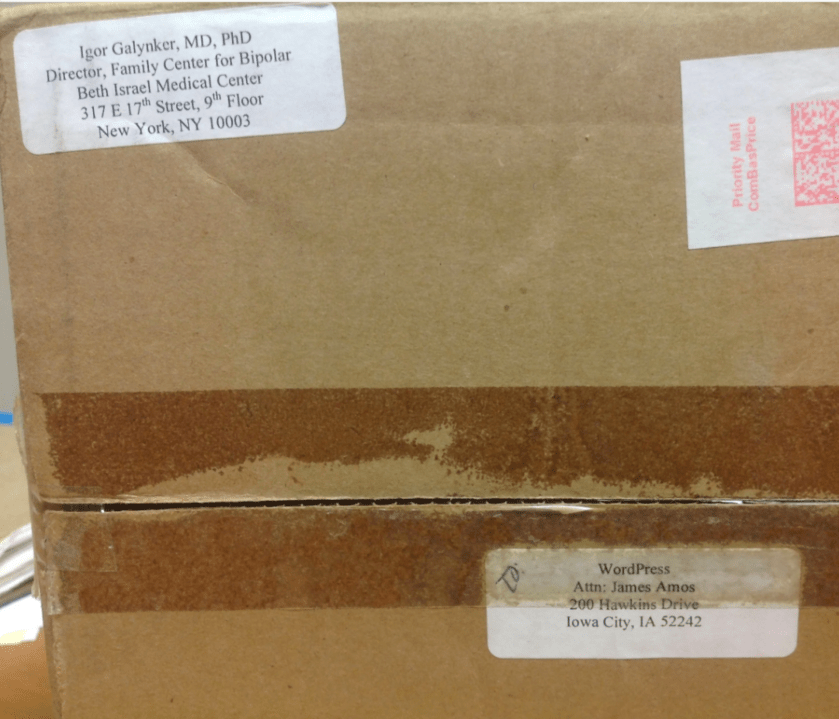
It arrived at my office at The University of Iowa Hospitals & Clinics in 2011. It was in a box addressed to:

WordPress

Attn: James Amos

200 Hawkins Drive

Iowa City, IA 52242

 I’m still not entirely sure why he sent me Bumpy. There was no letter of explanation. I was writing a blog at the time called “The Practical Psychosomaticist” and I might have posted something about some research he published on suicide risk assessment.

I bought a copy of his book a few years ago. I barely had time to skim a few of the chapters because I was too busy conducting suicide risk assessments in the emergency room, the general hospital, and the clinics in my role as a psychiatric consultant. In fact, I think it’s an excellent resource.

I also found a YouTube video (posted about a month ago) in which he describes his suicide crisis syndrome assessment. You can find the actual set of questions for the assessment here and in a link posted in the description below the YouTube.

September is National Suicide Prevention Month

September is National Suicide Prevention Month. The 988lifeline website has many resources for getting the word out about the importance of not missing any opportunities to help prevent suicide.

In fact, there is a recently published article entitled “Multiple Missed Opportunities for Suicide Risk Assessment in Emergency and Primary Care Settings.” A few of the important take home points:

  • “Screening for suicide risk, while a critical step in potentially preventing death or injury by suicide, is fraught with additional challenges centering around the poor sensitivity and specificity of many of the screening tools. The widely used PHQ-9 question about suicide has poor sensitivity and specificity. A much better screening tool we recommend is the Columbia-Suicide Severity Rating Scale Screener which can be administered by both clinicians and non-clinician individuals who have been trained in its use.
  • So called “no harm contracts” are best avoided and, instead, replaced with approaches that emphasize joint planning that more respectfully builds upon patients’ innate resiliency to self-soothe, build upon one’s protective factors and reduce those risk factors that are modifiable, and problem-solve ways to create a series of “what-if” scenarios of what to do if suicidal feelings start to intensify
  • Firearms are the leading means of fatal suicides in the U.S. Effort to ensure patients at risk for suicide do not have access is critical
  • There is a bidirectional and undoubtedly complicated relationship between substance use and suicide.”

This is National Suicide Prevention Week

Thanks to Dr. H. Steven Moffic for his Psychiatric Times article, “A Psychological Autopsy on My Only Patient Who Died by Suicide.” In it he describes his own experience with a patient who committed suicide. He also reminded us that this is National Suicide Prevention Week. It’s also National Suicide Prevention Month.

The quote I’m familiar with about psychiatrists and patients who die by suicide Moffit is by forensic psychiatrist, Robert Simon:

“There are two kinds of psychiatrists—those who have had a patient die by suicide and those who will.”

I have been through that experience. It led me to focus on my role as an educator to psychiatry residents and other trainees to learn as much as I could about the process of suicide risk assessment.

On the other hand, my first experience with someone who died by suicide happened long before I became a psychiatrist. It was in the early 1970s and I was working for a consulting engineer company. I was just a kid, learning on the job to be a drafter and surveyor’s assistant.

One of my teachers was a man I would come to respect a great deal. Lyle was a land survey crew chief and part time photographer. He was gruff, but kind and had a great sense of humor. We all liked him.

He was so tough that, while perched high in a tree and trimming a large branch to enable a line of sight for the instrument man running a theodolite (used to measure vertical and horizontal angles)—he accidentally cut a significant gash in his hand. We on the ground were aghast because blood was dripping from his hand.

He just laughed and said, “I don’t sweat the small stuff.”

One day, he told me and another survey crew member that his girlfriend left him, saying she was tired of picking up after him. He was crying. We felt sorry for him and didn’t know what to say. We never saw him cry before. This image was strikingly different from the tough guy persona he usually had.

As I look back on it, I wondered why he didn’t think the breakup was just more “small stuff.”

The next day, one of the leaders of the company made a short announcement, saying that Lyle had “passed away,” the night before, by suicide. A little later, the rest of the story gradually emerged. Lyle had shot himself in the chest. One of the guys said that it took a long time for him to die, that somebody found him early the next morning, and all Lyle could say was “It hurts.” At first, I thought he meant physical pain. Later, I wondered if he meant physical and emotional pain.

About a week later, one of the survey crew members was planning to pick me up and drive us to Lyle’s funeral. He never showed up.

Of course, I could not have foreseen Lyle’s suicide based on his being so upset about a breakup with his girlfriend. I was just a kid.

When I became a psychiatrist, I saw this quite a lot. I learned, a few times the hard way, how to make the best judgments I could about what might happen to a patient describing physical and emotional pain.

Thoughts on Suicide Risk Assessment

I know the term “suicide risk assessment” sounds very clinical. That’s because I did it for many years as a consultation-liaison psychiatrist in the general hospital.

The human part of it was using the suicide safety plan, which I got from the Centre for Applied Research in Mental Health & Addiction (CARMHA). You can download it yourself and adapt it by writing in the National Suicide Prevention Lifeline: 988 Suicide and Crisis Lifeline. That’s because the phone numbers on the form are specific to Canada.

Most often I interviewed patients in the intensive care units, where they were admitted after a suicide attempt. The interviews were very short if they refused to talk to me or were still delirious—often the case.

If they were awake and able to converse, the interviews were often pretty long. One way to connect with the patient was working on the safety plan together. I was often able to tell whether they were sincere or not by the level of detail they gave me about support persons they could get in touch with or things they could do to help them cope with whatever was troubling them.

A lack of detail in the plan, or refusal to work on some parts of it were areas of concern. If there were comments about friends, pets, or pastimes that spontaneously led to laughter (yes, that happened occasionally!), I was more confident that the patient was able to look toward the future and make specific plans for staying alive.

There is healthy debate about how useful specific suicide risk assessment scales are for predicting and preventing suicide. They are an essential part of the computerized medical records now, whatever anyone thinks of their reliability at predicting imminent suicide. I never used no-suicide contracts because well before the time I entered professional practice, most experts agreed that they don’t prevent suicide.

What was more useful for me as a clinician was to sit down at the patient’s bedside and, after getting the details about what the patient actually did in the suicide attempt and the events connected with it (along with a comprehensive and thorough history), I would get the safety plan from my clipboard, hold it up so they could see it and say, “Now let’s work on this; it’s your safety plan.”

I can’t tell you how often working on those plans, frequently for more than half an hour, led to laughter as well as tears from the patient. When it worked, meaning the relationship between us deepened, I sometimes did not find it necessary to admit the person to the psychiatric ward. While this occasionally alarmed the ICU nurses, things usually turned out fine later.

Suicide Risk Assessment Update 2019

I updated my suicide risk assessment presentation today in light of new data on suicide risk assessment stratification. It turns out that using such tools might not be supported by the research evidence. That’s not going to stop the use of such tools, which include the Columbia–Suicide Severity Rating Scale, which is in wide use.

I found criticism of these scales in a recently published article in Clinical Psychiatry News, published June 21, 2019, “Why we need another article on suicide contracts,” by Nicholas Badre, MD and Sanjay S. Rao, MD.

For many years now, psychiatrists and other health care professionals have learned that trying to use no-suicide or no-self harm contracts are controversial and don’t prevent suicide. Badre and Rao sound like they’re easing away from that contention although they still say that a thorough clinical suicide risk assessment ought to be done.

Until I saw this article, I was not aware of a recent review of 70 studies showed that: “no individual predictive instrument or pooled subgroups of instruments were able to classify patients as being at high risk of suicidal behavior with a level of accuracy suitable to be used to allocate treatment.”

Carter, G., et al. (2017). “Predicting suicidal behaviours using clinical instruments: systematic review and meta-analysis of positive predictive values for risk scales.” Br J Psychiatry 210(6): 387-395.

This was even more interesting because we recently changed our practice regarding suicide risk assessments on the psychiatry consultation service based on relatively new recommendations from the Joint Commission on Accreditation of Hospital Organizations (JCAHO). The Joint Commission favors the risk assessment tools.

Of course I’m not going to second-guess the Joint Commission but after 27 years (counting residency) of struggling to assess suicide risk, I’ve learned that it can hardly be reduced to any single rating instrument.

I have often said to patients that I don’t use no-suicide contracts because they’re too much like promises—and promises are broken every day. That segues into what I prefer which is to work with the patients on developing a safety plan, which I compare to no-suicide contracts by saying “a plan is better than a promise any time.”

Working on the safety plan with patients gives me another way of assessing the strength of my alliance with them and a way to improve it as well as a method for evaluating their ability to formulate a workable way to stay safe that emphasizes their individuality.

On the other hand, the safety plan is no guarantee of safety, any more than the no-suicide contract.

But often enough I’ve gotten the sense that some patients and I have even had a little fun working on suicide safety plans—ironic as that sounds. I find how important pets are, hear little anecdotes about a favorite hobby or goal, aspirations, hopes, and memories of better times when they coped really well.

Listening for understanding to someone who is contemplating suicide or who has attempted suicide is never easy. It’s the hardest thing I do. I can’t say that I’ll miss it when I retire. I have great faith in the next generation of doctors.

New suicide risk assessment presentation