Right on time, the Iowa City Sculptors Showcase is out in the parks. The featured pieces all have a plate on the showcase pad with a QR Code you can scan to learn more about the works. They’ll be up for two years.
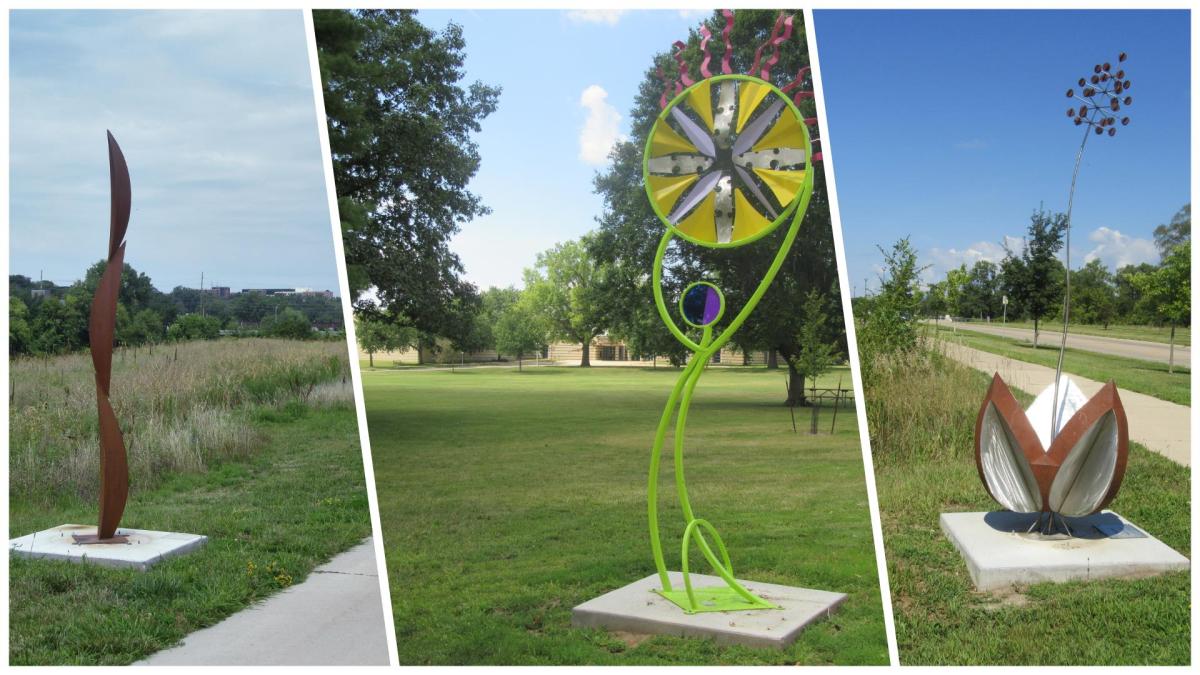
Tim Adams: “Exuberance” at Mercer Park, Bradford Dr; “Poppy” at Scott Park on Scott Blvd
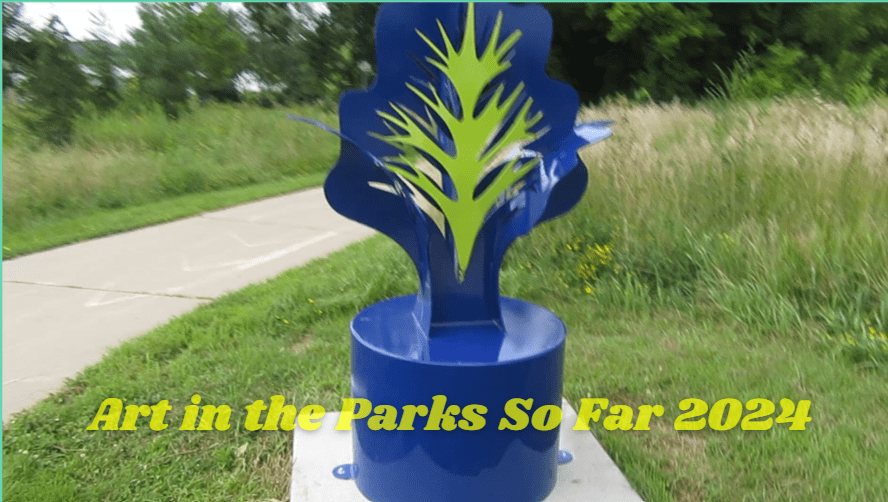
Hilde DeBruyne: “Gaia” and “Life Leaf” at Terry Trueblood Recreation Area, McCollister Blvd
V. Skip Willits: “Writing Figure” at Iowa River Trail; “Flight of Butterflies” at Riverfront Crossings Park
Kristin Garnant: “Mechanics of Grace” at Riverfront Crossings Park
Johnathan Goupell: “Pillars [1]” at Riverfront Crossings Park
We were driving by the Terry Trueblood Trail on July 28th and Sena noticed there was a new sculpture. We’ve been on the lookout for the new Art in the Parks collection since the announcement in May.
The anticipated opening date is August 7, 2024, but it looks like the artists are already getting started. Not all the new pieces we saw had title plaques yet, but there were 6 of them and they are very interesting.
We visited the parks earmarked in previous years: Terry Trueblood Recreational Area, Riverfront Crossings Park, Iowa River Corridor Trail, Mercer Park, and Scott Park.
So far, Tim Adams’s work, “Exuberance,” at Mercer Park is Sena’s favorite, although I think the sculpture of me and Herky is pretty good.
It was wicked hot, in the 90s and we saw a kid out at Mercer Park selling lemonade! Can you believe it? I peddled papers but I never sold lemonade. I figured he would charge a buck, but it was only 50 cents. He got a tip, believe me!
The new sculptures are out in the parks and they are wonderful! We dashed out a couple days ago and logged a little over 3 miles on my step counter visiting them in several locations. The best way to get started is to read the Iowa City article, “Iowa City Sculptors Showcase.” You can get a nice map to find out where the new sculptures are and more about the artists.
Sena can’t see why Tim Adams’ Open Arms sculpture was not named The Kiss—because that’s what she thinks it looks like.
We both like Adams’s interactive work, Prairie Tussock. It reportedly spins in the wind according to the description, but I think it would take something more like what the Weather Channel might warn you about.
In fact, it has a handle to grab and reminds me of a schoolyard game we called tetherball. It was a dangerous game and I just read that it was banned because the ball could smack you in the head. I don’t even want to think about what the swinging Prairie Tussock could do to you. Remember the movie Beetlejuice? One of the characters was a woman who was a sculptor. She had a great line, “This is my art and it is dangerous!” Keep your head down.
Sena’s number 2 favorite was Hilde DeBruyne’s Circle of Trust. Her number 3 was Adams’ The Kiss—I mean Open Arms.
Prairie Tussock was also my number 1 favorite. Number 2 was a toss up between Dan Perry’s Architrave and DeBruyne’s Circle of Trust. Number 3 for me was Aidar Ishemgulov’s Upside Down. There was so much height to Architrave that I missed getting the whole thing from top to bottom. We had to return the next day to get a proper shot. I think the top part of it resembles a torch.
We enjoyed all of them, though. We think you would too.
We finished the trek to all the sculptures in the new Art in the Parks collection. It was quite a day for walking in the August heat, but we made it. It was a day for the “nearly.” It was nearly 90 degrees and we walked nearly 5 miles.
Here’s a tip. The sculpture Emerging by Hilde DeBruyne is more than twice as far from Riverfront Crossings Park as it is from Terry Trueblood Recreation Area on the Iowa River Trail. But if you’re up for the exercise, go for it. The art is worth the walk.
All the sculptures are very interesting and worth making a day of exploration.
We went for a walk today in a couple of different parks recently. We were looking for the new art works that have been placed recently. We saw HOOPla in Mercer Park by Tim Adams and Succulent Bloom by Mike Sneller at Terry Trueblood Recreation Area. You can read more about art in the park in the Little Village magazine.
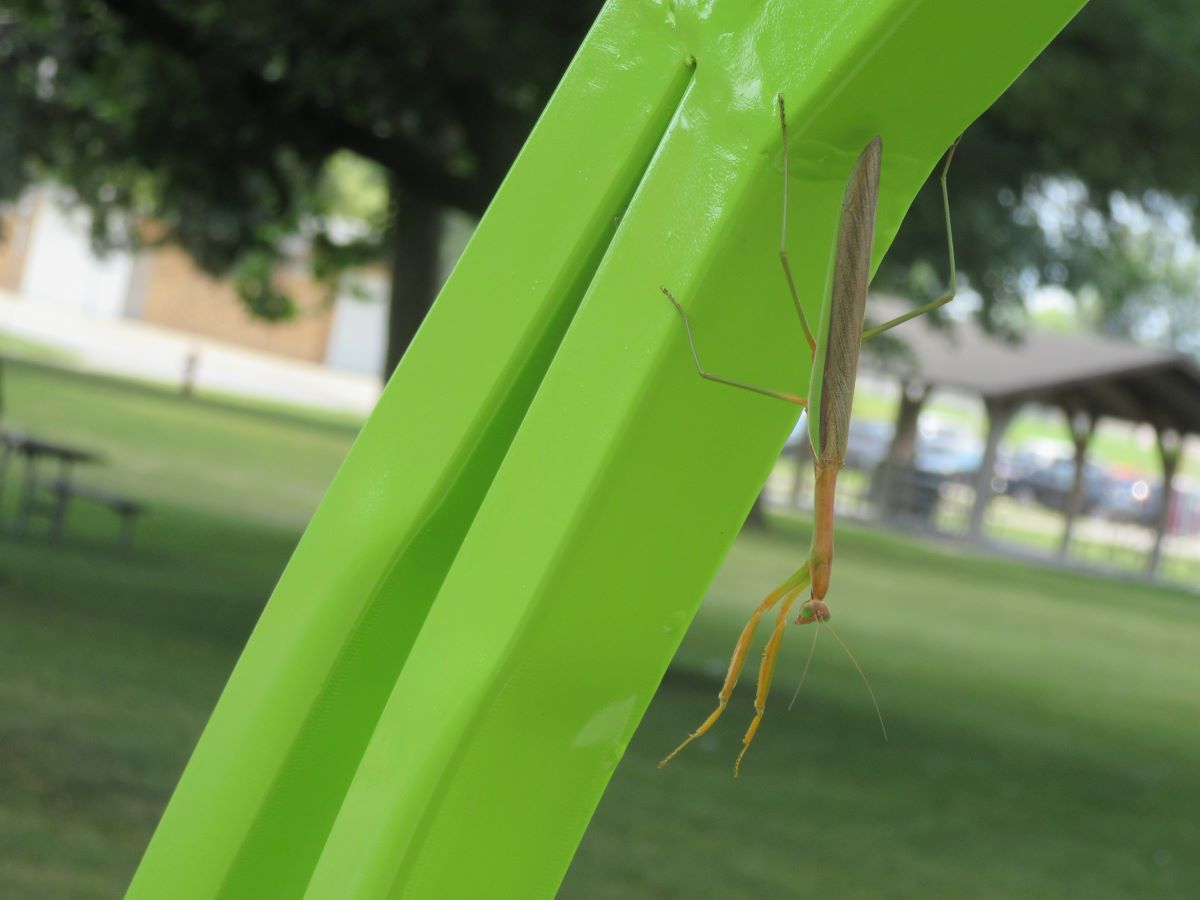
HOOPla happened to have a Chinese mantis on it. Sena thought it was part of the sculpture at first when seeing it from a distance. Then it moved.
We didn’t get to see all of the new art pieces, but plan on it soon.
Sena and I took a walk down Scott Boulevard today. The weather was practically balmy, compared to how cold it has been. Forty degrees above zero compared to 9 degrees below feels miraculous.
We walked past the Harvest Preserve entry. Across the street is what we’ve just learned is an old building that is known as the “Haunted Barn” (photo taken in August 2021).
We passed the 20-foot-tall, 110-ton Sitting Man sculpture, now on the west side of Scott Boulevard after it was moved from the east side of the road in July, 2020.
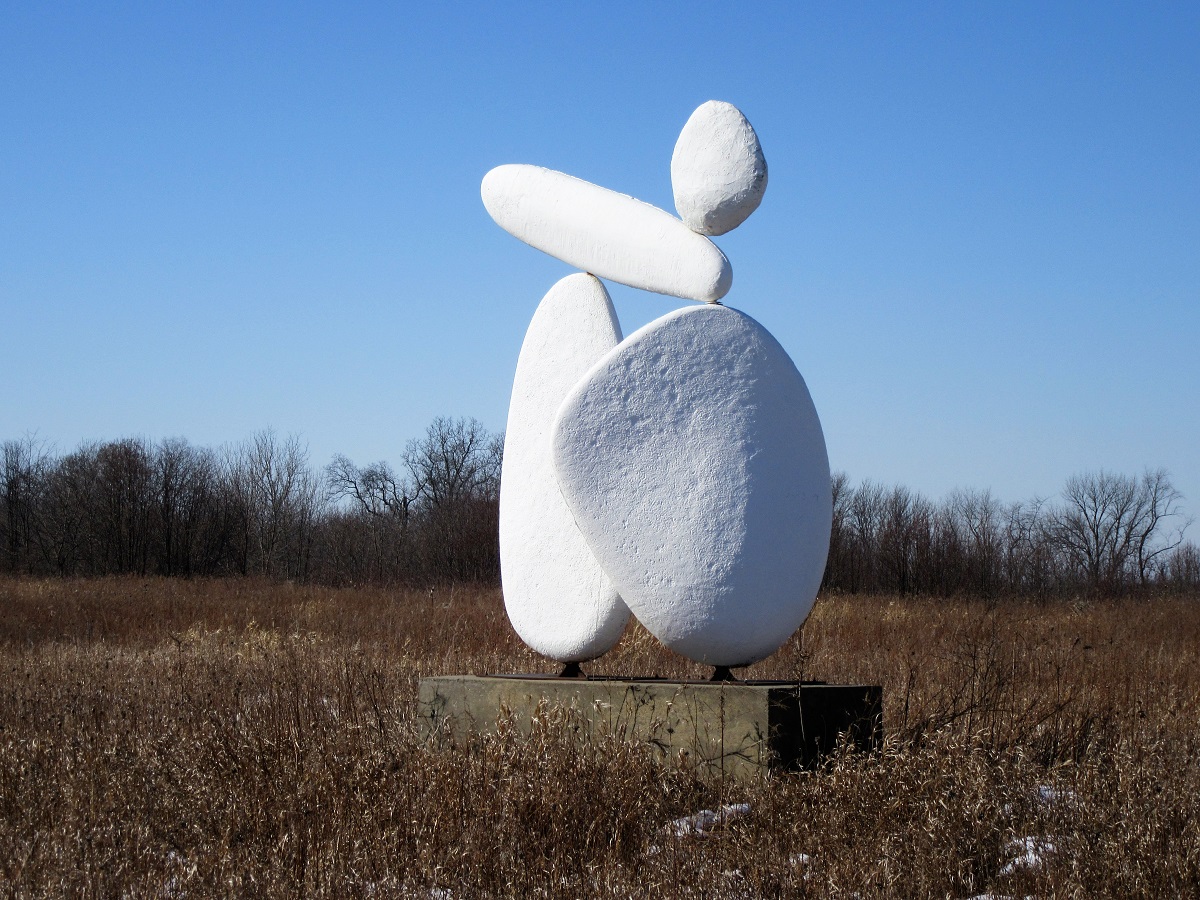
Today was the first time we trekked past the Sitting Man to Rochester Avenue and beyond. If we hadn’t, we would not have noticed a fascinating, blindingly white abstract sculpture mounted on a concrete block which we initially believed was on the Harvest Preserve property at the northwest corner of the intersection. Sena said it looked like a person, noting the head, arms, and body. I didn’t notice that.
After we got back home, I couldn’t find out anything about it on the web, no matter how much I connected the search terms to Harvest Preserve, the Sitting Man and so on. I found only one item with a photo and it was an announcement about a tour on Harvest Preserve in 2018. The impression is that the sculpture is on the property.
I sent an email inquiry to Executive Director of the Harvest Preserve Foundation, Inc., Julie Decker, whose email address is available on the website.
Ms. Decker informed me that the sculpture is technically not on Harvest Preserve property. She knew the sculpture is entitled “Family,” and the artist’s name was Eugene Anderson, who died in 2008. That’s all she knew.
It turns out that what little she knew led to an astonishing story that was even deeper and more engaging than we imagined. You can read the obituary of the Iowa City artist Eugene Anderson on legacy dot com. The highlights are that he started his career in architecture, was the University of Iowa Hospital and Clinics (UIHC) architect for 25 years, and then began creating original art work to display in the hospital to comfort patients. He later became a full-time sculptor, and was on the board of directors for “Arts Iowa City.”
I was a medical student, resident, faculty member and a consulting psychiatrist at UIHC, a career starting in 1988 and ending with my retirement in June of 2020. It’s possible I saw some of Anderson’s work while I was galloping around the hospital.
In 1994 he created the “Family Group” series of sculpture which have been displayed at Chait Galleries in Iowa City, Des Moines Art Center, and the Brunnier Art Museum in Ames, Iowa. The piece we saw might have been one of those. Unfortunately, I couldn’t find anything on the web about the series.
And what is more intriguing, Anderson also traveled extensively, even to Egypt where he cruised on the Nile and took a sunrise balloon ride over the pyramids.
How is it possible that so little of Eugene Anderson’s life and work are not better known? Come to think of it, I guess time can erase the memory of our accomplishments.
This little story reminded me of the poem “Ozymandias” by Percy Bysshe Shelley. I’ve forgotten all of my college freshman English Literature but a web search indicates that Ozymandias was based on Ramesses II, a king of ancient Egypt. Ozymandias was a great ruler of a vast empire. His sculptor built a huge monument in the desert and gave it the oft-quoted inscription, “Look on my works, ye Mighty, and despair!”
Ozymandias
Percy Bysshe Shelley-1792-1822
I met a traveller from an antique land Who said: “Two vast and trunkless legs of stone Stand in the desert . . . Near them, on the sand, Half sunk, a shattered visage lies, whose frown, And wrinkled lip, and sneer of cold command, Tell that its sculptor well those passions read Which yet survive, stamped on these lifeless things, The hand that mocked them, and the heart that fed: And on the pedestal these words appear: ‘My name is Ozymandias, king of kings: Look on my works, ye Mighty, and despair!’ Nothing beside remains. Round the decay Of that colossal wreck, boundless and bare The lone and level sands stretch far away.”
Today we searched for links on the web to find out more about a mysterious sculpture. We found links of a different kind, links to a stranger and to the near and the ancient past. Anderson’s sculpture, “Family,” is still standing, tall, clean, and bright for all to see.
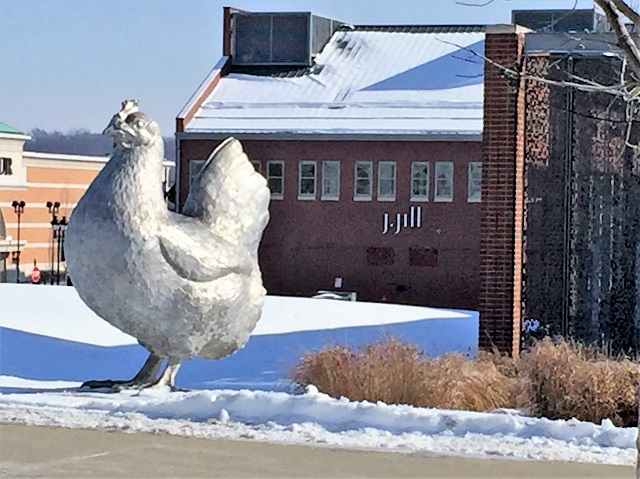
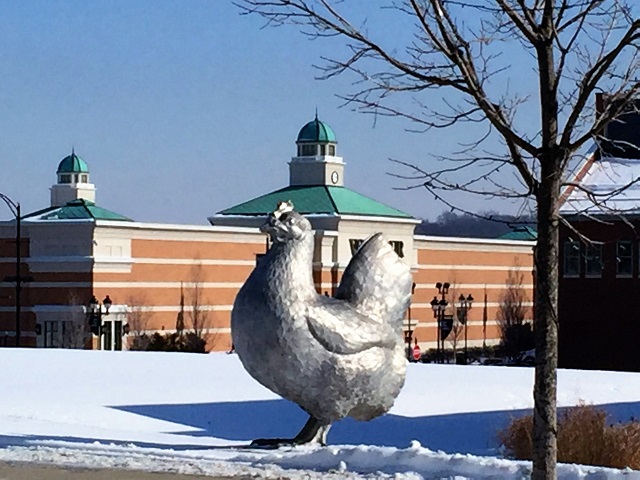
Last week, we were out at the Iowa River Landing (IRL) and saw a giant chicken. It’s actually a metal sculpture entitled Iowa Blue: The Urbane Chicken, 2013, one of 11 such works (all installed in 2013) of art making up the Iowa River Landing Sculpture Walk, located in the Coralville Marriott Hotel and Conference Center.
All of them are linked to literary works by authors associated with the Iowa Writers’ Workshop at the University of Iowa. The artist is Amber O’Harrow’s and her statement about the chicken is:
“I have created a sculpture of the noble chicken, as described in the poem by David B. Axelrod. The Iowa Blue Chicken is the only breed of chicken that was created in the state of Iowa and bred to survive Iowa’s harsh winters and its hot summers.”
The literary reference is to David B. Axelrod’s poem, The Man Who Fell in Love with a Chicken.
The chicken is made from cast aluminum and is taller than I am.
This set me off on an internet journey to find out more about the Iowa Blue chicken breed and Axelrod’s poem. It took a while, because there’s a lot to know.
If you’re a poultry enthusiast and an Iowan, then you know the story about the Iowa Blue Chicken Club (IBCC), not to be confused with the sandwich of the same name which doesn’t yet exist but should. The IBCC is an organization dedicated to making sure that the public at large realizes that the sculpture’s name is Betsy and that there is a big effort to get the breed recognized officially by the American Poultry Association (APA). So far, the APA has deferred, but the IBCC is not giving up.
The story of the origin of the Iowa Blue is somewhat apocryphal in that the breed was said to arise from the union of a White Leghorn (or Red depending on what you’ve been drinking) and a pheasant, which serves to explain the chestnut to striped colors of the feathers and certain behaviors of the chicks, which includes antics like crouching, fast fleeing, and something called “popping” which apparently means a kind of hopping which resembles popcorn popping. I gather this is typical for pheasant chicks.
Iowa Blue roosters will fight hawks, even slapping them with their wings and crowing challenges like “Have some of that!” or “You got something on your face, dude!” They’ll fight just about any critter: opossums, raccoons, snakes, rats, cats, congressmen.
Iowa Blue chickens are bred to thrive in Iowa’s harsh winters and oppressive summers. When the barnyard gets snowed in, they just grab little ergonomic shovels and scoop their way out—they just flip the bird at snow blowers.
Visit the IBCC web site to see photos of these beautiful birds.
Turning to Axelrod’s poem, The Man Who Fell in Love with a Chicken, the web search got a little complicated. For the longest time, I couldn’t find it. All I wanted to do was read it. Heck, you can look up Robert Frost’s The Road Not Taken in half a second at the Poetry Foundation web site.
I finally stumbled on it at a web site (the poetrydoctor) the owner of which I eventually found out was Axelrod himself! I found the chicken poem but the title was The Man Who Fell in Love with His Chicken. Now, I realize that even he says there are typos in the extremely long list of his works which you cannot search by the way, even though the author says there is a search box. The book of his poetry of the same name is 16 pages long and the title is The Man Who Fell in Love with a Chicken, which you can order through Amazon.
Interestingly, one publisher, Cross-Cultural Communications, says the book is “humorous poetry playing on poultry puns.”
This makes me wonder about O’Harrow’s description above including the phrase “…the noble chicken as described in the poem by David B. Axelrod.”
I can’t copy the poem here because that would be copyright violation (despite Axelrod’s making it available on his website—I guess he can do anything he wants with his own work). On the other hand, I think I can say that the poem does, in fact, contain several chicken puns and the man eventually does something to the chicken which is something less than noble and could involve lettuce, tomato, and possibly secret sauce.
The poem is dedicated to someone named Russell Edson, who I learned was called the “grandfather of the prose poem in America.” Edson wrote a few whimsical poems which could have been very much like Axelrod’s poem about the love affair with a chicken. One of them, Let Us Consider, was about a “farmer who makes his straw hat his sweetheart” and “an old woman who makes a floor lamp her son.” See the entry about him at the web site Poetry Foundation—where Axelrod entries can’t be found.
Well, that was my journey through the web about the Iowa Blue chicken sculpture. I’m next to clueless about chickens, unless their roasted, barbecued, fried, or what have you and I’m a terrible poet, as you can see from my video, Pseudobulbar Affect Top Ten—which somehow gets more views than almost anything else on my YouTube Channel.






 Go Retire Psychiatrist