


We were overall delighted with yesterday’s presentation, University of Iowa Free Webinar: “Breaking Barriers: Arts, Athletics, and Medicine (1898-1947).” It’s one in a series of 4 virtual seminars with two more scheduled this month, which you can register for at this link.
February 15: Endless Innovation: An R1 Research Institution (1948–1997)
February 22: The Next Chapter: Blazing New Trails (1998–2047)
The moderator was university archivist and storyteller, David McCartney.
Presenters include:
- Lan Samantha Chang (93MFA), Iowa Writers’ Workshop director and acclaimed author
- Quinn Early (87BA), Hawkeye football star and film producer
- Patricia Winokur (88R, 91F), professor of internal medicine–infectious diseases
Yesterday’s presentation was recorded and will be uploaded to The University of Iowa Center for Advancement YouTube site at a later date.
McCartney did an excellent job as moderator, although got stumped from a question from a viewer about who was the first African American faculty member in the College of Medicine. He’s still working on tracking that down. It wasn’t me. I’m not that old and I am not risen from the dead, as far as I can tell; but to be absolutely clear, you should ask my wife, Sena. I was able to google who was the first African American graduate of the University of Iowa law school: Alexander Clark, Jr. McCartney thinks he might have been the first University of Iowa alumnus, although he couldn’t confirm that.
On the other hand, I could have been the first African American consulting psychiatrist (maybe the only African American psychiatrist ever) in the Department of Psychiatry at UIHC—but I can’t confirm that. Maybe McCartney could work on that, too.
There are a few words about me in the department’s own history book, “Psychiatry at Iowa: The Shaping of a Discipline: A History of Service, Science, and Education by James Bass: Chapter 5, The New Path of George Winokur, 1971-1990:
“If in Iowa’s Department of Psychiatry there is an essential example of the consultation-liaison psychiatrist, it would be Dr. James Amos. A true in-the-trenches clinician and teacher, Amos’s potential was first spotted by George Winokur and then cultivated by Winokur’s successor, Bob Robinson. Robinson initially sought a research gene in Amos, but, as Amos would be the first to state, clinical work—not research—would be Amos’s true calling. With Russell Noyes, before Noyes’ retirement in 2002, Amos ran the UIHC psychiatry consultation service and then continued on, heroically serving an 811-bed hospital. In 2010 he would edit a book with Robinson entitled Psychosomatic Medicine: An Introduction to Consultation-Liaison Psychiatry.” (Bass, J. (2019). Psychiatry at Iowa: A History of Service, Science, and Education. Iowa City, Iowa, The University of Iowa Department of Psychiatry).”
And in Chapter 6 (Robert G. Robinson and the Widening of Basic Science, 1990-2011), Bass mentions my name in the context of being one of the first clinical track faculty (as distinguished from research track) in the department. In some ways, breaking ground as a clinical track faculty was probably harder than being the only African American faculty member in the department.
I had questions for Lan Samantha Chang and for Dr. Patricia Winokur (who co-staffed the UIHC Medical-Psychiatry Unit with me more years ago than I want to count.
I asked Dr. Chang what role did James Alan McPherson play in the Iowa Writers Workshop. She was finishing her presentation and had not mentioned him, so I thought I’d better bring him up. She had very warm memories of him being her teacher, the first African American to win a Pulitzer Prize for fiction, and a long-time faculty member at the Workshop.
She didn’t mention whether McPherson had ever been a director of the Workshop, though she went through the list of directors from 1897 to when she assumed leadership in 2006. You can read this on the Workshop’s History web page. I have so far read two sources (with Wikipedia repeating the Ploughshares article item) on the web indicating McPherson had been acting director between 2005-2007 after the death of Frank Conroy. One source for this was on Black Past published in 2016 shortly after his death, and the other was a Ploughshares article published in 2008. I sent an email request for clarification to the organizers of the zoom webinar to pass along to Lan Samantha Chang.
I asked Dr. Winokur about George Winokur’s contribution to the science of psychiatric medicine. Dr. George Winokur was her father and he was the Chair of the UIHC Psychiatry Department while I was there. She mentioned his focus on research in schizophrenia and other accomplishments. I’ll quote the last paragraph from Bass’s history on the George Winokur era:
“Winokur, in terms of research, was a prototype of the new empirical psychiatrist. Though his own research was primarily in the clinical realm, he was guided by the new neurobiological paradigm (perhaps in an overbalanced way) that was solidifying psychiatry with comparative quickness. New techniques in imaging and revelations of the possibilities in genetic study and neuropsychopharmacology lay ahead. George Winokur had helped the University of Iowa’s Department of Psychiatry—and American psychiatry as a whole—turn a corner away from subjectivity and irregularity of Freudian-based therapies. And once that corner had been turned there was no going back.”
George Winokur was the department chair at University of Iowa Hospitals and Clinics from 1971 to 1990 and had a unique and memorable style. George also had a rough sense of humor. He had a rolling, gravelly laugh. He had strict guidelines for how residents should behave, only slightly tongue-in-cheek. They were written in the form of 10 commandments. Who knows, maybe there are stone tablets somewhere:
Winokur’s 10 Commandments
- Thou shalt not sleep with any UI Psychiatry Hospital patient unless it be thy spouse.
- Thou shalt not accept recompense for patient care in this center outside thy salary.
- Thou shalt be on time for conferences and meetings.
- Thou shalt act toward the staff attending with courtesy.
- Thou shalt write progress notes even if no progress has been made.
- Thou shalt be prompt and on time with thy letters, admissions and discharge notes.
- Thou shalt not moonlight without permission under threat of excommunication.
- Data is thy God. No graven images will be accepted in its place.
- Thou shalt speak thy mind.
- Thou shalt comport thyself with modesty, not omniscience.
Quinn Early has a lot of energy and puts it to good use. His documentary of the sacrifices of African American sports pioneers, including “On the Shoulders of Giants” (Frank Kinney Holbrook) is impressive.
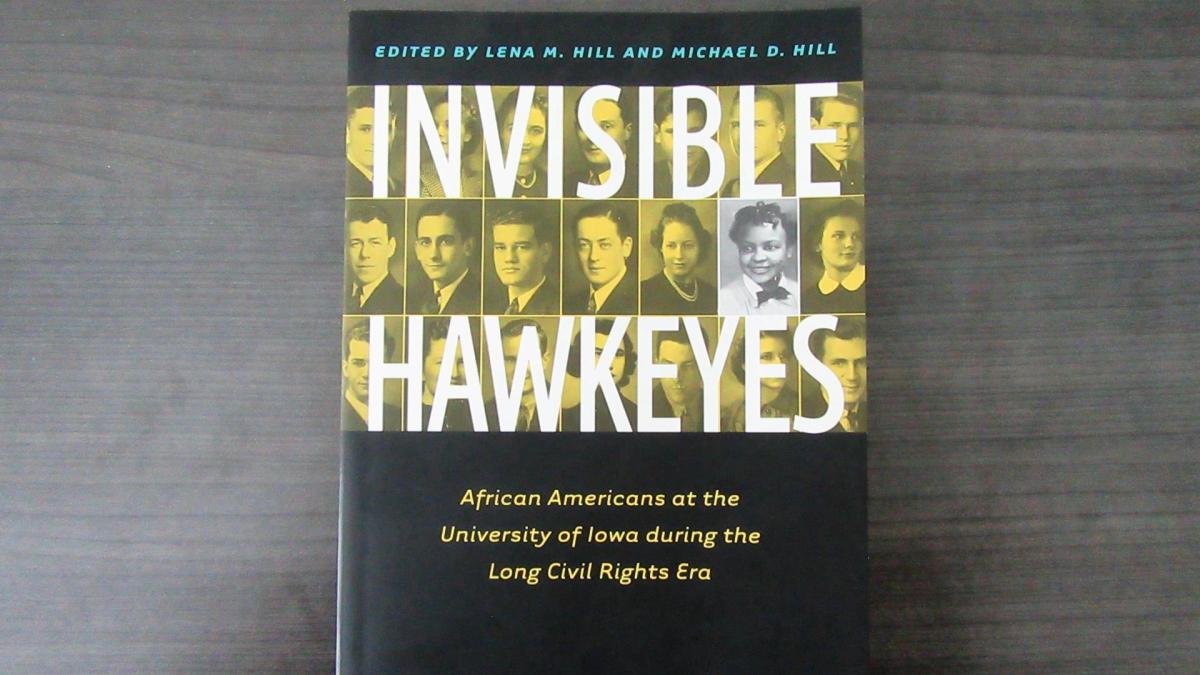
There was a good discussion of the importance of the book “Invisible Hawkeyes: African Americans at the University of Iowa during the Long Civil Rights Era”, edited by former UI faculty, Lena and Michael Hill.
Sena and I thought yesterday’s presentation was excellent. We plan to attend the two upcoming webinars as well. We encourage others to join.
 Go Retire Psychiatrist