I found this poem on the web entitled “Think.” The author was listed as “Anonymous.” It’s male centric and I’ve been trying to think of a way to modernize it so it’s more applicable to anyone, male or female. Now, according to Wikipedia, the original was actually written by Walter D. Wintle in the late 19th or early 20th century:
Thinking
If you think you are beaten, you are; If you think you dare not, you don’t. If you’d like to win, but you think you can’t, It is almost a cinch you won’t.
If you think you’ll lose, you’ve lost; For out in this world we find Success begins with fellow’s will It’s all in the state of mind.
If you think you’re outclassed, you are; You’ve got to think high to rise. You’ve got to be sure of yourself before You can ever win the prize.
Life’s battles don’t always go To the stronger or faster man; But sooner or later the man who wins Is the man who thinks he can!
–Walter D. Wintle
It’s a waste of time writing a variant of it, but it was fun trying:
Thinking (variation):
If you think you are beaten, you are; If you think you dare not, you don’t. If you’d like to win, but you think you can’t, It is almost a cinch you won’t.
If you think you’ll lose, you’ve lost; For out in this world we find Success begins with anyone’s will It’s all in the state of mind.
If you think you’re outclassed, you are; You’ve got to think high to rise. You’ve got to be sure of yourself before You can ever win the prize.
Life’s battles don’t always go To the stronger or faster hand; But sooner or later the one who wins Is the one who thinks “I can!”
–Walter D. Wintle with my edits in bold-face type.
The poem is still under copyright so this is just me fooling around. I imagine Wintle is turning in his grave.
You’ll probably think I’m nuts and you’d be right, but a problem with ordering a replacement part for something from Pella Windows and Doors Company made me think of William Carlos Williams’ poem “The Red Wheelbarrow.” The poem is in the public domain because it was published before 1927, so I guess that means I can include it in this post:
The Red Wheelbarrow
so much depends
upon
a red wheel
barrow
glazed with rain
water
beside the white
chickens
–William Carlos Williams
I’m not a poetry scholar and I have no idea what this poem written by a doctor means. One writer says that it’s probably impossible to get its meaning because it’s part of a much longer book-length work, “Spring and All” and the poem was split out of its context.
My connecting it to the Pella company has nothing to do with “Spring and All” or chickens or red wheelbarrows. It has to do with trying to order a replacement weather stripping part for a Pella door depending on having the right serial number.
It’s a bottom of door seal, made by Pella specifically for a specific Pella door on a house we moved into a couple of years ago and which was built over a decade ago. We have the size and type of the door, and the size and other important dimensions of the weather seal, which required us to take the door off the hinges in order to remove the old one and install the new one—if we can get one.
It’s a special type of bottom of door seal, which you can’t just run over to Lowes or Menards to pick up. In fact, they’ll tell you that you have to buy it direct from the Pella company.
It’s a peculiar looking seal. It fits into kerfs on the bottom of the door. I didn’t even know what a kerf was until we had to get a replacement bottom of the door weather seal. It’s just a slot into which some other piece fits into. There are two raised barbs or blades which fit into slots along the bottom of the door. The blades have to be exactly 5/8 inch apart and they run the length of the seal.
It’s called either a kerf seal or a drive-on door bottom seal, I guess because you drive it into the slots. The old one was stapled at both ends of the door bottom. It was 32 inches long. It was 1 and ¾ inches wide. The blades were in the kerfs doing what blades do in kerfs, which is securing the seal to the door bottom. I pulled the old one off and would need to drive the new one on.
That is, if we can acquire a new one. It turns out the right replacement can’t be found just by knowing the exact dimensions. You have to know the serial number of the door or the serial number of the seal.
The seal is in shreds. If it ever was marked with a serial number, it was destroyed long ago.
The door, which a Pella representative will patiently tell you, should have a serial number on a label fixed to the top hinge on the door. It’s not on the middle or the lower hinge—it’s on the top hinge, which would be fine if it were but it’s not.
How long can you expect a paper label to last on a door hinge that is more than a decade old?
It doesn’t matter if the hinges are all stamped permanently with the word “Pella.” If you don’t have the serial number, you don’t have anything.
All we want to know is whether we can purchase a replacement seal. Well:
The other day, I got to thinking about a previous interest in my early youth in learning to speak Esperanto. I couldn’t stick with it. It’s a constructed language, invented out of Russian, Polish, German, French, and English by a Polish ophthalmologist named Zamenhof in the late 19th century. It was supposed to be a universal second language for international communication. In that sense it was supposed to be the new language of diplomacy, a distinction held for a long time by French, although some would say that English has replaced French as the lingua franca. Don’t ask me why.
Diplomacy is a big thing today, given the recent Russian invasion of Ukraine and other forms of aggression around the world. The art of diplomacy used to include rare skills like respect, restraint, civility and the like, which are in short supply all over the planet.
Esperanto is said to be relatively easy to learn and there’s even a free Google translator available.
I need to give a shout-out to somebody who has given a very even-handed description of the benefits and limitations of Esperanto, Jakub Marian. Although Jakub notes that Esperanto is the most widely spoken constructed language, it’s still spoken by too few people to be recommended as a practical means of communication. Jakub also doubts that it could be the new lingua franca, although there are many who would disagree. Interlingua might be a candidate for that. There’s a Wikipedia article about it, but I can’t read it because it’s in Interlingua.
Moving right along, I might be embarking on one of my famous tangents here, but I noticed from a web search that of my favorite undergraduate college professors, Dr. Jenny Lind Porter-Scott (who died in 2020), was honored in October of 2021 with a poetry reading of her work in Texas.
The Texas Poets’ Corner sponsored A Virtual Evening with Jenny Lind Porter where she was honored by the appearance of Professor Cyrus Cassells, 2021 Poet Laureate of Texas.
Dr. Porter was a benefactor and patron of the Texas Poets’ Corner. In May of 2021, West Texas A&M University (WTAMU) announced a $2.8 million gift from her estate. She was appointed Poet Laureate of Texas, appointed in 1964 by then Governor John Connally. In 1979, she became the only woman to receive the Distinguished Diploma of Honor from Pepperdine University. She’s also in the Texas Women’s Hall of Fame.
She also taught English Literature at an HBCU, Huston-Tillotson University, where I learned a lot from her back in the mid-1970s. She’s a fit person to remember and honor during Women’s History Month.
Why is this relevant to Esperanto? Esperanto translates into “one who hopes.” It suggests hope for a better world, which we all should do if we want the human race to survive. Dr. Porter embodied that.
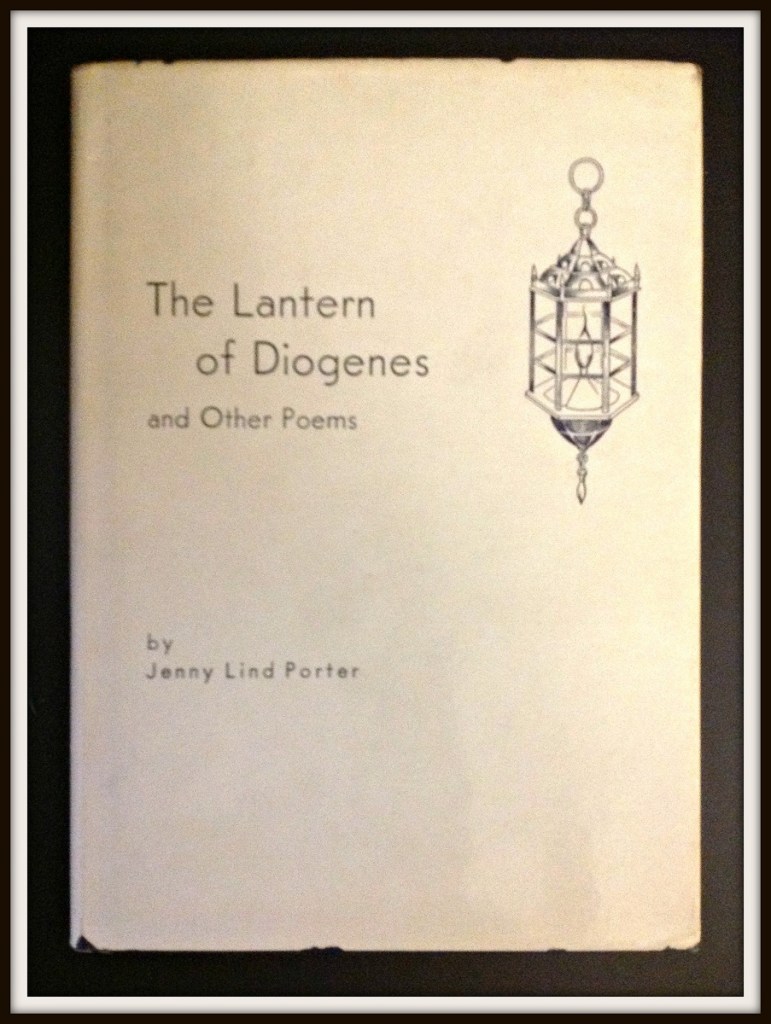
There has been talk of nuclear weapons and World War III lately, connected with the Russian invasion of Ukraine. A couple of Dr. Porter’s poems in her book, The Lantern of Diogenes and Other Poems, published in 1954, probably speak to this menace, albeit in classical language that might sound a little formal nowadays.
I have an old copy of this volume. A Texas bookseller sold it to me with a handwritten message, which I have kept:
Thanks for your purchase! It’s rare to find a book of this age that when you open the pages it creaks like it is unread. I guess someone liked the way it looked on their bookshelf! Haha. Enjoy the book and Happy New Year.
The two poems in the volume which probably are relevant to the present-day crisis in Ukraine are “Atomic Age 1953″ and ‘Atomic Age 2000.”
The first one sounds like it was written during the early 1950s when there was a lot of anxiety about atomic bombs.
The second one was puzzling to me until I looked at a timeline of the Nuclear Age. It sounds just as full of fear as the first, although it’s set much later in time, in the year 2000, about the time when the dismantling of Russian nuclear weapons was happening. But as time passes, uncertainty grows about the threat of nuclear war.
D-ro Porter skribis ambaŭ pecojn kaj ŝajnas, ke ŝi havis vizion de ĝena estonteco. Ni ne povas lasi ĉi tiun libron sidi nelegita sur la breto. Ni bezonas diplomation, ĉu ĝi estas en la formo de nova lingua franca aŭ simple simpla angla. English translation of Esperanto below:
Dr. Porter wrote both pieces and it seems like she had a vision of a troubling future. We can’t let this book sit unread on the shelf. We need diplomacy, whether it’s in the form of Esperanto, another new lingua franca, or just plain English.
I had so much fun with the giant chicken post on January 25, 2020 that I thought it would be nice to revisit the subject, only this time take a butt-freezing tour of the entire Iowa River Landing (IRL) Sculpture Walk.
We took the walk Tuesday, January 28, 2020. The weather was typical for Iowa in January. The temperature was in the teens and there were brief flurries. My wife, Sena, and I dressed warm and took a meandering journey through the Sculpture Walk, guided by a small map.
It was a little more challenging because snow and ice covered up many of the plaques identifying the works (and parts of the sculptures as well) although this lent even more visual interest to them. They’re three dimensional objects anyway and you really have to walk around them to fully appreciate their complexity. You have to watch out for yellow snow.
What made this adventure even more special was the Iowa Writers’ Library in the lobby of the Coralville Marriott Hotel and Conference Center. It’s maintained by the Coralville Public Library. One of the issues I had was being unfamiliar with the text of the poems and other literary works (all were connected with the Iowa Writers’ Workshop) referenced by the artists. The library was cozy, had a fireplace warming the softly lit room lined by bookshelves and a couple of ladders on wheels to help you reach the books higher up.
I have always felt comforted in libraries, ever since I was a little boy. Every day I got the chance, I would walk to my hometown library (which was about a mile trip), browse the stacks for hours, then tote home piles of books in both arms.
The hotel library had most of the books pertinent to the literary references cited by the artists for their sculptures. I even found David B. Axelrod’s book, The Man Who Fell in Love with a Chicken. It turns out that the title of Axelrod’s poem is “The Man Who Fell in Love with His Chicken.” There, I’ve said enough already about that chicken.
Of course, I couldn’t take the time to find and read every book; we would not have had time to freeze our butts off touring the sculptures.
I didn’t wear my heavy winter boots and had to crunch through the crusty snow nearly up to my ankles to reach certain sculptures. Sena was dressed better for the weather but we both slipped around on the ice and I began to think more and more about things like broken hips.
But we soldiered on because it was necessary to walk completely around the Made of Money sculpture by Aaron Wilson in order to see the message printed, “HOW CAN WE HELP YOU?” It’s funny because that’s what I typically ask patients in the general hospital when I sit down on my little camp stool after I introduce myself to them as a consultation-liaison psychiatrist.
The sculpture To Dorothy, by artist James Anthony Bearden, was in a difficult spot and initially we thought we’d have to either rappel down from the roof of the building it was in front of or climb up the big retaining walls to get a good look at it. We found a way out to it and ignored passersby who gawked at us. They needed to admire us for how unique we are (not how eccentric and possibly a danger to ourselves and others), which is what I think Iowa Poet Laureate Marvin Bell was getting at in his poem of the same title as Bearden’s sculpture.
The sculpture, A Thousand Acres, by artist V. Skip Willits was another piece you really have to walk around to fully appreciate, although you generally have to do that with any sculpture. The book of the same title by Jane Smiley is based on Shakespeare’s King Lear—which I have also never read—but which I got an earful about in my undergraduate days from a fellow student who thought he knew everything there was to know about King Lear. He was garrulous in the extreme and bested me in debating class mainly because he never let me open my mouth.
The sculpture by artist Victoria Ann Reed, called Convergence, was very intriguing and looked more like a human figure who had been through a wormhole than a memory.
The Tipping Point, by artist Sarah Deppe, was a convincing image of persons with holes in their heads (several holes in fact). Bureaucrats come to mind.
We nearly dismissed the sculpture called After Trillium by artist Anthony Castronovo as a broken lamppost with dysfunctional solar panels, only partly because snow and ice covered the panel describing it. On the other hand, the top part does resemble a flower called a Trillium, not to be confused with Trillian, a character in the book by Douglas Adams, The Ultimate Hitchhiker’s Guide to the Galaxy. I’m glad I could clear that up for you.
The Prairie Breeze Bench by artist Bounnak Thammavong is a sculpture you could actually sit on and watch the Bald Eagles. However, it’s made of steel and the seat was covered by snow. After you wipe away the Bald Eagle droppings, you can read the poem by James Hearst, “Landscape Iowa.” You can also hear it set to music and performed by Scott Cawelti, a former University of Northern Iowa educator who taught film, writing, and literature courses. He also edited The Complete Poetry of James Hearst (University of Iowa Press, 2001).
The Alidade sculpture by Dan Perry was the one Sena and I both really liked. I know Perry says the alidade was used by astronomers but I remember it as being a part of an instrument used by land surveyors, also for measuring distance and angles in topographical surveys. I used to work for consulting engineers as a surveyor’s assistance and draftsman many years ago. Perry links it to the poem entitled “1,2,3” from James Galvin’s book of poems, X: Poems. I confess I don’t see the connection yet. The poem for the most part reminds me of spelunking although Galvin describes a hole that he and a friend rappel into as being a planet. Much of the rest seems to be about something very painful. I’m sorry I can’t do better, but that’s why he’s a poet and I’m not.
Next, we encountered Bounnak Thammavong’s second sculpture, a very recognizable fish, a “lowly river carp,” entitled From the River. It’s linked to the poem “Where Water Comes Together with Other Water” by Raymond Carver. When I was a boy, I used to fish for bullhead in my hometown river. I sometimes caught carp and thought that was the poorer catch. It didn’t matter. I always threw both back into the river. My mom would not clean fish and neither would I.
Finally, by a pretty circuitous route, we saw the last sculpture, Gilead, by artist Kristin Garnant. The snow plow had piled up a lot of snow around it. I probably won’t read Gilead, the epistolary novel by Marilynne Robinson.
In fact, I probably won’t read a lot of the literature connected with the sculptures we saw. I did read Margaret Walker’s poem “For My people.” Sorry, Jubilee is way too much for me. She was the first African-American woman to be accepted into the Iowa Writers’ Workshop, of course depending on which story you believe about when the program formally began (Invisible Hawkeyes: African Americans at the University of Iowa during the Long Civil Rights Era, in Chapter Four: Obscured Traditions: Blacks at the Iowa Writers’ Workshop, 1940-1965, by Michael D. Hill, University of Iowa Press, 2016).
In some ways, I identify way with her, one of the reasons being obvious and skin-deep. The other is that she taught school at Jackson State, a historically black college in Jackson, Mississippi.
I wonder if the IRL Sculpture Walk could include another one for her, just to make it an even dozen?
I spent my Freshman and Sophomore college years at a historically black college. It was then called Huston-Tillotson College (now Huston-Tillotson University) in Austin, Texas. That was back in the mid-1970s. I had grown up in largely white neighborhoods and gone to predominantly white schools prior to going to H-TC. It was a culture shock and that’s probably about all I’ll say about it for now, since this post is way too long.
I can say one other thing about H-TC. I submitted a poem for the college’s annual poetry contest. Winners would have their work published in the school’s small anthology called Habari Gani (Swahili for What’s Going On?). Mine didn’t make it but years later I scoured the web looking for a way to get a copy of Habari Gani, finally succeeding only a few years ago after tracking a copy of the Spring 1975 volume down at the H-TU library. I like the short introductory poem:
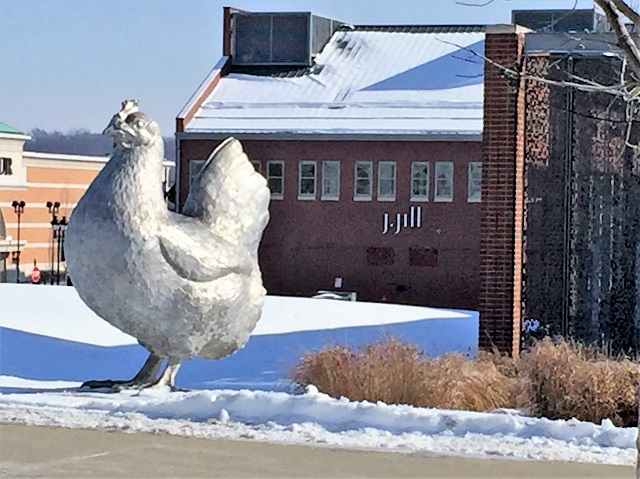
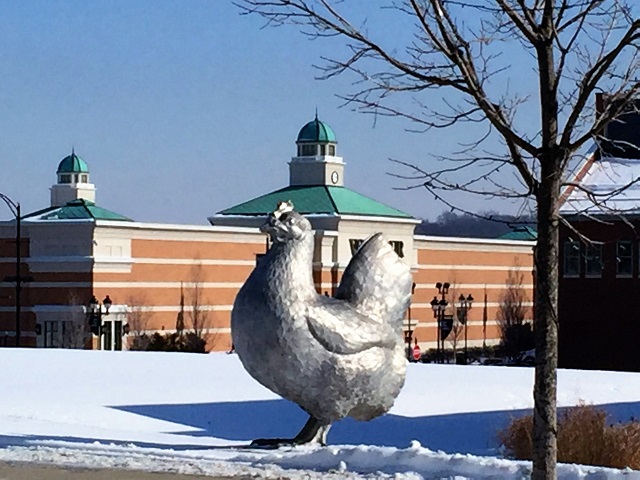
Last week, we were out at the Iowa River Landing (IRL) and saw a giant chicken. It’s actually a metal sculpture entitled Iowa Blue: The Urbane Chicken, 2013, one of 11 such works (all installed in 2013) of art making up the Iowa River Landing Sculpture Walk, located in the Coralville Marriott Hotel and Conference Center.
All of them are linked to literary works by authors associated with the Iowa Writers’ Workshop at the University of Iowa. The artist is Amber O’Harrow’s and her statement about the chicken is:
“I have created a sculpture of the noble chicken, as described in the poem by David B. Axelrod. The Iowa Blue Chicken is the only breed of chicken that was created in the state of Iowa and bred to survive Iowa’s harsh winters and its hot summers.”
The literary reference is to David B. Axelrod’s poem, The Man Who Fell in Love with a Chicken.
The chicken is made from cast aluminum and is taller than I am.
This set me off on an internet journey to find out more about the Iowa Blue chicken breed and Axelrod’s poem. It took a while, because there’s a lot to know.
If you’re a poultry enthusiast and an Iowan, then you know the story about the Iowa Blue Chicken Club (IBCC), not to be confused with the sandwich of the same name which doesn’t yet exist but should. The IBCC is an organization dedicated to making sure that the public at large realizes that the sculpture’s name is Betsy and that there is a big effort to get the breed recognized officially by the American Poultry Association (APA). So far, the APA has deferred, but the IBCC is not giving up.
The story of the origin of the Iowa Blue is somewhat apocryphal in that the breed was said to arise from the union of a White Leghorn (or Red depending on what you’ve been drinking) and a pheasant, which serves to explain the chestnut to striped colors of the feathers and certain behaviors of the chicks, which includes antics like crouching, fast fleeing, and something called “popping” which apparently means a kind of hopping which resembles popcorn popping. I gather this is typical for pheasant chicks.
Iowa Blue roosters will fight hawks, even slapping them with their wings and crowing challenges like “Have some of that!” or “You got something on your face, dude!” They’ll fight just about any critter: opossums, raccoons, snakes, rats, cats, congressmen.
Iowa Blue chickens are bred to thrive in Iowa’s harsh winters and oppressive summers. When the barnyard gets snowed in, they just grab little ergonomic shovels and scoop their way out—they just flip the bird at snow blowers.
Visit the IBCC web site to see photos of these beautiful birds.
Turning to Axelrod’s poem, The Man Who Fell in Love with a Chicken, the web search got a little complicated. For the longest time, I couldn’t find it. All I wanted to do was read it. Heck, you can look up Robert Frost’s The Road Not Taken in half a second at the Poetry Foundation web site.
I finally stumbled on it at a web site (the poetrydoctor) the owner of which I eventually found out was Axelrod himself! I found the chicken poem but the title was The Man Who Fell in Love with His Chicken. Now, I realize that even he says there are typos in the extremely long list of his works which you cannot search by the way, even though the author says there is a search box. The book of his poetry of the same name is 16 pages long and the title is The Man Who Fell in Love with a Chicken, which you can order through Amazon.
Interestingly, one publisher, Cross-Cultural Communications, says the book is “humorous poetry playing on poultry puns.”
This makes me wonder about O’Harrow’s description above including the phrase “…the noble chicken as described in the poem by David B. Axelrod.”
I can’t copy the poem here because that would be copyright violation (despite Axelrod’s making it available on his website—I guess he can do anything he wants with his own work). On the other hand, I think I can say that the poem does, in fact, contain several chicken puns and the man eventually does something to the chicken which is something less than noble and could involve lettuce, tomato, and possibly secret sauce.
The poem is dedicated to someone named Russell Edson, who I learned was called the “grandfather of the prose poem in America.” Edson wrote a few whimsical poems which could have been very much like Axelrod’s poem about the love affair with a chicken. One of them, Let Us Consider, was about a “farmer who makes his straw hat his sweetheart” and “an old woman who makes a floor lamp her son.” See the entry about him at the web site Poetry Foundation—where Axelrod entries can’t be found.
Well, that was my journey through the web about the Iowa Blue chicken sculpture. I’m next to clueless about chickens, unless their roasted, barbecued, fried, or what have you and I’m a terrible poet, as you can see from my video, Pseudobulbar Affect Top Ten—which somehow gets more views than almost anything else on my YouTube Channel.




 Go Retire Psychiatrist