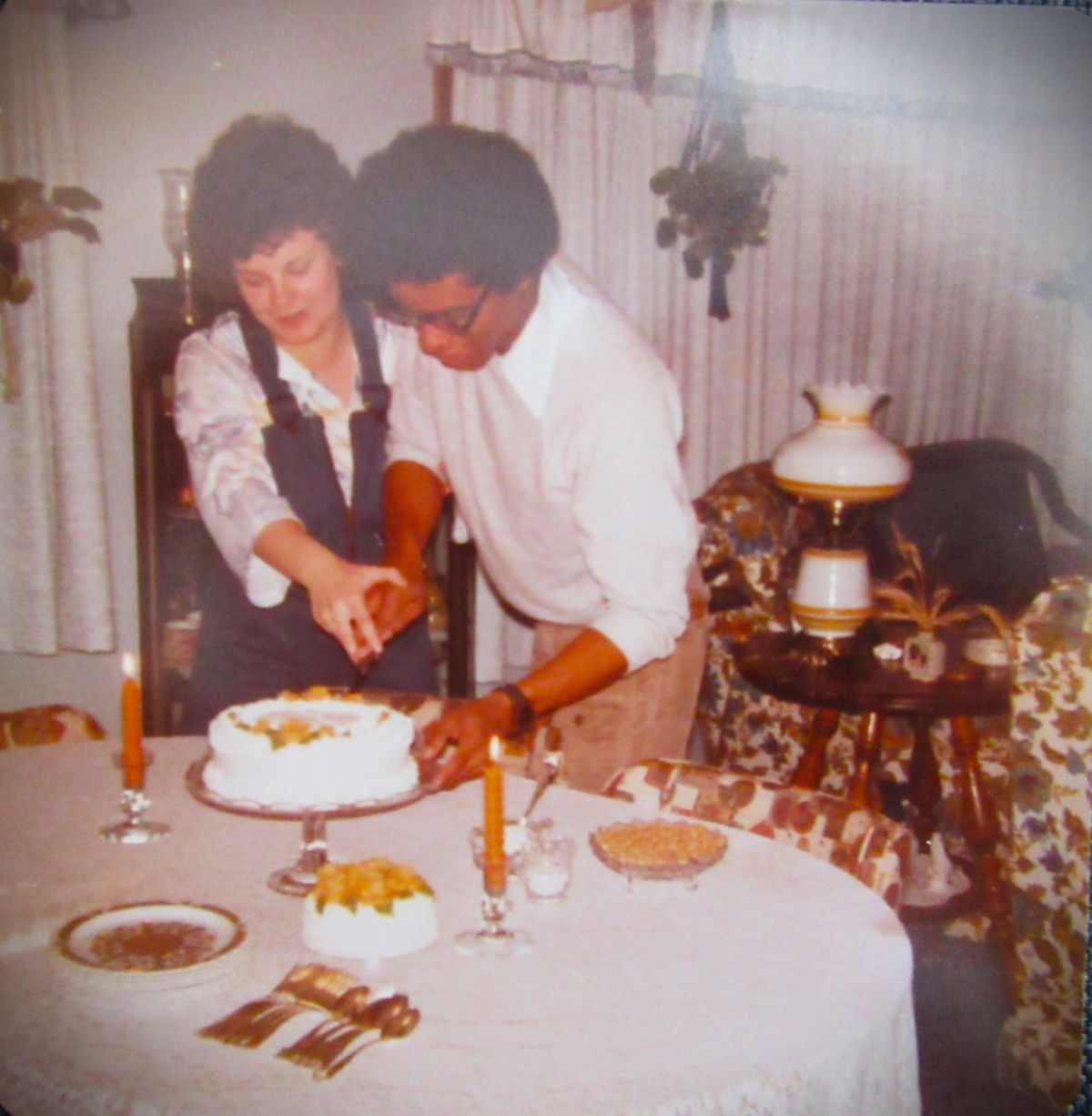
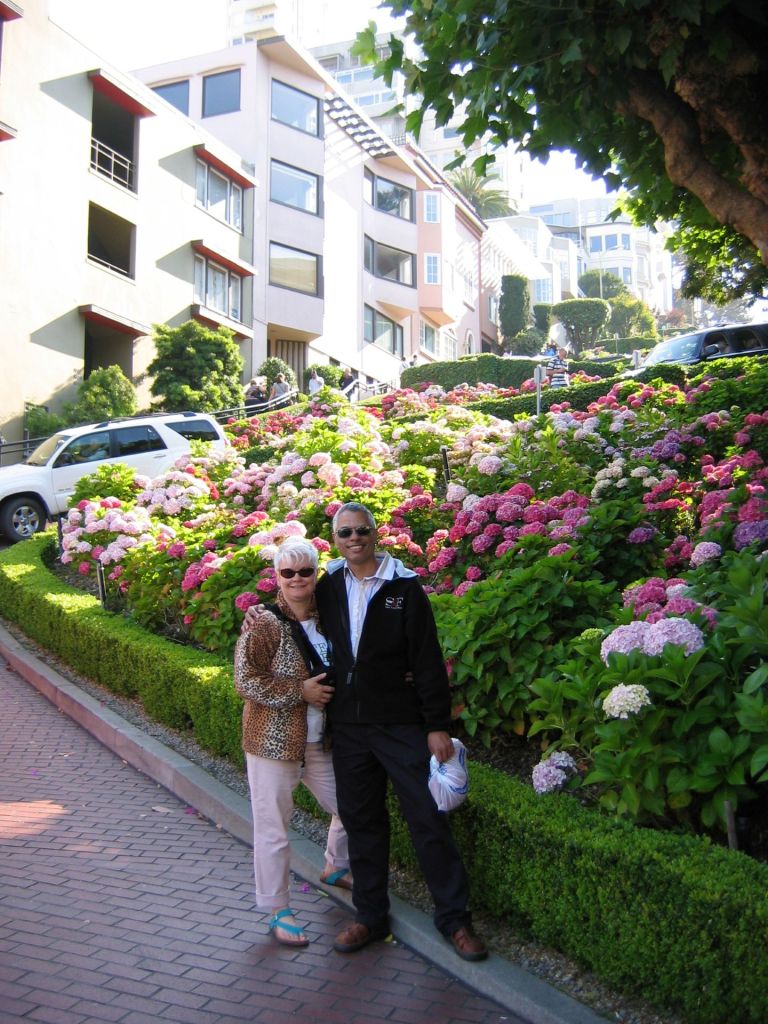
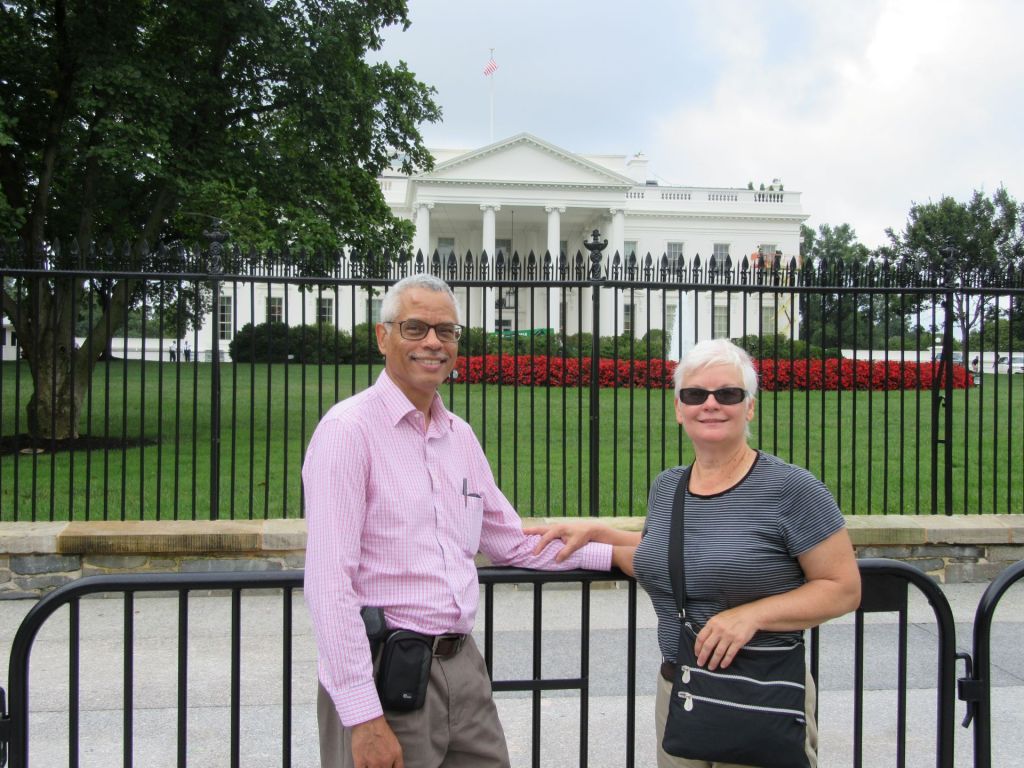
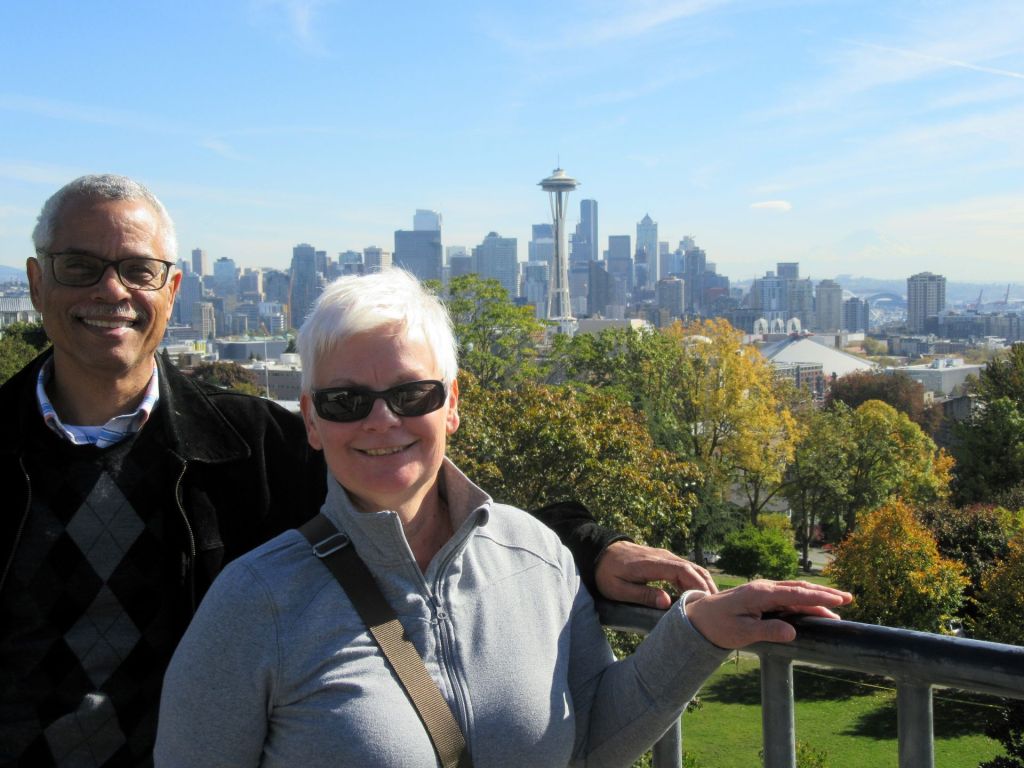
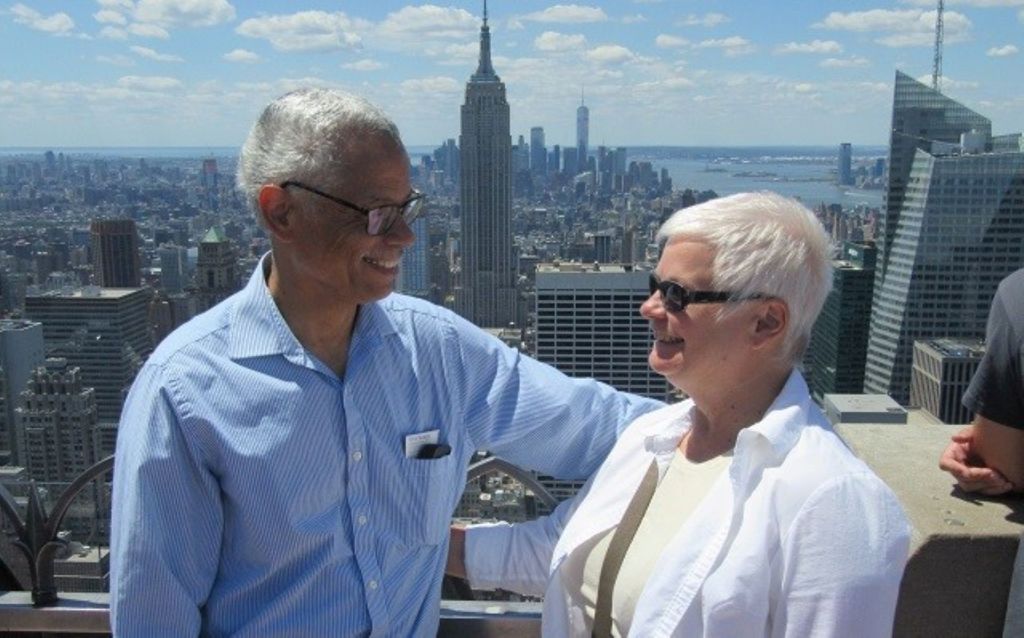
Today is our 48th wedding anniversary! I looked through a bunch of photos last night and probably picked all the wrong ones—but I doubt it’ll matter. It has been 48 years, so I’m unlikely to learn from mistakes now.
We were married at the Little Brown Church in Nashua, Iowa. We were nervous, but got through our vows, rang the bell, and cut the wedding cake. We are thankful for friends who were there for us and shared the joy.
We’ve been to a lot of places and had a lot of fun. Times are not always easy. We get through them.
I’m happy and grateful for this funny, crazy woman who wins a lot of cribbage games with me and does more for my soul than I can ever say.
Sena was looking up the meaning of a four-leaf clover the other day. You might call it a shamrock although that’s usually reserved for the 3-leaf variety. It’s fitting for St. Patrick’s Day to say the four-leaf clover is special because it’s rare to see one. The four leaves represent faith, luck, love, and hope.
The trouble going on in Haiti is regrettable to say the least. However, it also reminded us of how lucky it was for us to have known one of my former colleagues, Dr. Christopher T. Buresh, MD. He was an emergency room physician at the University of Iowa Hospital until just a few years ago, when he and his family moved to Seattle, Washington. Dr. Buresh is now an Associate Professor in the Department of Emergency Medicine with the University of Washington. He’s also Assistant Program Director of their Emergency Medicine Residency Program.
The connection between Dr. Buresh and Haiti goes back a long way. Many Haitians were lucky he and other physicians volunteered to help provide medical care for them on an annual basis for years.
Chris is really a humble, likeable, and practical guy. He and his family were our next-door neighbors for a while and fascinating things were going on there at times. We remember they built this really cool tree house that sort of looked like it grew out of their main home. They even had an apparatus for a zip line between the two structures. I don’t think the zip line ever actually got installed, but it was intriguing.
He and I sometimes saw each other in the emergency room at University of Iowa Hospital. His energy, compassion, and dedication to patient care were an inspiration to colleagues and learners at all levels. Sena saw one of his presentations about his volunteer work in Haiti. He never mentioned the difficult politics of the situation. He emphasized the work of caring for the Haitians most of all and gave credit to members of the team doing everything they could in that challenging and, I’m sure, sometimes horrifying environment.
It would be easy to just sit and wonder why he left Iowa, and to be sorry about that. On the other hand, when you thing about the 4-leaf clover, you really have to wonder about something else. Maybe he had one in his pocket with all four of what we all want: faith, luck, love, and hope.
I’ve been looking at my About Me page and see that it needs revising. I’m way past the stage of being in phased retirement and I’m pretty sure I can’t do without this blog—or at least some way to keep writing. I notice I said that I was not sure how long I’d keep blogging.
I recently updated my YouTube trailer. It’s my first attempt at an elevator pitch in years. It’s a 48 second video, probably the shortest video I’ve ever done. According to some experts, it’s 3 seconds too long. If you want to read the long version, it’s on this blog, “Elevator Pitch for a Very Slow Elevator.”
Anyway, I’ve been retired from psychiatry since June 30, 2020 (there was a minor clerical glitch in the exact date). My wife, Sena and I have gotten all of our Covid-19 vaccines—until they come up with more. We have made Iowa City our home for over thirty years.
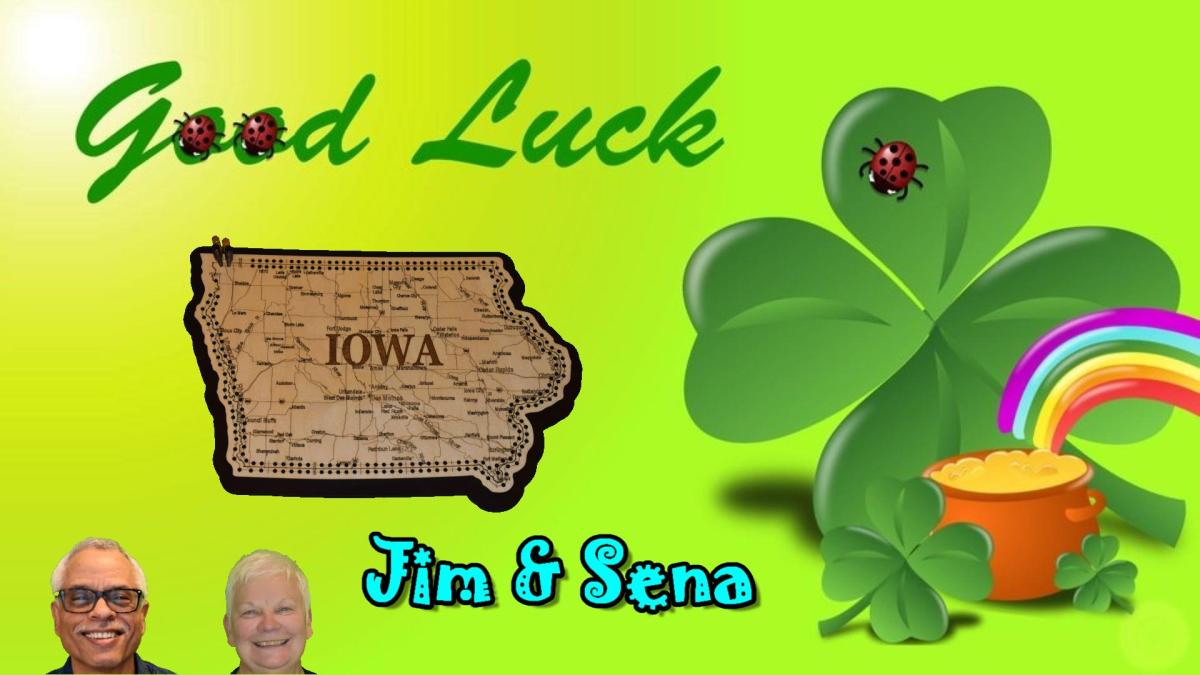
We play cribbage. One of the most fun cribbage games we played was the game on the Iowa state map board. That was a blast. The video of it was over 10 times longer than most YouTube videos I make. That’s because the main reason for the game was to talk up Iowa. You really ought to visit, maybe even move here. You can get used to snow. I keep reading articles on the web telling me I’ve got to stop shoveling at my age. I’ll think it over.
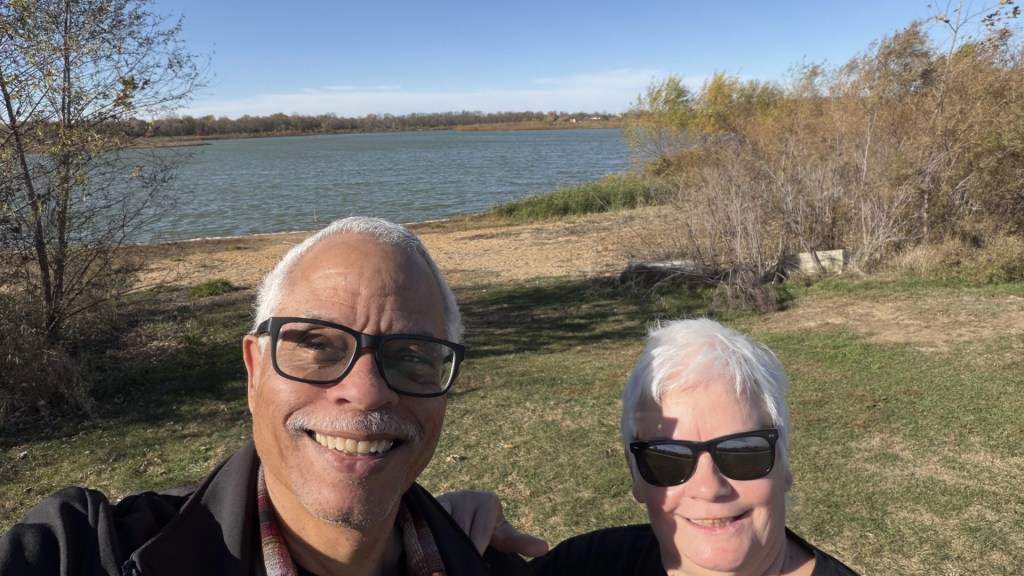
We also like going for walks. One of our favorite places to walk is on the Terry Trueblood Trail. Sometimes you can see Bald Eagles out there.
I have not yet mentioned Consultation-Liaison Psychiatry, even once. That’s a big difference from the old About Me page. It was the first thing I mentioned then, because it was just about the most important role I had in life.
It took a long time before I began to question that once I retired—about a year or so. It was a lot like being a firefighter. In fact, my pager was the bell, and I even had a firefighter’s helmet, a gift from a family medicine resident who rotated through the psychiatry consult service. I didn’t wear it when I interviewed patients. It would have alarmed them.
I also carried around a little camp stool. It was because there were never enough chairs in patient rooms to accommodate me, the trainees, and visiting family. Often, I sent a medical student to find me a chair from out in the hall—until I got the stool. I slung it over my shoulder and away I went. I was sort of like the guy on that old Have Gun—Will Travel (paladin) TV show (a 1950s-1960s relic with a gunslinger called Paladin). Have Stool—Will Travel. A surgeon, who also doubled as a palliative care medicine consultant, gave me the little chair as a gift. I passed it on to a resident who took it with good grace.
I miss work a lot less now than I did when I left. I think I must have loved my work. Maybe I loved it too much, because leaving it was hard. There are different kinds of love. I love writing. I love long walks and watching the birds. And most of all I love Sena.
Love
I’m gradually replacing work with something else I love, which is writing. Mindfulness meditation and exercise also help. And let’s not forget, I change electrical outlets. I think I’ve changed just about every outlet (and many toggle switches) in the house. They ought to do away with those bargain bin plugs. Just because they’re cheap doesn’t mean they’re any good.
I’m not sure yet how I’ll edit the About Me page. Maybe I’ll just call the first one Chapter One and this one Chapter Two.
When I think about all the mandates and bans against mandates for the COVID-19 vaccines and masks, I wonder about my own motive for getting the vaccine and wearing a mask.
In one sense, I’m doing it for myself. I’m a retired consultation-liaison psychiatrist and I got called to the intensive care units a lot. Almost always, the patient was delirious. And almost always, the patient was delirious in the setting of being on the ventilator or in the process of being liberated from the ventilator.
The critical care physician and the nurses were always looking for one specific thing from me. I was supposed to stop the patient from being agitated, to calm the wildly thrashing, terrified person fighting the restraints and struggling with hallucinations and fragmented paranoid delusions that every caregiver in the unit was trying to kill him. Often there were many medical problems, including multiple organ failure often from lack of oxygen, resulting in brain injury as well. Nowadays, COVID-19 is a frequent cause of delirium for the same reasons.
Years ago, the only tool I had was an antipsychotic called haloperidol, because it could be given intravenously. It would calm some patients, but it could and did cause side effects including akathisia (extreme restlessness), dystonia (severe muscle spasms), and neuroleptic malignant syndrome NMS, a rare, complex, life-threatening neurologic emergency attributable to antipsychotics. Over the past several years, the ICU pharmacies acquired newer drugs like dexmedetomidine, which is not a psychiatric drug. That didn’t stop the ICU from calling me.
I’ve seen all of that. I got the vaccine and wear the mask mostly because I don’t want to be in that boat. But I think those measures help protect others, too. I think many people have that motive. Those who think they’re getting it just for themselves can go on thinking that.
We’re taking a risk when we get the vaccine. It’s not completely harmless. There are very rare side effects which can be life-threatening and they have killed people. There is some level of altruism involved. Those who get the vaccine are playing a role, however small, in reducing the chance the virus will mutate into something that will kill even more people.
Wearing masks is a nuisance and doesn’t really feel heroic. But this act combined with other measures (the usual suspects: hand-washing, social distancing, avoiding large crowds) spreads love instead of infection.
We don’t have to agree. We don’t have to love each other. I just hope we can respect each other.
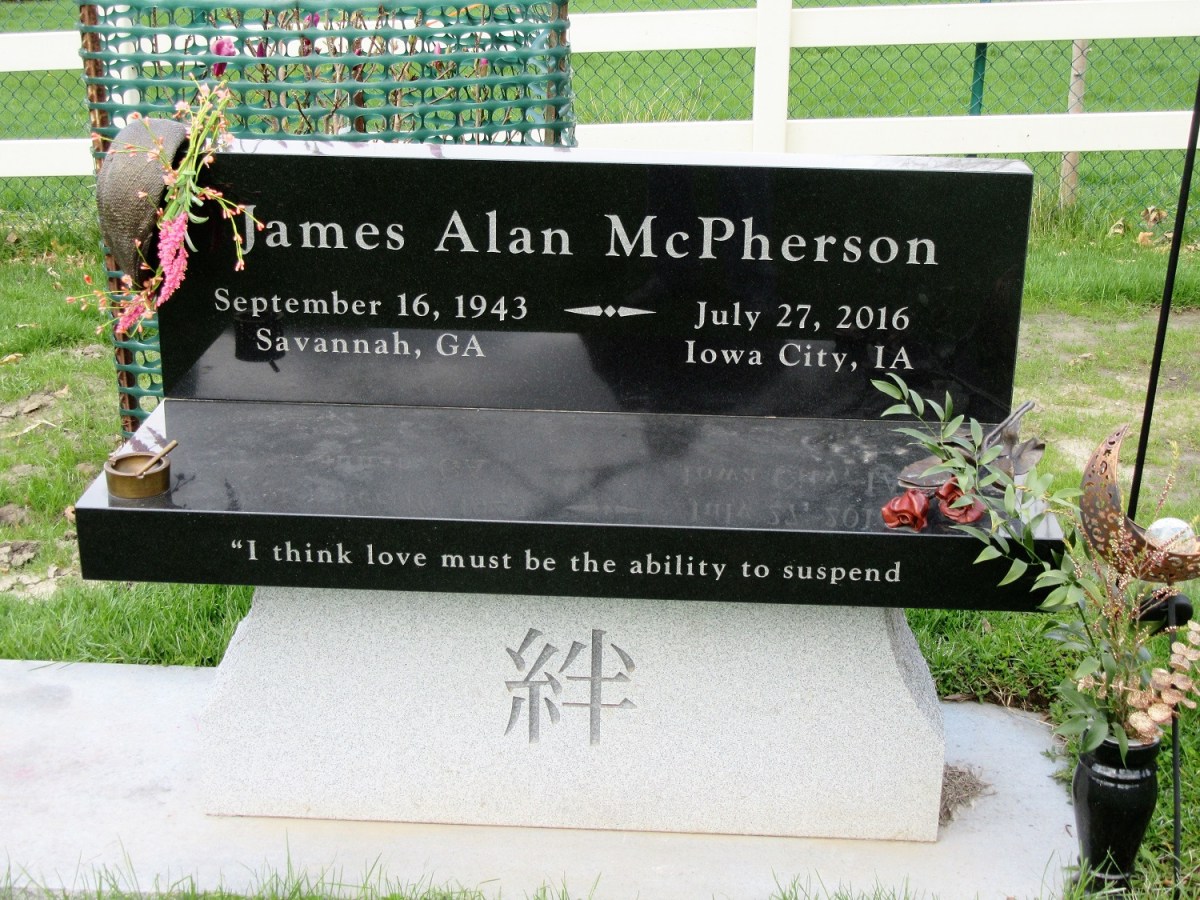
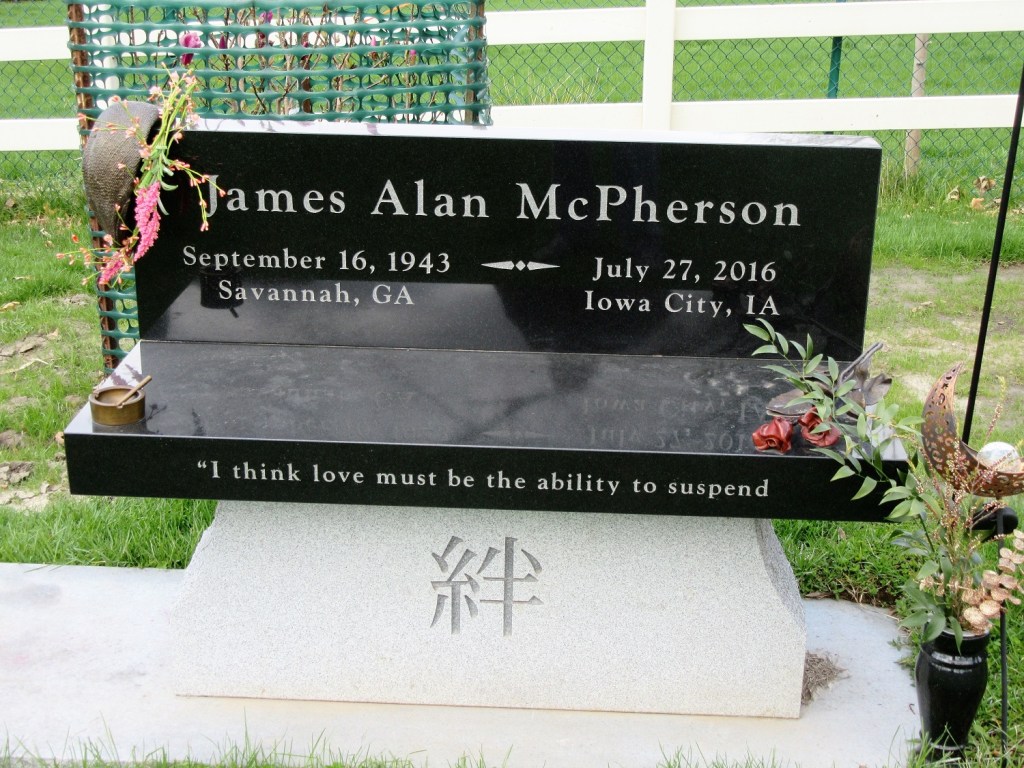
We don’t usually make trips to Oakland Cemetery (or any cemetery for that matter), but today we made an exception to find the grave of James Alan McPherson, the first African American to win a Pulitzer Prize for fiction and longtime Iowa Writers’ Workshop faculty who died in 2016 and for whom an Iowa City park was renamed a month ago.
We never met McPherson, although we are reading a couple of his books (Elbow Room, the Pulitzer Park winning work, and Hue and Cry) and just visited the James Alan McPherson Park on Monday this week.
This trip brought back happy memories right away. It’s not the first time we’ve been to Oakland Cemetery. In 2015 and 2016 we took the same route, parking at Happy Hollow Park on Brown Street and walking east to find the Black Angel. The main reason for going to Happy Hollow Park back then was not so much to see the Black Angel, but for two Psychiatry Department Faculty vs Resident Matball games at Happy Hollow Park. Matball is an imaginative combination of kickball and baseball using large mats for bases and a kickball for pitching, which the hitter actually kicks and runs the bases.
I was on faculty but didn’t play, which I thought would help them win. It was very hot both years. Faculty lost both years. There was another match in 2017 which I didn’t attend, and which I think faculty also lost.
But it was great fun. I don’t remember who put the 2015 trophy won by the residents in a bowl of red (possibly strawberry, I didn’t eat any) Jell-O. That took imagination. It was a stroke of genius, but was not repeated after the following two losses. There have been no Matball games since then.
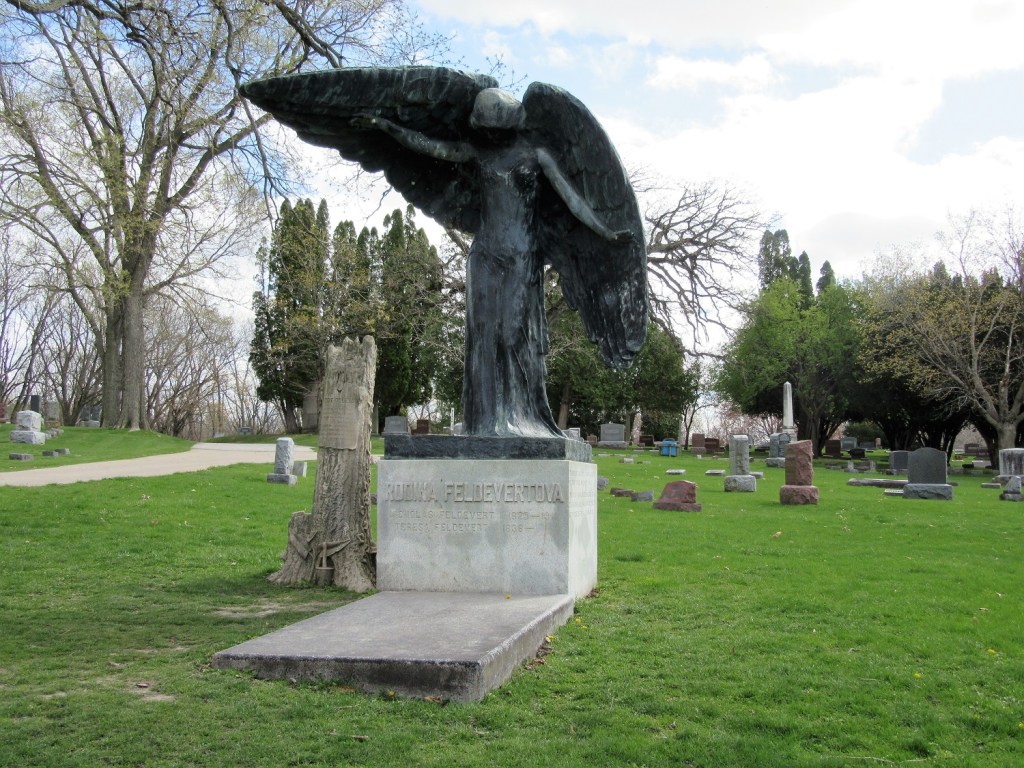
Anyway, we visited the Black Angel. I think I left some loose change at the foot of the sculpture, which is traditional I think, for good luck. The Black Angel has a very complicated story, which is in many cases, fueled by superhuman imagination. The stories get more complicated every year and the legends have been developing since the 9-foot statue with 4-foot pedestal was created in 1912.
Actually, the Black Angel is often used as a point of reference for the rest of the cemetery. That’s how we used it today to find McPherson’s grave, which is said to be in a place called the poets’ corner where many other artists, including Writers’ Workshop faculty, are buried.
The easiest way to find the Black Angel is probably to approach the cemetery from the west and head east to the intersection of Brown and Governor Streets, where there’s a big sign for Oakland Cemetery. There’s a map next to the cemetery office. We could not find any place marked “poets’ corner.” But the Black Angel is clearly marked.
You’ll notice you can drive through the cemetery, but the paved road is about the width of a car. It’s actually more like a service road, just right for riding mowers, but a little narrow for cars. There is no parking lot we could find, which is why we parked at Happy Hollow Park.
As you reach the Black Angel, you’ll notice one of her wings is raised at a right angle from her body. It points roughly North. You need to go in the opposite direction to find poets’ corner. As you pass the Black Angel, take the second path to the right and simply follow it around, moving south past the University of Iowa Deeded Body Program monument to a section marked with a narrow post labeled “Oak Green.” That’s where you’ll find McPherson’s headstone.
The headstone is easy to pick out; it’s an imaginative work of art. The black rectangular stone is decorated with clever sculptures including his signature car cap, two roses, and even a cigarette in an ashtray. He was a smoker. I don’t know what the characters on the pedestal mean.
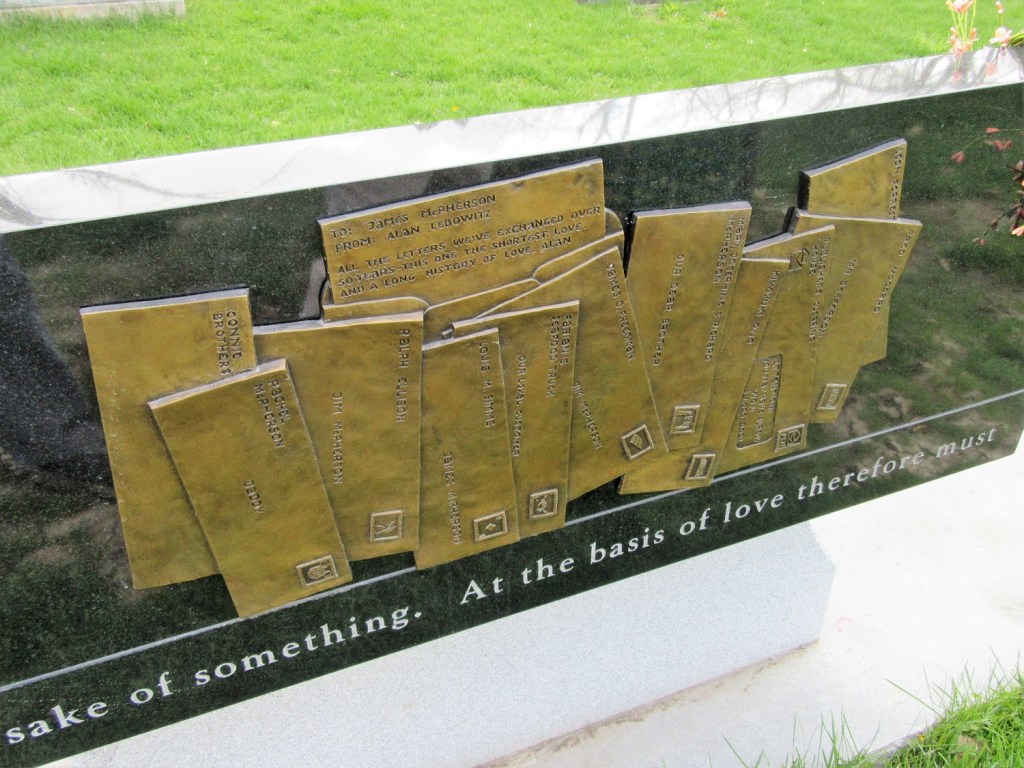
On the back of the stone are many carved envelopes indicating McPherson’s mail correspondence with many loving friends and family—and beyond. There is a sense of humor and imagination here too. One of the envelopes is from “Publisher’s Clearinghouse” and the recipient section says “ATTENTION: You may have already won $1,000,000!” I can just picture Ed McMahon! Another is from “Fabian’s Seafood Truck” to “Our Loyal Customer.” I didn’t realize it while we were there, but when we got home, it occurred to me that as we were driving home from James Alan McPherson Park, we saw a big refrigerated truck where seafood was being sold; it was next to the Dairy Queen on Riverside Street. I searched Fabian Seafood on the web and found a picture that exactly matched what we saw.
Around the edge of the headstone was an inscription that to read in its entirety you have to walk all the way around the monument because the words are carved in the front, sides and back:
“I think love must be the ability to suspend one’s intelligence for the sake of something. At the basis of love therefore must live imagination.” This is a quote from McPherson. He also wrote in his essay “Pursuit of the Pneuma” about “an ancient bit of spiritual wisdom” which denies that God rested on the seventh day after creating all existence. Instead, God created imagination and gave this gift to his human creations, enabling us to wield an integrative kind of power—which is what love can do.
I was out shoveling snow this morning in the subzero temperatures. It’s getting down to 20 and 30 degrees below zero with the wind chills today and tomorrow—and likely beyond. Try to keep your buns warm in weather like that. Sena helped by making hot cocoa when I came in for a break. Little things like that make a big difference. Like many other people in the country, we’re getting out despite the wind chill warnings. There are a couple of reasons for that. None of us want our neighbors falling on our sidewalks. The other reason is that you look for just about any kind of a break from the indoor routine caused by the Covid-19 pandemic, part of which is the TV show lineup.
On the other hand, I get a kick out of the Ancient Aliens program. Last night, William Shatner, the Star Trek star who has his own show about the weird and wonderful, UnXplained. He sat at the head of a table lined by a group of Ancient Aliens heavy hitters, along with video guest stars including physicist Michio Kaku. I think Shatner was playing the role of devil’s advocate, apparently trying to argue against the idea that aliens are driving their UFOs recklessly around our planet while intoxicated on oregano, crashing them on the Weather Channel’s Highway 401 in British Columbia, forcing the Heavy Rescue crews to pull them out of ditches using 65-ton rotators (which look like they’re from another planet, by the way) and occasionally kidnapping various humans for the odd anal probing.
Anyway, I suspect Shatner was playfully provocative and this got the Ancient Alien crew to talking loudly and rapidly all at once, interrupting each other and challenging Shatner to a knife fight and whatnot. Just kidding; they were all very polite and respectful.
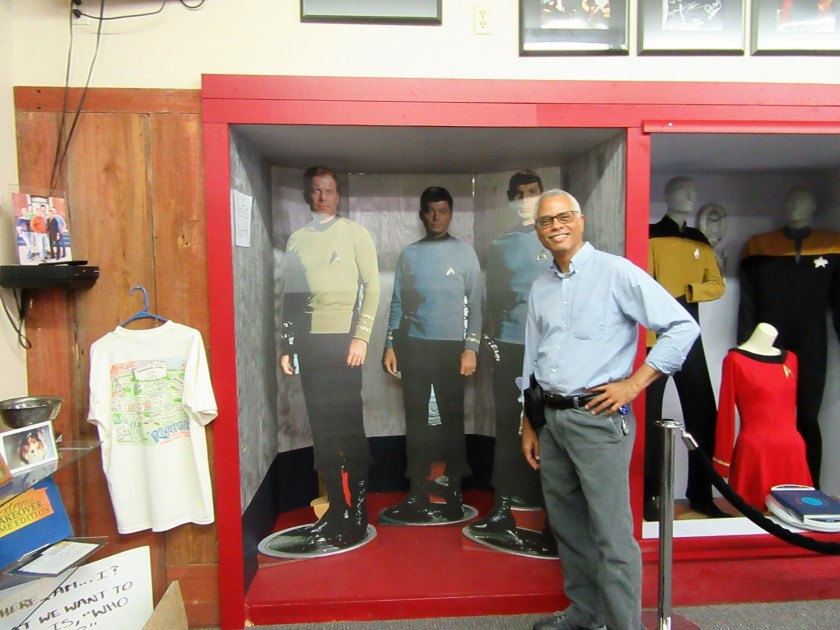
Me at the Star Trek Museum in Riverside, Iowa in 2016
I think it’s possible to take the Ancient Aliens show too seriously. I really wondered why Shatner was invited as a guest on Ancient Aliens. Maybe they don’t take themselves as seriously as some people think. Well, OK, they probably do.
In fact, I don’t think Shatner takes his own show, The UnXplained, seriously. I wonder if the title of the show is a sort of jab at the X-Files? Remember the 1999 episode, “The Unnatural”? Josh Exley (played by Jesse Martin) was an alien who took the form of an alien and was an excellent baseball player. He hid among an all-African American baseball team in Roswell in the 1940s but was executed by an alien bounty hunter who didn’t want him mixing with the human race. Think about that irony. The episode was warmly comical and at times, even poked fun at the preoccupation with alien invasions. I actually liked Jesse Martin’s version of the gospel song “Come and Go with Me to That Land.” There is no full version of it, but I also liked Sam Cooke’s rendition. Sena and I both really enjoyed watching the X-Files while eating popcorn. I treasure the memory.
Well, the sun is shining and it has finally almost stopped snowing. I have to go back out and finish shoveling.
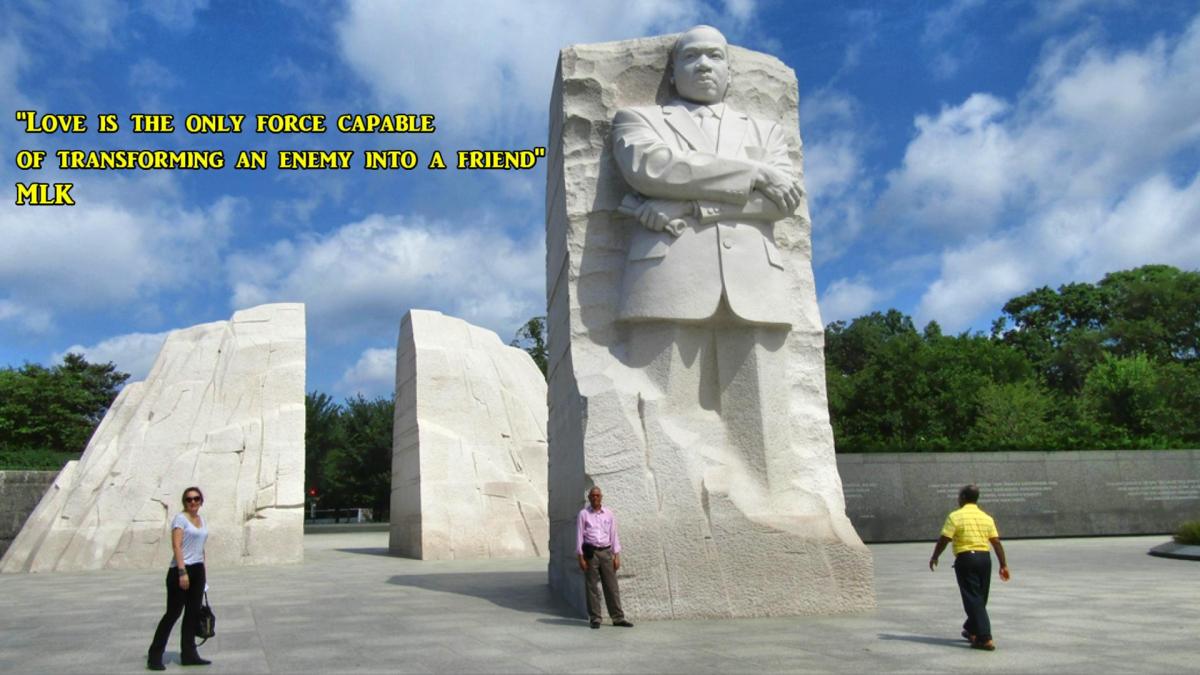
As I struggle to remember to write and say the year “2021” I noticed the University of Iowa Health Care quotation selection by Dr. Martin Luther King, Jr this month pertinent to the upcoming MLK Human Rights Week, starting January 18, 2021:
“Love is the only force capable of transforming an enemy into a friend.”
It’s funny because, as usual, the way my sense of humor works, I also recall quotes from the movie Men in Black 3. Agent K asks Agent J, “Do you know the most destructive force in the universe?” Agent J answers with a wisecrack, “Sugar?” Agent K replies, “Regret.”
Then what is the most constructive force in the universe? Dr. King thought it was love.
Since my retirement in July of last year, I’ve had a lot of time on my hands. It leaves me with too much time to reflect on my current life as a retired psychiatrist—and my past life as a consulting psychiatrist. As my thin veneer of authority, responsibility, and other lies I tell myself drop away, I become more aware of my flaws in both roles. I find deep holes in my identity as a person as my identity as a doctor fades. Just being a person who has a lot to learn about life despite being a psychiatrist—is hard. I have regrets and remorse. My sense of humor sometimes helps me get by.
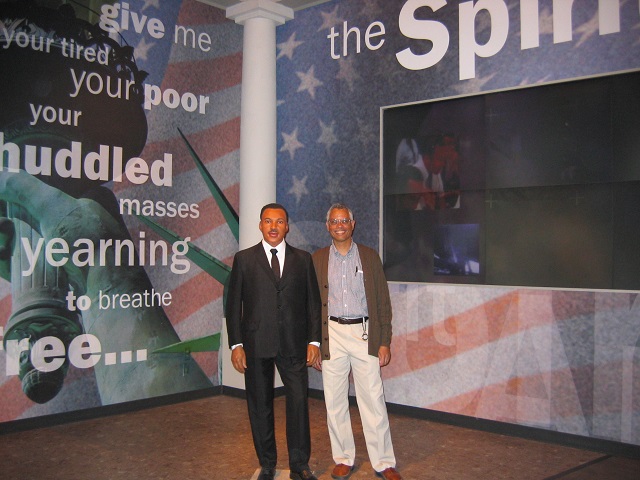
Dr. Martin Luther King, Jr and me in Vegas.
Regret can indeed be a destructive force. Though it’s similar to regret and painful, remorse could help me be a better person. It becomes more and more important that I find something constructive, both to do and to be.
Maybe love is the most constructive force in the universe. Because quotes are sometimes misquoted and inaccurately attributed, I googled the quote “Love is the only force capable of transforming an enemy into a friend.” I found the sermon from which I think the quote is derived on a Stanford University web site. It’s called the “Loving Your Enemies” sermon and it’s published in the book, A knock at midnight: inspiration from the great sermons of Reverend Martin Luther King, Jr.
There are YouTube and Vimeo videos of an audio recording of the sermon as well. The internet being what it is, you apply hyperlinks to these and other works at the risk of the links being broken at some point, which I have found and which might be due to uncertainty about whether the text of the sermon is in the public domain.
As an aside, I’m reminded of a quote variously attributed to Charles Schulz, creator of the Peanuts comic strip, Fyodor Dostoyevsky, and others: “I love mankind; it’s people I can’t stand.” This probably betrays my skepticism about the ability to love your enemies.
You know, it’s funny. I didn’t find the Dr. King quote, word for word, the first couple of times I scanned it in the Stanford University transcript. What I did was the thing most junior medical students do when they discover the vast load of information they have to memorize and digest. I scanned the sermon for the key words and didn’t see them.
Nor did I find it on the third read, in which I finally abandoned the scanning method and actually read the sermon. But I got the point.
If the Stanford version and my reading are accurate, what I found were probably the main ideas I needed to make sense of the sermon. King said that I have to look deep within myself first before attempting to understand anyone else, much less to love my enemies. I also would do well to look for the good in people who I judge are bad. Moreover, I gain nothing by trying to defeat my enemies. He even mentions the theories of psychologists and psychiatrists to support his profound conclusions. As I read them, I was acutely reminded of my shortcomings as a psychiatrist. You would think a psychiatrist would know how to analyze himself (and psychoanalysts do undergo analysis in training). I am not a psychoanalyst. But I am capable of reflection.
The exact quote might not be discoverable (at least to me) in King’s sermon. Nevertheless, the transformative and redemptive power of love is clearly expressed. The quote is distilled from the text of the sermon. That doesn’t mean that there might not be a different version of the sermon which could have contained each and every word. According to one writer, that may be the case. Perhaps it’s in the book, A Knock at Midnight: Inspiration from the Great Sermons of Martin Luther King, Jr.
What is more important for me at this time of my life is to accept that my search for the most constructive force in the universe will proceed in baby steps.
What I need to do is reflect on my own shortcomings and find ways to improve while avoiding making excuses. Stephen Covey said that we often blame our parents or our grandparents for our flaws. This was part of his three theories of determinism to explain man’s nature. Genetic determinism says I inherited my flaws from my grandparents (whom I never met), which implied my mistakes were encoded in my DNA. Psychic determinism supposedly explains what I got from my parents because of their mistakes in rearing me. Hmmm, I was exposed to fruitcake at Christmas. Environmental determinism implicates says that other people in my workplace, my school, my neighborhood or my country (politicians perhaps?) caused my flaws.
Covey disputed these ideas by the example of Viktor Frankl’s personal triumph over his experience as a prisoner in a Nazi death camp. His captors controlled his liberty to move about his environment. They could not control his freedom to choose what he thought and felt. He controlled his self-awareness, imagination, conscience, and independent will to draw meaning from his experience [The Seven Habits of Highly Effective People: By Stephen R. Covey. New York: Simon and Schuster, 1989].
How can I see the good in my enemies, despite their obvious flaws in comparison to my own angelic perfection? And how to avoid acting on the urge to defeat them, despite the reality that there have to be winners and losers at all levels in society, including elections, sports, cribbage (at which my wife regularly beats me)? Something tells me I’m getting off to a shaky start here.
I have to crawl before I can walk; I have to walk before I can run—before I fall flat on my face for the umpteenth time. Now more than any other time in my life, I must keep trying. I must get up and try again.
ADDENDUM January 11, 2021: I tried to access the King Library and Archives (KLA) today at The King Center website. There is a message indicating the KLA page is down indefinitely and redirects the reader to the Stanford University site noted above.











 Go Retire Psychiatrist