Remember to put your non-perishable food items out for the Scouting for Food 2023 food drive today! Collection site hours 9 AM- Noon. If your bag is not picked up by noon, please deliver to local food pantry.
Prepare non-perishable food items (canned or boxed)
The 2023 Scouting for Food drive is on! The Hawkeye Area Council announcement just arrived on our doorknob the other day. Pickup day is October 28, 2023. Instructions:
Prepare non-perishable food items (canned or boxed)
Place donations in a clean bag or box
Put them out by your doorstep by 8 AM
Make sure it’s visible from the street
The food drive supports local families in need. All items collected will be distributed locally. If your bag is not picked up by noon, please deliver to local food pantry.
The other day, Sena and I were talking about growing up in Mason City, Iowa. As kids, both of us were the ones who lugged the groceries home. That was back in the days of paper sacks and, for me and her, food stamps. The food stamp program got started during the Great Depression. The goal was to keep people from starving and farmers from going under. In other words, it was kindness.
Food stamps were a sign of hard times and I don’t think that has changed much, except now I think you get a debit card instead of stamps.
I did grocery shopping at Fareway Store, which got its start in Boone, Iowa. Sena did hers at Grupps Food Center.
When it comes to shopping, I followed what my mother put on a list. I got the items and paid with food stamps. I can’t remember ever coming up short. I think I just gave them the cashier the stamps and they took what was needed to cover the price. I walked to Fareway and then I just walked home carrying two or three paper sacks of groceries. It was about a mile trip up and a mile back. My arms were pretty sore when I got home.
On the other hand, Sena came up short on stamps one day. It was embarrassing enough to have to pay using food stamps. But it was awkward as hell when you didn’t have enough to pay. At that time, the cashier was a guy named Bud Grupp. Bud was Carl Grupp’s son. Carl bought the store in the early 1960s.
Bud counted out the stamps and had to tell Sena that there wasn’t enough. She didn’t know what to say. People were lined up behind her and they could probably tell something was wrong. Bud just said “We’ll put you on credit,” and that was that. He sacked all of the groceries like there was nothing out of the ordinary. Sena didn’t know what was done about the balance on credit, whether it was ever settled or it became just a running bill that never got paid off.
Sena also had to walk home carrying bags of groceries. One winter day during a light snowfall, she dropped all of the bags in the snow. They got wet and all torn up. A woman saw it, came out of her house with some bags and helped Sena get the groceries sacked up again. She got home alright.
About a year ago, Sena was in line waiting to check out groceries. An elderly woman was ahead of her and came up short on money to pay for her few items. She fished in her purse and looked embarrassed and pathetic. Sena was thinking about paying for them herself but just before she could, a guy behind her handed the cashier his credit card and told her he would cover it.
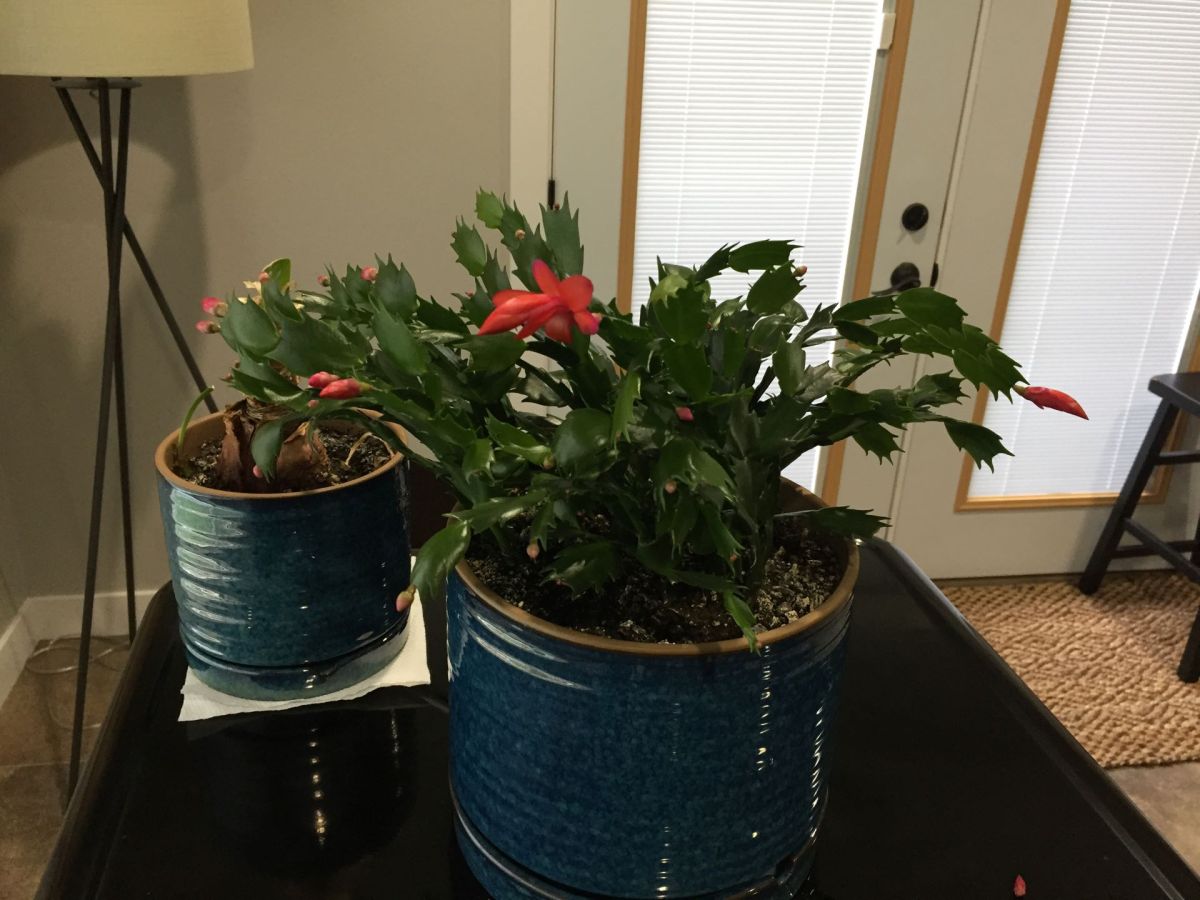
Regardless of what you see in the news, kindness is still out there. Our Christmas cactus is already blooming.
If you read the news, you rarely find any stories about acts of kindness. Everybody is slamming everybody else. Sena sees acts of kindness at Walmart. Not long ago, a Walmart grocery shopper went out of his way to be kind to her.
She was in the checkout lane of a cashier who greets everyone with a cheery “Did you find everything you want? Thank you for shopping at Walmart!” People actually try to get into her lane, probably to get a dose of her kindness. They will arm wrestle for the privilege, best 2 out of 3 wins.
I rarely go grocery shopping but actually recognized her from Sena’s description and scooted into her lane. She even placed the sacks of groceries up on top of the circle of bags to make it easier for me to grab them, making it less likely to forget them—which is something I would probably do. She’s easy to find; she’s the only one still wearing both a medical grade mask, face shield, and gloves.
Sena almost always encounters kindness from random shoppers and Walmart workers who see her struggling to reach an item on a high shelf. They’ll say “Let me help you with that.”
Anyway, where was I? Oh, the shopper kindness incident. She was in the kind cashier’s lane behind another couple who also prefer this cashier. She had encountered them elsewhere in the store and the guy joked with her about cottage cheese.
There were no dividers to separate Sena’s groceries on the conveyer belt from his, so she used a package of celery and announced it to the cashier—who forgot that and rung it up along with a couple of other items) for the guy and his wife in front of Sena. Sena caught the mistake and they all joked about it.
After the couple left the store with their groceries and as Sena was checking her items, she felt a tap on her shoulder. It was the guy who had been in front of her. He handed her a package of mushrooms, the one item that the cashier had charged to him by mistake and had not caught. He had probably gone all the way out to the parking lot and somehow noticed the mushrooms.
He gave Sena the mushrooms and told her that he didn’t want her to get all the way home and find out that she didn’t have them for a recipe.
Sena knew he’d been charged for them and because she didn’t carry enough cash to pay him back, advised him he could get the mistake fixed at customer service. By this time, it was too late for everyone’s favorite cashier to correct it.
The guy said the transaction was too complicated and not worth standing in the long line at customer service.
But it was worth his while to get all the way out to the parking lot and walk all the way back in to return a $2 package of mushrooms to Sena.
Sometimes, it seems to me we spend more time on the lookout for UFOs in the sky than for human acts of kindness on earth.
We had enough of bad news on the web, so we went out to Terry Trueblood Recreation Area today. Good things are happening around here, including what we found at Trueblood. Sena ordered some items last week. One is a clock, which we’ll hang somewhere and then not look at. Another is a chair that I will put together, and which will probably give me a reason to use up at least some of the oversupply of band aids.
The best deliveries, in my humble opinion, will be a couple of brand-new sets of juggling balls. One reason for buying them is that my other juggling balls are already starting to leak their millet fillings.
Millet is bird seed. I first noticed it on my hands, and then saw it on book shelves and my chair. I practice juggling every day, and see to it that they get banged up as much as possible, even if that happens to involve impacts with my head. Many juggling balls are stuffed with something: plastic pellets, sand, dandruff from extraterrestrials—no reason to avoid millet.
The new juggling balls will be bigger and heavier: a little over 2.5 inches in diameter and around 130 grams. I’ll probably knock myself unconscious dropping them on my head. One set of 3 will be as close to Iowa Hawkeye colors as I can get: black and yellow (which is what black and gold usually look like to me). The other set will be multicolored and have 12 panels. Balls covered with leather or other material have to be sewn shut and some say that the more panels, the more the impact will be spread, possibly reducing the risk for breakage. On the other hand, I can’t help wondering if there are more seams, wouldn’t it be more likely they’d be split when (not if) I drop them?
I’ll think about that later. We had the best time today at Trueblood. In fact, a lot of people were having a great time out there. The weather was fantastic; the temperature was in the fifties. One trail walker claimed she saw 16 bald eagles! I took this with a grain of salt, but then we saw at least a half dozen, though they were flying too high to get good photos. There were plenty of shore birds.
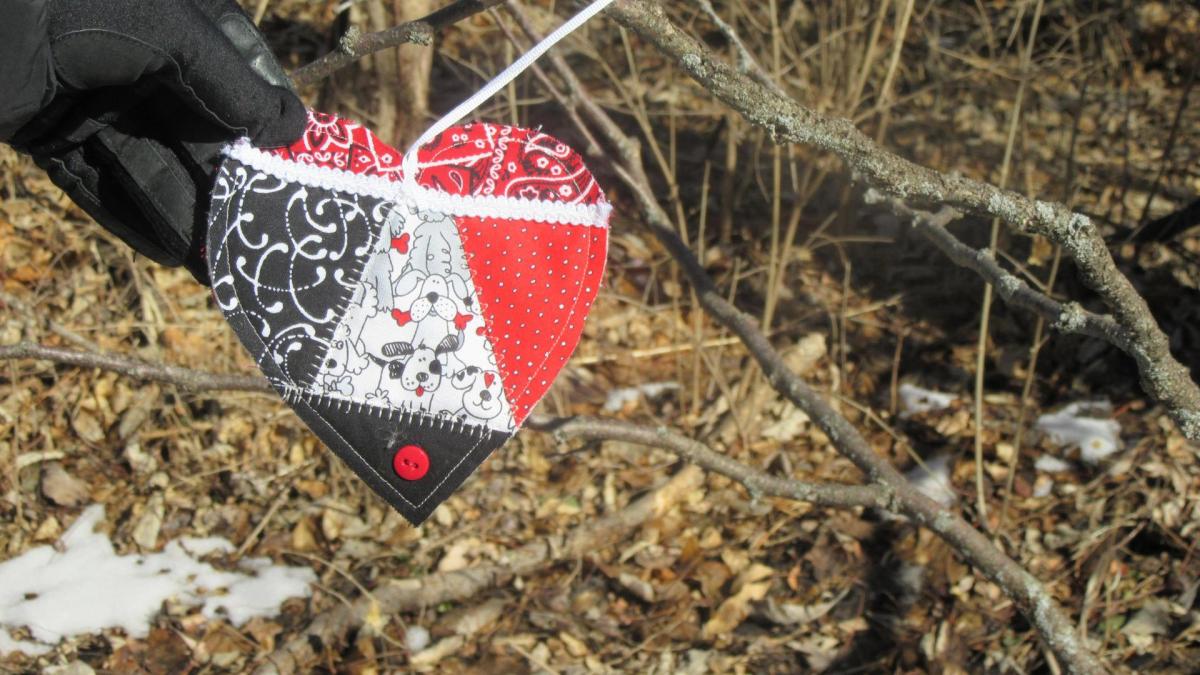
The best sightings were the quilted hearts hung on several trees. They are from an organization called “I Found A Quilted Heart” and you can learn more about the people who got this started at their web site www.ifoundaquiltedheart.com. Volunteers place the small quilted hearts in various places, often local parks. The sole purpose is to brighten your day. That beats the daily news any time.
What we didn’t know was that we could keep the quilted hearts we found. We saw 4 of them. We’re going to let others find them and share the joy.
Historically Black Colleges and Universities (HBCU) are in the news lately. It reminds me of the short time I spent at Huston-Tillotson College. It was renamed Huston-Tillotson University (H-TU) in 2005. I was there in the mid-1970s.
A new President and CEO was just named this month, Dr. Melva K. Williams. And H-TU was recently added to the National Register of Historic Places last month. It has been renovated and modernized. Pictures show a well-kept campus pretty much as I remember it over 40 years ago. I didn’t graduate from H-TU, but instead transferred credits to Iowa State University where I graduated in 1985.
My favorite teacher was Dr. Jenny Lind Porter-Scott, who was white, taught English Literature. Another very influential teacher was Reverend Hector Grant who was black. He taught philosophy and religion. He was instrumental in recruiting me to matriculate at H-TU. He helped me to process my loss on the debating team when the question was whether or not the death penalty played any role in the reduction of crime.
My opponent won the debate mainly because he talked so much, I couldn’t get a word in edgewise. I can’t remember which side of the question I argued, but I thought I could have done better if he had just shut up for a few minutes and let me speak. Reverend Grant used the word “bombastic” in describing the approach my opponent used. On the other hand, he also gently pointed out that sometimes this can be how debates are won.
There’s this “On the other hand” tactic in debating and in reflective thought that my debating opponent managed to repeatedly deflect.
I don’t know what ever happened to Reverend Grant. We spoke on the telephone years ago. He sounded much older and a hint of frailty was in his voice.
I could find only a photo on eBay of a man who closely resembles the teacher I knew and the name on the picture is Reverend Hector Grant. The only other artifact is a funeral program for someone I never knew, which lists Reverend Hector Grant as being the pastor and some of the pallbearers were members of one of the Huston-Tillotson College fraternities.
I think it’s unusual for people to disappear like that, especially nowadays when we have the world wide web. Reverend Hector Grant was an important influence for me. He was one of the few black men of professional stature I encountered in my early life.
On the other hand, contrast that with Reverend Glen Bandel, another clergyman who was a white man and another important influence starting in my early childhood. Reverend Bandel persuaded me to be baptized at Christ’s Church in Mason City, Iowa. He radiated mercy, generosity, and kindness. He died in June of this year. I can find out more about him on the web just from his obituary than I can ever find on Reverend Grant, who apparently disappeared from the face of the earth.
Both of these men were leaders for whom skin color didn’t matter when it came to treating others with respect and civility.
My path in life was largely paved by these two clergymen. Reverend Bandel sat up with our family one night when my mother was very sick. His family took me and my little brother into their home when she was in the hospital.
On the other hand, Reverend Grant was instrumental in guiding me to an HBCU where I saw more black people in a couple of years than I ever saw in my entire life. The First Congregational Church in Mason City was instrumental in making that possible because they helped fund the drive to support H-TU (one of six small HBCUs) by the national 17/76 Achievement Fund of the United Church of Christ.
The news is replete with stories, some of them tragic, about how Greek fraternities haze their pledges. On the other hand, H-TU was pretty rough on pledges too. Upper classmen would make the pledges roll down the steep hills around the campus. They looked exhausted, wearing towels around their necks, running in place when they weren’t running somewhere in the Texas heat.
One H-TU professor said that H-TU was “small enough to know you, but big enough to grow you.” Although I can’t remember ever seeing him on campus because he was traveling most of the time, I at least knew the name of the President was John Q. Taylor (1965-1988). On the other hand, when I transferred credit to Iowa State University, I never knew the name of the President of the university.
Habari Gani is Swahili for “What’s the news?” or as it translated in the context I’m about to set, “What’s going on?” Habari Gani was the name for the annually published book of poetry by the H-TU students. Dr. Porter supported the project. I submitted a poem for the 1975 edition, which didn’t make the cut. When I transferred to Iowa State University, I left without getting a copy.
On the other hand, years later, I got a digital copy of that edition. I tracked it down to the H-TU library in 2016. The librarian was gracious.
Habari Gani has always been a reminder of the reason why I went to H-TU in the first place. I grew up in Iowa and was always the only black student in school. I grew up in mostly white neighborhoods.
On the other hand, when I finally got to H-TU, one of the students asked me, “Why do you talk so hard?” That referred to my Northern accent, which was not the only cultural factor that made social life challenging.
Once I tried to play a pickup game of basketball in the gymnasium. I’m the clumsiest person for any sport you’ll ever see. I was terrible. But the other players didn’t give me a bad time about it. They softly encouraged me. This was in stark contrast to the time I played a pickup game with all white men years before in Iowa. When I heard one of them yell, “Don’t worry about the nigger!” I just sat down on the bleachers.
On the other hand, when I was a kid and our family was hit by hardship, Reverend Bandel was the kindest person on earth to us—it didn’t matter that he was white. And my 2nd grade teacher, who was black (the only black teacher I ever had before going to H-TU), slapped me in the face so hard it made my ears ring—because I was rambunctious and accidentally bumped into her. It’s far too easy to polarize people as good or bad based on the color of their skin, especially when you’re young and impressionable.
It takes practice and experience to learn how to say and think, “On the other hand….”
I remember getting a trephination of my fingernail a long time ago when I was working as a surveyor’s assistant. We were out taking elevation shots with a level and a rod measuring the depth of sewer pipes.
This required us to remove the manhole covers, which are very heavy. I got one of my fingers pinched and man that hurt. My crew drove me to the emergency room where an ER doctor drilled a tiny hole in my fingernail. The immediate pain relief resulting from the release of the subungual hematoma pressure felt miraculous.
That was trephination of the fingernail. I’ll bet some of you thought of my skull when you read the word in my first sentence, though.
Trephination is just the word for the medical procedure of making a hole in the body for some reason. In order to relieve pressure and severe pain from getting your finger mashed, a doctor can make a hole in your fingernail.
Trephination can also mean making a hole in your skull to treat brain injuries or to let the evil spirits out. That was done thousands of years ago, but making burr holes in the skull for other medical reasons is still being performed, including to relieve pressure.
It’s the origin of the old saying, “Well, I’ll be bored for the simples,” where the term “simples” means feeble-mindedness and “bored” refers to the obvious treatment.
Anyway, boring holes in either your mashed finger or your head can relieve certain kinds of pressure and pain.
Figuratively speaking, we can feel under pressure in our heads for all kinds of reasons. In fact, we’re born with several kinds of holes in our heads that can lead to the pressures of anger, anxiety, sorrow and fear.
Our eyes can fool us, even to the point of making us believe we see Bigfoot when all we’re really seeing are pictures or videos that are very blurred and pixelated. I didn’t say nobody ever sees Bigfoot. I’m saying that there’s a term for some forms of visual misperception, one of them being pareidolia—the tendency to perceive meaningful images in random or ambiguous visual patterns.
Our ears can also fool us. Mondegreens are misperceived song lyrics. One of the most common mondegreens is a line I was very embarrassed by for years, “Wrapped up like a douche, another runner in the night” from the song Blinded by the Light by Manfred Mann’s Earth Band. It’s actually “Revved up like a deuce, another runner in the night.” A deuce is a kind of automobile that was often converted into a hotrod in the 1930s, usually a Ford.
Those are just a couple of examples of how holes in our heads can sometimes lead to trouble getting along with each other. All you have to do to prove this is to look at news headlines. Everybody’s slamming each other.
There’s no magic cure for interpersonal conflict, although there have been plenty of efforts to help us understand how it may arise from misperceptions and misunderstandings, often arising from missteps in communication. I doubt making more holes in our heads would be helpful.
For example, I could have chosen to show you a picture of which one of my fingers got pinched in a manhole cover. How I might have done that could have been unnecessarily provocative and even offensive—even if I only meant it as a joke. A prominent scientist recently published a picture on social media of what he called a new star he said was taken by the Webb telescope. It later came out it was actually a picture of a slice of chorizo, which is a sausage. Many people didn’t think it was funny, but that was his explanation for the post.
I don’t have to say anything more to convey the message that being mindful of what and how we are communicating is vital to making ourselves understood while remaining respectful and kind.
Practicing mindfulness is one way to facilitate clear communication that can help solve problems without hurting the feelings of others and triggering vengeful counterattacks. We’ve all been there.
Not everybody gets the idea about mindfulness. I think the blogger thegoodenoughpsychiatrist does a great job discussing it in the post “Reflecting on DBT and Mindfulness.”
As the blogger says, “Sometimes, you just need to be brought back down to earth.”
And if that doesn’t work, we can always try trephination.
The other night I watched a show I’ve seen 3 times and it still makes me want to cry. It’s the Heavy Rescue 401 episode with Bear the heavy wrecker operator with the Ross company who lets an 8-year-old boy diagnosed with cancer hold the steering wheel and pull the horn as they take a drive around the farm where the family lives.
They hug and it’s tough to tell whether Bear is comforting the boy or the other way around. I guess it’s both.
I saw a Facebook page about the boy, who succumbed to cancer a few years ago. People are still leaving warm messages.
I watch a fair amount of TV and I make fun of most of it, including the paranormals. They’re pretty formulaic, re-investigating decades old cases that never get solved about alien visitors in spaceships, leaving behind evidence that goes missing from government storage warehouses. Because it gets lost, nobody has to explain why there is a notable lack of any convincing evidence for what most UFOs are and who might be flying them.
I can’t generate much emotion for the paranormals. I mostly laugh at them. How can you lose or throw out physical evidence of UFOs and aliens so many times?
“We need to make more room in here; can we toss something in the trash compactor?”
“Sure, get rid of those photos of military personnel taking selfies with aliens driving UFOs and drinking beer. That’ll make room for the 400-page binders of the syllabus for the graduate school course ‘Effect of Chimpanzee Eyebrow Dandruff on Prime Interest Rates During the 20th Century.’”
One of paranormal shows did an extensive review of the Kecksburg, Pennsylvania UFO, the one shaped like a macadamia. No wait, it was shaped like an acorn. It was dark and brooding, full of intrigue, veiled threats, and an alien pilot. As usual, evidence was lost.
Did you know Kecksburg throws an annual UFO-themed party? They just had the 17th Kecksburg UFO Festival just last month, replete with something called a burnout contest, fireworks, and crafts. The people of Kecksburg aren’t letting the government conspiracy get them down. They’re more than happy to let the paranormal producers visit because it gives the town leaders a chance to draw more tourists to the area.
I get a kick out of Men in Black (MIB) too, and I won’t tell you how many times I’ve seen the first one and the first two sequels. In Men in Black, Agent K shows the new recruit, Agent J, a special universal translator and says MIB is not even supposed to have it and says, “I’ll tell you why. Human thought is so primitive it’s looked upon as an infectious disease in some of the better galaxies.”
That’s why it helps to watch some other TV shows, the ones with heart where real people who are not acting but living do the mundane things which are seldom the most treasured of miracles. They remind you of the better human qualities like humor, kindness, love, generosity, gratitude, and the experience of sorrow that can sometimes humble a species which often suffers from overweening pride.
This is just a quick shout-out to the Iowa City Fire Department (Iowa City Fire Engine 4 and Engine 1) and the Johnson County ambulance service for their outstanding rescue of a person who suffered a cardiac arrest recently. It was reported in the news and the city of Iowa City wrote a great story about it as well.
We visited with a firefighter at Fire Engine 4 when we were out for a walk a while back.
Every day I see news stories about people acting up just to get attention. I pay attention to the stories about people who exemplify courage and kindness.
We went for a walk on the Terry Trueblood Trail yesterday. It was a nice break from reading the news.
Sena wore her shirt which has printed on it, “be kind, be nice, be love.” She got a compliment about it.
We saw a lot of birds, including Tree Swallow nestlings in the nest boxes along the trail.
There were three in one of the boxes. They seemed to be doing well. I thought we saw a Gray Catbird, although it was singing a complex song at the top of its lungs—from a treetop. I guess I’m not sure what it was because Catbirds are usually secretive and makes sounds like a house cat’s mewing.
I guess all I know is that the bird looked gray.
Anyway, friendly people were out and we said hello to each other. Kindness was in the air.










 Go Retire Psychiatrist