It’s Iowa’s 175th Birthday; Get Out and Shovel Snow!

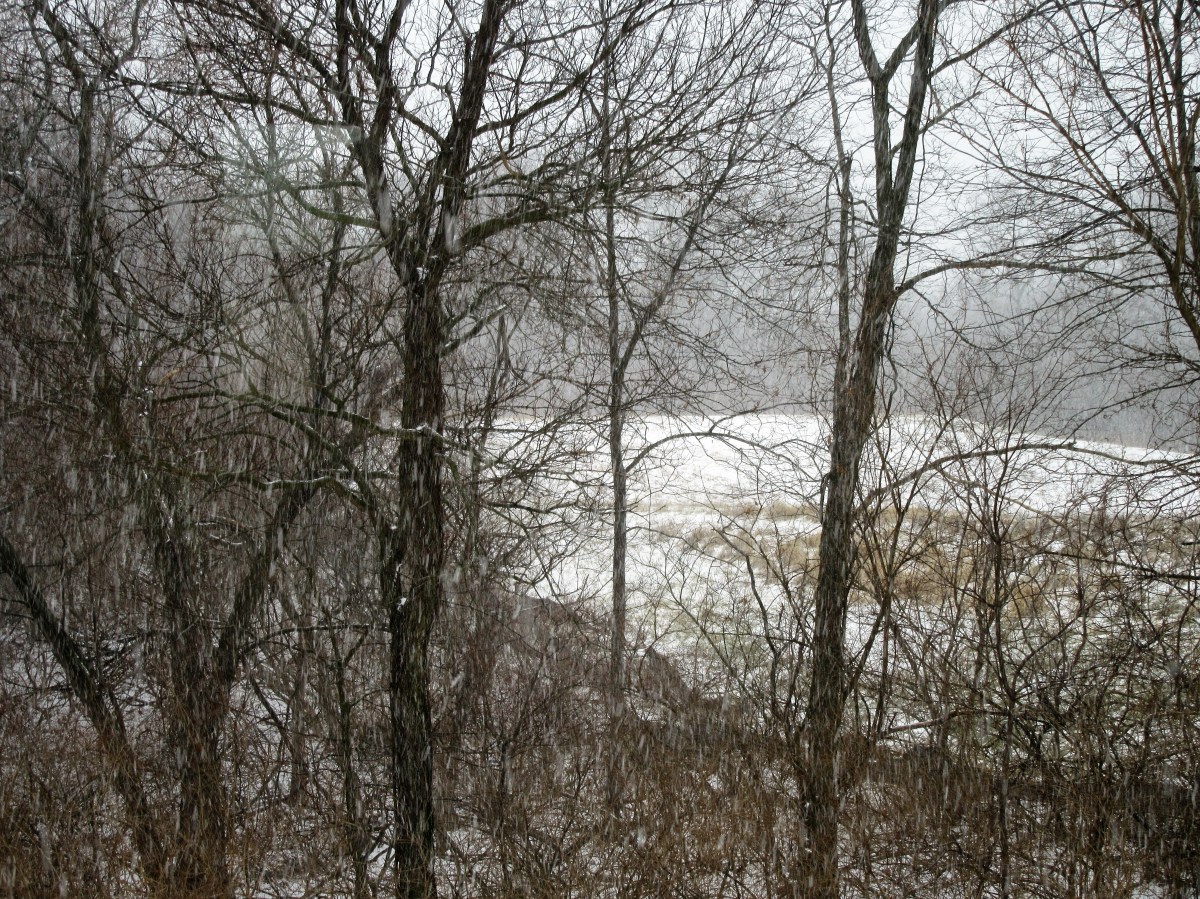
Today is Iowa’s 175th birthday. It’s also the first day of snow this winter. I had to get out there and shovel. I can celebrate Iowa’s 175th year of statehood by rubbing liniment on my sore shoulders. The Iowa statehood anniversary will be a year-long commemoration. If it snows anymore, I’ll be bathing in muscle cream for at least that long and will likely miss many of the events.

It was a wet, heavy snow. I pushed it around for hours. While sweeping snow from the front porch, I slipped off the first step and came down hard (but on my feet!) on the sidewalk instead of the second step. I was unhurt, but it was jarring. It reminded me of one of last year’s big snows which left enough ice on the driveway to make me slip and fall on my butt. The next-door neighbor, who was also out shoveling, saw it and looked at me a long time—but I bounced right back up. No need to call an ambulance. I’m good!

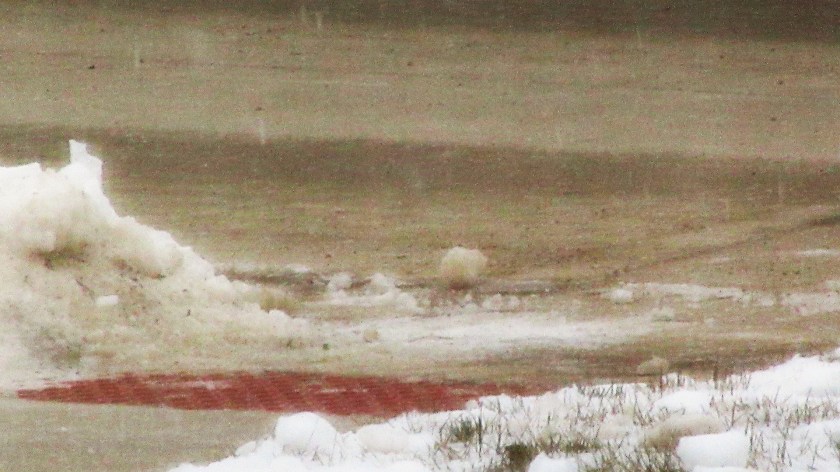
And then the city snow plows came through and did what they did last year. They left snow droppings in our driveway, which wasn’t really plugged but looked unsightly.

The only excuse I have for not going back out to clean it up is that it was raining steadily, and my winter coat and gloves were still soggy from sweat. It’s not like it was a couple of years ago, when we lived another part of town and the plows banked in drifts the size of small cars across our driveway. However, I have modified my shoveling technique. I no longer twist my back and throw snow over my shoulder (the John Henry model). I bend my knees and keep my back straight.

There will be more snow tomorrow, later in the day. Maybe it will be late enough that it will be too dark to shovel. Or maybe all the shovels in our garage will meet with some sudden, mysterious accidental breakage that makes them useless. The roads will probably be too icy and impassable from snow drifts for driving to the hardware store to buy replacements.

That’s how things go in the winter around the Midwest, especially in places like Iowa, ravaged by 175 years of snowstorms, freezing temperatures, shovels, and oceans of liniment.

On Christmas eve, when it looked like there would be no snow for Christmas Day, I remembered my blog on WordPress had a setting that would make snow fall and blow across our websites. It looks like that stopped about 6 or 7 years ago to allow a sharper focus on the business aspect. A lot of bloggers were unhappy about the change. You had to pay to play to get the Holiday Snow, which means you had to purchase the Business Plan blog and a special plugin, which could then be exploited by hackers.

Today, I got all the snow I would ever need. Happy Birthday, Iowa!

ADDENDUM 12/29/2021:

Today I used an ice chopper to clear the snow blobs from my driveway, which had been frozen into ice blobs overnight. I also chopped the ice from the curb ramp on my sidewalk which the city snow plow had also plugged yesterday. An official city truck was driving by and witnessed me clearing it. Will it make a difference? It started snowing again this evening.

Follow the Trail of the Woolly Bear Tale

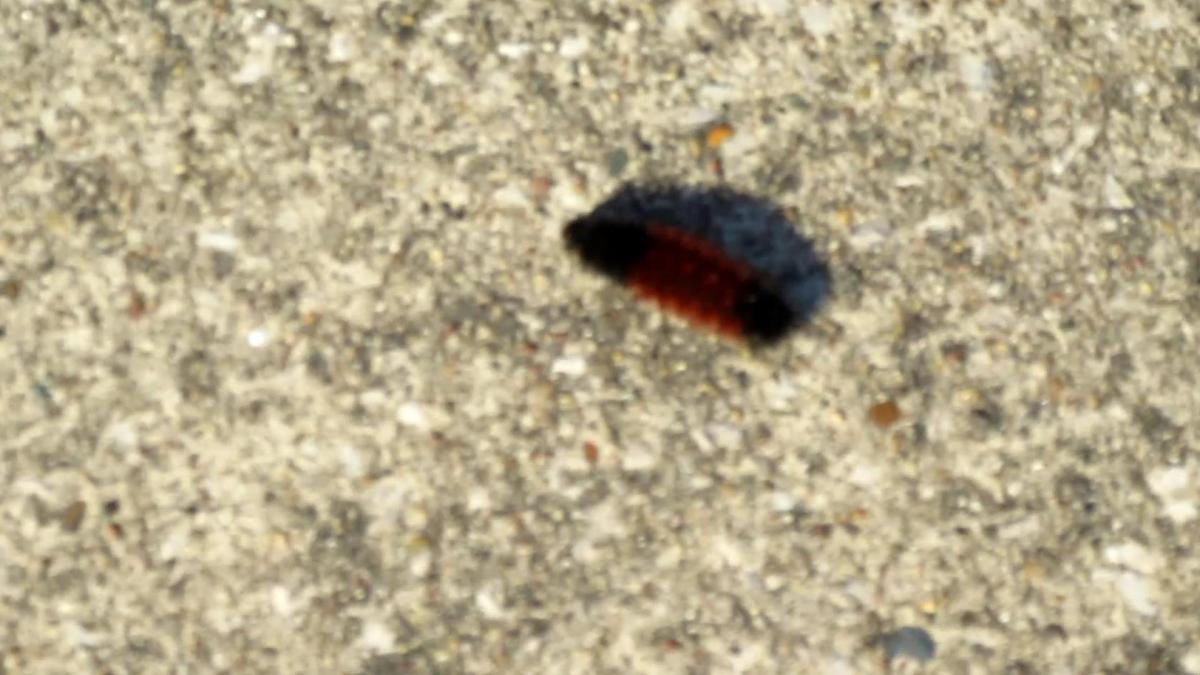
Sena and I went for a walk on the Clear Creek Trail today. It’s been about a year and a half since we last saw the place. A few things have changed, but one thing has not. You can nearly always find a woolly bear caterpillar somewhere along the trail, especially in the fall. I know I mentioned the insect not that long ago in a post after we thought we might have seen one on the Terry Trueblood Trail.

But we’re talking banded woolly bear, the genuine article. They have a brown band in the middle bounded by black bands at the head and tail ends. They’re fat and always busy looking for cover. There is a folk tale about it foretelling how hard the winter is going to get. The longer the black bands, the worse the winter will be.

However, the folk tale has long been debunked, according to my alma mater, Iowa State University (ISU). The bands are just indicators of the age of the insect, which is the larval stage of the Isabella moth.

But don’t try to tell that to the people of Vermilion, Ohio where they have the annual Woolly bear Festival. Dang, we just missed it in early October. They have a parade, woolly bear races, and an “official” examination of the woolly bears to nail down the winter forecast. I guess that’s sort of like hauling out the groundhog Punxsutawney Phil in Punxsutawney, Pennsylvania each Groundhog Day on February 2 to predict how much longer winter will last.

That reminds me (too late!) that we also missed this year’s ISU Department of Entomology Insect Zoo Film Festival, in Ames, Iowa, which was in late October. It’s an outreach program which travels all over Iowa to educate the public about insects.

I gather this evolved from another annual ISU Department of Entomology project called the Insect Horror Film Festival. It began in the early 1990s and gradually settled down into the Insect Zoo Film Festival in the mid-2000s.

That reminds me of one of my favorite movies, the 1997 film Men in Black, in which a bad-tempered giant cockroach alien crash lands its space ship on earth, eats a guy to use his skin as a disguise, tries to steal the Arquillian (tiny alien) galaxy, the best source of sub-atomic energy in the universe, and gets enraged every time it sees humans so much as swat a fly.

The other movie this makes me think of is the 1988 film Beetlejuice. Beetlejuice was sort of the star of the show, played by Michael Keaton. Beetlejuice was a dead guy who ate bugs and hired himself out to the newly dead, claiming to help ghosts get rid of a different species of pest—the living.

Finally, that makes me think of how long it’s going to take to get our Zombie Cribbage game delivered, given the recent slowdown of the Post Office. The snow may fly before it arrives.

But if the woolly bear analysis is right, at least there won’t be a lot of snow to slow down the mail truck.

The Iowa City Mask Mandate

The mask and vaccine mandates for COVID-19 have been in the news a lot and there has been plenty of controversy about them, which is putting it mildly. I’ve been thinking about the mask mandate that Iowa City Mayor Bruce Teague issued August 19, 2021 and scheduled to expire on September 30, 2021. I agree with it, just to get that out of the way. Johnson County is a high transmission area for the virus, as is most of the state of Iowa, according to the CDC’s COVID Data Tracker. Hospitalizations and deaths are increasing from COVID-19 infections. The CDC recommendations and rationale for interventions to control the spread of the virus make sense to me.

On the other hand, Iowa Attorney General Tom Miller is investigating whether or not the mandate is legal based on the conflict with the Iowa law passed in May 2021 by Governor Kim Reynolds. It’s sort of an anti-mandate similar to others I’ve seen in the news. I think it’s based on the state law which says that municipalities cannot adopt an ordinance requiring an owner of real property to implement a policy relating to the use of facial coverings that is more stringent than the state’s policy.

I have no idea what the difference is between persons who are owners of real property and persons who are just plain individuals. I thought they were the same—unless you consider homelessness an important factor. Would that make someone who is homeless a non-person? Just because they’re often treated that way is beside the point—isn’t it? I’m just kidding, sort of; it looks like the owners of real property might be understood as business owners and the like. And everyone knows they’re not real people.

Does Mayor Teague’s mandate apply to the University of Iowa? Not if you believe that the virus expressly avoids University of Iowa property; so at least that’s settled. The sticking point is that the Iowa Board of Regents and the Governor are the authorities over what happens on state-supported university property, unless it’s connected to beer.

AG Miller has plenty of time to consider the matter because there is no provision for enforcement of Mayor Teague’s mask mandate. By the way, the city of Coralville also has a mask mandate that was issued by Coralville Mayor John Lundell, effective August 11, 2021. I don’t know if Mayor Lundell’s mandate provides for enforcement if it’s not followed, but I suspect it isn’t. I’m not sure why AG Miller is not investigating Mayor Lundell’s order to see that it’s legal or not. I thought we were an equal opportunity state. University Heights has not had a mask mandate since August 18, 2020, unless there’s a typo on their website.

Many people are not aware that Coralville, Iowa City, and University Heights are separate municipalities. If you blink, you might miss the transitions between them.

I’m not sure how you’d enforce the mandate. I’m pretty sure police are not going to tackle you and secure a mask to your face using a county-approved staple gun. I’m also wondering what legal consequences there could be if AG Miller finds that Mayor Teague’s mandate is illegal, especially since it’s unenforceable.

I’m not sure what you can do to enforce such mandates or anti-mandates. Without enforcement, the mask mandate is a strong recommendation. In addition to the science, it has little more than common sense to back it up, although common sense is not commonly used.

You wonder how aliens (who are almost always idealized as being very advanced and superior to earthlings) would look at this situation and what they would do about it to help the human race. I’m reminded of what Agent K says to Agent J in Men in Black (MIB) as he shows Agent J a universal translator (one of the many gadgets MIB holds patents on, making them independent of governmental oversight): “We’re not even supposed to have it. I’ll tell you why. Human thought is so primitive it’s looked upon as an infectious disease in some of the better galaxies.”

Maybe aliens are vaccinated against us.

CDC Health Advisory Warning Against Using Ivermectin for COVID-19

I’ve seen a few warnings including the CDC Health Advisory issued August 26, 2021, against using Ivermectin in COVID-19. Ivermectin is a prescription drug used to treat parasitic infections in farm animals and humans. There’s no credible evidence supporting the use of Ivermectin to treat COVID-19 in humans and its use is currently restricted to research trials.

There have been calls to poison control centers across the country from people who suffer side effects, which can include nausea and vomiting, seizures, confusion, hallucinations and more from ingesting animal grade Ivermectin. It can cause death. Certain politicians and doctors are recommending and prescribing it for humans. At least one person has been hospitalized for treatment of side effects.

I saw the FDA warning tweet quote: “You are not a horse; you are not a cow; Seriously y’all. Stop it.” I’m not sure if that was from an FDA official, mostly because I doubt that the word “y’all” would be standard usage for FDA announcements. In any case, the FDA strongly advises against using Ivermectin to either prevent or treat COVID-19.

Merck, the manufacturer of the agent, warns against it as well.

Most of the headlines I’d seen until today were connected to Mississippi and Texas. This morning, I saw a story revealing that Iowans are also buying Ivermectin in animal supply stores, probably to self-treat or prevent COVID-19. One customer claimed it was safe for humans, purchased the product and left the store.

Nobody’s going to tackle a customer who insists on using Ivermectin in a misguided effort to treat COVID-19. There’s no law against it, so nobody’s going to call the police to intervene.

There’s a song titled “Iowa Stubborn” from the Music Man, a show starring Meredith Willson, who was from Iowa. I’m hoping the “chip-on-the-shoulder attitude” will eventually lead Iowans toward making the common-sense, community minded decisions (for which we are also known) that will eventually free us from the grip of the pandemic.

In times like these, I wonder—what would Chet Randolph think?

An Update on the Sitting Man Post

This is just an update on my Sitting Man post. I just found a YouTube presentation about the Sitting Man that clearly shows the title inscribed on the side of it was Man on a Bench in 2014. The inscription on the rear was illegible back then. I’m guessing that when the sculptors, Doug Paul and J.B. Barnhouse, moved it last summer from the east side to the west side of Scott Boulevard, they might have altered and refurbished the inscriptions at around the same time.

When we visited the site, the year inscribed on the side was 2013. Other people have described it as being finished in 2015. I’m not sure it matters to the artists. They might see it as a timeless artifact, which they happened to uncover, according to free-lance writer, Lori Erickson.

It reminded me of another sculptor’s work entitled Palimpsest by V. Skip Willits, from my post about the Iowa City Public Art Program. I think it might fit the palimpsest definition: something that’s been reused or altered but still has traces of its earlier form. 

Anyway, back when it was on the other side of Scott Boulevard, it was even harder to access. It was on private land that you had to ask Harvard Preserve permission to enter. In fact, for photographer David Weldon, the path to the sculpture was muddy and difficult to climb in 2015. There was no parking and that is still the case. If you’re not within walking distance, you have to scramble out of your car and grab a quick snapshot while avoiding traffic. And it’s still on private land owned by Harvest Preserve, although now you don’t have to obtain permission to climb the hill.

The artists have said that The Sitting Man was never intended to be called a Buddha, although it’s often called just that. You can make your own interpretation of what it means to you. However, according to Roadside America, Doug Paul has called it “distinctly Iowan.”

The Sitting Man of Iowa City

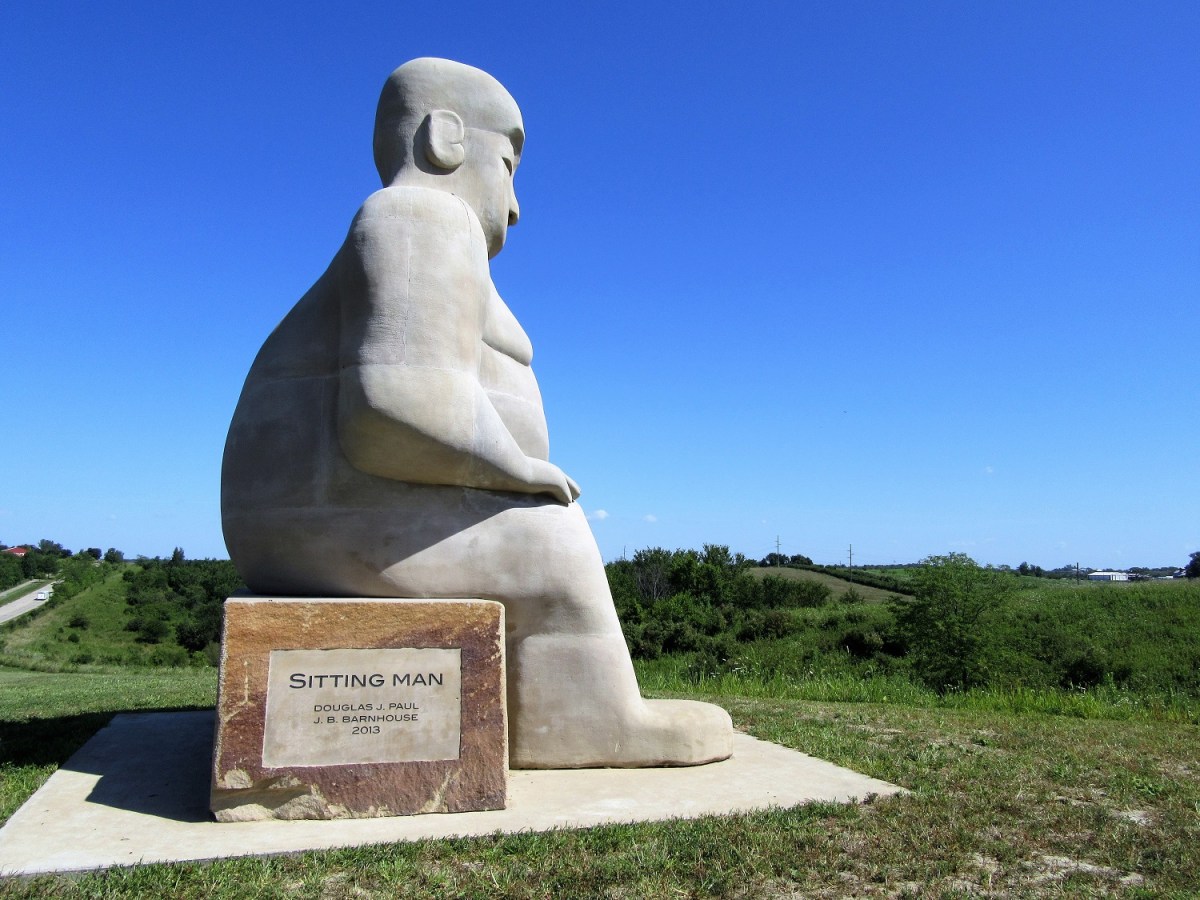
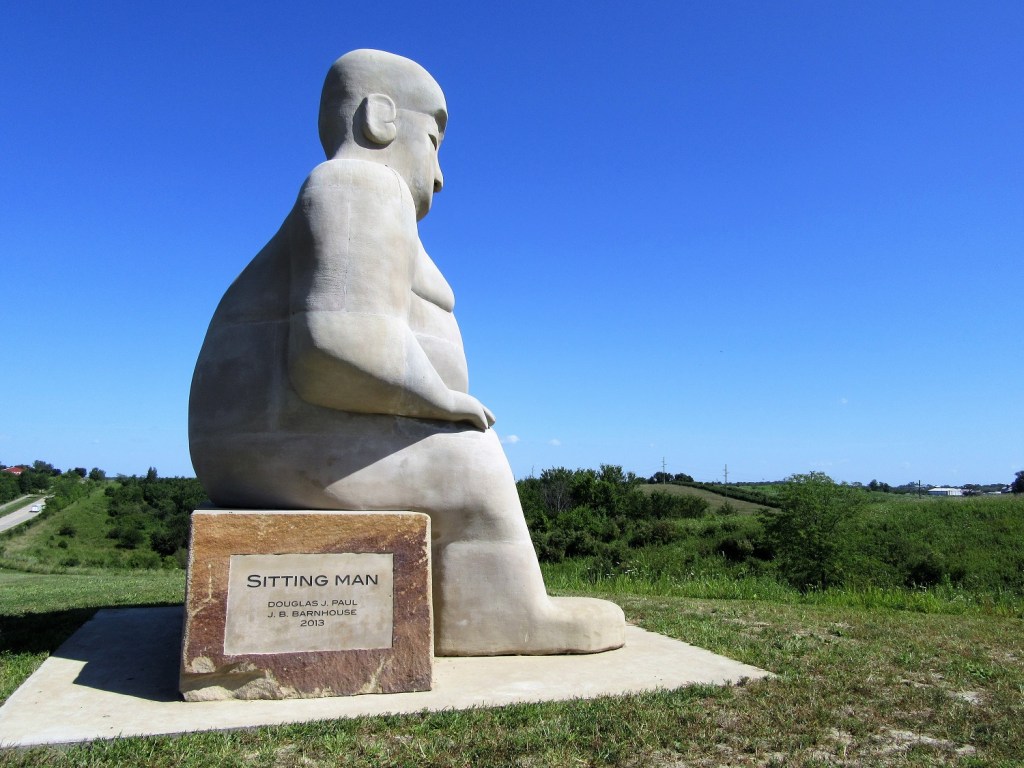
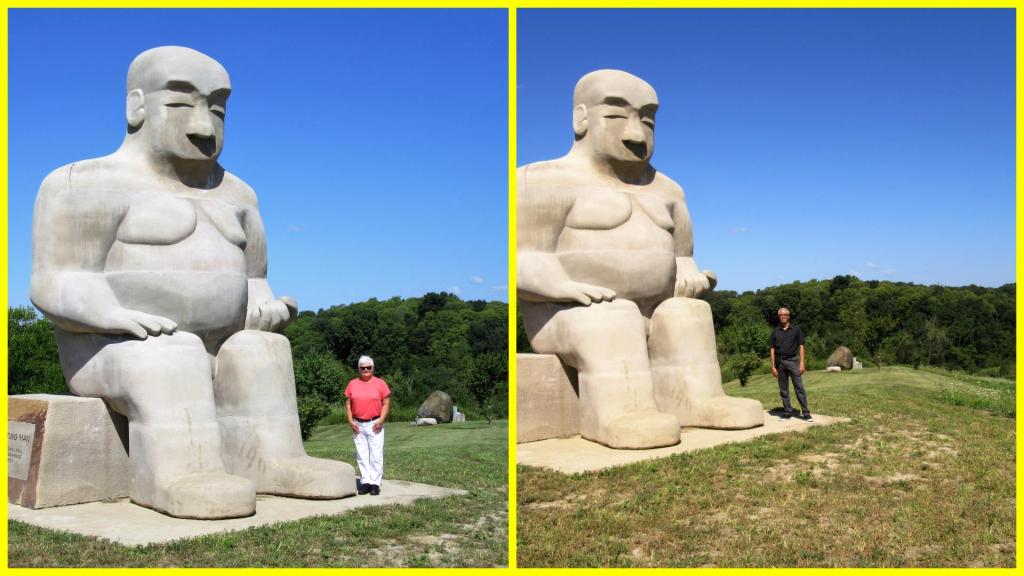
After 33 years living in Iowa City, Iowa, Sena and I finally trekked up Scott Boulevard to see Sitting Man, or Man on a Bench, or the Buddha of Iowa City. Whatever you call him, he’s steady as a rock, which is what he is—110 tons of limestone and 20 feet tall. He was carved by Douglas J. Paul and J.B. Barnhouse and finished in 2013. It was a monumental challenge to move him from the east side of Scott Boulevard to the west side in the summer of 2020 after a change in property ownership. He sits on land owned by Harvest Preserve.

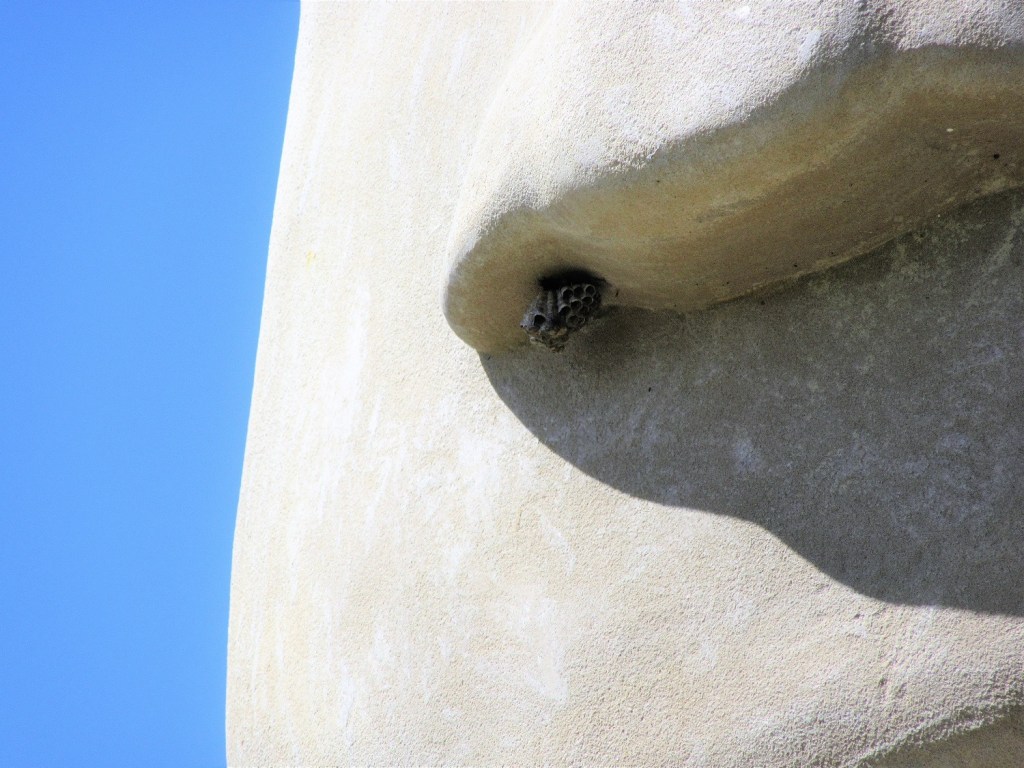
He had an old hornet’s nest booger up his nose, which actually tends to support the idea of him being some kind of Buddha. You have to be pretty serene to put up with that.

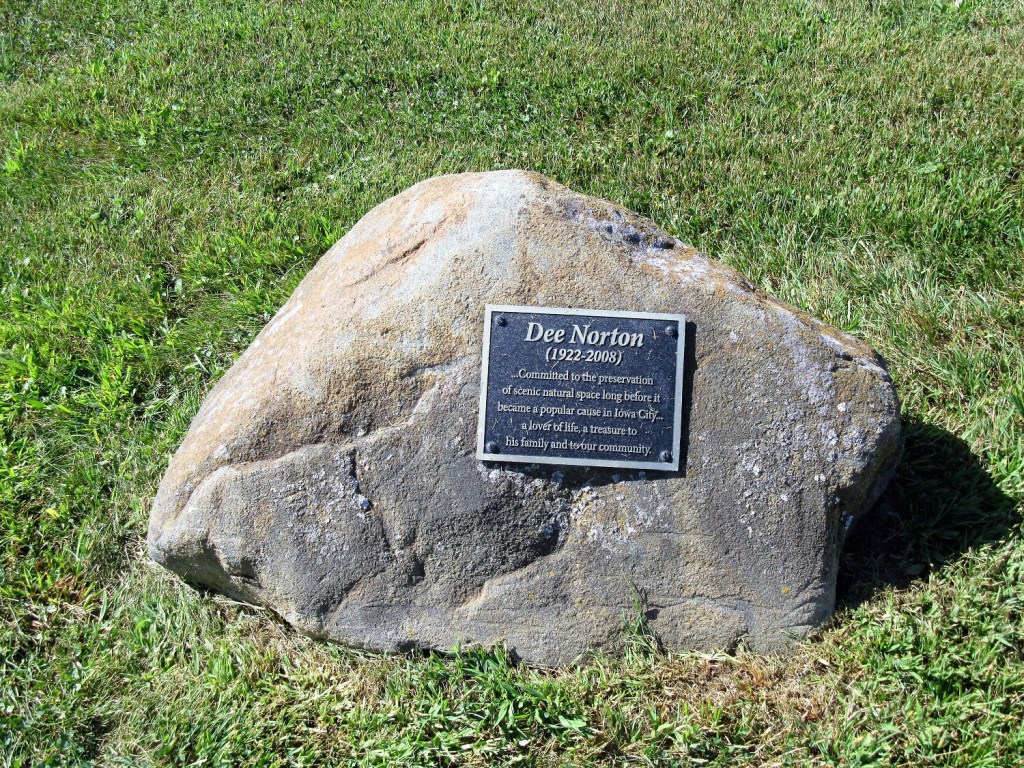
Before you get to the Sitting Man, you reach a contemplative space called the Visionary Stone. The inscription on it is about Dee Norton. According to his obituary on the web, Dee W. Norton was Associate Professor of Psychology and former chair of the Department of Psychology at The University of Iowa. In 1991, he received the Michael J. Brody Award for Faculty Excellence in service to The University of Iowa. He was a longtime member of the Unitarian Universalist Society. He made numerous contributions to education and the community. He had a pretty good sense of humor, too.

I learned more than I thought I would on the journey to the Sitting Man. On the back of the sculpture is an inscription of a prayer, which is dedicated to Paramahansa Yogananda, founder of the Self-Realization Fellowship Church, which I had never heard of or read about when I scanned the web trying to learn more about the Sitting Man. I briefly looked at the website and there seems to be an Iowa City Meditation Circle here, although only an email address is listed (iowacity.srf@gmail.com) and I don’t know what the fellowship is all about in any detail.

There may be more than meets the eye when it comes to a limestone giant with an old hornet’s nest up his nose and a hand open in what is probably a gesture of welcome and acceptance. We could sure use some of this now—minus the hornet’s nest.

Take a Break: Art in the Parks

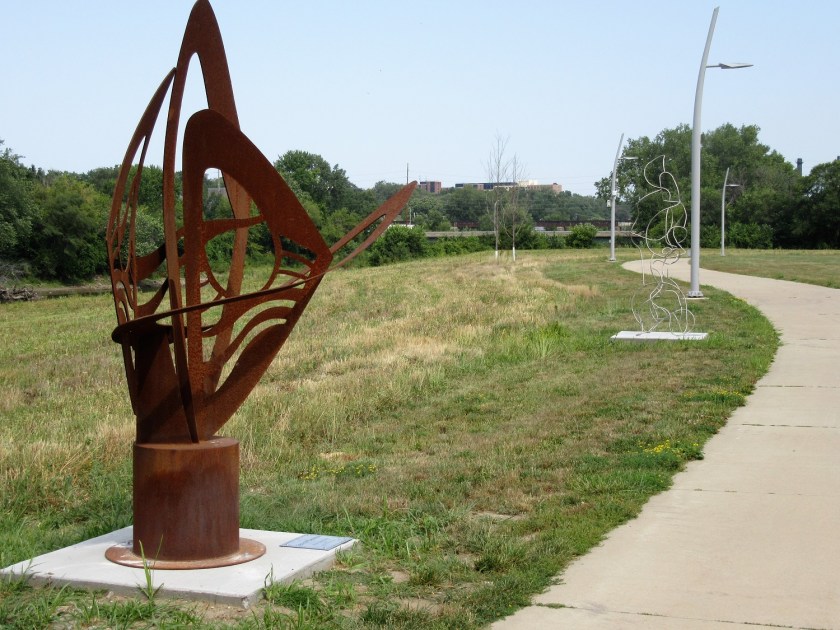
Since the weather took a break yesterday from the triple digit temperatures, we took a little getaway to a few of the city parks to see the new public art. This is connected with the Iowa City Public Art Program. Five sculptures were installed about a week ago at Terry Trueblood Recreation Area, Riverfront Crossings Park, and Mercer Park.

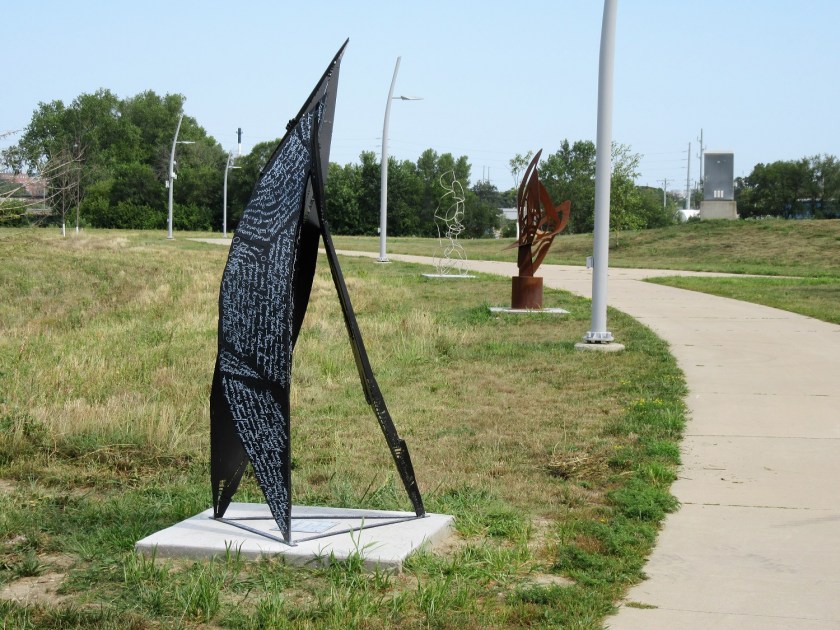
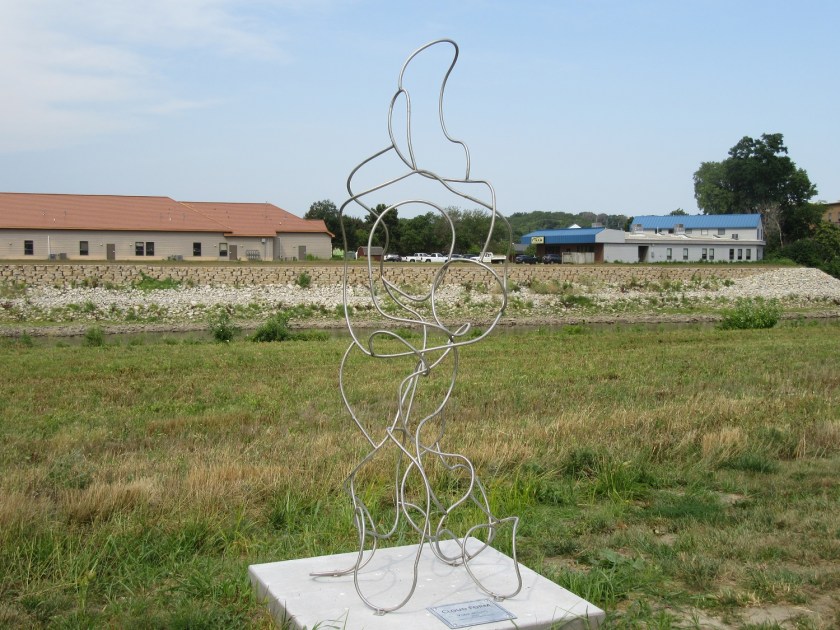
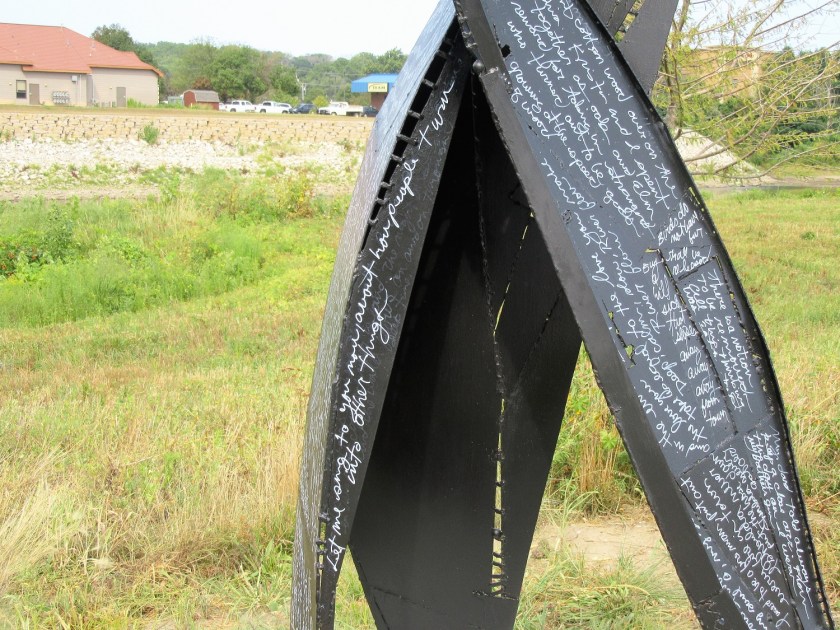
Three sculptures are at Riverfront Crossings. Two are by V. Skip Willits: Palimpsest and Cloud Form. The third is by Hilde DeBruyn: Sea of Change. Sena knows that Sea of Change looks like a sailboat when you look at it from the right angle. We could see clouds through Cloud Form.

I noticed that V. Skip Willits’s name could be spelled wrong (Willets vs Willits?) on the artist’s nameplate below the sculpture, Palimpsest (also on Cloud Form). I also discovered a 2013 news story of a similar sculpture at the Ames Annual Outdoor Sculpture Exhibition although it was given a different title: Prayer Torso. His sculpture Swans on the Marsh featured in a 2015 image on Sculpture Walk Peoria in Illinois and another fashioned out of corrugated iron in Effingham, Illinois resemble Palimpsest as well. A news story in the March 26, 2021 Effingham Daily News quotes Willits as identifying the sculpture’s title as Cipher. He and probably a few passersby had written on the piece. There are also variant spellings of his name, including V.skip Willits, lower case “s” for “skip.” He’s not the same person as Skip Willits, who is a photographer selling wall art. In any case, Palimpsest is a pretty good example of a palimpsest.

According to the dictionary, a palimpsest is a “piece of writing on which the original writing has been effaced to make room for later writing but of which traces remain.” More generally, it’s something that’s been reused or altered but still has traces of its earlier form. You might want to snap a picture of the sculpture and rotate it in order to see all that’s written there; for example:

“Let me sing to you now, about how people turn into other things.”

I think it could be evocative of what many have noticed and remarked on, only using different words in different languages in different circumstances over millennia. We’re all turning into other things in the turbulent sea of change, sort of like clouds which are the ultimate shape-shifters.

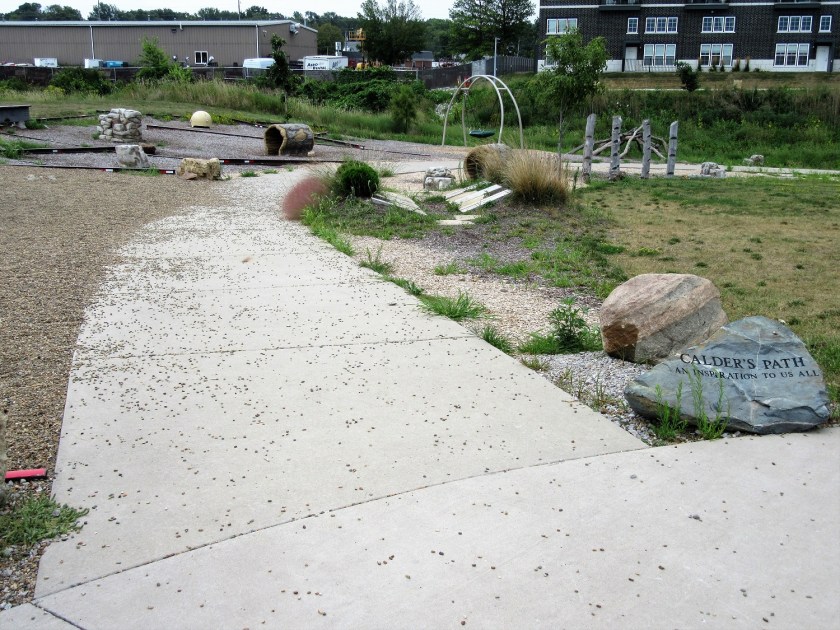
This was the first time we had ever visited Riverfront Crossings Park and we found something familiar there—a stone inscribed with the words Calder’s Path: An Inspiration to Us All. Pebbles were strewn all over the path. After all, no path is without stones. We frequently drive by a small and neatly kept neighborhood park called Calder Park many blocks away. It’s a memorial to a boy named Calder Wills, who passed away of leukemia several years ago. We never knew him or his family. Based on what I’ve gleaned on the web, Calder had big dreams. He was strong. He was a person who turned into a light.

We also enjoyed Mercer Park where we saw the sculpture The Other Extreme, by Tim Adams. Mercer Park and Aquatic Center is named in honor of Leroy S. Mercer who distinguished himself as Iowa City Mayor, state representative and state senator as well as a successful businessman and banker. The sculpture is the sun with a rock at the center. According to Adams, it’s utterly simple; a clear vision of how everything started. There was only the earth and the sun. That was it. And then change took over. Things changing into other things. People turning into other things. Tim Adams art has been influenced by his career as a Registered Landscape Architect. His subjects are influenced by the rugged Iowa weather, which his creations are designed to withstand with little need for maintenance.

Sena and I both got a kick of the automobile jungle gym.

We had already visited the 5th sculpture last week. It is called Bloom by Hilde DeBruyn. Again, the theme of change because it’s a flower and flowers start from seeds in the earth, and burst up to the sun. Because this is where it all begins. DeBruyn is another gifted Iowa artist who has said in an interview with Iowa Artisans Gallery that her work often involves the “natural cycle of growth and decay.”

We begin with one extreme, the raw and wild. Eventually, we reach the other extreme, the ultra-refined and wildly complex. In the middle, we erase and then reconstruct many things from the relics of ancient wisdom or folly, forgetful of bygone grandeur or catastrophe, rarely startled by déjà vu.

James Alan McPherson Park Sign Reveal

Yesterday evening the new sign reveal of James Alan McPherson Park made the new name of the park official. The weather was balmy and a big crowd showed up for the event, including Iowa City Mayor Bruce Teague. He joined McPherson’s daughter, Rachel McPherson; Director of Parks and Recreation Juli Seydell Johnson, and Iowa City Council member, Pauline Taylor for the ribbon-cutting ceremony.

This was immediately followed by a sing-along of a few bars of “You are My Sunshine,” led by Mayor Teague—who was in fine voice.

And even more music was provided by Cedar County Cobras. They were in a blues mood that evening—very popular with the crowd.

Prior to the ribbon-cutting, there were remarks from Mayor Teague, Rachel McPherson, and Juli Seydell Johnson. They shed personal stories highlighting McPherson’s gifts as a writer, intellectual, and humanist. They seemed to echo poet James Galvin’s perception of McPherson as not just the moral center of the Iowa Writers Workshop, but as the moral center of the universe.

You couldn’t miss the speakers’ impression of McPherson’s sense of humor, which tended to be ironic. Rachel shared an incredible anecdote about his tendency to write to far right-wing organizations (including the KKK) for more information about them, evidently giving them the impression that he was interested in becoming a member—to which they replied with enthusiastic offers to do so! This was not a one-time gag, but a running insider joke for years. Rachel is still getting mail from these groups. She also brought enough memorabilia to fill a table, and it included several “business cards” which deftly deflated the pomposity, posturing, racism, and outright villainy in society. I had to run to the web to get some of the jokes:

Guslar: traditional Bosnian-Croatian-Serbian name for an epic singer who performs long narrative tales (some detailing ancient battles and other historical events) while accompanying himself on a one-or-two stringed instrument called a gusle.

Ebonics: According to the Linguistics Society of America, this means literally “black speech” and refers to English spoken by African-Americans.

Enron was a company which perpetrated one of the largest accounting scandals and bankruptcy in recent history.  

We welcomed a member of the Iowa City Police, who set up a table offering many useful free items including a generous helping of good will.

Another part of the presentation was a discussion between consultants and interested community members about future enhancements to the park, which include a plan for a memorial plaque in honor of McPherson.

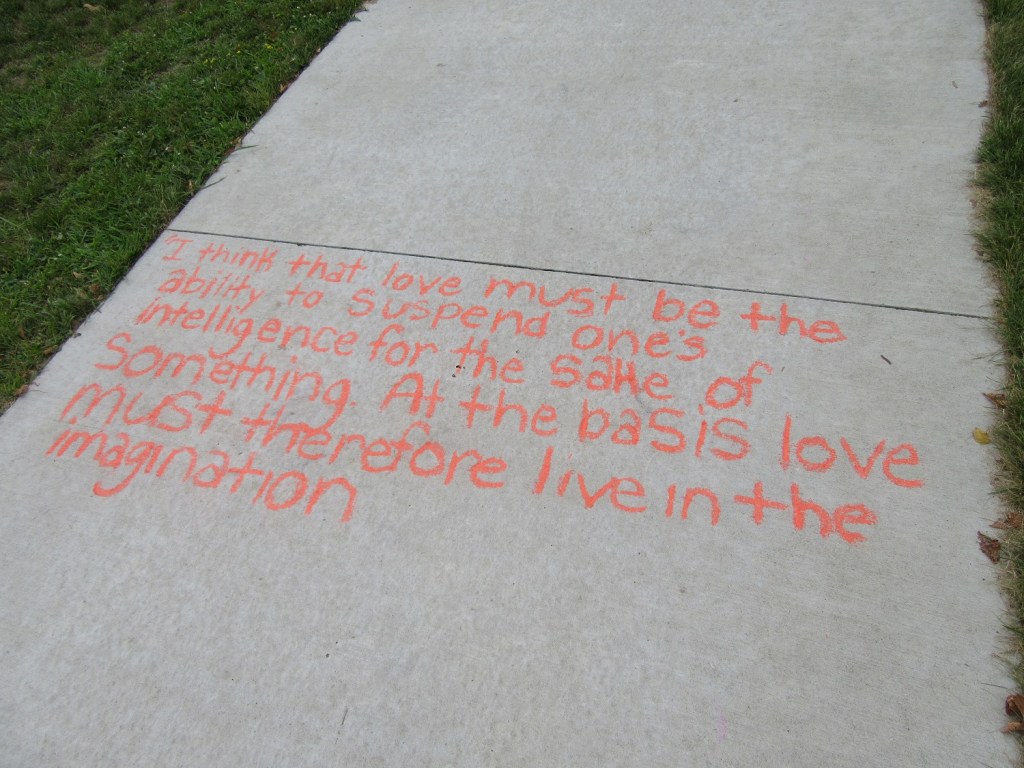
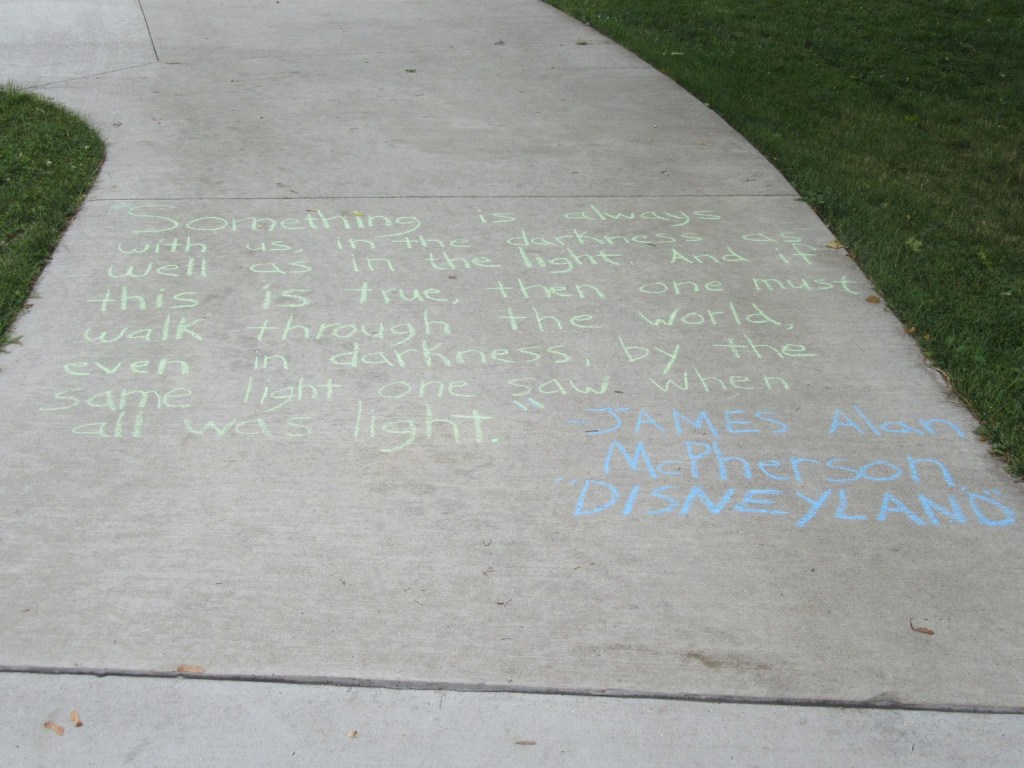
Many quotes from McPherson were written in colorful chalk on the walkways around the park, including one that is also inscribed on his monument in Oakland Cemetery:

“I think that love must be the ability to suspend one’s intelligence for the sake of something. At the basis love must therefore live in the imagination.”

What the Heck is a Shewhart Chart?

This is just a post from a retired psychiatrist who barely passed the statistics course in medical school, so take it with a big grain of salt. I found an article written by Rocco J. Perla about something called Shewhart control charts to monitor the course of pandemic fluctuations. I noticed it because of what Perla commented on, which is the tendency of the press to make sensational headlines about every squeak in the turning wheel of COVID-19, including CDC making changes in masking guidelines leading to congressmen calling for investigations of the CDC for making the changes. It makes it look as though we don’t know what we’re doing.

I don’t know if Shewhart charts can help us make better decisions about what to advise us to do at the community level to help monitor and predict outbreaks. But it looks like we need to try something better soon. Because I can’t stand the pop-up ads at the U.S. News & World Report web site and limitations on how many articles I can view for free where I first saw Perla’s story, I looked up his original article published in the Int J Qual Health Care.

This led to my discovering the web site ISQua (International Society for Quality in Health Care). There I found a Shewchart for my state of Iowa, which shows what happened here this month. I don’t know if the Iowa Department of Public Health (IDPH) is already using it and I’m not qualified to tell them what to do. By the way, I think that mindset of “Don’t tell me what to do” crankiness might be an epiphenomenon of the COVID-19 pandemic. Nobody wants to be told to wear masks or to get a vaccine. It just leads to a pandemic of backlashes. I don’t know if Rocco is right about the Shewhart chart method not being in use by public health officials. But I want to go on record as not telling anybody what to do.

The Shewhart charts look labor intensive and maybe that’s why some public health departments don’t use them. They’re understaffed and overworked. Iowa has been scaling back the collection and reporting of COVID-19 data, partly because things appeared to be so rosy early in July. I’m not so sure how rosy they’ll be after the Iowa State Fair in August, which is expected to draw about a million visitors.

But I’m not telling anyone not to go to the state fair and I’m not telling anyone to wear a mask and I’m not telling anyone to get vaccinated. I’m not even telling anyone to pay any attention to Perla’s article on the Shewhart chart. I am telling you that I’m too old and cranky to be getting backlashes about any of this business.

Have fun at the fair.

Perla RJ, Provost SM, Parry GJ, Little K, Provost LP. Understanding variation in reported covid-19 deaths with a novel Shewhart chart application. Int J Qual Health Care. 2021;33(1): mzaa069. doi:10.1093/intqhc/mzaa069

Inkelas M, Blair C, Furukawa D, Manuel VG, Malenfant JH, Martin E, et al. (2021) Using control charts to understand community variation in COVID-19. PLoS ONE 16(4): e0248500. https://doi.org/10.1371/journal.pone.0248500

New Namesake for Johnson County

I never knew until today that Johnson County; Iowa had originally been named for a slaveholder. That has changed since the Johnson County Board of Supervisors voted to rename the county for distinguished African American scholar, Dr. Lulu Merle Johnson on June 24, 2021. Read the Iowa Now story for the details. The drive to rename the county for Dr. Johnson, an accomplished University of Iowa alumna, began last year with an on-line petition that gathered 1,000 signatures, led by David McCartney, an archivist in UI Libraries’ Special Collections.

According to the Iowa Now story, the drive to rename the county for Dr. Johnson was also in the context of the deaths of several African Americans by police officers earlier this year. It reminds me of another famous African American, James Alan McPherson, a long-time faculty member at the Iowa Writers Workshop, for whom a local neighborhood park was recently renamed. Part of the drive for that came from members of Black Lives Matter.

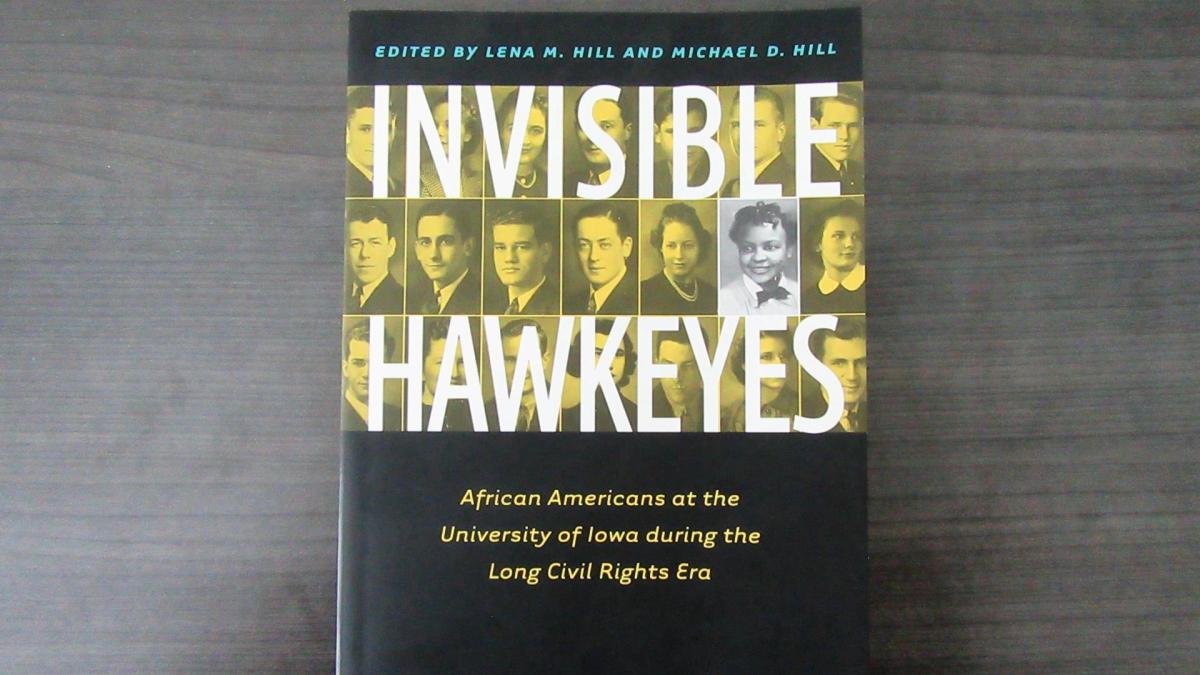
McPherson was written about in the book Invisible Hawkeyes: African Americans at the University of Iowa during the Long Civil Rights Era, edited by former UI faculty, Lena and Michael Hill. Although Dr. Johnson was not mentioned in their book, she certainly could have been because of her towering status as an educator, historian, and activist.

Support for the change also came from Leslie Schwalm, professor of gender, women’s and sexuality studies, and members of Dr. Johnson’s family.