Links to Ozymandias

Sena and I took a walk down Scott Boulevard today. The weather was practically balmy, compared to how cold it has been. Forty degrees above zero compared to 9 degrees below feels miraculous.

We walked past the Harvest Preserve entry. Across the street is what we’ve just learned is an old building that is known as the “Haunted Barn” (photo taken in August 2021).

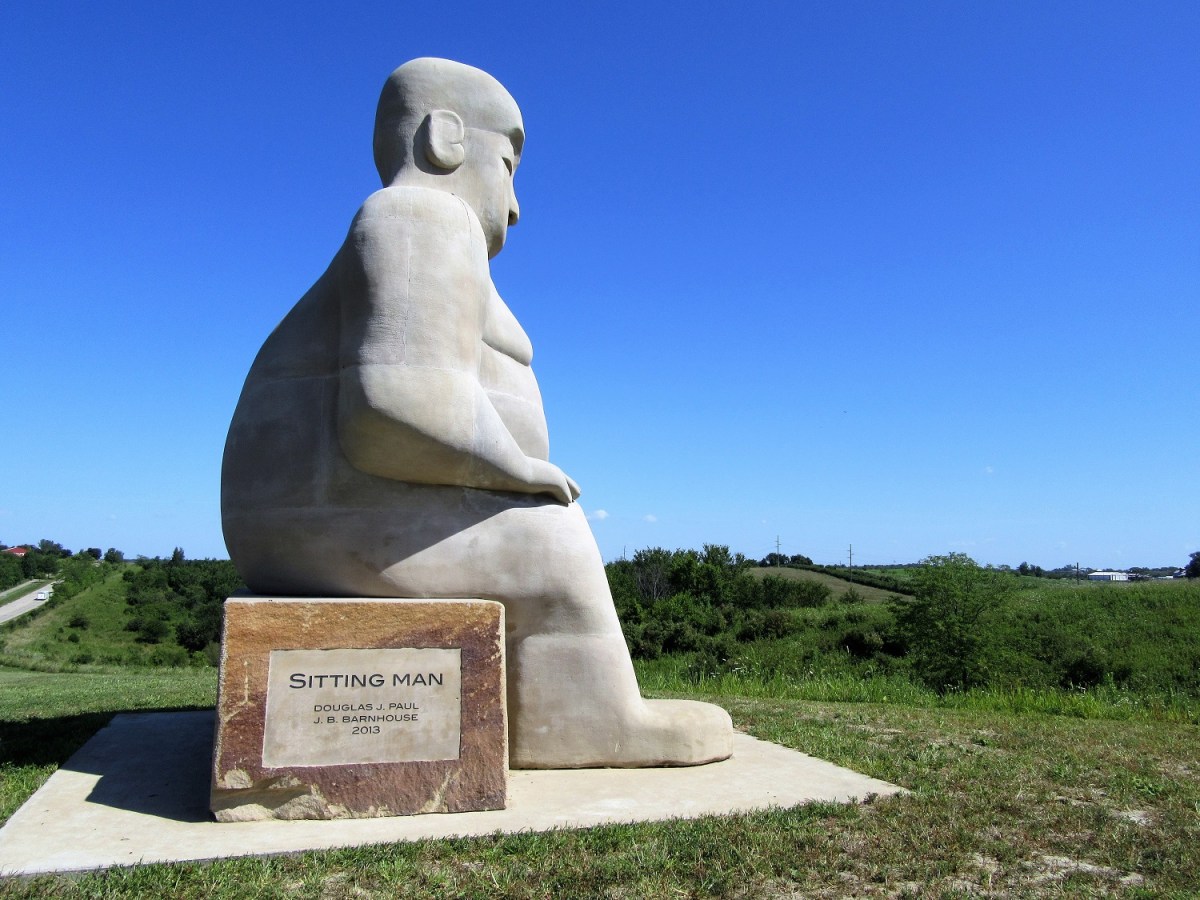
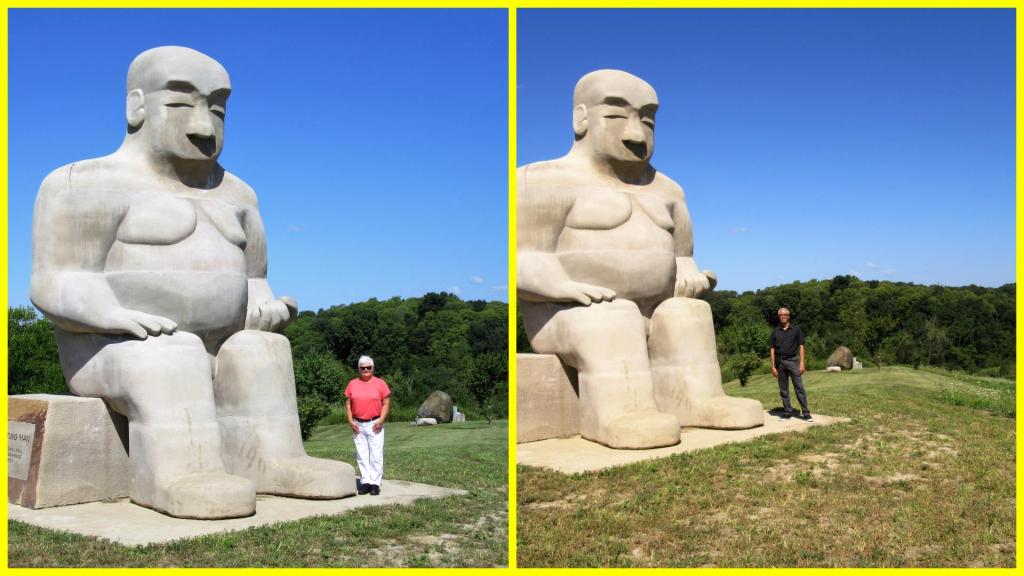
We passed the 20-foot-tall, 110-ton Sitting Man sculpture, now on the west side of Scott Boulevard after it was moved from the east side of the road in July, 2020.

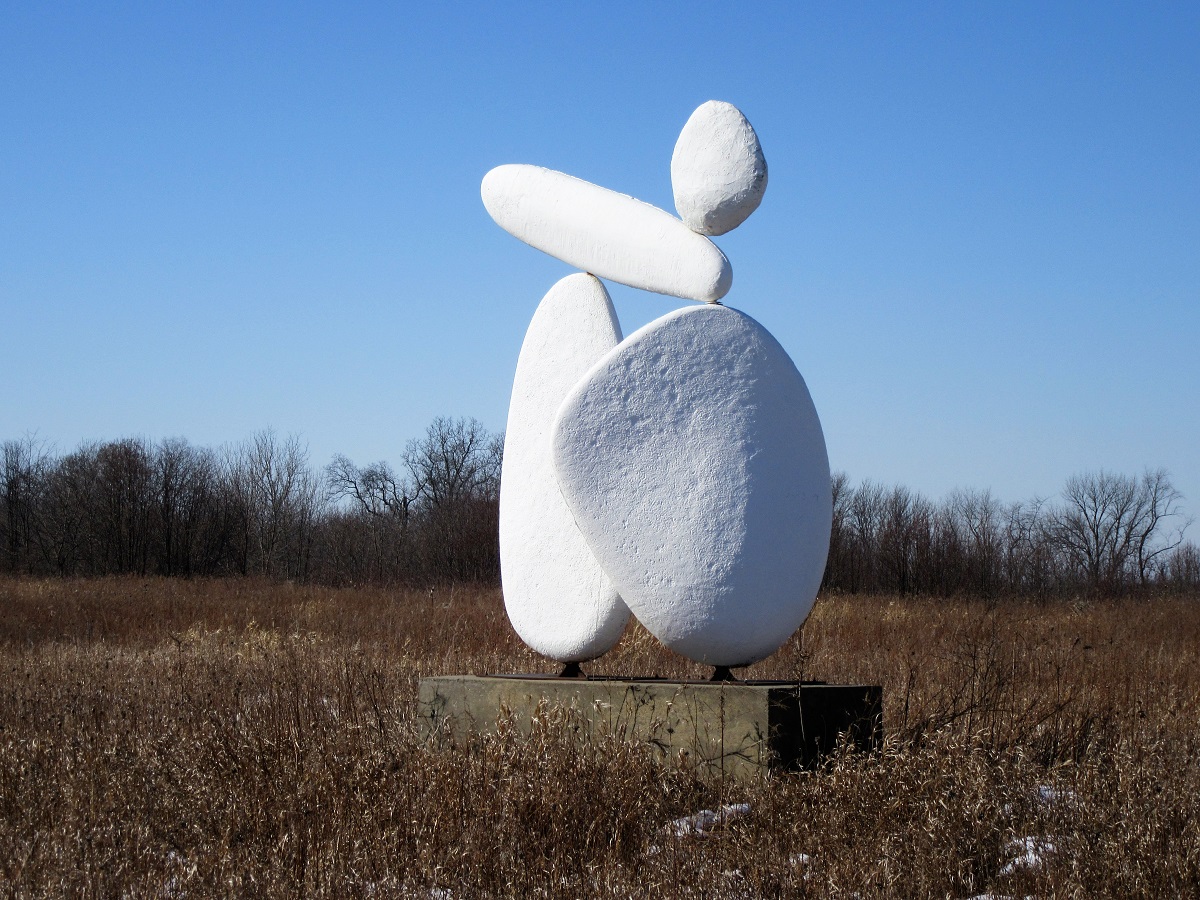
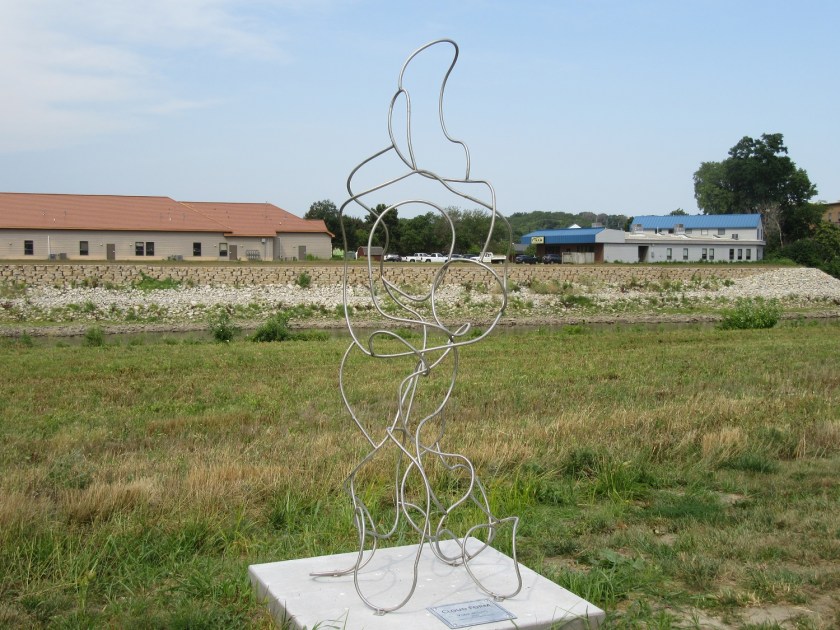
Today was the first time we trekked past the Sitting Man to Rochester Avenue and beyond. If we hadn’t, we would not have noticed a fascinating, blindingly white abstract sculpture mounted on a concrete block which we initially believed was on the Harvest Preserve property at the northwest corner of the intersection. Sena said it looked like a person, noting the head, arms, and body. I didn’t notice that.

After we got back home, I couldn’t find out anything about it on the web, no matter how much I connected the search terms to Harvest Preserve, the Sitting Man and so on. I found only one item with a photo and it was an announcement about a tour on Harvest Preserve in 2018. The impression is that the sculpture is on the property.

I sent an email inquiry to Executive Director of the Harvest Preserve Foundation, Inc., Julie Decker, whose email address is available on the website.

Ms. Decker informed me that the sculpture is technically not on Harvest Preserve property. She knew the sculpture is entitled “Family,” and the artist’s name was Eugene Anderson, who died in 2008. That’s all she knew.

It turns out that what little she knew led to an astonishing story that was even deeper and more engaging than we imagined. You can read the obituary of the Iowa City artist Eugene Anderson on legacy dot com. The highlights are that he started his career in architecture, was the University of Iowa Hospital and Clinics (UIHC) architect for 25 years, and then began creating original art work to display in the hospital to comfort patients. He later became a full-time sculptor, and was on the board of directors for “Arts Iowa City.”

I was a medical student, resident, faculty member and a consulting psychiatrist at UIHC, a career starting in 1988 and ending with my retirement in June of 2020. It’s possible I saw some of Anderson’s work while I was galloping around the hospital.

In 1994 he created the “Family Group” series of sculpture which have been displayed at Chait Galleries in Iowa City, Des Moines Art Center, and the Brunnier Art Museum in Ames, Iowa. The piece we saw might have been one of those. Unfortunately, I couldn’t find anything on the web about the series.

And what is more intriguing, Anderson also traveled extensively, even to Egypt where he cruised on the Nile and took a sunrise balloon ride over the pyramids.

How is it possible that so little of Eugene Anderson’s life and work are not better known? Come to think of it, I guess time can erase the memory of our accomplishments.

This little story reminded me of the poem “Ozymandias” by Percy Bysshe Shelley. I’ve forgotten all of my college freshman English Literature but a web search indicates that Ozymandias was based on Ramesses II, a king of ancient Egypt. Ozymandias was a great ruler of a vast empire. His sculptor built a huge monument in the desert and gave it the oft-quoted inscription, “Look on my works, ye Mighty, and despair!”

Ozymandias

Percy Bysshe Shelley-1792-1822

I met a traveller from an antique land
Who said: “Two vast and trunkless legs of stone
Stand in the desert . . . Near them, on the sand,
Half sunk, a shattered visage lies, whose frown,
And wrinkled lip, and sneer of cold command,
Tell that its sculptor well those passions read
Which yet survive, stamped on these lifeless things,
The hand that mocked them, and the heart that fed:
And on the pedestal these words appear:
‘My name is Ozymandias, king of kings:
Look on my works, ye Mighty, and despair!’
Nothing beside remains. Round the decay
Of that colossal wreck, boundless and bare
The lone and level sands stretch far away.”

Today we searched for links on the web to find out more about a mysterious sculpture. We found links of a different kind, links to a stranger and to the near and the ancient past. Anderson’s sculpture, “Family,” is still standing, tall, clean, and bright for all to see.

Rattlesnake Hat vs Hornet’s Nest Snoot Flute

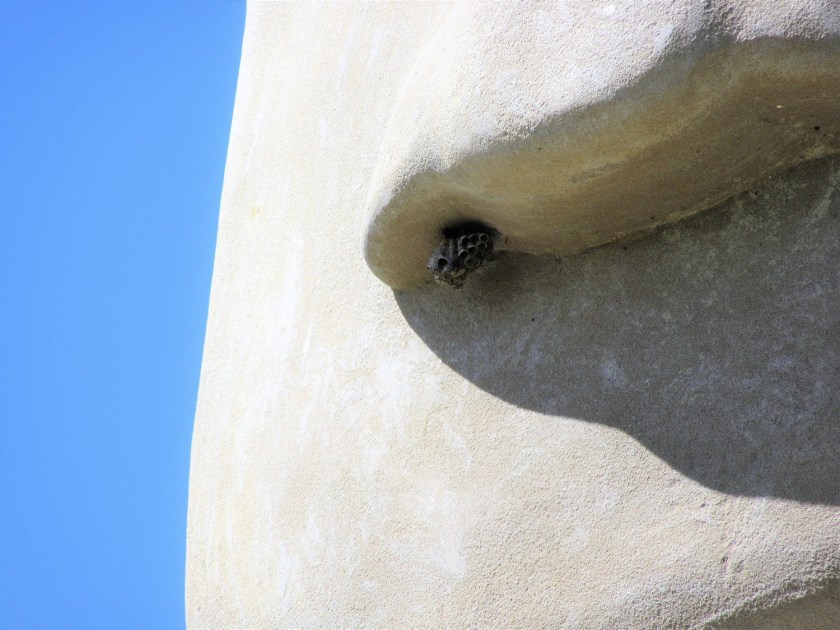
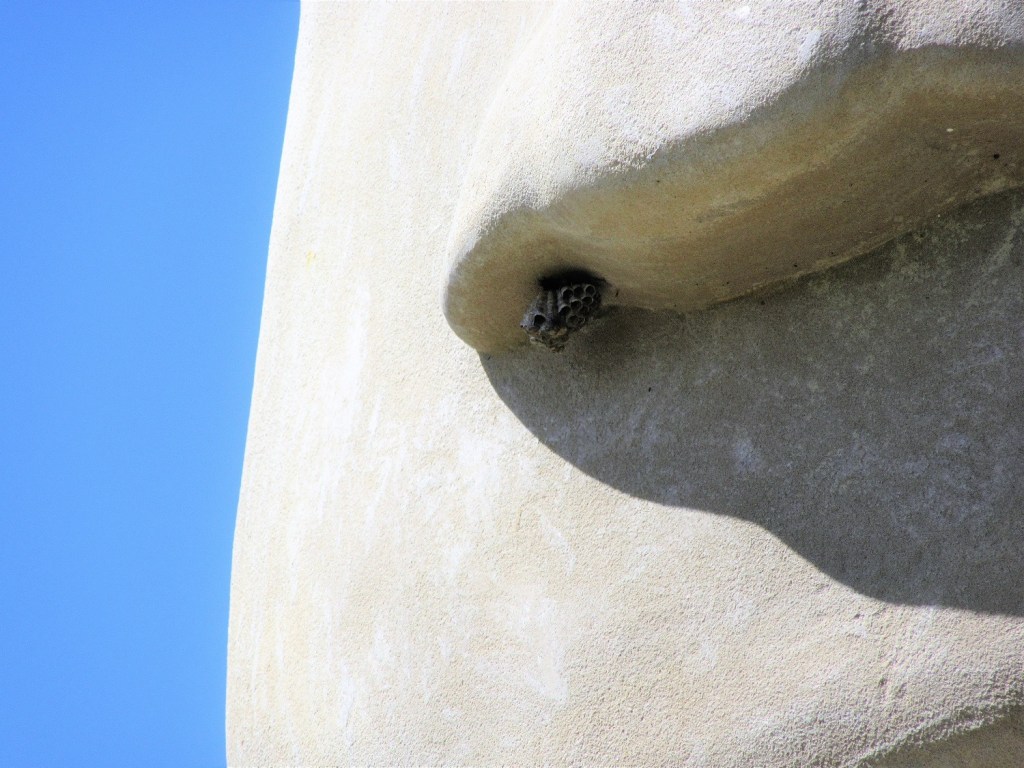
OK, so this should have been in yesterday’s post but I don’t care. You remember I mentioned the guy who wore the live rattlesnake on his head while strolling down State Street in Madison, Wisconsin? Well, in Iowa we have The Sitting Man who wore a hornet’s nest on his nose. It’s all about style points.

Beat that, Wisconsin.

Stretching Our Legs on the Terry Trueblood Trail

We got out on the Terry Trueblood Trail today to stretch our legs, feel the breeze, and free our minds of the daily news, which is usually bad. It’s nice to just listen to the wind and the birds on the lake.

We see something interesting every time we walk the trail. Caterpillars were pretty busy, trying to cross the sidewalk without getting crushed by bicycle wheels. Some don’t make it. The grasshoppers are a little sluggish.

There’s a myth about woolly bear caterpillars. If they’re all black, some people say it predicts a really bad winter. The longer the brown color band, the milder the winter. We didn’t see any woolly bears today, just some nervous caterpillars trying to avoid getting smashed.

The Iowa City Mask Mandate

The mask and vaccine mandates for COVID-19 have been in the news a lot and there has been plenty of controversy about them, which is putting it mildly. I’ve been thinking about the mask mandate that Iowa City Mayor Bruce Teague issued August 19, 2021 and scheduled to expire on September 30, 2021. I agree with it, just to get that out of the way. Johnson County is a high transmission area for the virus, as is most of the state of Iowa, according to the CDC’s COVID Data Tracker. Hospitalizations and deaths are increasing from COVID-19 infections. The CDC recommendations and rationale for interventions to control the spread of the virus make sense to me.

On the other hand, Iowa Attorney General Tom Miller is investigating whether or not the mandate is legal based on the conflict with the Iowa law passed in May 2021 by Governor Kim Reynolds. It’s sort of an anti-mandate similar to others I’ve seen in the news. I think it’s based on the state law which says that municipalities cannot adopt an ordinance requiring an owner of real property to implement a policy relating to the use of facial coverings that is more stringent than the state’s policy.

I have no idea what the difference is between persons who are owners of real property and persons who are just plain individuals. I thought they were the same—unless you consider homelessness an important factor. Would that make someone who is homeless a non-person? Just because they’re often treated that way is beside the point—isn’t it? I’m just kidding, sort of; it looks like the owners of real property might be understood as business owners and the like. And everyone knows they’re not real people.

Does Mayor Teague’s mandate apply to the University of Iowa? Not if you believe that the virus expressly avoids University of Iowa property; so at least that’s settled. The sticking point is that the Iowa Board of Regents and the Governor are the authorities over what happens on state-supported university property, unless it’s connected to beer.

AG Miller has plenty of time to consider the matter because there is no provision for enforcement of Mayor Teague’s mask mandate. By the way, the city of Coralville also has a mask mandate that was issued by Coralville Mayor John Lundell, effective August 11, 2021. I don’t know if Mayor Lundell’s mandate provides for enforcement if it’s not followed, but I suspect it isn’t. I’m not sure why AG Miller is not investigating Mayor Lundell’s order to see that it’s legal or not. I thought we were an equal opportunity state. University Heights has not had a mask mandate since August 18, 2020, unless there’s a typo on their website.

Many people are not aware that Coralville, Iowa City, and University Heights are separate municipalities. If you blink, you might miss the transitions between them.

I’m not sure how you’d enforce the mandate. I’m pretty sure police are not going to tackle you and secure a mask to your face using a county-approved staple gun. I’m also wondering what legal consequences there could be if AG Miller finds that Mayor Teague’s mandate is illegal, especially since it’s unenforceable.

I’m not sure what you can do to enforce such mandates or anti-mandates. Without enforcement, the mask mandate is a strong recommendation. In addition to the science, it has little more than common sense to back it up, although common sense is not commonly used.

You wonder how aliens (who are almost always idealized as being very advanced and superior to earthlings) would look at this situation and what they would do about it to help the human race. I’m reminded of what Agent K says to Agent J in Men in Black (MIB) as he shows Agent J a universal translator (one of the many gadgets MIB holds patents on, making them independent of governmental oversight): “We’re not even supposed to have it. I’ll tell you why. Human thought is so primitive it’s looked upon as an infectious disease in some of the better galaxies.”

Maybe aliens are vaccinated against us.

An Update on the Sitting Man Post

This is just an update on my Sitting Man post. I just found a YouTube presentation about the Sitting Man that clearly shows the title inscribed on the side of it was Man on a Bench in 2014. The inscription on the rear was illegible back then. I’m guessing that when the sculptors, Doug Paul and J.B. Barnhouse, moved it last summer from the east side to the west side of Scott Boulevard, they might have altered and refurbished the inscriptions at around the same time.

When we visited the site, the year inscribed on the side was 2013. Other people have described it as being finished in 2015. I’m not sure it matters to the artists. They might see it as a timeless artifact, which they happened to uncover, according to free-lance writer, Lori Erickson.

It reminded me of another sculptor’s work entitled Palimpsest by V. Skip Willits, from my post about the Iowa City Public Art Program. I think it might fit the palimpsest definition: something that’s been reused or altered but still has traces of its earlier form. 

Anyway, back when it was on the other side of Scott Boulevard, it was even harder to access. It was on private land that you had to ask Harvard Preserve permission to enter. In fact, for photographer David Weldon, the path to the sculpture was muddy and difficult to climb in 2015. There was no parking and that is still the case. If you’re not within walking distance, you have to scramble out of your car and grab a quick snapshot while avoiding traffic. And it’s still on private land owned by Harvest Preserve, although now you don’t have to obtain permission to climb the hill.

The artists have said that The Sitting Man was never intended to be called a Buddha, although it’s often called just that. You can make your own interpretation of what it means to you. However, according to Roadside America, Doug Paul has called it “distinctly Iowan.”

The Sitting Man of Iowa City

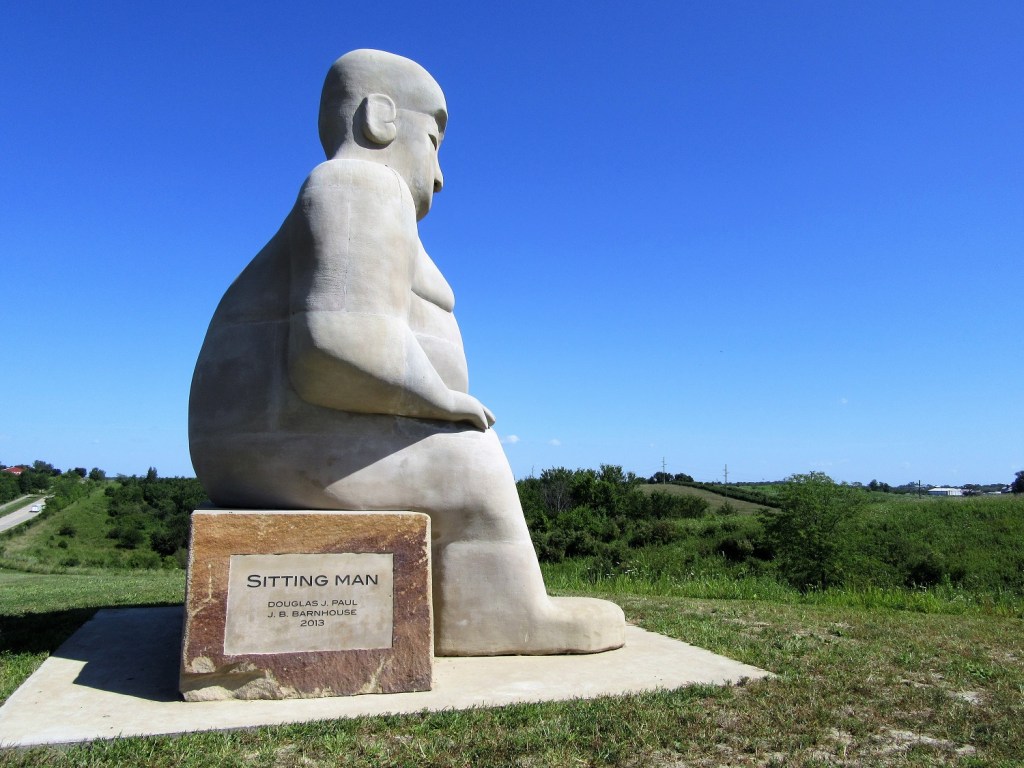
After 33 years living in Iowa City, Iowa, Sena and I finally trekked up Scott Boulevard to see Sitting Man, or Man on a Bench, or the Buddha of Iowa City. Whatever you call him, he’s steady as a rock, which is what he is—110 tons of limestone and 20 feet tall. He was carved by Douglas J. Paul and J.B. Barnhouse and finished in 2013. It was a monumental challenge to move him from the east side of Scott Boulevard to the west side in the summer of 2020 after a change in property ownership. He sits on land owned by Harvest Preserve.

He had an old hornet’s nest booger up his nose, which actually tends to support the idea of him being some kind of Buddha. You have to be pretty serene to put up with that.

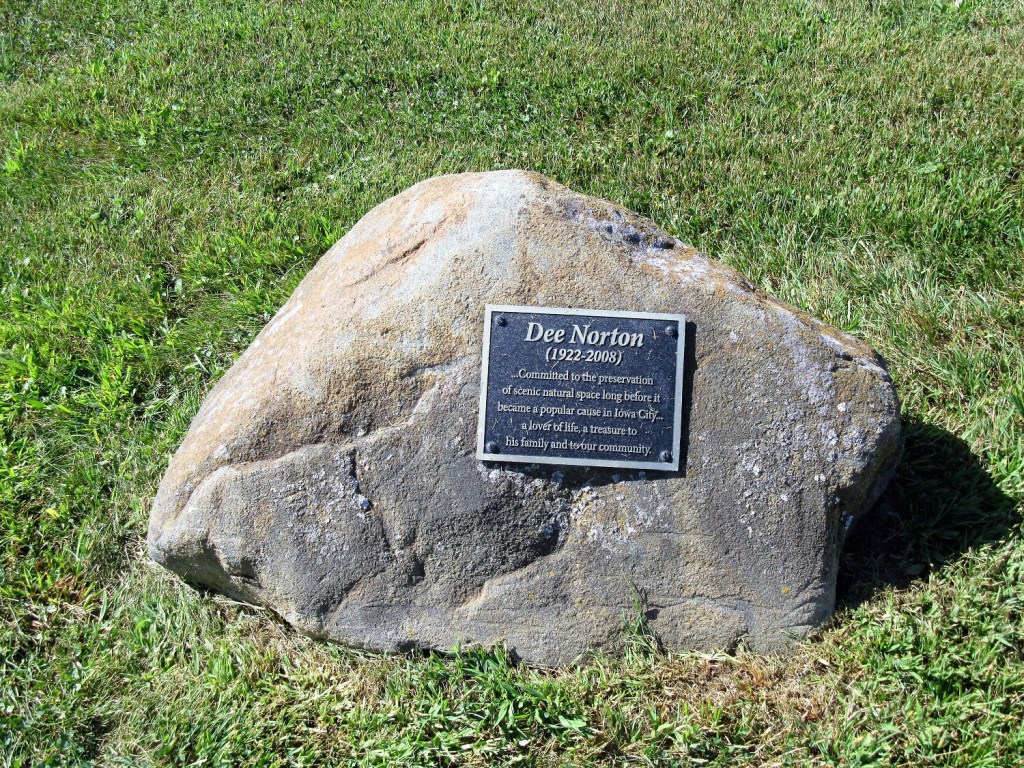
Before you get to the Sitting Man, you reach a contemplative space called the Visionary Stone. The inscription on it is about Dee Norton. According to his obituary on the web, Dee W. Norton was Associate Professor of Psychology and former chair of the Department of Psychology at The University of Iowa. In 1991, he received the Michael J. Brody Award for Faculty Excellence in service to The University of Iowa. He was a longtime member of the Unitarian Universalist Society. He made numerous contributions to education and the community. He had a pretty good sense of humor, too.

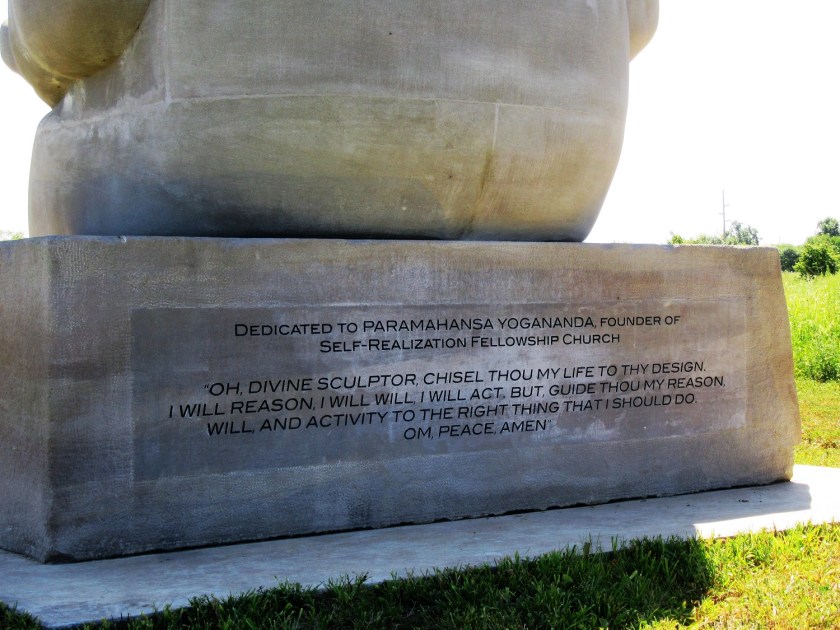
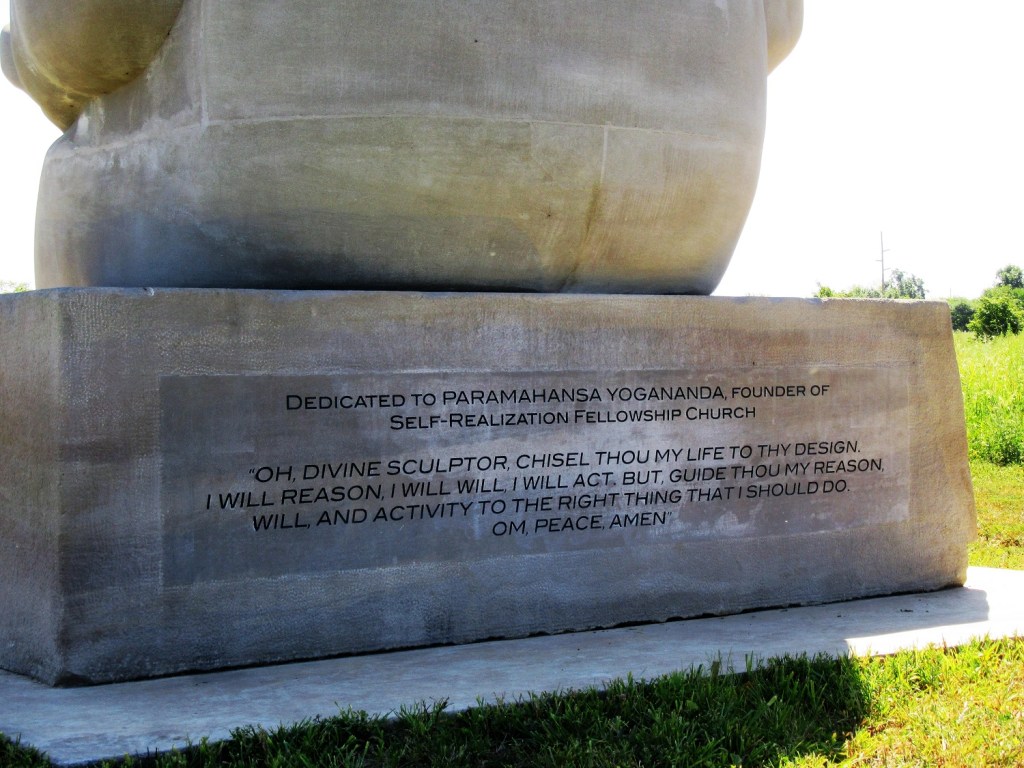
I learned more than I thought I would on the journey to the Sitting Man. On the back of the sculpture is an inscription of a prayer, which is dedicated to Paramahansa Yogananda, founder of the Self-Realization Fellowship Church, which I had never heard of or read about when I scanned the web trying to learn more about the Sitting Man. I briefly looked at the website and there seems to be an Iowa City Meditation Circle here, although only an email address is listed (iowacity.srf@gmail.com) and I don’t know what the fellowship is all about in any detail.

There may be more than meets the eye when it comes to a limestone giant with an old hornet’s nest up his nose and a hand open in what is probably a gesture of welcome and acceptance. We could sure use some of this now—minus the hornet’s nest.

Take a Break: Art in the Parks

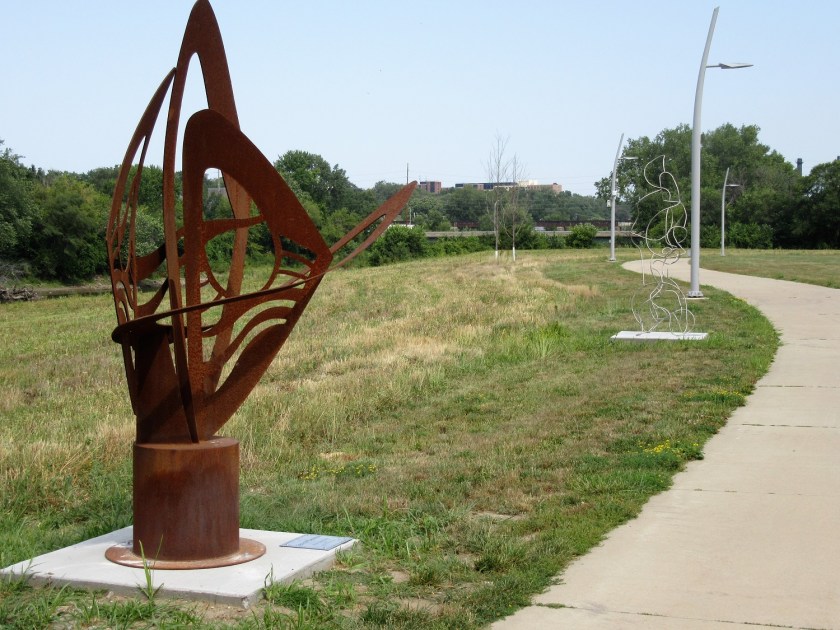
Since the weather took a break yesterday from the triple digit temperatures, we took a little getaway to a few of the city parks to see the new public art. This is connected with the Iowa City Public Art Program. Five sculptures were installed about a week ago at Terry Trueblood Recreation Area, Riverfront Crossings Park, and Mercer Park.

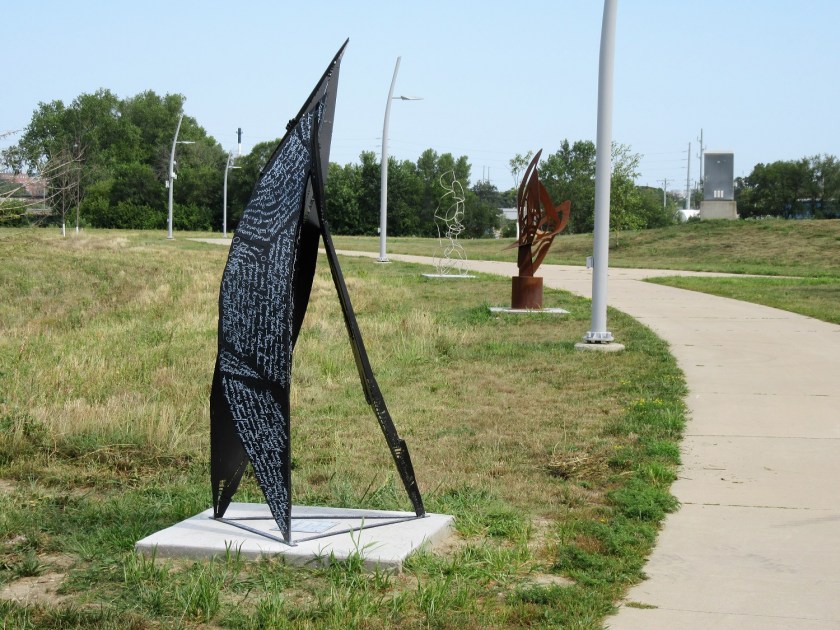
Three sculptures are at Riverfront Crossings. Two are by V. Skip Willits: Palimpsest and Cloud Form. The third is by Hilde DeBruyn: Sea of Change. Sena knows that Sea of Change looks like a sailboat when you look at it from the right angle. We could see clouds through Cloud Form.

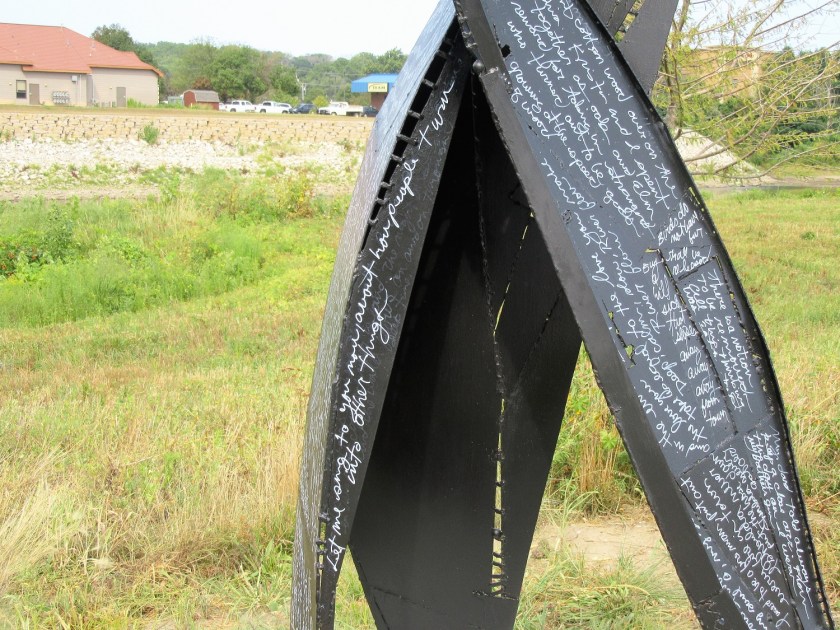
I noticed that V. Skip Willits’s name could be spelled wrong (Willets vs Willits?) on the artist’s nameplate below the sculpture, Palimpsest (also on Cloud Form). I also discovered a 2013 news story of a similar sculpture at the Ames Annual Outdoor Sculpture Exhibition although it was given a different title: Prayer Torso. His sculpture Swans on the Marsh featured in a 2015 image on Sculpture Walk Peoria in Illinois and another fashioned out of corrugated iron in Effingham, Illinois resemble Palimpsest as well. A news story in the March 26, 2021 Effingham Daily News quotes Willits as identifying the sculpture’s title as Cipher. He and probably a few passersby had written on the piece. There are also variant spellings of his name, including V.skip Willits, lower case “s” for “skip.” He’s not the same person as Skip Willits, who is a photographer selling wall art. In any case, Palimpsest is a pretty good example of a palimpsest.

According to the dictionary, a palimpsest is a “piece of writing on which the original writing has been effaced to make room for later writing but of which traces remain.” More generally, it’s something that’s been reused or altered but still has traces of its earlier form. You might want to snap a picture of the sculpture and rotate it in order to see all that’s written there; for example:

“Let me sing to you now, about how people turn into other things.”

I think it could be evocative of what many have noticed and remarked on, only using different words in different languages in different circumstances over millennia. We’re all turning into other things in the turbulent sea of change, sort of like clouds which are the ultimate shape-shifters.

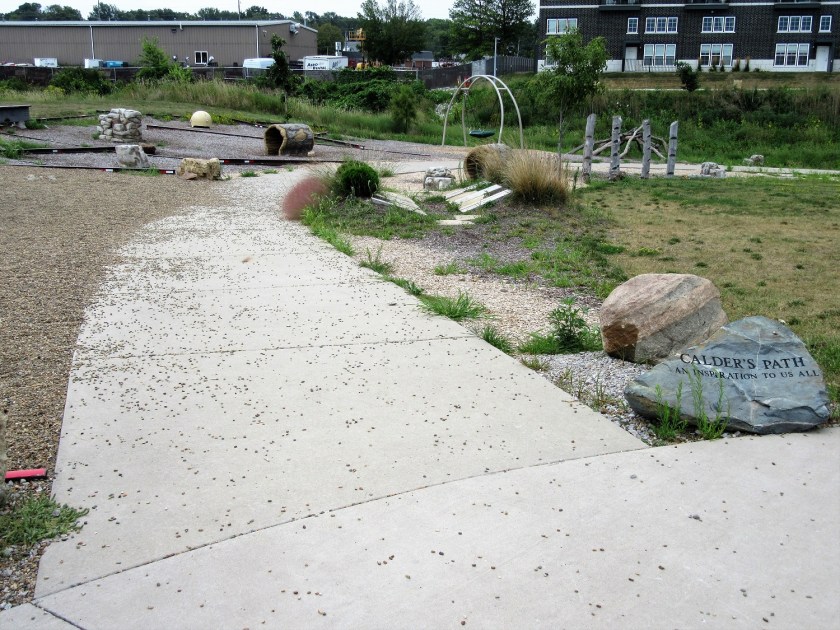
This was the first time we had ever visited Riverfront Crossings Park and we found something familiar there—a stone inscribed with the words Calder’s Path: An Inspiration to Us All. Pebbles were strewn all over the path. After all, no path is without stones. We frequently drive by a small and neatly kept neighborhood park called Calder Park many blocks away. It’s a memorial to a boy named Calder Wills, who passed away of leukemia several years ago. We never knew him or his family. Based on what I’ve gleaned on the web, Calder had big dreams. He was strong. He was a person who turned into a light.

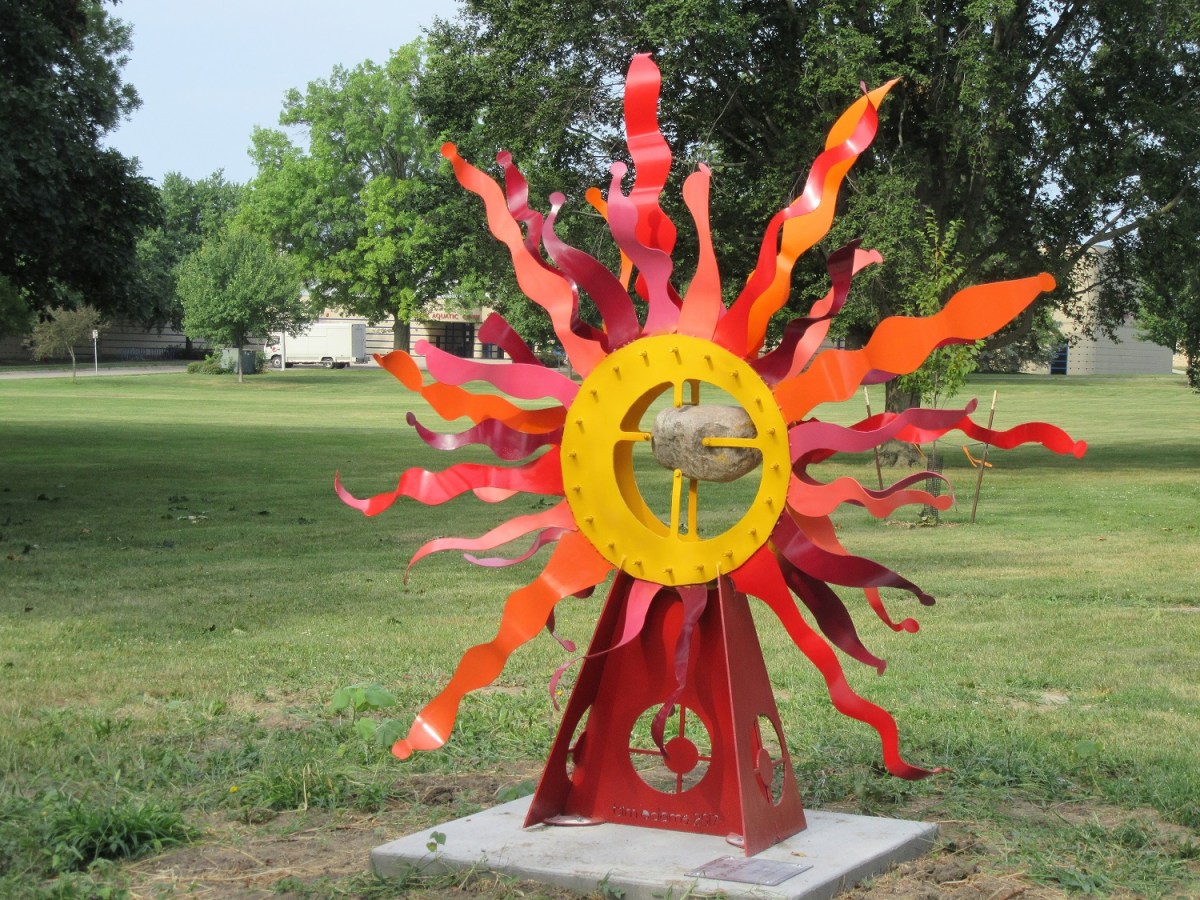
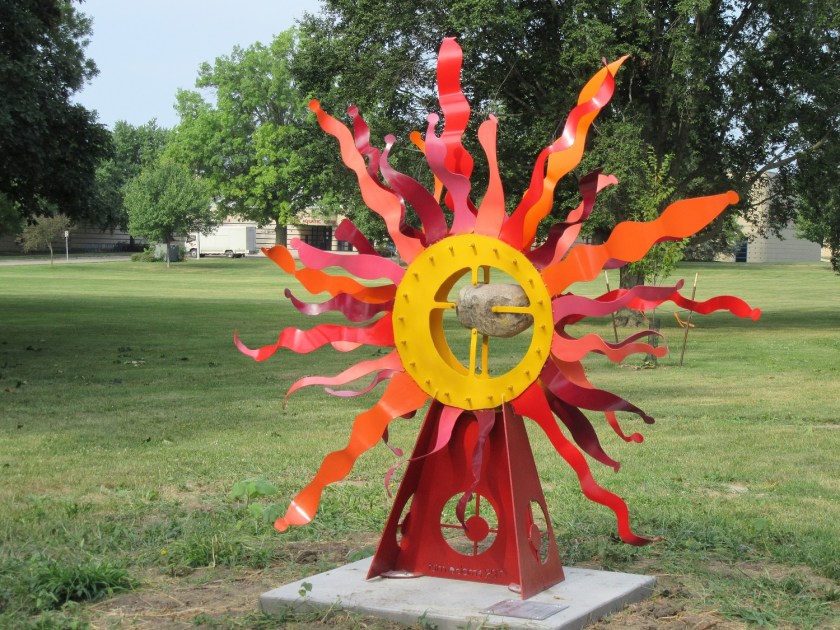
We also enjoyed Mercer Park where we saw the sculpture The Other Extreme, by Tim Adams. Mercer Park and Aquatic Center is named in honor of Leroy S. Mercer who distinguished himself as Iowa City Mayor, state representative and state senator as well as a successful businessman and banker. The sculpture is the sun with a rock at the center. According to Adams, it’s utterly simple; a clear vision of how everything started. There was only the earth and the sun. That was it. And then change took over. Things changing into other things. People turning into other things. Tim Adams art has been influenced by his career as a Registered Landscape Architect. His subjects are influenced by the rugged Iowa weather, which his creations are designed to withstand with little need for maintenance.

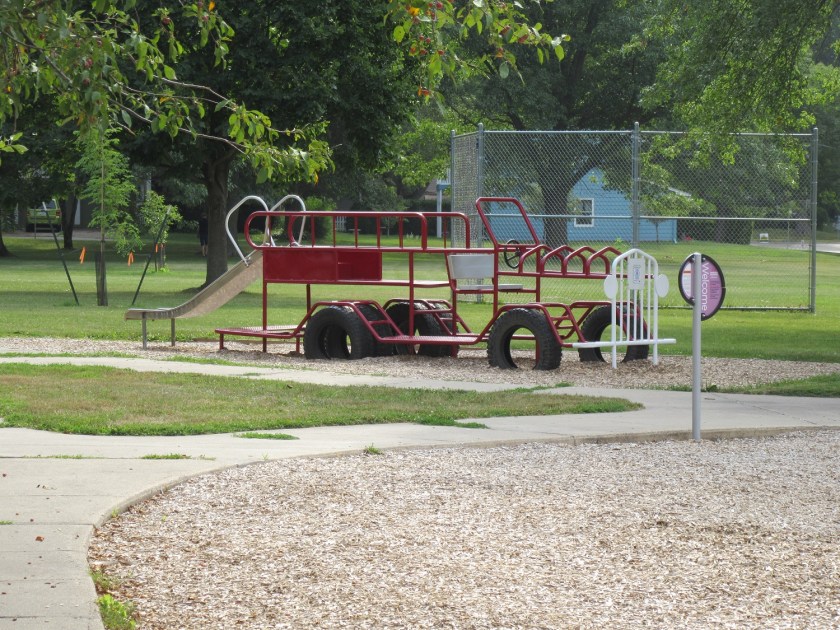
Sena and I both got a kick of the automobile jungle gym.

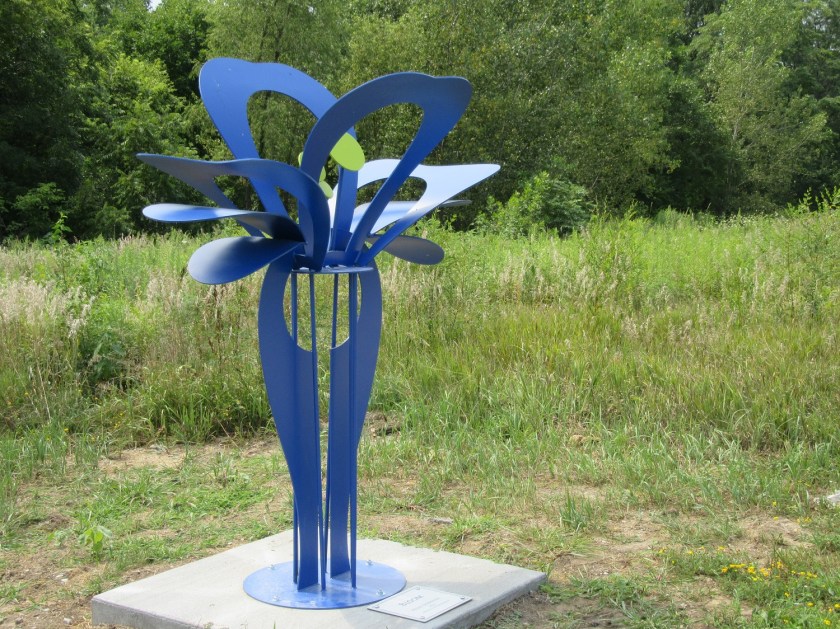
We had already visited the 5th sculpture last week. It is called Bloom by Hilde DeBruyn. Again, the theme of change because it’s a flower and flowers start from seeds in the earth, and burst up to the sun. Because this is where it all begins. DeBruyn is another gifted Iowa artist who has said in an interview with Iowa Artisans Gallery that her work often involves the “natural cycle of growth and decay.”

We begin with one extreme, the raw and wild. Eventually, we reach the other extreme, the ultra-refined and wildly complex. In the middle, we erase and then reconstruct many things from the relics of ancient wisdom or folly, forgetful of bygone grandeur or catastrophe, rarely startled by déjà vu.

James Alan McPherson Park Sign Reveal

Yesterday evening the new sign reveal of James Alan McPherson Park made the new name of the park official. The weather was balmy and a big crowd showed up for the event, including Iowa City Mayor Bruce Teague. He joined McPherson’s daughter, Rachel McPherson; Director of Parks and Recreation Juli Seydell Johnson, and Iowa City Council member, Pauline Taylor for the ribbon-cutting ceremony.

This was immediately followed by a sing-along of a few bars of “You are My Sunshine,” led by Mayor Teague—who was in fine voice.

And even more music was provided by Cedar County Cobras. They were in a blues mood that evening—very popular with the crowd.

Prior to the ribbon-cutting, there were remarks from Mayor Teague, Rachel McPherson, and Juli Seydell Johnson. They shed personal stories highlighting McPherson’s gifts as a writer, intellectual, and humanist. They seemed to echo poet James Galvin’s perception of McPherson as not just the moral center of the Iowa Writers Workshop, but as the moral center of the universe.

You couldn’t miss the speakers’ impression of McPherson’s sense of humor, which tended to be ironic. Rachel shared an incredible anecdote about his tendency to write to far right-wing organizations (including the KKK) for more information about them, evidently giving them the impression that he was interested in becoming a member—to which they replied with enthusiastic offers to do so! This was not a one-time gag, but a running insider joke for years. Rachel is still getting mail from these groups. She also brought enough memorabilia to fill a table, and it included several “business cards” which deftly deflated the pomposity, posturing, racism, and outright villainy in society. I had to run to the web to get some of the jokes:

Guslar: traditional Bosnian-Croatian-Serbian name for an epic singer who performs long narrative tales (some detailing ancient battles and other historical events) while accompanying himself on a one-or-two stringed instrument called a gusle.

Ebonics: According to the Linguistics Society of America, this means literally “black speech” and refers to English spoken by African-Americans.

Enron was a company which perpetrated one of the largest accounting scandals and bankruptcy in recent history.  

We welcomed a member of the Iowa City Police, who set up a table offering many useful free items including a generous helping of good will.

Another part of the presentation was a discussion between consultants and interested community members about future enhancements to the park, which include a plan for a memorial plaque in honor of McPherson.

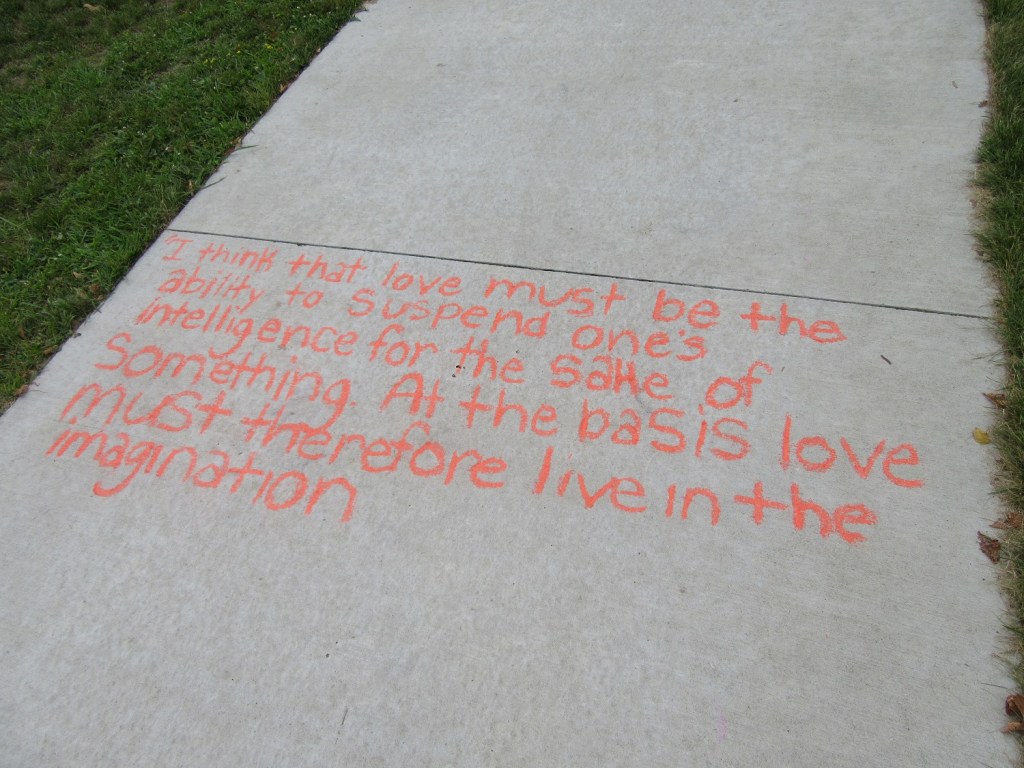
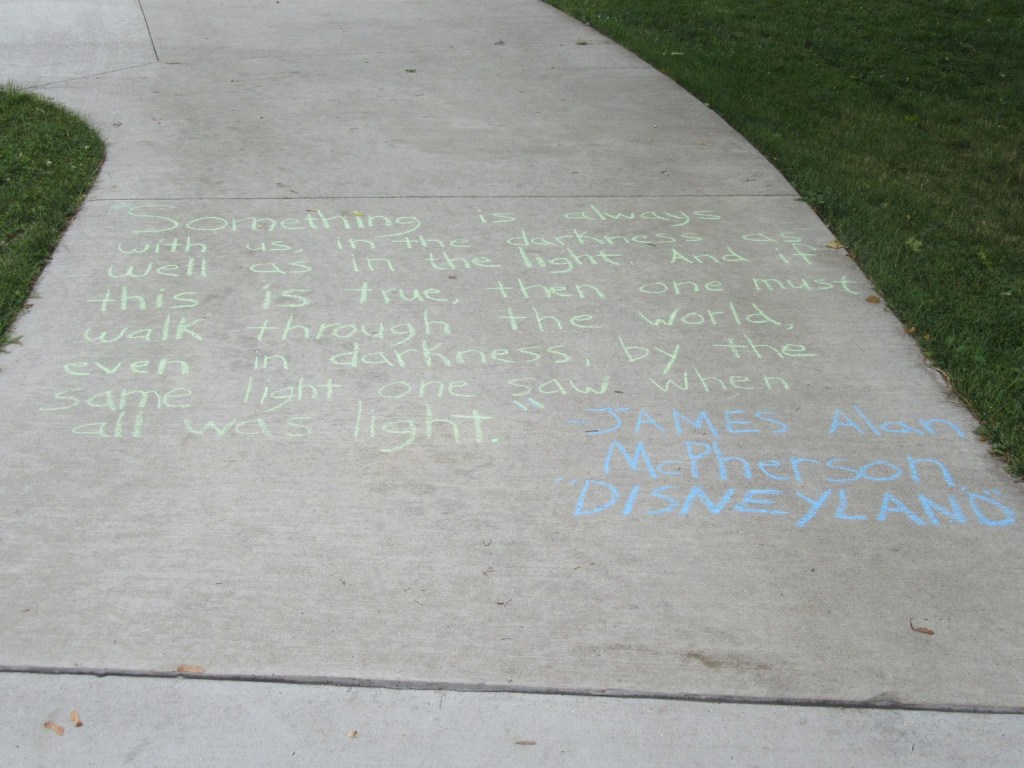
Many quotes from McPherson were written in colorful chalk on the walkways around the park, including one that is also inscribed on his monument in Oakland Cemetery:

“I think that love must be the ability to suspend one’s intelligence for the sake of something. At the basis love must therefore live in the imagination.”

Virtual Information Sessions On Covid-19 Vaccines Update

Just some quick thoughts on the Virtual Information Session on COVID-19 Vaccines, Session 2 on 4/19/2021. This was another enlightening presentation. I just noticed that you’ll have to scrub forward to about 10 minutes and 30 seconds to start playback on the YouTube recording. This gap might be edited out in the near future.
It’s worth noting that the risk for getting blood clots from COVID-19 infection is greater than the risk for getting them from the vaccines, according to Dr. Pat Winokur, University of Iowa and Dr. Caitlin Pedati, IDPH. There were other educational answers to very good questions from the audience.

Don’t forget the third session on Saturday, 4/24/2021 at 10:00 a.m. in Spanish only for the YouTube event while the WebEx event will be a bilingual event. See this link for full details.

Imagination Lives in Oakland Cemetery

We don’t usually make trips to Oakland Cemetery (or any cemetery for that matter), but today we made an exception to find the grave of James Alan McPherson, the first African American to win a Pulitzer Prize for fiction and longtime Iowa Writers’ Workshop faculty who died in 2016 and for whom an Iowa City park was renamed a month ago.

We never met McPherson, although we are reading a couple of his books (Elbow Room, the Pulitzer Park winning work, and Hue and Cry) and just visited the James Alan McPherson Park on Monday this week.

This trip brought back happy memories right away. It’s not the first time we’ve been to Oakland Cemetery. In 2015 and 2016 we took the same route, parking at Happy Hollow Park on Brown Street and walking east to find the Black Angel. The main reason for going to Happy Hollow Park back then was not so much to see the Black Angel, but for two Psychiatry Department Faculty vs Resident Matball games at Happy Hollow Park. Matball is an imaginative combination of kickball and baseball using large mats for bases and a kickball for pitching, which the hitter actually kicks and runs the bases.

I was on faculty but didn’t play, which I thought would help them win. It was very hot both years. Faculty lost both years. There was another match in 2017 which I didn’t attend, and which I think faculty also lost.

But it was great fun. I don’t remember who put the 2015 trophy won by the residents in a bowl of red (possibly strawberry, I didn’t eat any) Jell-O. That took imagination. It was a stroke of genius, but was not repeated after the following two losses. There have been no Matball games since then.

Anyway, we visited the Black Angel. I think I left some loose change at the foot of the sculpture, which is traditional I think, for good luck. The Black Angel has a very complicated story, which is in many cases, fueled by superhuman imagination. The stories get more complicated every year and the legends have been developing since the 9-foot statue with 4-foot pedestal was created in 1912.

Actually, the Black Angel is often used as a point of reference for the rest of the cemetery. That’s how we used it today to find McPherson’s grave, which is said to be in a place called the poets’ corner where many other artists, including Writers’ Workshop faculty, are buried.

The easiest way to find the Black Angel is probably to approach the cemetery from the west and head east to the intersection of Brown and Governor Streets, where there’s a big sign for Oakland Cemetery. There’s a map next to the cemetery office. We could not find any place marked “poets’ corner.” But the Black Angel is clearly marked.

You’ll notice you can drive through the cemetery, but the paved road is about the width of a car. It’s actually more like a service road, just right for riding mowers, but a little narrow for cars. There is no parking lot we could find, which is why we parked at Happy Hollow Park.

As you reach the Black Angel, you’ll notice one of her wings is raised at a right angle from her body. It points roughly North. You need to go in the opposite direction to find poets’ corner. As you pass the Black Angel, take the second path to the right and simply follow it around, moving south past the University of Iowa Deeded Body Program monument to a section marked with a narrow post labeled “Oak Green.” That’s where you’ll find McPherson’s headstone.

The headstone is easy to pick out; it’s an imaginative work of art. The black rectangular stone is decorated with clever sculptures including his signature car cap, two roses, and even a cigarette in an ashtray. He was a smoker. I don’t know what the characters on the pedestal mean.

On the back of the stone are many carved envelopes indicating McPherson’s mail correspondence with many loving friends and family—and beyond. There is a sense of humor and imagination here too. One of the envelopes is from “Publisher’s Clearinghouse” and the recipient section says “ATTENTION: You may have already won $1,000,000!” I can just picture Ed McMahon! Another is from “Fabian’s Seafood Truck” to “Our Loyal Customer.” I didn’t realize it while we were there, but when we got home, it occurred to me that as we were driving home from James Alan McPherson Park, we saw a big refrigerated truck where seafood was being sold; it was next to the Dairy Queen on Riverside Street. I searched Fabian Seafood on the web and found a picture that exactly matched what we saw.

Around the edge of the headstone was an inscription that to read in its entirety you have to walk all the way around the monument because the words are carved in the front, sides and back:

“I think love must be the ability to suspend one’s intelligence for the sake of something. At the basis of love therefore must live imagination.” This is a quote from McPherson. He also wrote in his essay “Pursuit of the Pneuma” about “an ancient bit of spiritual wisdom” which denies that God rested on the seventh day after creating all existence. Instead, God created imagination and gave this gift to his human creations, enabling us to wield an integrative kind of power—which is what love can do.

Imagination therefore lives in Oakland Cemetery.