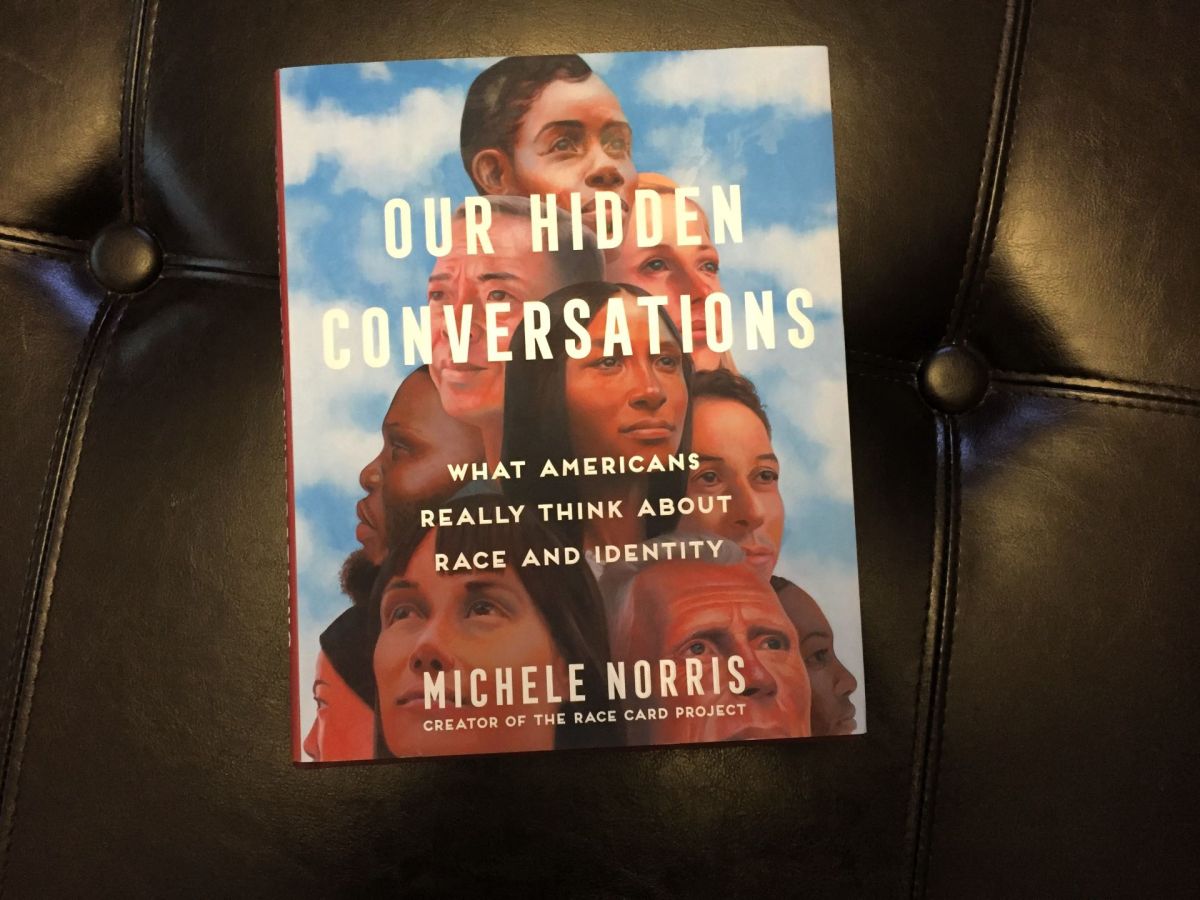
“Our Hidden Conversations” is a Very Tough Book to Read

As I approach the end of the book “Our Hidden Conversations” by Michele Norris, I find myself doing what I often do when I feel uncomfortable emotionally. I start to deploy my sense of humor.

As a psychiatrist (now retired since 2020), I learned early in my residency training that humor can be thought of as a “mature” psychological defense.

Given the painful memories that the book evokes, I find that I self-edit my usual habit of turning pain into comedy. Maybe it’s not always mature.

On the other hand, there are times when facing what is nowadays called my “lived experience” about racism and identity in the era my wife and I grew up in, while not funny, can be peeked at most safely from the funny edge.

So, with that in mind I took a look at the web page of the National Association of Black Social Workers (NABSW) which summarizes the organization’s position on white adoption of black children. I first read about it in Ms. Norris’s book, in the chapter “Black babies cost less to adopt.”

I was surprised to see the actual document, which has been posted since 2013. Sections of the position paper titled “Transracial Adoption Statement (c) 1972” are underlined. It expresses clearly an opposition to placing black and transracial adoptees with white parents. I might have missed it, but I don’t see another position statement that modifies it.

There are 30 state chapters of the NABSW. Iowa is not listed.

There is no National Association for White Social Workers. There is a website for the National Association of Social Workers (NASW). When I typed in “National Association of Black Social Workers” in the search field on the NASW website, almost 800 results were returned. When I applied the filter for ethnicity and race, there were 5 results attesting to the NASW efforts in countering racism. I didn’t see any mention of the NABSW. Maybe I just missed it.

I lived for a brief time in an African American foster home eons ago. I can’t think of anything funny to write about it. Has there ever been an opportunity for cross talk between the NASW and the NABSW? I’m not judging anyone here. I’m just asking.

Moving right along, I have again searched the web using the term “African American psychiatrists in Iowa.” I’ve posted about this before, looking at it from the funny edge (this allows me to take a deep breath). I still find my former colleague, Dr. Donald Black, MD listed. The only thing black about him is his name. And my 2019 blog post is the 3rd link down from the top, preceded by two from Psychology Today.

Most of the mental health care providers from the Psychology Today lists are Nurse Practitioners who are black. One of them does not look black. She looks white. She’s a psychiatrist. I’ve worked with her in the past and don’t recall her ever identifying as black. But because I’m reading the race card stories in “Our Hidden Conversations,” and because I’ve been around a little while, I’ve learned that some black people can look white. You can’t always judge a book by its cover.

A good black psychiatrist is hard to find. In fact, a black psychiatrist of any quality is hard to find. However, in general, there are notable black psychiatrists in our history. One of them was Chester Middlebrook Pierce, MD. Among his many accomplishments, he was the founding president of the Black Psychiatrists of America in 1969, which was one year after the NABSW was established. Dr. Pierce was also the president of the American Board of Psychiatry and Neurology in 1978. I didn’t learn about him until today. How is that possible?

There is a website for the Black Psychiatrists of America and you can try the search field to look for a black psychiatrist there. I couldn’t find any listed in Iowa. Most of them seem to be in Texas. I had a little trouble applying the search filters.

Those are my thoughts for now about “Our Hidden Conversations” by Michele Norris. This is not a funny book.

More Thoughts On “Our Hidden Conversations” Book by Michele Norris

I need to correct something I got wrong in my first post about Michele Norris’s Distinguished Lecture on January 23rd. While reading her book, “Our Hidden Conversations” I ran across this race card in the chapter “Black Babies Cost Less to Adopt:”

“Vote (for) Obama! He looks like me!”

That was the 8-year-old daughter said that. The person who sent in the card was her father, Dr. Val Sheffield and he was a medical student in Iowa at the time. Once you know that, you realize why he wondered whether he should have been “…happy or dismayed by this comment.”

Anyway, I’m a little over halfway through the book, “Our Hidden Conversations.”

The title of the chapter above, “Black Babies Cost Less to Adopt” is troubling and it has a lot to say about how it was common in the past to discount the cost of adopting black babies. Foster care of non-white kids was also a subject in the chapter. Identity conflicts are common and can lead to reminiscing about things like:

“I was not Black enough.”

“I was not Asian enough.”

“I was not Hispanic enough.”

What matters is being kind enough.

Putting the Exley in X-Files

A couple of nights ago Sena was looking at some old X-Files episodes on the web. It was on the Dailymotion site. For some reason, we could see them without login registration. I think it’s usually required. We watched the full length, The Unnatural episode two nights in a row without ads. It was an inconsistent experience. We saw it in both HD and non-HD modes and got slammed by ads at times and other times couldn’t access the show at all unless you logged in.

The weird thing was that all the subtitles and captions, and even the scenes were shown in mirror image. It turns out this mirror issue is not uncommon. I googled it and others have noticed it on YouTube as well as Dailymotion. You can flip the video out of mirror mode—often for the price of software being peddled for that purpose. The most common reason I saw given for the videos being mirrored was to avoid copyright strikes.

OK, so other than that, a lot of the old X-Files shows were available and Sena watched a little of the brutal episode “Home.” Sena can do a hilarious mimic of part of Mrs. Peacock snarling “I can tell you don’t have no children. Maybe one day you’ll learn… the pride… the love… when you know your boy will do anything for his mother.” Sena always ad libbed “the joy” to the “the pride, the love” phrase.

We used to watch the X-Files regularly, making popcorn downstairs in the kitchen and getting upstairs to watch it in bed just in time.

Anyway, we could watch the mirror version of “The Unnatural,” comfortably despite the backwards captions. This is one of our favorite episodes. There are many obvious references to racism and identity. I looked all over for a simplified plot summary, but found a lot of them have glaring mistakes, are too long, and wouldn’t fit with my simple-minded geezer interpretation. So, I’m going to cobble together something from reading a number of them. I’m not saying it’ll be straightforward.

I have to call it a Monster-of-The-Week (MOTW) episode because that’s what a lot of writers do.  It refers to X-Files episodes that usually feature some paranormal creature or a criminal with a supernatural ability.

Here’s a tangent I can’t resist because we just watched Mountain Monsters Sunday night for the first time, and I think it was the first episode of the new season of this show which has been on for 8 seasons. It is surely a parody of several shows of the Bigfoot adventure type. It’s basically an ongoing MOTW series featuring a cast of characters who survive on sasquatch snacks and cryptid colas and stage uproarious, slapstick comedy searches for legendary creatures (some of which are apparently part of genuine local folklore) like Spear Finger, the Smoke Wolf, the Cherokee Death Cat, and a dozen others, some of which are unfortunately prone to violent attacks of diarrhea, which Wild Bill (arguably one of the funnies members of the cast) did a side-splitting impression of by hanging on to a couple of trees and sticking his butt way too far out in a stunningly hysterical pantomime of projectile Hershey squirts, all the while getting more and more bug-eyed, cursing a blue streak and brandishing a gun which looked like a kid’s toy you could find at Walmart. The camera angles are all too perfect. We laughed until we cried.

Anyway, getting back to The Unnatural, the show is basically the reminiscence of an ex-cop named Arthur Dales who was assigned to protect a black baseball player named Josh Exley from being killed by the Ku Klux Klan (KKK). Actually, Josh is an alien who shape-shifted into a black man because he loves the game of baseball. He can also sing the old Negro Spiritual “Come and Go with Me to That Land” on the team bus so well that it was recorded on YouTube and one commenter said he’d pay $100 for a full version of it.

The episode starts with Fox Mulder finding an old newspaper clipping about a baseball game in 1947 in Roswell, New Mexico, the site of so many UFO crashes that the local landfill could not keep up with all the debris local ranchers were trucking in from the fields. He finds a story which shows a picture of an Alien Bounty Hunter in it. This is an executioner who also shape shifts and knocks off other aliens who misbehave by threatening to expose the alien colonization project going on at the time.

The KKK is threatening the team of black players and the head of the gang is the Alien Bounty Hunter. He’s after Exley because he threatens to expose the project simply because he loves to smack home runs and, even though Exley thinks the game of baseball is meaningless, it’s perfect because you can chew tobacco and get knocked out by wild pitches—which leads to him getting beaned and bleeding green blood on the catcher’s mitt. He wakes up speaking alien but because he remembers he’s from Macon, Georgia, everybody thinks he’s OK. The catcher’s mitt is sent to the lab guy for analysis.

Officer Dales finds out Exley is an alien after he breaks into his room and sees him in his alien form. After Dales wakes up from fainting a half dozen times, Exley tells him that he’s an alien; he’s forbidden from intermingling with humans, and he masquerades as a black baseball player because he loves the game and to escape notice. The way Exley puts it, “They don’t like for us to mingle with your people. The philosophy is we stick to ourselves; you stick to yourselves—everybody’s happy.”

Where have you heard this before? It sounds like Jim Crow to me.

The Bounty Hunter, masquerading as Exley, kills the lab guy and Exley is now fingered as the murderer.  Exley and Dales have a short talk while playing catch in the ball park in which Exley says it’s time for him to face the music and go back to his family. When Dales basically asks him why the human race can’t be his family, Exley takes either a surprisingly Green Supremacist attitude or just states the facts saying, “We may be able to look like y’all—but we ain’t y’all.”

In the end, the Alien Bounty Hunter executes Exley. But just before he kills Exley, he tells him to show his “true face” so he can die with dignity. Exley says simply, “This is my true face.”

 And while he dies in Dales’ arms, despite Exley telling him to get away because his green blood is poison to humans, Dales sees that it’s red and says “It’s just blood.”

I don’t know exactly what this means and some have called it ambiguous. I speculate that this might have been the culmination of a transformative process and it reminds me of Atticus Finch telling Scout (in To Kill a Mockingbird), “You never really understand a person until you consider things from his point of view…until you climb into his skin and walk around in it.”

Hanging In There

It has been a while since my last post. I’m hanging in there although sometimes it’s difficult to stay optimistic. I’m reminded of the Survivor Tree, the Callery Pear in New York City. You can easily google the story about this tree which somehow survived at Ground Zero after the 9/11 attack on America in 2001. We visited New York in the summer of 2017 and saw the Survivor Tree at the 9/11 Memorial & Museum plaza. It’s hard to believe that was 19 years ago. And now we’re dealing with the Covid-19 pandemic.

I’m still adjusting to my new identity as a retired person. I was reminded of that when I read the recent post “What is your Identity?” on 9/12/2020 by The Good Enough Psychiatrist. She’s resilient and optimistic, traits I admire. I tend to be rigid and pessimistic, especially when I have a lot of time on my hands.

I also need to get out of my head. It’s amazing how easily reminiscence can morph into rumination. Galloping all over the hospital as a psychiatric consultant distracted me from that habit. On the other hand, Sena and I reminisced the other night for quite a while. I was astonished at how much we both recalled about our 42-year long marriage and the adventures and challenges we’ve been through.

Our first house was a challenge. Shortly after we moved in, I had to try to mow the tall grass which had been neglected for a long time. I had to use either a scythe or a weed whacker. I honestly can’t recall exactly what I used but the scythe sounds more impressive, so I suspect it has crept into the story more for dramatic effect. It was a very hot day and my first encounter with my neighbor from across the street was his generous act of lending me his power lawnmower. He was a white man and, back in those days, kindness in that context was uncommon.

The only time I used a power mower other than at that house was when I went to Huston-Tillotson College in Austin, Texas. It’s now called H-T University. It was one of the historically black colleges in the country and I recall feeling a bit awkward there since I had grown up in largely white neighborhoods in the Midwest. Anyway, I helped mow the campus grounds. I guess “helped” might not be the right word, especially if you consider the perspective of the groundskeeper who was in charge of fixing the power lawnmowers I destroyed. I wrecked a few mainly because I kept running over rough, rocky ground. After I dragged the 2nd or 3rd ruined mower back to him, he stared at me and shook with rage. Mercifully, memory fails me at this point.

I’m realizing I could probably go on rambling like this for a good while. I guess that might mean I’m gradually adopting the identity of a garrulous old retired guy. I know that sounds pessimistic.

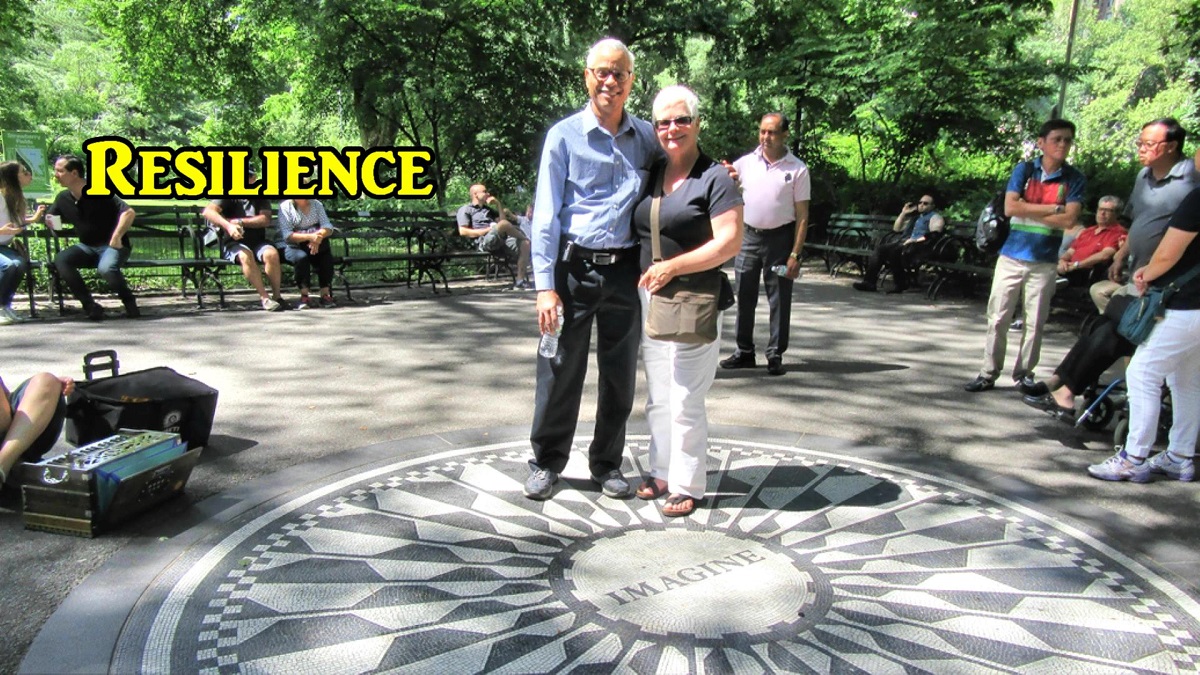
On a more positive note, Sena and I had a great time in New York City three years ago. We’re glad to have the memories. Sena is optimistic and resilient by nature. She’ll help me imagine brighter times coming in the future.