

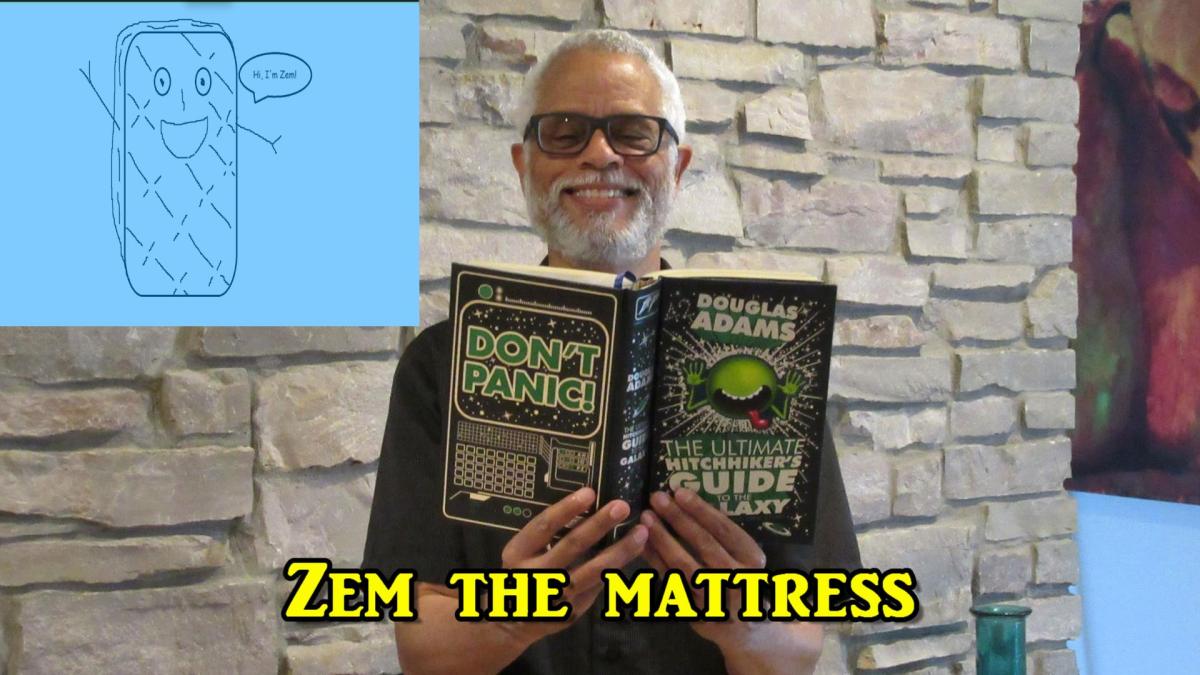
We’re saying goodbye to Zem the mattress. This raises important questions. Who the heck is Zem? Why does a mattress have a name? If you’ve ever read Douglas Adams’ book “The Ultimate Hitchhiker’s Guide to the Galaxy: Five Novels and One Story,” you’d probably wonder why anyone should ask.
The name Zem is given to every mattress that exists. According to the Guide, mattresses were once living beings who were slaughtered (not clear who slaughters them) and sold throughout the Universe. They are friendly, talkative, and originate on Sqornshellous Zeta, a swampy planet on which Zem the mattress has a long, idiotic conversation with a depressed robot named Marvin. It’s true, at least in Adams’ book. Find it in Chapter 7 of “Life, The Universe and Everything.”
This raises the issue of how to replace a mattress. It’s a difficult thing and it’s likely there are exceptions to the rule that all mattresses have to go to the junkyard.
I should say that the crude drawing of our Zem is an original work by me, using Microsoft Paint. It’s definitely not made by something called Image Creator. Recently, Windows 11 added Image Creator to Paint, which claims to be able to create drawings just by clicking on the AI icon—which appears almost everywhere nowadays.
It’s getting harder to ignore, but I did. That explains why my drawing of Zem looks like it was made by a 4-year-old child. It’s a form of protest against AI. I’m not sure how long I can hold out. I suspect that AI will eventually learn to disguise itself as something completely innocent without formally introducing itself as AI.
Anyway, like most people, it was challenging to find a new home other than the landfill for Zem. It turns out there is an informal underground railroad leading to new homes for Zem. Zem can be recycled, or at least some parts of it can be repurposed, which don’t include going back into mattress production.
And, there are places like Salvation Army, Goodwill, and homeless shelters which may publicly refuse to take Zem—but then not always stick to the rules on the signs. The websites may say they won’t adopt Zem, even if it doesn’t have a port wine stain on its face. On the other hand, there are circuitous, by word of mouth only code talkers who guide you (sometimes from half-closed doors) to what “could” be a new home for Zem, but you didn’t hear it from them. That rhyme was unintentional, but it worked.
The process is a little like the old TV show “Hogan’s Heroes,” in which Stalag 13 outwardly looked like a prison camp, but contained cleverly disguised nooks, crannies, and tunnels which allowed trips to the Dairy Queen if inmates were so inclined.
It turns out Zem might have a new home—but you didn’t hear it from me.
 Go Retire Psychiatrist