
More COVID-19 Vaccine Booster Sausages This Week?

I saw a nice summary by Stat News of last Friday’s FDA Advisory Committee meeting on Pfizer’s COVID-19 vaccine booster. They indicate the Advisory Committee on Immunization Practices (ACIP) are meeting this coming Wednesday and Thursday to fine-tune the FDA recommendations, which was a messy affair. I have been checking the ACIP web site frequently but so far, I’ve not seen any agenda or slide sets for September 22 and 23. Is that a signal that watching their meeting will be even more like watching sausages being made?

Just as an aside on the quote attributed to Otto Von Bismarck I mentioned in my post on Friday—it’s probably apocryphal.

Laws are like sausages; better not to see them being made.”

Otto Von Bismarck or maybe John Godfrey Saxe

I glanced around the web and ran across several articles which cast doubt on whether the big sausage duel ever took place. It’s kind of a shame because it had the medical science angle. Supposedly the scientist Rudolf Virchow who was studying the parasite responsible for causing trichinosis had responded to Bismarck’s challenge to a duel by proposing they each eat one of two sausages as weapons. Bismarck and Virchow would choose a sausage to eat, one of which was loaded with trichinella or one that was not. They couldn’t tell by looking at the sausages which was which. I first learned about this duel on the Travel Channel show (episode entitled “Sausage Duel”), which I think set the context as nasty factories churning out Trichinella laden sausages because of horrifyingly unsanitary practices. The show cast Virchow and Bismarck as opponents over that issue specifically. Bismarck conceded and that led to the factories cleaning up their act. Scientists triumph over politicians!

That probably never happened, according to more than one writer. So maybe I should choose another quote. One by a lawyer statesman might be a partial fit:

If Columbus had an advisory committee, he would probably still be at the dock.

Arthur Joseph Goldberg

Another that I like just because I’m a Dave Barry fan:

“If you had to identify, in one word, the reason why the human race has not achieved, and will never achieve, its full potential, that word would be ‘meeting.’”—Dave Barry.

If you had to identify, in one word, the reason why the human race has not achieved, and will never achieve, its full potential, that word would be “meeting”.

Dave Barry

Some sources on the web say Barry’s quote was in one of his many books I used to own: Dave Barry Turns 50. It’s in a list: “25 Things I Have Learned in 50 Years.” I didn’t check with Barry’s web site to verify the quote. You can find some of them on line. Many of those items are on the order of booger jokes, of which I happen to be a fan. This quote also happens to be highlighted on the website called mycommittee, which ironically advertises committee management software which promises to make them more productive. The home page shows a sample software document entitled “Decisions regarding response to Covid-19.”

Hmm. Maybe the advisory committees could use this.

ADDENDUM: Whoa! ACIP just posted this Wednesday’s draft agenda. More materials will surely follow.

Watching Sausages, Laws, and FDA Advisory Committee Decisions Being Made

Sena and I watched the FDA Advisory Committee live streamed meeting yesterday on whether or not Pfizer’s COVID-19 vaccine booster should be given full licensure. You know, there’s a much-discussed question about who actually made the following quote:

“Laws are like sausages; better not to see them being made.”—often attributed to Otto Von Bismarck although it’s been attributed to others.

You can view the arguments about who said it at this link. The point is I think it should also apply to FDA meeting decisions. Our overall impression is that it was a messy process. We watched the entire daylong proceeding. The bottom line was that the committee revised the original question and reframed the approval from full licensure to Emergency Use Authorization (EUA):

The FDA approved the EUA for the booster based on the “totality” of the available evidence instead of just the originally specified Clinical Trial C4591001 (because of the small number of subjects including only a dozen in the older age group; the data from Israel was also fair game) and restricted the population to those age 65 and older (instead of the original 16 years and older). They further specified further that the booster should target those at increased risk for severe disease—which is to be understood to include health care professionals and others at risk for high occupational exposure.

One of the voting members disclosed candidly that his wife had already received a booster shot at a pharmacy well in advance of the meeting (technically off-label) and that he planned to do the same—after they unanimously approved the booster after the question was reframed. Sena and I both thought this was an extraordinary statement coming from an FDA advisory committee member.

The original question was voted down with only 2 of 18 members voting in favor. Dr. Stanley Perlman of The University of Iowa voted no on the original question and voted yes on the revised question. For many days now, the news has been reporting that a large number of people have been getting a booster shot despite the lack of FDA approval.

Dr. Arnold “Arnie” Conto M.D., the Acting Chair of the committee, after being asked to read the original question, slipped by indicating the age as “16 months” instead of “16 years.” He was instrumental in holding the committee members to staying on time for each phase of the meeting.

Dr. Conto: “Do the safety and effectiveness data from clinical trial C4591001 support approval of a Comirnaty booster dose administered at least 6 months after completion of the primary series for use in individuals 16 months of age and older?”

“I see someone has his hand raised. Do you have a question?”

Dr. X: Lips clearly moving but no sound.

Moderator: “Please unmute your mike” (Everyone was guilty of this oversight repeatedly throughout the day. One participant actually started speaking audibly and then leaned over and switched off his mike, possibly not to break the trend).

Dr. X: “Oh my, sorry about that. Arnie, we’re not sure on that part about “16 months and older.”

Dr. Monto: Oh yeah, I meant “at least 16 days and younger.”

Dr. X: Lips moving but no sound.

Moderator: “Unmute, please!”

Dr. X: “Oops, sorry! OK, Arnie. Does anyone know whether we’re supposed to vote on the time machine today, or will that be for the Advisory Committee on Immunization Practices?”

Christopher Lloyd: “I got that covered! Dang, I mislaid the keys to the DeLorean.”

We listened to those making short presentations at the open public hearing. They were each given about 3 minutes to make their statements. Some were in favor of the vaccine booster, others were not. Safety concerns were prominent, especially for giving vaccine boosters to children.

In fact, the committee seemed very ready to change the focus of the booster to place less specific emphasis on children. We imagine that’s part of the reason why the age range was adjusted away from specifying those 16 years and older (although they’ve probably been getting the primary series, even before the August approval of the Pfizer vaccine). One of the committee members asked, after the change of the age from “16 years” to “65 years” (but also specifying those at “high risk for severe disease”) whether that still meant a 16-year-old could get the booster. The answer was “yes.”

That made sense since children can have medical illnesses that increase their risk of serious complications from COVID-19 infection. But some committee members wondered about the 65 years of age cutoff, probably because they were not 65 years old. This and other speculations about how to specify the vulnerable population led to scrambling to get the meeting over because this was a question which the ACIP could clarify—and because it was getting very close to the end of the day.

We still don’t know when the ACIP is going to meet about the booster. They’ve added something for September 22 and 23, but I don’t find an agenda for it yet. Maybe they’ll have sausages for lunch.

The Monsters

Sena and I got our annual flu shots last week, and I also got a pneumonia vaccine. We’ve been fully vaccinated against COVID-19 since earlier in the year. Now we’re waiting for the word on whether we’ll need COVID-19 vaccine boosters. We’ll probably know more about that by the end of the week after the FDA Advisory Committee meeting on the matter.

We’re part of the vaccinated, which is increasingly distinguished from the unvaccinated in various ways. The controversy about the unvaccinated almost amounts to them being discriminated against, according to some news headlines. The COVID-19 pandemic is now being called a pandemic of the unvaccinated, although some are able to resist the trend by seeing through it and realize we’re all in this together.

It reminds me of an old Cold War era episode of The Twilight Zone, “The Monsters Are Due on Maple Street,” which originally aired in 1960. The gist is that aliens seeking to conquer earthlings create paranoia and violent conflict amongst neighbors on a quiet cul-de-sac simply by manipulating the electrical power to cars and other devices. At first, the electrical malfunctions are only puzzling until a boy named Tommy tells everyone that the trouble is being perpetrated by aliens who are indistinguishable from humans, a notion he got from a comic book.

And after that, everyone on the street begins accusing each other of being malevolent aliens disguised as humans, often on the basis of interpreting benign behaviors like insomnia or tinkering with a ham radio as evidence for dangerous plots. One character even shoots his neighbor dead, believing he’s a dangerous alien.

There was a 2003 remake of this in which the government, instead of aliens, is doing the manipulating. No doubt both of these will be re-broadcast as part of Twilight Zone marathons next month as part of the usual October Halloween TV program lineup.

Sena thought of another Twilight Zone show, “The Shelter,” first broadcast in 1961, which also might fit the current pandemic context. A doctor builds a bomb shelter to protect just him and his family in case of a disaster. The unthinkable happens with UFOs being sighted and the friends and neighbors who threw a party for him all want to beg, bargain, or threaten their way into the doctor’s bomb shelter because they didn’t build their own. He refuses to allow them in. The neighbors turn on each other, showing the worst selfishness, hatred, and racism. They finally break into the doctor’s shelter with a battering ram (which, of course, negates the safety it might have provided)—only to find out in that moment that the UFOs were just satellites. They had become monsters and could not see how it happened.

Depending on what news media outlet you prefer to read, the vaccinated or the unvaccinated will be cast as bad guys or good guys. As the rhetoric heats up based on divisions between political parties, religious groups, scientists, races, and nations, the antipathy has fostered escalating tensions over whether vaccine and mask mandates should or should not prevail. The unvaccinated have their own battering ram—fake vaccination passports, which negate the safety assurance. The unvaccinated can’t get in to see their doctors in person, poison themselves with unproven medicines, or accuse the government of trying to poison them with vaccines. The wealthy vaccinated buy their booster shots at the expense of those who can’t afford them and before the medical experts can approve their safety and necessity. People are resorting to violence.

I always had a little trouble with the title of the Twilight Zone episode, “The Monsters Are Due on Maple Street.” The monsters are not just due—we have arrived. Why is it so hard for me to recall an episode showing exactly how to recover our humanity?

FDA Advisory Meeting on Pfizer COVID-19 Vaccine Booster Announcement

The FDA announcement about the Advisory Committee meeting on the Pfizer COVID-19 vaccine booster for September 17, 2021 is here. The time will be 8:30 AM-3:45 PM ET (check your time zone provided on the FDA YouTube web page). Review materials (if available) will be posted at the FDA link provided in the announcement.

Comirnaty vs Comiranty Spelling Bee Issue Resolved

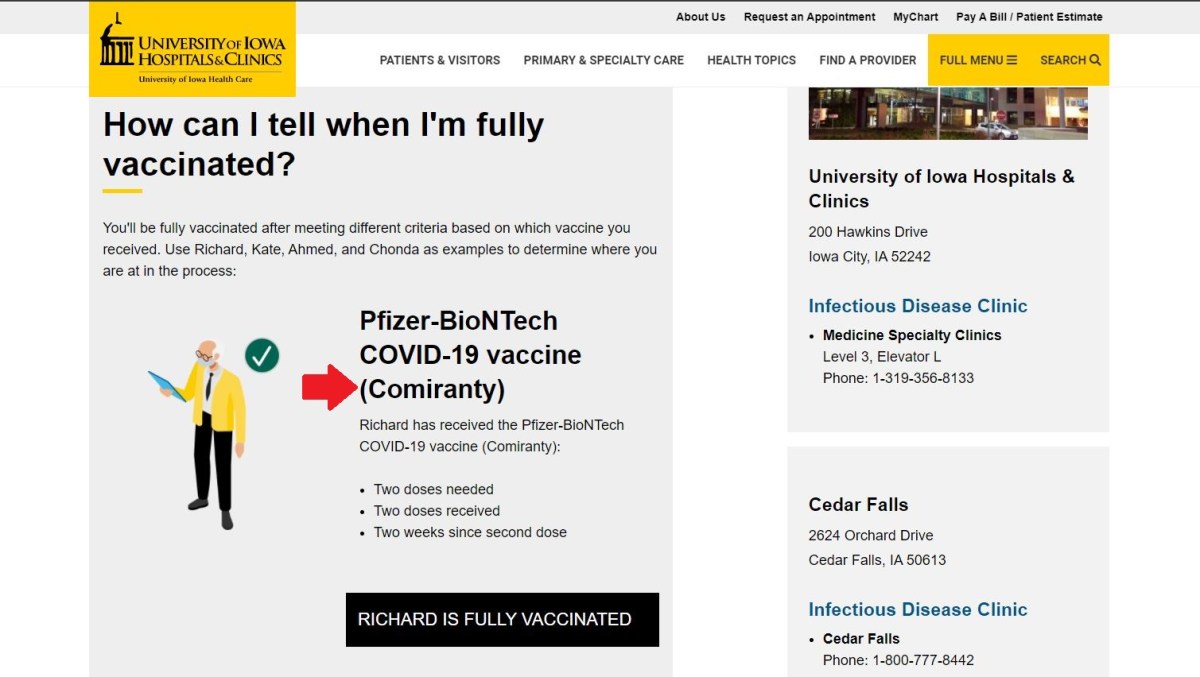
This is just an update on the Pfizer-BioNTech COVID-19 vaccine Comirnaty vs Comiranty spelling issue at UIHC, which has been resolved today. It took a few emails to get it fixed. I was beginning to think I was losing my mind and that I was the only who could see the mistake. Comirnaty had apparently been misspelled as Comiranty on several web pages for maybe a couple of weeks.

You can just look at the word Comirnaty and see how this could have happened. Looking at it in print makes me think there are two letter “m’s” in it. Transposing the two letters “a” and “n” looks easy to do. There are a few anagrams web sites that are picking up on the word Comirnaty. I kind of like “try anomic.” Can you really get “community,” “immunity,” and “mRNA” out of that agglomeration? Maybe. It’s a name game.

I could chalk this up to just me being a retired guy with too much time on his hands and nitpicking. On the other hand, there is that story about a typo ending World War II. In all fairness, there is some doubt about the accuracy of it. But it’s fascinating to think that the difference in spelling between cryptogamist (someone who studies algae) and cryptogramist (someone who studies codebreaking) might have made all the difference in the war’s outcome.

Comirnaty Misspelled by the Medical Community

This afternoon I just notified somebody at the University of Iowa Hospitals & Clinics (UIHC) that the Pfizer COVID-19 vaccine’s name is misspelled on several of their web pages. The new name for the vaccine is Comirnaty (pronounced koe-mir-na-tee). UIHC misspells it as “Comiranty.” And it has been that way for at least a week, probably since Pfizer publicly announced the name after the vaccine was fully licensed by the FDA. I found three instances of that although there could be more.

I found a news item that explains the name was deliberately chosen in order to remind us of the word “community” and the “mRNA” technology of the vaccine.

It actually reminded me of Foster Brooks whose comedy routine consisted of acting like he was drunk, slurring his speech in a parody of intoxication. The only way “Comirnaty” can make you think of “community” is if you’ve had a few too many.

On the other hand, “Comiranty” makes me think of the one Indiana Hoosier football player who was caught on camera with the word Indiana misspelled as “Indinia” on his jersey yesterday. By the way, Iowa beat Indinia 34-6 in the season opener. In all fairness, Indiana is not the only state that struggles with spelling.

Love Each Other More Now

When I think about all the mandates and bans against mandates for the COVID-19 vaccines and masks, I wonder about my own motive for getting the vaccine and wearing a mask.

In one sense, I’m doing it for myself. I’m a retired consultation-liaison psychiatrist and I got called to the intensive care units a lot. Almost always, the patient was delirious. And almost always, the patient was delirious in the setting of being on the ventilator or in the process of being liberated from the ventilator.

The critical care physician and the nurses were always looking for one specific thing from me. I was supposed to stop the patient from being agitated, to calm the wildly thrashing, terrified person fighting the restraints and struggling with hallucinations and fragmented paranoid delusions that every caregiver in the unit was trying to kill him. Often there were many medical problems, including multiple organ failure often from lack of oxygen, resulting in brain injury as well. Nowadays, COVID-19 is a frequent cause of delirium for the same reasons.

Years ago, the only tool I had was an antipsychotic called haloperidol, because it could be given intravenously. It would calm some patients, but it could and did cause side effects including akathisia (extreme restlessness), dystonia (severe muscle spasms), and neuroleptic malignant syndrome NMS, a rare, complex, life-threatening neurologic emergency attributable to antipsychotics. Over the past several years, the ICU pharmacies acquired newer drugs like dexmedetomidine, which is not a psychiatric drug. That didn’t stop the ICU from calling me.

I’ve seen all of that. I got the vaccine and wear the mask mostly because I don’t want to be in that boat. But I think those measures help protect others, too. I think many people have that motive. Those who think they’re getting it just for themselves can go on thinking that.

We’re taking a risk when we get the vaccine. It’s not completely harmless. There are very rare side effects which can be life-threatening and they have killed people. There is some level of altruism involved. Those who get the vaccine are playing a role, however small, in reducing the chance the virus will mutate into something that will kill even more people.

Wearing masks is a nuisance and doesn’t really feel heroic. But this act combined with other measures (the usual suspects: hand-washing, social distancing, avoiding large crowds) spreads love instead of infection.

We don’t have to agree. We don’t have to love each other. I just hope we can respect each other.

The COVID-19 Delta Variant

I’m passing along the University of Iowa Hospitals & Clinics information about the Delta variant of COVID-19. If you’re vaccinated and you get infected with the Delta variant, you might feel like your symptoms are from allergies or a cold. If you’re not vaccinated, you’re a lot more likely to get sick enough to be hospitalized.

According to Dr. Claudia Corwin, MD, MPH, an occupational medicine specialist and associate director of the University Employee Health Clinic, about 97% of those with a severe case of Delta variant are unvaccinated. That doesn’t mean the vaccines make us bullet proof and breakthrough infections of the Delta variant occur.

That’s probably part of the reason why the Advisory Committee on Immunization Practices (ACIP) thinks vaccine booster shots might be better reserved for the most vulnerable patients, such as the very elderly, those in Long Term Care Facilities, and health professionals. The ACIP met yesterday and there was no firm decision about booster rollout specifics and there was no vote on the matter. They plan to meet again in mid-September to review the need for boosters.

FDA Approves First COVID-19 Vaccine

Today the FDA approved the Pfizer COVID-19 vaccine (now marketed as Comirnaty). Excerpt of the media announcement below:

“The FDA’s approval of this vaccine is a milestone as we continue to battle the COVID-19 pandemic. While this and other vaccines have met the FDA’s rigorous, scientific standards for emergency use authorization, as the first FDA-approved COVID-19 vaccine, the public can be very confident that this vaccine meets the high standards for safety, effectiveness, and manufacturing quality the FDA requires of an approved product,” said Acting FDA Commissioner Janet Woodcock, M.D. “While millions of people have already safely received COVID-19 vaccines, we recognize that for some, the FDA approval of a vaccine may now instill additional confidence to get vaccinated. Today’s milestone puts us one step closer to altering the course of this pandemic in the U.S.” 

COVID-19 Boosters for The Immunocompromised: University of Iowa Hospitals & Clinics

Information from The University of Iowa Hospitals & Clinics on COVID-19 vaccine boosters for the immunocompromised is here.