Permissive Recommendation for Covid Vaccine 2nd Booster?

I have a question about the permissive recommendation by the CDC for the 2nd Covid vaccine booster. Does that mean I should get the booster or that I can get it if I just want one?

There’s an important distinction between “should” and “can.” According to the AMA, the CDC gave permissive recommendation, which means that it’s not saying you should get it, but that you can if you so choose:

“The CDC’s action is commonly known as a “permissive recommendation,” meaning that certain people may get the second booster if they wish to get it, though the agency itself is not yet officially urging them to do so.”

There are a couple of recently updated tables on the CDC website in which the language is clearly permissive about the 2nd booster dose.  One is dated April 2, 2022, Stay Up to Date with Your Covid-19 Vaccines. The other is dated April 1, 2022, Covid-19 Vaccine Boosters.

Some of us may be finding it challenging to get the booster scheduled right now. I wonder if that means even those providing the booster might be wondering who should or should not get one.

Does vaccine supply have a bearing on the issue? Or is there significant uncertainty about the necessity for the 2nd booster?

I wonder if experts are waiting for further guidance from the scheduled FDA Advisory Committee meeting on April 6, 2022.

That’s this coming Wednesday. I’d like to listen to the meeting as I have in the past, but I have a schedule conflict that day. That’s not the only conflict I have.

No officials are clearly saying that I should not get the 2nd booster. On the other hand, neither are they clearly saying I should.

Maybe I’ll wait for an FDA update after the April 6 meeting. And I wonder if that will lead to a CDC Advisory Committee meeting.

Update April 5, 2022: Here’s a link to a new article on CDC Director Rochelle Walensky’s remarks intended to clarify the confusion about this issue of whether the 2nd booster is needed or not. It turns out it all depends (as it usually does). If I’ve been infected with Omicron in the last 2-4 months, then I might not need one, at least for now.

The catch is that my immunity is waning. I might still need the 2nd booster. I’m old enough that it might be a good idea to get it. On the other hand, I’m probably still going to need another jab come autumn. Dr. Walensky says this is “a personal judgment call.”

I’m still waiting for the FDA Advisory Committee’s conclusions on April 6, 2022.

AMA Update on Covid-19 2nd Vaccine Booster

The AMA published an update on the Covid-19 Vaccine 2nd booster and the YouTube presentation is only a couple of days old and pretty thorough. While the CDC indeed gave a permissive recommendation, it sounds like another jab would be recommended in the fall anyway, likely targeting variants. The FDA Advisory Committee still has a meeting scheduled for April 6, 2022. It sounds like Medicare and private insurance will cover the cost. The Federal funding outlook doesn’t sound as positive for the uninsured.

Second Covid Vaccine Booster Got Any Mojo?

Tomorrow’s April Fool’s Day and I thought I’d get this post up today so it wouldn’t get confused with a joke.

I’m genuinely a little confused about the FDA and CDC approval of the 2nd Covid vaccine booster. It’s almost like this vaccine is getting a mojo of some kind, at least with some experts.

Although I’m not keen on getting another jab, I’ll do it if there is reasonable evidence to support it. Not everyone on the FDA Advisory committee is for it. Dr. Paul Offit was quoted in a news story as saying, “We’re going to have to learn to live with mild disease at some point.” 

Dr. Offit is the director of the Vaccine Education Center at Children’s Hospital of Philadelphia. I’ve heard him speak at FDA Advisory Committee meetings during public Zoom meetings on the subject and I respect his opinion. He doesn’t think frequent boosting is a reasonable thing to do. I’m inclined to agree with his opinion that most people won’t do it anyway. I’m sure he’ll have more to say at the April 6 FDA Covid Vaccine Advisory Committee meeting.

I was not surprised to learn that of the 90 million Americans who got their initial Covid vaccine series, only about half got the first booster. What kind of mojo is that?

Even the Pfizer drug company CEO, Albert Bourla, says frequent boosting is impractical.

There is some serious doubt in my mind about the booster mojo. Sena says that it would be helpful if more local infectious disease experts would express their own opinions about the direction this vaccination strategy is going. She has a point.

Does the Covid vaccine booster have any mojo? What do you think?

Featured image picture credit: pixydotorg.

FDA and CDC Endorse 2nd Vaccine Booster for Covid-19

On March 29, 2022, both the FDA and the CDC endorsed a 2nd Covid-19 booster vaccine dose. The FDA Advisory Committee on vaccines still has a meeting scheduled about vaccine boosters on April 6, 2022. Neither of the booster doses will be variant specific.

FDA Advisory Committee Meeting on Covid Vaccine Boosters Scheduled for April 6, 2022

The FDA Advisory Committee on Vaccines and Related Biological Products has scheduled a meeting on April 6, 2022 “to discuss considerations for use of COVID-19 vaccine booster doses and the process for COVID-19 vaccine strain selection to address current and emerging variants.” The meeting will run from 8:30 AM-5:00 PM ET.

UIHC Covid-19 Q&A: Omicron and Vaccines

Here’s a recently published YouTube by University of Iowa Health Care on the Covid-19 virus, the Omicron variant, and vaccines (actually there are two, see update below). Points that grabbed our attention were:

Omicron is more transmissible, but overall seems to cause less severe disease.

Current vaccines, especially with the booster, protect against getting severe disease, although may not protect against infection.

It’s not a great idea to just get it over with by getting infected with Omicron. Getting the disease can lead to severe medical complications (including myocarditis) leading to hospital admission. The vaccines rarely cause myocarditis as a side effect and it generally resolves without treatment.

Vaccines make getting Covid-19 long haul syndrome less likely.

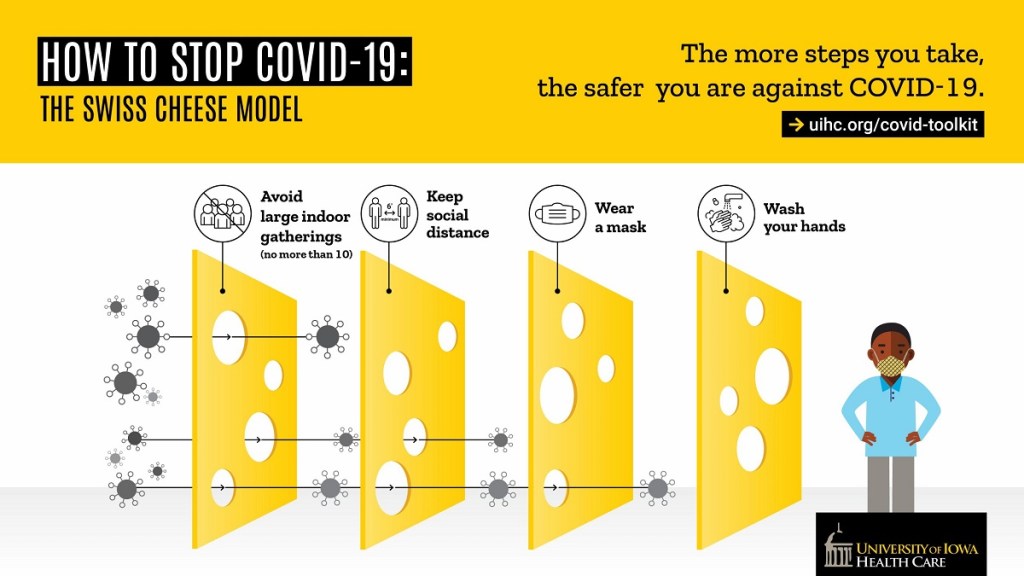
Avoiding getting together in groups of 10 or larger decreases the risk of infection with Omicron. The Swiss Cheese method of protecting yourself against Covid-19 still works best:

Include a slice getting the vaccine with booster: image credit Univ Iowa Health Care

There are medical treatments for Covid-19 disease if you get infected and have to be hospitalized. The treatments are not without side effects. One of them is dexamethasone, a corticosteroid. It can be used to reduce the immune system reaction that Covid-19 infection can eventually cause. Corticosteroids can cause neuropsychiatric side effects that can range from anxiety to frank delirium marked by psychosis. Fortunately, the duration of steroid treatment is relatively short. Vaccines don’t cause side effects of this type. Over the course of my career before I retired, as a psychiatric consultant in the general hospital, I was not infrequently called to assist in the management of extreme psychiatric side effects from high dose steroids (reference: García CAC, Sánchez EBA, Huerta DH, Gómez-Arnau J. Covid-19 treatment-induced neuropsychiatric adverse effects. Gen Hosp Psychiatry. 2020;67:163-164. doi:10.1016/j.genhosppsych.2020.06.001: quote : “Short course high-dose corticosteroid treatment, as occurs in COVID-19, may cause delirium and changes in mood (with a frequency of up to 52% of patients treated with more than 20 mg a day of prednisone during 3 months) [5], being mania and hypomania more frequently observed than depression.”)

Wearing a mask is protective. Recently the CDC recommended preferring medical grade or surgical masks over cloth masks. The guidance has a link to a YouTube on how to make the 3 layer disposable surgical mask fit closer to the face to provide a more effective barrier (and tends to reduce fogging on eyeglasses). N95 masks may be more widely available soon.

It takes a little practice

The vaccines are very safe and effective. We had minimal side effects, mainly sore arms.

Update: We watched the UIHC Covid-19 Family Forum last night which ran from 6:30-7:30 PM. I just noticed that it was recorded. It’s similar to the presentation above. It also contains helpful slides with graphs. There were great questions from the audience, which the experts answered and which are helpful to all of us. Many thanks to Dr. Dan Diekema, MD and Dr. Patricia Winokur, MD for this outstanding forum.

Advisory Committee on Immunization Practices Meeting on COVID-19 Vaccine Boosting: Day Two

The ACIP is back for Day Two of the COVID-19 vaccine boosters meeting. Today the focus will be on Moderna, Janssen, and heterologous boosting. They all got the green light from the FDA. I’ll be writing this post in real time according to the meeting schedule. Effectiveness and safety data will dominate the day. The afternoon presentations will cover the evidence, clinical implications, and policy questions. There will be a vote around 3:30 PM, CDT.

Questions were raised about the intention of using the same volume package of Moderna to administer both the primary series or the booster—just withdrawing half of the volume for the booster (50 micrograms in the booster as contrasted with 100 micrograms of the primary series). It sounds like there were concerns about making procedural mistakes in administration. Pharmacists would be concerned about this, and advocated for a separate booster dose package.

The Janssen vaccine booster data show that it’s safe, and increases protection against symptomatic COVID-19 infection. The combination of both humoral and cell-mediated immune responses associated with the Janssen vaccine primary single dose was emphasized. The booster dose is the same as the initial dose. The benefit of the Janssen booster dose might be higher when given at 6 months or later.

The NIH mix and match study showed relatively less boosting from the Janssen vaccine booster. The safety data were mostly reassuring. The study was non-randomized, correlates of protection are not completely elucidated, and not designed to compare between boosts. Heterologous boosts elicited similar or higher serologic responses as compared to their respective homologous booster responses. The 100-microgram dose of Moderna was used as the booster dose initially instead of the 50-microgram dose.

Update after the break:

The NIH mix and match study showed relatively less boosting from the Janssen vaccine booster. The safety data were mostly reassuring. The study was non-randomized, correlates of protection are not completely elucidated, and not designed to compare between boosts. Heterologous boosts elicited similar or higher serologic responses as compared to their respective homologous booster responses. The 100-microgram dose of Moderna was used as the booster dose initially instead of the 50-microgram dose.

Safety data were reviewed. Myocarditis/pericarditis rates (Dr. Nicky Klein’s slides) were highest in males age 18-39 years of age who got mRNA COVID-19 vaccines, generally after the second dose (data suggest maybe more from Moderna). Most patients recover. Thrombosis with thrombocytopenia syndrome (TTS) is still being monitored in the Janssen vaccine; it’s more common in women. There may be a causal association with TTS; it’s more common in females and it’s rare. There’s a lack of safety problems identified with current surveillance systems associated with heterologous dosing of mRNA and Janssen vaccines. Rare cases of Guillain-Barre Syndrome (GBS) occur with the Janssen vaccine. Risks of the aforementioned vaccines might be less with the booster doses. A couple of committee members expressed concerns about administration of a 2nd dose of Janssen as a booster given the rare but serious TTS and GBS adverse events. They favored heterologous boosting with mRNA vaccines instead.

After the break: Data were presented showing waning effectiveness of Moderna and Janssen vaccines. Vaccine effectiveness is lower in the Delta period. There is lower vaccine effectiveness for Janssen in those over age 65. In patients with chronic conditions, vaccine effectiveness in Moderna is better than in Janssen.  Moderna has 89-100% protection against severe disease. See the Summary and Conclusions slide of Dr. J. Jones (“COVID-19 vaccine effectiveness, primary series”). Someone asked about the role of risk behavior which could influence the estimate of vaccine effectiveness, which didn’t generate any solid answers.

See slide 5 in “Evidence for Recommendations” slide deck by Dooling for policy questions. Also see Summary slide 16 and slide 41, “Work Group Interpretation.”

The Clinical Considerations slide deck should be reviewed in its entirety. Although homologous boosting was initially recommended, the final language in the voting questions allowed for flexibility for heterologous boosting according to patient preference and product availability as well as taking into account the risk of TTS and GBS in those patients in higher risk groups for those adverse events. There was a consistent preference among some members for more permissive heterologous boosting.

There was a lot of discussion about the voting questions:

Vote #1: A single booster dose is recommended 6 months after completion of an mRNA series, in the same risk groups for whom CDC recommended a booster dose of Pfizer, under FDA EUA. This passed unanimously.

Vote #2: A single booster dose is recommended for persons aged 18 years, 2 months after receipt of the initial Janssen dose, under the FDA EUA. This passed unanimously.

The meeting was adjourned at around 4:20 PM, CDT.

FDA Authorizes COVID-19 Moderna and Janssen Boosters and Heterologous Boosting

The FDA just released a statement this afternoon announcing the extension of the EUA for COVID-19 boosting with Moderna and Janssen vaccine. The FDA also authorized heterologous boosting (mix and match).

Advisory Committee on Immunization Practices Meeting on COVID-19 Vaccine Boosters

I still can’t make heads or tails out of what’s happening with the CDC Advisory Committee on Immunization Practices (ACIP) meeting today and tomorrow. The agenda is still in draft form and it’s dated “Draft—October 14, 2021.” I’m writing this as the ACIP web page is testing it’s incoming and outgoing audio at 8:40 AM, CDT. I’m updating today as the meeting proceeds.

I thought the meeting was going to be mainly about the Moderna and Janssen COVID-19 vaccine boosters, but there are no slides published yet and the agenda looks like it’s mainly about other vaccines. There is one presentation scheduled for this afternoon about influenza vaccines entitled “Phase II safety and immunogenicity study of the coadministration of Fluzone® High-Dose Quadrivalent Influenza Vaccine and a third dose of mRNA-1273 COVID-19 vaccine (Moderna).” I have a stake in the meeting as I wait for the Moderna booster to get the green light.

Tomorrow’s agenda still says “Coronavirus Disease 2019 (COVID-19) Vaccines, TBD.” The only votes so far pertain to the pneumococcal and zoster vaccines, which is for later this afternoon.

There’s also no FDA website update on the final decision regarding recommendations for the Moderna and Janssen booster vaccines. There have been media rumors that the FDA might recommend heterologous boosting (mix and match).

The meeting started on time at approximately 9:00 AM, CDT and the agenda was abruptly updated to final form (which looked like it contained a typo for the presentation about the combination injection of the Fluzone and Moderna booster (omitted after the words “…third dose of…” compare above). The final agenda revealed discussion of the boosters tomorrow starting at 9:15 AM, CDT. Also updated were some of the slide presentations (just for today). There will be a vote tomorrow afternoon on the Moderna and Janssen boosters. This will follow presentations on Moderna and Janssen booster data, NIH mix-and-match booster study, COVID-19 vaccine safety data including data about myocarditis, effectiveness of COVID-19 vaccines, evidence for recommendations, and policy questions.

There was an announcement that the FDA favored using heterologous boosting and that later today that would be posted on the FDA website.

I’ll probably only be spot-checking the proceedings during the day, since it looks like the main event for COVID-19 boosters will take place tomorrow.

Afternoon Update: The presentation “Phase II safety and immunogenicity study of the coadministration of Fluzone® High-Dose Quadrivalent Influenza Vaccine and a third dose of mRNA-1273 COVID-19 vaccine (Moderna)” started around 1:30 PM, CDT this afternoon. Fatigue was the most frequently reported systemic reaction. There were no serious adverse events. The combination can be given safely together without evidence of immunogenicity interference. The shots were given in different arms. All subjects had previously received the primary series (both shots) of the Moderna vaccine. The CDC website already has indicated on their website that the COVID-19 vaccine and the flu vaccine can be given at the same visit.