What Dr. Melvin P. Sikes Said

While yesterday’s post on Dr. Melvin P. Sikes was mainly about my personal impressions of him as a teacher, there are a couple of web resources which gives a little more texture about him apart from my imperfect memory and limited experience.

One of them is a formal course outline and evaluations he and another teacher wrote in 1975, which was the year I first encountered him when I was a freshman at Huston-Tillotson College at that time. I know it seems like a tough read, but I was pretty impressed by what teachers said about him in the evaluation part of the document entitled “Report on Teaching in Multi-Cultural/Multi-Ethnic Schools (1974-75).”

The pdf document is 39 pages long, but I suggest focusing on the student teacher evaluations of his course. That starts on page 19. They all praise it, without exception. Many note that he didn’t really just lecture. One of the evaluators called him “supercalifragalisticexpialadoches!” Not sure if that’s spelled just right (it’s on p.33 so you can check it yourselves), but the point is well made—he was viewed as an extraordinarily gifted teacher.

Dr. Sikes’ comments start on pp.35-39 (Attachment D, entitled “Teaching in Multi-Cultural/Multi-Ethnic Schools; EDP F382 -Summer 1975l Professor Melvin Sikes) and I think that’s also worth reading. It’s short and without lofty, academic terminology.

The reading list caught my eye. I looked for Ralph Ellison’s novel “Invisible Man” which had been published in 1952, but it wasn’t on the list. That book has special meaning for me personally, because when I encountered Dr. Sikes in 1975, I was a freshman at one of the Historically Black Colleges and Universities (HBCUs), Huston-Tillotson College as it was then known. I was born and raised in Iowa and had never been in the southern United States. I sort of identified with the unnamed protagonist because the first section of the book deals with his experience at a southern black college.

It was a culture shock. I never saw anyone like Bledsoe. In fact, I never personally met the president of H-TC (now Huston-Tillotson University as of 2005), who was Dr. John Q. Taylor King, Sr. at the time. My main connection was Dr. Hector Grant, who recruited me while he was visiting Mason City, Iowa in connection with support from a local church. I still don’t know what happened to Dr. Grant. It’s like he dropped off the face of the earth.

Anway, I wanted to share another item I pulled off the web about Dr. Sikes. It’s a newspaper article about him published in the West Texas Times issue published May 4,1977. It’s in the collection of the Texas Tech University on line, with the link to the main front page story “Judge Orders Officials to Clean Up the Jail,” interestingly enough. It automatically downloads a pdf of the newspaper issue to your computer when you click the link. I’m just going to try to summarize it and pull some quotes.

The title of the story about Dr. Sikes is down the page, “UT’s Dr. Sikes Helps Students Know Themselves and Others.” The story begins with an anecdote about an interaction Dr. Sikes had with a teacher. It involved a black student coming to her with a complaint that a white student had hit him and he used bad language in describing it. The teacher was going to discipline the kid about his bad language, which Dr. Sikes questioned.

Sikes thought the teacher should have first gotten more information about what the student actually experienced in the encounter. The implication was that if she had listened first, she might not have jumped down his throat about his bad language.

The author of the news article writes that, according to Sikes, “I want my students to be more flexible, to understand that people are first people,” the professor likes to say. “I want them to grow out of looking at a color of a skin and making determinations, good, bad, or indifferent.” He goes on to say,

“I don’t even want them to look at blacks and say, ‘these are great people.’ I just want them to look at blacks and say ‘these are people.’

Quotes from Sikes:

“Before you can deal with another in a meaningful kind of way, you have to find some meaning and purpose in your own life—which means defining yourself….”

About teaching:

“Yes, I was lucky, I was taught by my parents, to some degree. But then I had teachers who taught this to me… And much of whatever I am… is the result of teachers and their concern—black teachers, white teachers.”

About our differences:

“If we’re all the same, we can’t make unique contributions because the contributions would be the same.”

The author of the story points out that Dr. Sikes often took student teachers to Huston-Tillotson College to see predominantly black students. The author also writes that Dr. Sikes mentions something about politics which rings a bell.

“He [Dr. Sikes] talks about the politicalization of education, and says that educating has been taken away from the educator and usurped by the politician.”

On teaching the teachers:

Dr. Sikes says: “People don’t realize how important you are and you don’t realize how important you are. You’re molding and shaping human lives, millions of lives, who will become, depending upon how you mold and help shape or help them become.”

“Now the doctor deals with his patient for a short length of time, and the patient dies and he buries his mistake, or he lives and he’s all right. But we can’t bury our mistakes. They walk around and haunt us and other people…sometimes their living is death. But people never realize that it’s teachers—we are the ones who have power.”

And finally, about Mel Sikes himself, one of his students says,

“Sikes is intense, loquacious and supremely personal. He immediately grabs you and talks on a person-to-person wavelength. He tells his students a lot about himself, his struggles as a black and as a radically caring person. He says he would die if it would help all people relate better. And he would.”

There was a lot more to Melvin Sikes than a lemon-yellow leisure suit.
The Red Green Show “Twinning” Episode A Model of Cooperation

I just read Dr. H. Steven Moffic’s post on Psychiatric Times, “The Space Station as a Model for Intercultural Cooperation.”  I also read the blog of another psychiatric I consider a colleague and friend, Dr. George Dawson, MD, and it’s sort of in the oppositive vein, being about the recent snafu of some Republican Minnesota legislators deciding to submit a bill to the legislature mansplaining Trump Derangement Syndrome (TDS) to the Democrats why TDS needs to become a law. It’s going over like a lead space station.

Incidentally, one legislature activity tracking website (Bill Track 50) has an Artificial Intelligence (AI) summary of the bill which says in part, “…the bill appears to be satirical or politically motivated…”

And the Minnesota Senate Minority Leader, Mark T. Johnson, said the bill was “a little bit tongue in cheek,” and possibly unintentionally joked that “Senate Republicans have always supported mental health funding…” while also calling attention to problems that the two political parties have cooperating with each other (story source WCCO News Minnesota, “Minnesota bill to define “Trump derangement syndrome” as mental illness provokes backlash” by Eric Henderson, Caroline Cummings; accessed March 18, 2025). Obviously these two pieces present opposites when it comes to collaboration.

The other issue pertinent to my post today has been the recent tariff and trade war going on between Canada and America, which is all about competition rather than cooperation.

Therefore, I did a web search for any Red Green Show episodes that demonstrated cooperation as a theme. In fact, the usual AI guidance (which I never ask for) pointed out that The Red Green Show didn’t present episodes about cooperation per se, but satirized the topic. For once, I had to agree with AI for the most part.

On the other hand, I did find a Red Green Show episode called “Twinning” that actually seemed to involve collaboration between Canada and Iowa, if you can imagine that nowadays. Back in the year 2000, The Red Green Show sponsored a survey of all 50 states in America, offering an opportunity for persons from an American city to twin with persons from Canada, I think it was Ontario. This meant that Americans would visit Canada and Canadians would visit America. I may not have the exact details right, but the idea of cross-cultural collaboration and getting to know each other was the main idea.

The whole state of Iowa endorsed the twinning offer with The Red Green Show, which of course, represented Canada. At the time, the Iowa Public Broadcasting Service (PBS) network was supporting the Red Green Show.

 I never knew about that when it happened in 2000, probably because I was pretty busy working as a consultation-liaison psychiatrist here in Iowa City, Iowa. Anyway, the “Twinning” episode was one of the funniest I’ve seen. You know, identical twins are not exactly identical in every way.

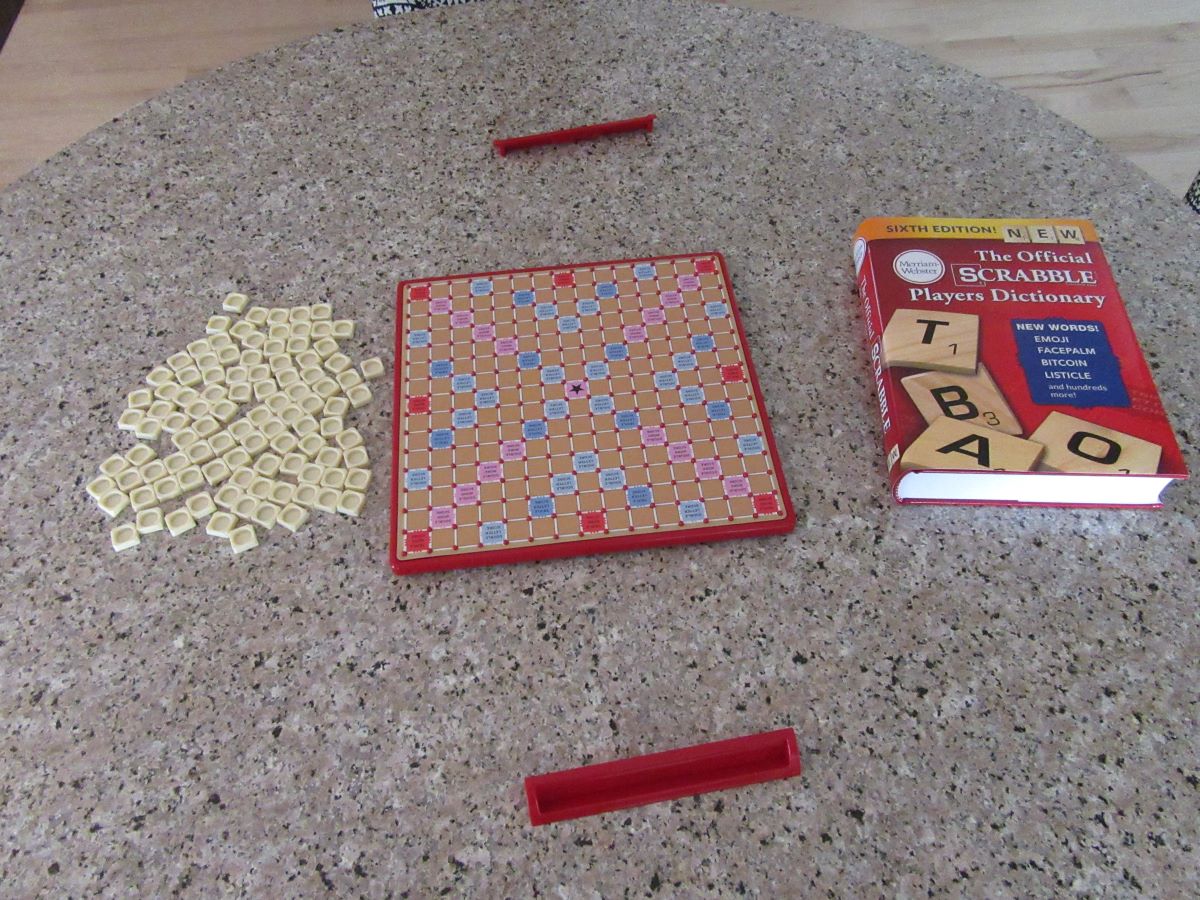
This is National Scrabble Day

I almost forgot that April 13 is National Scrabble Day. I don’t think I’ve ever blogged about it before, so I’ll inflict some thoughts on you now about it and add some others about International Cribbage Day, which is on February 10 annually—and which I evidently tend to forget every year.

The big news about Scrabble is that it’s changing in a major way, at least in Europe. I guess some people think the game is too difficult and they want to make it less “intimidating.” That’s what Mattel in Europe says, anyway. Others accuse the company of “dumbing it down.” I guess a certain generation of players want the game to be less competitive and more cooperative.

The thing about Scrabble Together is that it’s available only in Europe—for now. I just found out that Mattel is based in California and owns the rights to the game around most of the world. However, Hasbro licenses the game in the U.S. and has no plan to offer Scrabble Together in America.

We play Scrabble rarely—I’m not a very good player so I tend to avoid it. Sena has a couple of computer versions on CD, The Hasbro version of which is getting to be about eBay age. I think I bought it in 1999 (or was it 1998?) at Best Buy, back in the day when you could buy stuff in the actual stores. Even though the shelves looked pretty bare the last time I was there, web articles indicate it’s not going out of business, just evolving into online retailing.

Sena plays Maven (an interactive character that morphs, makes noises, and makes fun of or cheers your plays) on the Hasbro CD Scrabble version. She plays the Advanced Level and says she loses most of the time. Maven is very competitive. Funny thing, this doesn’t discourage Sena from playing. I tried to play Maven yesterday and got slaughtered. Maven thought it was pretty funny.

This change to Scrabble Together reminds me of a big story about a guy named Nigel Richards who won the French World Scrabble Championship Tournament in 2015—and he doesn’t speak a word of French. He memorized the French Dictionary. He concentrates on maximizing his scores without focusing on the actual words. It’s really more about the numbers than the vocabulary. Nigel Richards is definitely competitive and probably would not be interested in Scrabble Together.

Scrabble Together could attract more young people to an old game, which is more than you might say about cribbage. Just to be clear, cribbage is a competitive game and always has been. Every once in a while, you’ll see interesting descriptions about this two-hander card game which uses a board and can teach you a thing or two about math, strategy, logic, and building friendships.

People often observe that typical cribbage players tend to be older. It’s common to see there are fewer players under the age of 50. Many fans of cribbage try to attract younger players to the game by extolling its virtues and assuring younger novices they’ll be treated kindly. You can see that on the American Cribbage Congress (ACC) website page entitled “Cribbage Club Code of Congeniality.” Cribbage, while a competitive game, can be supportive as well. It’s not impossible.

Try not to let an experienced cribbage enthusiast persuade you to play for money.