We’re on schedule to get our new cribbage boards delivered today!
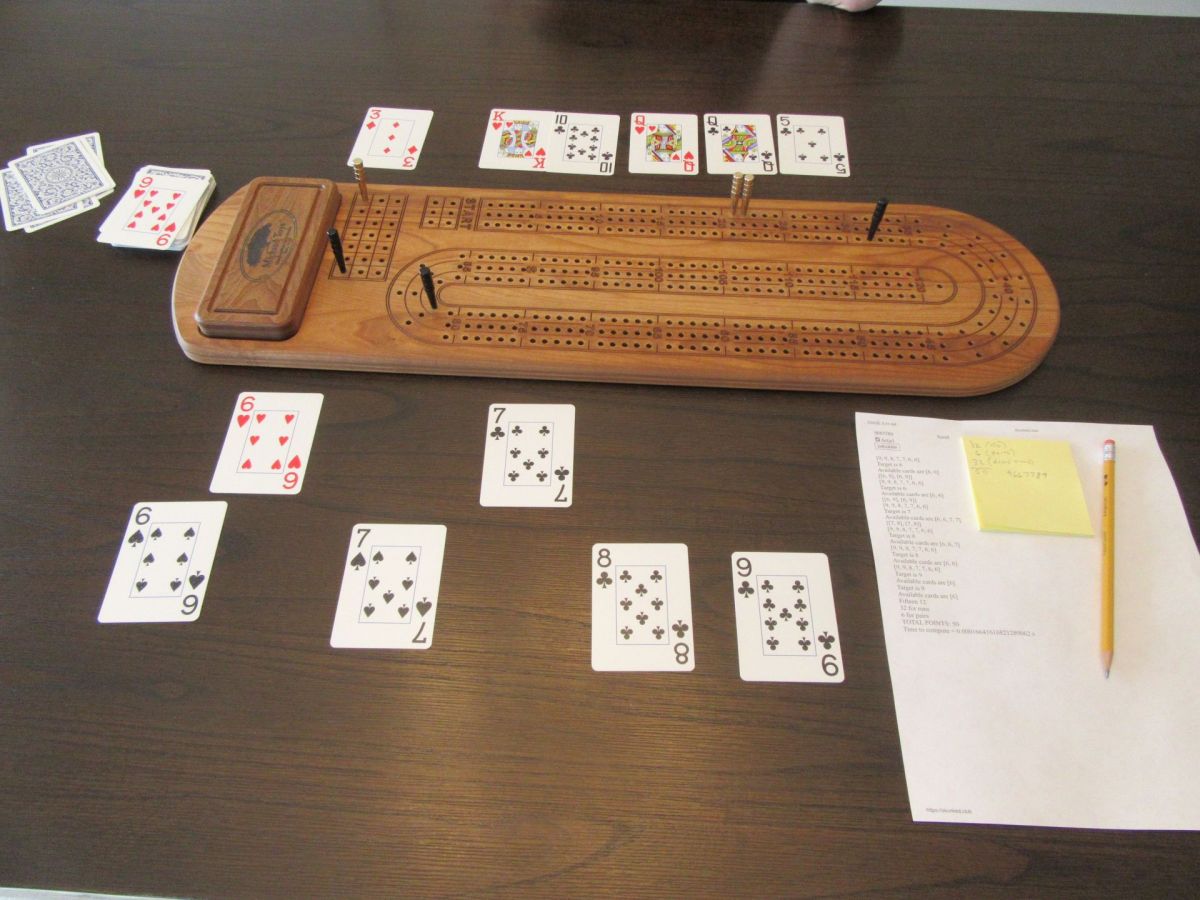
We played 9 card cribbage to 121 today and I got a 50-point hand! We both scored the complex hand, came up with 50 points, checked it with skunkeddotclub and it was correct! We played only 3 hands but the high scores led to a lot of time counting points. That’s why you’ll never see a 9-card cribbage tournament.
On the other hand, this might do something good for elder brain health.
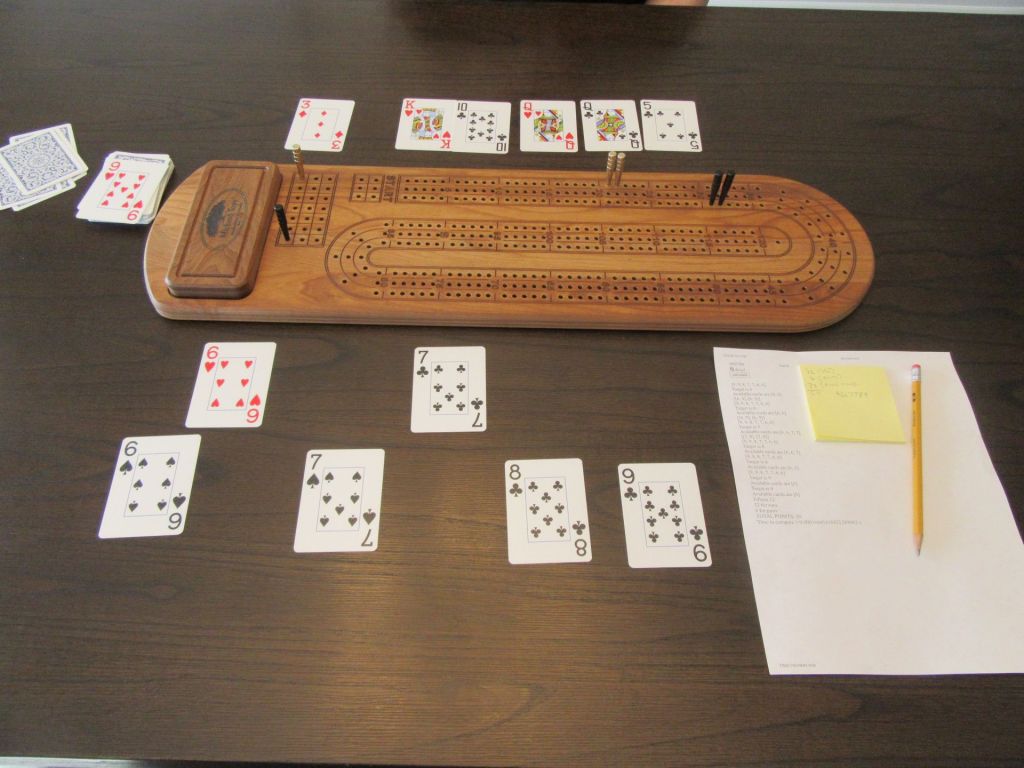
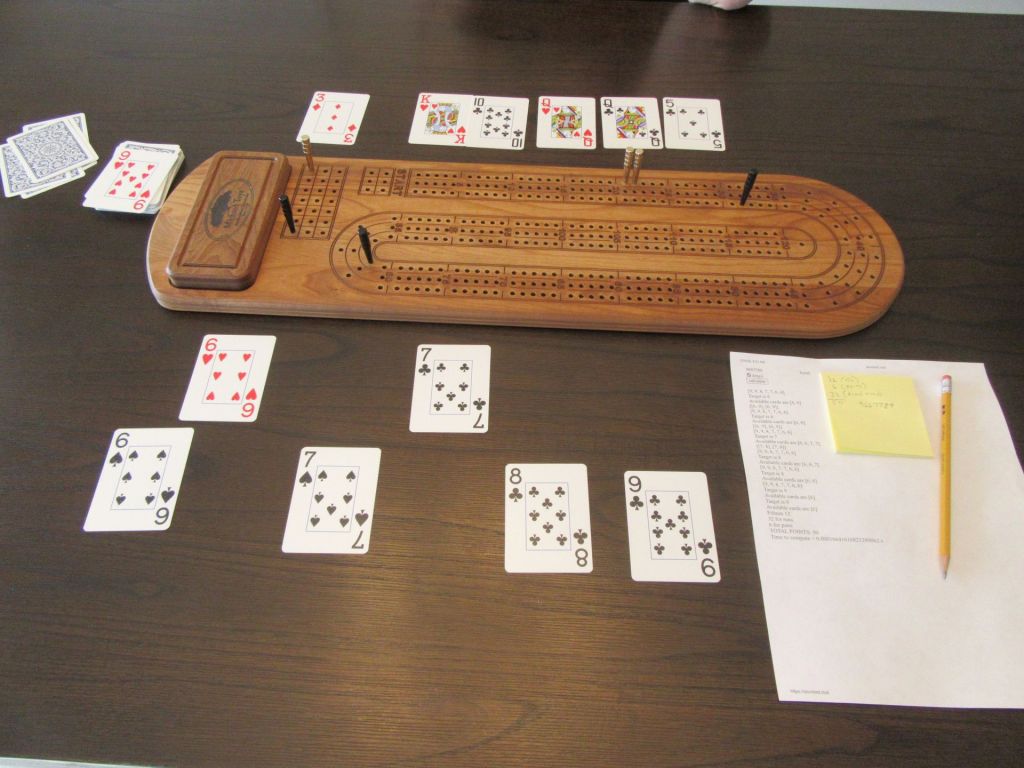
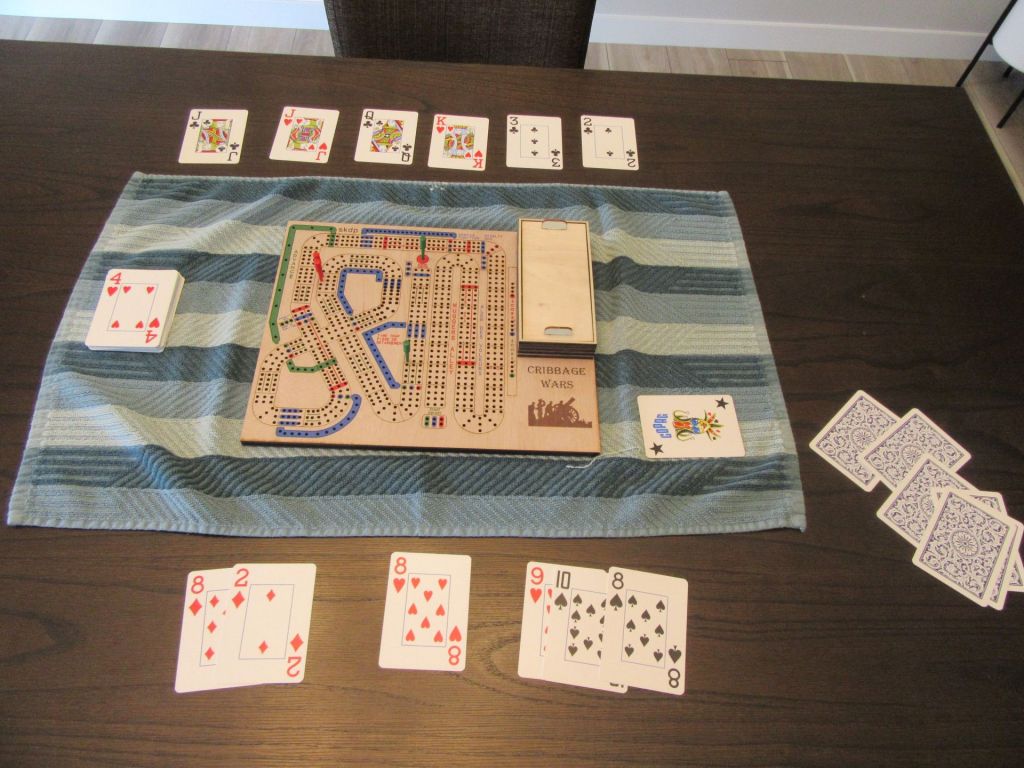
Counting the 50 points for runs was the most difficult part. There were eight different 4 card runs and spreading them out in the offset way shown in the picture made it easier to count them (32 points worth). There was 12 points for 15 for 2s and 6 points for the pairs. Adding the points for the runs, 15s, and pairs made 50. The photos compare the wide 50 point spread between my two black pegs before and after the move.
Before pegging the 50 pointsAfter pegging the 50 points
Sena’s been after me for weeks to play 9 card cribbage, so because it’s St. Patrick’s Day, I gave in because we might get lucky and the game might be playable.
We used a computer scorer developed by somebody who posted about 9 card cribbage (and other cribbage variants) and has a link to a program he developed to help with scoring: skunked.club. I found this on a reddit thread.
We got so involved and had so much fun, we lost track of time and couldn’t film the last hand because there wasn’t enough space on the memory card. We used the scorer to check our counts and it was helpful. Sena won!
Here we go again! Hybrid competitions are the rule around here lately and the news flash today is that Sena won the hybrid 9 card cribbage and crib wars game today, which took an hour and a half to play.
9 card cribbage & Crib Wars and Sena wins again!Sena is modest!
Just as an aside, I used the word “hybrid” because yesterday I just found out about the hybrid Chess Boxing sport in which opponents box for 3 minutes alternating with 3 minutes of blitz chess (fast paced chess game you have to finish in 10 minutes). Figure that one out; I would think that repeated blows to the head would do something not so good for your chess playing skills, but whatever.
So, the assumption here with hybrid 9-card cribbage and crib wars is that the higher than usual cribbage hand and crib scores you get help speed you past the crib wars obstacles like the Blue Time Traps and the Blue Penalty Boxes. However, by the same token you’d probably miss out on the Green Advance zones too—but would that even matter?
Briefly, the rules of 9 card cribbage are that each player is dealt 9 cards, both toss 3 cards to the dealer’s crib, and then you sweat the scoring of both. We tried scoring by hand first, and if we got stuck, we used the scoring program I found on a Reddit thread. We didn’t do too badly and sometimes we didn’t need the scorer. We got scores as high as 38, 28, and 26. If nothing else, the 9-card cribbage variant helps your ability to hand count your scores, something I think computer cribbage apps might not be helpful for.
Anyway, I thought the 9-card game might take even longer than the 3-hour game we had yesterday with the 7-card cribbage and crib wars game. But for some reason it didn’t, even with the running back and forth to run the scoring program. I suspect that’s largely from practice effect although we’ve played crib wars only 3 times (played 6-card, 7-card, and now 9-card variants).
While we did speed past the crib wars board hazards, we also missed the reward zones (Green Advance) as well. It felt more like a long regular cribbage game. And it could turn out the opposite way although you’d probably get out of the hazard zones more quickly. But I think that would tend to make crib wars less fun, because it’s a hybrid game. It’s both a board game and a cribbage game. Some people classify cribbage itself as a board game, but that’s a misnomer because the board is just for keeping score.
You have to use a different strategy in crib wars than you’d use in a straight-up cribbage game. Maybe that’s part of the reason why I’ve lost all 3 crib wars games so far. Nah, Sena is just good.
All morning long today we played the oddball cribbage variants and we are wiped out! It’ll drive me to drink!
Sena is to blame for this. She “suggested” we play all 4 of the new multi-card weird cribbage variants we learned just in the last few days: 7-card, 8-card, 9-card, and 10-card. What did we learn from this? We learned one of the reasons why 6-card cribbage is the American Cribbage Congress (ACC) choice for their big grand national tournaments. Talk about needing to be able to play a cribbage in 15 minutes!
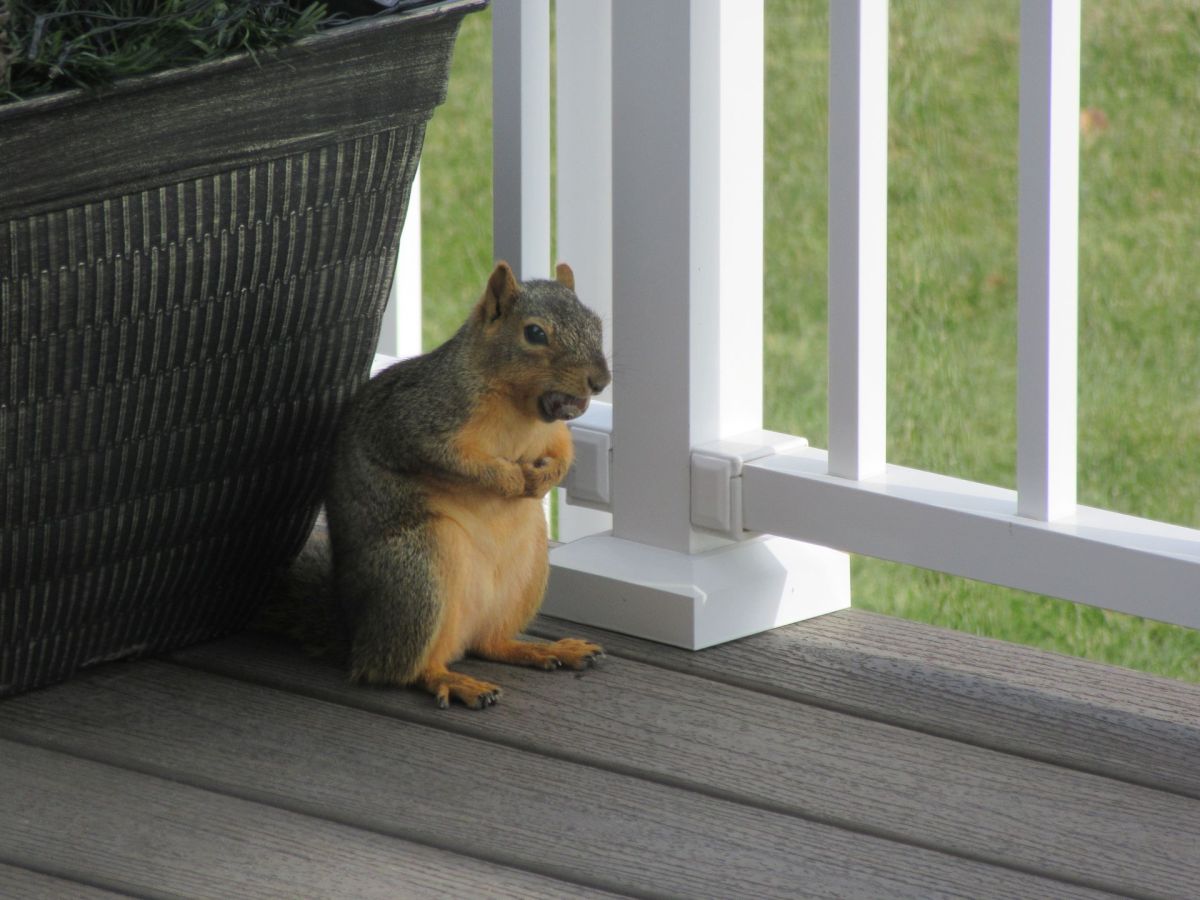
I won the 7, 8, and 9 card games and Sena won the 10-card game. We caught a squirrel on camera watching us who seemed catatonic probably because it couldn’t fathom why two people would subject themselves to this mind-bending ordeal.
You can spend an hour just trying to figure out your score for one hand in 9-card cribbage. If we had not had that cribbage scorer I found from a guy on a Reddit cribbage thread, we would not have been able to manage scoring a couple our hands. I know I said it didn’t work consistently—but it works well enough when you’re faced with scores as high as 36 and more! According to AI, the most common scores in 6-card cribbage are 4 and 2. Most cribbage scorers available on line or for smartphones are designed for 6-card cribbage, meaning you can’t enter more than 4 cards for the hand and one for the starter.
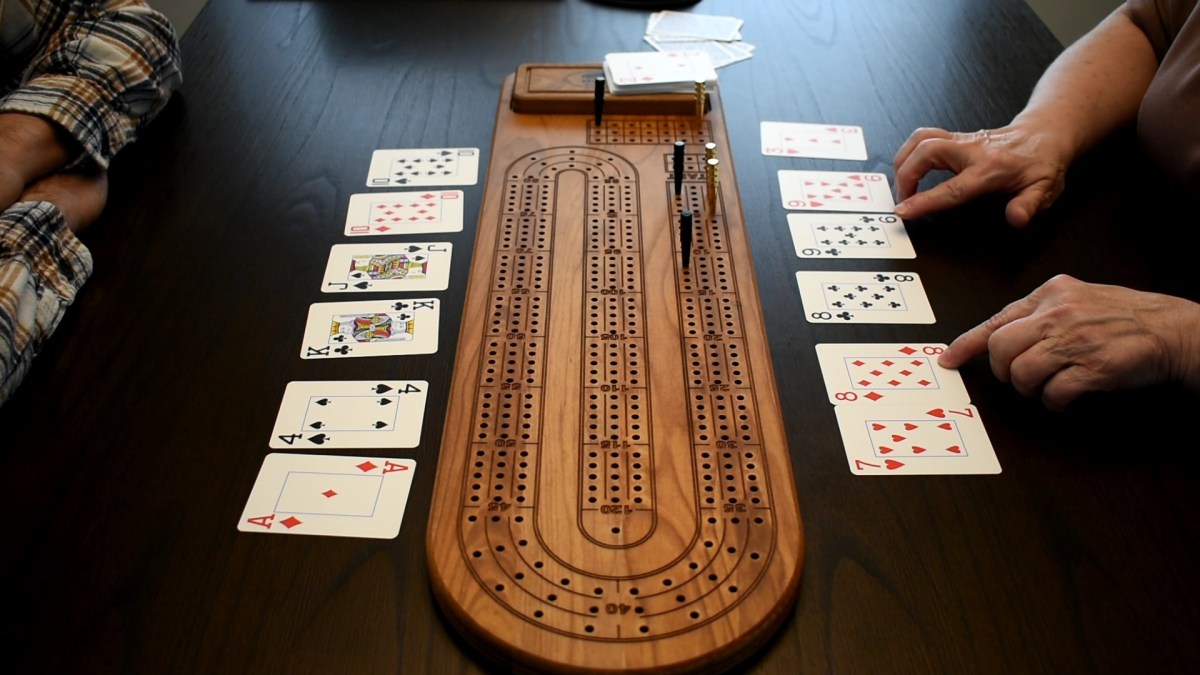
9 card cribbage hands
Thank goodness there is no information on the web for the rules of 11-card and 13-card cribbage, despite the ACC saying they are two of the many cribbage variations. If anybody asks me, “But Jim, what about the 12-card cribbage variant?” I will politely change the subject and talk about catatonic squirrels.
Sena is starting to warm up to the 8-card variant, although I’m doing my best to ignore her. It’s amazing the 10-card game is actually faster than the others and the hands are easier to count.
The only reason to play the 9-card variant is if you are tired of living. There should be a public service announcement about this game warning of the need for supplemental oxygen and K-rations because you won’t have time to do anything but mumble through the endless scoring rituals.
“OK, how many 15s for 2 do you see?”
“ZZZZZ…”
I would not play any of these variants past the 121 hole on a standard board, if you value your sanity. We agreed to play them that way. If you can’t persuade your spouse, friend, or catatonic squirrel to do that, you should consider resorting to thumb-wrestling, best 2 out of 3 falls. Seriously, playing 9-card cribbage to 363 should be considered a health hazard.
Short List of the Oddball Cribbage Variants with rules and comments (all are presumed to be for 2 players):
7-card: Deal 7 cards to each player, one to the dealer’s crib. Then look at your cards and throw 2 more cards to the dealer’s crib. There should be 5 cards in the crib and 5 cards in each player’s hand. The starter card makes 6 cards for your hand. Flushes are allowed: 4, 5, and 6 card flushes are allowed. In 4 and 5 card flushes all the cards should be in your hand. The highest score is 46 (4,4,5,6,6). I think this game has the smoothest play, but there will be hands that are difficult to score. There are 8 three-card runs for 24 points, 8 fifteens for 2 for 16 points, and 3 pairs for 6 points. Note, I found out the hard way that I can’t use the double run rule to count the runs and the pairs together to come up with the 30 points you have in pairs and 3-card runs. I missed two 3-card runs (6 points) and I could find them only by taking pictures of the double run counts including the pairs. In order to avoid missing them, it’s best to count all the runs and all the pairs separately and add them. Then add the 15 for 2 points (16).
8-card: Deal 8 cards to each player and each throw two cards to the dealer’s crib. Choose 4 cards to keep and two to the bottom of the deck. Each player then has 4 cards in their hands and uses the starter card to score with their hands. Play standard cribbage as usual to 121. This felt a little clunky at first, but you get used to it.
9-card: Carefully consider whether you really want to torture yourself with this variant—then go ahead and deal 9 cards to each player and throw 3 cards to the dealer’s crib. Play to 121. Scores will be high and challenging to count. There is one scoring program available which seems to work OK. I couldn’t put in J for Jack and make it work, but other initials like K for King seem to work. Numbers alone work best. Get the link from the Reddit thread:
10-card: This one is fun. Deal 10 cards each and two to the dealer’s crib. Divide your remaining 8 cards into 2 separate 4 card hands. Use one for pegging and both for the show (means scoring your hands). Play to 121. You get big scores but they’re more manageable.
OK, so Sena and I have been experimenting with a few cribbage variants in the last few days and I ran into this Calvinball comment on a Reddit cribbage thread about 10-card cribbage. Yes, people play that! I’m afraid to look on the web for 11-card cribbage although Sena asked about it.
Briefly, 10-card cribbage is usually a two-player game. Deal 10 cards each; 2 cards from each player go to the dealer’s crib; each player divides the remaining 8 cards into 2 four card hands, one for pegging and either one or both for the show.
As an aside, the Reddit thread person who started the thread about 10 card cribbage asked if anyone else ever played it. One commenter facetiously replied “Yes, there have been many many posts of Calvinball crib.”
You have to know where that term “Calvinball” comes from. I’m pretty sure it’s from another social media forum which plays a game called Calvinball—which is a whimsical, forever evolving game which has nothing to do with playing cards, is based on the comic Calvin & Hobbes and has no real rules whatsoever. Participants make it up as they go along. So, I think what the commenter might have meant was that 10-card cribbage is yet another of the many proliferating variants (some better than others) of the more well-established game, usually identified as 6-card cribbage.
Anyway, we found out later that there are two sets of rules for 10-card cribbage. The intent is to make the game play faster and yield higher scores.
Given that context, we played it both ways to 121. In the one set according to AI, you deal each player 10 cards and both throw 2 cards to the dealer’s crib. Each player divides the remaining cards into hands of 4 cards each. You play one hand only during the pegging phase and the other for the show (scoring the hand). It was pretty slow and didn’t yield high scores, partly because we used only the four card hand for the show.
And then there’s a Wikipedia article which says you peg with one hand and score both for the show. We got higher scores all around, the game was faster, and we both enjoyed it much more.
As a reminder follow up to the post about the 9-card and 8-card cribbage games, Sena still likes the 9-card variant but doesn’t care for the 8-card (neither do I) because it seems clunkier, probably because you need to bury cards under the deck. The 9-card variant has an on-line scorer which didn’t work consistently. We seemed to fare pretty well without it for the most part. The suggestion to play to 323 (up, back, and there again on a 121-hole board) seems like overkill. I’m retired but not that retired.





 Go Retire Psychiatrist