Facial Hair and the Masked Worker

I’ve seen the news warning us about how facial hair can interfere with the N95 respirator mask seal. It’s connected with the concerns about the novel coronavirus which you no doubt have heard unless you live under a rock. The Centers for Disease Control (CDC) reiterated their warning about how certain beard and mustache styles can interfere with the recommended mask for helping protect you from infection.

As a health care worker, I’m required to be fit tested annually for the N95 respirator mask. “Fit” is not an acronym, by the way; it just refers to how well the mask fits. It’s a twenty-minute test in which a technician or nurse uses a special machine to check for how tight the seal is around the mask in order to ensure protection from airborne particles, including viruses.

I passed my fit test.

I saw the graphic yesterday of all the different facial hair styles that pass muster—most of them don’t. I’ve never heard of half of them. Believe it or not, I didn’t know that little tuft of hair under my lower lip is called a “soul patch.” I guess maybe I’m the one who’s been living under a rock.

I’ve read that some experts think that any facial hair is bad and recommend that you have to be clean shaven. I think some places won’t even allow fit testing on anyone who has facial hair.

However, I found a PubMed study published in the latter part of 2018 which showed that you can pass a fit test “even with substantial facial hair in the face seal area;” the abstract is below:

Floyd, E. L., et al. (2018). “Influence of facial hair length, coarseness, and areal density on seal leakage of a tight-fitting half-face respirator.” J Occup Environ Hyg 15(4): 334-340.

                BACKGROUND: OSHA regulations state that an employer shall not permit tight-fitting respirators to be worn by employees who have facial hair that comes between the skin and facepiece seal. Studies have shown that facial hair in the face seal zone can increase penetration and decrease the fit factor (FF), although the relationship between the amount and characteristics of facial hair and the increase in penetration is not well quantified. This article examines the influence of facial hair length, areal density, and coarseness on FF for one model of half-face elastomeric negative-pressure air purifying respirator. APPROACH: Quantitative fit tests (QNFT) were performed on 19 subjects with beards initially 0.500-in long and subsequently trimmed to 0.250, 0.125, and 0.063 in, then after a razor shave. Three fit tests were performed at each of the 5 lengths, for 285 total tests. The average diameter and areal density of cheek and chin hair were measured. Penetration was modeled as a function of hair length category, beard areal density, and hair coarseness. RESULTS: FF decreased with beard length, especially beyond 0.125 in. However, passing FF scores were achieved on all tests by all subjects at the smooth shave and 0.063 in conditions, and 98% of tests were passed at 0.125 in; seven subjects passed all tests at all conditions. Chin and cheek areal densities were significantly different and were only weakly correlated. Beard hair diameters were normally distributed across subjects (mean 76 microm, standard deviation 7.4 microm). Beard length and areal density, but not coarseness, were statistically significant predictors of fit using an arcsine transformed penetration model. FF decreased with increasing beard length, especially beyond 0.125 in, although FF with a “stubble” beard did not differ significantly from a smooth shave. FF also decreased with increasing areal beard hair density. CONCLUSION: Beard length and areal density negatively influence FF. However, tight-fitting half-face negative-pressure respirator fit tests can achieve adequate fit factor scores even with substantial facial hair in the face seal area.

I generally have a stubble circle beard. When I don’t use the stubble guard on my trimmer for a while, I supposed my chin whiskers could lead to what some have called the “goatee leak.”

The CDC web site posted a funny article in 2017 on their web site entitled, “To Beard or not to Beard? That’s a good Question!” That facial hair chart is in the article. They also remind you check your mask seal every time you use it, no matter what your facial hair status is.

There’s a pretty funny YouTube video about this issue. The title is “The Bearded Guide to N95 Respirator Fit Testing.” My video is below.

Jumbo Cribbage Board Antics

Well, Sena and I played the official inaugural cribbage game on our new Jumbo Crib board from Ontario. That was a belated Valentine Day’s gift for us which Sena is only too happy to remind me about; but that’s OK, I deserve a little ribbing. You can get a sample of that from watching the video.

We have to stretch a bit more to reach across the table and the 8-inch-wide board. That’s good exercise. The 2-inch-tall pegs have a pleasing heft to them.

Making the video for our cribbage games is a big challenge. I think one of the best reasons for doing it is that we learn from our mistakes by watching them. We’re still rookies. It took us all day just to shoot a decent video—although it was fun to play. I’m pretty sure players out there will spot errors. Let us know what they are!

I just happened to come across an old newspaper article about a guy named Frank Lake who was a Grand Champion level player years ago. When the journalist interviewed him, he was around 83 years old—that was in 2005. Frank said that cribbage is “85% luck and 15% smarts.”

We think there has got to be more skill involved than that. Somebody once said that cribbage is a game which takes a few minutes to learn but a lifetime to master. At my rate, it’ll take more years than I have left in my lifetime just to learn.

Each game is different. In a two-hander, each player gets only 6 cards. The non-dealer ends up with only 4 after dropping two into the dealer’s crib. We take about 30 minutes to play a game, which is about half the time we took when we first started playing. I’ve read that you really can’t expect to play at the tournament level unless you can finish a game in 15 minutes. I doubt we’ll ever get there.

The Jumbo is the fourth cribbage board in our small collection. Frank Lake accumulated quite a few cribbage boards in his career, some of them trophies. I think he owned a collection of around twenty of them. One of them was in the shape of the state of Oregon. Hmmm…

The Geezer is Redeemed

Well, as far as this tardy Valentine’s Day gift is concerned, the Geezer is redeemed. The answer to the riddle in the 2/18/2020 post “I’m Late for Valentine’s Day” is a new Jumbo cribbage board (the Jumbo Crib).

This is the gift I forgot to order for our Valentine’s Day, which was a Canadian Hard Maple cribbage board. It arrived today from Ontario. It was shipped only this past Tuesday, so we were pleasantly surprised (almost shocked) that it arrived so quickly. It’s really big compared to our other cribbage boards.

The clues in the post a couple of days included a picture of us in rain gear at Niagara Falls, taken about 5 years ago. The picture of a bed of flowers in the shape of a Maple leaf with a bunch of falling Maple leaves was taken in Canada, just across the border.

Sena keeps telling me that she told me to order the board, but I honestly don’t remember her telling me that.

The board is made by Michaud Toys, a small, family-owned craft shop in Ontario not that far from the Niagara area. They are well-known for making excellent wooden toys, games, and puzzle boxes. They believe in family game night, which for me and Sena is almost every night.

I ordered it on Valentine’s Day, which was just last Friday. It shipped the very next Tuesday and we got it this morning.

It came with a nice storage bag, some metal pegs (2 inches long), a deck of cards, and a set of very accurate rules. It’s 27 ½” long and 8” wide. It’s great fun to play on.

Wow!

It has a handy little cubby on the board which can hold the card deck, pegs, and rule booklet. This is covered by a cap which fits snugly over the hole and is secured by “powerful rare earth magnets.” They work. I can turn the board upside down and shake it—nothing pops out.

Jumbo Crib stuff

The rare earth magnets remind me of the 1970s soul music band, Rare Earth. I went to one of their concerts when I was a teenager and it was so loud that I think I suffered some mild but permanent hearing loss.

Maybe that’s why I didn’t hear Sena when she told me to order the cribbage board. Anyway, we’re celebrating!

I’m Late for Valentine’s Day

I’m a little late for Valentine’s Day, but you could give me a break because I’ve been a little busy being retired. Don’t throw things at me because I’m getting too old to duck. And I did get my wife a card, flowers, and some candy on time.

It was something else I forgot. It’ll take a few days before I can tell you what it was.

We made a Valentine’s Day wish by breaking a chicken wishbone the other day. I believe that was before Valentine’s Day. In fact, it was about a week prior.

I don’t know if there are any rules about how to you’re supposed to hold the wishbone. Some will probably say our technique was poor when they see the video.

I think if you talk about what you wish for, you’re liable to break the spell and you won’t get what you wish for. I believe you’re allowed to hint, though. Pay close attention to the video.

Happy late Valentine’s Day!

Milestones

I got a nice, if puzzling surprise today. At a faculty meeting I was recognized for my 10-year anniversary of service at our hospital. It’s an important milestone, even if it is wrong. They scheduled this small event a couple of months ago, but I was too busy on the psychiatry consult service to break away. I also usually carry the pager for the trainees during the noon hour when the faculty meetings are held.

The 10-year anniversary recognition was very kind—except that I’ve been here for twenty odd years, not counting residency and medical school.

In all fairness, my department knows that and we shared a few jokes about it. I guess I should clarify that I have left the university for private practice a couple of times, which interrupts the years of service recognition timelines.

I was gone both times for a total of less than 12 months—just sayin’. I returned for a few reasons, although mainly because I missed teaching.

Anyway, I showed up at the faculty meeting, albeit a little guilty looking because I’m usually too busy to attend. My department chair arrived and said that she had to run back to get my “statue.”

That jarred me. Several years ago, when I had my first blog, The Practical Consultation-Liaison (C-L) Psychiatrist, I used to kid my readers that someday a statue of me would be erected in the university Quad. It would be made of Play-Doh.

And that’s why I asked her as she turned to leave, “Is it made of Play-Doh?” She looked puzzled and I didn’t really think I could explain in a way that wouldn’t make me look like I’d been smoking something illegal.

The “statue” is a handsome little sculpture of the number 10, standing for 10 years of service. It has color photos embedded in it of various aspects of academic life at the University of Iowa, many of which I’ve had the privilege of enjoying in the 30 odd years my wife, Sena, and I have been in Iowa City.

Just before the meeting, I had walked up to the 8th floor (I always take the stairs) to the psychiatry department offices to see if I could get a copy of the recently published history of the department, Psychiatry at Iowa: The Shaping of a Discipline: A History of Service, Science, and Education, written by James Bass.

Mr. Bass interviewed many people in the department, including me. I didn’t expect that my perspective on the consultation service, the clinical track, or my race would even get mentioned. However, 2 out of 3 made it into print.

It didn’t really surprise me that my being African American was not mentioned. I think I’m probably the only African American faculty member of the department in its 100-year history, at least until very recently.

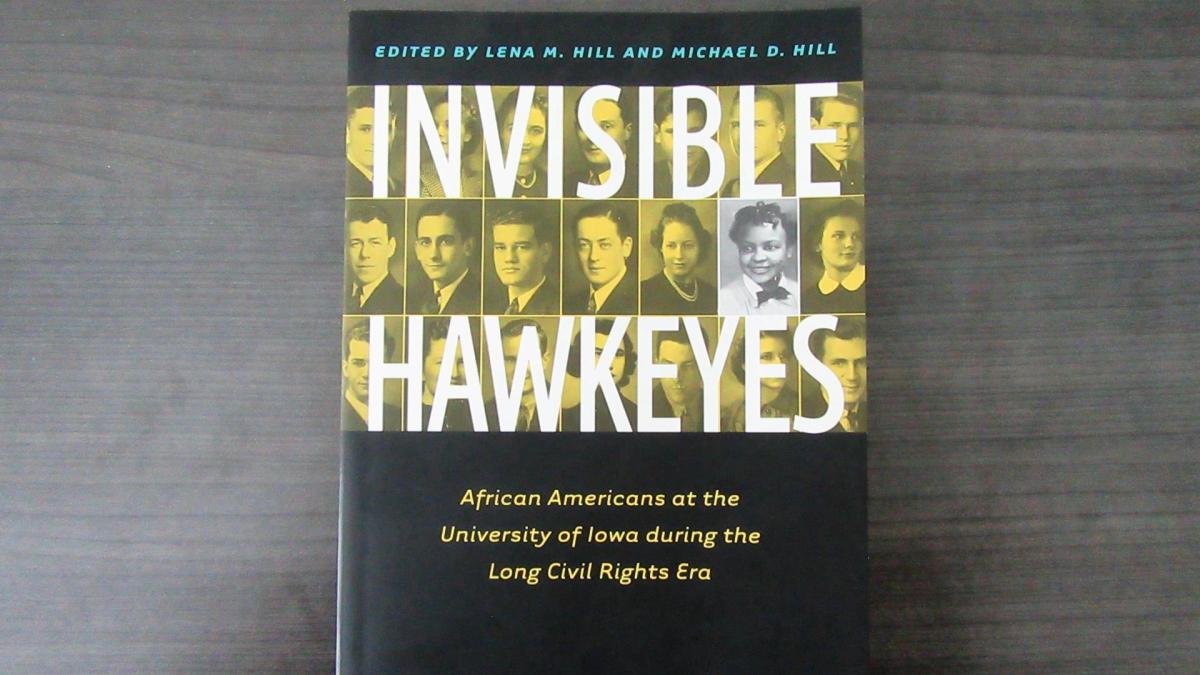
It reminded me of another book that I just acquired, Invisible Hawkeyes: African Americans at the University of Iowa during the Long Civil Rights Era, edited by Lena M. Hill and Michael D. Hill.

In a small way, I’m making the invisible visible.

Making the invisible visible

And also, because it’s great for my ego, I’m going to quote what Bass wrote about me in Chapter 5, The New Path of George Winokur, 1971-1990:

“If in Iowa’s Department of Psychiatry there is an essential example of the consultation-liaison psychiatrist, it would be Dr. James Amos. A true in-the-trenches clinician and teacher, Amos’s potential was first spotted by George Winokur and then cultivated by Winokur’s successor, Bob Robinson. Robinson initially sought a research gene in Amos, but, as Amos would be the first to state, clinical work—not research—would be Amos’s true calling. With Russell Noyes, before Noyes’ retirement in 2002, Amos ran the UIHC psychiatry consultation service and then continued on, heroically serving an 811-bed hospital. In 2010 he would edit a book with Robinson entitled Psychosomatic Medicine: An Introduction to Consultation-Liaison Psychiatry.” (Bass, J. (2019). Psychiatry at Iowa: A History of Service, Science, and Education. Iowa City, Iowa, The University of Iowa Department of Psychiatry).

In chapter 6 (Robert G. Robinson and the Widening of Basic Science, 1990-2011), he mentions my name in the context of being one of the first clinical track faculty in the department. In some ways, breaking ground as a clinical track faculty was probably harder than being the only African American faculty member in the department.

As retirement approaches this coming June, I look back at what others and I worked together to accomplish within consultation-liaison psychiatry. The challenges were best described by a former President of the Academy of Consultation-Liaison Psychiatry, Thomas Hackett (this quote I helped find for James Bass and anyone can view it on the Internet Archive):

“A distinction must be made between a consultation service and a consultation liaison service.  A consultation service is a rescue squad.  It responds to requests from other services for help with the diagnosis, treatment, or disposition of perplexing patients.  At worst, consultation work is nothing more than a brief foray into the territory of another service, usually ending with a note written in the chart outlining a plan of action.  The actual intervention is left to the consultee.  Like a volunteer firefighter, a consultant puts out the blaze and then returns home.  Like a volunteer fire brigade, a consultation service seldom has the time or manpower to set up fire prevention programs or to educate the citizenry about fireproofing.  A consultation service is the most common type of psychiatric-medical interface found in departments of psychiatry around the United States today.

A liaison service requires manpower, money, and motivation.  Sufficient personnel are necessary to allow the psychiatric consultant time to perform services other than simply interviewing troublesome patients in the area assigned.  He must be able to attend rounds, discuss patients individually with house officers, and hold teaching sessions for nurses. Liaison work is further distinguished from consultation activity in that patients are seen at the discretion of the psychiatric consultant as well as the referring physician.  Because the consultant attends social service rounds with the house officers, he is able to spot potential psychiatric problems.”— Hackett, T. P., MD (1978). Beginnings: liaison psychiatry in a general hospital. Massachusetts General Hospital: Handbook of general hospital psychiatry. T. P. Hackett, MD and N. H. Cassem, MD. St. Louis, Missouri, The C.V. Mosby Company: 1-14.

I have what seems like precious few mementos of my sojourn here in the department and, indeed, on this earth. I have a toy fireman’s helmet I found hanging in a plastic sack on my office doorknob one day. It was a gift from a Family Medicine resident who rotated on the consult service and who learned why I called it a fire brigade.

For the same reason, I have a toy fire truck, sent to me by a New York psychoanalyst who was also a blogger.

I have Bumpy the Bipolar Bear, believe or not, sent to me by psychiatrist, Dr. Igor Galynker, about whose emergency room suicide risk assessment method I had blogged about several years ago. C-L psychiatrists do a lot of suicide risk assessments in the hospital and the clinics. I still have the box with the address to me:

WordPress

Attn: James Amos

200 Hawkins Drive

Iowa City, IA 52242

I have my first homemade handbook for C-L Psychiatry and the published handbook that eventually replaced it. Thank goodness the leaders of the Academy of Consultation-Liaison Psychiatry listened to the membership and changed the name from Psychosomatic Medicine to C-L Psychiatry.

I have an award for being an excellent clinical coach.

And I have my little camp stool, which a colleague who is a surgeon and emergency medicine physician gave me and which allows me to sit with my patients anywhere in the hospital, so that I don’t have to stand over them.

It will all fit in a cardboard box on my last day—the next milestone.

29 Cribbage Board Antics

After a lot of encouragement from Sena, we got the 29-cribbage board. It’s a novelty board shaped like the very rare perfect 29 cribbage hand. You’re more likely to spot aliens in your back yard than to get a 29 hand—the odds are 1 in 216,580. See our 29 cribbage board antics in our YouTube video.

This is a follow up cribbage post, the most recent one being “Kitchen Table Cribbage” featuring our other new board, which was a v-tournament model.

We have a lot of fun playing cribbage and making the videos are a challenge, given that we’re still learning how to play. If we wait for the perfect video (meaning one without mistakes), it would be similar to waiting for the perfect 29 hand to show up.

On the cribbagecorner web site, there are interesting facts about the 29 hand probabilities. According to them, given the assumption that there’s a cribbage tournament somewhere in the United States almost daily, you should expect to see one 29 hand a year during tournament play.

One the other hand, there are many cribbage games, including kitchen table versions, occurring daily between commoners like us. Who knows how many 29 hands show up in all those unofficial competitions?

We’re not shy about comments from cribbage players helping us develop our skills. I suppose another way to do that would be to join a cribbage club. The American Cribbage Congress (ACC) sponsors the ACC Grass Roots organizations which has about 200 such clubs across North America.

Players in the ACC Grass Roots clubs compete to earn points for awards including being crowned champion and for getting 29 hand. There is one ACC Grass Roots club in Iowa and it’s in Ankeny. It’s called the Capital City 9-game club (given that most club members get together to play 9 games about once a week or so).

Just for the record, the capital city of Iowa is Des Moines. Ankeny is about 13 miles north of there. If we were to join the Capital City club, that would mean about a 2-hour drive from Iowa City. Since the season runs from September to May, we’d be driving in winter weather conditions sometimes.

If you earn enough lifetime milestone points in the ACC Grass Roots club, you can earn a trip to big tournaments such as the annual ACC Tournament of Champions, usually held in Reno, Nevada. However, the ACC announcement says the 2020 Grand National tournament XXXIX will be in Sacramento from September 22-27, 2020. The first-place trophy is a gold pan. The last time anybody from Iowa won it was in 1990. He was from Des Moines.

The obvious question is why isn’t there an ACC Grass Roots club in Iowa City? I don’t know if there is enough interest, frankly. I did see a small 29 cribbage board at a local hobby shop here. It fit in the palm of my hand. The one we just got works out better for us.

I just found out that National Cribbage Day is celebrated annually on February 10, which is just around the corner! February 10 happens to be the birthday of Sir John Suckling, the creator of cribbage in the early 17th century. He was also a poet. According to the Poetry Foundation web page for him, his poetry showed him to be a cynical party animal, womanizer, and gambler. He invented cribbage from an earlier game called Noddy and it was gambling game. I gather it’s still the only game that can be play in an English pub for money. Cribbage came to American with the first English settlers.

Can you tell we really like playing cribbage? Please, no wagering.

Market to Market Memories

I’m a fan of Iowa Public Television (IPT) and I recall watching the show Market to Market, a show which I knew nothing about because it dealt with agriculture. Not everybody who lives in Iowa is a farmer, you know. I remember the days when Chet Randolph was the host. He had a wonderfully deep, resonant voice, a focused yet congenial manner when interviewing guests—and his left ear stuck out.

It was a show for farmers and there were two main reasons I watched it. I enjoyed listening to Chet (even though I never understood a single thing he said), and listening to the snippet of the catchy tune which introduced and closed the show.

It was years before I found out that the tune was Buy For Me the Rain by the Nitty Gritty Dirt Band. The song came out in 1967 (Baby Boomer era) and it’s a love song that hints at mortality.

Chet started out in Mason City, Iowa as a farm news broadcaster and in his early days, he made part of his show an offer to do chores for farm families who otherwise would never have had the time to take a vacation. He spent about 16 years (1975-1990) hosting Market to Market back when it was first called Farm Digest in 1974. That’s just what I picked up about him on the web.

Even though I enjoyed Market to Market mainly for the homey, trustworthy, practical feeling I got from it, I just plain never followed the farm lingo.

I can give you my sense of it in this sample fictional broadcast:

Hello, I’m Chet Randolph and welcome to yet another incomprehensible edition of Farm Digest; oops, I mean Market to Market, in which I talk rings around topics like corn and soybean markets and how that affects your horoscopes. Today our guest is Ernie J. Kudzuclamper representing Beans R Us CO-OP. How the hell are you, Ernie?

Ernie: Hay muchos libros en la biblioteca. Sorry; I mean, I’d be a darn sight better, Chet, if the sowbelly futures were trending up like they would if the Mariana Trench weren’t so full of plastic bottles and pastel pampers.

Chet: I couldn’t agree more, Ernie. It makes my left ear stick out even farther than usual when I think of the Dumbo Octopus population overcome by anxiety about that and the new restrictions on silo height. Moving right along, what do you think of the fungus market so far?

Ernie: Well, Chet, I’d be inclined to be leaning toward but not too far, mind you, prices going through a teal-tinted wormhole on the way to higher prices in the 2 cent per bushel range—provided aliens reduce their tendency to get distracted into making fancy crop circles when they ought to be abducting  catchy tune earworms.

Chet: Good point, Ernie. That earworm has been spreading all over Iowa; seems like I hear the darn things every time our show starts. But we have to move along because I have this list of 500 issues that we have to discuss in the next half hour.

Ernie: Fine. Mind if I take a little dipping tobacco?

Chet: Go right ahead, I think there’s an old empty coffee can around here somewhere. Are you strong on spring wheat futures?

Ernie: I would be cautious about it for just a few seconds, or at least until I pass gas.

Chet: I’ll notify a technician to switch the fans up to high speed. I’ve been watching the chicken hindquarters market in the last few weeks and I’d like your opinion about whether anyone ever cleans out the cloacas on those things before they ship them.

Ernie: If I were a betting man, I’d put a few hundred bucks against, Chet. Why, just last week my whole family was in the emergency room with projectile vomiting and bloody diarrhea that drove all the nurses…

Chet: Moving right along, we should talk about the state legislature’s plan to actually pass a bill that would favor agricultural progress.

Ernie: Chet, I assume from the rhythmic wagging of your left ear that you’re referring to the bill to regulate cow tipping?

Chet: No, but go ahead, I’m easy.

Ernie: I think there’s a petition opposing it on the grounds of religious freedom, but I expect this bill to be signed by the governor because he signs everything put in front of him, even blank checks.

Chet: Strong words, coming from you, Ernie. Do you come from a long line of cow tippers?

Ernie:  Going back hundreds of generations, we’ve been tipping cows and I doubt there’s any regulation that will make an appreciable difference.

Chet: And just how do you do it, Ernie? Do you use a front-end loader? Cows tend to be pretty heavy.

Ernie: We learned the technique from Himalayan monks originally. Diligent practice allows you to tip a cow over with just one finger.

Chet: That’s how I learned to wag my left ear. Thanks, Ernie. And that’s a wrap for another edition of Market to Market, folks; thanks for watching.

I’m sure you get the same feeling I do.

The Iowa River Landing Sculpture Walk

I had so much fun with the giant chicken post on January 25, 2020 that I thought it would be nice to revisit the subject, only this time take a butt-freezing tour of the entire Iowa River Landing (IRL) Sculpture Walk.

We took the walk Tuesday, January 28, 2020. The weather was typical for Iowa in January. The temperature was in the teens and there were brief flurries. My wife, Sena, and I dressed warm and took a meandering journey through the Sculpture Walk, guided by a small map.

It was a little more challenging because snow and ice covered up many of the plaques identifying the works (and parts of the sculptures as well) although this lent even more visual interest to them. They’re three dimensional objects anyway and you really have to walk around them to fully appreciate their complexity. You have to watch out for yellow snow.

What made this adventure even more special was the Iowa Writers’ Library in the lobby of the Coralville Marriott Hotel and Conference Center. It’s maintained by the Coralville Public Library. One of the issues I had was being unfamiliar with the text of the poems and other literary works (all were connected with the Iowa Writers’ Workshop) referenced by the artists. The library was cozy, had a fireplace warming the softly lit room lined by bookshelves and a couple of ladders on wheels to help you reach the books higher up.

I have always felt comforted in libraries, ever since I was a little boy. Every day I got the chance, I would walk to my hometown library (which was about a mile trip), browse the stacks for hours, then tote home piles of books in both arms.

The hotel library had most of the books pertinent to the literary references cited by the artists for their sculptures. I even found David B. Axelrod’s book, The Man Who Fell in Love with a Chicken. It turns out that the title of Axelrod’s poem is “The Man Who Fell in Love with His Chicken.” There, I’ve said enough already about that chicken.

Of course, I couldn’t take the time to find and read every book; we would not have had time to freeze our butts off touring the sculptures.

I didn’t wear my heavy winter boots and had to crunch through the crusty snow nearly up to my ankles to reach certain sculptures. Sena was dressed better for the weather but we both slipped around on the ice and I began to think more and more about things like broken hips.

But we soldiered on because it was necessary to walk completely around the Made of Money sculpture by Aaron Wilson in order to see the message printed, “HOW CAN WE HELP YOU?” It’s funny because that’s what I typically ask patients in the general hospital when I sit down on my little camp stool after I introduce myself to them as a consultation-liaison psychiatrist.

The sculpture To Dorothy, by artist James Anthony Bearden, was in a difficult spot and initially we thought we’d have to either rappel down from the roof of the building it was in front of or climb up the big retaining walls to get a good look at it. We found a way out to it and ignored passersby who gawked at us. They needed to admire us for how unique we are (not how eccentric and possibly a danger to ourselves and others), which is what I think Iowa Poet Laureate Marvin Bell was getting at in his poem of the same title as Bearden’s sculpture.

The sculpture, A Thousand Acres, by artist V. Skip Willits was another piece you really have to walk around to fully appreciate, although you generally have to do that with any sculpture. The book of the same title by Jane Smiley is based on Shakespeare’s King Lear—which I have also never read—but which I got an earful about in my undergraduate days from a fellow student who thought he knew everything there was to know about King Lear. He was garrulous in the extreme and bested me in debating class mainly because he never let me open my mouth.

The sculpture by artist Victoria Ann Reed, called Convergence, was very intriguing and looked more like a human figure who had been through a wormhole than a memory.

The Tipping Point, by artist Sarah Deppe, was a convincing image of persons with holes in their heads (several holes in fact). Bureaucrats come to mind.

We nearly dismissed the sculpture called After Trillium by artist Anthony Castronovo as a broken lamppost with dysfunctional solar panels, only partly because snow and ice covered the panel describing it. On the other hand, the top part does resemble a flower called a Trillium, not to be confused with Trillian, a character in the book by Douglas Adams, The Ultimate Hitchhiker’s Guide to the Galaxy. I’m glad I could clear that up for you.

The Prairie Breeze Bench by artist Bounnak Thammavong is a sculpture you could actually sit on and watch the Bald Eagles. However, it’s made of steel and the seat was covered by snow. After you wipe away the Bald Eagle droppings, you can read the poem by James Hearst, “Landscape Iowa.” You can also hear it set to music and performed by Scott Cawelti, a former University of Northern Iowa educator who taught film, writing, and literature courses. He also edited The Complete Poetry of James Hearst (University of Iowa Press, 2001).

The Alidade sculpture by Dan Perry was the one Sena and I both really liked. I know Perry says the alidade was used by astronomers but I remember it as being a part of an instrument used by land surveyors, also for measuring distance and angles in topographical surveys. I used to work for consulting engineers as a surveyor’s assistance and draftsman many years ago. Perry links it to the poem entitled “1,2,3” from James Galvin’s book of poems, X: Poems. I confess I don’t see the connection yet. The poem for the most part reminds me of spelunking although Galvin describes a hole that he and a friend rappel into as being a planet. Much of the rest seems to be about something very painful. I’m sorry I can’t do better, but that’s why he’s a poet and I’m not.

Next, we encountered Bounnak Thammavong’s second sculpture, a very recognizable fish, a “lowly river carp,” entitled From the River. It’s linked to the poem “Where Water Comes Together with Other Water” by Raymond Carver. When I was a boy, I used to fish for bullhead in my hometown river. I sometimes caught carp and thought that was the poorer catch. It didn’t matter. I always threw both back into the river. My mom would not clean fish and neither would I.

Finally, by a pretty circuitous route, we saw the last sculpture, Gilead, by artist Kristin Garnant. The snow plow had piled up a lot of snow around it. I probably won’t read Gilead, the epistolary novel by Marilynne Robinson.

In fact, I probably won’t read a lot of the literature connected with the sculptures we saw. I did read Margaret Walker’s poem “For My people.” Sorry, Jubilee is way too much for me. She was the first African-American woman to be accepted into the Iowa Writers’ Workshop, of course depending on which story you believe about when the program formally began (Invisible Hawkeyes: African Americans at the University of Iowa during the Long Civil Rights Era, in Chapter Four: Obscured Traditions: Blacks at the Iowa Writers’ Workshop, 1940-1965, by Michael D. Hill, University of Iowa Press, 2016).

In some ways, I identify way with her, one of the reasons being obvious and skin-deep. The other is that she taught school at Jackson State, a historically black college in Jackson, Mississippi.

I wonder if the IRL Sculpture Walk could include another one for her, just to make it an even dozen?

I spent my Freshman and Sophomore college years at a historically black college. It was then called Huston-Tillotson College (now Huston-Tillotson University) in Austin, Texas. That was back in the mid-1970s. I had grown up in largely white neighborhoods and gone to predominantly white schools prior to going to H-TC. It was a culture shock and that’s probably about all I’ll say about it for now, since this post is way too long.

I can say one other thing about H-TC. I submitted a poem for the college’s annual poetry contest. Winners would have their work published in the school’s small anthology called Habari Gani (Swahili for What’s Going On?). Mine didn’t make it but years later I scoured the web looking for a way to get a copy of Habari Gani, finally succeeding only a few years ago after tracking a copy of the Spring 1975 volume down at the H-TU library. I like the short introductory poem:

“Let your hum be the dream

Of an understanding universe…

Let your hum be a perfect

Utopia of Love”

–Patricia Lloyd

A Giant Chicken

Last week, we were out at the Iowa River Landing (IRL) and saw a giant chicken. It’s actually a metal sculpture entitled Iowa Blue: The Urbane Chicken, 2013, one of 11 such works (all installed in 2013) of art making up the Iowa River Landing Sculpture Walk, located in the Coralville Marriott Hotel and Conference Center.

All of them are linked to literary works by authors associated with the Iowa Writers’ Workshop at the University of Iowa. The artist is Amber O’Harrow’s and her statement about the chicken is:

“I have created a sculpture of the noble chicken, as described in the poem by David B. Axelrod. The Iowa Blue Chicken is the only breed of chicken that was created in the state of Iowa and bred to survive Iowa’s harsh winters and its hot summers.”

The literary reference is to David B. Axelrod’s poem, The Man Who Fell in Love with a Chicken.

The chicken is made from cast aluminum and is taller than I am.

This set me off on an internet journey to find out more about the Iowa Blue chicken breed and Axelrod’s poem. It took a while, because there’s a lot to know.

If you’re a poultry enthusiast and an Iowan, then you know the story about the Iowa Blue Chicken Club (IBCC), not to be confused with the sandwich of the same name which doesn’t yet exist but should. The IBCC is an organization dedicated to making sure that the public at large realizes that the sculpture’s name is Betsy and that there is a big effort to get the breed recognized officially by the American Poultry Association (APA). So far, the APA has deferred, but the IBCC is not giving up.

The story of the origin of the Iowa Blue is somewhat apocryphal in that the breed was said to arise from the union of a White Leghorn (or Red depending on what you’ve been drinking) and a pheasant, which serves to explain the chestnut to striped colors of the feathers and certain behaviors of the chicks, which includes antics like crouching, fast fleeing, and something called “popping” which apparently means a kind of hopping which resembles popcorn popping. I gather this is typical for pheasant chicks.

Iowa Blue roosters will fight hawks, even slapping them with their wings and crowing challenges like “Have some of that!” or “You got something on your face, dude!” They’ll fight just about any critter: opossums, raccoons, snakes, rats, cats, congressmen.

Iowa Blue chickens are bred to thrive in Iowa’s harsh winters and oppressive summers. When the barnyard gets snowed in, they just grab little ergonomic shovels and scoop their way out—they just flip the bird at snow blowers.

Visit the IBCC web site to see photos of these beautiful birds.

Turning to Axelrod’s poem, The Man Who Fell in Love with a Chicken, the web search got a little complicated. For the longest time, I couldn’t find it. All I wanted to do was read it. Heck, you can look up Robert Frost’s The Road Not Taken in half a second at the Poetry Foundation web site.

I finally stumbled on it at a web site (the poetrydoctor) the owner of which I eventually found out was Axelrod himself! I found the chicken poem but the title was The Man Who Fell in Love with His Chicken. Now, I realize that even he says there are typos in the extremely long list of his works which you cannot search by the way, even though the author says there is a search box. The book of his poetry of the same name is 16 pages long and the title is The Man Who Fell in Love with a Chicken, which you can order through Amazon.

Interestingly, one publisher, Cross-Cultural Communications, says the book is “humorous poetry playing on poultry puns.”

This makes me wonder about O’Harrow’s description above including the phrase “…the noble chicken as described in the poem by David B. Axelrod.”

I can’t copy the poem here because that would be copyright violation (despite Axelrod’s making it available on his website—I guess he can do anything he wants with his own work). On the other hand, I think I can say that the poem does, in fact, contain several chicken puns and the man eventually does something to the chicken which is something less than noble and could involve lettuce, tomato, and possibly secret sauce.

The poem is dedicated to someone named Russell Edson, who I learned was called the “grandfather of the prose poem in America.” Edson wrote a few whimsical poems which could have been very much like Axelrod’s poem about the love affair with a chicken. One of them, Let Us Consider, was about a “farmer who makes his straw hat his sweetheart” and “an old woman who makes a floor lamp her son.” See the entry about him at the web site Poetry Foundation—where Axelrod entries can’t be found.

Well, that was my journey through the web about the Iowa Blue chicken sculpture. I’m next to clueless about chickens, unless their roasted, barbecued, fried, or what have you and I’m a terrible poet, as you can see from my video, Pseudobulbar Affect Top Ten—which somehow gets more views than almost anything else on my YouTube Channel.

My own poetry

Bridges: An Essay on MLK Day of Service 2020

The Martin Luther King Jr. Day of Service is today and the University of Iowa has taken a quote from King to set the tone each year for this event. This year it is:

“Let us build bridges rather than barriers, openness rather than walls. Rather than borders, let us look at distant horizons together in a spirit of acceptance, helpfulness, cooperation, peace, kindness and especially love.”—Dr. Martin Luther King, Jr.

Dr. Martin Luther King, Jr.

As I look back on my career in medicine, it’s only natural for me to think of my role as a consultation-liaison psychiatrist as a sort of bridge between medicine and psychiatry. I’m pretty sure most would agree that as I chased around the hospital up and down the stairs doing the 3 and 30 (3 miles and 30 floors; I never take the elevator), I was doing my level best to bring psychiatric care to the patients in the general hospital who were suffering from medical illness as well.

The featured image shows the cover of a little book of kind remembrances I received from colleagues and trainees when, during one of my two such lapses in good judgment, I left the University of Iowa to have a try at private practice. The book has an image of a bridge on it. At the time, I thought of it as a depiction of my path between academia and community psychiatry. We need bridges there too, although one person let me know that someone has to teach new doctors.

I also got a fancy birdhouse as a going-away gift. I still do some bird-watching.

As I head into retirement, I hope that I’ve been a bridge of sorts between the old ways and the new to the next generation of doctors. After all, I’m the institutional memory of psychiatry on the medical and surgical units, in a manner of speaking.

The Medical-Psychiatry Unit (MPU) at University of Iowa Hospitals & Clinics was where I learned how this ward of patients with both medical and psychiatric illness served as a bridge between the departments of psychiatry and medicine. My teachers were doctors who were and still are great leaders. I still recall Dr. Roger Kathol, MD, an internist who also trained in psychiatry, and who designed and started the MPU decades ago, gave readings during sit-down rounds in the unit conference room. He read passages from the works of Galen, the Greek physician, surgeon, and philosopher in the Roman Empire.

Dr. Kathol assigned to me a task one day, which was to give a short presentation the following day on hyponatremia and how to distinguish psychogenic polydipsia from the Syndrome of Inappropriate Antidiuretic Hormone (SIADH). That night I was on call and got 4 admissions on the unit, which was chaotic. One patient actually broke a bed. I didn’t get any sleep. I was up running around until we all sat down to discuss patients.

I struggled through presentations of the 4 patients I had admitted the night before. I could barely talk. I had actually looked up a little information for my assigned presentation on hyponatremia but I was sweating it because I could barely stay awake. I was not the first resident to have episodes of microsleep on rounds and I knew Dr. Kathol saw it happening to me. That was in the days of 32 hours of call. They don’t make trainees do that now.

Dr. Kathol gave me sort of a sidelong glance as we finished discussing patients, which was usually when trainees were expected to give short educational talks. That day, he skipped me.

I should mention that he thought the proper name for the MPU was the Complexity Intervention Unit (CIU), owing to not just the medical and psychiatric complexity of our patients, but also to their social environments and the U.S. payer system which often led to many having inadequate, dis-integrated health care, meaning that there was no bridge between psychiatric and medical illness treatment and split health insurance coverage even though research showed that mental illness definitely lessened quality of life and increased health care costs. He has his own company, aptly named Cartesian Solutions, and it’s a major organization dedicated to helping hospitals and clinics set up collaborative ways to bridge the needs of patients with comorbid psychiatric and medical illness.

The University of Iowa model for the MPU has been disseminated to a number of other hospitals in the country, one of them in Pennsylvania, which I mentioned in a previous post, “Brief News Item,” on May 23, 2019. I’ve just received word a couple of days ago from Dr. Kolin Good that the unit, called the Medical Complexity Unit (MCU), a name which bridges the underlying intent of MPU and CIU, has saved the hospital a great deal of money, has drastically cut the use of sitters doing one to one observation (an extremely expensive intervention), is treasured by patients, and popular with trainees. They are very proud of it and have every right to be so. They are bridge builders too.

Dr. Louis Kirchhoff has been one the most notable internal medicine co-attendings on the MPU. He’s an infectious disease specialist, but has a knack for communicating effectively with patients who are mentally and medically ill, even speaking fluent Spanish with some of them. He and I shared triage call to the MPU every other night before the triage system was changed to a more humane schedule. He was a bridge between internal medicine and psychiatry trainees rotating on the ward. He could explain psychiatry to the medicine residents as well as I could.

I have had a penchant for finding a chair to sit down when I interview patients in their hospital rooms. There are usually not enough chairs in the rooms. A few years ago, Dr. Tim Thomsen, a surgeon and Palliative Care Medicine specialist as well, lent me a camp stool which I carry around with me so that I’m never at a loss for a chair. Everyone likes it. I think the camp stool helps build an emotional bridge with patients.

The little chair

There are special combined specialty residencies at the University of Iowa Hospitals and Clinics which bridge Internal Medicine and Psychiatry and Family medicine and Psychiatry. Slowly but surely the siloed departments of academic medical centers are broadening their curricula and training regimens to rebuild the bridge between mind and body.

It’s been evolving for years. I’m proud to have played a small role in it. This is a place where teachers, researchers, and clinicians build bridges in many ways, foster openness, and search the “distant horizons in a spirit of acceptance, helpfulness, cooperation, peace, kindness and especially love.”