Thoughts on Long Covid

I read Dr. Ron Pies, MD’s essay today, “What Long COVID Can Teach Psychiatry—and Its Critics.” As usual, he made thought- provoking points about the disease concept in psychiatry. What I also found interesting was the connection he made with Long Covid, a debilitating illness. He cited someone else I know who was involved with a group assigned to create a working definition for it—Dr. E. Wes Ely, an intensive care unit physician at Vanderbilt University in Nashville, Tennessee.

I remember when I first encountered Dr. Ely, way back in 2011 when I was a consulting psychiatrist in the University of Iowa Health Care general hospital. I was blogging back then and mentioned a book he and Valerie Page and written, Delirium in Critical Care. Back then I sometimes read parts of it to trainees because I thought they were amusing:

“…there is a clearly expressed opinion about the role of psychiatrists. It’s in a section titled “Psychiatrists and delirium” in Chapter 9 and begins with the sentence, “Should we, or should we not, call the psychiatrist?” The authors ask the question “Can we replace them with a screening tool, and then use haloperidol freely?” The context for the following remarks is that Chapter 9 is about drug treatment of the symptoms and behaviors commonly associated with delirium.”

I would point out that the authors say, while acknowledging that the opinions of psychiatrists and intensivists might differ, “…we would advocate that a psychiatrist should be consulted for patients already under the care of a psychiatrist or on antipsychotic medications”. Usually, in most medical centers in the U.S.A. a general hospital consultation-liaison psychiatrist sees the delirious inpatient rather than the patient’s outpatient psychiatrist. And many delirious patients don’t have a previous formal history of psychiatric illness and so would not have been seeing an outpatient psychiatrist in the first place.” (Page, V. and E.W. Ely, Delirium in Critical Care: Core Critical Care. Core Critical Care, ed. A. Vuylsteke 2011, New York: Cambridge University Press).

I’m pretty sure I got an email from Wes shortly after I posted that, with his suggestion that I write more about the delirium research he was doing. He sent me several references. I met him in person at a meeting of the American Delirium Society later on and attended an internal medicine grand rounds he presented at UIHC in 2019, “A New Frontier in Critical Care Medicine: Saving the Injured Brain.” He’s also written a great book, “Every Deep-Drawn Breath.”

Anyway, Dr. Ely and others were tasked by the Administration for Strategic Preparedness and Response and the Office of the Assistant Secretary of Health in the Department of Health and Human Services tasked the National Academies of Sciences, Engineering, and Medicine (NASEM) with developing an improved definition for long Covid.

At first, I was puzzled by the creation of criteria that essentially defined Long Covid as a disease state which didn’t even necessitate a positive test for Covid in the history of patients who developed Long Covid. I then read the full essay by Family Medicine physician, Dr. Kirsti Malterud, MD, PhD, “Diagnosis—A Tool for Rational Action? A Critical View from Family Medicine.”

I was hung up on the dichotomy between physical illness and somatization and thought the Long Covid definition posed a dilemma because it purposely omits any need for an “objective” test to verify previous Covid infection, making the Long Covid diagnosis based completely on clinical grounds. The section on persistent oppositions (dichotomies) was helpful, especially the 2nd point on the dichotomy of the question of whether an illness is physical or psychological (p.28).

The point on how to transcend the dichotomy was well made. I guess it’s easy to forget how the body and mind are related when a consultation-liaison psychiatrist is called to evaluate somebody for “somatization.” Often that was the default question before I ever got to see the patient.

Still, the person suffering from Long Covid often doesn’t seem to have a consistently effective treatment and may stay unwell or even disabled for months or years. Social Security criteria for disability look well-established.

I can imagine that many persons with Long Covid might object to have their care transferred to psychiatric services alone. I can see why there are Long Covid clinics in several states. It’s difficult to tell how many and which ones have psychiatrists on staff. The University of Iowa calls its service the Post Covid Clinic and can refer to mental health and neuropsychology services. On the other hand, a recent study of how many Long Covid clinics are available and what they do for people showed it was difficult to ascertain what services they actually offered, concluding:

“We find that services offered at long COVID clinics at top hospitals in the US often include meeting with a team member and referrals to a wide range of specialists. The diversity in long COVID services offered parallels the diversity in long COVID symptoms, suggesting a need for better consensus in developing and delivering treatment.” (Haslam A, Prasad V. Long COVID clinics and services offered by top US hospitals: an empirical analysis of clinical options as of May 2023. BMC Health Serv Res. 2024 May 30;24(1):684. doi: 10.1186/s12913-024-11071-3. PMID: 38816726; PMCID: PMC11138016.)

I’m interested in seeing how and whether the new Long Covid definition will be widely adopted.
CDC ACIP Meeting Today on Covid-19 Vaccine

We watched the Covid-19 vaccine part of today’s meeting this morning. I thought it got off to sort of a rough start, mainly with technical difficulties. I can’t recall any other meetings in which the camera flipped back and forth oddly between speakers and their slides. I thought that was distracting.

The question-and-answer periods ran too long which put them behind schedule. One member of the original 8 committee members, Dr. Michael Ross, was missing from the CDC roster. There were news articles about his withdrawing after a review of financial holdings.

While most of the Covid-19 presentation was review, I thought it was too bad that ACIP Chair Dr. Martin Kulldorff announced there would be no vote on the Covid-19 vaccine today. He also said that the ACIP committee would look forward to the missing Evidence to Recommendations (EtR) material in the fall. Dr. Adam MacNeil, the presenter of the Covid-19 vaccine review, admitted that the EtR was not finished. I was not clear on why.

I didn’t really see the point of Dr. Kulldorff’s giving a rather long speech about why he was fired from Harvard after he refused to get the Covid-19 vaccine. I would much rather have heard him give details about his emphasis on the importance of conducting controlled trials (I think he meant placebo-controlled?) and posing this as a question to Dr. MacNeil. I think this is what led to Dr. MacNeil’s response which implied that they would take too long to produce actionable results (I might be putting words in his mouth but that’s my interpretation)—which could lead to saving more lives. It looked like a rather awkward moment.

Dr. MacNeil reviewed the FDA approval of using a JN.1 lineage vaccine at the VRBPAC meeting in May and also mentioned the FDA leadership preference for the LP.8.1 variant. I noticed the CDC variant genomic tracker today shows that the new kid on the block, NB.1.8.1, is now just as prevalent or more prevalent as LP.8.1. They’re both from the JN.1 lineage.

Some of the questions from the newly appointed committee members were over my head. But in all fairness, one of the members asked a question which not only I didn’t get but that Dr. MacNeil said he didn’t quite understand either.

So far, we’re planning to watch the influenza vaccine presentation tomorrow morning. I’m not sure why there’s a vote on thimerosal in the flu vaccine tomorrow but there was no vote on the Covid-19 vaccine today.

CDC Advisory Committee Meeting on Vaccines Starts Tomorrow

The CDC ADVISORY COMMITTEE ON IMMUNIZATION PRACTICES (ACIP) is scheduled to begin their meeting tomorrow at 10:00 AM ET despite US Senator Bill Cassidy’s recommendation that it be postponed due to concerns about the lack of experience of the committee members and because there is not yet confirmation of a new CDC Director.

In fact, the CDC Director nominee, Dr. Susan Monarez, of Wisconsin, is scheduled for her confirmation hearing at the same time as the start of the CDC ACIP meeting tomorrow morning at 10:00 AM ET. Dr. Monarez would be the first CDC director “…in decades…” (according to a report posted in The Hill in May) who has neither previously worked at the CDC “…nor obtained a Doctor of Medicine degree…”

As of this morning around 10:00 AM, the meeting agenda has not yet been finalized. So far, it looks like there will be no vote on the Covid-19 vaccine update, although there will be a vote on Thimerosal in flu vaccines about which the FDA has previously published an extensive summary.  

University of Minnesota CIDRAP Story on CDC ACIP Meeting Next Week

The University of Minnesota Center for Infectious Disease Research and Policy (CIDRAP) posted a news report about the upcoming CDC ACIP meeting next Wednesday. Apparently, so far the new advisory committee draft agenda does not include a vote on the Covid-19 vaccine.

Center for Infectious Disease Research and Policy Outlook on Covid Data and New CDC ACIP Committee

I have a lot more faith in the infectious disease news from the University of Minnesota Center for Infectious Disease Research and Policy Outlook (CIDRAP) than most other news outlets. Their review of the so far 8 newly appointed CDC ACIP committee members is interesting. I plan to watch the upcoming June 25-27 CDC ACIP meeting.

They also provide updates on the CDC Covid-19 variant tracking data. While the LP.8.1 has been in the spotlight lately as the upcoming variant of note, the Nowcast estimates of the proportion of NB.1.8.1 are currently almost equal to LP.8.1. They report the NB.1.8.1 is minimally more immune evasive than LP.8.1. They are both descended from the JN.1 lineage. Overall, Covid-19 activity is low.

Can We Calm Down?

First of all, I want to make it clear that I am not now nor have I ever been pregnant. Now that I have your attention, I’ll add some context to that weird statement by saying how puzzled I am by all the controversy about whether or not there’s actually a federal recommendation against pregnant women getting the Covid-19 vaccine.

I admit, I actually did think about the movie “Signs” in which the lead character, Graham Hess, says “Everybody in this house needs to calm down and eat some fruit or something.” I think it fits.

I found a lot of news stories claiming that HHS and the CDC don’t recommend that pregnant women get the Covid-19 vaccine. What I actually found on the HHS web site says the opposite—the agency recommends it.

That seems to agree with the paper from the FDA leadership, published in the New England Journal of Medicine by Drs. Prasad and Makary (An Evidence-Based Approach to Covid-19 Vaccination. Authors: Vinay Prasad, M.D., M.P.H., and Martin A. Makary, M.D., M.P.H. Author Info & Affiliations). Published May 20, 2025. DOI: 10.1056/NEJMsb2506929.

“Moving forward, the FDA will adopt the following Covid-19 vaccination regulatory framework: On the basis of immunogenicity — proof that a vaccine can generate antibody titers in people — the FDA anticipates that it will be able to make favorable benefit–risk findings for adults over the age of 65 years and for all persons above the age of 6 months with one or more risk factors that put them at high risk for severe Covid-19 outcomes, as described by the CDC (Figure 2).”

Figure 2 is a table which lists many medical conditions that are indications for getting the Covid-19 vaccine. Pregnancy is one of them, based on the idea that it could increase the severity of Covid-19 disease.

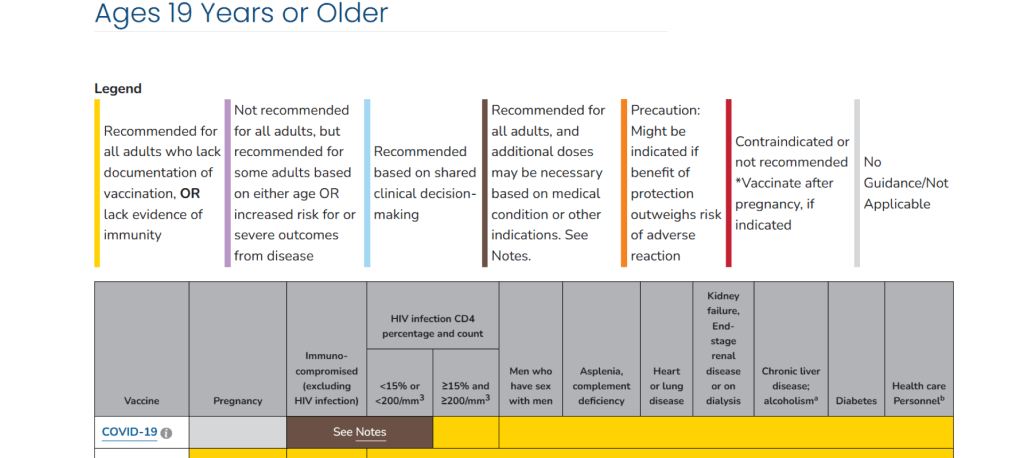
On the other hand, when I looked at the health care provider page on the CDC website, the table showing the clinical indications for the Covid-19 vaccine sends a confusing message by showing pregnancy as a condition for which there is currently “No Guidance/Not Applicable.”

Just in case this web page gets updated, I took a screenshot of that part of the table:

screenshot June 12, 2025

But elsewhere on the CDC website are pages which clearly recommend that pregnant women get the Covid-19 vaccine.

I’m not making any political statements here. I’m just an old guy who clearly does have an indication for getting the Covid-19 vaccine and I recently did just that last month.

Dept of Health & Human Services to Reconstitute CDC Advisory Committee on Immunization Practices

HHS announced the removal and replacement of the current members of the CDC Advisory Committee on Immunization Practices in a press release today. The CDC ACIP meeting for vaccine recommendations is still scheduled for June 25-27. According to the Federal Register announcement under Supplementary Information:

“SUPPLEMENTARY INFORMATION:

Purpose: The Advisory Committee on Immunization Practices is charged with advising the Director, Centers for Disease Control and Prevention (CDC), on the use of immunizing agents. In addition, under 42 U.S.C. 1396s, the Committee is mandated to establish and periodically review and, as appropriate, revise the list of vaccines for administration to vaccine-eligible children through the Vaccines for Children program, along with schedules regarding dosing interval, dosage, and contraindications to administration of vaccines. Further, under applicable provisions of the Affordable Care Act and section 2713 of the Public Health Service Act, immunization recommendations of ACIP that have been adopted by the Director, CDC, and appear on CDC immunization schedules generally must be covered by applicable health plans.

Matters To Be Considered: The agenda will include discussions on anthrax vaccines, chikungunya vaccines, COVID-19 vaccines, cytomegalovirus (CMV) vaccine, Human papillomavirus (HPV) vaccine, influenza vaccines, Lyme disease vaccine, meningococcal vaccines, pneumococcal vaccines, Respiratory Syncytial Virus (RSV) vaccines for adults, and RSV vaccines for maternal and pediatric populations. Recommendation votes are scheduled for COVID-19 vaccines, HPV vaccine, influenza vaccines, meningococcal vaccine, RSV vaccines for adults, and RSV vaccine for maternal and pediatric populations. Vaccines for Children (VFC) votes are scheduled for COVID-19 vaccines, HPV vaccine, influenza vaccines, and RSV vaccines. Agenda items are subject to change as priorities dictate. For more information on the meeting agenda, visit https://www.cdc.gov/​acip/​meetings/​index.html.

Meeting Information: The meeting will be webcast live via the World Wide Web. For more information on ACIP, please visit the ACIP website: https://www.cdc.gov/​acip.

So, I Got the Covid-19 Booster Today

After giving the Covid-19 summer booster a lot of thought, I got it today. What the heck. I’m an old guy and the experts all agree that the summer surge is real, including the current leaders of the FDA Center for Biologics Evaluation and Research (Vinay Prasad, M.D., M.P.H and Martin A. Makary, M.D., M.P.H.).

 I read their article “An Evidence-Based Approach to Covid-19 Vaccination” published in the New England Journal of Medicine on May 20, 2025. It sounds like they’re going to require placebo-controlled trials for new vaccines for almost everybody except those over age 65 and high risk because they’re not recommending it for certain other groups such as healthy children.

I didn’t think it was worth the wait for the upcoming CDC ACIP meeting on June 22, 2025 in order to decide whether or not to get the summer vaccine. It’s the same one I got last fall and the same one the FDA advisory committee decided at this month’s meeting would be appropriate going forward (the JN.1 lineage).

It wasn’t like there was a long wait time to get the vaccine today. There wasn’t a line. I scheduled it but I didn’t have to because I got right in.

It’s true that vaccine uptake has been low. However, I think on balance they’ve been proven to be safe and effective so I’m not sure that placebo-controlled trials are warranted. I guess we’ll just have to agree to disagree.

Reference:

An Evidence-Based Approach to Covid-19 Vaccination

Authors: Vinay Prasad, M.D., M.P.H., and Martin A. Makary, M.D., M.P.H.Author Info & Affiliations

Published May 20, 2025

DOI: 10.1056/NEJMsb2506929

The FDA VRBPAC  Meeting Today on Covid-19 Vaccines for 2025-26

The FDA VRBPAC meeting today on the Covid-19 vaccines for 2025-26 is so far leading me to believe that the best choice for the voting question-

Based on the evidence presented, please discuss considerations for the selection of JN.1 and/or a specific JN.1-lineage strain for COVID-19 vaccines (2025-2026 Formula) to be used in the U.S.

-might just be sticking with last year’s Covid-19 JN.1 lineage vaccine rather than targeting the newest LP.8.1 strain. The strains so far aren’t suggesting a seasonal pattern. Some strains only last for weeks and it seems getting or making a vaccine for a Covid-19 strain that disappears by the time the manufacturer rolls out a vaccine for it could turn out to be a waste of time.

Neverthe less, all three of the industry presenters are calling this a “seasonal” update to their Covid-19 vaccine products. They’re hedging their bets, so to speak, and would be ready to market a vaccine targeting LP.8.1 if the FDA decides to license the product.

I’ve held off getting the JN.1 vaccine so far in anticipation of today’s meeting, to see if there’s any reason not to get it based on today’s decision.

But the day is young. I’ll probably be making periodic updates to this post today. I think Dr. Jerry Weir’s slides are excellent, as usual.

“Voting Question
For the 2025-2026 Formula of COVID-19 vaccines in the U.S., does the committee recommend a monovalent JN.1-lineage vaccine composition?
Please vote “Yes” or “No” or “Abstain”

“Discussion Topic
Based on the evidence presented, please discuss considerations for the selection of
JN.1 and/or a specific JN.1-lineage strain for COVID-19 vaccines (2025-2026 Formula) to be used in the U.S.”

Update: Of course, the committee voted unanimously for the JN.1 lineage because there was no alternate choice. The only choice for the members was to vote for the JN.1-lineage or against it. Although I agree with the “vote,” I think they should have had the alternate of LP.8.1 available, otherwise why have a vote at all? I wonder what the FDA will do now.

FDA Vaccines and Related Biological Products Advisory Committee Meeting May 22, 2025

The meeting of the FDA VRBPAC on the composition of Covid-19 vaccines will be tomorrow, May 22, 2025 at 8:30 am-4:30 pm EST. Some materials have recently become available on the FDA website.

The briefing document indicates that there will be a discussion of the most recent Covid-19 variants and whether the current vaccine needs to be modified as the viral antigenic strain has mutated.

The World Health Organization has formed a new technical advisory group: “Technical Advisory Group on COVID19 Vaccine Composition (TAG-CO-VAC) to review and assess the public health implications of emerging SARS-CoV-2 variants of concern (VOCs) on the performance of COVID-19 vaccines and to provide recommendations to WHO on proposed modifications to COVID-19 vaccine antigen composition. Recently, the TAG-CO-VAC advised that a monovalent JN.1 or KP.2 vaccines remain as appropriate vaccine antigen, while a monovalent LP.8.1 is a suitable alternative vaccine antigen (Ref: https://www.who.int/news/item/15-05-2025-statement-on-the-antigen-composition-of-covid-19-vaccines) to be included in the composition of COVID-19 vaccines (2025-2026 Formula).”

The VRBPAC meeting topics:

“On May 22, 2025, VRBPAC will meet in open session to discuss and make recommendations on the selection of the 2025-2026 Formula for COVID-19 vaccines for use in the U.S. The committee will be asked to discuss available evidence on recent and currently circulating SARS-CoV-2 variants, including data from virus surveillance and genomic analyses, antigenic characterization analyses, vaccine effectiveness and clinical immunogenicity studies of current U.S.- authorized/approved COVID-19 vaccines and nonclinical immunogenicity studies of candidate vaccines expressing or containing updated Spike antigens.”

The attendees include:

The TAG-CO-VAC presenter:

Kanta Subbarao, M.B.B.S., M.P.H. Professor Department of Microbiology and Immunology Faculty of Medicine Laval University (Laval University is in Quebec City, Quebec, Canada).

There’s an Iowa City member on the committee roster:

Stanley M. Perlman, M.D., Ph.D. Expertise: Pediatrics, Infectious Diseases Term: 08/23/2022 – 01/31/2026 Professor University of Iowa Distinguished Chair Department of Microbiology and Immunology Carver College of Medicine University of Iowa, Iowa City, IA 52242.

And the acting chair of the meeting will once again be: Arnold Monto, M.D. Expertise: Epidemiology Term: 02/01/2022 – 01/31/2026 Thomas Francis Jr. Collegiate Professor Emeritus of Public Health and Epidemiology School of Public Health University of Michigan Ann Arbor, MI 48109.

Vaccine manufacturer presentations will be from Moderna, Pfizer, Novavax, and Sanofi.